
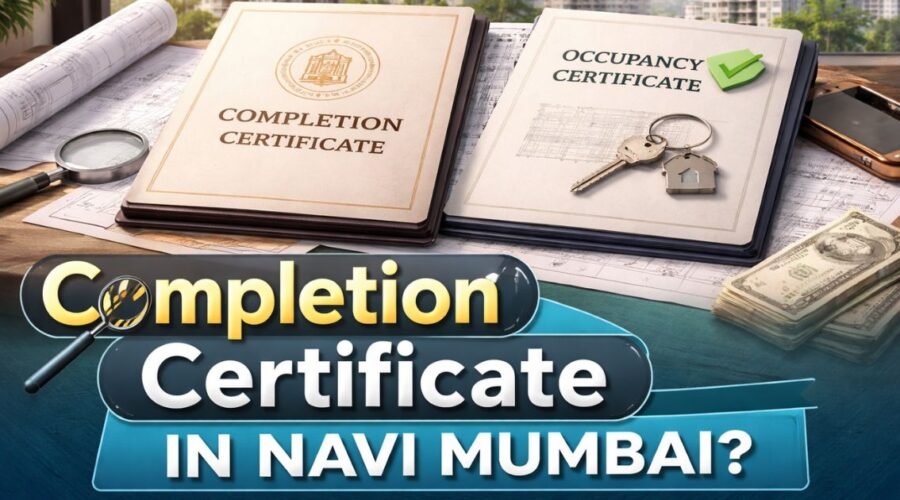
What Is a Completion Certificate (CC) in Navi Mumbai and Why Does It Matter to Buyers?
A Completion Certificate, or CC, in Navi Mumbai is the authority-side proof that a building has been constructed according to the sanctioned plan and approval conditions. It is not the same as an Occupancy Certificate, or OC. In simple terms, CC tells you the structure is completed as approved, but it does not by itself mean the building is legally ready to live in. That difference matters a lot for buyers, investors, and resale cases.
If you are checking a flat in Kharghar, Ulwe, Nerul, Taloja, Belapur, Kamothe, or any other Navi Mumbai node, this is one of those documents you should understand properly before final payment, possession, or resale. A lot of confusion in the local market starts when brokers, builders, or even owners casually use CC and OC as if they mean the same thing. They do not.
Quick Summary: What a CC Means for a Buyer in Navi Mumbai
| Point | What it means in practical terms |
|---|---|
| Full form | Completion Certificate, often also called Building Completion Certificate |
| What it confirms | The building has been constructed in line with the sanctioned plan and approval conditions |
| What it does not confirm | That the building is legally fit for occupation or fully ready for lawful stay |
| Is it the same as OC? | No |
| Why buyers care | It helps prove the structure is not unauthorized, but it is still not the final comfort document for occupation |
| Who may issue it | NMMC, PMC, or CIDCO, depending on where the project falls |
| Best use for buyers | As one part of due diligence, not as the only green signal |
What a Completion Certificate in Navi Mumbai actually confirms in plain language

A Completion Certificate marks the end of the construction stage from the authority’s point of view. It tells you that the building, as built, matches the approved plan in key structural and planning respects.
That means the authority has accepted, at least at the construction-compliance level, that the builder has followed the sanctioned layout, setbacks, height limits, and permitted construction parameters. For a buyer, that is meaningful. It reduces the risk that the structure itself is outright unauthorized.
But this is the part many people miss: a CC is not the final word on whether you should move in, release final payments comfortably, or assume that all occupancy-related issues are settled. It proves construction completion. It does not automatically prove habitation readiness.
In a city like Navi Mumbai, where different projects may fall under NMMC, Panvel Municipal Corporation, or CIDCO-linked planning control, that distinction becomes more practical than theoretical. It changes how you verify the document and how much comfort you should take from it.
Is Completion Certificate the same as Occupancy Certificate in Navi Mumbai?

No. This is the biggest mistake buyers make.
A Completion Certificate and an Occupancy Certificate serve different purposes. The CC is about whether the building was constructed according to approved plans. The OC is about whether the building is fit to be occupied.
What CC usually tells you
A CC tells you that the physical structure has been completed in line with sanctioned parameters. It focuses on construction compliance. Think of things like approved floors, built form, layout, and planning norms.
What OC tells you that CC alone does not
An OC goes further. It tells you the building is cleared for occupation. This is where utility readiness, safety systems, and functional habitability become important. So even if a project has a CC, it may still not have crossed the line into lawful occupation.
Where buyers get confused by Form 4 and possession language
Another local source of confusion is the architect’s completion certificate, often referred to as Form 4 in the MahaRERA context. Buyers sometimes see this uploaded and assume the project has a proper government-issued CC or even an OC. That is not a safe assumption.
Form 4 is not a substitute for a municipal or planning authority certificate. It is not the same as a government-issued CC. And it definitely should not be treated as a replacement for an OC.
CC vs OC: What should a buyer conclude?
| Document | What it mainly proves | What a buyer can safely conclude | What a buyer still cannot assume |
|---|---|---|---|
| Completion Certificate (CC) | The building has been completed according to sanctioned plans and approval conditions | The structure has crossed an important legality milestone | That it is legally ready for occupation |
| Occupancy Certificate (OC) | The building is fit for occupation and occupation-related compliance has been accepted | Occupation comfort is much stronger, and possession-stage risk is lower | That every other title, transfer, or society issue is automatically solved |
So if someone says, “Project is completed, your CC is here,” that is not the end of the conversation. Your next question should be: “what about OC? Is it pending or completed?”
Who issues the CC in Navi Mumbai, and why the authority depends on the project location
This is where Navi Mumbai becomes different from a generic property article.
The issuing authority is not always described the same way because jurisdiction depends on the project’s location and planning history. If you do not first identify the authority, you may end up checking the wrong portal or asking the wrong questions.
NMMC-side context
In the older and more established Navi Mumbai nodes such as Vashi, Sanpada, Nerul, Belapur, Koparkhairane, and Airoli, the Navi Mumbai Municipal Corporation is usually the key local authority for building permissions and completion-related approvals.
So, if you are checking a resale flat or a completed society in one of these nodes, NMMC-side verification becomes relevant.
Panvel-side context
In growth belts such as Kharghar, Kamothe, Kalamboli, Taloja-side areas, and New Panvel-side locations, Panvel Municipal Corporation often becomes the more practical authority to check for current building permission and certificate context.
This matters because many buyers still speak about such areas in older CIDCO language, while the actual certificate trail may now involve PMC-side administration.
Where CIDCO enters the conversation, and where it does not replace due diligence
CIDCO remains central in Navi Mumbai’s land and planning history, especially in leasehold contexts and in developing areas such as Ulwe, Dronagiri, Pushpak Nagar, and NAINA-related zones. In some of these areas, CIDCO continues to be the planning authority.
But buyers should not make a lazy shortcut here. Just because a project is in a CIDCO-planned area does not mean all legal readiness questions are automatically answered. CIDCO relevance is real, but it is not a substitute for checking the actual certificate status of the specific project, wing, or unit.
How buyers should verify whether a project really has a valid CC

This is the section many competitor articles fail to do properly. A smart buyer should verify a CC in layers.
What to ask the builder, broker, or seller for
First, ask for the actual copy of the Completion Certificate. Do not settle for verbal assurance, a WhatsApp screenshot without details, or a vague statement like “approval complete.”
Check these basic points:
- Issuing authority name
- Certificate number or reference number
- Date
- Project name
- Wing or phase details, if the project is large
- Whether the document appears authority-issued, not just consultant-issued
In phased projects, this becomes even more important. One wing may have a certificate while another may still be pending.
What to cross-check on MahaRERA and public systems
The second step is cross-verification. On MahaRERA, check the project’s uploaded documents and progress status. If the builder has uploaded completion-related documents, compare names, dates, and the stage shown there with the physical copy given to you.
If the project falls in NMMC, PMC, or CIDCO-controlled approval areas, check the relevant public systems or property-related records where available. The exact route can differ, so the main goal is not “portal hunting” but consistency checking. The document shown to you should match the project’s legal stage, not contradict it.
What to check if the project is wing-wise or phase-wise
This is one of the most practical traps in Navi Mumbai projects.
Large complexes in Kharghar, Taloja, Ulwe, and even some newer Panvel-side developments may be approved or certified in parts. A builder may show you a certificate from Wing A while you are actually buying in Wing C. Or a partial occupancy status may exist only for certain floors.
Always ask: does this certificate cover my exact wing, my exact building, and my exact phase?
A simple buyer example
Suppose a buyer is booking a newly completed flat in Kharghar. The broker says, “Project complete hai, people are already doing interiors.” The buyer sees a completion-related document and assumes all is fine.
But after checking carefully, it turns out the project has a CC for part of the structure, while the OC for the buyer’s specific wing is still pending. That changes everything. The building may be physically complete, but occupation-stage comfort is still not strong enough.
If a project has CC but no OC yet, should you proceed?
This is not a yes-or-no question for every case. It depends on what stage you are at, why you are buying, and how much risk you are willing to take.
A project with a CC but no OC is not in the same category as an outright unauthorized structure. That is important. But it is also not in the same category as a fully OC-ready project.
If you are an end user planning to move in soon, CC alone should not be treated as enough comfort. Legal occupation, permanent utility normalisation, and overall possession confidence are stronger when OC is in place.
If you are an investor and not planning immediate occupation, you may see CC as a meaningful structural milestone. Even then, you should be careful. The safest approach is to understand why the OC is pending and whether the delay is minor and administrative, or whether it points to a deeper compliance issue.
The practical risks of proceeding too casually
Common risks in CC-only situations include:
- living or taking possession before lawful occupation comfort is in place
- higher utility costs in some real-life situations
- delayed final loan disbursement
- resale hesitation from future buyers
- longer dependence on builder-controlled maintenance arrangements
- hidden compliance issues being brushed aside with “OC in process”
That last phrase deserves special caution. “OC in process” can mean a small delay. It can also mean a much bigger issue. The phrase alone tells you almost nothing.
What changes in under-construction, newly completed, and resale property cases
The same document does not carry the same weight in every deal type. That is why buyers should think in stages.
Under-construction purchase
In an under-construction project, the Completion Certificate is not your immediate focus yet. Here, the bigger concerns are the sanctioned plan, commencement stage, and project registration and progress. At this stage, the CC is a future milestone, not today’s main comfort marker.
Newly completed possession-stage purchase
This is where CC becomes relevant, but OC becomes even more important. If a builder is close to handover and says the project is ready, the buyer should not stop at “CC mil gaya.” This is exactly the stage where buyers need clarity on whether lawful occupation readiness has also been reached.
This is also where fit-out possession language can become misleading. If you are being encouraged to start interior work before OC clarity is available, slow down and ask more questions.
Resale flat in an older building
In older nodes like Vashi, Nerul, Belapur, and Sanpada, a resale buyer may assume that if the building is old and occupied, everything must be regular. That assumption can be dangerous.
For resale, a CC can still matter as part of title comfort, but missing OC or incomplete compliance history can affect bankability, future resale confidence, society formalities, and redevelopment comfort later. Older buildings should not be treated casually just because they look settled from the outside.
What other documents should be checked along with the CC before final payment or registration
A Completion Certificate should be read as part of a document chain, not as a standalone magic paper.
Here is the practical sequence a buyer should think about:
- sanctioned plan and approved layout
- commencement and construction-stage legality
- completion-stage proof
- occupancy-stage permission
- possession and registration readiness
If you are close to final payment or registration, these supporting documents matter far more than a single certificate in isolation.
Practical due-diligence checklist
Before final payment, possession, or a serious resale commitment, check:
- sanctioned building plan and layout
- project registration details on MahaRERA
- actual Completion Certificate copy
- Occupancy Certificate status, whether full or partial
- whether your exact wing or unit is covered
- fire and utility readiness where relevant
- possession stage paperwork
- property tax and dues position in resale situations
- whether the authority trail matches the project location
That is the real buyer mindset. Not “document hai ya nahi,” but “document kya prove karta hai, aur kya abhi bhi pending ho sakta hai?”
Local red flags in Navi Mumbai that a smart buyer should not ignore

Navi Mumbai has a few recurring patterns that buyers should recognise early.
The first is vague certificate language. If no one can clearly tell you whether the project has CC, OC, part OC, or only architect certification, pause. Genuine compliance does not usually need fuzzy explanations.
The second is wing confusion. This is especially common in large complexes across growth nodes. Never assume a project-level statement automatically covers your unit.
The third is CIDCO name-dropping. Buyers hear “CIDCO project,” “CIDCO area,” or “CIDCO land” and assume that means approval comfort is automatically strong. It does not. CIDCO relevance may matter, but you still need the exact certificate trail.
The fourth is possession pressure. If the builder or seller is pushing for registration, interiors, or physical handover while occupation-stage clarity remains weak, that is not a small detail. That is the core risk.
The fifth is old-building complacency. In older Navi Mumbai societies, people often assume paperwork must be fine because the building has existed for years. But age does not clean up documentation by itself.
What a Completion Certificate does and does not help with in real life
A CC is useful. It just should not be overread.
It helps because it gives structural and planning-stage comfort. It tells you the building has crossed an important compliance milestone. That matters for due diligence, for title comfort, and for assessing whether a project is fundamentally illegal or not.
But it does not, on its own, solve the occupation question. It does not automatically mean you can move in safely from a legal and utility-comfort perspective. It does not guarantee smooth final loan disbursement, easy resale, or zero society-level issues later.
That is why the best buyer mindset is this: CC is necessary in many situations, but OC is the stronger occupation-stage comfort document.
Conclusion
A Completion Certificate in Navi Mumbai is a serious and useful document, but it is not the final answer buyers often think it is. It tells you the building has been completed in line with approved plans. It does not, by itself, confirm lawful occupation readiness.
For practical property decisions in Navi Mumbai, the smartest approach is simple: treat the CC as an important structural-compliance milestone, then immediately check the OC status, the exact authority, and whether your specific wing or unit is covered. That one extra layer of caution can save a buyer from years of confusion, higher costs, weak resale confidence, and avoidable legal stress.
FAQ's
Frequently Asked Questions