
Blogs

Everything about Navi Mumbai

How to Choose the Right MBA College in Navi Mumbai

One college advertises a big placement package. Another has lower fees. A third is closer to home. Which one should you choose? When comparing MBA colleges in Navi Mumbai, these differences matter more than a glossy brochure. You need a course that fits your career plans, a cost you can manage and placement claims you can check. Before paying an admission deposit, compare what each college actually offers. Quick answer: Choose an MBA college in Navi Mumbai by checking the exact qualification, admission route, specialisation, placement evidence, complete fees and daily commute. Shortlist three colleges, speak to current students and ask for written fee details. Compare typical placement outcomes rather than relying on the highest advertised package. 1. Check the Qualification Before Comparing Colleges MBA, MMS or PGDM: What Does the College Award? Students often search for “MBA colleges” while comparing different management qualifications. Qualification What to verify MBA Awarding university and recognition of the programme MMS Awarding university, affiliation and applicable approvals PGDM Programme approval and equivalence, if needed for your future plans For example, SIES College of Management Studies in Nerul lists an MMS programme affiliated with the University of Mumbai and approved by AICTE. Check the exact institution and programme name. Similar branding does not mean two courses have the same fees, admission process or placement record. Which Entrance Exam and Admission Route Apply? For participating MBA/MMS programmes, check the Maharashtra CET Cell’s current CAP information. Other programmes may require separate applications and selection rounds. Use the [official MBA/MMS admission portal](https://cetcell.mahacet.org/mba-mms/) to check notices. Taking an entrance exam and completing the admission process are separate steps. 2. Choose a Course That Fits Your First Job Goal Compare Subjects, Projects and Internships “Finance specialisation” sounds useful, but what will you actually practise? Look at the syllabus, recent student projects and internship roles. Your interest Evidence worth checking Marketing Customer research, campaigns and sales projects Finance Financial modelling, analysis and relevant internships HR Recruitment projects and HR analytics Operations Supply-chain case studies and practical assignments If you want a finance analyst role, ask whether students receive relevant training and recruitment opportunities. A banking company’s logo alone does not tell you whether it hired analysts or sales staff. Ask to see examples of completed projects, not just a list of subjects. 3. Read the Placement Report Beyond the Biggest Number Check Typical Salaries, Batch Size and Job Roles The highest package tells you about one outcome. It does not tell you what most students received. Look for the median salary where available, average salary, number placed and total batch size. Check whether figures cover your chosen programme and campus. Also separate final placements from internships. CTC is not the same as monthly take-home salary. It can include variable incentives, employer contributions and other benefits. Ask These Three Questions Before Trusting a Placement Claim 1. How many students were placed, and out of which batch? 2. What job roles did they receive? 3. How much of the reported CTC was fixed pay? If a report leaves these questions unanswered, ask the placement team before using its numbers to justify a large education loan. 4. Compare the Total Cost, Including Daily Travel Add the Expenses Missing From the Headline Fee Request a written fee schedule for the complete course. For example, [BVIMSR’s official MMS page](https://bvimsr.org/courses/mba-mms/) lists first-year fees of ₹1,65,000 for 2026–27, subject to government revision. That is a first-year figure, not a confirmed two-year total. Your budget should include: Course fees and compulsory additional charges. Examination fees, where separately payable. Travel, hostel or rented accommodation. A laptop and other necessary study expenses. Compare colleges using the same cost categories. Do not compare one college’s annual tuition with another’s complete course fee. If you plan to rent nearby, use our [Navi Mumbai locality comparison guide](https://ilovenavimumbai.com/best-areas-to-live-in-navi-mumbai/) as a starting point, then check current accommodation options yourself. 5. Test the Navi Mumbai Commute Before Taking Admission Compare Door-to-Door Travel During Class Hours A campus being “in Kharghar” does not tell you how easily you can reach it. Whether you live in Vashi, Nerul, Airoli, Kalamboli or Panvel, include the journey from home to the station, waiting time and the final stretch to campus. Visit on a weekday around the actual class starting time. Check the return journey too. For Kharghar campuses, our [Kharghar locality guide](https://ilovenavimumbai.com/kharghar-navi-mumbai/) and [Navi Mumbai Metro guide](https://ilovenavimumbai.com/navi-mumbai-metro-2/) can help you understand the area and possible connections. Then test your specific route. A manageable daily journey leaves more time for assignments, internships and group work. 6. Visit Your Final Three Colleges With Specific Questions Speak to Current Students About the Everyday Experience Ask current students whether classes run consistently, projects involve practical work and the college helps students find internships. Also ask the admissions team about placement eligibility, attendance requirements, additional charges and refund terms. Record the answers in one comparison sheet. Keep missing information visible rather than filling gaps with assumptions. Before paying, make sure important commitments are available in writing. Conclusion: The right MBA college in Navi Mumbai should suit your career direction, budget and daily routine. Compare three options using the same questions. Verify the course, read placement evidence carefully and calculate the complete cost. Make the decision after a campus visit, not during a sales call. FAQs Frequently Asked Questions How do I choose the right MBA college in Navi Mumbai?​ Compare qualification, career fit, placement evidence, full fees and commute. Verify important details before paying. What should I check in an MBA college’s placement report?​ Check the reporting year, programme, batch size, students placed, typical salary and job roles. Should I prioritise lower fees or better placement outcomes?​ Balance affordability with credible outcomes. Higher fees alone do not prove better career opportunities. Is it worth choosing a college farther from home?​ It can be, if the course offers clear advantages and the daily journey remains manageable. Test the commute first.

Read More


How to Choose the Right Digital Marketing Class in Navi Mumbai

Choosing a digital marketing class in Navi Mumbai can get confusing fast. Most institutes show a long syllabus, mention AI, promise practical training and offer a certificate. But similar-looking courses can deliver very different learning. Before joining, ask one simple question: what will I actually be able to do on my own after this course? If you are comparing different digital marketing classes in Navi Mumbai, look beyond the course title and check how much practical work, project exposure and portfolio building the program actually includes. That question tells you much more than the number of modules printed in a brochure. Quick Answer Check What to Look For Practical training Real execution, not only lectures Live projects Actual business work or live data Core skills Ads, SEO, analytics, content and websites AI Used inside real marketing workflows Trainers Current industry and business experience Portfolio Work you can actually show A course with fewer modules but stronger execution may be more useful than one advertising dozens of disconnected topics. 1. First, Decide What You Want From the Course Are You Learning for a Job, Freelancing or Your Own Business? Your goal changes what you need from a digital marketing course. For a job, focus on campaign execution, SEO, analytics and portfolio work. A freelancer also needs client communication, proposals, reporting and basic pitching skills. A business owner should understand leads, funnels, ad budgets, customer acquisition and ROI. Choose the course around what you want to do after learning, not simply around the size of its syllabus. 2. Check How Much of the Course Is Actually Practical Ask What You Will Actually Work On “Practical training” sounds impressive until nobody explains what practical actually means. Ask whether you will create landing pages, work inside ad accounts, analyse campaign data, optimise real webpages or create content for actual businesses. A classroom assignment and a live project are not the same. A Simple Red Flag If an institute talks about practical learning but cannot show recent student work, ask more questions. The course should gradually move you from watching the trainer to doing the work yourself. 3. Don’t Judge a Course Only by Its Module List Look for a Complete Digital Marketing Skill Stack A useful beginner course should connect important skills such as: Meta Ads and Google Ads SEO Content and social media Analytics and tracking Lead generation Websites and landing pages AI and automation The connection between these skills matters. An ad brings traffic. A landing page converts that traffic. Tracking records what happened. Analytics then tells you what needs improvement. That is much more useful than learning 40 tools separately. AI Should Be Integrated Into Marketing, Not Added as a Buzzword An “AI-powered course” title tells you very little. Ask how AI is actually used. It can support market research, content ideas, ad variations, data analysis, reporting and workflow automation. Learning a list of ChatGPT prompts is not the same as understanding how AI can make everyday marketing work faster and better. 4. Find Out Who Is Actually Teaching You Prefer Real Marketing and Business Exposure Do not stop at “our faculty has years of experience.” Ask what the trainer has worked on recently. Can they discuss campaigns, leads, conversions, budgets and ROI? Can they explain what they changed when a campaign did not perform? Digital platforms keep changing, so current practical exposure matters. A good trainer should teach both how to use a platform and why a particular marketing decision is being made. 5. Ask One Important Question: “What Will I Have Built by the End?” Certificate vs Portfolio A certificate shows that you completed a course. A portfolio shows what you can actually do. Useful portfolio pieces could include a landing page, SEO project, advertising campaign, content plan, performance report or documented case study. According to its course brochure, Digital To Infinity follows this execution-focused approach with Meta and Google Ads, content, SEO and analytics, websites and funnels, AI and automation, live business projects, portfolio work and case studies. These are the kinds of outputs you should ask any institute about before joining. Good Portfolio Examples Instead of Only Saying… Better Proof “I learned Meta Ads” A documented campaign project “I know SEO” A page you researched and optimised “I learned websites” A working landing page “I know analytics” A simple performance report The goal is simple: leave the course with something you can show, not only something you can mention on your resume. 6. Check What Happens After You Learn the Tools Does the Course Teach You How to Use the Skills in the Real World? Knowing the software is only part of digital marketing. If you want to freelance or work with clients, you also need to understand requirements, explain results, prepare reports, pitch ideas and communicate clearly. Check whether the course gives you exposure to client reporting, communication and basic pitching. These skills become important the moment you move from a classroom project to working with an actual business. 7. Does Location Matter When Choosing a Digital Marketing Class in Navi Mumbai? Choose Accessibility Over a Famous Address For an offline practical course, location matters more than people expect. A student travelling from Panvel or Kalamboli will have a different routine from someone living near Vashi, Nerul or Belapur. Check whether you can attend classes regularly and stay back when extra practical work is required. A famous institute address is not very useful if the commute makes you skip practice every second week. For students based around Kalamboli, Roadpali, Kamothe or nearby Panvel areas, comparing digital marketing classes in Kalamboli can also make regular attendance and extra practical sessions easier. 8. Use This 7-Point Checklist Before Paying Any Admission Fee Ask the Institute These Questions # Question to Ask 1 What will I personally build during the course? 2 Are the projects real, simulated or only assignments? 3 Who will actually teach my batch? 4 Can I see recent student projects or case studies? 5

Read More

Navi Mumbai Airport Cargo Impact: How NMIA Is Reshaping Logistics in Western India

The Navi Mumbai International Airport cargo terminal launched Phase 1 operations with 0.5 million metric tonnes of annual handling capacity in early 2026 making it one of the most significant additions to India’s air freight infrastructure in years, and positioning western India as a genuine global logistics corridor. If you are tracking how cargo economics shift in the Mumbai Metropolitan Region, or why businesses from MSMEs to multinationals are reorienting their supply chains toward the NMIA belt, this article explains the full picture. NMIA’s Cargo Infrastructure: What Exists Today The D B Patil Navi Mumbai International Airport was designed with cargo as a core operational function, not an afterthought. From the beginning, CIDCO and Adani Airports Holdings built the facility’s infrastructure to serve both passenger and freight needs simultaneously. Phase 1 Cargo Specifications Parameter Detail Phase 1 Cargo Capacity 0.5 million metric tonnes per year (MMT) Terminal Type Semi-automated with digital tracking Cold Chain Infrastructure Yes (pharmaceutical and perishables focus) Target Full Capacity 3.2 MMT across all phases Phase 1 Full Operational Date January 2026 According to NMIA’s own operational statements, the airport was designed to be a “logistics hub, with cargo as a core focus” language that distinguishes it from passenger-first airports where freight is a secondary consideration. The cargo terminal includes: Semi-automated material handling systems Cold chain logistics catering to pharmaceutical companies, fresh produce exporters, and e-commerce Temperature-controlled storage for perishable goods Digital tracking and integration with freight management systems The FedEx Hub: What It Signals On February 18, 2026, FedEx and NMIA broke ground on a fully automated air cargo hub at the airport the single largest signal yet of how seriously global logistics players are treating NMIA’s strategic position. The details are significant: Investment: ₹2,500 crore (long-term commitment) Facility size: 3,00,000 sq ft Ultimate handling capacity: 3.25 MMT annually Initial capacity: 0.5 MMT (scaling up in phases) Jobs created: More than 6,000 direct and indirect employment opportunities across logistics, warehousing, transportation, and allied services Developer partnership: Adani Airport Holdings Ltd (AAHL) Maharashtra Chief Minister Devendra Fadnavis attended the groundbreaking and stated directly: “This will write history in the chapter of logistics.” The hub is designed as a regional consolidation and redistribution center, connecting India to four major trade zones: Southeast Asia West Asia Europe United States For FedEx, NMIA is not just a distribution point it is an integration node that places global network capability directly inside India’s primary western trade corridor. The Mumbai Freighter Pause: Why It Matters for NMIA A significant, time-bound shift is accelerating NMIA cargo’s importance in 2026. According to a formal notification issued by Mumbai International Airport (MIAL) in late December 2025, freighter operations at the Chhatrapati Shivaji Maharaj International Airport (CSMIA) in Mumbai are paused from August 2026 to May 2027 a ten-month window to re-carpet Runway 09/27, rebuild the ageing cargo apron, and construct Taxiway E. This pause will: Reduce existing freighter capacity at CSMIA Increase freight yields and rates in the near term Force shippers to find alternative gateways for exports NMIA is the natural destination for that diverted cargo volume. Also part of the Adani Group, NMIA is operationally positioned to absorb freighter movements that can no longer be handled at CSMIA during the upgrade window. Industry observers note that “logistics ecosystem is not fully ready” at NMIA yet but the pace of development is accelerating precisely because of this window. The pause at CSMIA effectively brought forward NMIA’s cargo ramp-up by months. What Sectors Benefit from NMIA Cargo The airport’s cargo infrastructure is designed for specific high-value freight categories where air transport is either essential or strongly preferred. Pharmaceuticals Maharashtra is India’s largest pharmaceutical manufacturing hub. The combination of cold chain infrastructure, temperature-controlled storage, and direct international connections especially to West Asia, Southeast Asia, and eventually Europe makes NMIA a critical gateway for finished drug exports and active pharmaceutical ingredient (API) trade. Perishable Goods The Konkan and Raigad belts produce significant agricultural output. With cold chain capability built into Phase 1, NMIA allows local producers to access air freight routes that previously required overland transport to CSMIA adding cost, time, and temperature risk. E-Commerce India’s e-commerce exports are growing rapidly, and small parcel air freight is a high-growth segment. The FedEx hub’s automated systems are specifically designed for parcel-level sorting and redistribution, making NMIA a direct participant in the India-to-world e-commerce corridor. MSME Exports The FedEx announcement specifically cited improved reliability for micro, small, and medium enterprises. Lowering logistics costs and reducing turnaround times for MSME exporters has been a stated government priority, and NMIA’s position within the MMR gives regional manufacturers direct access to global freight routes without routing through CSMIA. Scale Comparison: NMIA vs CSMIA Understanding what NMIA’s cargo growth path means requires a comparison with the existing airport’s limitations. Metric CSMIA (Mumbai Airport) NMIA (Phase 1) NMIA (Full Build) Cargo Capacity Approaching ceiling 0.5 MMT/year 3.2 MMT/year Freighter Operations Paused Aug 2026-May 2027 Active and absorbing diverted freight Full freighter hub Automation Level Legacy systems Semi-automated Fully automated (FedEx hub) International Routes Established Domestic now; international from late 2026 Full global network CSMIA is “fast approaching its operational ceiling,” according to NMIA’s own planning documents. When combined with the ten-month freighter pause, NMIA’s role as the region’s primary cargo gateway is not a future scenario it is an accelerating present reality. Employment Impact of Cargo Operations NMIA’s total employment projections across all phases stand at over 2 lakh (200,000) direct and indirect jobs. The cargo segment is a significant contributor to that figure. The FedEx hub alone accounts for 6,000 direct and indirect roles. When the full 3.25 MMT cargo terminal ecosystem is operational, job categories will include: Cargo handlers and ramp agents Freight forwarders and customs brokers Cold chain logistics technicians Warehouse operations staff Transport and last-mile delivery personnel IT, tracking, and compliance roles According to a detailed analysis published on I Love Navi Mumbai, NMIA cargo recruitment for 2026 is among the most searched job topics across Panvel, Ulwe, Karanjade,

Read More

CBD Belapur Metro Station Guide: Timings, Fare, Route Map & Property Rates Impact

CBD Belapur Metro Station is considered a major turning point in Navi Mumbai’s transport system. After years of delays, contractor changes, funding complications, and political approvals, Navi Mumbai Metro Line 1 finally became operational in 2023. By 2026, this metro corridor has gradually developed into a stable and reliable commuter network. Belapur is already known as the administrative and commercial center of Navi Mumbai. With the CIDCO headquarters, government offices, court complex, corporate buildings, and strong Palm Beach Road connectivity, the area had an established identity. However, after the metro became operational, the locality received structured rapid transit support. This has noticeably changed daily commute patterns, rental demand, and property market dynamics. This blog provides a complete 2026 guide to CBD Belapur Metro Station — covering timings, fare structure, route map, station facilities, connectivity challenges, and most importantly, a detailed analysis of property rates and investment impact. CBD Belapur Metro Overview – Basic Information 2026 CBD Belapur Metro Station is the southern terminal of Navi Mumbai Metro Line 1. The total corridor length is approximately 11.1 kilometers, and the line consists of 11 elevated stations. The station is located in Sector 11 and is strategically positioned near CBD Belapur Railway Station. As of 2026, the first train typically starts around 6:00 AM, while the last metro operates around 10:00 PM. During peak hours, train frequency is approximately every 10 minutes, and during non-peak hours, trains run every 12 to 15 minutes. The fare starts at ₹10 and goes up to ₹40 for the full stretch. Belapur was already known as an administrative hub, but with the metro, it is now evolving into a transit-oriented zone. For office commuters, students, and MIDC workers, this station has become an important interchange point. Timings & Daily Commuter Experience Metro timings are designed to be commuter-friendly, although there is still scope for improvement. The 6:00 AM first service is highly beneficial for government employees, industrial workers, and early-shift professionals. The last train around 10:00 PM covers the majority of office commuters, but late-night workers still depend on alternative transport options. Peak hours are generally between 7:30 AM to 10:00 AM and 5:30 PM to 8:00 PM. During these hours, trains operate at a 10-minute frequency. In non-peak hours, the 12–15 minute interval can slightly increase waiting time. The complete journey from CBD Belapur to Pendhar takes approximately 25 to 30 minutes. Compared to road travel, especially considering traffic at Sion-Panvel Highway and Kharghar junction, which can take 45 to 60 minutes, the metro provides predictable and reliable travel time — one of its biggest advantages for daily commuters. Connectivity from Belapur Railway Station to Metro (By Car) Belapur Railway Station to Belapur Metro (By Car) Step Direction Instructions Distance 1 Head northeast. 90 m 2 Turn left at the medical store toward Sakal Bhavan Road. 48 m 3 Slight left toward Sakal Bhavan Road. 51 m 4 Turn left onto Sakal Bhavan Road (Pass by Raigad Bhawan / Belapur Bhavan on the left). 200 m 5 Turn left onto Kokan Bhavan Road (Pass by Harshad Thombare on the left). Destination will be on the left. 170 m Total Drive Time: Approximately 2 minutes 550 m Bus Routes from Sector 6 Kharghar to Navi Mumbai International Airport (NMIA) Route Option Bus Numbers Transfer / Connection Point Estimated Time Primary Shuttle 22AC / 52 / 125AC → A-3 Take local bus to Belapur Railway Station, then transfer to the A-3 Airport Shuttle. 1 hr 10 min Nerul Connection Local Bus → A-4 Take local bus to Nerul Station (E), then transfer to the A-4 Airport Shuttle. 1 hr 15 min Reti Bandar Link 22AC / 125AC → A-2 Board at Shilp Chowk (Sector 6 area), get down at Reti Bandar, and transfer to A-2 Shuttle. 1 hr 12 min Premium Direct (BOM) Chalo Bus S-105 Direct AC Premium Bus from Jalvayu Vihar Kharghar to Mumbai Airport (CSMIA). 1 hr 32 min Ulwe Link 17AC → A-2 Transfer at Reti Bandar to reach NMIAL Terminal 1 via Ulwe. 1 hr 20 min Bus Routes from Sector 6 Kharghar to Navi Mumbai International Airport Several bus route options are available for commuters traveling from Sector 6 Kharghar to Navi Mumbai International Airport. One option is to take bus numbers 22AC, 52, or 125AC to Belapur Railway Station and then transfer to the A-3 Airport Shuttle, taking approximately 1 hour and 10 minutes. Another option is to travel to Nerul Station (E) and transfer to the A-4 Airport Shuttle, with an estimated travel time of around 1 hour and 15 minutes. Passengers can also board at Shilp Chowk and transfer at Reti Bandar to the A-2 Shuttle, which takes approximately 1 hour and 12 minutes. A premium direct option includes the Chalo Bus S-105 AC service from Jalvayu Vihar, Kharghar to Mumbai Airport (CSMIA), taking around 1 hour and 32 minutes. Fare Structure & Ticketing System (2026 Updated) CBD Belapur Metro follows a distance-based fare model. For short-distance commuters, pricing remains affordable, making daily travel economical for residents of Kharghar and nearby sectors. From CBD Belapur, the fare to Sector 7 (1.2 km) is ₹10. Traveling to Kharghar Village (4.2 km) costs ₹20. Central Park (5.5 km) is also ₹20, while Utsav Chowk (6.5 km) costs ₹30. Taloja MIDC (8.5 km) is ₹30, and the full stretch to Pendhar (11.1 km) costs ₹40. Passengers can purchase single-journey tokens or use smart cards. QR-based ticket booking and UPI payment options have reduced manual queues. For regular commuters, smart cards offer faster entry and exit, especially during peak hours. Route Map & Connectivity Structure Metro Line 1 includes the following stations in sequence: CBD Belapur, Sector 7, Kharghar Village, Central Park, Pethpada, Utsav Chowk, Sector 34, Taloja MIDC, Taloja Phase 1, Taloja Phase 2, and Pendhar. This corridor directly connects residential zones with employment hubs. Residents of Kharghar and Taloja now have faster access to Belapur’s commercial district. Although CBD Belapur Metro Station is located near the railway station, there

Read More

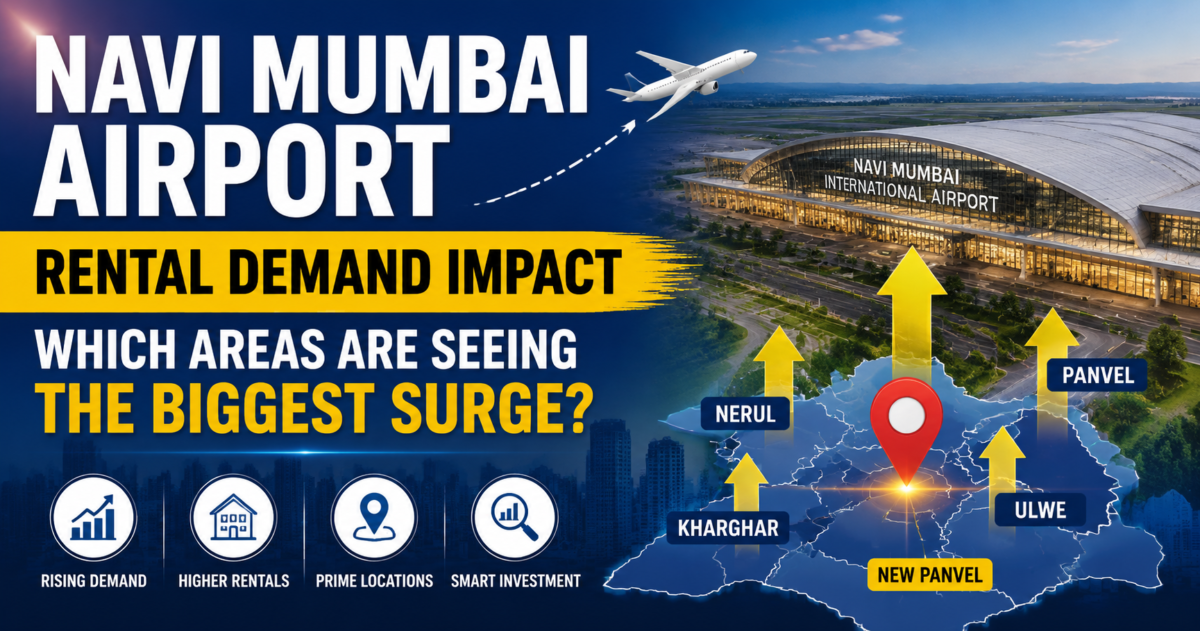
Navi Mumbai Airport Rental Demand Impact: Which Areas Are Seeing the Biggest Surge

Rental demand in Navi Mumbai rose 14.19% over the two years leading up to 2025, with the Navi Mumbai International Airport (NMIA) emerging as the dominant driver of that growth. As operations scale through 2026, the rental market across Ulwe, Panvel, Kharghar, and surrounding nodes is entering a demand-led expansion phase that property analysts expect to sustain through at least 2030. This is no longer speculative. NMIA commenced commercial flights on December 25, 2025, and moved to 24/7 operations in February 2026. The airport economy is now generating real jobs, real workers, and real rental demand. Why NMIA Is Driving Rental Demand Every operational airport creates a workforce catchment zone. The larger the airport, the wider and denser that zone becomes. NMIA is designed to handle 20 million passengers annually in Phase 1, scaling to 90 million by 2032. That growth trajectory implies a corresponding expansion in airport staff, ground handlers, airline crew, logistics workers, customs officials, hospitality employees, and the broader service economy that clusters around major aviation hubs. Add to that: The FedEx Rs 2,500 crore cargo hub generating over 6,000 direct and indirect jobs Planned Aerocity development with office parks, hotels, hospitals, and retail Logistics parks, warehousing clusters, and ancillary service companies relocating to the NMIA corridor The result is a sustained pipeline of professionals needing housing within practical commuting distance of the airport. That is the foundation of rental demand growth, and it is compound in nature: more airport activity creates more jobs, which creates more rental demand, which attracts more housing investment. Rental Demand Data: What the Numbers Show According to [Magicbricks data reported by BusinessToday], rental demand in Navi Mumbai increased 14.19% over the two years to late 2025. That figure covers the broader Navi Mumbai market. Within the airport-linked micro-markets specifically (Dronagiri, Kharghar, Panvel, Ulwe, and Uran), overall housing demand rose 7.2% even as supply dipped 3.6% on average. Supply-demand compression in rental markets typically precedes rental yield expansion. Property price appreciation in the same zone during this period: Dronagiri: 41.9% price increase Panvel: 26.05% price increase Kharghar: 19.75% price increase Demand for plotted developments in the same corridor surged sharply: Panvel +209.85%, Uran +205.43%, and Dronagiri +160.87%. While this reflects investor activity as much as rental demand, it signals the depth of conviction in the long-term rental income potential of these areas. Micro-Market Breakdown: Where Rental Demand Is Concentrating Ulwe: The Primary Airport Residential Catchment Ulwe is geographically the closest major residential node to the NMIA terminal. Five years ago, residential prices in Ulwe averaged Rs 5,500 to Rs 6,500 per square foot. By 2026, established sector prices range from Rs 9,000 to Rs 13,000 per square foot, representing 60 to 80% capital appreciation. According to [Housivity’s January 2026 market analysis], Ulwe is expected to emerge as the primary residential catchment near the airport. The profile of incoming tenants is shifting toward airport and logistics sector workers who need proximity to the terminal without the premium pricing of central Navi Mumbai. For landlords, this creates a reliable mid-market rental base with relatively low vacancy risk. As airlines scale operations and logistics clusters around NMIA mature, the tenant pipeline deepens. Current market rates in Ulwe (2026) have stabilized at Rs 10,500 to Rs 12,500 per square foot for negotiated deals, with premium airport-view projects asking Rs 15,000+. Panvel: The Long-Term Rental Hub Panvel’s rental story is different from Ulwe’s but equally compelling. The area’s strength comes not from airport proximity alone, but from infrastructure depth. Panvel sits at the intersection of the Mumbai-Pune Expressway, the Atal Setu corridor, and the future metro expansion, making it viable as a primary residence for professionals working across the broader MMR region. According to [The Propertyist’s 2026 analysis], this gives Panvel a relatively balanced investment profile with strong rental potential and steady appreciation. The airport has accelerated demand, but Panvel’s broader advantage lies in becoming a transport and logistics hub for the larger MMR region. Property prices in Panvel have moved from approximately Rs 6,000 per square foot to Rs 9,500 to Rs 11,500 per square foot over five years, a 50 to 60% appreciation. [According to Godrej Properties], with improved connectivity through the Atal Setu, Mumbai-Pune Expressway, and future metro lines, Panvel is fast becoming a prime investment zone. The Atal Setu specifically has been transformative for Panvel’s rental appeal. By cutting commute times from South Mumbai to the Panvel region to approximately 20 to 45 minutes, the 21.8-kilometer sea bridge has made Panvel viable as a primary residence for professionals working in traditional Mumbai business districts. Kharghar: Premium Rentals, Established Infrastructure Kharghar operates at a different segment of the rental market. It already had a well-developed residential base before the airport boom began, with solid social infrastructure: schools, parks, hospitals, and the operational Metro Line 1. According to [Housivity], the upcoming Metro Line 1 expansion is expected to further boost rental yields in Kharghar, making it a prime target for HNI (high-net-worth individual) rental portfolios. Current prices range from Rs 15,000 to Rs 18,000 per square foot for premium locations. The rental demand in Kharghar is driven by a more senior corporate tenant base: executives, expats, senior logistics professionals, and families who prioritize liveability alongside connectivity. Airport-linked demand here is a secondary driver; established residential quality is primary. Dronagiri: Early-Stage but High Conviction Dronagiri is the highest-risk, highest-potential node in the airport rental corridor. Located within the JNPT-SEZ zone and adjacent to the airport influence area, it has recorded 41.9% price appreciation over two years. Demand for plotted development in Dronagiri surged 160.87%, which reflects investor conviction in the long-term rental income potential of the area as JNPT and NMIA cargo operations scale. However, Dronagiri’s social infrastructure is still developing, which limits near-term tenant demand to logistics-sector workers rather than a broad professional base. Prices in Dronagiri currently range from Rs 6,500 per square foot on the lower end, offering an entry point for investors with a 5 to 7 year horizon. What Kinds

Read More

Atal Setu Impact on Uran: How the MTHL Is Changing Real Estate and Connectivity

Atal Setu, India’s longest sea bridge, has directly transformed Uran from a remote coastal town into one of the most strategically connected locations in the Mumbai Metropolitan Region. Since the bridge opened in January 2024, travel time from Uran to South Mumbai has dropped from over two hours to approximately 20 minutes, triggering a significant shift in real estate interest, infrastructure investment, and residential demand in the area. What Is Atal Setu and Where Does It Connect? Atal Setu, officially called the Mumbai Trans Harbour Link (MTHL), spans 21.8 km across Thane Creek, connecting Sewri in Mumbai to Nhava Sheva in Navi Mumbai. It is the longest sea bridge in India and among the longest in the world. For Uran, this matters directly. Uran is located just a short drive from the Nhava Sheva end of the bridge. Residents of Uran can now access South Mumbai, BKC, and the Eastern Freeway within 25 to 30 minutes on a normal day. This was practically impossible before January 2024 without ferry or a long detour through Panvel. According to [MSRDC (Maharashtra State Road Development Corporation)](https://www.msrdc.org), Atal Setu can handle up to 70,000 vehicles per day and is designed for speeds of up to 100 km/h, making it one of the fastest land routes connecting the island city to Navi Mumbai’s southern nodes. Atal Setu Impact on Uran: The Direct Connectivity Shift Before the Bridge Before Atal Setu, Uran was geographically isolated despite being relatively close to Mumbai. The only practical options were: Ferry from Gateway of India or Bhaucha Dhakka (unreliable in monsoon) Road route via Panvel, adding 45 to 60 km and over 90 minutes to any Mumbai commute This isolation kept Uran undervalued despite its coastal setting, proximity to JNPT (Jawaharlal Nehru Port Trust), and significant industrial employment base. After the Bridge The calculus has changed entirely. Travel from Uran to Nariman Point or BKC is now under 30 minutes under normal traffic. This single connectivity improvement has repositioned Uran from a “too far” zone to a genuine commuter option for Mumbai-based professionals. According to [JNPT’s official data](https://www.jnport.gov.in), Uran hosts a significant working population employed directly or indirectly in port-related operations. With improved connectivity, this population now has realistic access to Mumbai without relocating, and Mumbai-based professionals now have a reason to look at Uran’s comparatively lower property prices. Real Estate Impact: What Has Changed in Uran Since Atal Setu Property Price Movement Residential property prices in Uran were significantly lower than comparable coastal micro-markets in Navi Mumbai pre-bridge. After the bridge launch, market observers have noted: Increased inquiry volume from outside Uran, particularly from buyers in Mumbai and Vashi A rise in plotted development demand, especially along the Uran-Nhava Sheva road corridor Growing developer interest in the Uran tehsil area, where land parcels are still available at relatively accessible rates compared to Kharghar, Panvel, or Karanjade Important: Property prices in Uran are subject to local market conditions and CIDCO’s development framework. Buyers should verify current rates through [MahaRERA’s registered project database](https://maharera.mahaonline.gov.in) and conduct independent due diligence before transacting. [verify before transaction] Plotted Schemes and Developer Activity Several developers have begun marketing plotted residential schemes and low-rise apartments in Uran, citing Atal Setu connectivity as the primary demand driver. The narrative being sold: buy at current prices before the full impact of upcoming infrastructure (KSC New Town, metro expansion, JNPT fourth terminal) is priced in. Buyers evaluating these schemes should check: 1. Whether the project is registered under MahaRERA 2. Land title clarity, especially in coastal and CRZ-adjacent zones 3. CIDCO approvals for development 4. Connectivity to utilities (water, electricity) which are still developing in parts of Uran JNPT and Industrial Employment: Uran’s Other Demand Driver Uran’s real estate story is not purely speculative. There is genuine, existing employment demand. JNPT is the largest container port in India, handling approximately 55-65% of India’s containerized cargo. The port directly employs thousands and supports a large indirect workforce. According to [JNPT](https://www.jnport.gov.in), the port is undergoing a capacity expansion with the fourth terminal expected to significantly increase throughput over the next decade. The fourth terminal and associated logistics park development will add employment in Uran and Nhava Sheva, creating sustained housing demand for workers, managers, and support staff who prefer to live close to their workplace. This is a real, employment-backed demand signal. It is not purely dependent on investor sentiment or bridge traffic. Infrastructure Pipeline That Amplifies the Atal Setu Impact The Atal Setu is not the only infrastructure development affecting Uran. Several projects in the pipeline will further unlock the area: Navi Mumbai International Airport (NMIA) The Navi Mumbai International Airport at Ulwe is scheduled for operations in 2025-2026. Uran is located within 15-20 km of the proposed airport site. Once operational, the airport will create an entirely new employment and logistics ecosystem in South Navi Mumbai, with Uran positioned to benefit from residential spillover. According to [CIDCO](https://www.cidco.maharashtra.gov.in), the airport project is progressing and its surrounding areas, including Ulwe, Dronagiri, and Uran, are being planned for integrated development. Dronagiri Metro Station and Connectivity The proposed metro line connecting the airport zone to the rest of Navi Mumbai includes planned stations in the Dronagiri and Uran area. Metro connectivity would reduce dependence on private vehicles and make the Uran location viable for a broader range of buyers, including those without cars. [verify with CIDCO and NMMC for latest metro alignment and station confirmation] JNPT Fourth Terminal As mentioned, the port’s fourth terminal will significantly expand cargo operations and employment. The logistics ecosystem around JNPT is expected to grow substantially through 2030, supporting residential demand in Uran on a sustained basis. Who Should Consider Buying in Uran Right Now? Uran is not for every buyer. Here is an honest picture: Good fit: Buyers working at JNPT or in port-related industries Long-term investors comfortable with a 5-7 year horizon Buyers priced out of Kharghar, Panvel, or Karanjade looking for coastal options at lower entry prices Those who specifically benefit from South Mumbai connectivity

Read More

Navi Mumbai Airport Impact on Panvel: Property Prices, Connectivity & Investment Guide

Panvel is the closest established urban node to the Navi Mumbai International Airport located approximately 12 kilometres from the terminal and has seen property prices appreciate 74% since 2021, with residential land plots near the airport influence zone recording 93% growth over the same period. Now that NMIA has been operational since December 2025, Panvel has moved from anticipation-driven demand to real, employment-led growth. Panvel’s Position in the Airport Story Of all the nodes in the NMIA corridor, Panvel has the clearest gateway argument. It is the closest major urban centre with existing social infrastructure, railway connectivity, and road access on three sides. The airport sits in its backyard. The Atal Setu (MTHL) connects it to South Mumbai in under 20 minutes. And it is the first node passengers and airport-economy workers reach when they enter or exit the NMIA ecosystem. That combination does not exist anywhere else in the airport influence zone. Ulwe may be closer to the airport terminal in straight-line distance. Kharghar may have more developed social infrastructure. But Panvel has the unique position of being both airport-adjacent and city-connected which is exactly the profile that drives sustained, multi-decade real estate value in established twin-airport cities. Property Price Data: How Much Has Panvel Moved? The numbers are significant and are now backed by actual airport operations rather than future projections. Price Range and Growth Rate Residential apartments in Panvel currently range from ₹10,000 to ₹12,000 per sq ft for established mid-range projects. Premium developments and areas closer to the airport influence zone command higher rates, with some projects quoting between ₹12,000 and ₹15,000 per sq ft. Residential land (plots) near the airport vicinity has seen even more aggressive movement. Plot prices have surged approximately 93% since 2021 and are currently trading at ₹80,000 to ₹85,000 per square yard in prime locations. Overall capital value appreciation from FY2021 to 2025 across the Panvel region stands at 74% a growth rate that significantly outperforms the broader Mumbai Metropolitan Region. Year-on-year appreciation since NMIA became operational in December 2025 is running at 15% to 20%, with analysts forecasting sustained annual growth of 8% to 12% over the next seven years as airport-linked commercial activity builds up. Price Comparison Across Panvel Sub-Markets Micro-Market Current Price Range Key Driver New Panvel ₹9,500 – ₹11,500/sq ft RERA-registered townships, metro access Panvel (core) ₹10,000 – ₹12,000/sq ft Railway connectivity, established social infra Airport Influence Zone ₹12,000 – ₹15,000/sq ft Direct NMIA proximity, plot market SEZ-adjacent (Taloja belt) ₹7,500 – ₹9,000/sq ft Industrial demand, workforce housing Entry-level configurations 1 BHK and 2 BHK are still available in the ₹40 lakh to ₹80 lakh range across RERA-registered projects in Panvel and its surrounding localities, making it one of the few airport-adjacent nodes in the MMR that remains accessible to the middle segment. Why Panvel Has the Strongest Multimodal Connectivity Story NMIA is designed to be India’s first fully multimodal aviation hub and Panvel is the nerve centre of that network. Railway Access Panvel railway station is the closest major station to NMIA at approximately 12 kilometres. It sits on the Harbour Line and is already well-connected to Mumbai, Gujarat, and the Konkan. The station itself is being upgraded to function as a terminal for long-distance trains. The NMMT A-2 AC shuttle bus from Targhar (2 kilometres south of Panvel) reaches NMIA in approximately 15 minutes, making Panvel residents among the most airport-accessible in the entire region. Panvel-Karjat Suburban Rail Corridor This is a major ongoing project with direct implications for Panvel’s value. The ₹491 crore Panvel-Karjat corridor, part of the Mumbai Urban Transport Project 3 (MUTP-3), adds double-line capacity to one of the busiest and most constrained rail routes in Navi Mumbai. Key stations include Panvel, Mahape, Chikle, Chowk, and Karjat. The corridor strengthens connections between Navi Mumbai, Raigad district, and Pune, and directly supports NMIA’s role as a regional transport hub. For Pune-bound passengers, this corridor reduces travel time significantly, positioning Panvel as the go-to transit point for the Mumbai-Pune corridor. Atal Setu and Road Connectivity Panvel has three-sided highway access, an advantage CIDCO has called out specifically. The MTHL, operational since January 2024, connects the Chirle area near Panvel to Sewri in South Mumbai across 21.8 kilometres, cutting that journey to under 20 minutes. The Sion-Panvel Highway, NH-48, and the Mumbai-Pune Expressway all converge in the Panvel region, making it the most well-connected node in the airport zone from a road perspective. The Ulwe Coastal Road, a ₹1,590 crore project connecting Amra Marg to the Atal Setu junction and directly into the NMIA terminal via an elevated airport link, will further strengthen the airport-to-Panvel road corridor. Kalamboli Signal-Free Access to NMIA and JNPT The Kalamboli interchange located at the confluence of five major highways including NH-4 is being developed for signal-free access to both NMIA and the Jawaharlal Nehru Port Trust (JNPT). For commercial and logistics players, this makes Panvel’s surrounding belt the most operationally efficient location in the MMR for port-and-airport-linked businesses. Metro Connectivity The planned Metro Line 8 (Gold Line) will directly connect NMIA to CSMIA (Mumbai’s existing airport). Panvel falls within the metro network feeding into this corridor. When operational (estimated 2026-2027), it will be the fastest route from Panvel to the airport for daily commuters. The Commercial Real Estate Opportunity in Panvel The airport’s commercial impact in Panvel is already visible and is expected to intensify significantly over the next five years. Employment Generation NMIA is expected to generate approximately 4 lakh direct and indirect jobs across aviation, hospitality, logistics, retail, and services. Panvel, as the closest established urban centre, is the natural residential and commercial base for this workforce. Hotels, serviced apartments, restaurants, retail outlets, and logistics facilities are already establishing themselves in the Panvel belt to serve airport employees and passengers. This is not speculative future demand it is happening. SEZ and Industrial Activity Special Economic Zones in Panvel, New Panvel, and Taloja continue to drive industrial real estate demand. These zones attract manufacturing and trading businesses,

Read More

Airport Zone Restrictions and Noise Impact on Property Near Navi Mumbai Airport

Navi Mumbai’s real estate market crossed a historic milestone on December 25, 2025. The Navi Mumbai International Airport (NMIA) opened for commercial operations with its first IndiGo flight from Bengaluru. It was the moment the city had been building toward for over two decades. For most buyers, the headlines were about price surge and investment opportunity. And they were right to be excited. Property values in the Panvel region have jumped 74% since 2021. Plots near the airport are trading at Rs 80,000 to Rs 85,000 per square yard. But here is what those headlines did not tell you. A significant portion of Navi Mumbai including Ulwe, Kharghar, Seawoods, and areas from Nerul to Panvel sits inside the airport’s regulatory zone. That means height restrictions, funnel zone constraints, noise exposure, and legal compliance requirements that directly affect what you can build, how high you can go, and how livable your property will be long-term. This is not a reason to avoid the area. It is a reason to understand it properly before you buy. What Is the Airport Influence Zone (NAINA) and Why It Matters The Navi Mumbai Airport Influence Notified Area, or NAINA, was formed in 2013 under CIDCO as a special planning authority. Its jurisdiction covers the Panvel and Uran talukas of Raigad district. The purpose was to ensure that as the airport region developed, land use, building heights, and infrastructure stayed aligned with aviation safety requirements and planned urban growth. When you buy property inside NAINA, you are not just buying under municipal rules. You are buying under a second layer of regulatory oversight that governs everything from how high your building can go to what activities are permitted on the land around you. This matters for buyers, developers, and investors alike. Height Restrictions: The 55-Metre Cap That Reshaped Navi Mumbai Development This is the restriction that hit developers hardest and it is one that many individual buyers still do not know about. After NMIA was transferred to the Adani Group, the Airports Authority of India (AAI) took over the responsibility of issuing height clearance certificates that were previously issued by CIDCO. The AAI capped maximum building height at 55 metres across a wide swath of Navi Mumbai. That cap covers developments from Nerul all the way to Panvel. The Floor Space Index (FSI) allowed in many of these zones is far higher than what a 55-metre structure can accommodate. Developers who purchased plots expecting to build tall residential towers found themselves unable to submit final proposals for approval. CREDAI-MCHI has been in continuous communication with AAI to either resume the CIDCO-led process or increase the cap for areas outside the airport’s critical zone. As of 2025, dozens of tender plots across Navi Mumbai have been left unfinalized because of this restriction. For buyers, this means one important thing: always verify the height clearance status of any project before booking. If the developer has not secured AAI approval, your possession timeline is uncertain. The Funnel Zone: What 65% of Ulwe and Surrounding Areas Fall Under The funnel zone is the aeronautical obstacle limitation surface that extends outward from both ends of a runway. It determines the maximum height of any structure inside the zone based on distance from the runway. NMIA’s single runway (08/26) is oriented northeast-southwest. Its funnel cuts across the southern Navi Mumbai corridor. According to data from 1acre.in’s Mumbai Airport Funnel Zone study, 65% of Ulwe, as well as areas including Chinchpada, Khandeshwar, and Mansarovar, falls inside the funnel zone of NMIA. Here is the number that every buyer in this region needs to carry: at 4 km from the runway, the permissible building height threshold is just 17.87 metres. That is roughly a 5 to 6 storey structure. Beyond that height, you need an NOC from AAI mandatory, not optional. At the CSIA funnel zone in Mumbai, this threshold has been in place since 1928 and covers virtually 50% of suburban Mumbai, including Vile Parle, Andheri, and Santacruz. NMIA is creating the same regulatory reality for Navi Mumbai’s southern nodes. Buyers purchasing land near NMIA without checking the current Colour-Coded Zoning Map (CCZM) face the same regulatory surprises that CSIA buyers encountered for decades. Height Violation Notices: Societies Already Receiving Them This is not a future risk. It is already happening. NMIAL conducted an aeronautical survey and discovered several structures that potentially violate prescribed height limits in and around the airport zone. Notices were sent to housing societies in Ulwe, Kharghar, and Sector 50E of Seawoods, Nerul. The violations identified were not just towers. They included water tanks, hoardings, antennas, parapets, and staircases on rooftops that exceed the permissible height limits. Societies receiving these notices were given 15 days to submit full documentation: top height of the building, date of construction, copies of approved building plans, occupation certificates, and any height clearance documents from AAI. NMIAL clarified that it was asked by CIDCO to issue these notices as required by law, and that reports will be submitted to the relevant authority. If you are already a resident in this belt, check your society’s compliance status. If you are looking to buy into a society here, ask specifically whether a height NOC from AAI has been issued and whether the building is within the funnel zone. Noise Zones: What Buyers Should Actually Expect The airport is operational. That means noise is real, not hypothetical. Aircraft noise is measured using ANEF (Aircraft Noise Exposure Forecast) contour mapping: Under 20 ANEF units Noise levels considered insignificant. Normal residential development is unaffected. 20 to 25 ANEF units Noise begins to have a detectable impact on quality of life. Buyers in this zone will notice aircraft sounds but it does not preclude residential development. 25 to 30 ANEF units Effects become progressively more severe. New residential, school, university, and hospital development is typically discouraged in this band. Above 30 ANEF units Highest noise impact. Residential development is considered unacceptable for planning purposes. For NMIA, the areas closest

Read More

Navi Mumbai Airport Logistics Impact: How NMIA Is Reshaping Western India’s Supply Chain

The Navi Mumbai International Airport (NMIA) is not just another passenger terminal. It is fundamentally restructuring how goods move through western India, positioning the Mumbai Metropolitan Region as one of Asia’s most powerful logistics corridors. With commercial flight operations underway since December 25, 2025, and 24/7 status confirmed from February 2026, the airport’s cargo infrastructure is now at the center of a supply chain transformation that industry analysts believe will add enormous economic value to Maharashtra over the next decade. What Makes NMIA a Logistics Game-Changer Most airports are built for passengers first. NMIA was designed differently. According to [NMIAL (Navi Mumbai International Airport Limited)], the airport was conceived as a multimodal greenfield hub, built to integrate air cargo with road, rail, and planned water transport networks from day one. That blueprint is already translating into real infrastructure. Phase 1 capacity is set at 0.5 million metric tonnes of cargo annually, with a long-term expansion path to 3.25 million metric tonnes in later phases. That would place NMIA among India’s largest air cargo facilities by throughput. The cargo terminal features: A fully automated handling system with digital tracking Temperature control zones for pharmaceuticals and perishables Dedicated customs clearance infrastructure Bonded warehousing for re-export operations Pharmaceuticals and perishables are expected to anchor early volumes, two categories where speed, cold chain integrity, and customs efficiency directly affect product value. FedEx Breaks Ground: A Rs 2,500 Crore Signal When a global logistics giant makes a nine-figure bet on a new airport, the market takes note. In February 2026, FedEx broke ground on a fully automated air cargo hub at NMIA, backed by a [Rs 2,500 crore investment] developed in partnership with Adani Airport Holdings. The hub is expected to generate over 6,000 direct and indirect jobs across logistics, warehousing, and transport. FedEx President Kami Viswanathan described the rationale clearly: India’s competitiveness in global trade will increasingly depend on the reliability and speed of its logistics infrastructure. The NMIA hub integrates FedEx’s global network strength with India’s fastest-growing trade corridor. What this means practically: Indian exporters in pharmaceuticals, textiles, electronics, and auto components will gain more direct access to trade lanes connecting Southeast Asia, the Middle East, Europe, and the United States, without needing secondary consolidation stops. That is a meaningful efficiency gain for manufacturers and exporters across Maharashtra and the wider MMR. The JNPT Synergy: Sea-Air Transhipment Comes of Age NMIA’s most underrated logistics advantage is its location. The airport sits approximately 20 kilometers from Jawaharlal Nehru Port Trust (JNPT), India’s largest container port. JNPT is on track to handle 10 million TEUs (twenty-foot equivalent units) annually by 2027, which would make it one of the world’s top ports by throughput. According to [NMIAL], this geographic pairing creates a rare advantage: goods arriving at JNPT by sea can be quickly processed and airlifted to Europe, North America, or Asia within hours. Together, NMIA and JNPT will cover the entire spectrum of freight movement, from bulk ocean cargo to time-critical air shipments. This sea-air transhipment model is already proven in cities like Dubai and Singapore. Navi Mumbai now has the physical infrastructure to replicate it. Integrated free trade and warehousing zones, supported by dedicated freight corridors connecting the two facilities, are being developed to allow importers and exporters to clear cargo efficiently and re-export with minimal friction. NMIA as the New Primary Cargo Gateway for Mumbai The transition to NMIA as the dominant cargo hub for the Mumbai region accelerated faster than most expected. In August 2025, [Chhatrapati Shivaji Maharaj International Airport (BOM)] halted all cargo flight operations to carry out major airside infrastructure upgrades, including new taxiways for Runway 14/32. This affected 24 major cargo carriers, including Lufthansa, Emirates, and Cathay Pacific. NMIA stepped in as the primary cargo gateway for the Mumbai region during this period, giving the new airport an early operational workout and establishing it as the functional center of Mumbai’s air freight network. The transition also triggered a re-evaluation of cargo routing strategies among freight forwarders, with many now building NMIA-first operations into their standard workflows. What Logistics Infrastructure Is Being Built Around NMIA The airport itself is the anchor, but the logistics ecosystem forming around it is equally significant. Warehousing and Cold Chain Demand for Grade A warehousing near NMIA has accelerated sharply since 2024. Cold chain infrastructure in particular is a priority, given the airport’s focus on pharmaceuticals and perishables. Several major developers have acquired land in the Panvel-Taloja-Dronagiri belt specifically for logistics park development. Bonded warehousing facilities near the airport allow importers to store goods under customs supervision before final clearance, reducing the need for immediate duty payment and enabling more flexible inventory management. Freight Corridors and Road Connectivity The airport is being served by a dedicated Airport Road, with upgrades to the Mumbai-Pune Expressway and improved arterial connections to JNPT already underway. The Atal Setu (Mumbai Trans Harbour Link), inaugurated in January 2024, has also significantly shortened the logistics route between South Mumbai distribution centers and the new airport zone. The NMI Airport Cargo Community System NMIA has adopted an integrated Cargo Community System designed for error-free, paperless transactions with real-time tracking across the entire supply chain. This digital layer is critical for freight forwarders, customs agents, and airlines to coordinate seamlessly, reducing dwell times and clearance delays. Economic Impact: The Numbers Behind the Shift The logistics transformation around NMIA carries significant macro-economic weight. Independent estimates suggest NMIA could add [Rs 50,000 crore annually to Maharashtra’s trade value by 2035], while creating over 200,000 jobs across logistics, warehousing, and allied services. The FedEx hub alone is projected to generate over 6,000 jobs directly. Multiply that by the number of freight forwarders, customs brokers, third-party logistics providers, and transport operators expected to cluster around the airport, and the employment multiplier becomes substantial. For the broader MMR economy, the airport’s logistics impact will be felt in sectors well beyond aviation: manufacturing, retail, pharmaceuticals, agriculture exports, and e-commerce fulfillment all stand to benefit from faster, more reliable

Read More

Pethpada Metro Station Guide: Timings, Fare, Route & Property Impact

Since the metro corridor became operational in 2023, connectivity across Navi Mumbai has improved significantly. By 2026, Pethpada has developed into a reliable commuter access point for office employees, students, and local residents who travel toward CBD Belapur, Kharghar, and Taloja regularly. This blog provides a detailed 2026 guide to Pethpada Metro Station  including timings, fare structure, connectivity, facilities, nearby infrastructure, and property market impact. Pethpada Metro – Quick Overview (2026) Detail Information Metro Line Navi Mumbai Metro Line 1 Route CBD Belapur – Pendhar Location Kharghar Node, Navi Mumbai Total Stations on Line 11 First Train 6:00 AM Last Train Approx. 10:00 PM Peak Frequency Every 10 Minutes Non-Peak Frequency 12–15 Minutes Fare Range ₹10 – ₹40 📍 Location & Strategic Importance Pethpada Metro Station is located between Central Park and Utsav Chowk stations in Kharghar. The station serves residential sectors that previously depended heavily on road transport and autos for reaching Belapur or other commercial zones. Kharghar is known for its planned layout, wide roads, educational institutions, and green spaces like Central Park. With the metro now operational, residents benefit from faster and more predictable travel times. Being a mid-route station, Pethpada functions more as a residential access station rather than a terminal or interchange hub, but its importance for local connectivity is substantial. Metro Timings & Daily Travel Experience Metro services at Pethpada begin around 6:00 AM and continue until approximately 10:00 PM. This schedule effectively covers most office and institutional working hours. Peak hours typically run from 7:30 AM to 10:00 AM and 5:30 PM to 8:00 PM. During these times, trains operate every 10 minutes. In non-peak hours, commuters may experience a waiting interval of 12 to 15 minutes. Travel time from Pethpada to CBD Belapur is roughly 15–18 minutes, while reaching Pendhar takes about 12–15 minutes. Compared to road traffic delays at Kharghar junction and internal sector roads, the metro provides a significant time advantage. Fare Structure from Pethpada (2026) The metro follows a distance-based pricing model. From Pethpada, short-distance travel to nearby stations such as Central Park or Utsav Chowk costs around ₹10–₹20. Traveling to CBD Belapur generally falls in the ₹20–₹30 range depending on the final destination. A full route trip to Pendhar costs approximately ₹30–₹40. Passengers can purchase single-journey tokens or use rechargeable smart cards. QR-based digital ticketing and UPI payments have reduced manual queue times, improving the overall commuter experience. Route Connectivity & Station Sequence Metro Line 1 stations in sequence are: CBD Belapur, Sector 7, Kharghar Village, Central Park, Pethpada, Utsav Chowk, Sector 34, Taloja MIDC, Taloja Phase 1, Taloja Phase 2, and Pendhar. How To Reach From pethpada To NMAI Pethpada Metro Station is equipped with modern infrastructure similar to other stations on the line. Facilities include escalators, elevators, CCTV surveillance, automated fare collection gates, and digital information displays. The station provides basic commuter amenities such as seating areas and clean platforms. Accessibility ramps and lifts are available for senior citizens and differently-abled passengers. Although parking facilities are limited compared to terminal stations, nearby roadside parking and residential society parking options support local commuters. 🌆 Nearby Infrastructure & Lifestyle Connectivity Pethpada is close to Central Park, educational institutions, residential complexes, and small commercial outlets. The presence of schools, coaching centers, grocery stores, and healthcare clinics makes the area self-sufficient for families. The station also supports connectivity to employment zones in Belapur and industrial hubs in Taloja, benefiting working professionals. Modern Ticketing & Updated Fare Structure (2026) Navi Mumbai Metro has embraced a fully digital ecosystem to make commuting seamless. Gone are the days of standing in long queues at Pethpada station. WhatsApp Ticketing: Commuters can now book tickets instantly by sending a ‘Hi’ to the official Navi Mumbai Metro WhatsApp number. The QR ticket is generated on your phone, which can be scanned directly at the AFC gates. “Mumbai 1” Mobile App: This unified app allows users to top up their smart cards, check real-time train arrivals at Pethpada, and navigate the entire Line 1 route. Revised Fare Cap: To encourage public transport, the fare structure for Navi Mumbai Metro Line 1 has been optimized. As of 2026, the fares are highly affordable: Minimum Fare: ₹10 (for short distances like Pethpada to Central Park). Maximum Fare Cap: ₹30 (for the entire Phase 1 stretch from Belapur to Pendhar). 🏠 Property Rates Near Pethpada Metro (2026) Location Avg Price Per Sq Ft 1 BHK Range 2 BHK Range Kharghar (Near Pethpada) ₹14,000 – ₹18,000 ₹60L – ₹90L ₹1 Cr – ₹1.7 Cr Central Park Vicinity ₹15,000 – ₹19,000 ₹70L – ₹1 Cr ₹1.2 Cr – ₹1.8 Cr Taloja (Affordable Zone) ₹6,500 – ₹9,000 ₹28L – ₹45L ₹48L – ₹75L Properties within walking distance of Pethpada Metro Station generally command a premium due to transit convenience. 📈 Rental Market & Investment Perspective Rental demand in Kharghar remains stable due to the presence of educational institutions and corporate offices. A 1 BHK near Pethpada rents between ₹15,000 and ₹25,000 per month depending on furnishing and society amenities. From an investment perspective, Kharghar offers balanced growth. It is neither as expensive as Belapur nor as entry-level as Taloja. Investors seeking moderate appreciation with relatively lower risk often prefer this micro-market. Metro proximity improves tenant preference, ensuring better occupancy rates for landlords. ⚖ Stability vs Growth Comparison Belapur is a mature market offering stability. Kharghar, including Pethpada vicinity, offers balanced appreciation and consistent demand. Taloja provides higher growth potential with lower entry cost but slightly higher risk. Thus, Pethpada is positioned as a mid-segment investment location within Navi Mumbai. FAQs Frequently Asked Questions Where is Pethpada Metro Station located? It is located in Kharghar, between Central Park and Utsav Chowk stations. What is the first and last metro timing? First train around 6:00 AM and last around 10:00 PM. Is parking available? Limited parking is available nearby; major parking is available at terminal stations. How much time does it take to reach Belapur? Approximately 15–18 minutes. Is property investment near Pethpada a

Read More