
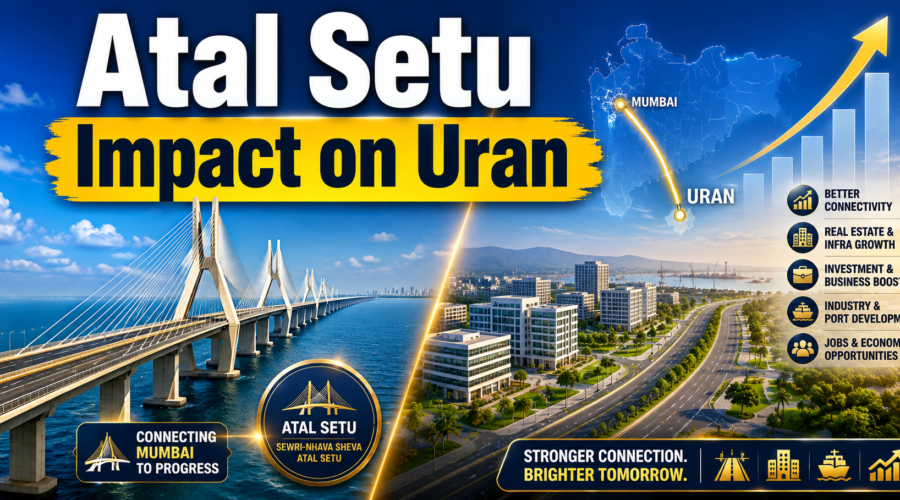
Atal Setu Impact on Uran: How the MTHL Is Changing Real Estate and Connectivity
Atal Setu, India’s longest sea bridge, has directly transformed Uran from a remote coastal town into one of the most strategically connected locations in the Mumbai Metropolitan Region. Since the bridge opened in January 2024, travel time from Uran to South Mumbai has dropped from over two hours to approximately 20 minutes, triggering a significant shift in real estate interest, infrastructure investment, and residential demand in the area.
What Is Atal Setu and Where Does It Connect?
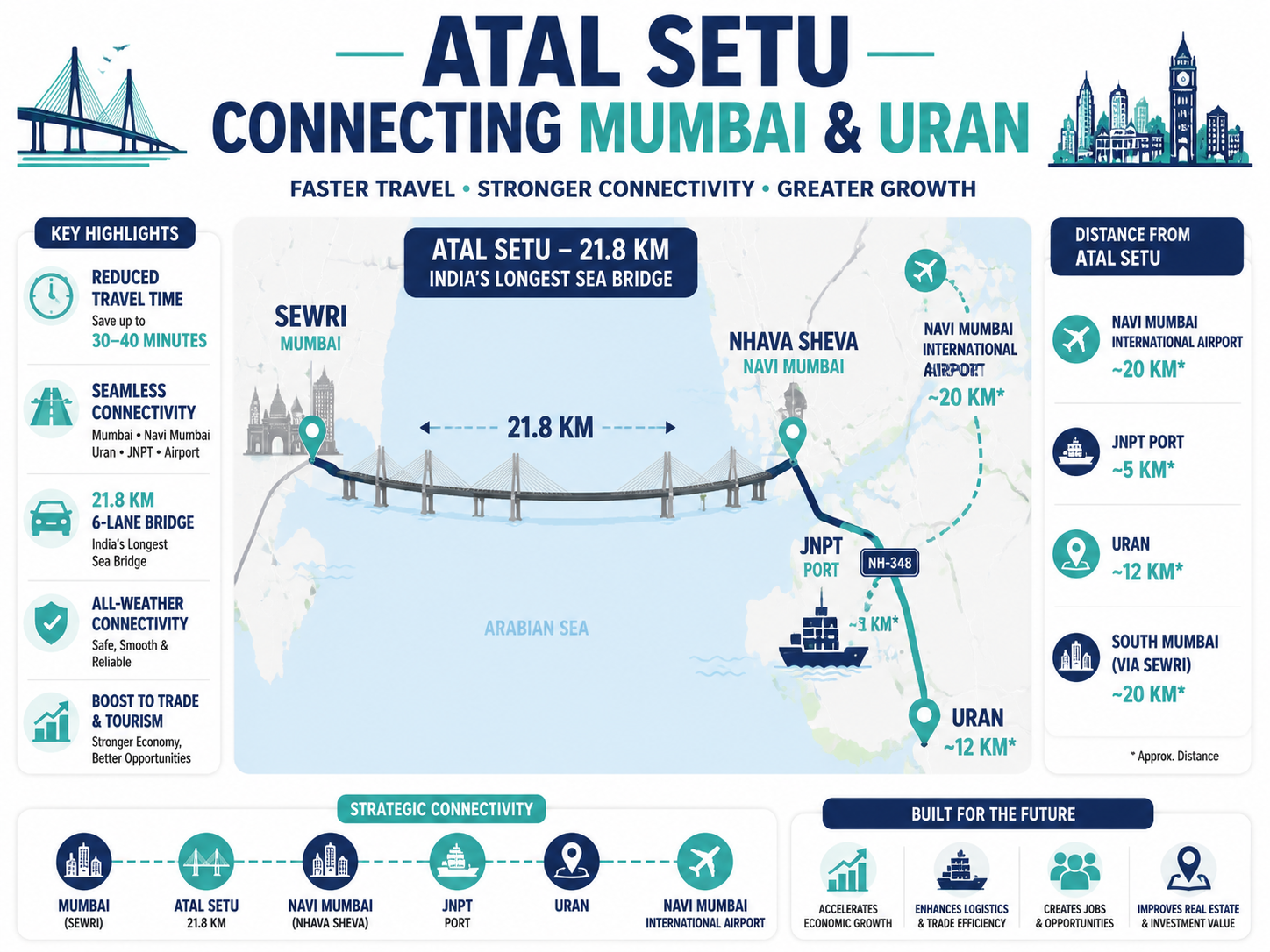
Atal Setu, officially called the Mumbai Trans Harbour Link (MTHL), spans 21.8 km across Thane Creek, connecting Sewri in Mumbai to Nhava Sheva in Navi Mumbai. It is the longest sea bridge in India and among the longest in the world.
For Uran, this matters directly. Uran is located just a short drive from the Nhava Sheva end of the bridge. Residents of Uran can now access South Mumbai, BKC, and the Eastern Freeway within 25 to 30 minutes on a normal day. This was practically impossible before January 2024 without ferry or a long detour through Panvel.
According to [MSRDC (Maharashtra State Road Development Corporation)](https://www.msrdc.org), Atal Setu can handle up to 70,000 vehicles per day and is designed for speeds of up to 100 km/h, making it one of the fastest land routes connecting the island city to Navi Mumbai’s southern nodes.
Atal Setu Impact on Uran: The Direct Connectivity Shift
Before the Bridge
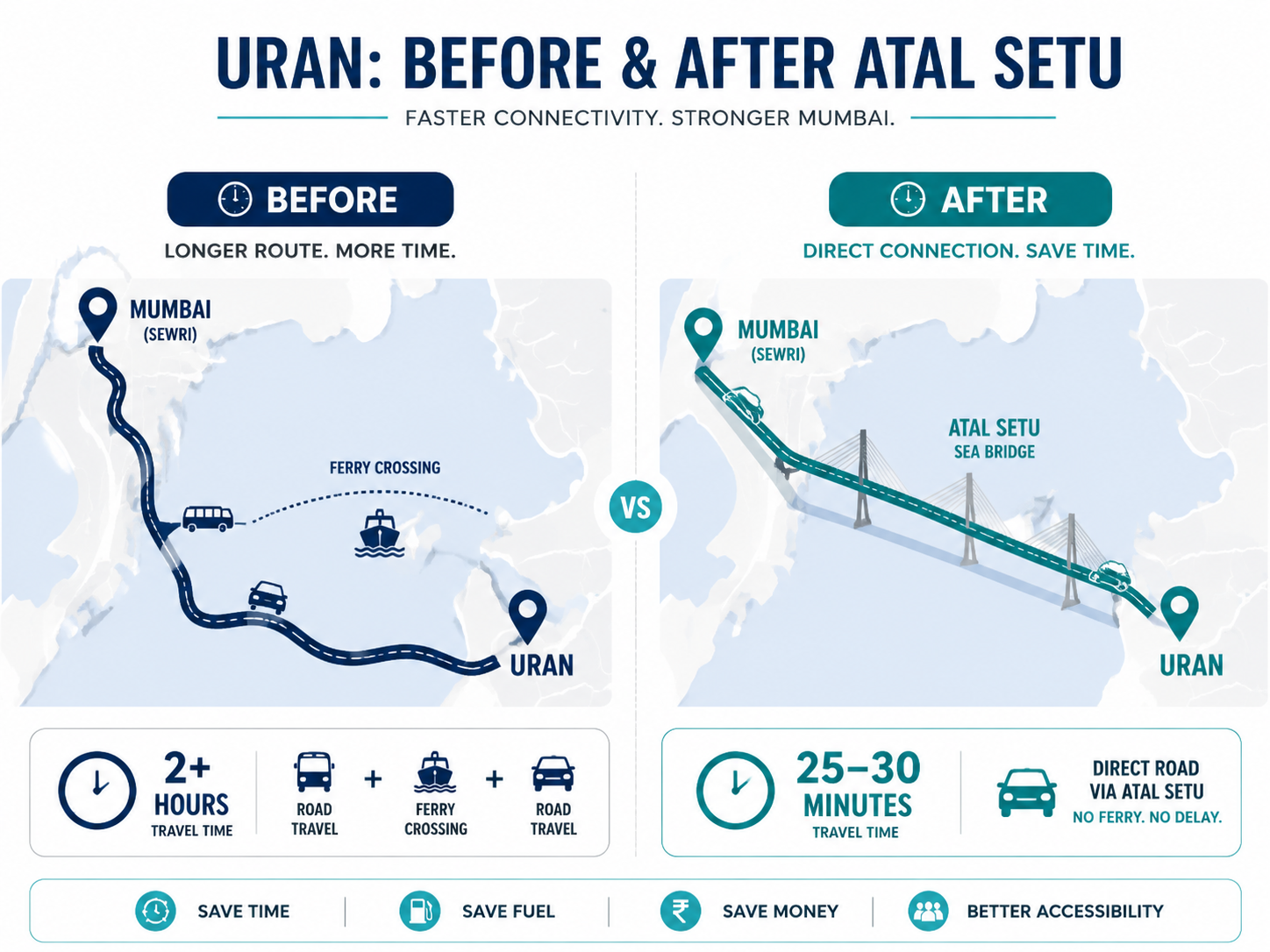
Before Atal Setu, Uran was geographically isolated despite being relatively close to Mumbai. The only practical options were:
- Ferry from Gateway of India or Bhaucha Dhakka (unreliable in monsoon)
- Road route via Panvel, adding 45 to 60 km and over 90 minutes to any Mumbai commute
This isolation kept Uran undervalued despite its coastal setting, proximity to JNPT (Jawaharlal Nehru Port Trust), and significant industrial employment base.
After the Bridge
The calculus has changed entirely.
Travel from Uran to Nariman Point or BKC is now under 30 minutes under normal traffic. This single connectivity improvement has repositioned Uran from a “too far” zone to a genuine commuter option for Mumbai-based professionals.
According to [JNPT’s official data](https://www.jnport.gov.in), Uran hosts a significant working population employed directly or indirectly in port-related operations. With improved connectivity, this population now has realistic access to Mumbai without relocating, and Mumbai-based professionals now have a reason to look at Uran’s comparatively lower property prices.
Real Estate Impact: What Has Changed in Uran Since Atal Setu
Property Price Movement
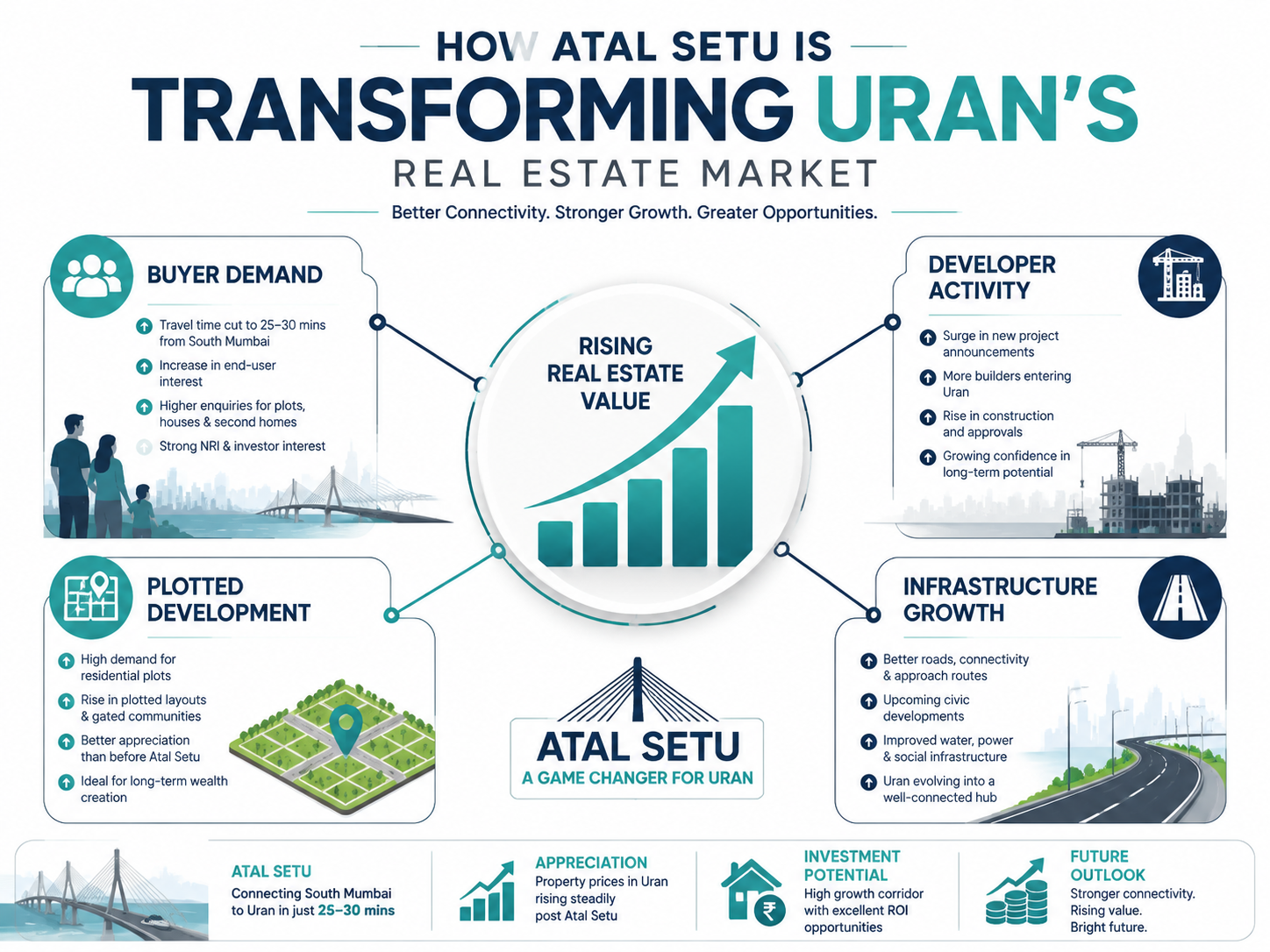
Residential property prices in Uran were significantly lower than comparable coastal micro-markets in Navi Mumbai pre-bridge. After the bridge launch, market observers have noted:
- Increased inquiry volume from outside Uran, particularly from buyers in Mumbai and Vashi
- A rise in plotted development demand, especially along the Uran-Nhava Sheva road corridor
- Growing developer interest in the Uran tehsil area, where land parcels are still available at relatively accessible rates compared to Kharghar, Panvel, or Karanjade
Important: Property prices in Uran are subject to local market conditions and CIDCO’s development framework. Buyers should verify current rates through [MahaRERA’s registered project database](https://maharera.mahaonline.gov.in) and conduct independent due diligence before transacting. [verify before transaction]
Plotted Schemes and Developer Activity
Several developers have begun marketing plotted residential schemes and low-rise apartments in Uran, citing Atal Setu connectivity as the primary demand driver. The narrative being sold: buy at current prices before the full impact of upcoming infrastructure (KSC New Town, metro expansion, JNPT fourth terminal) is priced in.
Buyers evaluating these schemes should check:
1. Whether the project is registered under MahaRERA 2. Land title clarity, especially in coastal and CRZ-adjacent zones 3. CIDCO approvals for development 4. Connectivity to utilities (water, electricity) which are still developing in parts of Uran
JNPT and Industrial Employment: Uran's Other Demand Driver
Uran’s real estate story is not purely speculative. There is genuine, existing employment demand.
JNPT is the largest container port in India, handling approximately 55-65% of India’s containerized cargo. The port directly employs thousands and supports a large indirect workforce. According to [JNPT](https://www.jnport.gov.in), the port is undergoing a capacity expansion with the fourth terminal expected to significantly increase throughput over the next decade.
The fourth terminal and associated logistics park development will add employment in Uran and Nhava Sheva, creating sustained housing demand for workers, managers, and support staff who prefer to live close to their workplace.
This is a real, employment-backed demand signal. It is not purely dependent on investor sentiment or bridge traffic.
Infrastructure Pipeline That Amplifies the Atal Setu Impact
The Atal Setu is not the only infrastructure development affecting Uran. Several projects in the pipeline will further unlock the area:
Navi Mumbai International Airport (NMIA)
The Navi Mumbai International Airport at Ulwe is scheduled for operations in 2025-2026. Uran is located within 15-20 km of the proposed airport site. Once operational, the airport will create an entirely new employment and logistics ecosystem in South Navi Mumbai, with Uran positioned to benefit from residential spillover.
According to [CIDCO](https://www.cidco.maharashtra.gov.in), the airport project is progressing and its surrounding areas, including Ulwe, Dronagiri, and Uran, are being planned for integrated development.
Dronagiri Metro Station and Connectivity
The proposed metro line connecting the airport zone to the rest of Navi Mumbai includes planned stations in the Dronagiri and Uran area. Metro connectivity would reduce dependence on private vehicles and make the Uran location viable for a broader range of buyers, including those without cars.
[verify with CIDCO and NMMC for latest metro alignment and station confirmation]
JNPT Fourth Terminal
As mentioned, the port’s fourth terminal will significantly expand cargo operations and employment. The logistics ecosystem around JNPT is expected to grow substantially through 2030, supporting residential demand in Uran on a sustained basis.
Who Should Consider Buying in Uran Right Now?
Uran is not for every buyer. Here is an honest picture:
Good fit:
- Buyers working at JNPT or in port-related industries
- Long-term investors comfortable with a 5-7 year horizon
- Buyers priced out of Kharghar, Panvel, or Karanjade looking for coastal options at lower entry prices
- Those who specifically benefit from South Mumbai connectivity via Atal Setu (BKC, Nariman Point, Ballard Estate commuters)
Not ideal if:
- You need immediate social infrastructure (schools, hospitals, malls are still developing)
- You want high rental yield right now (rental market in Uran is still maturing)
- You need fast resale liquidity (the market is less liquid than mainline Navi Mumbai nodes)
Uran vs. Other Navi Mumbai Micro-Markets Post Atal Setu
| Parameter | Uran | Panvel | Kharghar |
|---|---|---|---|
| Mumbai connectivity post-bridge | 25-30 min via MTHL | 45-60 min via highway | 50-70 min |
| Entry price (approx.) | Lower | Moderate | Higher |
| Social infrastructure | Developing | Established | Well-developed |
| Employment anchors | JNPT, port logistics | Industrial, Panvel hub | IT/residential |
| Investment horizon | 5-7 years | 3-5 years | 3-5 years |
| Market liquidity | Lower | Moderate | Higher |
Note: Price ranges and timings are approximate indicators only. Verify current market data from registered brokers or MahaRERA.
How to Evaluate a Property in Uran: A Practical Approach
Given that Uran is still a developing market, the evaluation process requires more legwork than buying in an established Navi Mumbai node.
Step 1: Confirm Jurisdiction
Uran falls partly under CIDCO jurisdiction, partly under the Uran Municipal Council, and in some pockets under gram panchayat jurisdiction. The authority governing a plot or project directly affects what approvals are required and what infrastructure commitments are in place.
Ask the developer or seller clearly: which authority has approved this project? Then verify that approval independently.
Step 2: Check CRZ Status
Uran’s coastal geography means a significant portion of its land falls under the Coastal Regulation Zone (CRZ). CRZ-I and CRZ-II classifications restrict construction heavily. CRZ-III allows limited development with conditions.
Before finalizing any property near the coastline or creek areas in Uran, verify the CRZ classification for that specific plot with a local lawyer. Do not rely on the seller’s representation alone. [verify before transaction]
Step 3: MahaRERA First, Everything Else Second
Every under-construction project in Uran must be registered under MahaRERA. This is non-negotiable. Check [maharera.mahaonline.gov.in](https://maharera.mahaonline.gov.in) for:
- Project registration certificate
- Declared possession date
- Construction progress updates (mandatory quarterly uploads)
- Any complaints or legal issues flagged against the project or promoter
Step 4: Title Search Through a Lawyer
Engage a registered advocate familiar with Raigad district land records. Uran’s land history includes CIDCO acquisitions, JNPT-adjacent land, and legacy agricultural titles that require careful examination before any transaction.
Step 5: Physical Site Visit
Aerial maps and brochures will not show you the actual road quality outside the project, the distance to the nearest government hospital, or whether basic utilities are connected. Visit in person and ask locals about water supply reliability, power cut frequency, and commute experience to the Nhava Sheva toll plaza.
Current Challenges and Realistic Expectations for Uran
The Atal Setu has genuinely improved Uran’s connectivity story. But buyers should not ignore the ground realities:
Social infrastructure gap: Uran still lacks the density of schools, multi-specialty hospitals, and retail that established Navi Mumbai nodes have. Families with children in school or with elderly members requiring frequent healthcare access need to plan carefully.
Road network inside Uran: While Atal Setu connects to Nhava Sheva efficiently, internal road quality and connectivity within Uran itself varies significantly. Buyers should physically inspect access to any plot or property.
CIDCO approvals and CRZ compliance: Uran’s coastal geography means portions of the area fall under Coastal Regulation Zone (CRZ) rules. Any plot or project in or near CRZ zones requires additional clearances. [verify before transaction]
Water and utility supply: Parts of Uran still face inconsistent water supply. Infrastructure upgrades are ongoing, but buyers of under-construction projects should check current status.
FAQs
Frequently Asked Questions