
Navi Mumbai Airport Impact on Panvel: Property Prices, Connectivity & Investment Guide
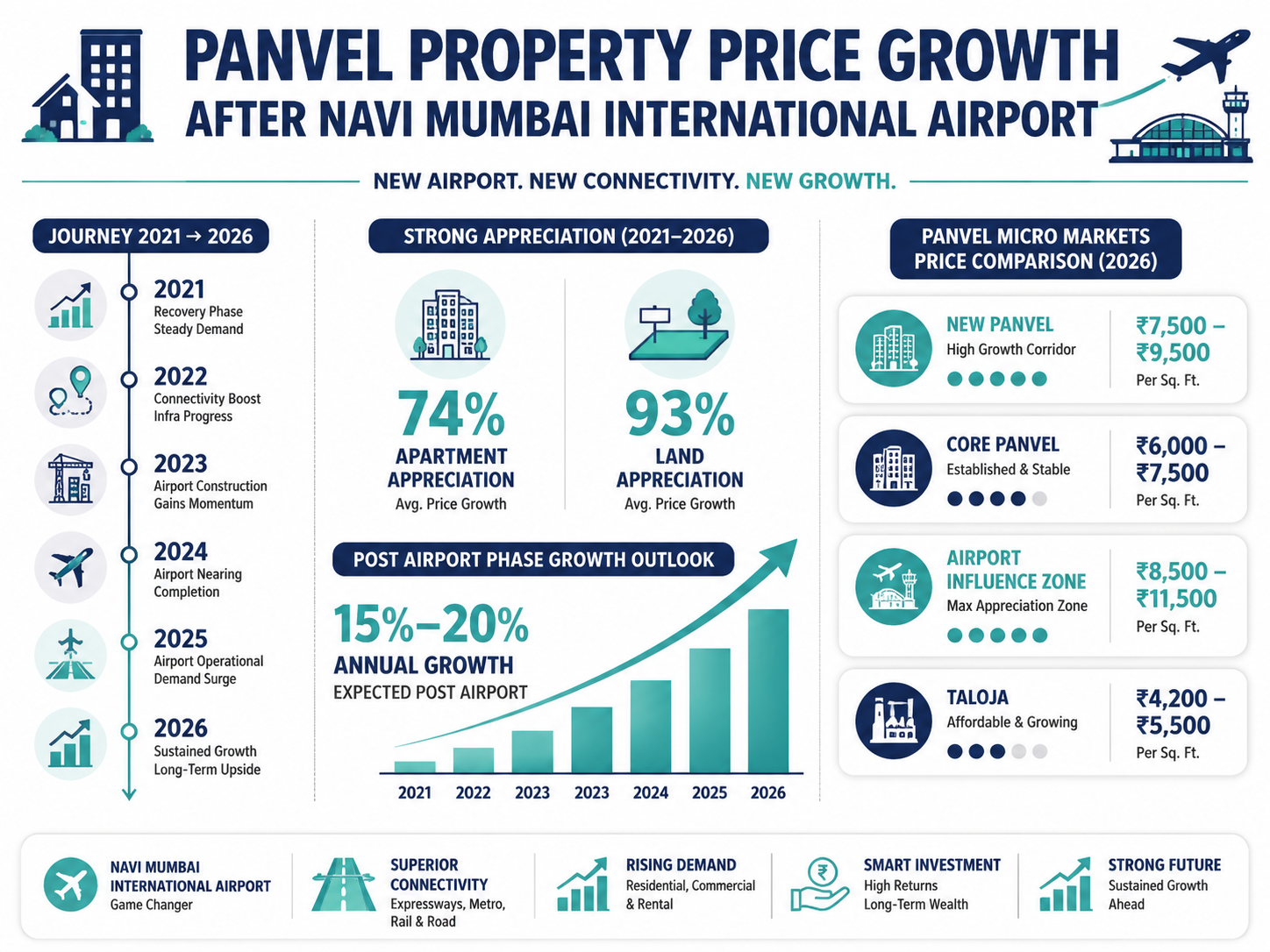
Panvel is the closest established urban node to the Navi Mumbai International Airport located approximately 12 kilometres from the terminal and has seen property prices appreciate 74% since 2021, with residential land plots near the airport influence zone recording 93% growth over the same period. Now that NMIA has been operational since December 2025, Panvel has moved from anticipation-driven demand to real, employment-led growth.
Panvel's Position in the Airport Story
Of all the nodes in the NMIA corridor, Panvel has the clearest gateway argument.
It is the closest major urban centre with existing social infrastructure, railway connectivity, and road access on three sides. The airport sits in its backyard. The Atal Setu (MTHL) connects it to South Mumbai in under 20 minutes. And it is the first node passengers and airport-economy workers reach when they enter or exit the NMIA ecosystem.
That combination does not exist anywhere else in the airport influence zone.
Ulwe may be closer to the airport terminal in straight-line distance. Kharghar may have more developed social infrastructure. But Panvel has the unique position of being both airport-adjacent and city-connected which is exactly the profile that drives sustained, multi-decade real estate value in established twin-airport cities.
Property Price Data: How Much Has Panvel Moved?

The numbers are significant and are now backed by actual airport operations rather than future projections.
Price Range and Growth Rate
Residential apartments in Panvel currently range from ₹10,000 to ₹12,000 per sq ft for established mid-range projects. Premium developments and areas closer to the airport influence zone command higher rates, with some projects quoting between ₹12,000 and ₹15,000 per sq ft.
Residential land (plots) near the airport vicinity has seen even more aggressive movement. Plot prices have surged approximately 93% since 2021 and are currently trading at ₹80,000 to ₹85,000 per square yard in prime locations.
Overall capital value appreciation from FY2021 to 2025 across the Panvel region stands at 74% a growth rate that significantly outperforms the broader Mumbai Metropolitan Region.
Year-on-year appreciation since NMIA became operational in December 2025 is running at 15% to 20%, with analysts forecasting sustained annual growth of 8% to 12% over the next seven years as airport-linked commercial activity builds up.
Price Comparison Across Panvel Sub-Markets
| Micro-Market | Current Price Range | Key Driver |
|---|---|---|
| New Panvel | ₹9,500 – ₹11,500/sq ft | RERA-registered townships, metro access |
| Panvel (core) | ₹10,000 – ₹12,000/sq ft | Railway connectivity, established social infra |
| Airport Influence Zone | ₹12,000 – ₹15,000/sq ft | Direct NMIA proximity, plot market |
| SEZ-adjacent (Taloja belt) | ₹7,500 – ₹9,000/sq ft | Industrial demand, workforce housing |
Entry-level configurations 1 BHK and 2 BHK are still available in the ₹40 lakh to ₹80 lakh range across RERA-registered projects in Panvel and its surrounding localities, making it one of the few airport-adjacent nodes in the MMR that remains accessible to the middle segment.
Why Panvel Has the Strongest Multimodal Connectivity Story
NMIA is designed to be India’s first fully multimodal aviation hub and Panvel is the nerve centre of that network.
Railway Access
Panvel railway station is the closest major station to NMIA at approximately 12 kilometres. It sits on the Harbour Line and is already well-connected to Mumbai, Gujarat, and the Konkan. The station itself is being upgraded to function as a terminal for long-distance trains.
The NMMT A-2 AC shuttle bus from Targhar (2 kilometres south of Panvel) reaches NMIA in approximately 15 minutes, making Panvel residents among the most airport-accessible in the entire region.
Panvel-Karjat Suburban Rail Corridor
This is a major ongoing project with direct implications for Panvel’s value. The ₹491 crore Panvel-Karjat corridor, part of the Mumbai Urban Transport Project 3 (MUTP-3), adds double-line capacity to one of the busiest and most constrained rail routes in Navi Mumbai. Key stations include Panvel, Mahape, Chikle, Chowk, and Karjat. The corridor strengthens connections between Navi Mumbai, Raigad district, and Pune, and directly supports NMIA’s role as a regional transport hub.
For Pune-bound passengers, this corridor reduces travel time significantly, positioning Panvel as the go-to transit point for the Mumbai-Pune corridor.
Atal Setu and Road Connectivity
Panvel has three-sided highway access, an advantage CIDCO has called out specifically. The MTHL, operational since January 2024, connects the Chirle area near Panvel to Sewri in South Mumbai across 21.8 kilometres, cutting that journey to under 20 minutes. The Sion-Panvel Highway, NH-48, and the Mumbai-Pune Expressway all converge in the Panvel region, making it the most well-connected node in the airport zone from a road perspective.
The Ulwe Coastal Road, a ₹1,590 crore project connecting Amra Marg to the Atal Setu junction and directly into the NMIA terminal via an elevated airport link, will further strengthen the airport-to-Panvel road corridor.
Kalamboli Signal-Free Access to NMIA and JNPT
The Kalamboli interchange located at the confluence of five major highways including NH-4 is being developed for signal-free access to both NMIA and the Jawaharlal Nehru Port Trust (JNPT). For commercial and logistics players, this makes Panvel’s surrounding belt the most operationally efficient location in the MMR for port-and-airport-linked businesses.
Metro Connectivity
The planned Metro Line 8 (Gold Line) will directly connect NMIA to CSMIA (Mumbai’s existing airport). Panvel falls within the metro network feeding into this corridor. When operational (estimated 2026-2027), it will be the fastest route from Panvel to the airport for daily commuters.
The Commercial Real Estate Opportunity in Panvel
The airport’s commercial impact in Panvel is already visible and is expected to intensify significantly over the next five years.
Employment Generation
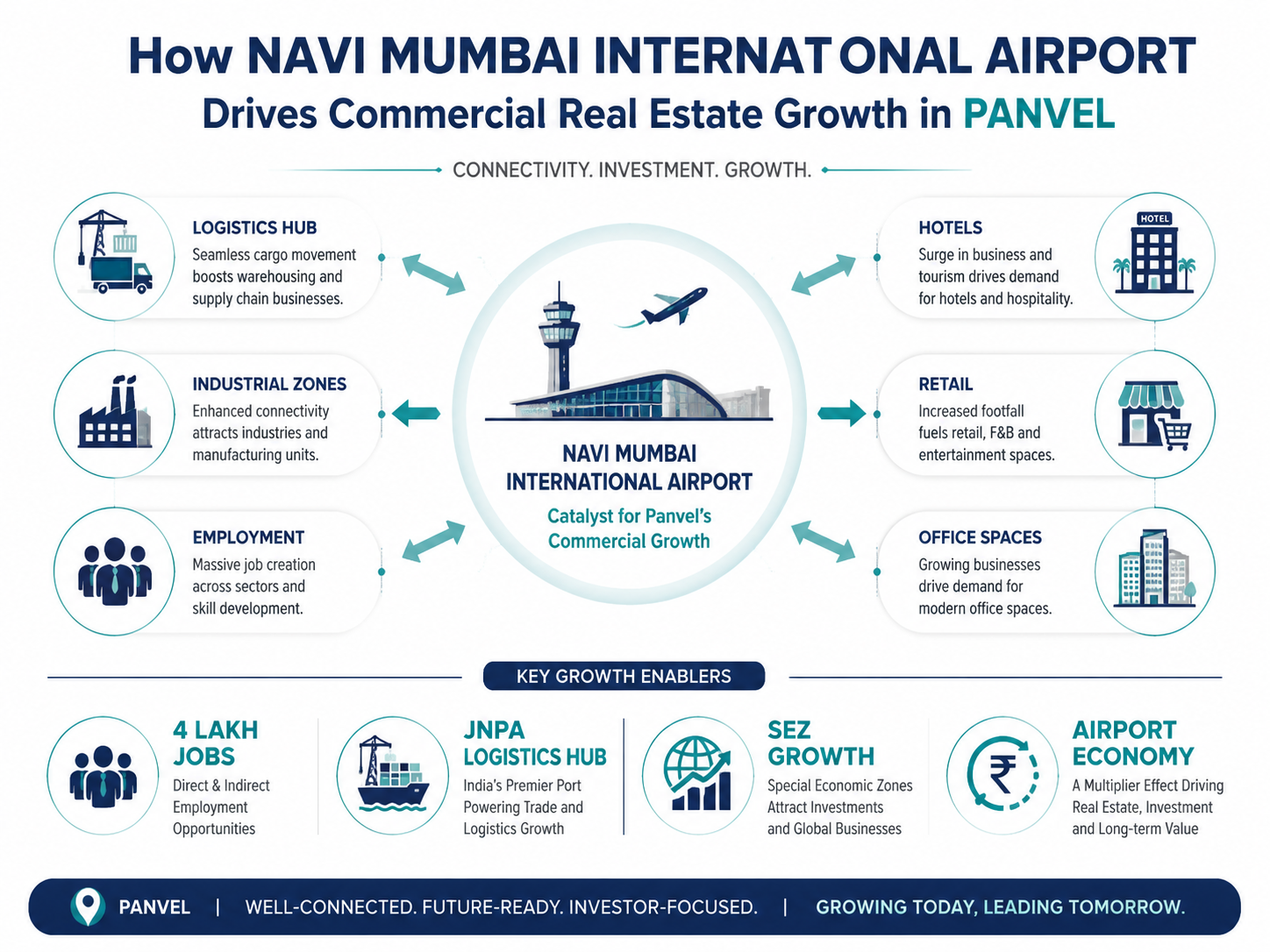
NMIA is expected to generate approximately 4 lakh direct and indirect jobs across aviation, hospitality, logistics, retail, and services. Panvel, as the closest established urban centre, is the natural residential and commercial base for this workforce.
Hotels, serviced apartments, restaurants, retail outlets, and logistics facilities are already establishing themselves in the Panvel belt to serve airport employees and passengers. This is not speculative future demand it is happening.
SEZ and Industrial Activity
Special Economic Zones in Panvel, New Panvel, and Taloja continue to drive industrial real estate demand. These zones attract manufacturing and trading businesses, creating secondary residential demand from workers. Combined with JNPT’s ongoing expansion at Nhava Sheva which drives warehousing and logistics growth in the surrounding belt Panvel’s commercial ecosystem is multi-layered.
Logistics Hub Development
CIDCO has announced a 560-hectare logistics hub near JNPA in its ₹16,250 crore FY27 budget. This hub, combined with NMIA and JNPT, positions the Panvel-JNPT belt as one of the most significant logistics and freight corridors in India. For commercial property investors, this is a long-term, infrastructure-backed demand driver.
What the Airport Means for Different Buyer Profiles in Panvel
The airport has not created one type of buyer for Panvel. It has expanded the market significantly.
First-time buyers and affordable housing seekers remain active because Panvel still has accessible price points not found in established Navi Mumbai nodes like Vashi or Nerul. 1 BHK configurations in the ₹40 lakh to ₹55 lakh range from RERA-registered builders continue to attract working professionals.
Investors targeting rental yield are focused on the employment pipeline. With 4 lakh jobs expected from NMIA-linked industries, the demand for rental accommodation in Panvel will remain structurally elevated for years. Projects within 2 to 3 kilometres of the airport terminal are already seeing premium rental enquiries.
Upgrade buyers from Mumbai who have been priced out of South Mumbai or Thane are looking at Panvel because MTHL has made the commute viable. A Panvel address now gives a Mumbai professional airport access, lower housing costs, and a manageable commute a combination that did not exist before 2024.
Commercial investors are acquiring retail and office space in Panvel ahead of the full commercial ecosystem maturing around the airport. Demand for commercial space near the Targhar bus terminal and the airport access roads is growing.
Panvel vs. Other Airport Nodes: The Honest Comparison
Every airport corridor node is making a growth claim. Here is where Panvel actually stands.
Compared to Ulwe: Ulwe is closer to the terminal and has seen sharper percentage appreciation from a lower base. But Ulwe’s social infrastructure is still developing. Panvel has decades of residential development, established schools, hospitals, and markets. For end-users, Panvel is more liveable today.
Compared to Kharghar: Kharghar has superior lifestyle infrastructure, a golf course, Asia’s largest urban park, and institutions like NIFT. Property prices are higher. Panvel offers better airport proximity, rail access, and price accessibility. For investors focused on employment-led demand, Panvel has a stronger near-term rental story.
Compared to Dronagiri: Dronagiri offers the lowest entry points but is the most under-developed node. Panvel’s existing infrastructure gives it a clear edge for buyers who need to live in a functioning city while waiting for long-term appreciation.
Panvel’s unique advantage is that it does not require the buyer to bet on future development. The infrastructure is largely here. The airport is operational. The jobs are coming. The only question is timing and the market data suggests the entry window for below-peak prices is narrowing.
Key Projects and Developments to Watch
Panvel Railway Station Upgrade: Being redeveloped as a major terminal for long-distance trains, adding a new dimension to Panvel’s regional connectivity.
Panvel-Karjat Suburban Rail Corridor: Adds double-line capacity to the busiest segment of Navi Mumbai’s rail network, with five new stations and connections to Karjat, enabling Pune access.
Ulwe Coastal Road: 6.7-kilometre elevated airport link connecting the Panvel/Ulwe area directly into NMIA’s terminal infrastructure.
Metro Line 8 (Gold Line): Planned NMIA to CSMIA express metro connection running through the Navi Mumbai belt. Expected 2026-2027.
Logistics Hub near JNPA: 560-hectare hub announced in CIDCO’s FY27 budget, creating sustained commercial real estate demand in the Panvel-JNPT belt.
What Buyers Should Verify Before Investing
The price appreciation in Panvel is real, but not every project in the region is equal.
Confirm MahaRERA registration and possession timelines before committing. Projects in areas like Karanjade, Taloja, and outer Panvel belts are still developing social infrastructure schools, hospitals, and daily convenience facilities may be limited in some sub-markets.
The Panvel-Karjat rail corridor and several road projects are in advanced stages but not fully operational. Factor realistic timelines into any connectivity-based investment thesis.
Panvel’s core areas with established railway access, RERA-registered projects, and proximity to the NMMT shuttle corridor represent the lowest-risk entry points in the airport influence zone.
This article is for informational purposes only and does not constitute investment advice. Verify all property claims with MahaRERA, CIDCO, or a registered real estate consultant before transacting.