
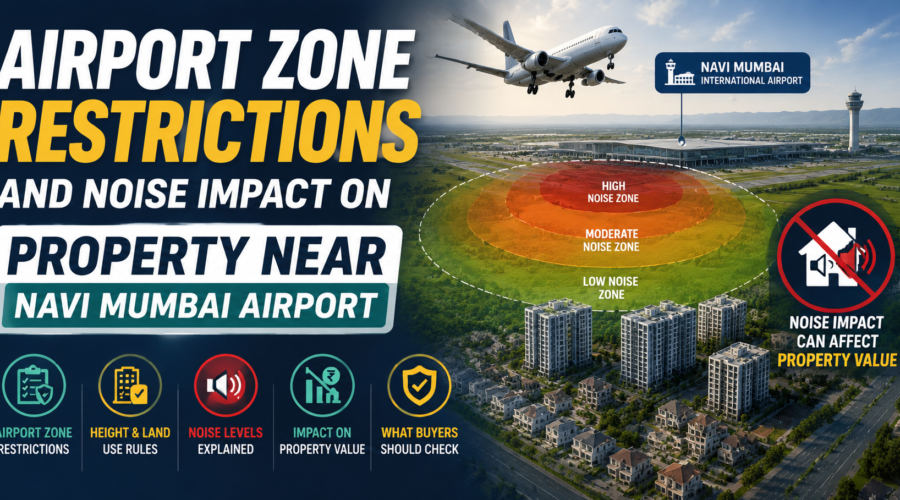
Airport Zone Restrictions and Noise Impact on Property Near Navi Mumbai Airport
Navi Mumbai’s real estate market crossed a historic milestone on December 25, 2025.
The Navi Mumbai International Airport (NMIA) opened for commercial operations with its first IndiGo flight from Bengaluru. It was the moment the city had been building toward for over two decades.
For most buyers, the headlines were about price surge and investment opportunity. And they were right to be excited. Property values in the Panvel region have jumped 74% since 2021. Plots near the airport are trading at Rs 80,000 to Rs 85,000 per square yard.
But here is what those headlines did not tell you.
A significant portion of Navi Mumbai including Ulwe, Kharghar, Seawoods, and areas from Nerul to Panvel sits inside the airport’s regulatory zone. That means height restrictions, funnel zone constraints, noise exposure, and legal compliance requirements that directly affect what you can build, how high you can go, and how livable your property will be long-term.
This is not a reason to avoid the area. It is a reason to understand it properly before you buy.
What Is the Airport Influence Zone (NAINA) and Why It Matters
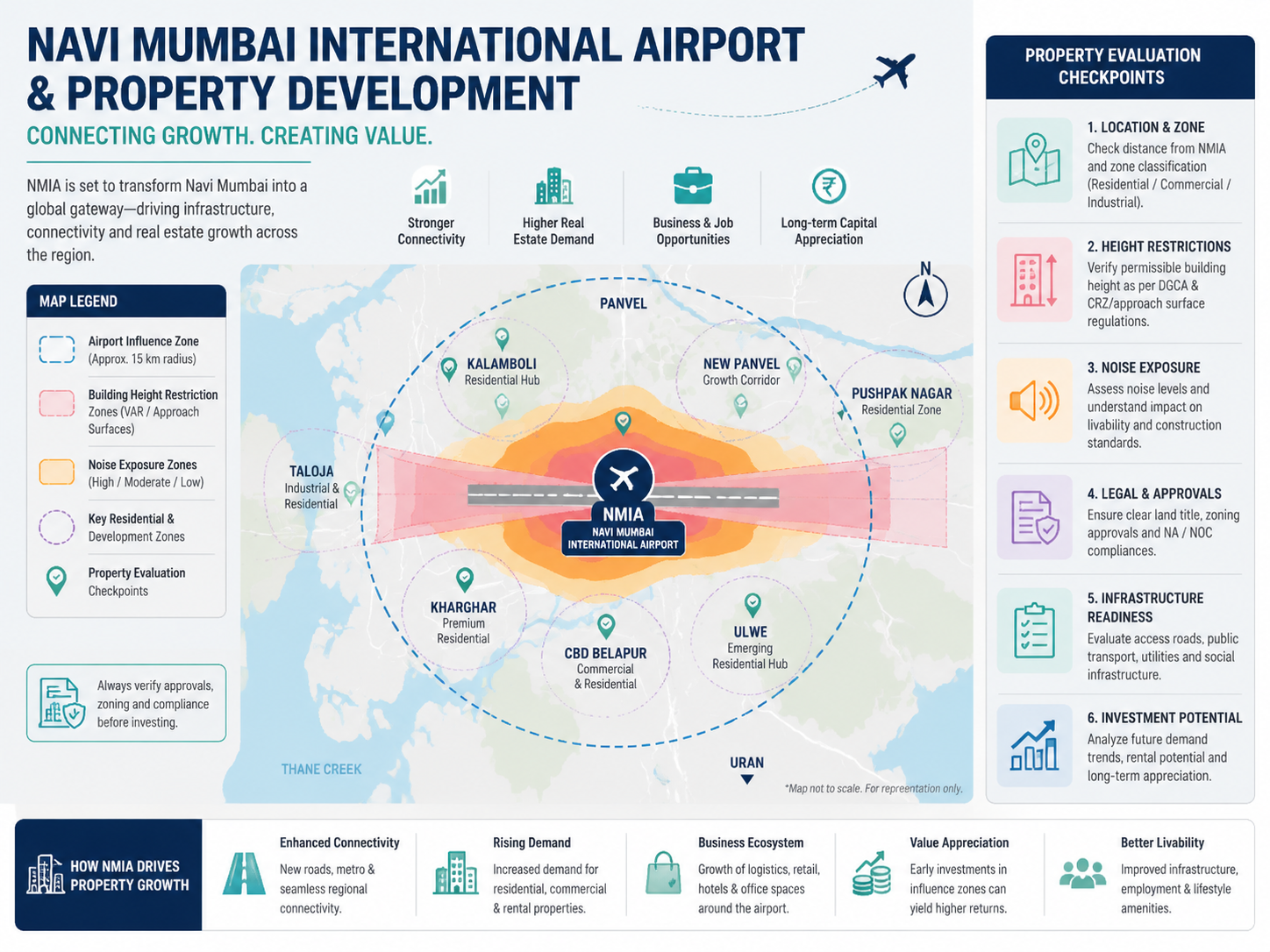
The Navi Mumbai Airport Influence Notified Area, or NAINA, was formed in 2013 under CIDCO as a special planning authority.
Its jurisdiction covers the Panvel and Uran talukas of Raigad district. The purpose was to ensure that as the airport region developed, land use, building heights, and infrastructure stayed aligned with aviation safety requirements and planned urban growth.
When you buy property inside NAINA, you are not just buying under municipal rules. You are buying under a second layer of regulatory oversight that governs everything from how high your building can go to what activities are permitted on the land around you.
This matters for buyers, developers, and investors alike.
Height Restrictions: The 55-Metre Cap That Reshaped Navi Mumbai Development
This is the restriction that hit developers hardest and it is one that many individual buyers still do not know about.
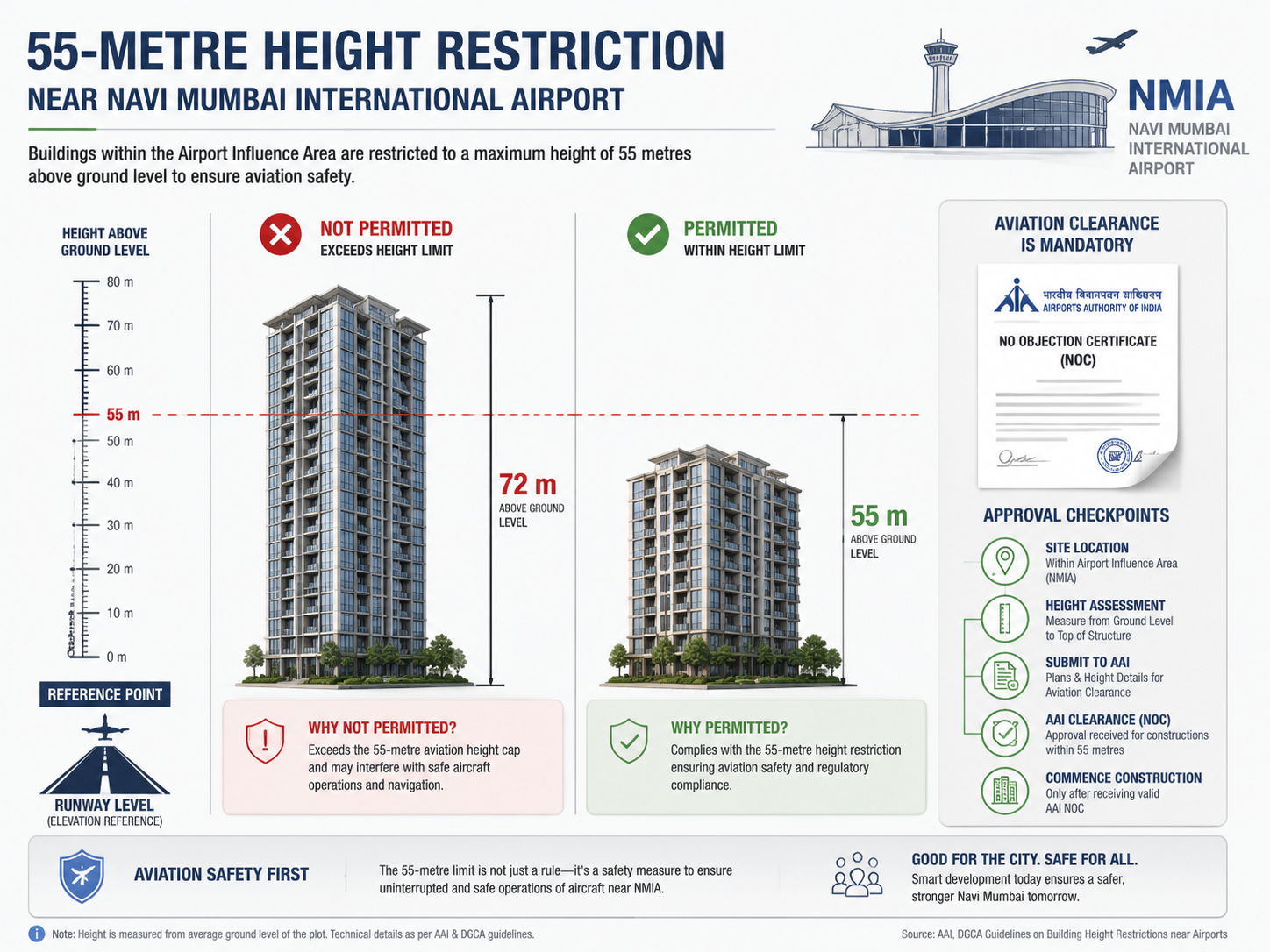
After NMIA was transferred to the Adani Group, the Airports Authority of India (AAI) took over the responsibility of issuing height clearance certificates that were previously issued by CIDCO.
The AAI capped maximum building height at 55 metres across a wide swath of Navi Mumbai.
That cap covers developments from Nerul all the way to Panvel.
The Floor Space Index (FSI) allowed in many of these zones is far higher than what a 55-metre structure can accommodate. Developers who purchased plots expecting to build tall residential towers found themselves unable to submit final proposals for approval.
CREDAI-MCHI has been in continuous communication with AAI to either resume the CIDCO-led process or increase the cap for areas outside the airport’s critical zone. As of 2025, dozens of tender plots across Navi Mumbai have been left unfinalized because of this restriction.
For buyers, this means one important thing: always verify the height clearance status of any project before booking. If the developer has not secured AAI approval, your possession timeline is uncertain.
The Funnel Zone: What 65% of Ulwe and Surrounding Areas Fall Under
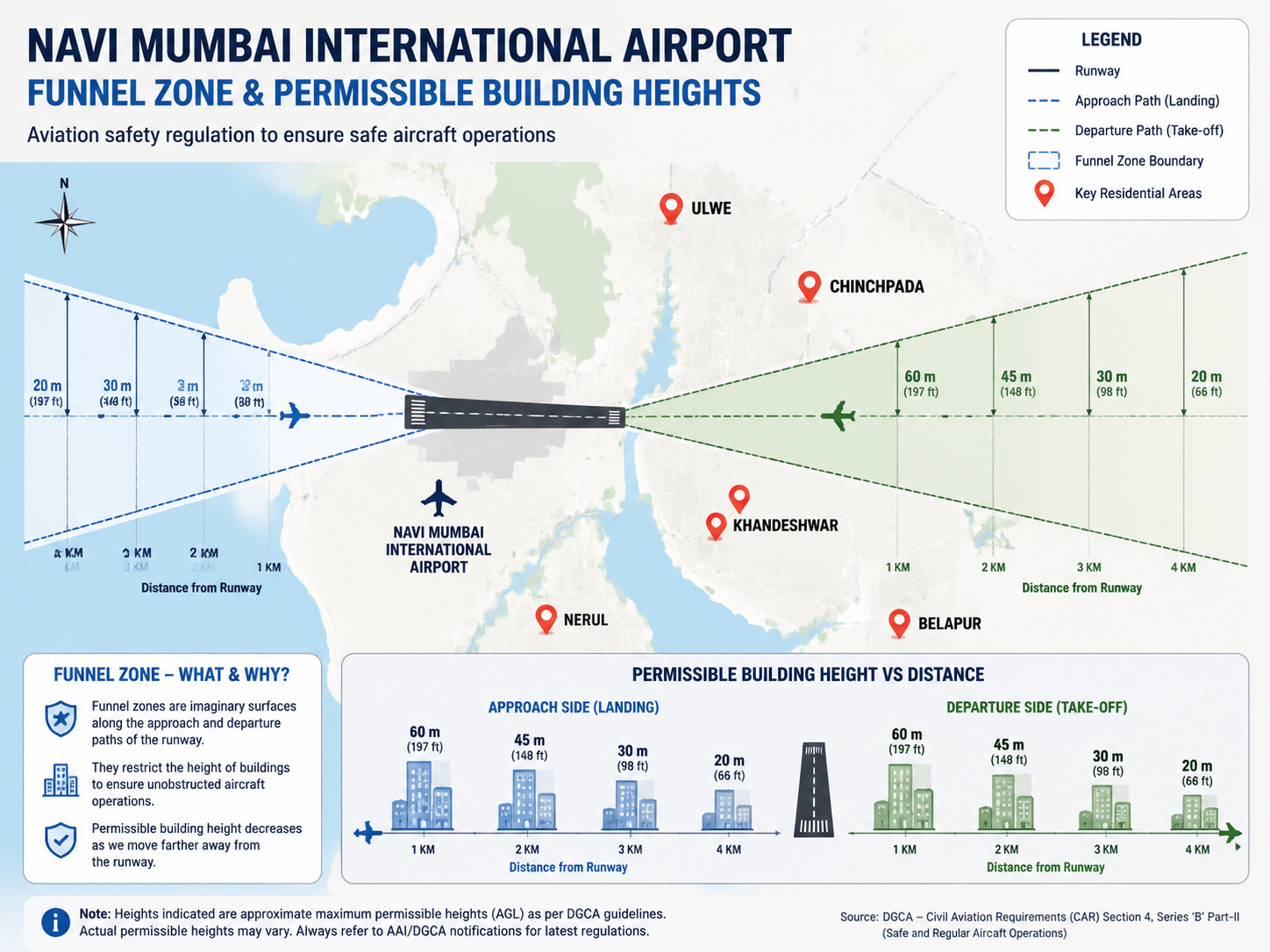
The funnel zone is the aeronautical obstacle limitation surface that extends outward from both ends of a runway. It determines the maximum height of any structure inside the zone based on distance from the runway.
NMIA’s single runway (08/26) is oriented northeast-southwest. Its funnel cuts across the southern Navi Mumbai corridor.
According to data from 1acre.in’s Mumbai Airport Funnel Zone study, 65% of Ulwe, as well as areas including Chinchpada, Khandeshwar, and Mansarovar, falls inside the funnel zone of NMIA.
Here is the number that every buyer in this region needs to carry: at 4 km from the runway, the permissible building height threshold is just 17.87 metres. That is roughly a 5 to 6 storey structure.
Beyond that height, you need an NOC from AAI mandatory, not optional.
At the CSIA funnel zone in Mumbai, this threshold has been in place since 1928 and covers virtually 50% of suburban Mumbai, including Vile Parle, Andheri, and Santacruz. NMIA is creating the same regulatory reality for Navi Mumbai’s southern nodes.
Buyers purchasing land near NMIA without checking the current Colour-Coded Zoning Map (CCZM) face the same regulatory surprises that CSIA buyers encountered for decades.
Height Violation Notices: Societies Already Receiving Them
This is not a future risk. It is already happening.
NMIAL conducted an aeronautical survey and discovered several structures that potentially violate prescribed height limits in and around the airport zone. Notices were sent to housing societies in Ulwe, Kharghar, and Sector 50E of Seawoods, Nerul.
The violations identified were not just towers. They included water tanks, hoardings, antennas, parapets, and staircases on rooftops that exceed the permissible height limits.
Societies receiving these notices were given 15 days to submit full documentation: top height of the building, date of construction, copies of approved building plans, occupation certificates, and any height clearance documents from AAI.
NMIAL clarified that it was asked by CIDCO to issue these notices as required by law, and that reports will be submitted to the relevant authority.
If you are already a resident in this belt, check your society’s compliance status. If you are looking to buy into a society here, ask specifically whether a height NOC from AAI has been issued and whether the building is within the funnel zone.
Noise Zones: What Buyers Should Actually Expect
The airport is operational. That means noise is real, not hypothetical.
Aircraft noise is measured using ANEF (Aircraft Noise Exposure Forecast) contour mapping:
Under 20 ANEF units Noise levels considered insignificant. Normal residential development is unaffected.
20 to 25 ANEF units Noise begins to have a detectable impact on quality of life. Buyers in this zone will notice aircraft sounds but it does not preclude residential development.
25 to 30 ANEF units Effects become progressively more severe. New residential, school, university, and hospital development is typically discouraged in this band.
Above 30 ANEF units Highest noise impact. Residential development is considered unacceptable for planning purposes.
For NMIA, the areas closest to the runway parts of Ulwe, Chinchpada, and the sectors immediately adjacent to the flight path will carry the highest noise exposure.
Globally, research consistently shows that properties directly in high-noise zones sell at a discount relative to otherwise comparable properties. A study on airport relocation found that house prices inside a severe noise zone increased by 21.86% relative to a control group once the noise source was removed. The inverse holds when a new noise source is introduced.
In Navi Mumbai’s context, this creates a two-category market inside the airport zone:
Properties that benefit from connectivity and employment growth (within 10-15 km but outside direct flight path) will continue to appreciate.
Properties directly under the flight path with ANEF exposure above 25 need to price in the quality-of-life discount that typically follows once an airport becomes fully operational.
Which Areas Are Directly Affected vs. Which Are Investment Opportunities
Directly under flight path / noise exposure risk:
- Ulwe sectors closest to the runway
- Chinchpada
- Parts of Khandeshwar near the approach funnel
Height restrictions apply but investment case remains strong:
- Kharghar (funnel zone applies; prices already at Rs 14,750-17,750 per sq ft, up 20% in 4 years)
- Seawoods / Nerul (Sector 50E societies already received notices; funnel zone applies)
- Kamothe and Kalamboli (proximity advantage without being directly under the runway)
Strong investment zone outside direct noise band:
- Panvel (10-25% price appreciation post-NMIA opening; outside primary noise contour)
- Dronagiri (developing logistics and port-linked industrial corridor; residential demand rising)
- Karanjade (emerging micro-market in the NMIA influence zone)
What to Check Before Buying Any Property in the Airport Zone
1. NOC from AAI via NOCAS Portal All height clearances are issued through AAI’s NOCAS portal at nocas.aai.aero. For any project inside the funnel zone, the developer must have a valid NOC. Ask for it. Do not accept verbal assurances.
2. CCZM Grid Position The Colour-Coded Zoning Map determines the maximum permissible height at your specific plot’s distance from the runway. Your lawyer or a local property consultant can look this up.
3. NAINA Land Use Classification Under NAINA, certain land uses are restricted in specific sectors. Confirm that the intended use residential, commercial, mixed is permitted in the zone your plot falls in.
4. Society Compliance Record If buying into a resale flat in an older society in Ulwe, Kharghar, or Nerul, verify whether NMIAL has issued any height violation notice to the society. This is now a standard due diligence item.
5. Flight Path Overlay Check whether your property sits under the primary approach or departure path. The runway 08/26 orientation means the flight path runs northeast-southwest. Properties on this axis experience more frequent overhead aircraft.
The Long-Term Picture: Discount or Premium?
The honest answer is both depending on exactly where you are.
Research from global markets shows that properties within 10 km but outside severe noise contours tend to appreciate significantly post-airport opening due to employment growth, improved connectivity, and the commercial ecosystem that develops around airports.
Properties directly inside high-noise contours or under approach corridors tend to trade at a 7-15% discount relative to similar properties outside those zones, even in high-demand markets.
Navi Mumbai will follow the same pattern.
The NMIA opened on December 25, 2025 with 23 daily departures connecting 16 domestic destinations. Phase 1 handles 20 million passengers annually. The full build-out plans for 90 million passengers per year. As traffic grows, so will the noise footprint.
Buyers who understand the zone they are buying in and price accordingly will make informed decisions.
Buyers who ignore the restriction map and buy purely on the headline appreciation story may find that their specific plot carries regulatory or quality-of-life constraints that were entirely avoidable with a few hours of due diligence.
Conclusion
The Navi Mumbai International Airport is a genuine game-changer for the region. The 74% appreciation in Panvel since 2021 is real. The employment, commercial growth, and connectivity premium are real.
But so are the height restrictions. So is the funnel zone covering 65% of Ulwe. So are the violation notices already sent to housing societies in Kharghar and Seawoods.
Buying property near NMIA in 2025-26 is not complicated. It just requires knowing which map to look at before you sign the agreement.
Check the NOCAS portal. Understand the CCZM grid. Verify NAINA land use classification. Ask about violation notices. Know your distance from the runway.
Do that, and the airport zone becomes one of the most compelling investment corridors in the Mumbai Metropolitan Region.
Skip it, and you might be buying a great location with a complicated compliance story attached.
For more guides on Navi Mumbai real estate, infrastructure, and investment, visit ilovenavimumbai.com.