
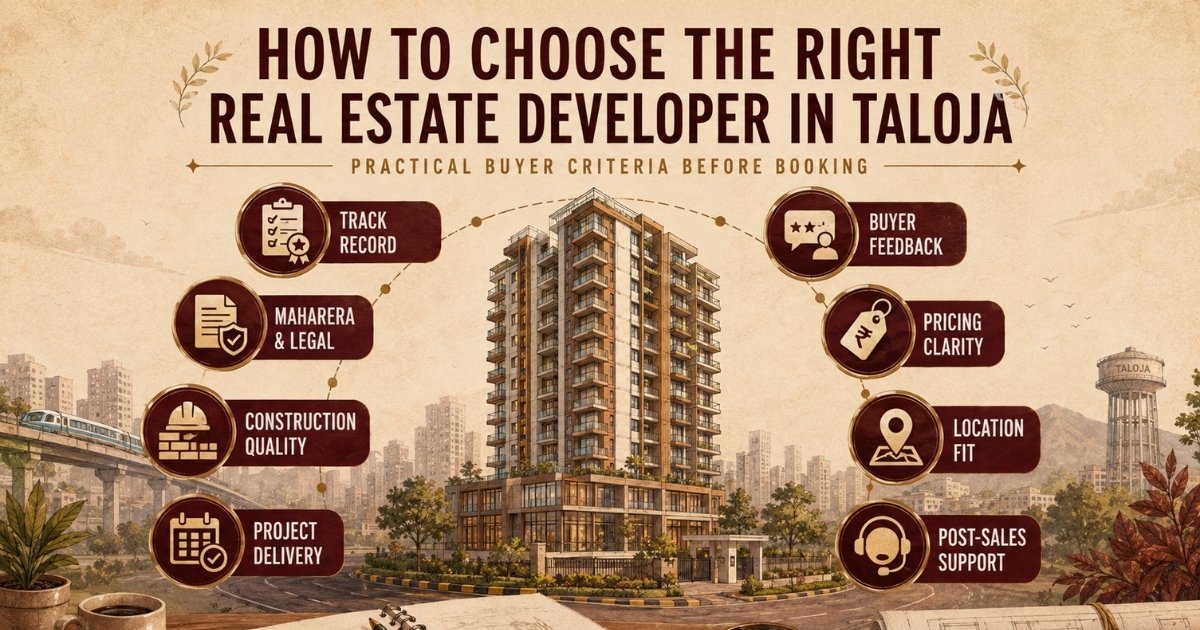
How to Choose the Right Real Estate Developer in Taloja | Buyer Guide
To choose the right real estate developer in Taloja, buyers should verify the developer’s past delivery record, MahaRERA details, CIDCO land documents, legal approvals, construction quality, pricing clarity, water planning, buyer feedback and OC-based possession before paying token money. In Taloja, this due diligence is especially important because the area has strong growth potential, but also real challenges such as water dependency, MIDC pollution influence, leasehold land complexity and under-construction project risk. Quick Summary: How to Choose the Right Real Estate Developer in Taloja Taloja is one of Navi Mumbai’s most affordable growth locations, especially for first-time homebuyers looking for 1 BHK and 2 BHK flats below the price levels of Kharghar, Nerul, Seawoods or Vashi. The operational Navi Mumbai Metro Line 1, airport-led growth expectations and improving connectivity have increased buyer interest in Taloja Phase 1, Taloja Phase 2, Ghot, Petali, Roadpali and nearby pockets. But affordability should not make buyers careless. A cheap flat in the wrong project can become expensive later through delay, leakage, tanker water cost, hidden charges, weak society handover or unclear CIDCO documentation. What to Check Why It Matters in Taloja Good Sign Red Flag MahaRERA details Confirms project registration, timelines and disclosures Clear registration, updated progress, no major litigation pattern Repeated extensions, poor disclosure, pending complaints CIDCO / land title Taloja has CIDCO leasehold and PAP / 12.5% plot-related risks Clear allotment, transfer and title documents Builder avoids sharing documents before token OC and CC Protects buyer from illegal possession and approval mismatch CC and OC status clearly explained in writing “Fit-out possession” offered without OC Water planning Taloja has known water supply stress in several societies Adequate storage, legal water connection, resident satisfaction Permanent tanker dependency in older projects Construction quality Monsoon leakage and maintenance issues can reduce livability Older buildings show good upkeep and no major seepage Damp walls, basement flooding, poor lift condition Pricing clarity Advertised base rates often exclude many charges All-inclusive cost sheet on letterhead Verbal discounts, hidden PLC, parking and maintenance charges Location fit Taloja Phase 1, Phase 2 and MIDC-side pockets differ Project suits daily commute, air quality and budget Good builder but weak micro-location The safest way to choose a real estate developer in Taloja is to verify legal documents, completed projects, pricing clarity and buyer feedback before paying token money. MahaRERA registration is important, but it should not be treated as the only proof of developer quality. Why Choosing the Right Real Estate Developer Matters in Taloja Choosing the right builder matters in every real estate market, but in Taloja it matters more because the buyer is not only buying a flat. The buyer is also accepting the developer’s ability to handle local approvals, CIDCO land conditions, water planning, construction quality, environmental realities and society handover. Taloja is no longer just an industrial periphery. It is now a metro-linked residential growth corridor with strong interest from first-time buyers, MIDC employees, investors and families priced out of Kharghar or Panvel. However, rapid development has also brought uneven project quality. Some developers have managed to deliver usable, well-planned homes, while others have struggled with delays, poor construction quality, weak maintenance planning or legal complications. A wrong developer choice in Taloja can create problems such as: EMI and rent burden due to delayed possession No proper OC at handover High monthly maintenance due to tanker water Leakage during monsoon Poor society formation and conveyance delays Hidden charges after booking Difficulty in resale because of weak project reputation This article is for general buyer awareness. Before booking or signing an agreement, buyers should verify documents with a qualified legal professional. Understand the Developer’s Past Track Record A developer’s past record is often more reliable than their sales presentation. In Taloja, where many buyers are attracted by affordable pricing and future appreciation hopes, checking older projects is one of the most practical ways to avoid a poor decision. A builder may show impressive brochures, sample flats and 3D renders, but the real test is how their completed buildings look after five to ten years. Check Completed Projects Before Trusting New Launches Before trusting a new launch in Taloja, ask the developer for a list of completed projects. Do not only ask for names. Ask for addresses, possession dates and whether the projects received OC. A completed project helps you check: Whether the developer delivered close to the promised timeline Whether the project received Occupancy Certificate Whether the society was formed properly Whether residents are satisfied with maintenance Whether there are leakage, lift or water issues If a developer has many under-construction projects but very few completed projects, buyers should be careful. It does not automatically mean the developer is bad, but it increases the need for stricter verification. Visit Older Buildings Developed by the Same Builder A five-year-old building tells the truth better than a new sales office. In Taloja, this is especially important because monsoon seepage, humidity, industrial dust and water stress can expose weak construction quickly. When visiting an older building by the same developer, check the basement, external walls, lobby, staircase, lift area, terrace and parking. Look for damp patches, peeling plaster, cracked tiles, rusted railings, poor drainage and waterlogging marks. Also observe whether the building feels properly maintained or abandoned after handover. A good developer does not disappear immediately after possession. Speak to Existing Residents and Buyers Existing residents can tell you what the sales team will not say clearly. Ask simple, direct questions: Was possession delayed? Was the final cost the same as promised? Is water supply regular? Does the building depend heavily on tankers? Was society formation completed smoothly? Are there leakage problems during monsoon? Does the builder respond after possession? In Taloja, buyers should specifically ask about water supply timing and tanker dependency. Some societies in the wider Taloja belt have faced very short municipal water windows and have relied on private tankers. If the developer’s older projects are still struggling badly for basic water, treat it as a serious warning
Read More


