Blogs

Everything about Navi Mumbai

Mumbai Trans Harbour Link Real Estate Impact: Navi Mumbai Buyer Guide

The Mumbai Trans Harbour Link real estate impact is strongest in Ulwe, Dronagiri, Uran, Panvel, Pushpak Nagar, and airport-linked areas. It improves Mumbai–Navi Mumbai access, but it does not automatically make every property safe. Before paying token money, verify title, 7/12, IGR records, RERA, CIDCO/NAINA approvals, zoning, CRZ, NA/use status, and legal access road. What MTHL Changes for Navi Mumbai Property Mumbai Trans Harbour Link, also called Atal Setu, connects Mumbai with Navi Mumbai through the Sewri–Nhava Sheva side. For property buyers, the biggest change is simple: some Navi Mumbai and Raigad-side locations are now easier to access from South Mumbai and central Mumbai. That can improve buyer interest, rental demand, commercial movement, and long-term land value in selected areas. But there is one important rule. Connectivity can improve demand. It cannot clean defective documents. If the property has bad title, unclear ownership, missing approvals, agricultural land-use issues, CRZ restrictions, NAINA zoning problems, or no legal road access, MTHL will not remove that risk. This is especially important for plots, gaothan properties, village land, NAINA land, and coastal areas near Uran, Dronagiri, Panvel, Raigad, and creek-side belts. MTHL Basics Buyers Should Know MTHL is a major infrastructure link between Mumbai and Navi Mumbai. It improves east-west connectivity and reduces dependence on older routes for certain journeys. For a buyer, the important question is not just “Is the property near Atal Setu?” The better question is: How much real daily-life benefit does this property get from MTHL? Check: Actual distance to MTHL entry or exit Peak-hour travel time Toll cost Road condition from the property to the bridge Last-mile connectivity Railway, metro, airport and highway access Whether future roads are approved or only promised by the seller A flat in a well-developed node may benefit differently from a remote plot marketed as “future MTHL investment.” Area-Wise MTHL Real Estate Impact Ulwe Ulwe has one of the strongest MTHL stories because it is close to the Navi Mumbai side of the bridge and also benefits from airport-linked growth. For homebuyers, Ulwe can work well if the project has clean approvals, good access, and realistic pricing. Check before buying: CIDCO allotment or lease documents Commencement Certificate Occupancy Certificate MahaRERA status for under-construction projects Society records for resale flats Builder delivery history Whether the price already includes the MTHL premium Do not buy only because the brochure says “near Atal Setu.” Dronagiri Dronagiri benefits from MTHL, Uran-side access, port-linked activity, and future logistics demand. It can be attractive for patient buyers and investors. But Dronagiri also needs careful checking because some areas may have coastal, mangrove, CRZ, or infrastructure-readiness issues. Check: CIDCO node status Project approvals CRZ/CZMP risk if near creek, mangroves, or coast Road access Social infrastructure Resale liquidity Actual commute to workplace Dronagiri can be a long-term play, but it should not be treated like a fully mature residential market everywhere. Uran Uran may benefit from MTHL, JNPT/JNPA activity, logistics, warehousing, and port-linked employment. But Uran property needs stricter due diligence. Many buyers get attracted by “cheap land near Atal Setu.” That is where mistakes happen. Check: 7/12 extract Mutation entries Ownership chain IGR registration search Road access CRZ/CZMP status Land-use permission Whether the seller has the legal right to sell If it is village land, agricultural land, gaothan property, or land sold through Power of Attorney, consult a property lawyer before token money. Panvel Panvel gets a combined benefit from MTHL, Navi Mumbai International Airport, Mumbai–Pune Expressway, rail, highways, and NAINA growth. But Panvel has mixed jurisdictions. A property may fall under PMC, CIDCO, NAINA, MMRDA influence area, or rural revenue limits. That changes what documents you must verify. Check: Whether the property is CIDCO, NAINA, PMC, gaothan, or village land 7/12 extract and 8A Ferfar / mutation entries IGR search Development Plan or Regional Plan zoning NA/use permission status Approved layout Road access Do not compare every Panvel property only by price per sq. ft. Jurisdiction and approval status matter. Pushpak Nagar Pushpak Nagar is mainly an airport and CIDCO-led growth story. MTHL adds connectivity value, but the airport and planned node development are major drivers. Check: CIDCO documents MahaRERA registration Commencement Certificate Occupancy Certificate Airport influence restrictions, where applicable Builder delivery record Actual livability today Pushpak Nagar can be strong for buyers who understand timelines. Avoid paying a future-price premium without document clarity. Kharghar Kharghar gets indirect MTHL benefit. For most buyers, metro, rail, highway, schools, hospitals, Central Park, golf course area, and social infrastructure may matter more than Atal Setu. Kharghar is not usually a pure MTHL play. Check: Actual travel time to Mumbai Metro and rail access RERA status OC and society records Resale title Maintenance dues Comparable prices in the same sector If a seller charges a heavy MTHL premium in Kharghar, ask for real commute logic. Taloja Taloja is more connected to affordability, metro access, MIDC proximity, Kharghar, Panvel, and industrial employment. MTHL may improve sentiment, but it is not the main reason to buy in Taloja. Check: Metro access Industrial proximity Pollution or environment concerns Project approvals MahaRERA status Water, road, and social infrastructure Rental demand realism Taloja can work for budget buyers, but avoid exaggerated MTHL-based appreciation claims. NAINA and Raigad Villages NAINA and Raigad-side villages may get long-term interest due to MTHL, airport, KSC New Town, logistics, and planning-led development. But these areas carry higher risk if buyers do not verify land records and zoning. Before buying NAINA or village land, check: Survey number / gut number 7/12 extract 8A extract Mutation entries IGR registered document search Zone Confirmation Statement Development Plan or Interim Development Plan status Road access Reservation or acquisition risk CRZ/CZMP if near creek or coast NA/use status Seller’s legal authority NAINA notification does not mean every plot is immediately buildable or legally safe. Verify before transaction. Direct Impact vs Hype Area Real MTHL Benefit Main Checks Buyer Verdict Ulwe Strong Mumbai access and airport-linked demand CIDCO, OC, RERA, resale title Strong, but price-sensitive Dronagiri Port, Uran and

Read More

Mumbai to Navi Mumbai Connectivity Impact on Property: Buyer Guide

Mumbai to Navi Mumbai connectivity has improved demand in areas linked to Atal Setu, Navi Mumbai Airport, metro, railway, JNPT and expressway corridors. Ulwe, Pushpak Nagar, Panvel, Dronagiri, Uran, Kharghar and Taloja benefit the most. But connectivity alone does not make a property safe. Before paying token money, verify title, RERA, CIDCO/NAINA approvals, land records, CRZ, zoning and registered documents. Why Mumbai to Navi Mumbai Connectivity Matters for Property Buyers The Mumbai to Navi Mumbai connectivity impact is real. When travel becomes easier, more buyers start looking at nearby locations. Offices, warehouses, airport-linked businesses, logistics companies and service workers also create rental demand. But the mistake is simple. Many buyers assume better connectivity means guaranteed appreciation. That is not true. A flat near a metro station can still have poor approvals. A plot near Atal Setu can still have title issues. A land parcel near Navi Mumbai Airport can still fall under NAINA, CRZ, green zone, no-development zone or aviation restrictions. So the right question is not only: “Which area will grow?” The better question is: “Which area has connectivity, liveability and clean documents?” That is how a Navi Mumbai buyer should think. Main Projects Changing Mumbai to Navi Mumbai Connectivity 1. Atal Setu / Mumbai Trans Harbour Link Atal Setu, also called the Mumbai Trans Harbour Link or MTHL, connects Sewri in Mumbai to the Nhava Sheva / Chirle side of Navi Mumbai. It has made the Mumbai–Navi Mumbai movement faster for people using the Sewri, Ulwe, Dronagiri, Uran, JNPT and Panvel side. This has increased attention on: Ulwe Pushpak Nagar Dronagiri Uran Panvel JNPT-linked logistics locations NAINA influence areas For property buyers, the Mumbai Trans Harbour Link real estate impact is strongest where the property has actual road access, future employment demand and clear planning status. Warning: Atal Setu improves access. It does not verify title, land use, CRZ status or building permission. 2. Harbour Line and Trans-Harbour Railway For daily commuters, railway connectivity still matters more than marketing hype. The Harbour Line supports demand in: Vashi Sanpada Juinagar Nerul Seawoods CBD Belapur Kharghar Panvel The Trans-Harbour Line supports demand in: Airoli Rabale Ghansoli Kopar Khairane Vashi Thane-linked office routes This is why the Harbour Line Property Impact and Trans Harbour Line Property Impact are different from Atal Setu impact. Railway-connected areas usually attract stable end-users and rental demand because people can commute daily without depending only on private vehicles. 3. Navi Mumbai Metro Navi Mumbai Metro Line 1 connects the Belapur–Kharghar–Taloja–Pendhar belt. This improves the practical value of areas such as: CBD Belapur Kharghar Taloja Pendhar The Navi Mumbai Metro Real Estate Impact is strongest for buyers who need daily public transport access and want lower entry prices compared to premium nodes. But do not pay a premium only because a broker says “future metro extension.” Check whether the metro station is operational, proposed or still only on paper. 4. Navi Mumbai International Airport Navi Mumbai International Airport is one of the biggest long-term demand drivers for the region. It affects: Ulwe Pushpak Nagar Panvel Dronagiri Uran Kharghar Taloja NAINA villages Logistics and cargo-linked areas The airport can create demand from airline staff, cargo workers, hospitality, warehousing, offices, rental housing and supporting services. But airport proximity has two sides. It can improve demand. It can also bring noise, traffic, aviation height restrictions, land-use restrictions and overpricing in some pockets. So if someone says “airport ke paas hai, rate double hoga,” treat it as a claim, not proof. 5. JNPT, Expressways and Logistics Corridors JNPT, Mumbai–Pune Expressway, Mumbai–Goa Highway, Sion–Panvel Highway and Uran Road also shape Navi Mumbai property demand. These routes help: Logistics parks Warehousing Industrial demand Commercial property Rental housing for workers Transport-linked businesses Areas like Uran, Dronagiri, Panvel, Taloja and JNPT-side belts may benefit from this. But buyers must also check pollution, truck movement, access roads, drainage, parking, liveability and resale demand. Best Connected Areas in Navi Mumbai: Practical Buyer View Area Connectivity Driver Best For Main Benefit Main Risk Ulwe Atal Setu, airport, railway End-users, airport-linked buyers Strong location story Check CIDCO leasehold, OC, RERA, CRZ where relevant Pushpak Nagar Airport, Atal Setu, Panvel access Early-growth buyers Airport-led demand Check project approvals, RERA, access roads Panvel Railway, airport, expressway, NAINA Families, investors, plot buyers Regional hub potential Check land records, NA/NAINA status, flooding/access Kharghar Metro, Sion-Panvel, Belapur access Families, professionals Better social infrastructure Check approvals, hill/green-zone/CRZ claims where relevant Taloja Metro, industrial belt, affordability Budget buyers, rental investors Lower entry price Check pollution, water, liveability, project delivery Dronagiri Atal Setu, JNPT, Uran, airport Long-term investors Logistics and port demand Check CRZ, occupancy, access, resale liquidity Uran Atal Setu, JNPT, coastal access Long-term land/property buyers Strategic location Check CRZ, title, access, village records Airoli/Ghansoli Trans-Harbour, Thane-Belapur Road IT workers, rental investors Stable office-linked demand Higher entry price NAINA Villages Airport influence, future planning Plot buyers, landowners Long-term planning potential Highest due diligence required Connectivity Benefit vs Legal Safety A well-connected property is not automatically a safe property. This is the most important point. Connectivity can increase demand, but documents decide whether the transaction is safe. For example: A NAINA plot may be near the airport but fall under a reservation. A gaothan property may be close to Panvel but have unclear title. A resale flat may be near the station but lack a proper OC. A CIDCO leasehold property may need transfer compliance. A coastal plot near Uran or Dronagiri may need CRZ verification. Do not pay token money only because the broker says “Atal Setu se rate badhega” or “airport ke paas hai.” First verify documents. Documents to Check Before Buying For Flats and Under-Construction Projects Check these documents: Document Why It Matters MahaRERA registration Confirms project registration details on the official portal Commencement Certificate Shows permission to start construction Occupancy Certificate Shows the building is approved for occupation Approved building plan Confirms sanctioned layout and floors Agreement for Sale Shows payment, possession, carpet area and buyer rights Land title report Helps check

Read More

Atal Setu Impact on Ulwe: Connectivity, Airport Proximity & Property Prices

Atal Setu has reduced travel time from Ulwe to South Mumbai to under 20 minutes, making Ulwe one of the best-connected emerging nodes in Navi Mumbai. Combined with its position as the closest residential zone to the upcoming Navi Mumbai International Airport, Ulwe is now sitting at the intersection of two of the biggest infrastructure plays in the Mumbai Metropolitan Region. If you’re looking at Ulwe — whether as a buyer, investor, or someone weighing it against other Navi Mumbai nodes — this article covers what has actually changed, what it means for property prices, and what risks to factor in before deciding. Why Ulwe Is Different from Other Navi Mumbai Nodes Most Navi Mumbai nodes have one infrastructure story. Kharghar has Metro connectivity and the upcoming BKC-Kharghar Metro corridor. Panvel has rail access and highway coverage. Ulwe has two simultaneous infrastructure plays at a scale that affects the entire area fundamentally: Atal Setu on the connectivity side, and Navi Mumbai International Airport on the economic activity side. Neither of these was available — or even near completion — five years ago. Both are now either live or in advanced stages. This is what separates Ulwe from other affordable Navi Mumbai options at a similar price point. Atal Setu and Ulwe: The Direct Connectivity Shift Travel Time Before and After Atal Setu Ulwe’s location near the Chirle end of Atal Setu gives it among the most direct bridge access in Navi Mumbai. Route Before Atal Setu After Atal Setu Ulwe to Nariman Point 75-90 minutes 20-30 minutes Ulwe to Sewri/Wadala 60-70 minutes 15-20 minutes Ulwe to BKC 80-100 minutes 35-50 minutes Ulwe to Mumbai Airport 90-110 minutes 50-65 minutes These are approximate figures under normal traffic conditions. Peak-hour travel will be longer, but even with buffer, the improvement is significant enough to change Ulwe’s commute calculus entirely. How Close Is Ulwe to the Chirle Interchange? The Chirle interchange — the Navi Mumbai entry and exit point of Atal Setu — is approximately 5-8 km from most residential pockets in Ulwe. According to MSRDC, the Mumbai Trans Harbour Link (MTHL) spans 21.8 km and the Chirle end provides direct road access into the Ulwe-Dronagiri corridor. This proximity is not accidental. Ulwe was planned by CIDCO as part of a broader south Navi Mumbai expansion, and the Atal Setu alignment has validated that planning intent. Property Price Impact in Ulwe Post Atal Setu Current Price Ranges by Property Type Ulwe remains one of the more affordable nodes in Navi Mumbai despite the infrastructure upgrade. Approximate price ranges as of 2025: Property Type Approximate Price Range 1 BHK Rs. 45-65 lakh 2 BHK Rs. 70-1.05 crore 3 BHK Rs. 1.10-1.60 crore Plots (CIDCO allotted) Varies significantly by sector and plot size These figures are indicative. Prices vary by builder reputation, project stage, exact sector within Ulwe, and current market conditions. [Verify with registered local agents and confirm project registration on MahaRERA at maharera.maharashtra.gov.in before any transaction.] Ulwe has seen a notable increase in new launches and project registrations since Atal Setu’s inauguration in January 2024. Developers who had acquired land in Ulwe 5-8 years ago at low rates are now launching projects, which is itself a signal of increased market confidence. Rental Demand and Yield Trends The rental market in Ulwe has picked up alongside purchase demand. Key rental demand drivers: Airport-adjacent workforce. As pre-opening activity around Navi Mumbai International Airport increases, Ulwe is attracting construction contractors, airport-sector workers, and early employees of airport-linked businesses. Rental demand from this segment is expected to grow substantially once the airport becomes operational. South Mumbai and BKC commuters. Professionals who work in South Mumbai but want to avoid Mumbai rental prices are now looking at Ulwe as a live option. A 2 BHK at Rs. 18,000-25,000 per month in Ulwe compares favorably to equivalent options in Chembur or Govandi at Rs. 35,000-50,000. Rental yields in Ulwe currently hover around 3-4% annually, consistent with other emerging Navi Mumbai nodes. This is expected to improve as social infrastructure catches up with housing supply. The Airport Factor: Navi Mumbai International Airport What the Airport Means for Ulwe’s Real Estate The Navi Mumbai International Airport (NMIA) is located in Ulwe itself, making it one of the few residential zones in India where buyers can live within the vicinity of a new international airport being built from scratch. According to NMIA’s official project information, the airport is being developed by the City and Industrial Development Corporation (CIDCO) and is designed to handle an initial capacity of approximately 20 million passengers per year, with expansion planned over subsequent phases. The real estate implications are direct: Employment generation. Airport operations, logistics, retail, hospitality, and ancillary services will generate significant employment in and around Ulwe. This drives residential demand from workers and professionals who prefer proximity to their workplace. Commercial development. Airport-adjacent zones tend to see hotels, service apartments, warehousing, and retail develop quickly. Ulwe will benefit from this commercial layer, which in turn supports residential property values. Perception upgrade. Having an international airport as a neighbor changes the perceived status of an area significantly. Post-airport, Ulwe will likely be described differently in real estate marketing — that shift in perception has a real price impact. It’s important to note: as of mid-2025, the airport is still in an advanced construction and commissioning phase. Buyers should not assume the airport is fully operational when making purchase decisions. [Verify current airport status at nmairport.com or with CIDCO before transacting.] Who Is Buying in Ulwe Right Now? Buyer activity in Ulwe since Atal Setu has come from several distinct profiles: First-time homebuyers on a budget. The combination of CIDCO-backed land, new-launch pricing, and Atal Setu connectivity makes Ulwe one of the most compelling entry-level options in Navi Mumbai. Buyers who previously defaulted to Taloja or Panvel for affordability are now comparing Ulwe seriously. Long-horizon investors. Buyers who understand the airport story and are willing to hold for 5-7 years are entering at current prices to

Read More

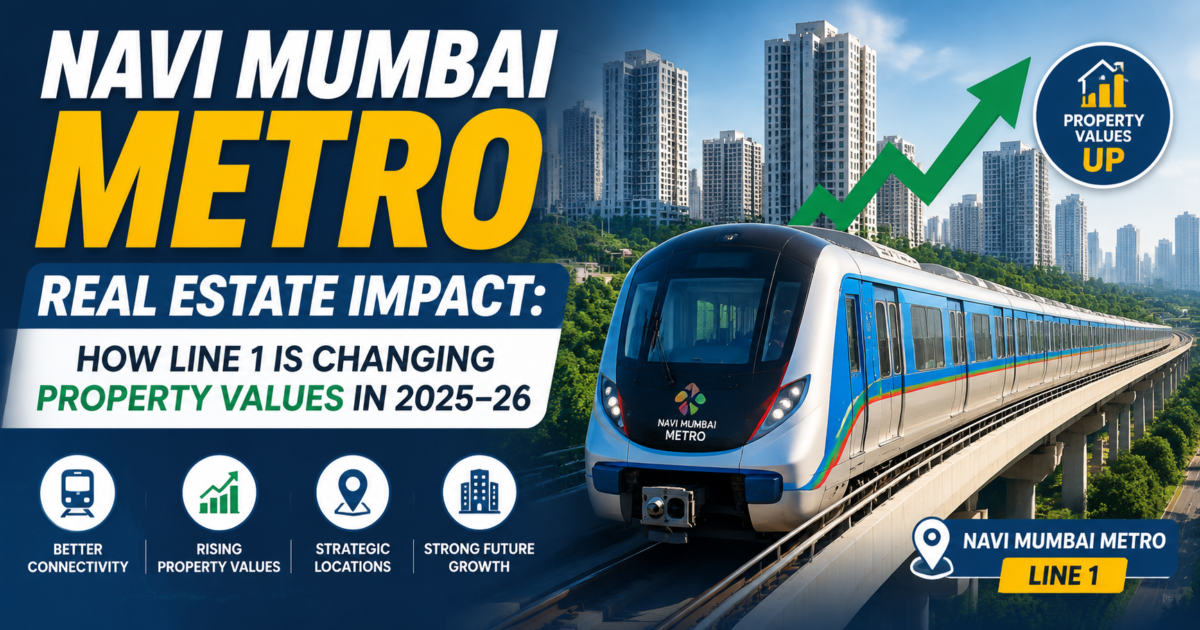
Navi Mumbai Metro Real Estate Impact: How Line 1 Is Changing Property Values in 2025–26

The city had been waiting for it since 2011. The project was delayed by over seven years legal hurdles, contractor issues, poor project management. By the time the first train ran from Belapur to Pendhar, the people of Kharghar and Taloja had stopped expecting it on time. But now it is running. And the real estate market has noticed. Properties near Navi Mumbai Metro stations are commanding a 10-15% premium compared to similar properties even a kilometre away. Taloja once considered a disconnected industrial fringe has been pulled into the mainstream. Kharghar’s rental market is outperforming most of Navi Mumbai. And the upcoming airport connectivity via planned metro extensions is setting up the next wave of appreciation. This guide breaks down exactly how the metro is reshaping Navi Mumbai’s property market node by node, station by station. Understanding the Navi Mumbai Metro Network Before getting into prices, here is what the current and planned network looks like. Line 1 (Operational since November 2023) The only operational line. It runs 11.1 km elevated, from CBD Belapur to Pendhar, covering 11 stations. The stations are: 1. CBD Belapur (Terminal) interchange with Belapur railway station 2. RBI Colony (Sector 7) 3. Belpada (interchange with Kharghar railway station) 4. Utsav Chowk, Kharghar 5. Kendriya Vihar (Sector 11) 6. Kharghar Village (Sector 14) 7. Central Park, Kharghar 8. Pethpada, Kharghar 9. Amandoot (Sector 34) 10. Panchanand (Taloja) 11. Pendhar (Terminal) Phase 1 was inaugurated in November 2023. The full Line 1 will ultimately run 23.4 km from Belapur to Khandeshwar once all phases are complete covering 20 stations. Line 2 (Planned): Taloja MIDC to Khandeshwar This extension of Line 1 will be approximately 10.3 km with 8 stations. Line 3 (Planned): Pendhar to MIDC Taloja A 2.2 km link to close the loop from Belapur to Khandeshwar. Line 4 (Planned): Khandeshwar to Navi Mumbai International Airport The most anticipated extension. It will be approximately 4.17 km with elevated and underground sections, directly connecting the metro to NMIA. The total master plan covers 106.4 km across 6 lines, though implementation of the full plan remains uncertain. What is certain is that Line 1 is operational, ridership is growing, and the property market has already begun pricing in the metro effect. What Is the Metro Effect and How Does It Show Up in Prices? The metro effect is a well-documented real estate phenomenon. When rapid transit reaches an area, it does three things almost simultaneously: First, it reduces effective distance. Taloja to Belapur by road could mean 45 minutes in traffic. By metro, it takes under 20 minutes. That time saving is capitalized directly into property values. Second, it triggers commercial development. Malls, hospitals, clinics, schools, and offices cluster near metro stations because footfall is guaranteed. That commercial growth raises the desirability of surrounding residential areas. Third, it changes the buyer and renter profile. Corporate professionals who previously avoided Taloja because of the commute problem are now actively looking there. That demand shift pushes both sale prices and rental yields upward. In Mumbai’s broader metro expansion, properties within a 1 km radius of stations have seen 10-40% appreciation, depending on supply constraints and location. Navi Mumbai’s Line 1 is showing the same pattern, particularly in Kharghar and Taloja. Belapur: The Terminal Station Effect CBD Belapur is the northern terminus of Line 1. It is the only station on the network that connects to Indian Railways, providing direct interchange with Belapur railway station. Belapur was already one of Navi Mumbai’s most established commercial nodes before the metro arrived. It houses the headquarters of several public sector banks, government offices, and corporate campuses. The metro has added one more layer to its connectivity stack. And the market has responded. Belapur property has moved from Rs 14,750 per sq ft in 2021 to approximately Rs 17,750 per sq ft in 2025 about 20% appreciation in four years. The metro is cited as a major driver of this. Properties near the Belapur terminal station specifically are commanding a 10-15% premium over comparables farther from the station. For end users who want the best of both worlds railway connectivity, metro access, established commercial infrastructure, and proximity to the upcoming airport via planned Line 4 Belapur remains one of the strongest bets in Navi Mumbai. Kharghar: The Biggest Beneficiary of Line 1 Kharghar is the heart of Navi Mumbai Metro Line 1. Six of the 11 stations on Phase 1 serve the Kharghar node: Belpada, Utsav Chowk, Kendriya Vihar, Kharghar Village, Central Park, and Pethpada. No other node in Navi Mumbai has this level of metro penetration. The result has been dramatic. Sector 5 Kharghar has seen 103.7% price appreciation over the last three years the highest in all of Navi Mumbai. That is not entirely attributable to the metro alone; the airport effect, MTHL connectivity, and Kharghar’s natural green landscape all contribute. But metro access is a primary driver. Properties within 1 km of Kharghar metro stations are commanding higher rental yields driven by intense demand from corporate professionals who have discovered that Kharghar now offers genuine commuting convenience to Belapur and beyond. The rental market reflects this directly. Before the metro, many corporate tenants in Belapur and Nerul were paying premiums to avoid the Taloja-Kharghar commute problem. That premium has flipped. Kharghar now attracts them rather than pushing them away. Central Park station is worth calling out specifically. It sits adjacent to Kharghar’s Central Park one of the largest urban parks in Maharashtra. Properties near this station combine green living, metro access, and proximity to educational institutions, making them particularly attractive to families. The premium here is not just price per sq ft it is the lifestyle multiplier that keeps demand sticky. Taloja: The Transformation Story Before the metro, Taloja meant one thing to most Navi Mumbai buyers: industrial zone, long commute, avoid unless you have no choice. That narrative has been disrupted entirely. The Panchanand and Pendhar stations have pulled Taloja right into the mainstream of the Navi Mumbai

Read More

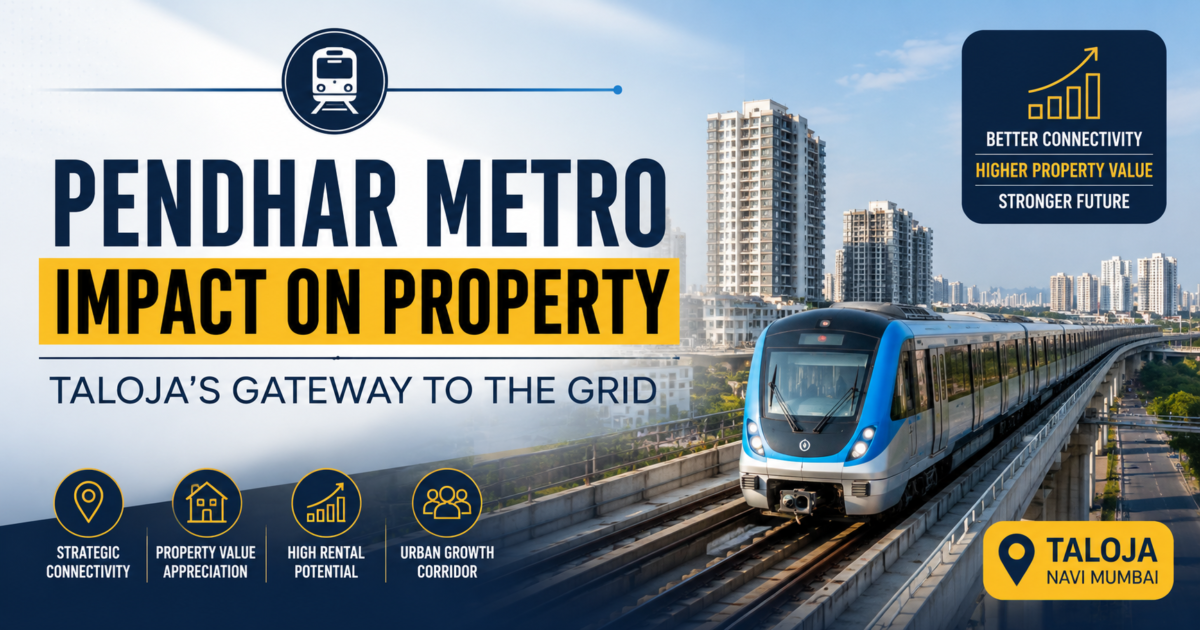
Pendhar Metro Impact on Property: Taloja’s Gateway to the Grid

The Pendhar metro station has done something no road improvement could: it connected Taloja Phase 2 to CBD Belapur in a single, reliable daily commute. Pendhar is the southern terminus of Navi Mumbai Metro Line 1, and its opening in November 2023 marked the moment Taloja shifted from “affordable and isolated” to “affordable and connected.” Property rates in the Pendhar-Taloja belt now range from ₹6,500 to ₹9,000 per sq ft, with an average of around ₹8,700. For context, that is still the lowest serious entry point inside Navi Mumbai’s developed nodes. But the gap between price and potential is narrowing. This guide covers what the Pendhar metro station has actually changed about property values, who benefits most, and what the path forward looks like as the metro corridor expands toward the Navi Mumbai International Airport. What the Pendhar Metro Station Is Pendhar is Station 11 on Navi Mumbai Metro Line 1, the southern terminus of the operational corridor. The line runs 11.1 km from CBD Belapur Terminal (Station 1) to Pendhar (Station 11), elevated throughout. Pendhar sits at the southern end of Kharghar, bordering the Taloja Phase 2 area. Line 1 quick facts: Operational since: 17 November 2023 Operated by: CIDCO / Konkan Railway (O&M from June 2024) Daily operating hours: 6:00 AM to 10:00 PM Frequency: Every 10 minutes peak, 15 minutes off-peak Fares: ₹10 minimum, ₹30 maximum Total ridership: Crossed 1 crore passenger journeys within two years Pendhar station is a short auto-rickshaw ride from Taloja Phase 2 residential areas. For residents of Taloja Phase 2 projects, this is the entry point to the metro network, from which they can reach CBD Belapur in under 20 to 25 minutes. According to [CIDCO], the broader master plan envisions the metro extending beyond Pendhar toward Khandeshwar and ultimately to the Navi Mumbai International Airport in later phases. The Before and After: What Changed at Pendhar Pre-Metro Taloja Taloja’s commute challenge was well-documented. The nearest suburban railway station sat 12 to 13 km from Taloja and Kharghar localities, according to market experts quoted by 99acres. Road access during peak hours on the Kharghar-Taloja stretch was slow and unreliable. For professionals working in CBD Belapur, living in Taloja was a trade-off: you got a significantly cheaper 2 BHK, but you paid for it in commute time, road congestion, and unpredictability. Many buyers chose to stretch their budget and buy in Kharghar instead, even at a 40 to 60% price premium, simply for the better road access to Belapur. Post-Metro Taloja The Pendhar station changed that calculus. Taloja Phase 2 residents can now walk or take a short auto to Pendhar station and reach CBD Belapur in 20 to 25 minutes on the metro. The commute is reliable, air-conditioned, and costs ₹30 for the full stretch. As one detailed 2026 Taloja real estate report from Revaa Homes put it: Metro Line 1 terminating at Pendhar put Taloja on the map for Belapur-CBD professionals who want a 2 BHK they can actually own instead of renting in Kharghar forever. That shift in positioning is real. A 2 BHK in Taloja Phase 2 starts around ₹48 lakh. A comparable size in established Kharghar starts around ₹1 crore. The metro has compressed the commute time gap between the two nodes to under 5 minutes. Property Price Data: Pendhar and Taloja Post-Metro Metric Current Status Average rate (Taloja) ₹8,700 per sq ft Rate range ₹6,500 to ₹9,000 per sq ft 2 BHK range (affordable end) ₹48 lakh 2 BHK range (premium Phase 2) ₹72 lakh Reckoner value vs market 40 to 80% below market value Projected annual appreciation 11 to 16% through 2027 The reckoner value gap is significant: actual Taloja market rates are 40 to 80% higher than their government-registered reckoner values, which market analysts cite as a clear indicator of future upside as the gap closes over time. According to Tescon Green’s Q1-Q2 2026 market report, Taloja and the Pendhar corridor are expected to show 11 to 16% annual appreciation as metro ridership grows and employers continue establishing in the MIDC belt. What Pendhar Station Has Done to Specific Areas Taloja Phase 2 This is the primary beneficiary of the Pendhar metro station. Phase 2 is a large residential zone developing primarily with mid-budget projects targeting first-time homebuyers and professionals relocating from Mumbai. Before the metro, Phase 2 felt geographically disconnected from the commercial hubs of Navi Mumbai. Post-Pendhar, the dynamic has shifted. Builders are now marketing Phase 2 projects explicitly on metro connectivity. The Pendhar station is reachable by auto from most Phase 2 societies, and commute times to Belapur CBD are under 25 minutes. The profile of the Phase 2 buyer has also shifted. Pre-metro, the dominant profile was blue-collar and MIDC industrial workers. Post-metro, white-collar professionals from Belapur and Kharghar’s commercial areas are increasingly evaluating Taloja Phase 2 as an ownership option, having previously been locked out of Kharghar pricing. Pushpak Nagar Colony Pushpak Nagar is a newer premium pocket within the Pendhar-Taloja belt, with modern infrastructure, asphalt roads, and connectivity to major highways. It is positioned as a mid-to-premium alternative within an otherwise affordable zone. Metro access via Pendhar has made Pushpak Nagar Colony more attractive for families and professionals who want newer construction and better civic infrastructure at a price that central Kharghar cannot match. Pendhar Gaon The original village settlement of Pendhar Gaon has seen its surroundings transform with the metro station’s arrival. New residential colonies are developing in the area. Metro line infrastructure, combined with widened roads, has increased accessibility from Navi Mumbai overall and raised the property value of land and housing in surrounding pockets. The Bigger Picture: Why Pendhar Is a Strategic Node The Airport Extension Pipeline The most significant long-term factor for Pendhar property is not the current Line 1 terminus status. It is what comes next. Line 1 Phase 2 will extend the corridor from Khandeshwar to the Navi Mumbai International Airport. This extension passes through or near the Taloja-Pendhar corridor. When this

Read More

Belapur Metro Impact on Property: What It Means for Buyers and Investors

The Navi Mumbai Metro’s CBD Belapur terminal has directly boosted property values in the area, with apartments now averaging ₹25,500 per sq ft and year-on-year appreciation of around 11.6%. Belapur was already Navi Mumbai’s administrative and corporate hub. The metro has added a new dimension: seamless daily connectivity that did not exist before November 2023. This article breaks down exactly how the metro has impacted Belapur property prices, which micro-markets are benefiting most, and what buyers and investors should know before making a decision in 2026. What the Belapur Metro Station Actually Is The CBD Belapur Metro Terminal is Station 1 on Navi Mumbai Metro Line 1. This is the northern terminus of the 11.1 km elevated corridor that runs from CBD Belapur all the way down to Pendhar in South Navi Mumbai. The line was inaugurated on 17 November 2023 and is operated by CIDCO under Maha Metro. Key facts about the line: 11 stations across 11.1 km, fully elevated Runs from 6:00 AM to 10:00 PM daily Frequency: Every 10 minutes during peak hours, 15 minutes otherwise Fare: ₹10 minimum, ₹30 maximum for the full stretch Operated by: Konkan Railway (O&M from June 2024) The Belapur Terminal station sits approximately 400 metres from CBD Belapur railway station, creating a genuine multi-modal hub for the first time. According to CIDCO, total ridership on the line crossed 1 crore passenger journeys within the first two years of operation, which signals consistent adoption, not just opening-day curiosity. How the Metro Has Changed Belapur’s Property Market The Core Shift: From Administrative Hub to Transit-Oriented Destination Belapur was always Navi Mumbai’s corporate address. Home to government offices, IT parks, and Grade-A commercial spaces, it attracted employment but not always residential buyers who wanted to live close to work. The metro changed that equation. Before the metro, the internal road network between Belapur, Kharghar, and Taloja was bottlenecked during peak hours. Commuting from Pendhar or deeper Kharghar sectors to CBD Belapur via road could take 30 to 45 minutes during peak traffic. Post-metro, that same journey takes under 20 minutes. The result: professionals working in Belapur’s corporate belt can now live further down the corridor in Kharghar or even Taloja and still maintain a comfortable commute. But it has also made Belapur itself more desirable for end-users who want to live close to the Belapur Terminal. Property Price Movement at Belapur Post-Metro Metric Current Status Average apartment rate ₹25,500 per sq ft Year-on-year appreciation 11.6% Rental yield 3.5% to 4.2% Typical 2 BHK range ₹20,000 to ₹22,000 per sq ft According to market data from 99acres and NoBroker, Belapur’s flat rates have appreciated approximately 11.6% year-on-year. The rental market has tightened, with yields between 3.5% and 4.2%, which is strong for a mature node. The premium is partly driven by a “walk-to-work” culture that has become realistic here. With Grade-A office spaces integrated into or adjacent to the station area, and the metro providing onward connectivity, Belapur has moved up in the buyer’s consideration set. The Airport Multiplier Effect The Navi Mumbai International Airport (NMIA) opened for commercial operations on 25 December 2025. This has created what analysts are calling a secondary ripple: Belapur, described as the “front office” for the airport corridor, is now seeing interest from global business travelers and corporates setting up operations close to the new airport zone. Properties in the direct Belapur catchment are clocking year-on-year growth that outperforms several traditional Mumbai micro-markets, according to investment firm data compiled in early 2026. Line 4 of the Navi Mumbai Metro, currently planned, will extend the corridor from Khandeshwar to NMIA. Once this is operational, CBD Belapur will sit at one end of an uninterrupted metro corridor connecting the airport to the CBD. That is a significant long-term value driver. Which Micro-Markets Within Belapur Are Gaining Most Sectors Close to the Metro Terminal Properties within a 1 km radius of the Belapur Terminal station are commanding the highest premiums. This is consistent with the broader “metro effect” observed across Indian cities, where proximity to a station adds a measurable 10 to 20% premium over comparable properties further away. Sector 11, Sector 15, and Sector 30 Belapur are the residential pockets most directly benefiting from station proximity. Sector 9N and Adjacent Areas Sector 9N sits close to the commercial spine of CBD Belapur. While the area has some infrastructure drawbacks including parking constraints, its proximity to both the metro and employment hubs keeps demand firm. Buyers looking at resale inventory here are finding price appreciation that has accelerated post-metro. Commercial Real Estate Response The metro’s bigger immediate impact has arguably been on commercial real estate. Rental demand from SME professionals and IT employees working in Belapur’s office parks has increased. The availability of Grade-A space near the metro terminal, combined with the multi-modal advantage of metro plus local train at Belapur station, has made this one of the more sought-after commercial addresses in the Mumbai Metropolitan Region (MMR). Belapur vs Nearby Nodes: How Does It Stack Up? Node Average Rate (2026) Metro Access YoY Appreciation CBD Belapur ₹20,000 to ₹22,000 per sq ft Direct (Terminal) ~11.6% Kharghar ₹11,000 to ₹18,000 per sq ft 6 stations on Line 1 ~16 to 24% Nerul ₹14,000 to ₹18,000 per sq ft Nearby (planned expansion) Stable Taloja ₹6,500 to ₹9,000 per sq ft Near Pendhar terminus ~11 to 16% Belapur commands a premium over Kharghar and Taloja primarily because of its established commercial infrastructure. However, Kharghar is seeing faster appreciation rates because it is earlier in the growth cycle. For end-users who want to live in the node where they work, Belapur’s pricing is justified. For investors chasing appreciation upside, Kharghar and Taloja along the metro corridor offer higher growth potential from a lower base. The Infrastructure Stack Behind Belapur’s Premium The metro is not operating in isolation. Belapur sits at the intersection of multiple connectivity upgrades that have arrived almost simultaneously: Mumbai Trans Harbour Link (MTHL / Atal Setu) The 21.8 km sea bridge

Read More

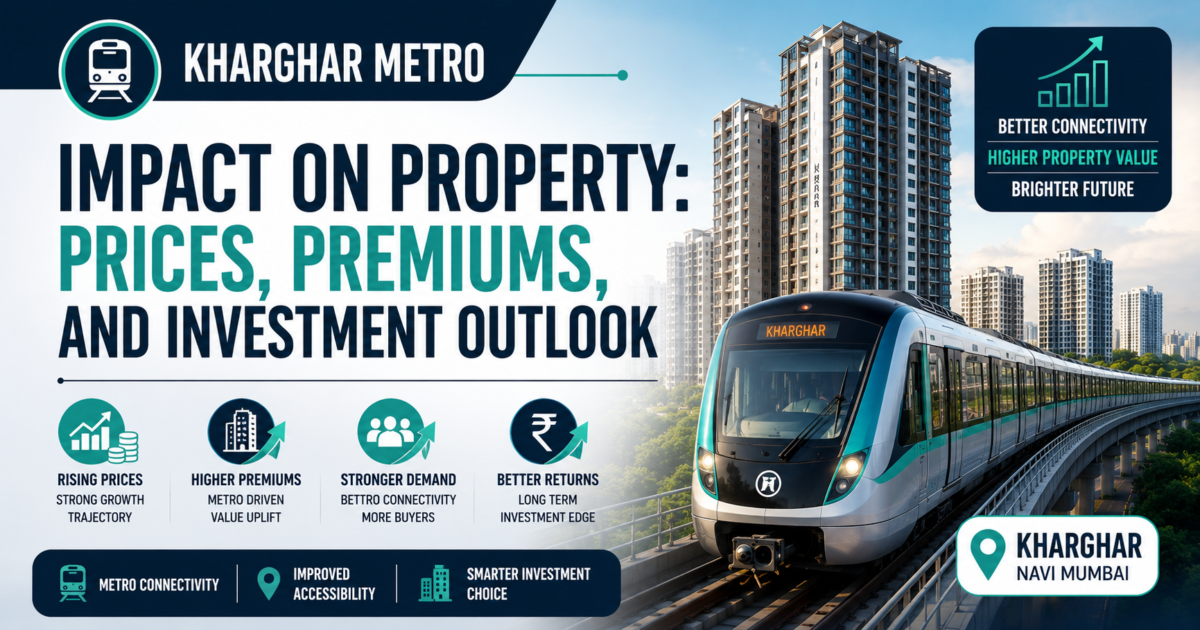
Kharghar Metro Impact on Property: Prices, Premiums, and Investment Outlook

Kharghar is the biggest beneficiary of the Navi Mumbai Metro Line 1. With 6 metro stations running through its heart, from Utsav Chowk to Pethpada and Amandoot, the node has achieved transit-oriented development at a scale rare for any Indian suburb. Property prices have appreciated 23.7% over the last five years, and current rates range from ₹11,000 to ₹18,000 per sq ft with an average of ₹17,500 per sq ft. This guide explains what the metro has done to Kharghar’s real estate, which sectors are outperforming, and what buyers should know before committing in 2026. Kharghar’s Metro Infrastructure: What’s Actually Running Navi Mumbai Metro Line 1 covers the full length of Kharghar. The 11.1 km elevated corridor from CBD Belapur to Pendhar passes through six Kharghar stations: 1. Utsav Chowk (Kharghar entry point from Belapur side) 2. Kendriya Vihar (Sector 11 area) 3. Kharghar Village 4. Central Park (the premium residential spine) 5. Pethpada 6. Amandoot (Sector 34 area, southern end) The line was inaugurated on 17 November 2023 and is operated by CIDCO under Maha Metro, with Konkan Railway handling operations and maintenance from June 2024. Trains run from 6:00 AM to 10:00 PM daily, every 10 minutes during peak hours and 15 minutes otherwise. Fares are ₹10 to ₹30 for the full corridor. According to CIDCO, the total ridership on Line 1 crossed 1 crore passenger journeys within the first two years, confirming sustained daily usage, not just initial excitement. The Metro Effect on Kharghar Property Prices Before and After: What Changed Kharghar was always Navi Mumbai’s best-planned node. Well-laid sectors, Central Park, the Golf Course, proximity to good schools and hospitals. But it had one persistent problem: traffic. During peak hours, the internal roads connecting Kharghar to Belapur CBD and onward to the railway corridor were bottlenecked. Professionals working in Belapur often chose to rent or buy closer to their workplace simply to avoid the commute. The metro eliminated that friction. A professional living near Central Park metro station can now reach CBD Belapur Terminal in under 15 minutes. The same journey by road during peak hours took 30 to 45 minutes on a bad day. The result was immediate: demand from corporate professionals working in Belapur’s office belt shifted toward Kharghar, where 2 BHKs start at ₹1 crore vs. significantly higher prices in Belapur itself. Current Price Data Metric Current Status Average apartment rate ₹17,500 per sq ft Rate range ₹11,000 to ₹18,000 per sq ft 2 BHK range ₹95 lakh to ₹1.62 crore 3 BHK (premium) ₹1.8 crore to ₹2.5 crore Average rental yield ~4% 5-year appreciation 23.7% 3-year appreciation 17.9% 1-year appreciation 3.8% The 1-year appreciation of 3.8% looks modest, but this follows a period of rapid catch-up. The 5-year number of 23.7% reflects the cumulative re-rating since metro construction became visible and then operational. Properties within a 1 km radius of Kharghar metro stations are commanding a 15 to 20% premium over comparable properties further from the line, according to Shreeji Ventures market data. Which Kharghar Sectors Are Outperforming Premium Sectors: 10, 12, and 21 These established residential pockets near Central Park and the hill backdrop offer the strongest combination of lifestyle and rental returns. Average rental here runs ₹25,000 to ₹30,000 per month for a good 2 BHK, translating into a rental yield structure that is above the Navi Mumbai average for this price bracket. These sectors are ideal for end-users who want the full Kharghar lifestyle, and for buy-to-let investors targeting corporate professionals on longer tenancies. Emerging Sectors: 34, 36, and Pendhar Fringe This is where the metro’s impact has been most visible on appreciation metrics. Sector 34 is directly served by the Amandoot metro station. Before the metro, Sector 34 was considered “far” by buyers who preferred the established sectors closer to Central Park. That perception has reversed. As one market observer put it in a verified 2026 buyer review: “Sector 34 is far” is no longer a valid objection. Metro changed that. It is the new pocket of promise. Under-construction projects near the Amandoot and Pethpada stations are attracting investors targeting 20 to 30% appreciation by 2028 as the metro ridership grows and the neighbourhood matures. Upper Kharghar and the Airport Corridor Pocket The areas of Kharghar bordering the airport corridor, specifically projects with line of sight toward the NMIA side, represent a separate investment thesis. The Navi Mumbai International Airport opened on 25 December 2025. Kharghar’s premium upper sectors are positioned to benefit from the secondary ripple of airport-facing demand as the airport ecosystem matures through 2027 and 2028. According to Revaa Homes market analysis (April 2026), Upper Kharghar and airport-corridor pockets are still in the appreciation phase, with 6 to 9% annual growth expected through 2030. The Full Infrastructure Stack Driving Kharghar The metro does not operate in isolation. Kharghar’s re-rating since 2023 reflects the convergence of three major infrastructure events: 1. Navi Mumbai Metro Line 1 (Operational since November 2023) Six stations through Kharghar. Daily commute to Belapur CBD is now under 15 minutes. 2. Mumbai Trans Harbour Link / Atal Setu (Operational since January 2024) The 21.8 km sea bridge connecting Sewri to Chirle near Panvel cut travel time to South Mumbai to under 20 to 25 minutes. Kharghar residents with MTHL access can now realistically work in South Mumbai and live in Kharghar. This has opened the market to a buyer profile that previously would not have considered Navi Mumbai. 3. Navi Mumbai International Airport (Operational since December 2025) The NMIA’s launch has created commercial and employment density in the southern corridor. Kharghar sits at an accessible distance from the airport and will benefit from the airport economy as it scales. 4. Kharghar-Turbhe Link Road (Expected September 2028) When complete, this will add a direct east-west road connection to Turbhe and Thane. Combined with the metro, Kharghar’s multi-directional connectivity will be among the strongest of any Navi Mumbai node. According to [CIDCO’s official infrastructure plans], the overall metro master plan envisions connections extending

Read More

Atal Setu Real Estate Impact: Which Navi Mumbai Areas Actually Gained

1. What Atal Setu Actually Did to Navi Mumbai’s Geography Atal Setu is a 21.8 km, six-lane sea bridge connecting Sewri in South Mumbai to Chirle in Navi Mumbai.Before the bridge, travel toward Ulwe and Panvel depended on longer, congested routes such as Thane–Belapur Road.The biggest connectivity gain is for the southern Navi Mumbai corridor, especially Ulwe, Dronagiri, Chirle and Panvel.Navi Mumbai International Airport (NMIA) began commercial operations in December 2025 and is located close to the Chirle side.The same growth belt is also supported by NAINA, a large planned development zone around the airport influence area. 2. Which Nodes Got Direct Impact vs. Indirect Benefit? This is the part most agents and portals gloss over. The Chirle interchange on the Navi Mumbai side connects directly south toward Ulwe, Dronagiri, and the NMIA belt. That southern corridor is where the commute math changed. A professional working in BKC or South Mumbai can now realistically live in Ulwe and commute. That logic does not apply to Vashi, Ghansoli, Nerul, or Airoli. Those nodes already had reasonable access via the Thane–Belapur Road or rail. Atal Setu did not meaningfully shorten their commute to Mumbai. Their price movement post-2024 has been driven by the broader Navi Mumbai market, not by the bridge specifically. Node Atal Setu Impact Reason Ulwe High Direct Sits on the Chirle exit corridor Dronagiri High Direct Adjacent to Chirle; port and industrial belt Panvel High Direct Gateway to NMIA; bridge shortened Mumbai–Panvel travel Chirle High Direct Bridge exits here on the Navi Mumbai side Kharghar Moderate Indirect Broader MTHL momentum; not on exit corridor Taloja Moderate Indirect Benefits from NAINA and industrial demand Kamothe Moderate Indirect Spillover from Panvel demand Vashi Low Minimal Access to Mumbai already existed via older routes Ghansoli / Airoli / Nerul / Seawoods Low Minimal No direct routing benefit from MTHL The honest takeaway: Atal Setu made some corridors dramatically more accessible. It made Navi Mumbai’s geography more unequal in opportunity, not more equal. 3. Node-by-Node Price Data (2022–2026) Ulwe Ulwe has been the fastest-appreciating micro-market post-MTHL. It combines direct bridge access with proximity to NMIA (roughly 18 km). CIDCO planned the node, so infrastructure layout is more structured than many suburban markets. Within Ulwe, sectors 9–24 are still considered relatively affordable entry points compared to sectors already at premium pricing. That changes quickly as airport-related demand builds. Panvel Panvel has absorbed the combined impact of the bridge, the airport, and the Mumbai–Pune Expressway. Property prices are up significantly from 2021 levels. The affordable floor is compressing. New Panvel still offers more accessible price points with strong infrastructure growth. Dronagiri Dronagiri’s story is more complex. The node has massive long-term potential port connectivity, direct bridge access, CIDCO planned development. But it also has CRZ (Coastal Regulation Zone) complications (see Section 6). CIDCO recently resumed land allotments after an 18-year pause, issuing intent letters to 319 beneficiaries. That’s a positive signal, but documentation must be verified before any transaction. 4. The NMIA and NAINA Amplifier The Atal Setu alone would be a strong enough story. But buyers in this corridor are really betting on three converging forces. Navi Mumbai International Airport (NMIA) commenced commercial operations on 25 December 2025, with Phase 1 designed for a capacity of 20 million passengers per year. The airport’s connectivity story has now moved beyond construction: scheduled international operations began on 15 July 2026, when Air India Express launched direct services between Navi Mumbai and Abu Dhabi. For real-estate analysis, this matters because airport connectivity is now an operational factor, not simply a future promise. However, property demand and prices will still depend on actual flight connectivity, passenger activity, employment generation, local infrastructure and neighbourhood livability. NAINA the Navi Mumbai Airport Influence Notified Area covers 370+ sq km and 170+ villages around the airport. CIDCO has awarded over ₹6,600 crore in infrastructure tenders for roads, drainage, and utilities across Town Planning Schemes (TPS) 2 to 12. The first residential and commercial plots from NAINA schemes are projected to be ready for possession from 2027–28 onward. In March 2024, CIDCO issued tenders for infrastructure work across TPS 2 to 7 in 94 NAINA villages. Development timelines for mega-projects often slip. Buyers should treat NAINA as a 2027–2030+ story, not a 2025 shortcut. Example Scenario: Ulwe vs. Ghansoli in Early 2024 Priya works in BKC. In early 2024, she was comparing a 1BHK in Ghansoli (₹90L) versus Ulwe (₹85L). Her agent said both benefit from MTHL. That was misleading. Ulwe sits directly on the Chirle exit corridor. Her commute to BKC via MTHL would be under 40 minutes. Ghansoli’s commute to BKC had not changed she would still take the Thane–Belapur Road or rail. By mid-2026, the Ulwe property had appreciated 20%+. The Ghansoli flat moved with the broader Navi Mumbai market. The bridge geography mattered more than the agent’s pitch. 5. Is the Appreciation Window Still Open? The honest answer: it depends entirely on which node and which use case. Already substantially priced in: Ulwe and central Panvel have absorbed most of the initial MTHL impact. Buying here now is not a mistake for end-users commute, livability, and rental yield are real. But expecting another 25% appreciation quickly is speculative. Still early-stage potential: Dronagiri (subject to CIDCO documentation being clean), Chirle, and NAINA-adjacent agricultural land (subject to TPS approval and legal clearance) may still offer upside. But the risk profile is higher and the timelines are longer. A caution for investors: The availability of large land reserves in Navi Mumbai could moderate price growth over time. Infrastructure timelines regularly slip. Do not price in NAINA possession by 2026. 6. What to Check Before Paying Token Money For Flats in Ulwe, Panvel, or Kharghar Document / Check Where to Verify What to Look For MahaRERA registration rera.maharashtra.gov.in Active registration, realistic completion date, no orders against developer 7/12 extract (Satbara) shows land ownership and use mahabhulekh.maharashtra.gov.in Owner name, survey number, any encumbrance or lien noted Index II igrmaharashtra.gov.in Chain of ownership, previous

Read More

Navi Mumbai Airport Real Estate Impact: Which Areas Are Rising and by How Much

The Navi Mumbai International Airport (NMIA) has already triggered one of the most significant real estate surges in the Mumbai Metropolitan Region. Since NMIA began commercial operations in December 2025, apartment prices in key surrounding zones have risen 74% compared to 2021, with residential plots in some pockets appreciating by as much as 93%. For buyers and investors tracking the Navi Mumbai airport real estate impact, the data is now clear: the airport effect is not speculative anymore. It is measurable, on-ground, and still unfolding. What Is the Navi Mumbai Airport and Why Does It Matter for Real Estate? The Navi Mumbai International Airport (NMIA), developed by Adani Airports (74%) and CIDCO (26%), is built across 1,160 hectares in Ulwe. The total project investment stands at approximately Rs 16,700 crore. Phase 1 is designed to handle 20 million passengers annually, with a long-term capacity target of 90 million passengers. NMIA was inaugurated by Prime Minister Narendra Modi on October 8, 2025. Commercial flights commenced on December 25, 2025, with the first IndiGo flight arriving from Bengaluru. According to CIDCO, the airport was decades in planning and is now India’s most significant greenfield airport in terms of scale. Its impact on surrounding land values is being compared to how Hyderabad’s Rajiv Gandhi International Airport transformed the Shamshabad corridor. The “airport effect” in real estate is well-documented globally: when a major transit hub opens, surrounding land sees strong appreciation driven by employment generation, commercial activity, and improved connectivity. In Navi Mumbai, all three are now active simultaneously. Key Micro-Markets Seeing the Highest Appreciation Ulwe: The Closest Bet to the Runway Ulwe sits directly adjacent to NMIA and has emerged as the highest-appreciation zone. Properties here have seen 40-80% appreciation over the past five years, depending on location and project quality. Current apartment rates are in the range of Rs 12,000 to Rs 18,000 per square foot. Ulwe was considered an overlooked micro-market as recently as 2020. Post-airport, it has become one of Navi Mumbai’s most sought-after investment destinations, attracting both end-users and high-net-worth investors. For investors with a 3 to 5-year horizon, Ulwe offers the strongest correlation between infrastructure and appreciation. The risk is that much of the speculative price movement has already occurred in the most premium projects. Panvel: Infrastructure Depth, Not Just Airport Adjacency Panvel’s strength is not just its proximity to NMIA. It is the convergence of multiple infrastructure projects: the Mumbai-Pune Expressway, Atal Setu (MTHL), metro line expansion, and the airport itself. Between 2021 and 2025, apartment prices in Panvel climbed to Rs 10,000 to Rs 12,000 per square foot, representing a 74% increase in capital value. Residential plot prices have surged 93%, currently trading at Rs 80,000 to Rs 85,000 per square yard. Panvel is increasingly being positioned as a transport and logistics hub for the broader MMR. With the airport operational and the Atal Setu reducing travel time to South Mumbai to 20-45 minutes, Panvel has effectively shed its satellite-city status. Kharghar: Established Demand Meeting Fresh Momentum Kharghar was already one of Navi Mumbai’s most developed residential zones before the airport boom. Appreciation here has been steadier rather than explosive. Some projects have reported 20% gains over 18 months. Current rates in Kharghar range from Rs 12,000 to Rs 15,000+ per square foot depending on the project. The arrival of CIDCO’s 375-acre International Corporate Park and the airport’s employment ecosystem are expected to deepen commercial demand in Kharghar through 2027. For buyers seeking livability alongside investment value, Kharghar remains one of the most balanced options in the airport influence zone. Dronagiri: The Affordable Entry Point Dronagiri is positioned as a future growth corridor. It offers relatively affordable entry points at Rs 6,500 to Rs 9,000 per square foot, making it the go-to zone for first-time buyers and long-horizon investors. The trade-off is infrastructure maturity. Dronagiri still requires time for on-ground amenities, connectivity, and commercial activity to fully develop. Buyers entering here should plan for a minimum 5-year hold period. Taloja: Metro-Driven Growth Taloja is benefiting more from Metro Line 1 (Belapur-Pendhar) than directly from the airport. With the metro fully operational, Taloja is seeing 11-16% annual appreciation forecasts. Current rates are among the more affordable in the Navi Mumbai corridor at around Rs 8,700 per square foot, making it viable for mid-income buyers. Property Price Data: What Numbers Actually Look Like The table below summarizes current price benchmarks across key airport-influence zones as of 2026: Area Approx. Rate (Per Sq Ft) Appreciation (2021-2026) Investor Profile Ulwe Rs 12,000 – Rs 18,000 40-80% High-risk, high-return Panvel Rs 10,000 – Rs 12,000 74% Balanced Kharghar Rs 12,000 – Rs 15,000+ Steady 15-20% Livability + growth Dronagiri Rs 6,500 – Rs 9,000 Early appreciation Long-horizon investors Taloja Rs 8,700 11-16% annually Mid-income buyers Figures sourced from market reports and property consultants. Verify current rates directly with developers or [MahaRERA](https://maharera.maharegistration.gov.in) registered projects before transacting. What Is Driving the Appreciation Beyond the Airport? The NMIA’s impact is amplified by three parallel infrastructure developments that have matured simultaneously. Atal Setu (MTHL): India’s longest sea bridge, inaugurated in January 2024, cut travel time between South Mumbai and Navi Mumbai from two hours to 20-25 minutes. Areas like Ulwe and Panvel, previously considered remote, are now viable daily commute zones for Mumbai’s business districts. Navi Mumbai Metro Line 1: Fully operational on the Belapur-Pendhar corridor, the metro has opened up Kharghar and Taloja to a wider base of daily commuters. The planned extension connecting the airport to BKC (Bandra-Kurla Complex) is under development and will further reshape the southern corridor’s investment profile. NAINA (Navi Mumbai Airport Influence Notified Area): CIDCO is implementing a planned urban development framework across 94 villages surrounding the airport. Infrastructure projects worth Rs 2,550 crore are underway, including roads, utilities, and civic amenities. NAINA is designed to function as an aerotropolis over the long term, ensuring that the growth around NMIA is structured rather than speculative sprawl. Aerocity Development: The Maharashtra government has accelerated plans for a 667-acre Aerocity

Read More

Navi Mumbai Airport Impact on Pushpak Nagar: Property Prices, Growth & Investment Guide

Pushpak Nagar is the closest CIDCO-planned residential node to the Navi Mumbai International Airport sitting just 1.5 to 3 kilometres from the terminal and is currently in the earliest stages of what analysts describe as an airport-driven growth cycle. Property prices here have moved from ₹6,000 to ₹7,000 per sq ft a few years ago to ₹9,000 to ₹11,000 per sq ft today, with experts projecting 30% to 50% appreciation over the next three to five years as airport operations, metro connectivity, and the logistics hub development mature. What Is Pushpak Nagar? Pushpak Nagar is a planned residential node developed by CIDCO, located in the Dapoli area of Navi Mumbai. It sits within the cluster formed by Ulwe, Dronagiri, and Uran all of which fall inside CIDCO’s airport influence planning zone. Unlike most of the other nodes discussed in Navi Mumbai’s airport story, Pushpak Nagar is not an established city district. It is a purpose-built node positioned to serve as a residential and commercial base for the airport economy. That distinction is both its risk and its upside. The proximity is not metaphorical. Areas around Bamandongri, which falls within the Pushpak Nagar development zone, are just 2 to 3 kilometres from the NMIA terminal. Central sectors of Pushpak Nagar fall within a 5-kilometre radius. No other planned residential node in Navi Mumbai sits this close to the airport. The Airport Opens and Pushpak Nagar’s Clock Starts The Navi Mumbai International Airport was inaugurated by Prime Minister Narendra Modi on October 8, 2025. Commercial flight operations began on December 25, 2025, with the first IndiGo flight from Bengaluru landing at 8:00 AM. The airport is now fully operational with Phase 1 capacity of 20 million passengers annually, scaling toward 90 million passengers across its full multi-phase build-out. The inauguration activated a dynamic that Pushpak Nagar investors had been positioning for: the transition from speculative demand to actual economic activity. Jobs in aviation, ground handling, hospitality, logistics, retail, and services are being created within minutes of Pushpak Nagar. Local businesses hotels, restaurants, logistics providers, service companies are establishing operations in the node to serve both airport employees and passengers. This wave of commercial activity is what turns a planned node into a functioning economic cluster. For reference, a comparable dynamic played out in Ulwe over the years preceding the airport’s inauguration. Pushpak Nagar is now entering the early phase of that same cycle but with the airport already operational rather than years away. Property Prices in Pushpak Nagar: Where Things Stand The most important thing to understand about Pushpak Nagar’s price story is that it is in the early growth phase, not the mature phase. That means prices have moved but have not yet reflected the full value of what is being built around them. Current Price Range Residential apartments in Pushpak Nagar currently range from ₹9,000 to ₹11,000 per sq ft for standard configurations. Some projects closer to the airport boundary and main access roads quote a slight premium. A more granular view from 2026 data puts most active projects between ₹7,000 and ₹8,500 per sq ft depending on construction stage, sector, and builder. Premium projects with better finishes and airport-facing positions are closer to ₹10,000 to ₹15,000 per sq ft. The weighted average price on platforms like 99acres shows approximately ₹10,750 per sq ft across active listings. How Prices Have Moved Plots and apartments that were transacting at ₹6,000 to ₹7,000 per sq ft a few years ago are now in the ₹10,000 plus range a 40% to 65% increase from early baseline levels. The airport’s inauguraton in October 2025 accelerated the pace of enquiries and transactions noticeably. For context, areas immediately adjacent to NMIA’s influence zone have appreciated 40% to 80% over the past five years depending on location and project quality. Pushpak Nagar sits at the lower end of that range historically, which is precisely what makes it attractive to buyers entering now. Price Comparison With Adjacent Nodes Node Current Residential Range Proximity to NMIA Development Stage Pushpak Nagar ₹7,000 – ₹11,000/sq ft 1.5 – 5 km Early growth Ulwe ₹14,500 – ₹16,600/sq ft 3 – 7 km Mid-stage, active Panvel ₹10,000 – ₹12,000/sq ft 12 km Established Dronagiri ₹6,500 – ₹9,000/sq ft 5 – 9 km Very early stage Kharghar ₹12,000 – ₹18,000/sq ft 10 – 15 km Mature, established Pushpak Nagar currently occupies the gap between Dronagiri’s raw, very early stage and Ulwe’s more established mid-stage pricing. It offers airport proximity closer than Ulwe at prices still below Ulwe’s current levels. That gap is expected to narrow as infrastructure matures. The Infrastructure Building Around Pushpak Nagar Pushpak Nagar’s growth story is not just about the airport terminal nearby. It is about everything being built around and between the airport and this node. CIDCO’s 925-Acre Integrated Logistics Park (ILP) at Pushpak Node This is one of the most significant commercial developments directly tied to Pushpak Nagar’s future. CIDCO has launched the bidding process for the first phase of a 925-acre Integrated Logistics Park at the Pushpak Node. This is expected to be one of the largest logistics infrastructure projects in the Mumbai Metropolitan Region. The ILP will attract warehousing, cold chain, freight forwarding, and e-commerce fulfilment operations that need airport and port adjacency. JNPT, India’s largest container port, is also nearby. Together, NMIA and JNPT make the Pushpak Node one of the most strategically located logistics corridors in India. The employment that flows from this logistics park direct and indirect will create structured housing demand within Pushpak Nagar for years. Ulwe Coastal Road This ₹1,590 crore project is a 6.7-kilometre six-lane elevated road connecting the Atal Setu junction at Shivajinagar directly into the airport terminal via an elevated link. Construction is progressing. When complete, this road will make Pushpak Nagar one of the most airport-accessible nodes in the entire MMR not just in straight-line distance but in actual drive time. Mumbai Trans Harbour Link (Atal Setu) The MTHL, India’s longest sea bridge at 21.8 kilometres, connects

Read More