
Navi Mumbai Metro Real Estate Impact: How Line 1 Is Changing Property Values in 2025–26
The city had been waiting for it since 2011. The project was delayed by over seven years legal hurdles, contractor issues, poor project management. By the time the first train ran from Belapur to Pendhar, the people of Kharghar and Taloja had stopped expecting it on time.
But now it is running. And the real estate market has noticed.
Properties near Navi Mumbai Metro stations are commanding a 10-15% premium compared to similar properties even a kilometre away. Taloja once considered a disconnected industrial fringe has been pulled into the mainstream. Kharghar’s rental market is outperforming most of Navi Mumbai. And the upcoming airport connectivity via planned metro extensions is setting up the next wave of appreciation.
This guide breaks down exactly how the metro is reshaping Navi Mumbai’s property market node by node, station by station.
Understanding the Navi Mumbai Metro Network
Before getting into prices, here is what the current and planned network looks like.
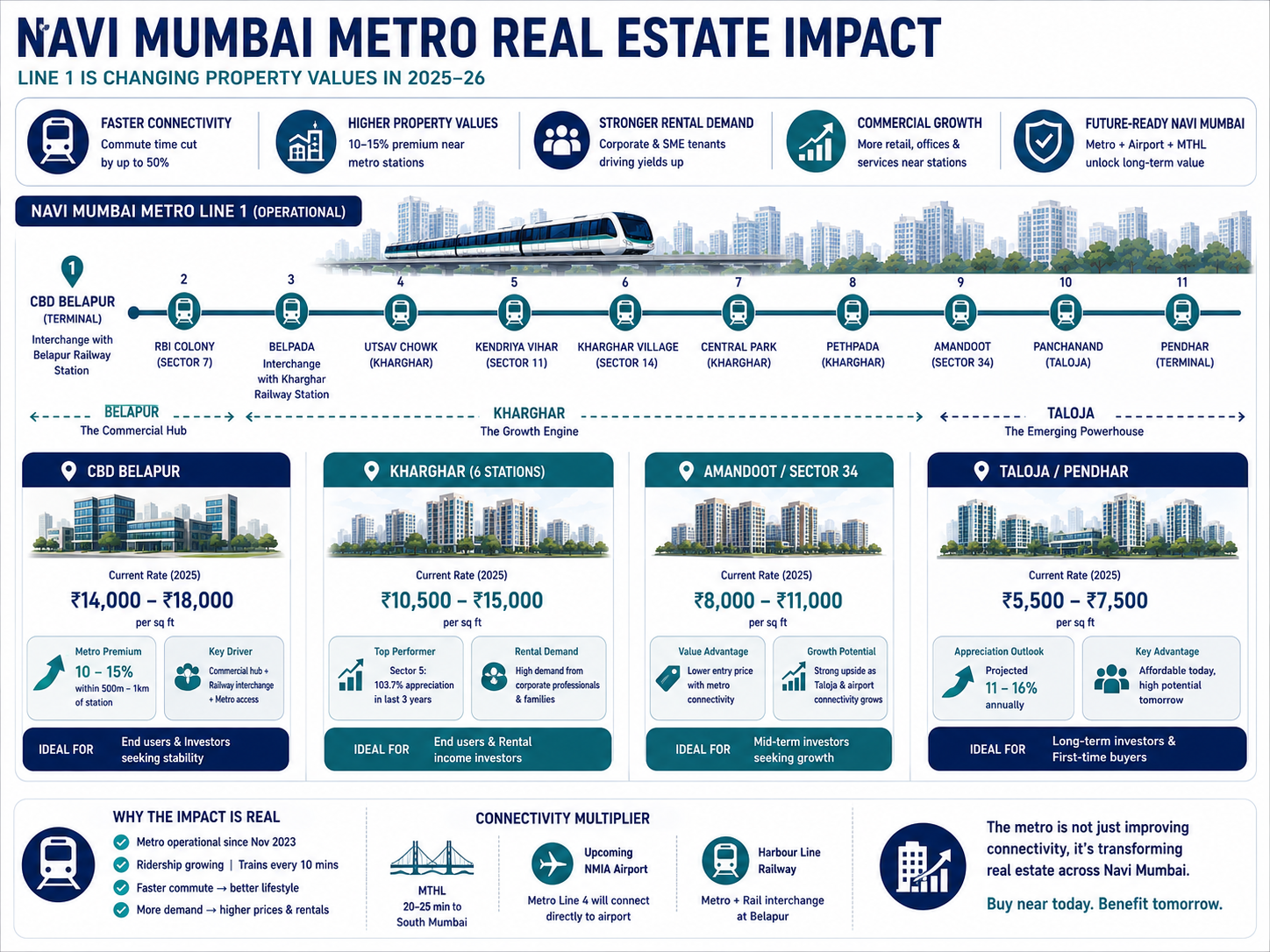
Line 1 (Operational since November 2023) The only operational line. It runs 11.1 km elevated, from CBD Belapur to Pendhar, covering 11 stations. The stations are:
1. CBD Belapur (Terminal) interchange with Belapur railway station 2. RBI Colony (Sector 7) 3. Belpada (interchange with Kharghar railway station) 4. Utsav Chowk, Kharghar 5. Kendriya Vihar (Sector 11) 6. Kharghar Village (Sector 14) 7. Central Park, Kharghar 8. Pethpada, Kharghar 9. Amandoot (Sector 34) 10. Panchanand (Taloja) 11. Pendhar (Terminal)
Phase 1 was inaugurated in November 2023. The full Line 1 will ultimately run 23.4 km from Belapur to Khandeshwar once all phases are complete covering 20 stations.
Line 2 (Planned): Taloja MIDC to Khandeshwar This extension of Line 1 will be approximately 10.3 km with 8 stations.
Line 3 (Planned): Pendhar to MIDC Taloja A 2.2 km link to close the loop from Belapur to Khandeshwar.
Line 4 (Planned): Khandeshwar to Navi Mumbai International Airport The most anticipated extension. It will be approximately 4.17 km with elevated and underground sections, directly connecting the metro to NMIA.
The total master plan covers 106.4 km across 6 lines, though implementation of the full plan remains uncertain. What is certain is that Line 1 is operational, ridership is growing, and the property market has already begun pricing in the metro effect.
What Is the Metro Effect and How Does It Show Up in Prices?
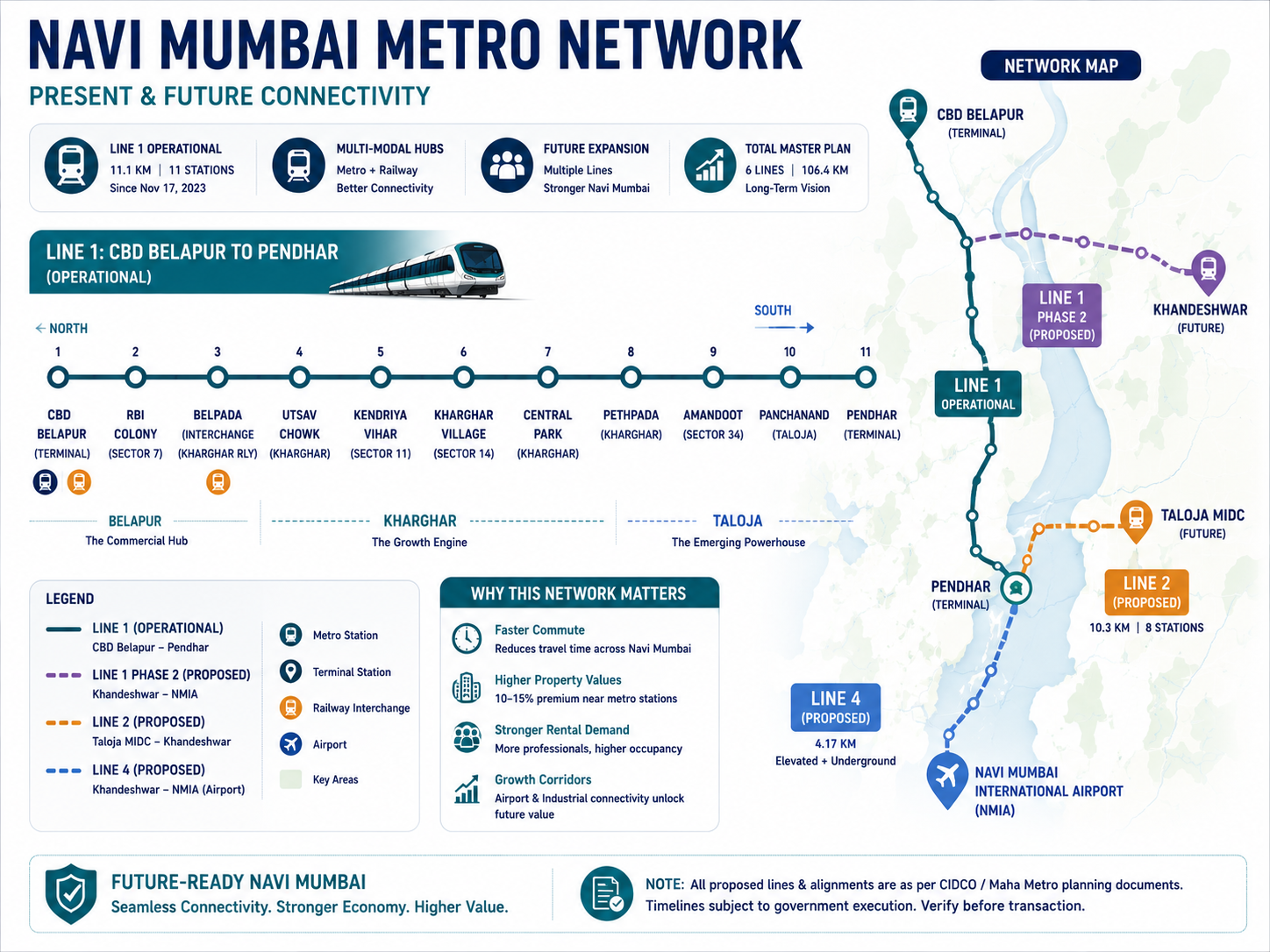
The metro effect is a well-documented real estate phenomenon. When rapid transit reaches an area, it does three things almost simultaneously:
First, it reduces effective distance. Taloja to Belapur by road could mean 45 minutes in traffic. By metro, it takes under 20 minutes. That time saving is capitalized directly into property values.
Second, it triggers commercial development. Malls, hospitals, clinics, schools, and offices cluster near metro stations because footfall is guaranteed. That commercial growth raises the desirability of surrounding residential areas.
Third, it changes the buyer and renter profile. Corporate professionals who previously avoided Taloja because of the commute problem are now actively looking there. That demand shift pushes both sale prices and rental yields upward.
In Mumbai’s broader metro expansion, properties within a 1 km radius of stations have seen 10-40% appreciation, depending on supply constraints and location. Navi Mumbai’s Line 1 is showing the same pattern, particularly in Kharghar and Taloja.
Belapur: The Terminal Station Effect
CBD Belapur is the northern terminus of Line 1. It is the only station on the network that connects to Indian Railways, providing direct interchange with Belapur railway station.
Belapur was already one of Navi Mumbai’s most established commercial nodes before the metro arrived. It houses the headquarters of several public sector banks, government offices, and corporate campuses.
The metro has added one more layer to its connectivity stack. And the market has responded.
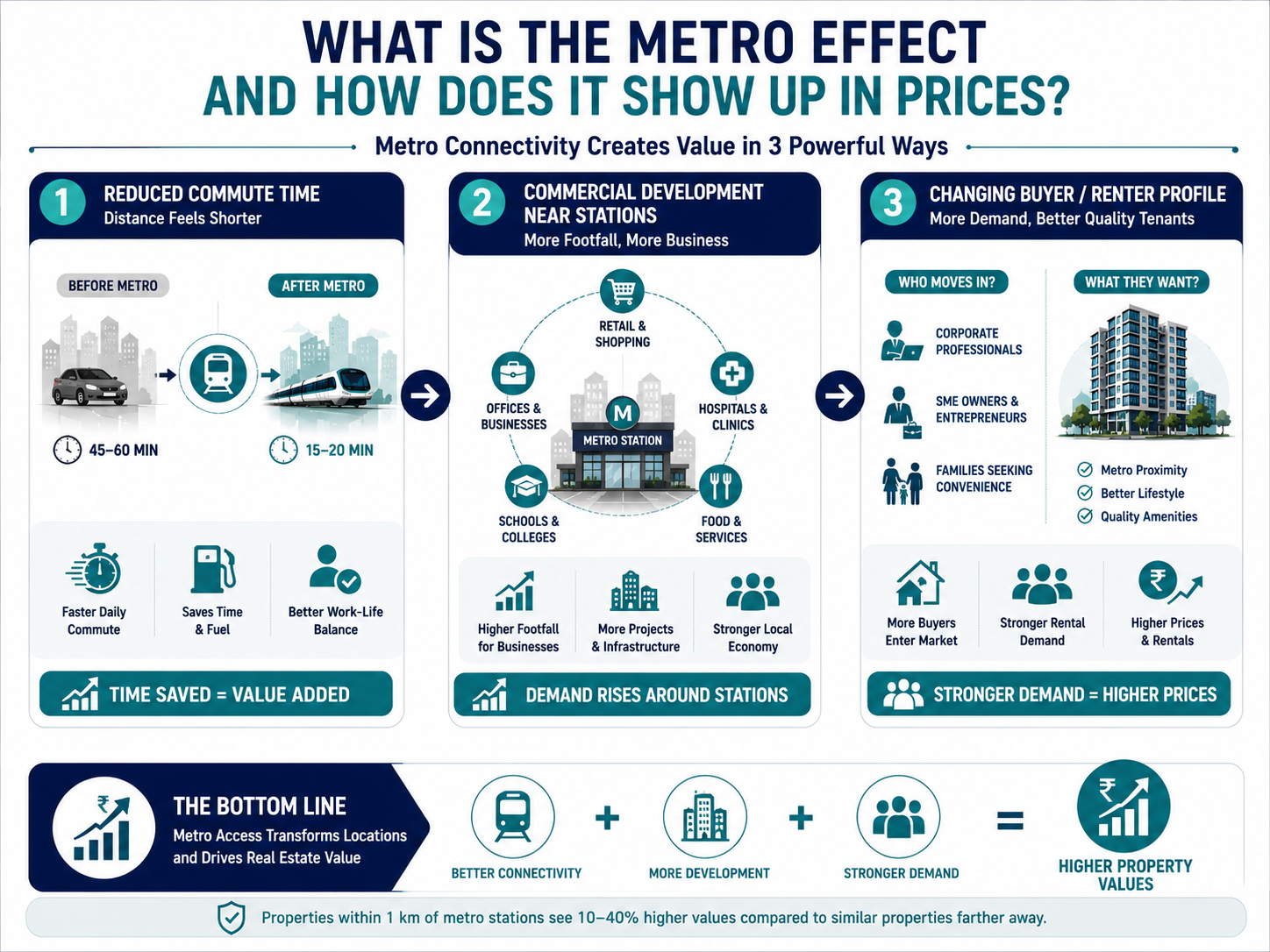
Belapur property has moved from Rs 14,750 per sq ft in 2021 to approximately Rs 17,750 per sq ft in 2025 about 20% appreciation in four years.
The metro is cited as a major driver of this. Properties near the Belapur terminal station specifically are commanding a 10-15% premium over comparables farther from the station.
For end users who want the best of both worlds railway connectivity, metro access, established commercial infrastructure, and proximity to the upcoming airport via planned Line 4 Belapur remains one of the strongest bets in Navi Mumbai.
Kharghar: The Biggest Beneficiary of Line 1
Kharghar is the heart of Navi Mumbai Metro Line 1. Six of the 11 stations on Phase 1 serve the Kharghar node: Belpada, Utsav Chowk, Kendriya Vihar, Kharghar Village, Central Park, and Pethpada.
No other node in Navi Mumbai has this level of metro penetration.
The result has been dramatic. Sector 5 Kharghar has seen 103.7% price appreciation over the last three years the highest in all of Navi Mumbai. That is not entirely attributable to the metro alone; the airport effect, MTHL connectivity, and Kharghar’s natural green landscape all contribute. But metro access is a primary driver.
Properties within 1 km of Kharghar metro stations are commanding higher rental yields driven by intense demand from corporate professionals who have discovered that Kharghar now offers genuine commuting convenience to Belapur and beyond.
The rental market reflects this directly. Before the metro, many corporate tenants in Belapur and Nerul were paying premiums to avoid the Taloja-Kharghar commute problem. That premium has flipped. Kharghar now attracts them rather than pushing them away.
Central Park station is worth calling out specifically. It sits adjacent to Kharghar’s Central Park one of the largest urban parks in Maharashtra. Properties near this station combine green living, metro access, and proximity to educational institutions, making them particularly attractive to families. The premium here is not just price per sq ft it is the lifestyle multiplier that keeps demand sticky.
Taloja: The Transformation Story
Before the metro, Taloja meant one thing to most Navi Mumbai buyers: industrial zone, long commute, avoid unless you have no choice.
That narrative has been disrupted entirely.
The Panchanand and Pendhar stations have pulled Taloja right into the mainstream of the Navi Mumbai property market. Commute times to Belapur were slashed by half. The industrial belt connectivity has actually become an asset logistics professionals, MIDC employees, and blue-collar workers now have a reliable public transit option for the first time.
Township projects that once struggled to find buyers are now selling with genuine confidence. A 1 BHK in Taloja starts around Rs 45 lakhs. Spacious 2 BHKs range from Rs 60 lakhs to Rs 85 lakhs.
Taloja and the Dhansar belt are projected to show steady 11-16% annual appreciation as metro ridership grows and more employers establish themselves in the MIDC belt.
The upcoming Line 2 extension (Taloja MIDC to Khandeshwar) will further cement Taloja’s position by connecting it to the Khandeshwar railway station and eventually to NMIA via Line 4. That chain of connectivity is what makes Taloja the most interesting long-term investment story in the metro corridor.
The Upcoming Extensions: Where the Next Wave of Appreciation Is Coming From
The current metro effect is based on Line 1 alone. The planned extensions will create new appreciation corridors.
Khandeshwar to NMIA (Line 4) This is the extension that will change everything in the lower Navi Mumbai corridor. A direct metro link from Khandeshwar to the Navi Mumbai International Airport will create a seamless transit chain from Belapur through Kharghar, Taloja, Khandeshwar, and straight to the airport terminal.
Properties near Khandeshwar station are currently priced below their eventual utility. Once Line 4 gets a confirmed timeline, expect the same kind of speculative run-up that preceded every other major infrastructure announcement in Navi Mumbai.
NAINA Area Extensions Two new routes are planned for the NAINA area the Airport Influence Zone. These will connect the outer suburbs around Panvel and Uran to the metro network. The specific alignments are still in planning, but the intention is to integrate the rapid growth happening in Dronagiri, Karanjade, and New Panvel with the broader metro grid.
For investors with a 3-5 year horizon, proximity to planned metro alignments in the NAINA zone is one of the highest-conviction plays available in Navi Mumbai right now.
How Ridership Growth Is Validating the Investment Case
Metro projects in India often struggle with ridership in the first few years. That was a concern when Line 1 opened in November 2023.
The numbers have been reassuring.
CIDCO introduced a new timetable starting January 2025 with trains running every 10 minutes a sign that demand has reached a level that justifies frequency improvements. In September 2024, CIDCO slashed fares by 33% to encourage ridership further, bringing the one-way fare range to Rs 10-30 for the full 11 km stretch.
The metro generated Rs 1.16 crore from ticket sales in a notable period, with families flocking to the service especially during weekends and holidays.
Higher ridership means more commercial development near stations, stronger rental demand, and sustained property price support. A metro line that runs empty is a liability. A metro line running every 10 minutes with rising passenger counts is an infrastructure asset that compounds in value over time.
Making Sense of Price Data Across the Metro Corridor
Here is where the numbers stand as of 2026, mapped to the metro corridor:
CBD Belapur (Terminal Station) Current rates: Rs 14,000-18,000 per sq ft. The commercial-residential blend and railway interchange make this the most expensive node on the metro line. Metro premium of 10-15% visible for properties within 500m of the station.
Kharghar (Utsav Chowk to Pethpada zone) Current rates: Rs 10,500-15,000 per sq ft depending on sector and proximity to stations. Sector 5 has seen 103.7% appreciation in three years. Properties near Central Park station command the highest premiums. Strong rental demand from corporate tenants.
Amandoot / Sector 34 (transition zone) Current rates: Rs 8,000-11,000 per sq ft. Positioned between Kharghar’s premium and Taloja’s affordability. Benefits from metro access while offering lower entry prices. Good rental yield for mid-size investors.
Taloja / Pendhar (terminal zone) Current rates: Rs 5,500-7,500 per sq ft. The highest-potential appreciation story on the corridor. Currently affordable relative to Kharghar but with metro access and planned Line 2 and 4 extensions, the gap will narrow. Projected 11-16% annual appreciation.
Who Should Buy Where Along the Metro Corridor
End users looking for best liveability: Kharghar, particularly around Central Park and Utsav Chowk stations. Premium pricing is justified by quality of life green spaces, educational institutions, metro access, and commercial growth.
Investors with a 3-5 year horizon: Taloja and the Pendhar-to-Khandeshwar corridor. Entry prices are still accessible. The planned Line 2 extension and Line 4 airport link make this the highest appreciation zone on the metro network.
Rental income focus: Belapur and Kharghar stations closest to the CBD. Corporate demand is strongest here. Rental yields have improved materially since the metro opened and are expected to improve further as more employers set up near the metro corridor.
Long-term land banking: NAINA zone plots near planned metro alignments. High risk, high reward. Requires patience and the ability to wait for alignment confirmations, but the asymmetry is meaningful.
Conclusion
The Navi Mumbai Metro is not a promise anymore. It is operational, running every 10 minutes, generating ticket revenue, and visibly reshaping the property market along its corridor.
Kharghar has gone from a pleasant but inconvenient suburb to one of Navi Mumbai’s most sought-after residential nodes. Taloja has gone from an industrial also-ran to a genuine investment opportunity. Belapur’s status as the commercial anchor of southern Navi Mumbai has been further cemented.
The next wave of metro-driven appreciation will come from Line 4’s airport connection and the NAINA area extensions. Properties positioned in the path of those lines before the alignments are confirmed and the speculative run begins represent some of the most compelling risk-reward plays in Navi Mumbai’s 2026 market.
The metro is running. The question is whether you are positioned to benefit from where it is going next.
FAQs
Frequently Asked Questions