
Pendhar Metro Impact on Property: Taloja’s Gateway to the Grid
The Pendhar metro station has done something no road improvement could: it connected Taloja Phase 2 to CBD Belapur in a single, reliable daily commute. Pendhar is the southern terminus of Navi Mumbai Metro Line 1, and its opening in November 2023 marked the moment Taloja shifted from “affordable and isolated” to “affordable and connected.”
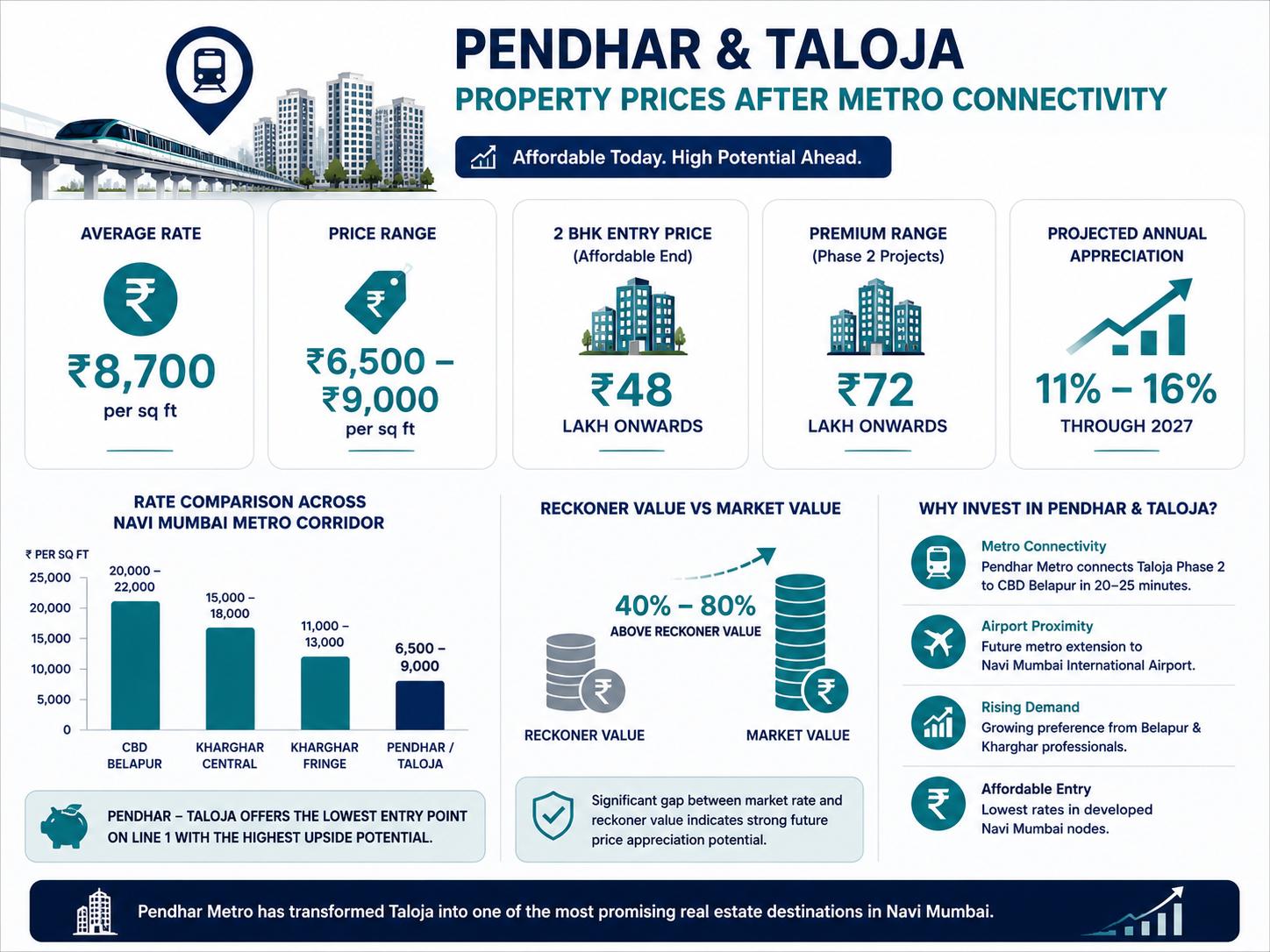
Property rates in the Pendhar-Taloja belt now range from ₹6,500 to ₹9,000 per sq ft, with an average of around ₹8,700. For context, that is still the lowest serious entry point inside Navi Mumbai’s developed nodes. But the gap between price and potential is narrowing.
This guide covers what the Pendhar metro station has actually changed about property values, who benefits most, and what the path forward looks like as the metro corridor expands toward the Navi Mumbai International Airport.
What the Pendhar Metro Station Is
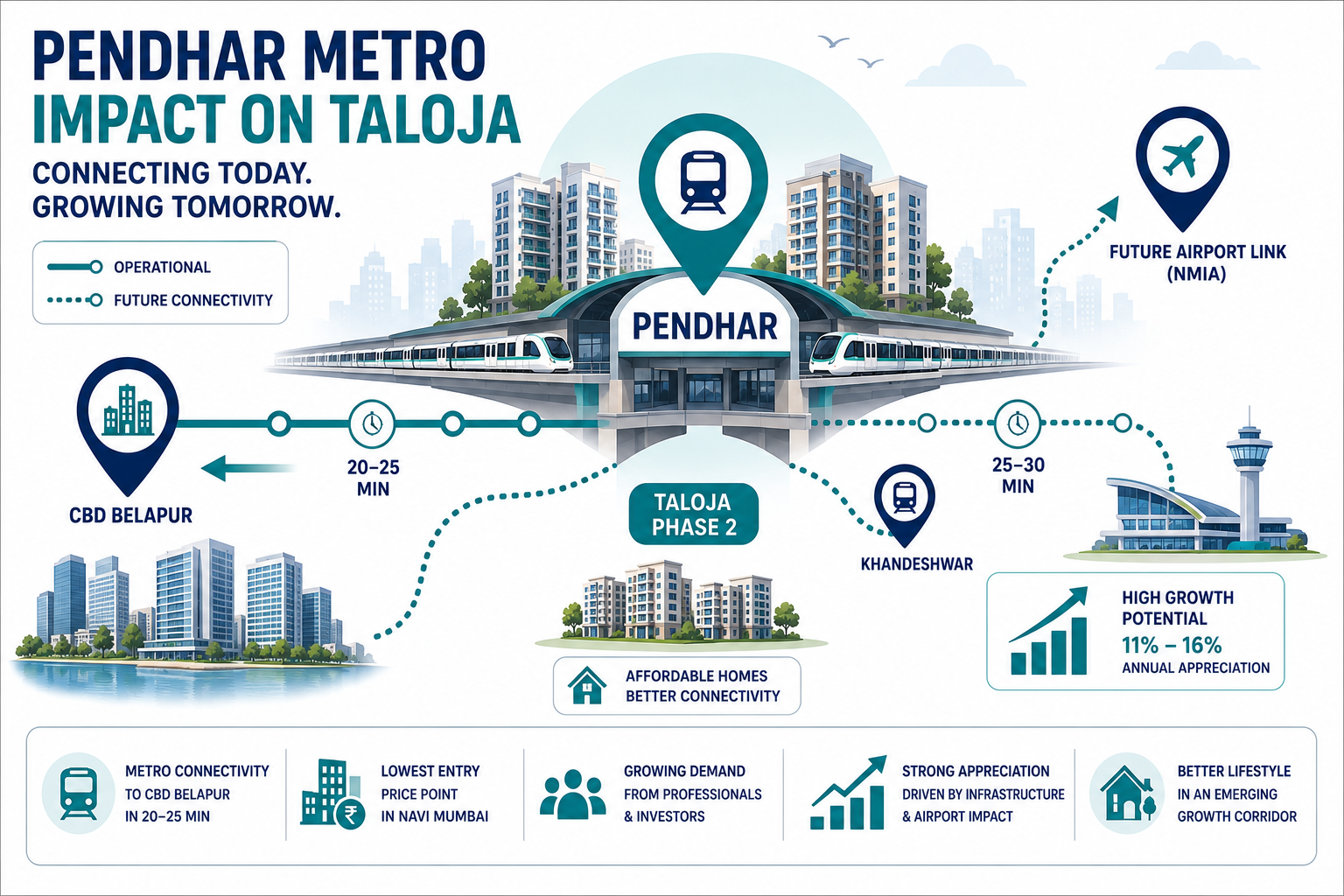
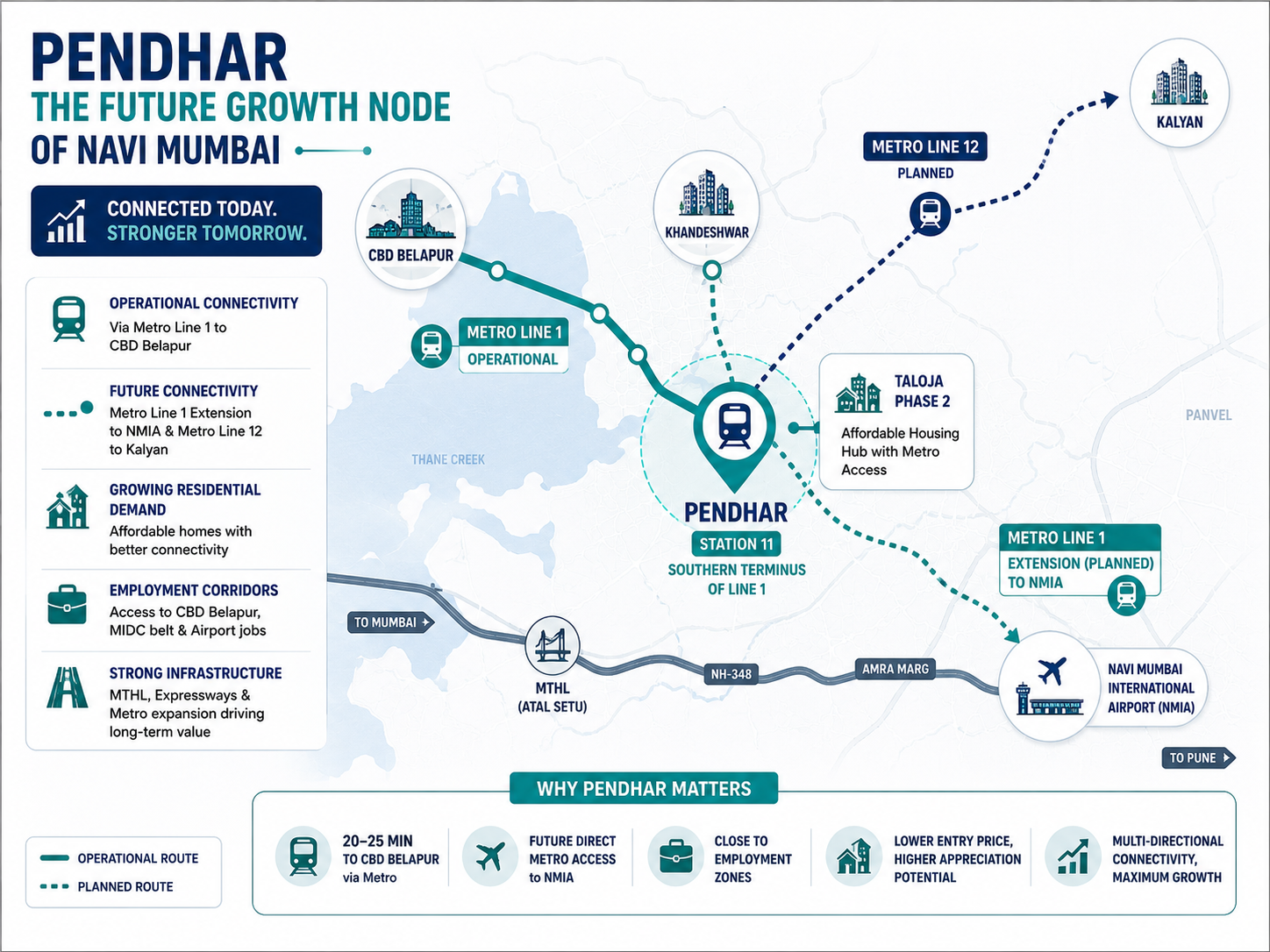
Pendhar is Station 11 on Navi Mumbai Metro Line 1, the southern terminus of the operational corridor.
The line runs 11.1 km from CBD Belapur Terminal (Station 1) to Pendhar (Station 11), elevated throughout. Pendhar sits at the southern end of Kharghar, bordering the Taloja Phase 2 area.
Line 1 quick facts:
- Operational since: 17 November 2023
- Operated by: CIDCO / Konkan Railway (O&M from June 2024)
- Daily operating hours: 6:00 AM to 10:00 PM
- Frequency: Every 10 minutes peak, 15 minutes off-peak
- Fares: ₹10 minimum, ₹30 maximum
- Total ridership: Crossed 1 crore passenger journeys within two years
Pendhar station is a short auto-rickshaw ride from Taloja Phase 2 residential areas. For residents of Taloja Phase 2 projects, this is the entry point to the metro network, from which they can reach CBD Belapur in under 20 to 25 minutes.
According to [CIDCO], the broader master plan envisions the metro extending beyond Pendhar toward Khandeshwar and ultimately to the Navi Mumbai International Airport in later phases.
The Before and After: What Changed at Pendhar
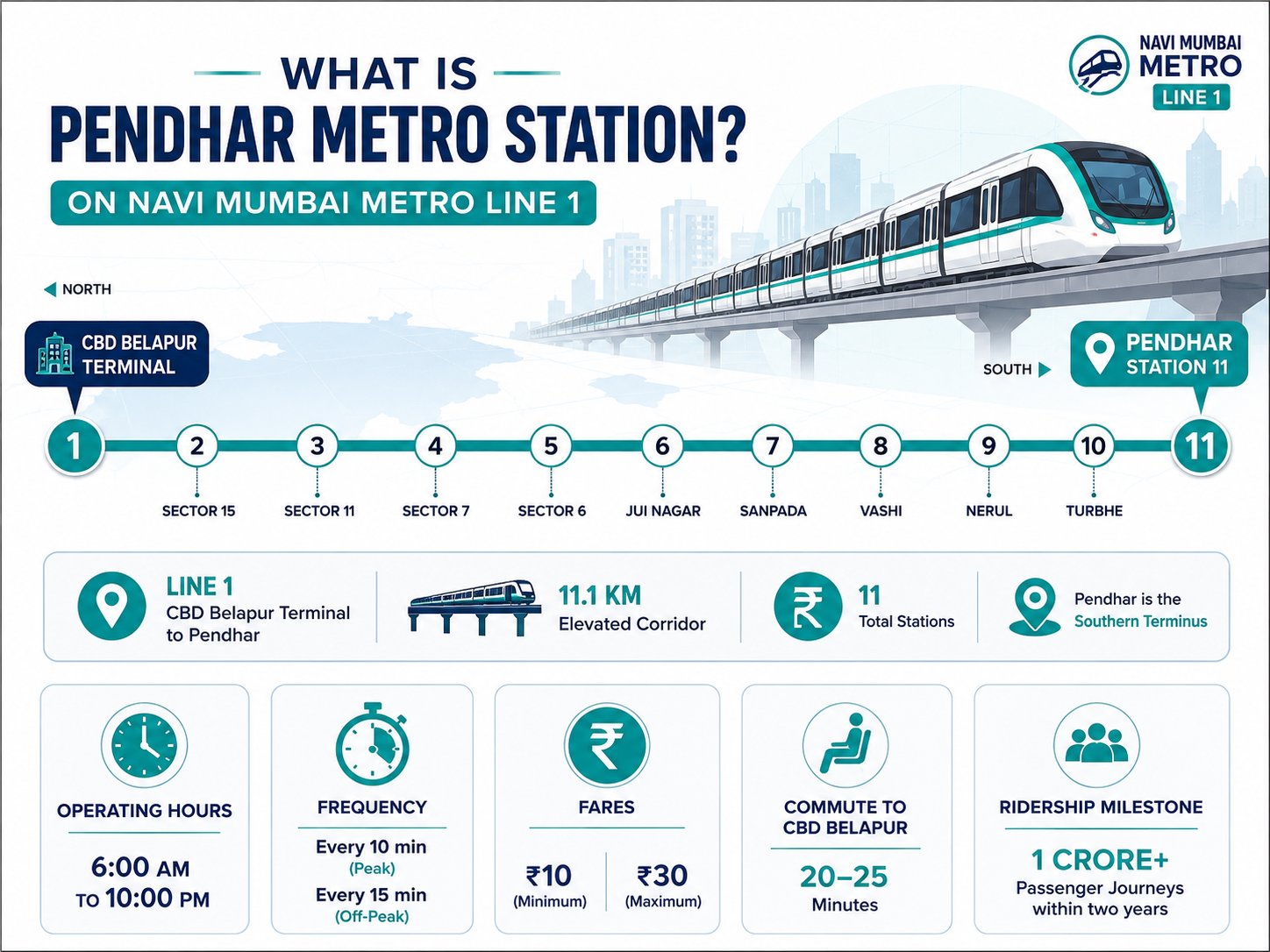
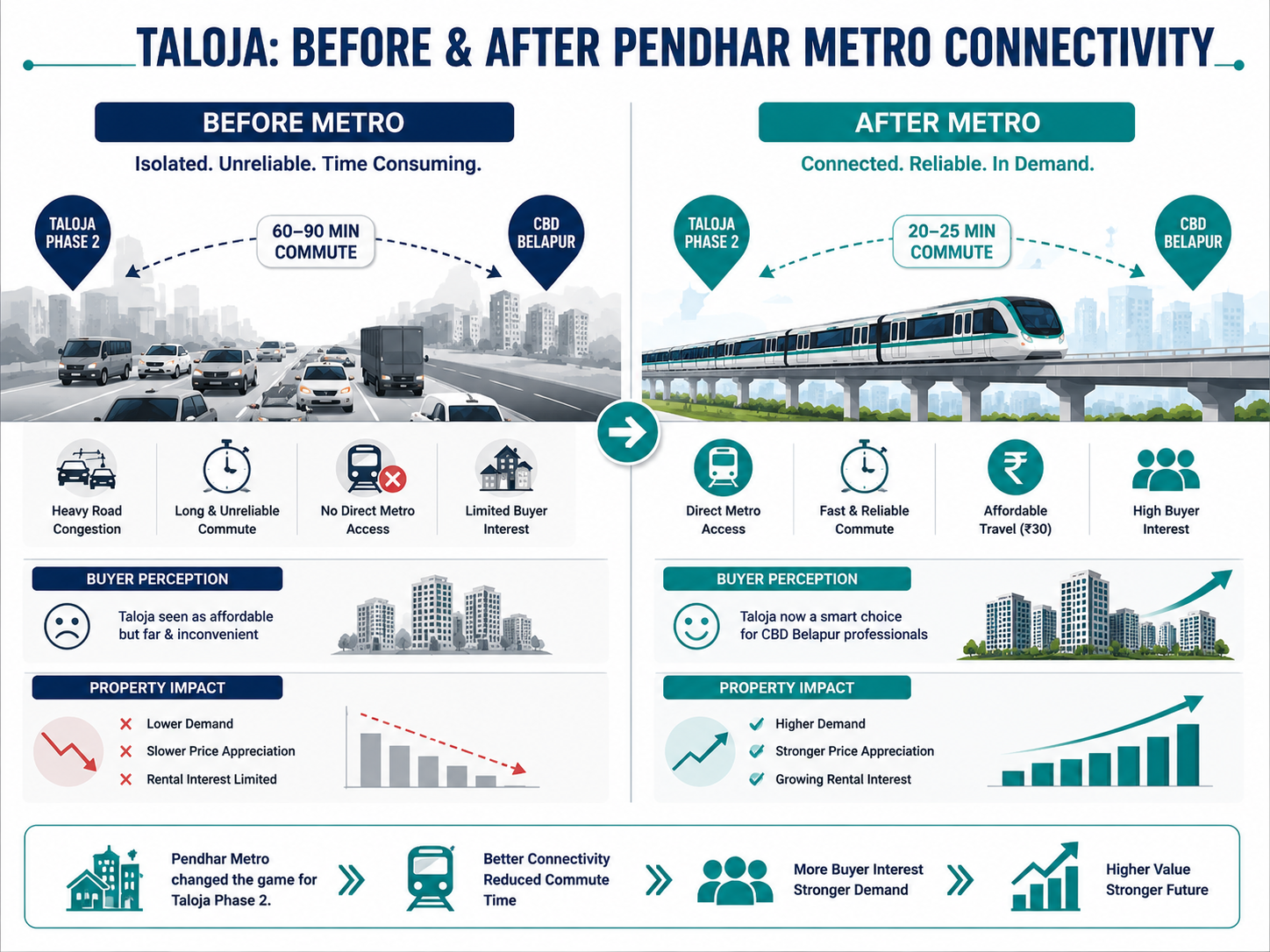
Pre-Metro Taloja
Taloja’s commute challenge was well-documented.
The nearest suburban railway station sat 12 to 13 km from Taloja and Kharghar localities, according to market experts quoted by 99acres. Road access during peak hours on the Kharghar-Taloja stretch was slow and unreliable.
For professionals working in CBD Belapur, living in Taloja was a trade-off: you got a significantly cheaper 2 BHK, but you paid for it in commute time, road congestion, and unpredictability.
Many buyers chose to stretch their budget and buy in Kharghar instead, even at a 40 to 60% price premium, simply for the better road access to Belapur.
Post-Metro Taloja
The Pendhar station changed that calculus.
Taloja Phase 2 residents can now walk or take a short auto to Pendhar station and reach CBD Belapur in 20 to 25 minutes on the metro. The commute is reliable, air-conditioned, and costs ₹30 for the full stretch.
As one detailed 2026 Taloja real estate report from Revaa Homes put it: Metro Line 1 terminating at Pendhar put Taloja on the map for Belapur-CBD professionals who want a 2 BHK they can actually own instead of renting in Kharghar forever.
That shift in positioning is real. A 2 BHK in Taloja Phase 2 starts around ₹48 lakh. A comparable size in established Kharghar starts around ₹1 crore. The metro has compressed the commute time gap between the two nodes to under 5 minutes.
Property Price Data: Pendhar and Taloja Post-Metro
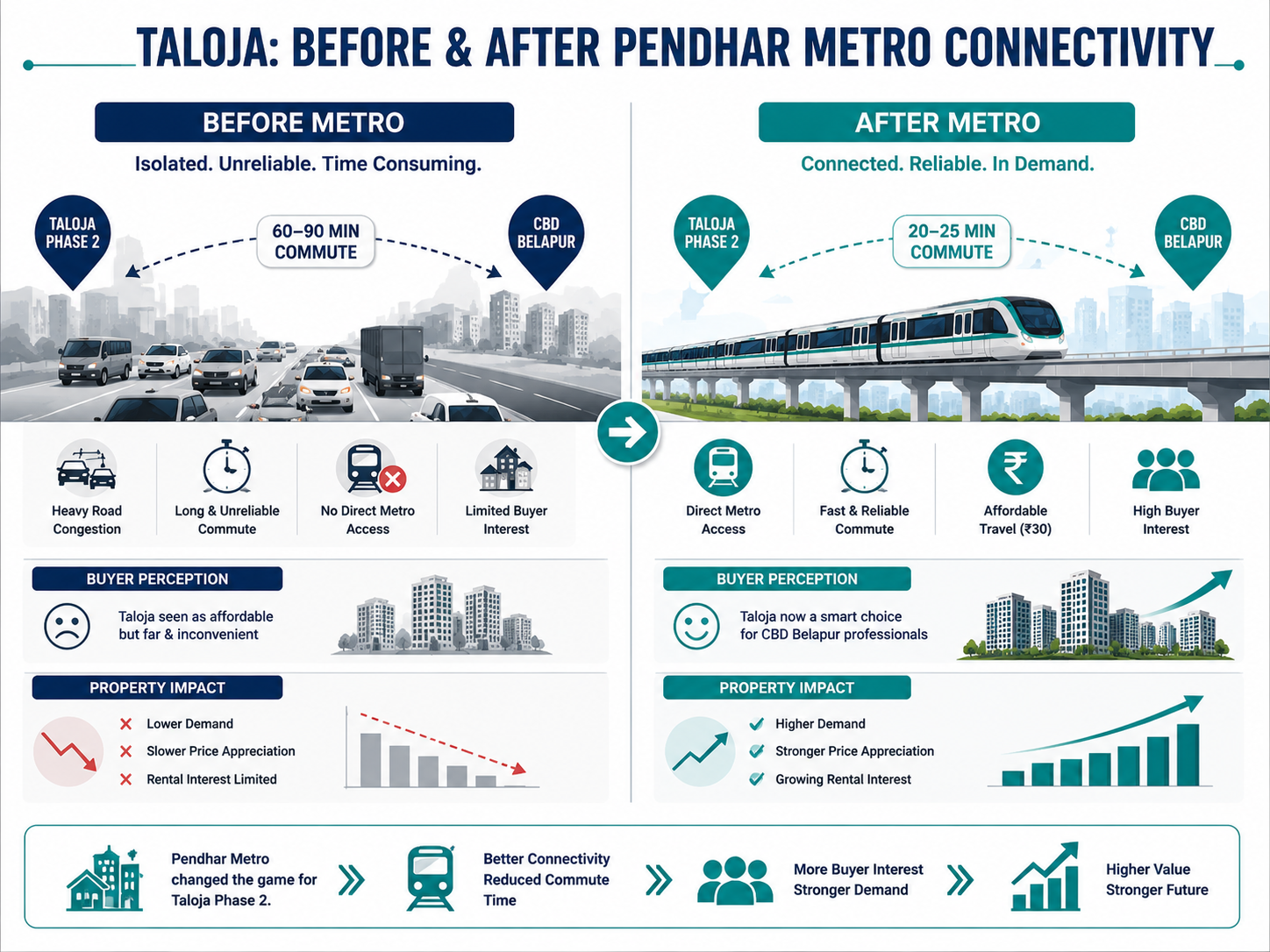
| Metric | Current Status |
|---|---|
| Average rate (Taloja) | ₹8,700 per sq ft |
| Rate range | ₹6,500 to ₹9,000 per sq ft |
| 2 BHK range (affordable end) | ₹48 lakh |
| 2 BHK range (premium Phase 2) | ₹72 lakh |
| Reckoner value vs market | 40 to 80% below market value |
| Projected annual appreciation | 11 to 16% through 2027 |
The reckoner value gap is significant: actual Taloja market rates are 40 to 80% higher than their government-registered reckoner values, which market analysts cite as a clear indicator of future upside as the gap closes over time.
According to Tescon Green’s Q1-Q2 2026 market report, Taloja and the Pendhar corridor are expected to show 11 to 16% annual appreciation as metro ridership grows and employers continue establishing in the MIDC belt.
What Pendhar Station Has Done to Specific Areas
Taloja Phase 2
This is the primary beneficiary of the Pendhar metro station.
Phase 2 is a large residential zone developing primarily with mid-budget projects targeting first-time homebuyers and professionals relocating from Mumbai. Before the metro, Phase 2 felt geographically disconnected from the commercial hubs of Navi Mumbai.
Post-Pendhar, the dynamic has shifted.
Builders are now marketing Phase 2 projects explicitly on metro connectivity. The Pendhar station is reachable by auto from most Phase 2 societies, and commute times to Belapur CBD are under 25 minutes.
The profile of the Phase 2 buyer has also shifted. Pre-metro, the dominant profile was blue-collar and MIDC industrial workers. Post-metro, white-collar professionals from Belapur and Kharghar’s commercial areas are increasingly evaluating Taloja Phase 2 as an ownership option, having previously been locked out of Kharghar pricing.
Pushpak Nagar Colony
Pushpak Nagar is a newer premium pocket within the Pendhar-Taloja belt, with modern infrastructure, asphalt roads, and connectivity to major highways. It is positioned as a mid-to-premium alternative within an otherwise affordable zone.
Metro access via Pendhar has made Pushpak Nagar Colony more attractive for families and professionals who want newer construction and better civic infrastructure at a price that central Kharghar cannot match.
Pendhar Gaon
The original village settlement of Pendhar Gaon has seen its surroundings transform with the metro station’s arrival. New residential colonies are developing in the area. Metro line infrastructure, combined with widened roads, has increased accessibility from Navi Mumbai overall and raised the property value of land and housing in surrounding pockets.
The Bigger Picture: Why Pendhar Is a Strategic Node
The Airport Extension Pipeline
The most significant long-term factor for Pendhar property is not the current Line 1 terminus status. It is what comes next.
Line 1 Phase 2 will extend the corridor from Khandeshwar to the Navi Mumbai International Airport. This extension passes through or near the Taloja-Pendhar corridor.
When this is built, Pendhar residents will have metro access not just to CBD Belapur in the north, but to NMIA in the south. The airport opened for commercial operations on 25 December 2025 and is expected to generate approximately 4 lakh direct and indirect jobs.
A metro line connecting Pendhar to both Belapur CBD and NMIA would make the Taloja Phase 2 and Pendhar belt one of the better-connected affordable nodes in the entire MMR.
This is not priced in yet.
Metro Line 12: Kalyan to Taloja
Metro Line 12, planned to connect Kalyan APMC to Taloja Pisarve, is the next major event for this belt.
When operational, this line will open Taloja’s housing stock to the Kalyan-Dombivli professional pool. That is a massive buyer and tenant catchment that currently has no direct connectivity to Taloja.
The combination of Line 1 (Belapur access) and Line 12 (Kalyan access) would make Taloja Phase 2 a multi-directional commuter hub at affordable prices.
[verify before transaction: Metro Line 12 and Line 1 Phase 2 are planned but not yet under construction as of 2026. Timelines are subject to CIDCO approvals and government execution. Confirm current status at cidco.maharashtra.gov.in before making investment decisions based on these lines.]
NMIA and MTHL Ripple Effect
The Navi Mumbai International Airport opened in December 2025. The Mumbai Trans Harbour Link (Atal Setu) connecting Sewri to Chirle has been operational since early 2024.
Both these projects are generating demand in the southern Navi Mumbai belt. Taloja is adjacent to this demand zone. Properties in Ulwe and Panvel have already seen 20 to 25% year-on-year appreciation driven by airport proximity. As those prices rise, buyers are looking at Taloja and the Pendhar belt as the next logical affordable step.
Honest Assessment: What Pendhar Metro Does Not Fix
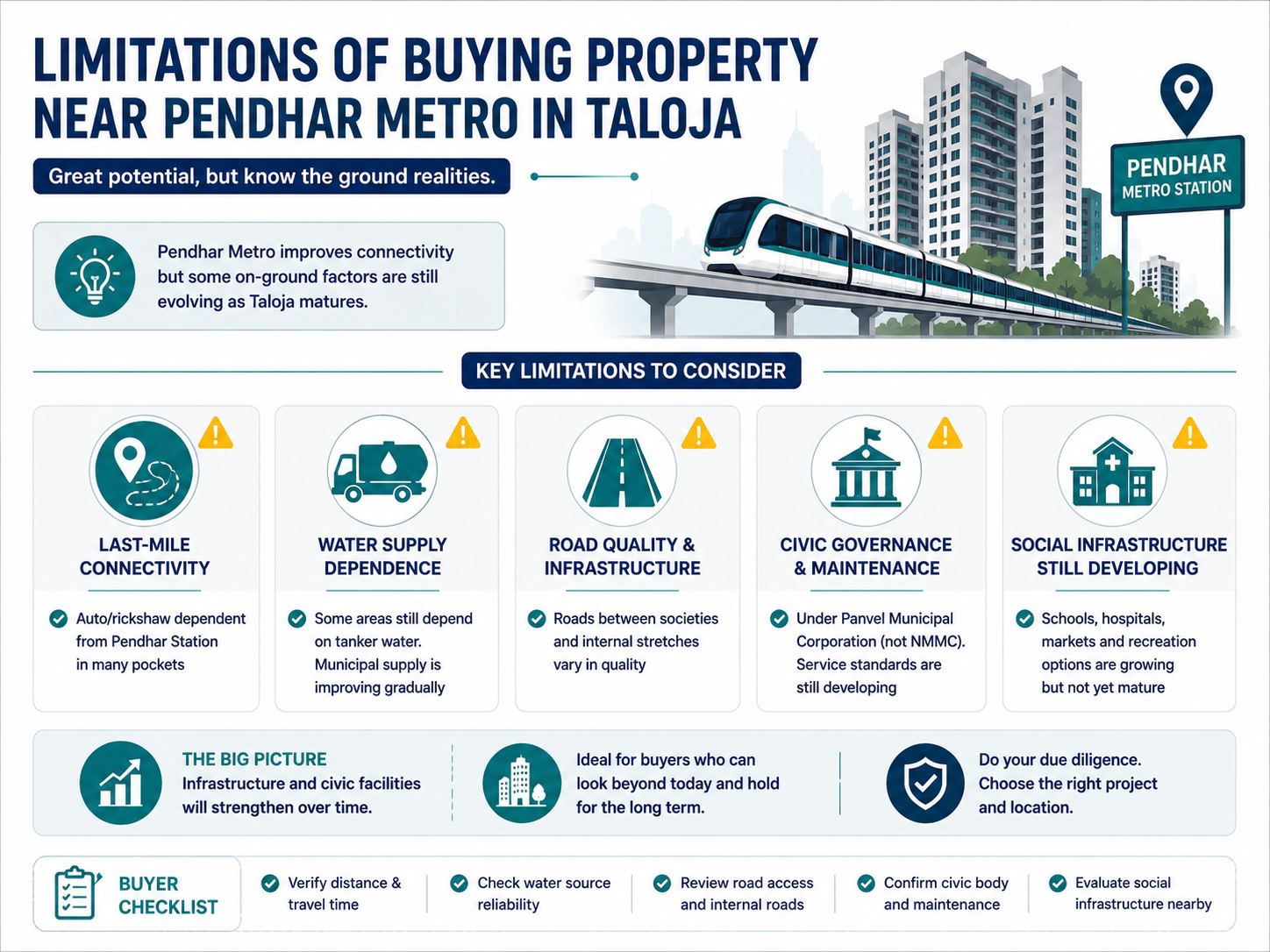
Taloja’s upgrade story is real. But some ground-level realities remain.
Governance of Taloja falls under Panvel Municipal Corporation, not NMMC. The civic standard, road maintenance expectations, and infrastructure delivery differ from NMMC-governed nodes like Kharghar.
The metro improves broader connectivity. It does not resolve poor last-mile links in every part of Phase 2, tanker water dependence in some projects, or inconsistent road finish between societies.
As one detailed 2026 Taloja buyer guide noted: Metro connectivity upgrades commute. It does not automatically upgrade the full lifestyle experience.
For buyers expecting mature social infrastructure on par with Kharghar or Belapur immediately after possession, Taloja may not deliver that in 2026. In 3 to 5 years, as the node matures, this gap should close.
The right buyer for Pendhar-adjacent Taloja is one who can accept a still-developing environment in exchange for the ownership opportunity that Kharghar no longer offers at current prices.
Buyer and Investor Profiles for the Pendhar Belt
First-Time Homebuyer (Budget: ₹50 to ₹70 lakh)
The most natural fit for Taloja Phase 2 near Pendhar.
You get a 2 BHK at a price that Kharghar cannot match, with metro connectivity making the Belapur commute manageable. If you are buying to live in the property for 5 to 7 years, the capital appreciation during that period should be meaningful.
Check RERA status, water supply reliability, and builder track record carefully before committing.
Investor (Budget: ₹50 to ₹80 lakh, 5-year horizon)
Taloja offers the most alpha on the Line 1 corridor from a pure appreciation standpoint.
Entry prices are the lowest of any functional node in Navi Mumbai. Infrastructure catalysts are piling up (operational metro, operational airport, MTHL, upcoming Line 12). The gap between current prices and medium-term fair value is the widest on the corridor.
Rental yield in this bracket is modest now, but as the professional tenant pool grows via metro, yields should improve.
Upgrade Buyer from Mumbai or Western Suburbs
If you are looking to relocate from Mumbai and want to own (not rent) a home, the Pendhar-Taloja belt in 2026 is what Kharghar was in 2018: available, developing, metro-connected, and still at a price where ownership is within reach for a salaried professional.
[verify before transaction: Always check MahaRERA registration at maharerait.mahaonline.gov.in. Confirm actual Pendhar metro station walking distance or auto-rickshaw time from any specific project before purchase. “Metro-connected” is often used loosely by builders for projects 3 to 4 km from the station.]
Pendhar vs Rest of the Metro Corridor
| Node | Avg Rate | Distance to Belapur | Metro Access | 2 BHK Entry |
|---|---|---|---|---|
| CBD Belapur | ₹20,000 to ₹22,000/sq ft | 0 min (origin) | Direct terminal | ₹1.8 cr+ |
| Kharghar central | ₹15,000 to ₹18,000/sq ft | ~15 min by metro | 6 stations | ₹1 cr |
| Kharghar fringe | ₹11,000 to ₹13,000/sq ft | ~18 min | 6 stations | ₹95 lakh |
| Pendhar / Taloja | ₹6,500 to ₹9,000/sq ft | ~20 to 25 min | Terminus (1 station) | ₹48 lakh |
The Pendhar-Taloja price advantage is significant. You trade 5 to 10 minutes of extra metro travel for 40 to 60% lower property prices compared to Kharghar fringe.
FAQs
Frequently Asked Questions