

Belapur Metro Impact on Property: What It Means for Buyers and Investors
The Navi Mumbai Metro’s CBD Belapur terminal has directly boosted property values in the area, with apartments now averaging ₹25,500 per sq ft and year-on-year appreciation of around 11.6%. Belapur was already Navi Mumbai’s administrative and corporate hub. The metro has added a new dimension: seamless daily connectivity that did not exist before November 2023.
This article breaks down exactly how the metro has impacted Belapur property prices, which micro-markets are benefiting most, and what buyers and investors should know before making a decision in 2026.
What the Belapur Metro Station Actually Is
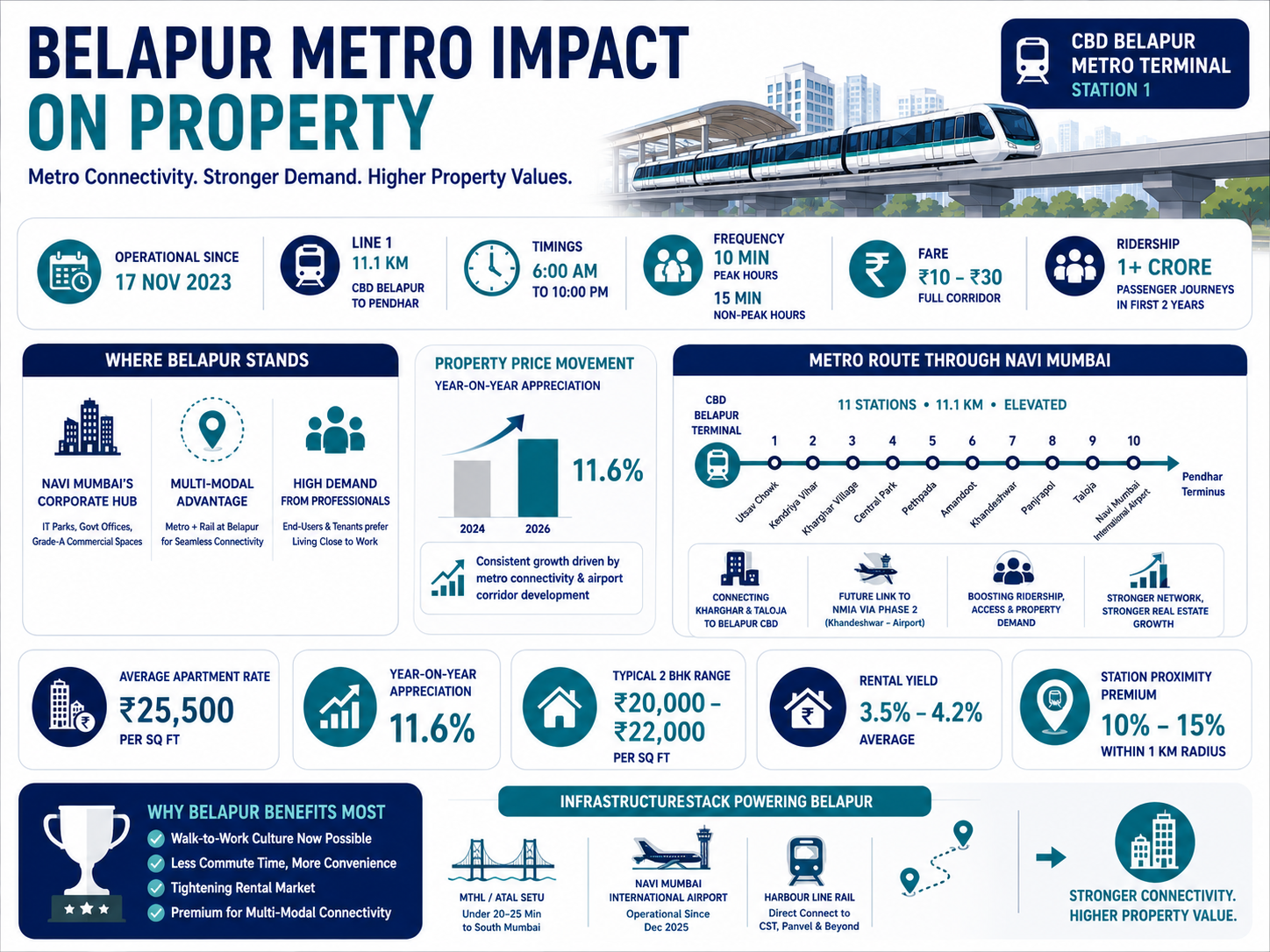
The CBD Belapur Metro Terminal is Station 1 on Navi Mumbai Metro Line 1.
This is the northern terminus of the 11.1 km elevated corridor that runs from CBD Belapur all the way down to Pendhar in South Navi Mumbai. The line was inaugurated on 17 November 2023 and is operated by CIDCO under Maha Metro.
Key facts about the line:
- 11 stations across 11.1 km, fully elevated
- Runs from 6:00 AM to 10:00 PM daily
- Frequency: Every 10 minutes during peak hours, 15 minutes otherwise
- Fare: ₹10 minimum, ₹30 maximum for the full stretch
- Operated by: Konkan Railway (O&M from June 2024)
The Belapur Terminal station sits approximately 400 metres from CBD Belapur railway station, creating a genuine multi-modal hub for the first time.
According to CIDCO, total ridership on the line crossed 1 crore passenger journeys within the first two years of operation, which signals consistent adoption, not just opening-day curiosity.
How the Metro Has Changed Belapur's Property Market
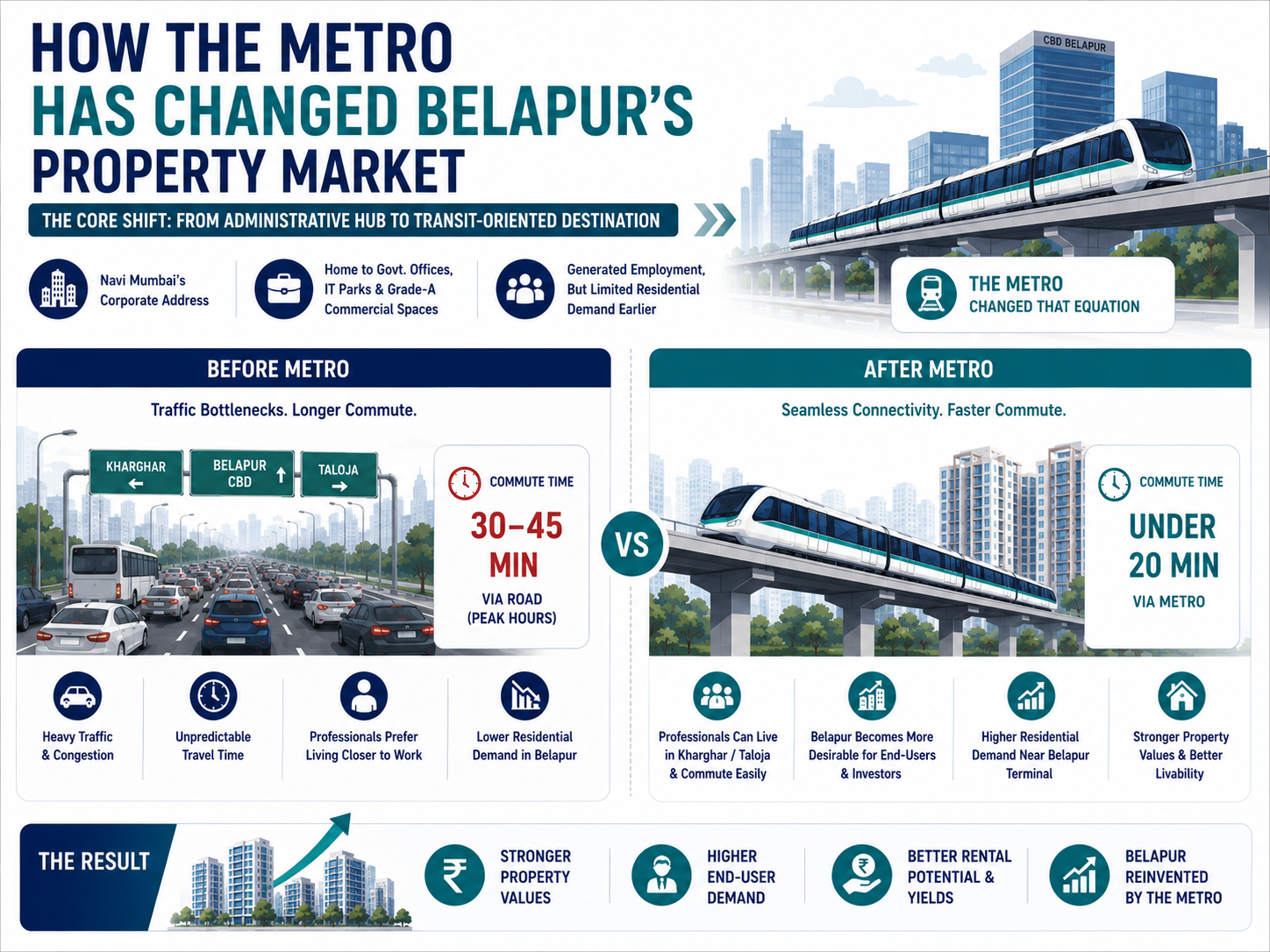
The Core Shift: From Administrative Hub to Transit-Oriented Destination
Belapur was always Navi Mumbai’s corporate address. Home to government offices, IT parks, and Grade-A commercial spaces, it attracted employment but not always residential buyers who wanted to live close to work.
The metro changed that equation.
Before the metro, the internal road network between Belapur, Kharghar, and Taloja was bottlenecked during peak hours. Commuting from Pendhar or deeper Kharghar sectors to CBD Belapur via road could take 30 to 45 minutes during peak traffic.
Post-metro, that same journey takes under 20 minutes.
The result: professionals working in Belapur’s corporate belt can now live further down the corridor in Kharghar or even Taloja and still maintain a comfortable commute. But it has also made Belapur itself more desirable for end-users who want to live close to the Belapur Terminal.
Property Price Movement at Belapur Post-Metro
| Metric | Current Status |
|---|---|
| Average apartment rate | ₹25,500 per sq ft |
| Year-on-year appreciation | 11.6% |
| Rental yield | 3.5% to 4.2% |
| Typical 2 BHK range | ₹20,000 to ₹22,000 per sq ft |
According to market data from 99acres and NoBroker, Belapur’s flat rates have appreciated approximately 11.6% year-on-year. The rental market has tightened, with yields between 3.5% and 4.2%, which is strong for a mature node.
The premium is partly driven by a “walk-to-work” culture that has become realistic here. With Grade-A office spaces integrated into or adjacent to the station area, and the metro providing onward connectivity, Belapur has moved up in the buyer’s consideration set.
The Airport Multiplier Effect
The Navi Mumbai International Airport (NMIA) opened for commercial operations on 25 December 2025.
This has created what analysts are calling a secondary ripple: Belapur, described as the “front office” for the airport corridor, is now seeing interest from global business travelers and corporates setting up operations close to the new airport zone.
Properties in the direct Belapur catchment are clocking year-on-year growth that outperforms several traditional Mumbai micro-markets, according to investment firm data compiled in early 2026.
Line 4 of the Navi Mumbai Metro, currently planned, will extend the corridor from Khandeshwar to NMIA. Once this is operational, CBD Belapur will sit at one end of an uninterrupted metro corridor connecting the airport to the CBD. That is a significant long-term value driver.
Which Micro-Markets Within Belapur Are Gaining Most

Sectors Close to the Metro Terminal
Properties within a 1 km radius of the Belapur Terminal station are commanding the highest premiums. This is consistent with the broader “metro effect” observed across Indian cities, where proximity to a station adds a measurable 10 to 20% premium over comparable properties further away.
Sector 11, Sector 15, and Sector 30 Belapur are the residential pockets most directly benefiting from station proximity.
Sector 9N and Adjacent Areas
Sector 9N sits close to the commercial spine of CBD Belapur. While the area has some infrastructure drawbacks including parking constraints, its proximity to both the metro and employment hubs keeps demand firm. Buyers looking at resale inventory here are finding price appreciation that has accelerated post-metro.
Commercial Real Estate Response
The metro’s bigger immediate impact has arguably been on commercial real estate.
Rental demand from SME professionals and IT employees working in Belapur’s office parks has increased. The availability of Grade-A space near the metro terminal, combined with the multi-modal advantage of metro plus local train at Belapur station, has made this one of the more sought-after commercial addresses in the Mumbai Metropolitan Region (MMR).
Belapur vs Nearby Nodes: How Does It Stack Up?
| Node | Average Rate (2026) | Metro Access | YoY Appreciation |
|---|---|---|---|
| CBD Belapur | ₹20,000 to ₹22,000 per sq ft | Direct (Terminal) | ~11.6% |
| Kharghar | ₹11,000 to ₹18,000 per sq ft | 6 stations on Line 1 | ~16 to 24% |
| Nerul | ₹14,000 to ₹18,000 per sq ft | Nearby (planned expansion) | Stable |
| Taloja | ₹6,500 to ₹9,000 per sq ft | Near Pendhar terminus | ~11 to 16% |
Belapur commands a premium over Kharghar and Taloja primarily because of its established commercial infrastructure. However, Kharghar is seeing faster appreciation rates because it is earlier in the growth cycle.
For end-users who want to live in the node where they work, Belapur’s pricing is justified. For investors chasing appreciation upside, Kharghar and Taloja along the metro corridor offer higher growth potential from a lower base.
The Infrastructure Stack Behind Belapur's Premium

The metro is not operating in isolation. Belapur sits at the intersection of multiple connectivity upgrades that have arrived almost simultaneously:
Mumbai Trans Harbour Link (MTHL / Atal Setu) The 21.8 km sea bridge connecting Sewri in Mumbai to Chirle near Panvel cut travel time from Belapur to South Mumbai to under 20 to 25 minutes. For Belapur residents commuting to Mumbai’s business districts, this changed the calculus entirely.
Navi Mumbai International Airport (NMIA) Operational since December 2025. The planned Phase 4 extension of Metro Line 1 will eventually connect NMIA directly to Belapur Terminal. Until that is built, the airport is accessible via road, but the intent is clear.
Existing Harbour Line Rail CBD Belapur railway station on the Mumbai Harbour Line connects directly to CST, Panvel, and intermediate stations. Metro plus railway in one interchange is a premium that few suburban nodes in the MMR can match.
According to [CIDCO’s official documentation](https://www.cidco.maharashtra.gov.in/), the master plan for Navi Mumbai metro envisions 6 lines spanning over 106 km once all phases are complete. Belapur is the northern anchor of this network.
What Buyers Should Consider Before Investing in Belapur
End-Users
If you work in Belapur or the nearby commercial belt and are looking for a stable, high-quality residential address, Belapur makes strong sense.
The metro has reduced the daily friction of commuting for anyone living along the corridor. If you can afford a property within 500 metres to 1 km of the Belapur Terminal, the rental demand and resale liquidity are both strong.
Families benefit from the social infrastructure: institutions like DY Patil, Apollo Hospital, and proximity to Seawoods Grand Central Mall round out the lifestyle equation.
Investors
Belapur is not a high-alpha play at current prices. With apartments averaging ₹25,500 per sq ft, the base is already elevated. The rental yield of 3.5 to 4.2% is decent but not exceptional.
The more interesting investment thesis is in the commercial segment, where metro-adjacent Grade-A space is tightening, and in the longer-term play tied to the NMIA connectivity once Line 4 is planned and executed.
If appreciation is your goal, properties at the Kharghar end of the metro corridor offer better upside from a lower entry price. [Read our Kharghar Metro Impact guide for that thesis in detail.]
[verify before transaction: Always confirm RERA registration and project completion status with the Maharashtra RERA portal at maharerait.mahaonline.gov.in before any financial commitment.]
Future Plans: Where the Line Goes from Here
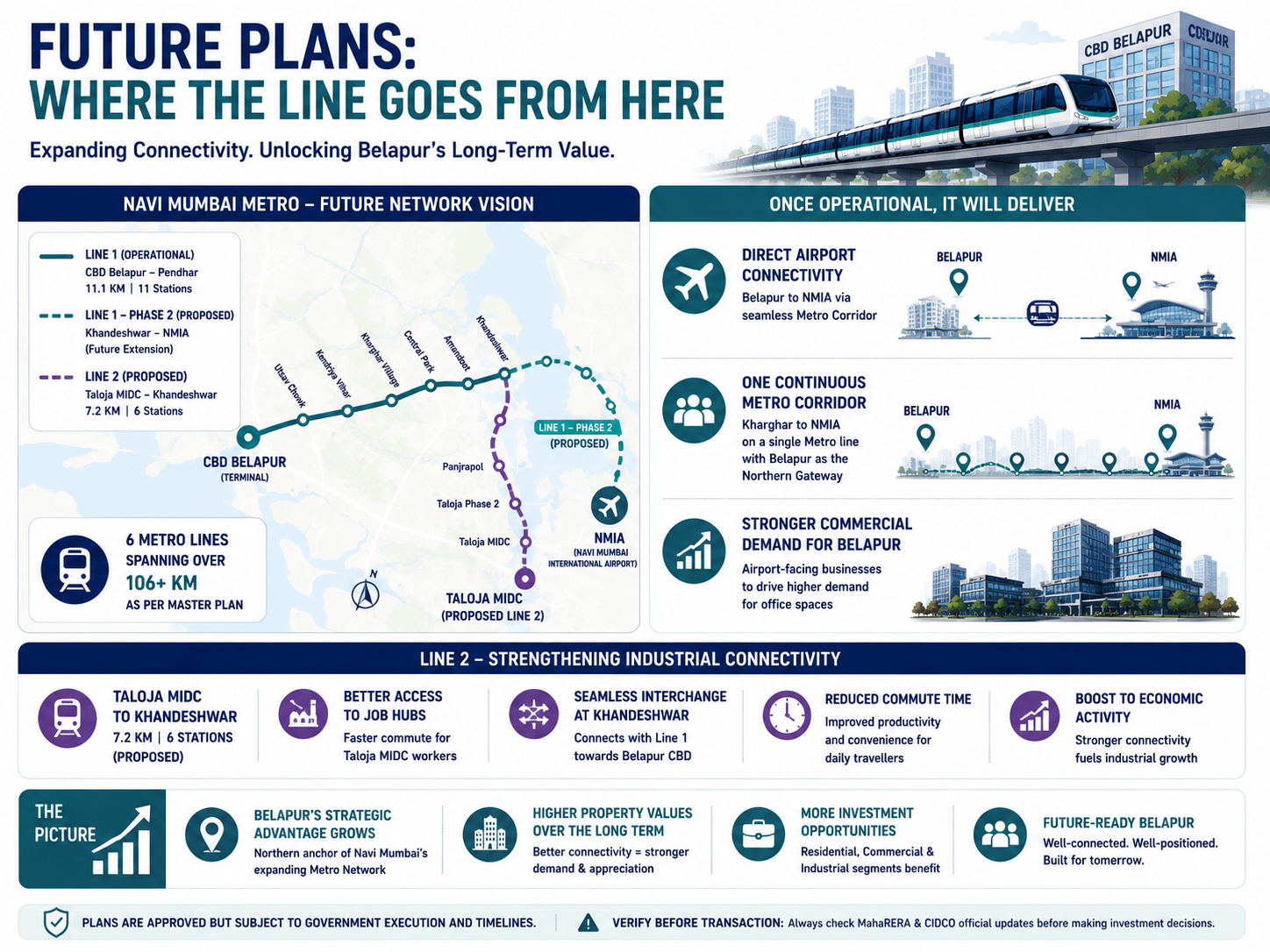
Line 1 Phase 2 will extend the corridor from Khandeshwar toward the NMIA. This is the most consequential pending development for Belapur’s long-term value.
When this is operational:
- Belapur will sit at one end of a metro corridor that connects directly to the airport
- The entire Kharghar to NMIA belt will be accessible via a single metro system with Belapur as the northern gateway
- Commercial demand for Belapur office space from airport-facing businesses is expected to intensify
Line 2 (Taloja MIDC to Khandeshwar, 7.2 km, six stations) is also planned. This will tighten the industrial commuter connection between Taloja MIDC workers and the Belapur CBD.
According to MahaRERA and CIDCO planning documents, these expansions are approved but timelines remain subject to government execution. [verify before transaction]
FAQs
Frequently Asked Questions