
Kharghar Metro Impact on Property: Prices, Premiums, and Investment Outlook
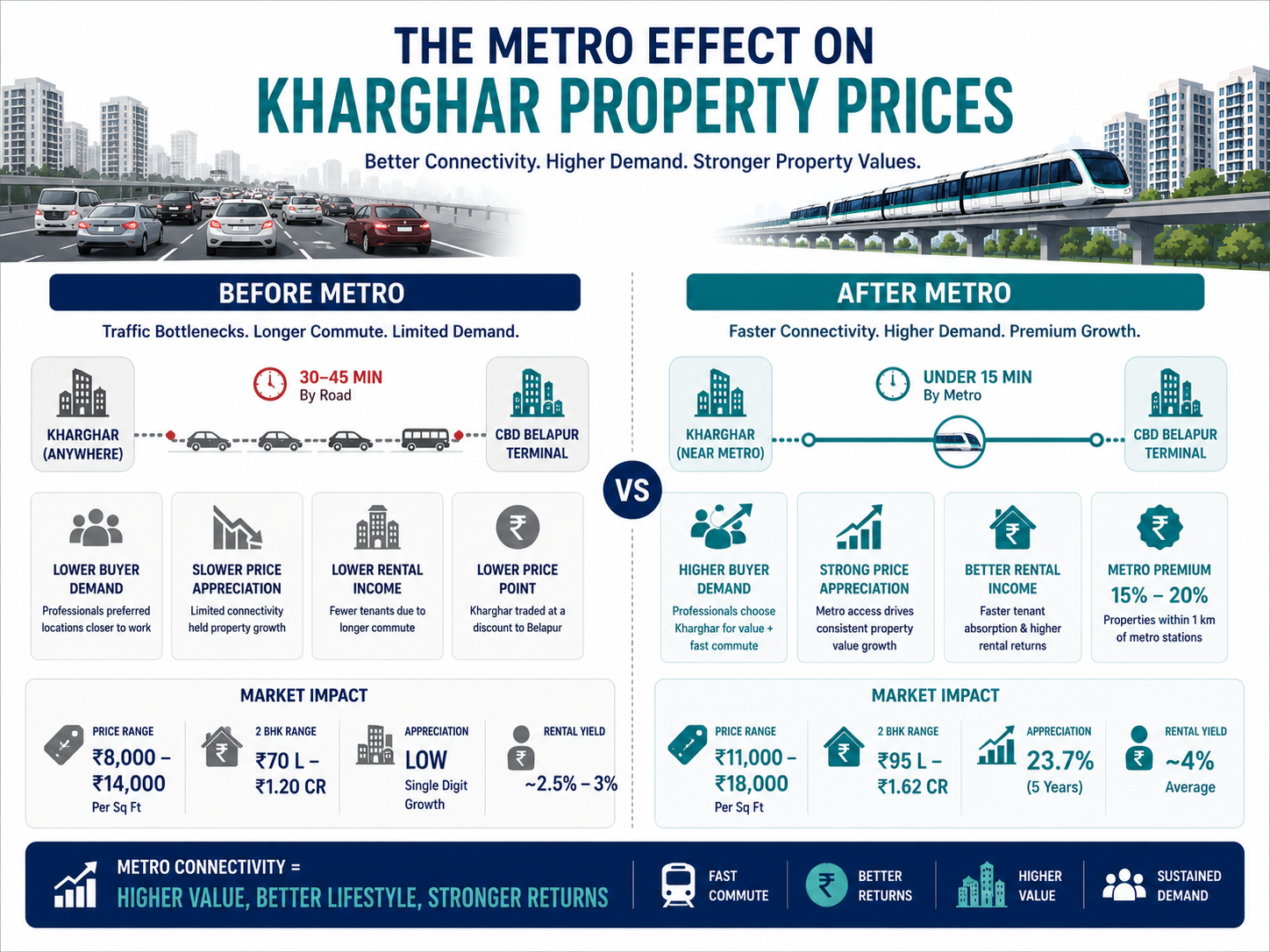
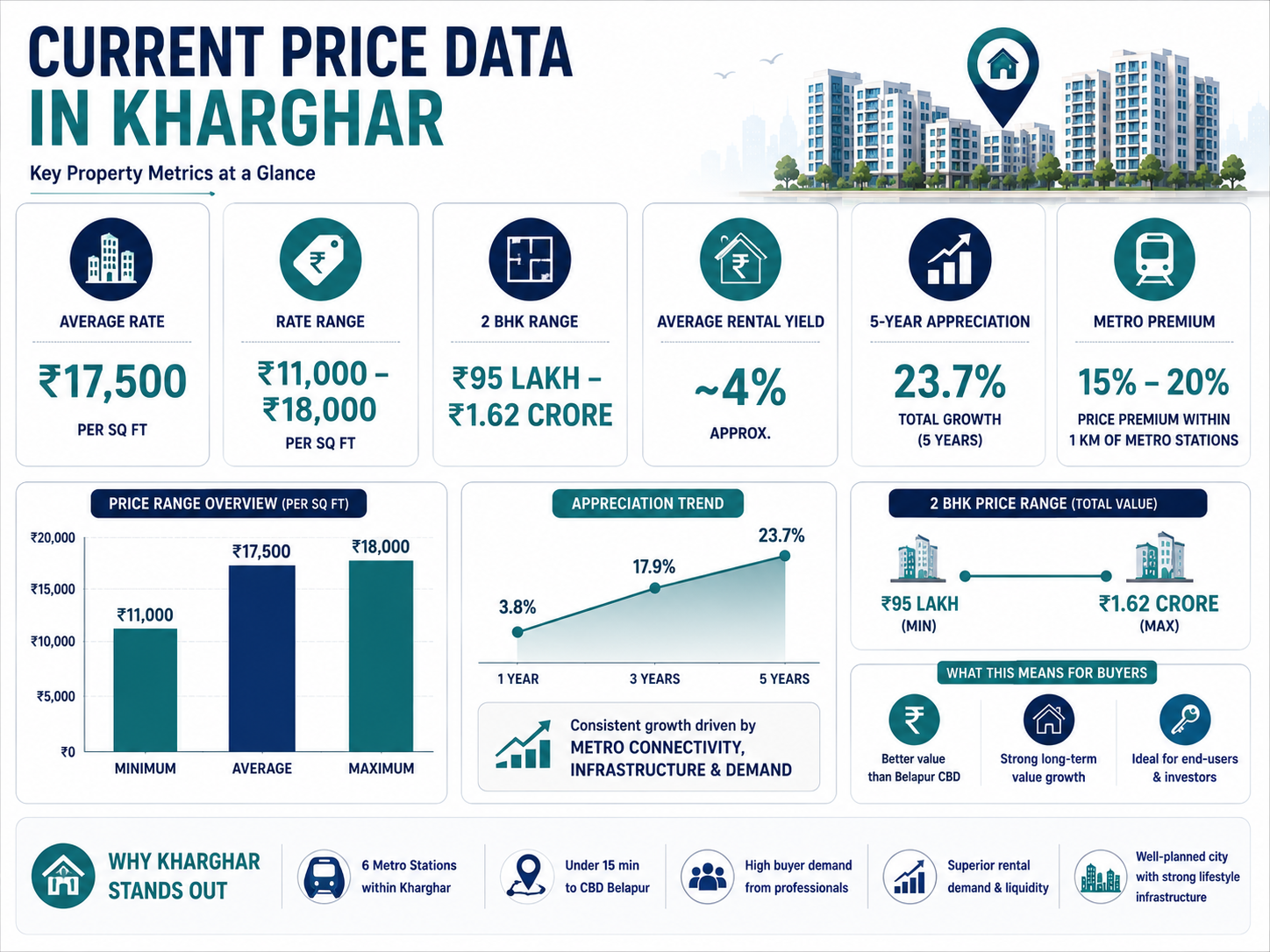
Kharghar is the biggest beneficiary of the Navi Mumbai Metro Line 1. With 6 metro stations running through its heart, from Utsav Chowk to Pethpada and Amandoot, the node has achieved transit-oriented development at a scale rare for any Indian suburb. Property prices have appreciated 23.7% over the last five years, and current rates range from ₹11,000 to ₹18,000 per sq ft with an average of ₹17,500 per sq ft.
This guide explains what the metro has done to Kharghar’s real estate, which sectors are outperforming, and what buyers should know before committing in 2026.
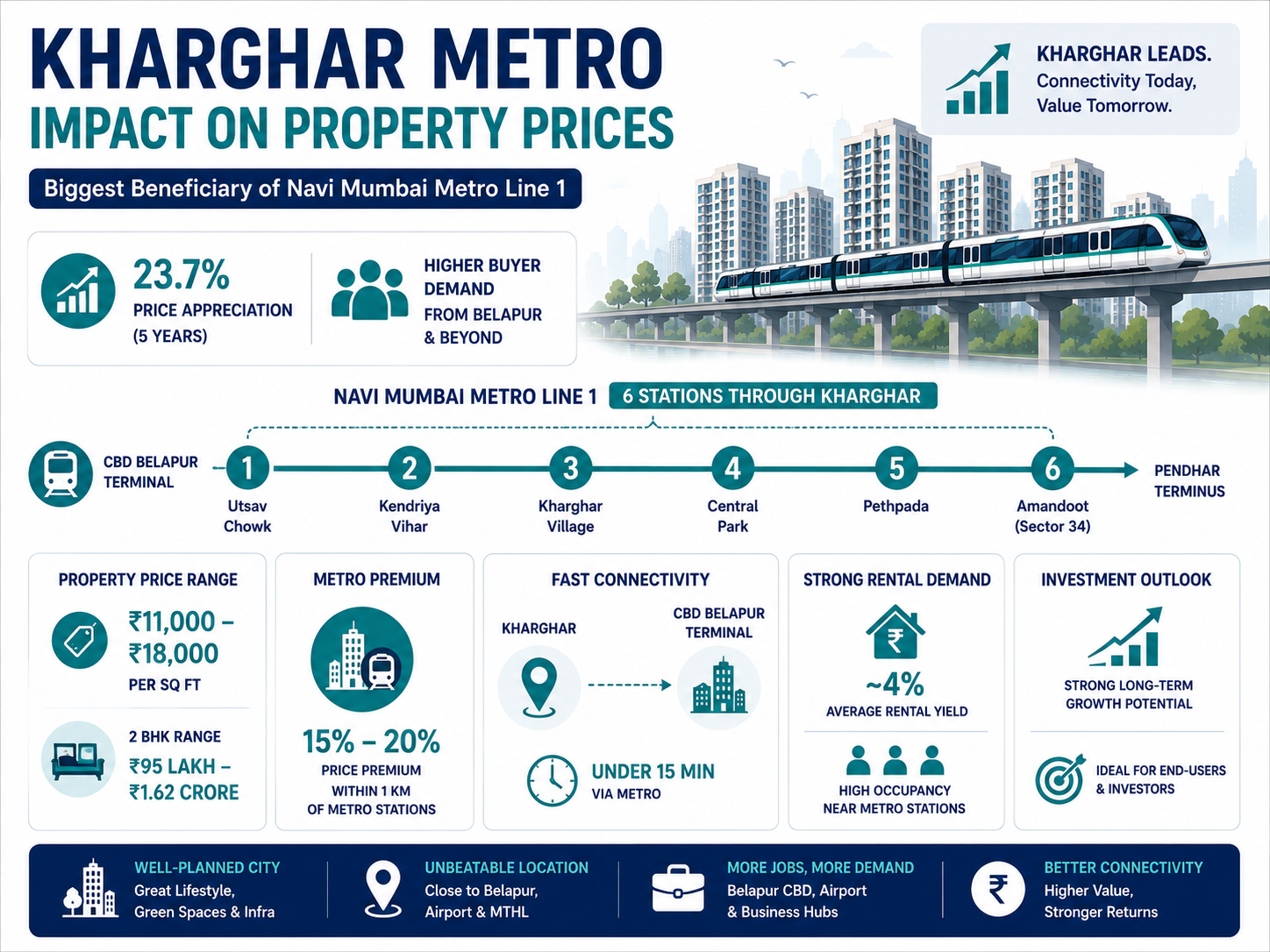
Kharghar's Metro Infrastructure: What's Actually Running
Navi Mumbai Metro Line 1 covers the full length of Kharghar.
The 11.1 km elevated corridor from CBD Belapur to Pendhar passes through six Kharghar stations:
1. Utsav Chowk (Kharghar entry point from Belapur side) 2. Kendriya Vihar (Sector 11 area) 3. Kharghar Village 4. Central Park (the premium residential spine) 5. Pethpada 6. Amandoot (Sector 34 area, southern end)
The line was inaugurated on 17 November 2023 and is operated by CIDCO under Maha Metro, with Konkan Railway handling operations and maintenance from June 2024.
Trains run from 6:00 AM to 10:00 PM daily, every 10 minutes during peak hours and 15 minutes otherwise. Fares are ₹10 to ₹30 for the full corridor.
According to CIDCO, the total ridership on Line 1 crossed 1 crore passenger journeys within the first two years, confirming sustained daily usage, not just initial excitement.
The Metro Effect on Kharghar Property Prices
Before and After: What Changed
Kharghar was always Navi Mumbai’s best-planned node. Well-laid sectors, Central Park, the Golf Course, proximity to good schools and hospitals. But it had one persistent problem: traffic.
During peak hours, the internal roads connecting Kharghar to Belapur CBD and onward to the railway corridor were bottlenecked. Professionals working in Belapur often chose to rent or buy closer to their workplace simply to avoid the commute.
The metro eliminated that friction.
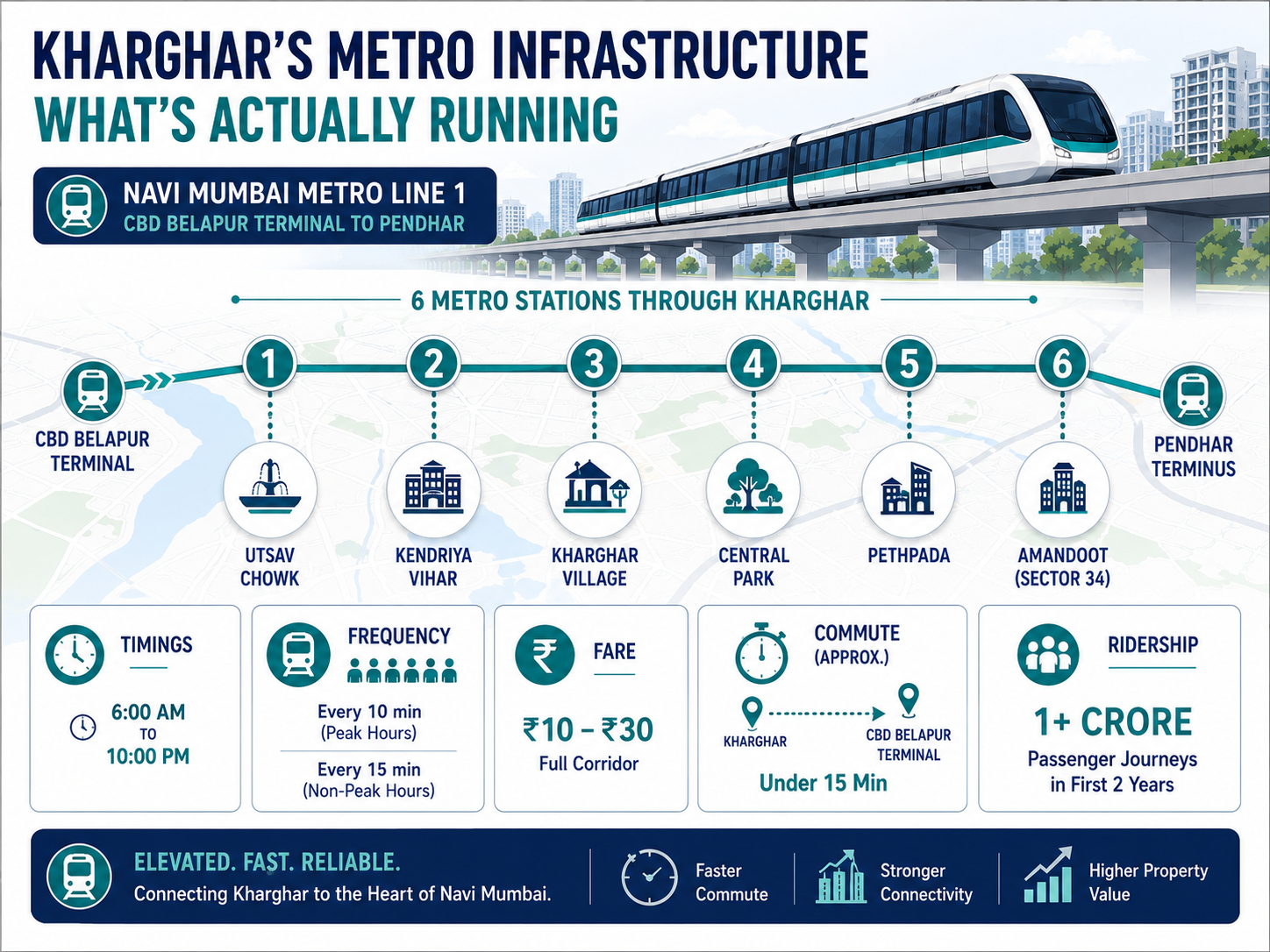
A professional living near Central Park metro station can now reach CBD Belapur Terminal in under 15 minutes. The same journey by road during peak hours took 30 to 45 minutes on a bad day.
The result was immediate: demand from corporate professionals working in Belapur’s office belt shifted toward Kharghar, where 2 BHKs start at ₹1 crore vs. significantly higher prices in Belapur itself.
Current Price Data
| Metric | Current Status |
|---|---|
| Average apartment rate | ₹17,500 per sq ft |
| Rate range | ₹11,000 to ₹18,000 per sq ft |
| 2 BHK range | ₹95 lakh to ₹1.62 crore |
| 3 BHK (premium) | ₹1.8 crore to ₹2.5 crore |
| Average rental yield | ~4% |
| 5-year appreciation | 23.7% |
| 3-year appreciation | 17.9% |
| 1-year appreciation | 3.8% |
The 1-year appreciation of 3.8% looks modest, but this follows a period of rapid catch-up. The 5-year number of 23.7% reflects the cumulative re-rating since metro construction became visible and then operational.
Properties within a 1 km radius of Kharghar metro stations are commanding a 15 to 20% premium over comparable properties further from the line, according to Shreeji Ventures market data.
Which Kharghar Sectors Are Outperforming
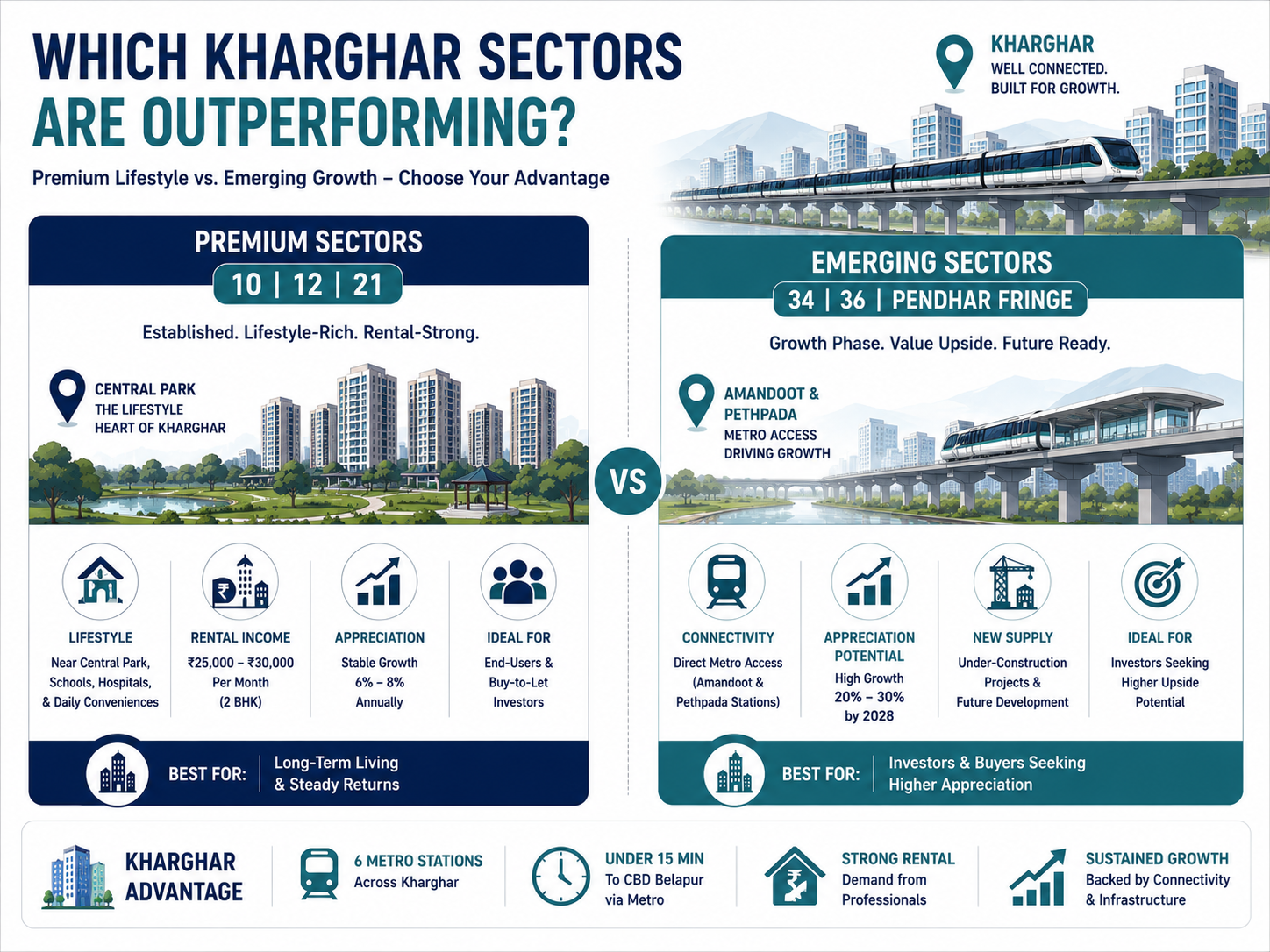
Premium Sectors: 10, 12, and 21
These established residential pockets near Central Park and the hill backdrop offer the strongest combination of lifestyle and rental returns.
Average rental here runs ₹25,000 to ₹30,000 per month for a good 2 BHK, translating into a rental yield structure that is above the Navi Mumbai average for this price bracket.
These sectors are ideal for end-users who want the full Kharghar lifestyle, and for buy-to-let investors targeting corporate professionals on longer tenancies.
Emerging Sectors: 34, 36, and Pendhar Fringe
This is where the metro’s impact has been most visible on appreciation metrics.
Sector 34 is directly served by the Amandoot metro station. Before the metro, Sector 34 was considered “far” by buyers who preferred the established sectors closer to Central Park. That perception has reversed.
As one market observer put it in a verified 2026 buyer review: “Sector 34 is far” is no longer a valid objection. Metro changed that. It is the new pocket of promise.
Under-construction projects near the Amandoot and Pethpada stations are attracting investors targeting 20 to 30% appreciation by 2028 as the metro ridership grows and the neighbourhood matures.
Upper Kharghar and the Airport Corridor Pocket
The areas of Kharghar bordering the airport corridor, specifically projects with line of sight toward the NMIA side, represent a separate investment thesis.
The Navi Mumbai International Airport opened on 25 December 2025. Kharghar’s premium upper sectors are positioned to benefit from the secondary ripple of airport-facing demand as the airport ecosystem matures through 2027 and 2028.
According to Revaa Homes market analysis (April 2026), Upper Kharghar and airport-corridor pockets are still in the appreciation phase, with 6 to 9% annual growth expected through 2030.
The Full Infrastructure Stack Driving Kharghar
The metro does not operate in isolation. Kharghar’s re-rating since 2023 reflects the convergence of three major infrastructure events:
1. Navi Mumbai Metro Line 1 (Operational since November 2023) Six stations through Kharghar. Daily commute to Belapur CBD is now under 15 minutes.
2. Mumbai Trans Harbour Link / Atal Setu (Operational since January 2024) The 21.8 km sea bridge connecting Sewri to Chirle near Panvel cut travel time to South Mumbai to under 20 to 25 minutes. Kharghar residents with MTHL access can now realistically work in South Mumbai and live in Kharghar. This has opened the market to a buyer profile that previously would not have considered Navi Mumbai.
3. Navi Mumbai International Airport (Operational since December 2025) The NMIA’s launch has created commercial and employment density in the southern corridor. Kharghar sits at an accessible distance from the airport and will benefit from the airport economy as it scales.
4. Kharghar-Turbhe Link Road (Expected September 2028) When complete, this will add a direct east-west road connection to Turbhe and Thane. Combined with the metro, Kharghar’s multi-directional connectivity will be among the strongest of any Navi Mumbai node.
According to [CIDCO’s official infrastructure plans], the overall metro master plan envisions connections extending from Belapur through to NMIA as later phases are built.
Kharghar vs the Metro Corridor: Comparative View
| Node | Average Rate | Metro Stations | Typical 2 BHK |
|---|---|---|---|
| CBD Belapur | ₹20,000 to ₹22,000/sq ft | 1 (Terminal) | ₹1.8 cr+ |
| Kharghar (central) | ₹15,000 to ₹18,000/sq ft | 6 | ₹1 cr to ₹1.62 cr |
| Kharghar (fringe) | ₹11,000 to ₹13,000/sq ft | 6 | ₹95 lakh |
| Pendhar / Taloja | ₹6,500 to ₹9,000/sq ft | 2 (terminus) | ₹48 lakh to ₹72 lakh |
The table makes clear why Kharghar occupies the middle tier of the value chain along this corridor. It is cheaper than Belapur but better-developed than Taloja. The metro has allowed buyers to live in Kharghar at a discount to Belapur while maintaining Belapur-level commute times.
Rental Market: What Metro Access Did to Yields
Kharghar’s average rental yield sits at approximately 4%, which is strong for a mature mid-market suburb.
The driver is clear: corporate professionals working in CBD Belapur’s IT parks, government offices, and financial services companies are choosing to rent in Kharghar and commute via metro. The effective cost saving compared to renting inside Belapur, combined with larger flat sizes and better lifestyle amenities, makes the trade-off straightforward.
Properties within 500 metres to 1 km of metro stations are reporting tenant occupancy within 10 to 15 days of possession, according to investor accounts compiled in 2026.
The rental range for a 2 BHK in premium Kharghar sectors runs ₹18,000 to ₹30,000 per month, creating a dual income stream for buy-to-let investors: capital appreciation and monthly rental income.
What Buyers and Investors Should Know
For End-Users
Kharghar is one of the strongest end-user propositions in Navi Mumbai right now.
You get planned sector layout, Central Park, good schools and hospitals, a functioning metro, and Belapur-level commute times at Belapur-minus prices.
For families, sectors near schools and the Central Park corridor (Sectors 10, 12, 21) are the most livable. For young professionals, sectors near the metro line with 1 BHK and 2 BHK options (Sectors 34, 36, Utsav Chowk area) offer the best value.
For Investors
Kharghar is no longer an early-stage bet. The 5-year appreciation of 23.7% has already happened.
The better investment angle in 2026 is sector-specific:
Central Park and established sectors offer stable 6 to 8% annual appreciation with strong rental yield.
Emerging sectors near Amandoot (Sector 34) and Pethpada offer more upside as the neighbourhood matures and the airport corridor effect extends.
The broader Navi Mumbai market consensus, per multiple analyst reports compiled in Q1 to Q2 2026, is that Kharghar will sustain 10 to 20% annual appreciation through 2027, anchored by the ICP commercial development and the airport ecosystem maturing.
Future Metro Plans That Will Impact Kharghar
Line 1 Phase 2 will extend from Khandeshwar toward NMIA. When this is operational, Kharghar’s metro connection extends south all the way to the airport.
Line 2 (Taloja MIDC to Khandeshwar, 7.2 km) will add industrial commuter demand from Taloja MIDC workers, increasing rental demand in Kharghar’s affordable sectors.
The planned CIDCO International Convention Centre (ICP) and EduCity projects in the Kharghar zone will generate significant new employment demand once construction progresses.
FAQs
Frequently Asked Questions