

Atal Setu Real Estate Impact: Which Navi Mumbai Areas Actually Gained
1. What Atal Setu Actually Did to Navi Mumbai's Geography
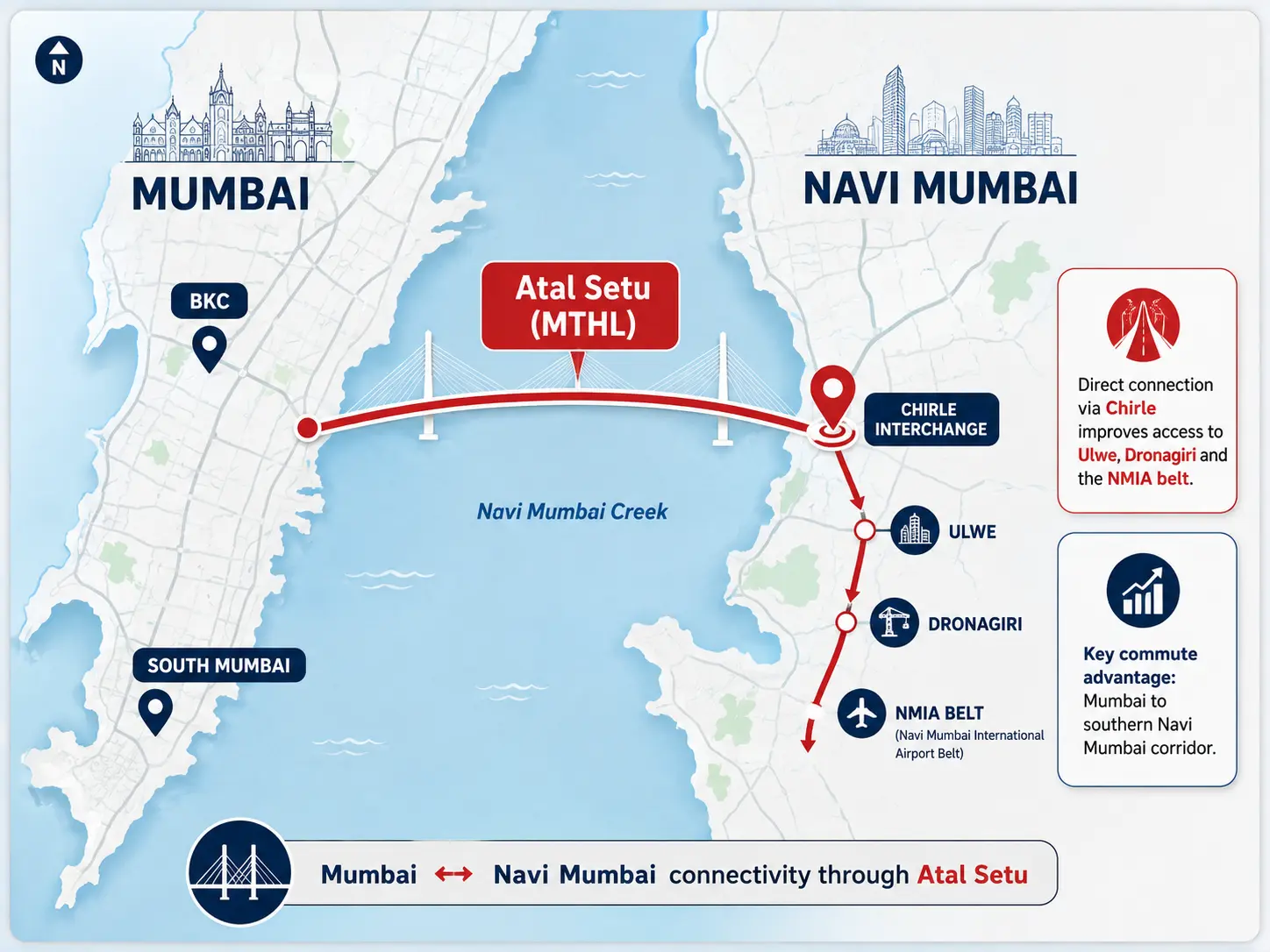
Atal Setu is a 21.8 km, six-lane sea bridge connecting Sewri in South Mumbai to Chirle in Navi Mumbai.
Before the bridge, travel toward Ulwe and Panvel depended on longer, congested routes such as Thane–Belapur Road.
The biggest connectivity gain is for the southern Navi Mumbai corridor, especially Ulwe, Dronagiri, Chirle and Panvel.
Navi Mumbai International Airport (NMIA) began commercial operations in December 2025 and is located close to the Chirle side.
The same growth belt is also supported by NAINA, a large planned development zone around the airport influence area.
2. Which Nodes Got Direct Impact vs. Indirect Benefit?
This is the part most agents and portals gloss over.
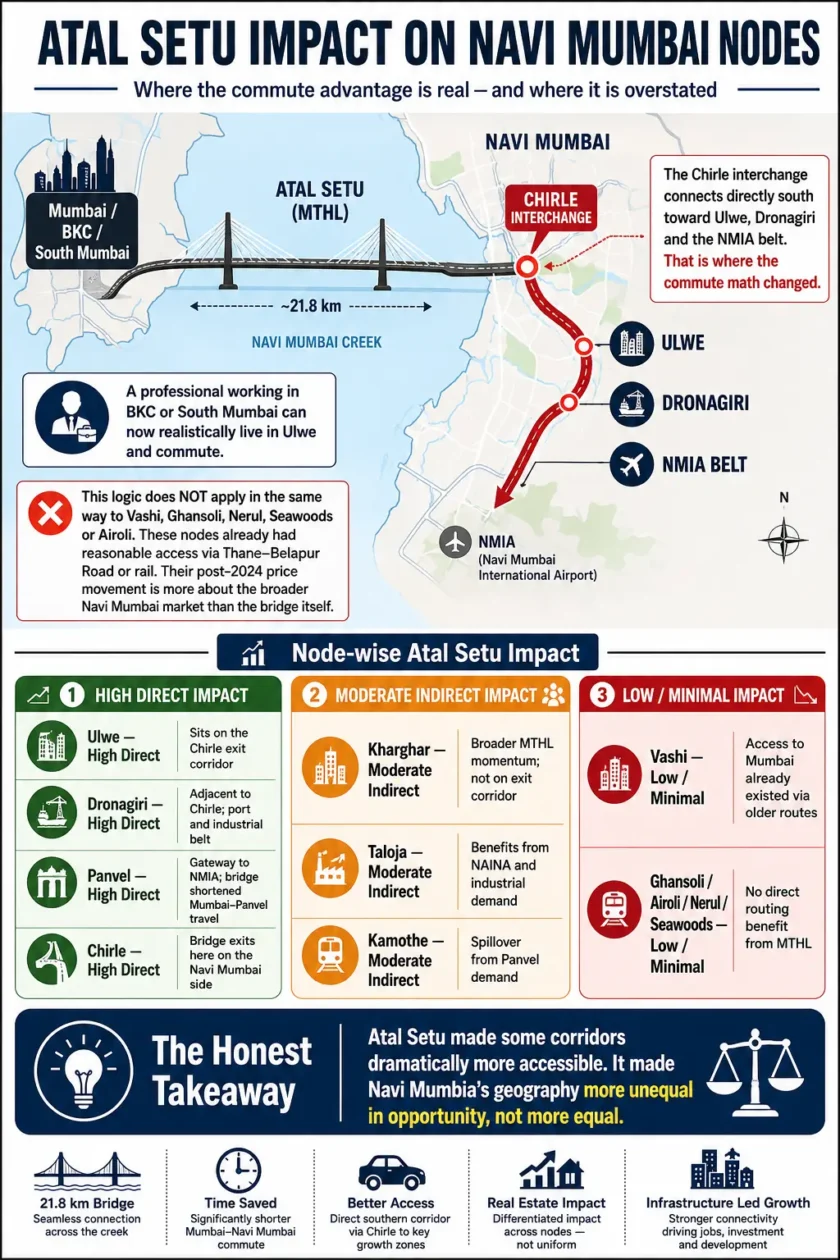
The Chirle interchange on the Navi Mumbai side connects directly south toward Ulwe, Dronagiri, and the NMIA belt. That southern corridor is where the commute math changed. A professional working in BKC or South Mumbai can now realistically live in Ulwe and commute.
That logic does not apply to Vashi, Ghansoli, Nerul, or Airoli. Those nodes already had reasonable access via the Thane–Belapur Road or rail. Atal Setu did not meaningfully shorten their commute to Mumbai. Their price movement post-2024 has been driven by the broader Navi Mumbai market, not by the bridge specifically.
| Node | Atal Setu Impact | Reason |
|---|---|---|
| Ulwe | High Direct | Sits on the Chirle exit corridor |
| Dronagiri | High Direct | Adjacent to Chirle; port and industrial belt |
| Panvel | High Direct | Gateway to NMIA; bridge shortened Mumbai–Panvel travel |
| Chirle | High Direct | Bridge exits here on the Navi Mumbai side |
| Kharghar | Moderate Indirect | Broader MTHL momentum; not on exit corridor |
| Taloja | Moderate Indirect | Benefits from NAINA and industrial demand |
| Kamothe | Moderate Indirect | Spillover from Panvel demand |
| Vashi | Low Minimal | Access to Mumbai already existed via older routes |
| Ghansoli / Airoli / Nerul / Seawoods | Low Minimal | No direct routing benefit from MTHL |
The honest takeaway: Atal Setu made some corridors dramatically more accessible. It made Navi Mumbai’s geography more unequal in opportunity, not more equal.
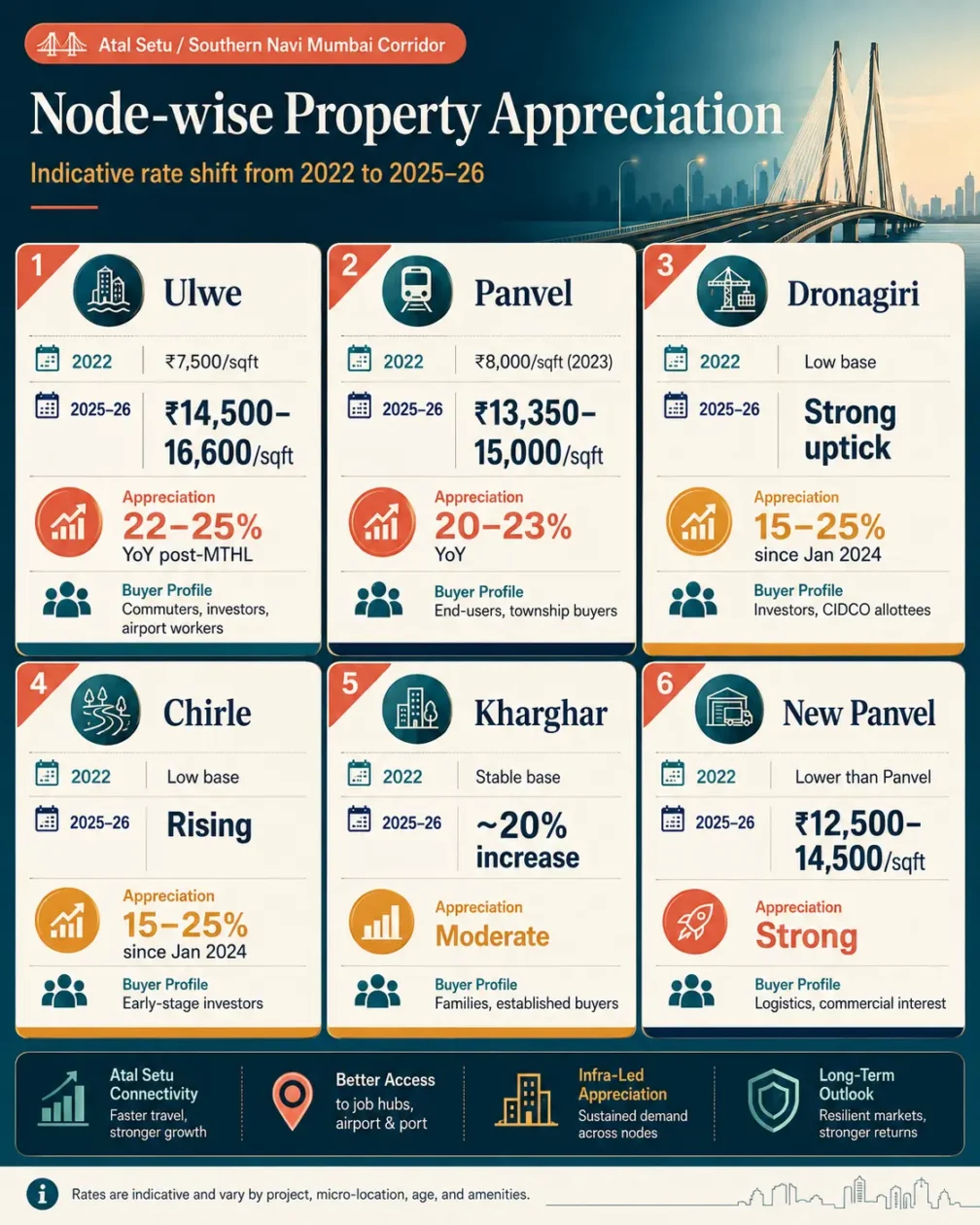
3. Node-by-Node Price Data (2022–2026)
Ulwe
Ulwe has been the fastest-appreciating micro-market post-MTHL. It combines direct bridge access with proximity to NMIA (roughly 18 km). CIDCO planned the node, so infrastructure layout is more structured than many suburban markets.
Within Ulwe, sectors 9–24 are still considered relatively affordable entry points compared to sectors already at premium pricing. That changes quickly as airport-related demand builds.
Panvel
Panvel has absorbed the combined impact of the bridge, the airport, and the Mumbai–Pune Expressway. Property prices are up significantly from 2021 levels. The affordable floor is compressing. New Panvel still offers more accessible price points with strong infrastructure growth.
Dronagiri
Dronagiri’s story is more complex. The node has massive long-term potential port connectivity, direct bridge access, CIDCO planned development. But it also has CRZ (Coastal Regulation Zone) complications (see Section 6). CIDCO recently resumed land allotments after an 18-year pause, issuing intent letters to 319 beneficiaries. That’s a positive signal, but documentation must be verified before any transaction.
4. The NMIA and NAINA Amplifier
The Atal Setu alone would be a strong enough story. But buyers in this corridor are really betting on three converging forces.
Navi Mumbai International Airport (NMIA) commenced commercial operations on 25 December 2025, with Phase 1 designed for a capacity of 20 million passengers per year. The airport’s connectivity story has now moved beyond construction: scheduled international operations began on 15 July 2026, when Air India Express launched direct services between Navi Mumbai and Abu Dhabi.
For real-estate analysis, this matters because airport connectivity is now an operational factor, not simply a future promise. However, property demand and prices will still depend on actual flight connectivity, passenger activity, employment generation, local infrastructure and neighbourhood livability.
NAINA the Navi Mumbai Airport Influence Notified Area covers 370+ sq km and 170+ villages around the airport. CIDCO has awarded over ₹6,600 crore in infrastructure tenders for roads, drainage, and utilities across Town Planning Schemes (TPS) 2 to 12. The first residential and commercial plots from NAINA schemes are projected to be ready for possession from 2027–28 onward.
In March 2024, CIDCO issued tenders for infrastructure work across TPS 2 to 7 in 94 NAINA villages. Development timelines for mega-projects often slip. Buyers should treat NAINA as a 2027–2030+ story, not a 2025 shortcut.
Example Scenario: Ulwe vs. Ghansoli in Early 2024
Priya works in BKC. In early 2024, she was comparing a 1BHK in Ghansoli (₹90L) versus Ulwe (₹85L). Her agent said both benefit from MTHL.
That was misleading.
Ulwe sits directly on the Chirle exit corridor. Her commute to BKC via MTHL would be under 40 minutes. Ghansoli’s commute to BKC had not changed she would still take the Thane–Belapur Road or rail. By mid-2026, the Ulwe property had appreciated 20%+. The Ghansoli flat moved with the broader Navi Mumbai market.
The bridge geography mattered more than the agent’s pitch.
5. Is the Appreciation Window Still Open?
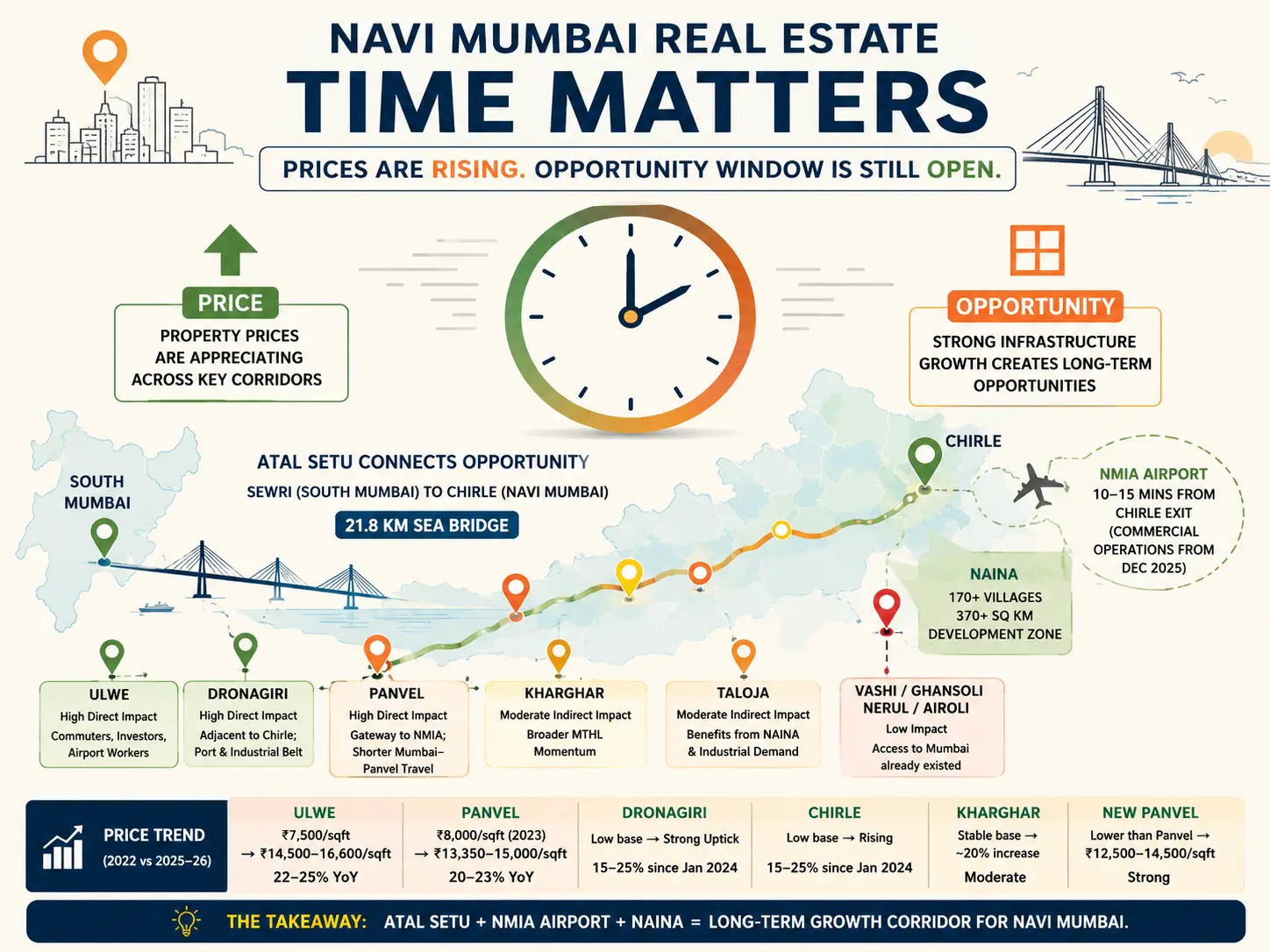
The honest answer: it depends entirely on which node and which use case.
Already substantially priced in:
Ulwe and central Panvel have absorbed most of the initial MTHL impact. Buying here now is not a mistake for end-users commute, livability, and rental yield are real. But expecting another 25% appreciation quickly is speculative.
Still early-stage potential:
Dronagiri (subject to CIDCO documentation being clean), Chirle, and NAINA-adjacent agricultural land (subject to TPS approval and legal clearance) may still offer upside. But the risk profile is higher and the timelines are longer.
A caution for investors: The availability of large land reserves in Navi Mumbai could moderate price growth over time. Infrastructure timelines regularly slip. Do not price in NAINA possession by 2026.
6. What to Check Before Paying Token Money
For Flats in Ulwe, Panvel, or Kharghar
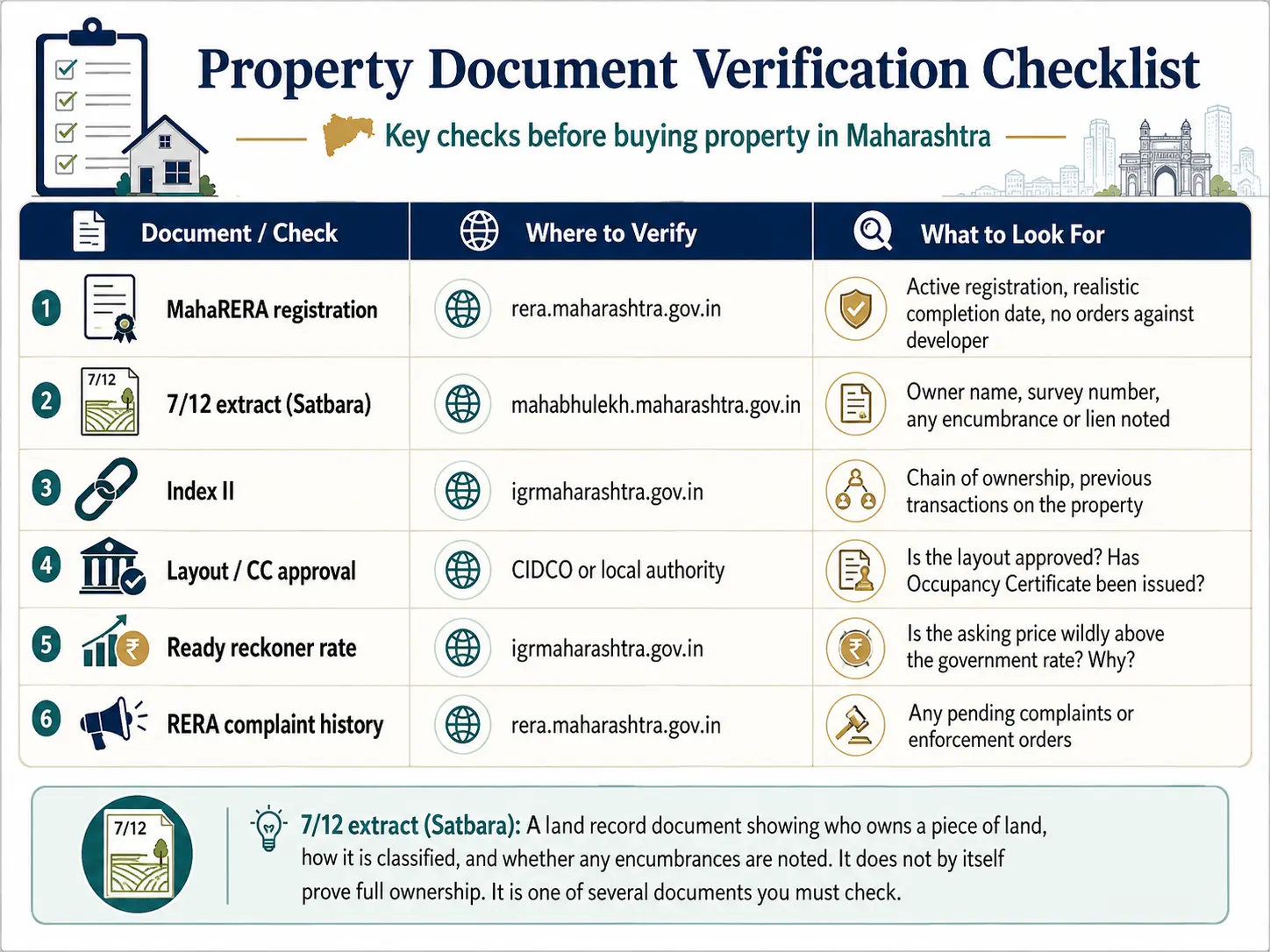
| Document / Check | Where to Verify | What to Look For |
|---|---|---|
| MahaRERA registration | rera.maharashtra.gov.in | Active registration, realistic completion date, no orders against developer |
| 7/12 extract (Satbara) shows land ownership and use | mahabhulekh.maharashtra.gov.in | Owner name, survey number, any encumbrance or lien noted |
| Index II | igrmaharashtra.gov.in | Chain of ownership, previous transactions on the property |
| Layout / CC approval | CIDCO or local authority | Is the layout approved? Has Occupancy Certificate been issued? |
| Ready reckoner rate | igrmaharashtra.gov.in | Is the asking price wildly above the government rate? Why? |
| RERA complaint history | rera.maharashtra.gov.in | Any pending complaints or enforcement orders |
> A 7/12 extract (called Satbara in Marathi) is a land record document showing who owns a piece of land, how it is classified, and whether any encumbrances are noted. It does not by itself prove full ownership it is one of several documents you must check. >
For Land or Plots in Dronagiri or Near NAINA
CRZ Check: Parts of Dronagiri may come under CRZ rules, which can limit construction. Before paying token money, check the exact plot’s CRZ status with MCZMA and a property lawyer. Do not depend only on the seller or agent.
CIDCO Documents: Check whether the plot comes under an approved NAINA TPS, who the original CIDCO allottee is, and whether the property is leasehold or freehold. The ownership and transfer documents should be clear.
NA Permission: If the land was agricultural earlier, ask for the official NA (Non-Agricultural) permission from the District Collectorate. Do not accept only a verbal claim that the plot is “NA approved.”
If you are unsure, verify the documents with the CIDCO/NAINA office, District Collectorate and a property lawyer before buying.
7. Red Flags to Watch For in the MTHL Corridor
Agent red flags
- Claims MTHL will raise prices everywhere
- NAINA plots without TPS/CIDCO proof
- High prices without clear reason
- Verbal CIDCO promises only
Document red flags
- CRZ/no-development land sold as residential
- No written NA order
- Ownership-chain issues in Index II
- Missing or lapsed MahaRERA registration
Pricing red flags
- NAINA land priced like developed Ulwe/Panvel
- Token money asked before document verification
8. Common Buyer Mistakes
Assuming all Navi Mumbai areas benefit equally. They do not. Atal Setu mainly benefits the southern corridor. Do not buy in areas like Ghansoli only because of MTHL hype.
Treating NAINA land as ready to build. NAINA projects have different timelines. Before buying, check the exact TPS status and approvals of the plot.
Paying extra because of Atal Setu. The bridge does not guarantee future price growth. Property value also depends on demand, occupancy, rental demand and airport activity.
Not checking CIDCO documents in Dronagiri. Always check the original CIDCO allotment letter, pending dues and transfer records before buying.
Trusting verbal CRZ claims. Do not depend only on an agent or seller. Check the exact plot’s CRZ status with MCZMA and a property lawyer.
9. When to Consult a Professional

- Before paying any token money on Dronagiri, Uran-adjacent, or NAINA-boundary land
- If the seller cannot produce a valid NA order for agricultural-to-residential conversion
- For any gaothan property near the Chirle–Ulwe corridor (gaothan = original village settlement area; these plots have their own title and planning issues)
- Any time CRZ, green zone, or no-development zone comes up in a property description
- If the Index II from IGR shows a dispute, a previous legal case, or a gap in the ownership chain
> This is an educational guide. Verify the latest position with the relevant authority or a property lawyer before making a transaction. >
FAQs
Frequently Asked Questions