
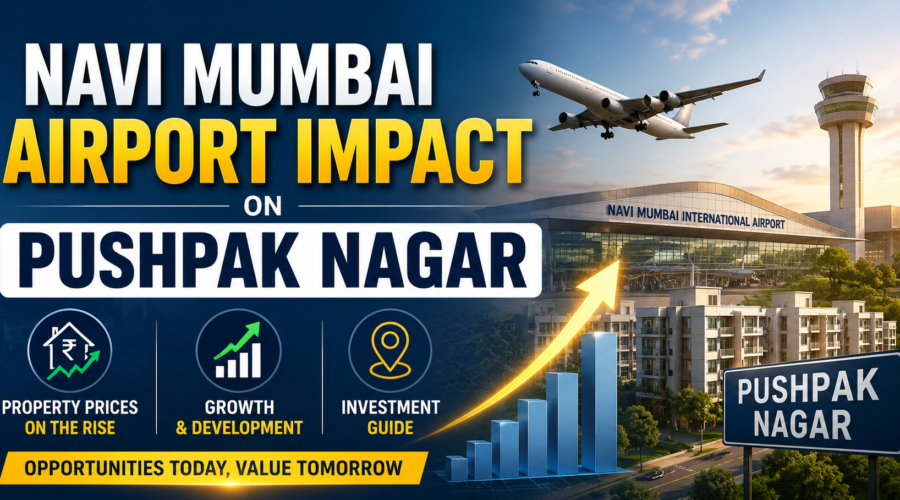
Navi Mumbai Airport Impact on Pushpak Nagar: Property Prices, Growth & Investment Guide
Pushpak Nagar is the closest CIDCO-planned residential node to the Navi Mumbai International Airport sitting just 1.5 to 3 kilometres from the terminal and is currently in the earliest stages of what analysts describe as an airport-driven growth cycle. Property prices here have moved from ₹6,000 to ₹7,000 per sq ft a few years ago to ₹9,000 to ₹11,000 per sq ft today, with experts projecting 30% to 50% appreciation over the next three to five years as airport operations, metro connectivity, and the logistics hub development mature.
What Is Pushpak Nagar?
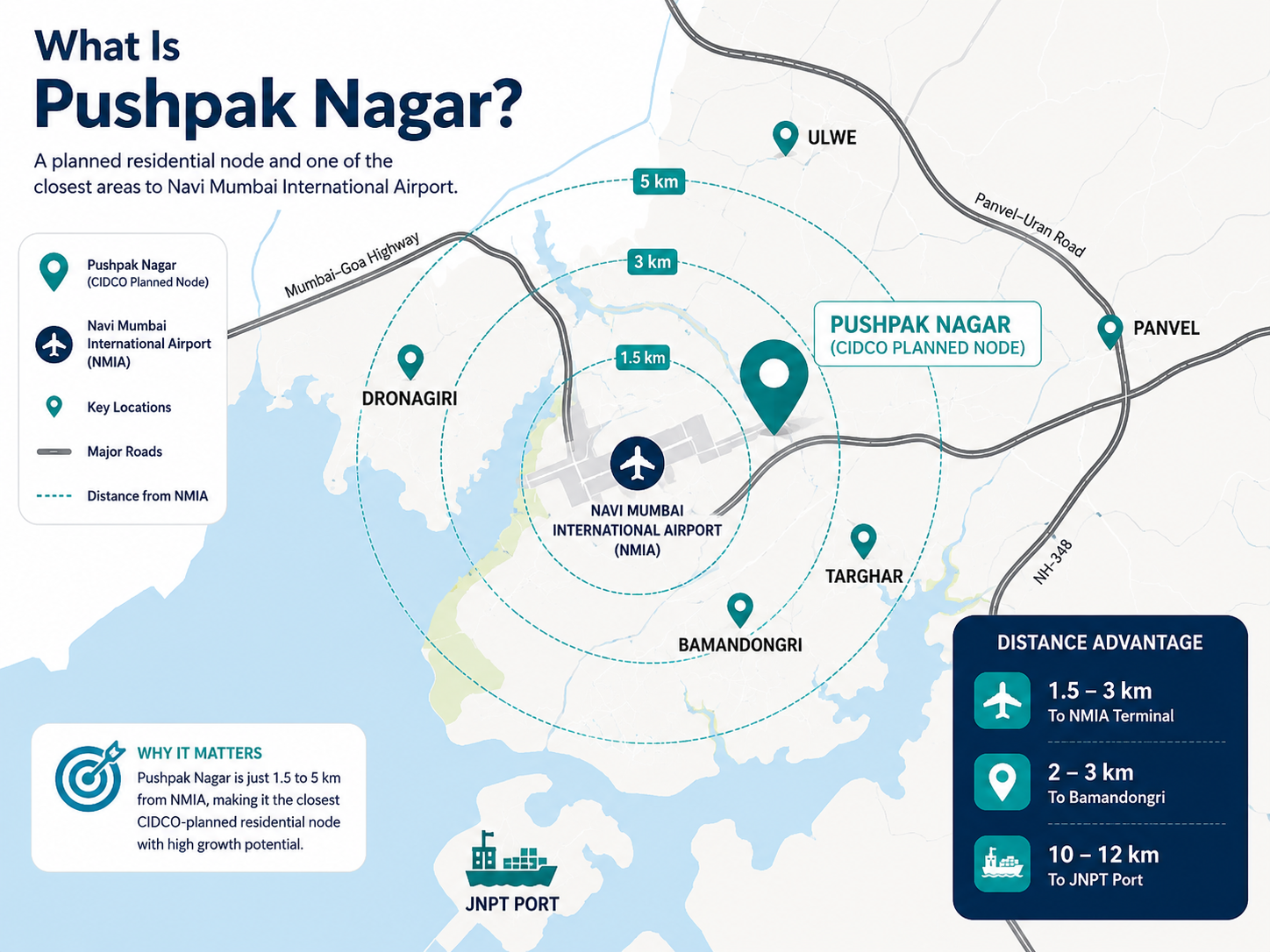
Pushpak Nagar is a planned residential node developed by CIDCO, located in the Dapoli area of Navi Mumbai. It sits within the cluster formed by Ulwe, Dronagiri, and Uran all of which fall inside CIDCO’s airport influence planning zone.
Unlike most of the other nodes discussed in Navi Mumbai’s airport story, Pushpak Nagar is not an established city district. It is a purpose-built node positioned to serve as a residential and commercial base for the airport economy. That distinction is both its risk and its upside.
The proximity is not metaphorical. Areas around Bamandongri, which falls within the Pushpak Nagar development zone, are just 2 to 3 kilometres from the NMIA terminal. Central sectors of Pushpak Nagar fall within a 5-kilometre radius. No other planned residential node in Navi Mumbai sits this close to the airport.
The Airport Opens and Pushpak Nagar's Clock Starts
The Navi Mumbai International Airport was inaugurated by Prime Minister Narendra Modi on October 8, 2025. Commercial flight operations began on December 25, 2025, with the first IndiGo flight from Bengaluru landing at 8:00 AM. The airport is now fully operational with Phase 1 capacity of 20 million passengers annually, scaling toward 90 million passengers across its full multi-phase build-out.
The inauguration activated a dynamic that Pushpak Nagar investors had been positioning for: the transition from speculative demand to actual economic activity.
Jobs in aviation, ground handling, hospitality, logistics, retail, and services are being created within minutes of Pushpak Nagar. Local businesses hotels, restaurants, logistics providers, service companies are establishing operations in the node to serve both airport employees and passengers. This wave of commercial activity is what turns a planned node into a functioning economic cluster.
For reference, a comparable dynamic played out in Ulwe over the years preceding the airport’s inauguration. Pushpak Nagar is now entering the early phase of that same cycle but with the airport already operational rather than years away.
Property Prices in Pushpak Nagar: Where Things Stand
The most important thing to understand about Pushpak Nagar’s price story is that it is in the early growth phase, not the mature phase. That means prices have moved but have not yet reflected the full value of what is being built around them.
Current Price Range
Residential apartments in Pushpak Nagar currently range from ₹9,000 to ₹11,000 per sq ft for standard configurations. Some projects closer to the airport boundary and main access roads quote a slight premium.
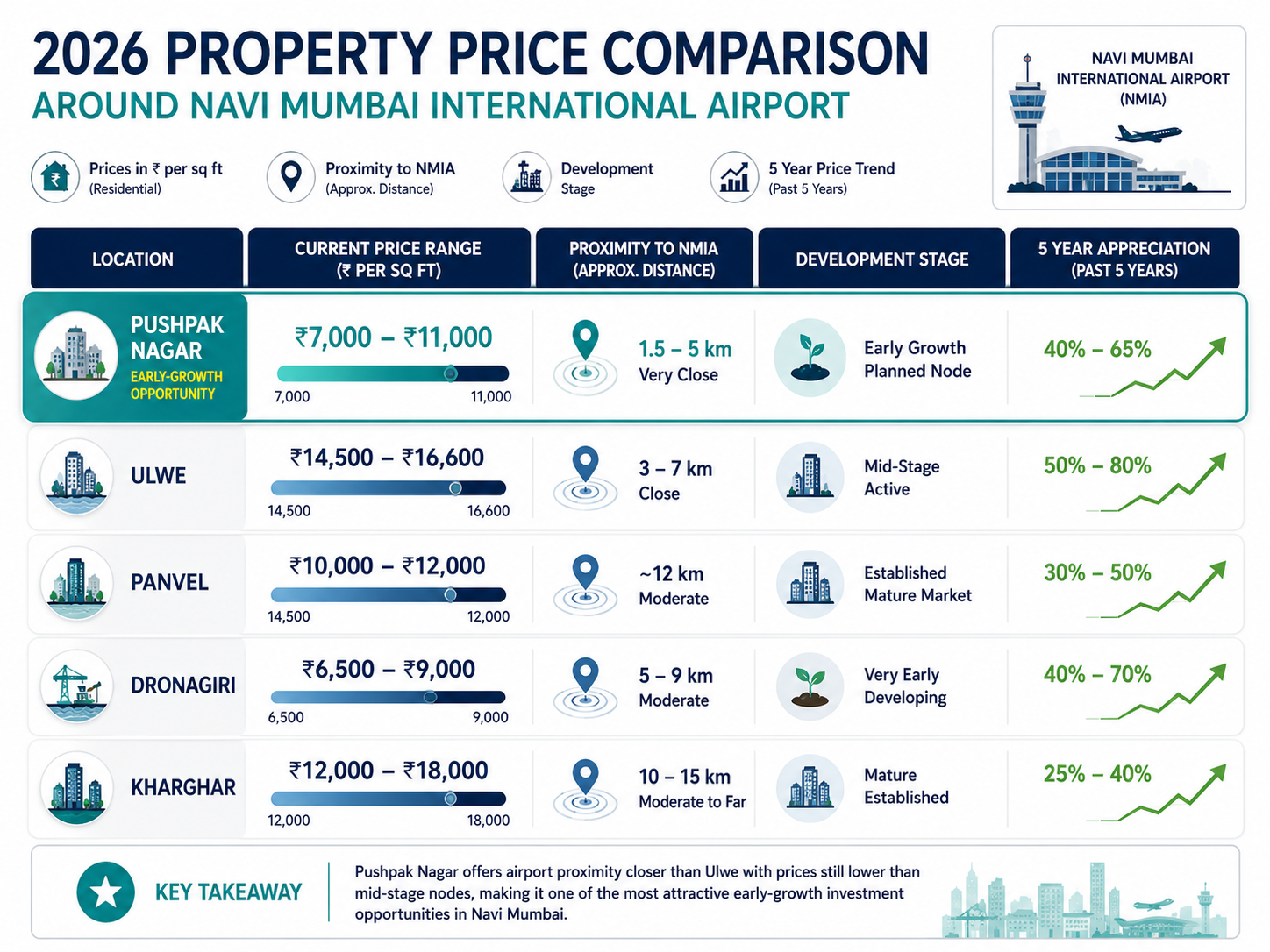
A more granular view from 2026 data puts most active projects between ₹7,000 and ₹8,500 per sq ft depending on construction stage, sector, and builder. Premium projects with better finishes and airport-facing positions are closer to ₹10,000 to ₹15,000 per sq ft.
The weighted average price on platforms like 99acres shows approximately ₹10,750 per sq ft across active listings.
How Prices Have Moved
Plots and apartments that were transacting at ₹6,000 to ₹7,000 per sq ft a few years ago are now in the ₹10,000 plus range a 40% to 65% increase from early baseline levels. The airport’s inauguraton in October 2025 accelerated the pace of enquiries and transactions noticeably.
For context, areas immediately adjacent to NMIA’s influence zone have appreciated 40% to 80% over the past five years depending on location and project quality. Pushpak Nagar sits at the lower end of that range historically, which is precisely what makes it attractive to buyers entering now.
Price Comparison With Adjacent Nodes
| Node | Current Residential Range | Proximity to NMIA | Development Stage |
|---|---|---|---|
| Pushpak Nagar | ₹7,000 – ₹11,000/sq ft | 1.5 – 5 km | Early growth |
| Ulwe | ₹14,500 – ₹16,600/sq ft | 3 – 7 km | Mid-stage, active |
| Panvel | ₹10,000 – ₹12,000/sq ft | 12 km | Established |
| Dronagiri | ₹6,500 – ₹9,000/sq ft | 5 – 9 km | Very early stage |
| Kharghar | ₹12,000 – ₹18,000/sq ft | 10 – 15 km | Mature, established |
Pushpak Nagar currently occupies the gap between Dronagiri’s raw, very early stage and Ulwe’s more established mid-stage pricing. It offers airport proximity closer than Ulwe at prices still below Ulwe’s current levels. That gap is expected to narrow as infrastructure matures.
The Infrastructure Building Around Pushpak Nagar
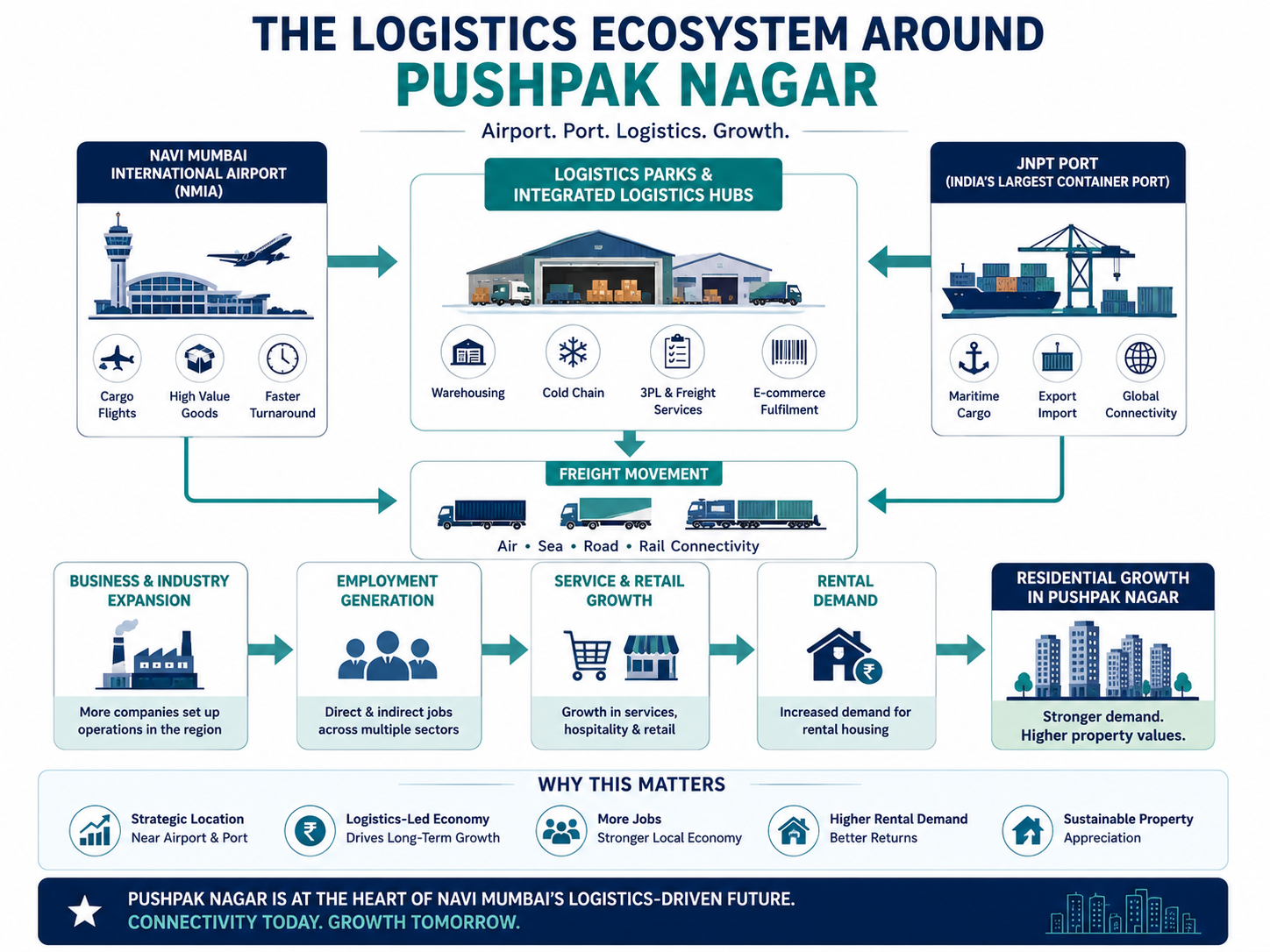
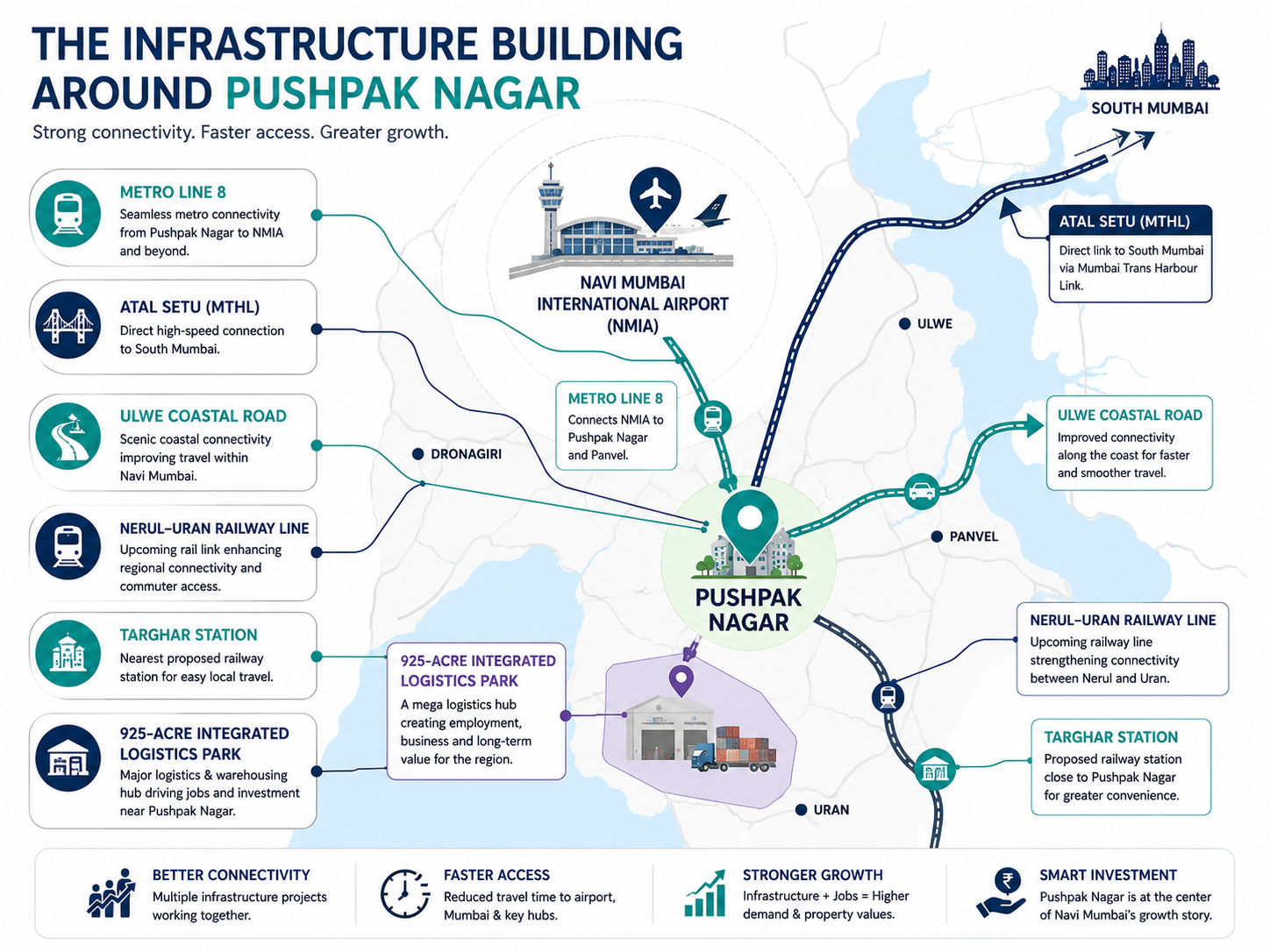
Pushpak Nagar’s growth story is not just about the airport terminal nearby. It is about everything being built around and between the airport and this node.
CIDCO's 925-Acre Integrated Logistics Park (ILP) at Pushpak Node
This is one of the most significant commercial developments directly tied to Pushpak Nagar’s future. CIDCO has launched the bidding process for the first phase of a 925-acre Integrated Logistics Park at the Pushpak Node. This is expected to be one of the largest logistics infrastructure projects in the Mumbai Metropolitan Region.
The ILP will attract warehousing, cold chain, freight forwarding, and e-commerce fulfilment operations that need airport and port adjacency. JNPT, India’s largest container port, is also nearby. Together, NMIA and JNPT make the Pushpak Node one of the most strategically located logistics corridors in India.
The employment that flows from this logistics park direct and indirect will create structured housing demand within Pushpak Nagar for years.
Ulwe Coastal Road
This ₹1,590 crore project is a 6.7-kilometre six-lane elevated road connecting the Atal Setu junction at Shivajinagar directly into the airport terminal via an elevated link. Construction is progressing. When complete, this road will make Pushpak Nagar one of the most airport-accessible nodes in the entire MMR not just in straight-line distance but in actual drive time.
Mumbai Trans Harbour Link (Atal Setu)
The MTHL, India’s longest sea bridge at 21.8 kilometres, connects Chirle (near the Panvel belt) to Sewri in South Mumbai. It has already cut travel time from this corridor to South Mumbai to under 20 minutes. For Pushpak Nagar residents, this creates a commutable link to Mumbai’s business districts that simply did not exist before 2024.
Nerul-Uran Railway Line and Targhar Station
The 27-kilometre fourth corridor railway line through Belapur/Nerul to Kharkopar and Uran has made Targhar station a major rail linkage to the airport. Pushpak Nagar’s connectivity to this railway line via Targhar and Bamandongri stations is one of its key transit strengths. CBD Belapur, Dapoli, and Targhar railway stations connect Pushpak Nagar to the broader Navi Mumbai network.
Metro Line 8 (Gold Line)
The planned metro Gold Line will directly connect NMIA to CSMIA (Mumbai’s existing international airport). This creates a seamless aviation corridor across the MMR. Properties near NMIA-adjacent metro stations which includes Pushpak Nagar’s broader belt represent an early-entry opportunity identified by analysts tracking the 2026 investment landscape.
The Logistics Economy: Why Pushpak Nagar Is Different From Other Residential Nodes

Most airport-adjacent residential nodes in Navi Mumbai are primarily benefiting from business and lifestyle demand corporate employees, hospitality workers, professionals seeking airport access.
Pushpak Nagar has an additional economic layer: the port-and-airport logistics economy.
Its location between NMIA and JNPT is not incidental. CIDCO planned this node specifically to serve both infrastructure ecosystems. The 925-acre ILP makes that explicit. Businesses needing air freight access from NMIA and sea freight access from JNPT which includes most import-export heavy industries, pharmaceutical logistics, auto parts, electronics, and perishable goods will congregate in this belt.
That is a different quality of economic driver compared to what most Navi Mumbai residential nodes are benefiting from. It is structural demand tied to global trade flows, not just domestic employment cycles.
For investors focused on long-term rental yield from blue-collar and mid-level workforce housing, this distinction matters.
Who Is Buying in Pushpak Nagar Right Now?
The buyer profile in Pushpak Nagar today is primarily investors and early-stage buyers with a medium-to-long-term horizon.
Investors seeking early-cycle returns are the dominant buyer type. The Ulwe analogy is frequently invoked Ulwe was in a similar stage five to seven years ago before airport activity and infrastructure investment drove prices sharply higher. Buyers who entered Ulwe at that stage have seen substantial appreciation.
Airport economy workers are beginning to enquire about rental accommodation in Pushpak Nagar. The airport’s Phase 1 employment across ground handling, retail, security, hospitality, and operations will create a workforce that needs affordable housing within commuting distance of the terminal.
Logistics sector professionals attracted by the ILP development are another emerging buyer segment.
CIDCO lottery applicants target Pushpak Nagar for affordable housing under CIDCO’s structured schemes. CIDCO’s master plan for the node includes a 22.5% rehabilitation allocation in certain sectors, with lottery units providing below-market entry points.
NRI investors drawn by the airport’s international connectivity and the node’s raw growth potential are active in the plot and apartment market.
Honest Assessment: What Pushpak Nagar Is and Is Not
Any credible assessment of Pushpak Nagar must acknowledge what the data shows clearly.
What it is: One of the highest-proximity planned residential nodes to NMIA in all of Navi Mumbai. Backed by CIDCO planning with structured road and utility infrastructure. Positioned to benefit from both airport and port logistics demand. Currently at price points well below mature airport-corridor nodes. In early growth phase with sustained infrastructure investment confirmed.
What it is not: An established city with functioning social infrastructure. Schools, hospitals, shopping centres, and daily convenience services are still developing. Public transport options are more limited compared to central Navi Mumbai nodes like Vashi or Nerul. Rental options are fewer than sale properties. Construction activity across multiple pockets will continue for several years.
Buyers who enter Pushpak Nagar today are making a medium-to-long-term bet. That does not mean the bet is unwise the data from analogous airport-adjacent nodes globally and domestically supports the thesis. But it requires realistic expectations about the timeline for social infrastructure to mature.
What to Verify Before Buying in Pushpak Nagar
MahaRERA registration: Confirm that any project is registered with MahaRERA and that possession timelines are binding. Pushpak Nagar has projects at different stages of development. Some are ready-to-move, others are pre-launch or under construction. [Verify registration at maharerait.maharashtra.gov.in]
CIDCO approvals: For CIDCO-planned plots and lottery units, confirm allotment status and occupancy certificate timelines through CIDCO’s official portal at cidco.maharashtra.gov.in.
Connectivity status: The Ulwe Coastal Road and some metro extensions are in progress. Verify actual completion timelines rather than relying on projected dates in marketing materials.
Social infrastructure proximity: Map the distance to the nearest operational school, hospital, and grocery infrastructure from the specific project, not the node broadly.
This article is for informational purposes only. It does not constitute investment advice. Consult a RERA-registered real estate advisor and verify all claims with relevant authorities before any transaction.
FAQs
Frequently Asked Questions