
Kharghar Property Rates and Market Trend in 2026: Sector Prices, Budget Range and Buying Signals
Kharghar property rates are strong in 2026, but they are not uniform and they are definitely not justified everywhere. Some sectors, societies, and micro-pockets deserve a real premium because of location, livability, and long-term infrastructure logic. Others are simply being quoted high because of branding, future hype, or the general Kharghar name. If you are planning to buy here, the market has to be read sector by sector, building by building, not by one average number.
Kharghar is no longer the old affordable extension of Navi Mumbai. It has moved into a more selective phase. Metro Line 1 is already operational, the Navi Mumbai International Airport continues to shape long-term sentiment, the Kharghar-Turbhe Tunnel is under execution, and the International Corporate Park has started changing land-value expectations. At the same time, buyers still face practical realities such as uneven sector quality, older societies, heavy quote inflation in some new launches, and the very important question of water reliability.
That is why a simple “Kharghar average rate” is not enough anymore.
Kharghar property rates in 2026 are strong, but not every part of Kharghar deserves the same price
The first thing to understand is this: there is no single meaningful average for Kharghar.
On paper, the broader market can look like it sits around the mid-teens to high-teens per sq.ft. range, with a broad working average near ₹17,500 per sq.ft. But that number hides the real market. In practice, older or weaker-value pockets can still sit around ₹9,000 to ₹11,000 per sq.ft., while high-demand premium towers or stronger sectors can move beyond ₹20,000 and even ₹25,000 per sq.ft. In some top-end cases, much higher asking numbers are also seen.
Even inside the same sector, rates can vary sharply depending on the society. One building may command a serious premium because it has better maintenance, clearer product positioning, better internal layout, and stronger day-to-day livability. Another may trade much lower despite sharing the same pin code.
At this budget level, it becomes more useful to compare the best sectors in Kharghar rather than looking at Kharghar as one uniform market.
Quick summary
| Market factor | What it means in Kharghar in 2026 |
|---|---|
| Overall rate trend | Strong, but highly uneven |
| Old belief that “all Kharghar will appreciate equally” | No longer true |
| Premium pricing | Justified only in selected sectors and better societies |
| Budget buyer position | Mostly pushed toward older resale or less preferred pockets |
| New-launch market | Often pricing in future value aggressively |
| Best use case | Strong for self-use, selective for investment, average for pure yield |
So the right question is not “What is the Kharghar rate?”
The right question is: Which Kharghar, which sector, which building, and for what purpose?
What is the realistic price range for 1 BHK, 2 BHK, and larger flats in Kharghar
Budgets in Kharghar now decide not just size, but also age of building, society quality, and how much compromise you will accept.
A compact 1 BHK with around 400 to 450 sq.ft. carpet generally falls in the ₹45 lakh to ₹65 lakh range. These are mostly older resale options, standalone buildings, or locations that are not part of the premium micro-market. Entry-level buyers should understand that 1 BHK supply in better new launches is limited, and where available, it is rarely value-for-money.
A 2 BHK is where the market becomes very wide. In 2026, a practical range is roughly ₹75 lakh to ₹1.55 crore. That is a huge spread, and it exists because a basic older 2 BHK and a compact branded new 2 BHK are completely different products.
For 3 BHK and larger homes, the market moves from around ₹1.20 crore upward, and in branded or premium developments it can comfortably go beyond ₹2.50 crore.
Realistic budget band guide
| Configuration | Approx. carpet area | 2026 realistic price range | What this usually means |
|---|---|---|---|
| 1 BHK | 400–450 sq.ft. | ₹45 lakh – ₹65 lakh | Mostly older resale or peripheral/value-led locations |
| 2 BHK | 600–750 sq.ft. | ₹75 lakh – ₹1.55 crore | Can range from old practical stock to compact premium towers |
| 3 BHK+ | 900–1100+ sq.ft. | ₹1.20 crore – ₹2.50 crore+ | Mostly premium sectors, branded towers, or lifestyle-led products |
Where compact 1 BHK budgets still work
They usually work only if the buyer is realistic. In Kharghar, a lower entry budget now often means accepting one or more of these trade-offs: older building age, weaker amenities, less prime internal location, or distance from the strongest family-led sectors.
Rates alone do not decide value, because your result also depends on new projects vs resale flats in Kharghar and what each format actually offers.
What mid-budget buyers usually get in 2 BHK
This is the most important segment in the market. A mid-budget buyer can either get:
- an older but more established resale flat in a mature sector, or
- a much newer but more compact unit at a higher per sq.ft. rate
This is where many buyers get confused. They compare headline area and miss the deeper question of value.
Where larger and premium homes start separating from the rest
At the upper end, Kharghar becomes a lifestyle market. Branding, clubhouse scale, security, views, low-density feel, and proximity to prestige pockets begin to matter more. This is where golf-course-facing or stronger premium-sector pricing shows up more clearly.
Which sectors and pockets in Kharghar usually sit in higher, middle, and more value-led price bands
Kharghar works best when you divide it into pricing behaviour, not just map labels.
Premium belts
Premium sectors and pockets usually include areas such as Sectors 23, 6, 12, and 20. These are the parts of Kharghar where better social infrastructure, Central Park influence, better visual environment, stronger address value, and lower-density feel can support higher pricing.
This is where premium pricing is more often justified, though even here not every quote should be accepted blindly.
Stable family-led belts
Sectors such as 11, 18, 19, and 21 generally fit the stable family segment better. These sectors often make more sense for end users because they combine practical daily living with better-established surroundings. School access, regular market convenience, and mature residential character matter a lot here.
This band is often the safest zone for buyers who want long-term self-use, not speculative excitement.
Value or emerging belts
Upper Kharghar, especially Sectors 34, 35, and 36, sits in a different logic altogether. The entry price can be more approachable relative to stronger core pockets, and Metro Line 1 improves long-term relevance. But the ground reality is still mixed. Construction activity, dust, uneven local market maturity, and the wider effect of the Taloja side environment still matter.
These sectors suit buyers who understand that they are buying future potential, not fully settled comfort today.
Why are some Kharghar properties priced much higher than others
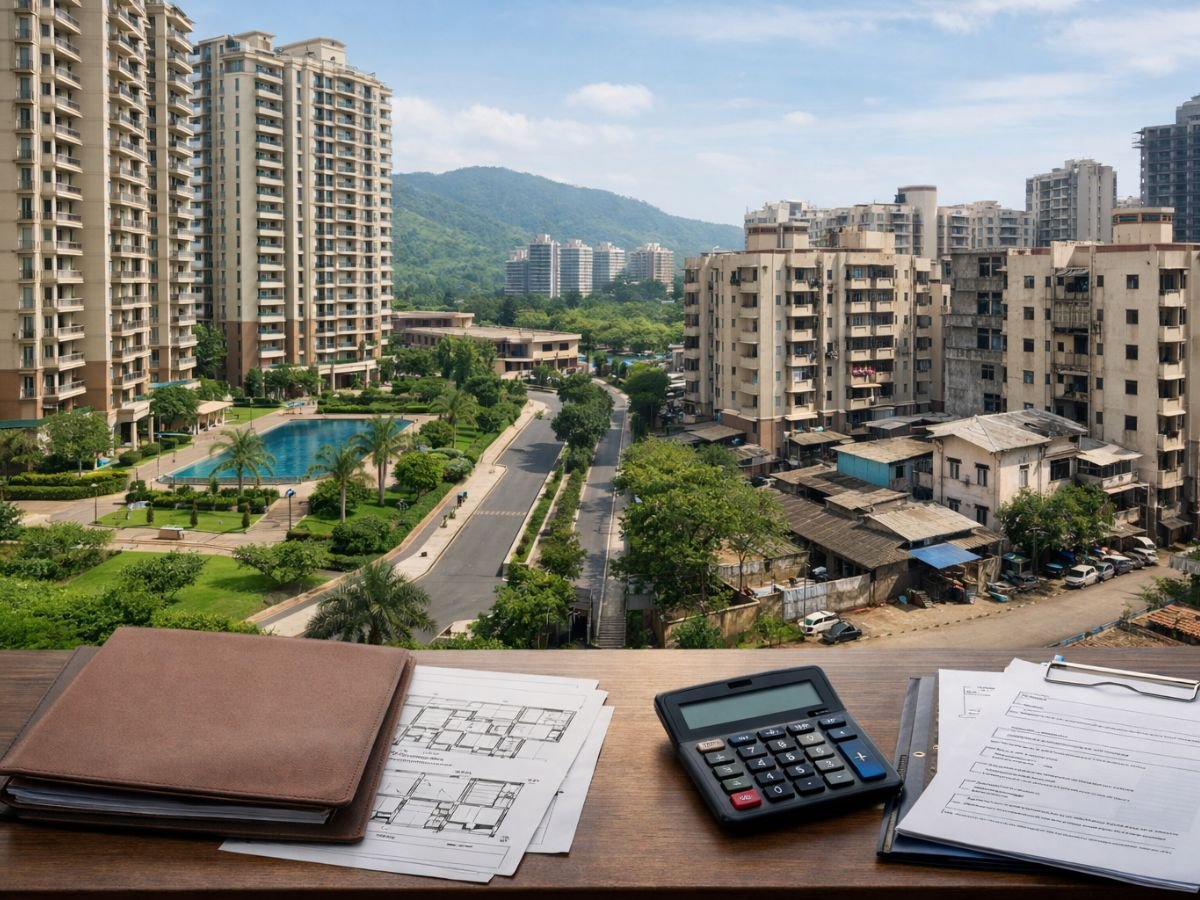
A higher price in Kharghar is not always fake. But it is also not always deserved.
The market usually rewards a property for five real reasons: stronger sector, better walkability or access, healthier society condition, better overall livability, and lower daily friction. That last point is very important. In 2026, buyers are not just paying for carpet area. They are paying for convenience, reputation, and predictability.
Here is what can genuinely justify a premium:
- strong sector reputation and mature surroundings
- better access to major roads or transit, including real metro usefulness, not just brochure distance
- better-maintained society with stable occupancy
- stronger view, internal planning, or lower congestion
- better school, market, and daily-service convenience
- clearer legal and civic comfort, including OC and basic infrastructure stability
- lower hidden friction, especially water-related stress
One local reality deserves special attention here. Kharghar’s rapid high-rise growth has, in many cases, moved faster than civic water supply integration. That means some societies depend meaningfully on private tanker support. In resale deals, this can quietly affect maintenance cost, resident satisfaction, and long-term purchase value. Two buildings that look similar on paper may differ sharply on this point.
So if one society is quoting a strong premium, the buyer should ask a blunt question: is this premium based on real livability, or only on launch marketing and future story?
Is Kharghar still appreciating, or has the market become selective
Kharghar is still an appreciating market, but the old easy-growth phase is gone.
The broader node has seen meaningful appreciation in recent years, but the growth is no longer uniform. Some micro-pockets and branded launches show sharp upward movement. Others are much flatter. This is now a selective market where infrastructure, sector strength, and product quality decide the result.
That distinction matters. A portal can show rising asking prices, but asking prices are not the same as closed-deal strength. In many cases, the rise is partly driven by new launches setting higher anchors rather than all existing buildings truly moving upward at the same pace.
This is why 2026 should not be seen as a blind “buy now before it doubles” market. It should be seen as a market where appreciation still has logic, but mainly in places where the base product is already sound and the infrastructure story is believable.
The long-term support for Kharghar is real:
- Metro Line 1 is operational
- the Kharghar-Turbhe Tunnel is under execution with a 2028 target
- NMIA continues to shape broader investor confidence
- the International Corporate Park is creating a higher long-term land-value narrative
But a buyer should still separate infrastructure-backed value from future hype already priced in today.
Resale flats vs new projects in Kharghar: which side of the market makes more sense now
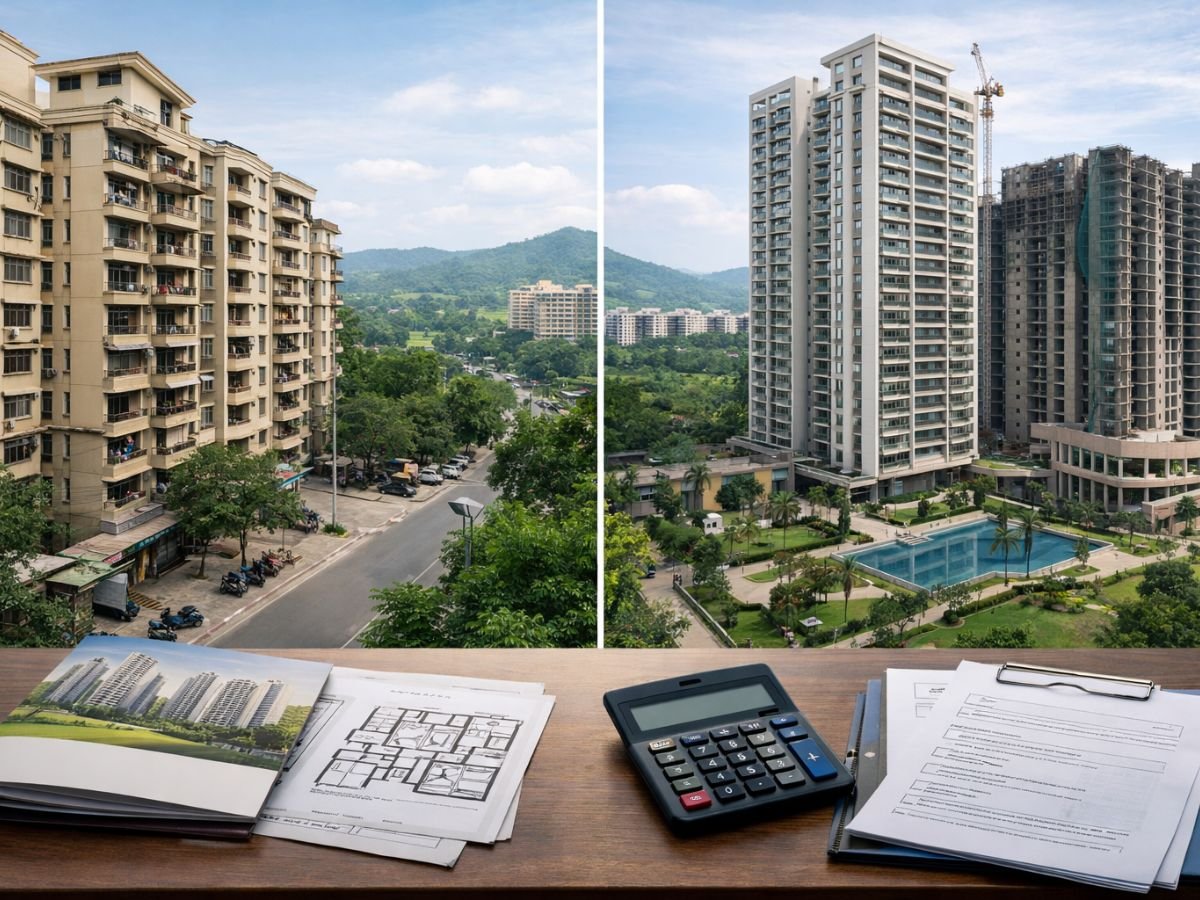
This is one of the biggest practical decisions in Kharghar right now.
New projects are often quoting at levels that already assume a stronger 2028 to 2030 story. Premium and branded launches may ask well above many resale properties in the same node. That does not automatically make them wrong. For some buyers, especially higher-budget families, that premium buys convenience, design, amenities, and a smoother lifestyle product.
But mathematically, resale often looks sharper for value.
A well-maintained 5 to 10-year-old resale flat in a stable sector can still offer a much more sensible entry price, immediate usability, and rental income from day one. New under-construction projects come with 5% GST, execution timelines, and the risk that today’s premium is being paid for tomorrow’s promise.
Resale vs new project comparison
| Factor | Resale flat | New project |
|---|---|---|
| Entry price | Usually lower | Usually higher |
| Possession | Immediate | Delayed |
| GST | No GST on completed resale | 5% GST applicable |
| Rental income | Can start quickly | Not immediate |
| Society maturity | Clearer on ground | Future promise |
| Amenities | Often limited in older stock | Usually stronger |
| Pricing risk | More negotiable | More marketing-led |
| Best for | Value-focused end users | Premium lifestyle buyers with holding power |
What budget is now needed to buy in Kharghar without forcing a weak compromise
This is where the market becomes real.
A buyer with ₹65 lakh to ₹80 lakh is not really shopping across all of Kharghar. That budget mainly opens older 2 BHKs in weaker or legacy pockets, or smaller 1 BHK/compact options where society quality and product comfort may not match the premium Kharghar image many people carry in their mind.
A buyer with around ₹1.2 crore to ₹1.5 crore is in a much stronger position. This is the band where a practical, well-maintained 2 BHK in a stable family sector starts becoming realistic. It may also open compact new-build options, though value has to be checked carefully.
At ₹2 crore and above, the buyer is entering the premium lifestyle side of Kharghar more meaningfully. This budget allows better sector choice, larger homes, and stronger amenity-driven projects.
One important point: buyers should not plan only for purchase price. Stamp duty, registration, interiors, parking, maintenance deposit, and moving costs together need a proper buffer.
Does Kharghar still make sense for self-use, investors, and rental-focused buyers
Kharghar does not suit all buyer types equally.
For self-use buyers, Kharghar remains one of the strongest choices in Navi Mumbai. It offers green cover, broad internal planning in many parts, strong educational presence, and a more complete family lifestyle than many cheaper nodes.
For investors, the answer is more selective. Buying purely because “Kharghar name will always go up” is not enough now. At current pricing, an investor needs to be far more careful about entry point, sector, and product type. Long-hold investors may still do well in the right pocket, especially where infrastructure value is not fully exhausted, but lazy buying is risky.
For rental-yield-focused buyers, the market works, but it is not outstanding. Typical residential yields remain modest, generally around the high-2% to low-3% range for many practical 2 BHK formats. Vacancy risk can remain manageable because of educational demand, local work movement, and broader residential appeal, but this is not a pure cash-flow market.
Where buyers should be careful even if the Kharghar pin code looks attractive
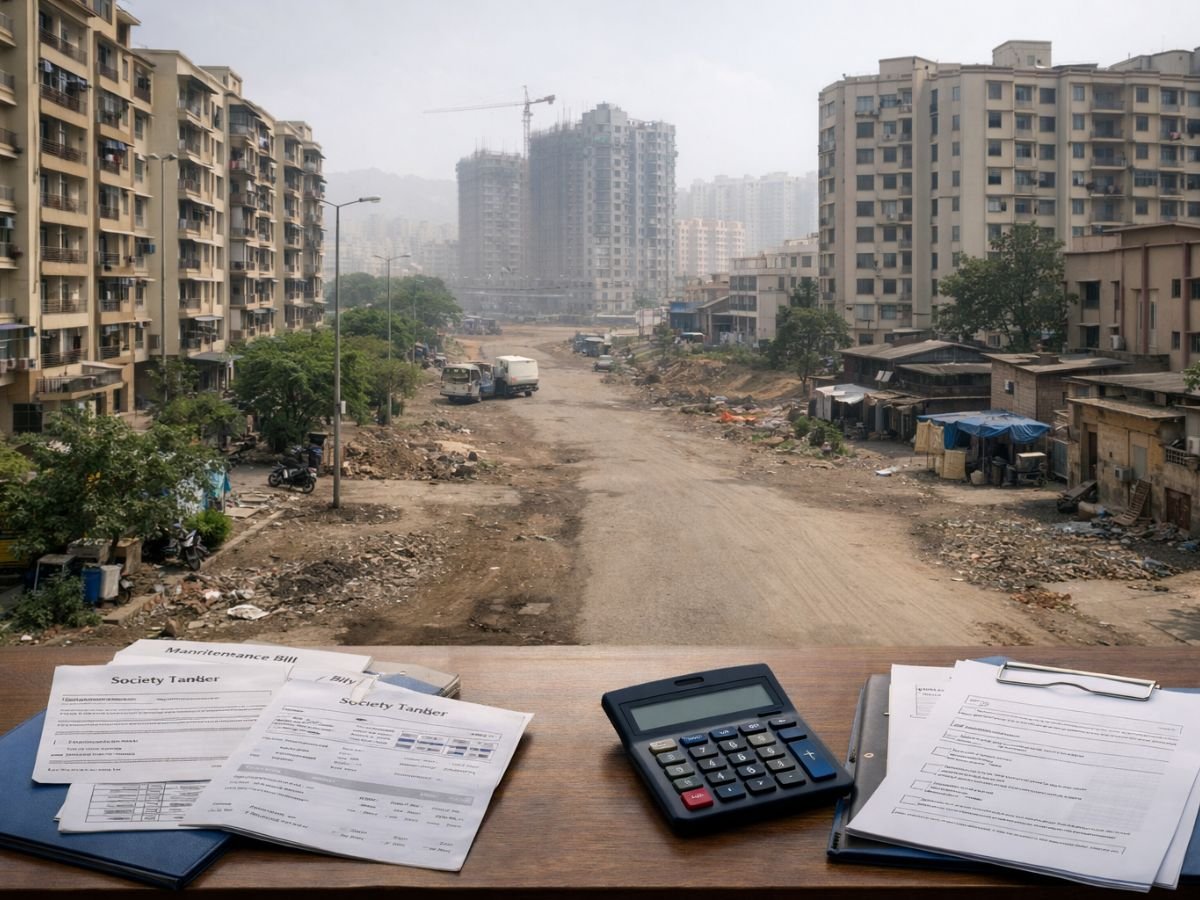
This is the part many generic articles avoid.
Kharghar’s branding is strong, but not all of its real-life friction is visible in listing photos. A buyer should be especially careful in four situations:
- when the quote is premium but the society is older and under-invested
- when the flat is “near metro” only in marketing language, not in actual walkability
- when the micro-pocket faces dust, weak surroundings, or long-term livability issues
- when the society depends heavily on tanker water and the buyer has not checked maintenance burden
The water issue deserves special caution. A practical buyer should ask for the last several months of society maintenance bills and understand how much of the running cost is influenced by tanker dependency. That is not a small detail. It affects operating cost and long-term comfort.
Upper Kharghar buyers should also think carefully. It offers future value logic, but parts of it still come with construction-heavy surroundings and the wider Taloja-side influence, which not every family will enjoy immediately.
How to read Kharghar rates correctly before you shortlist or negotiate
Good buying in Kharghar is not only about choosing the right flat. It is about reading the rate correctly.
Do not treat portal quotes as final truth. In many cases, especially in resale, quoted prices can still come down depending on urgency, time on market, and building quality. If a property has been sitting for a while, negotiation room may exist.
Also remember that Maharashtra’s Ready Reckoner rate is not the same as actual market value. It helps determine the minimum stamp duty basis, but buyers should not use it as a shortcut to judge whether a market quote is fair.
Use this checklist before you commit:
Buyer checklist before accepting a Kharghar price
- compare the quote with recent transaction patterns where possible
- ask whether the per sq.ft. number is based on carpet or saleable area
- check society age and likely repair burden
- verify Occupancy Certificate and building status
- ask about water source mix and tanker dependency
- understand actual walking or commuting distance, not just brochure positioning
- check maintenance level, parking terms, and pending dues
- separate premium for real livability from premium for only branding
This one discipline alone can save a buyer a lot of money.
So, are Kharghar property rates justified in 2026
Yes, but only in the right pockets and for the right reason.
Kharghar is not overpriced as a whole. That is too simplistic. The stronger sectors, better societies, and genuinely livable premium pockets have real support behind them: Metro Line 1, improving regional connectivity, airport-led sentiment, corporate district planning, and a strong end-user base. Those rates can be justified, especially for long-term self-use buyers.
But the market is also carrying stretched pricing in selected new launches and weaker-value pockets where future story has run ahead of present-day product quality. That is where buyers must slow down.
The best way to read Kharghar in 2026 is this: buy for real livability first, future upside second, and marketing promise last. Buyers who follow that order are far less likely to overpay.
Conclusion
Kharghar property rates in 2026 are not cheap, and they should not be approached casually. But this is still one of the few Navi Mumbai markets where stronger prices can make real sense if the buyer chooses carefully. The safest logic today is in mature family sectors, well-kept resale societies, and premium pockets where livability is already proven. The weakest logic is in blindly paying future-driven premiums without checking current ground reality.
If you are buying in Kharghar now, do not ask whether the node is good. Ask whether the exact sector, exact society, and exact price are good. That is the real market question in 2026.
FAQs
Frequently Asked Questions