
Old Panvel vs New Panvel for Business and Commercial Property: Which area is better for living?
Old Panvel is usually better for traditional retail, dense local catchment, and old-market business formats. New Panvel is usually better for organized offices, modern service businesses, cleaner access, and businesses that need parking and a more structured client experience. That is the practical answer. But there is no single winner. The better choice depends on what your business actually does, how customers reach you, how much frontage you need, and whether you are buying for self-use or investment.
Choosing between Old Panvel and New Panvel for commercial property is not really a debate about which area looks better on paper. It is a business model decision. A pharmacy, jeweller, hardware trader, coaching centre, dental clinic, CA office, or café will not all succeed in the same type of commercial location.
That is where many buyers get it wrong. They compare Old Panvel and New Panvel the way people compare residential areas. Commercial property does not work like that.
Before comparing both sides too closely, Panvel Commercial Property Guide is worth reading for the bigger picture.
Quick Summary
| Factor | Old Panvel | New Panvel |
|---|---|---|
| Best suited for | Traditional retail, bazaar-led businesses, dense pedestrian demand | Offices, clinics, coaching, organized service businesses, modern retail pockets |
| Shop suitability | Strong in proven market lanes | Selective, pocket-dependent |
| Office suitability | Usually weaker except limited specific uses | Usually much stronger |
| Footfall type | Dense, friction-heavy, local and repeat | More planned, mixed commuter and destination-driven |
| Parking ease | Weak | Better |
| Road width and access | Often constrained in legacy belts | Generally more organized |
| Building stock | Older, variable, needs stronger checks | More structured, planned, and easier to evaluate |
| Self-use ease | Good only if your business suits old-market conditions | Usually safer for modern daily operations |
| Investment style | Stronger for premium retail visibility and stable shop demand | Better for structured office demand and lower-entry growth bets |
| Main risk | Congestion, parking stress, older building issues | Buying the wrong internal pocket and expecting retail magic |
Old Panvel and New Panvel are not the same commercial market
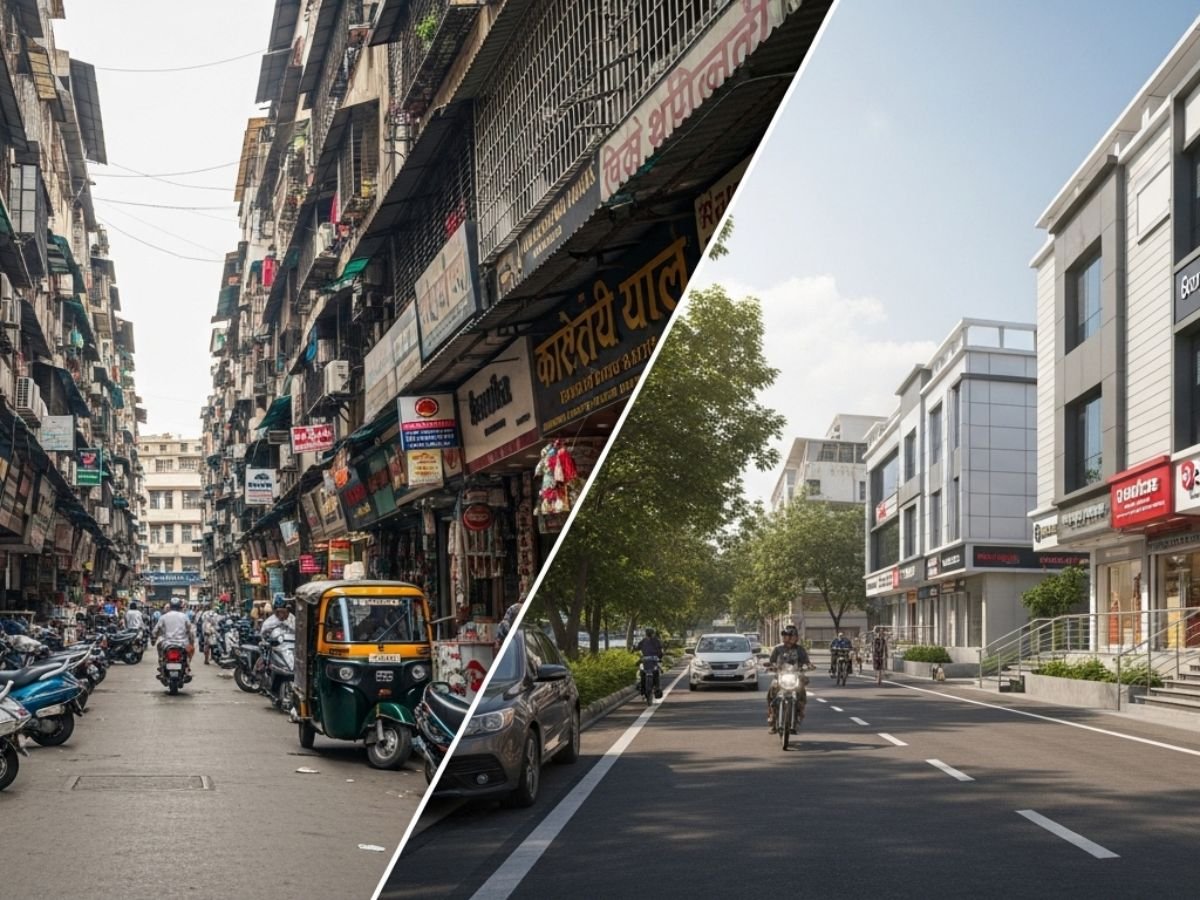
The biggest mistake is to treat Panvel as one single commercial market. It is not.
Old Panvel is an organically evolved market area. It behaves like a traditional bazaar economy. Streets, legacy shopping habits, clustered categories, repeat local trust, and dense movement matter a lot here. Areas around Joshi Ali, Shivaji Chowk, Tapal Naka, and Bunder Road carry this logic strongly.
New Panvel is a planned CIDCO-origin node, though civic governance and taxation are now under Panvel Municipal Corporation (PMC). It works more through sectors, road layout, station-side movement, defined commercial pockets, and cleaner access. The Sector 1–Orion Mall–ST Depot axis and Khanda Colony matter here for different reasons.
So the real comparison is not old versus new in an emotional sense. It is bazaar-density commercial logic versus planned-node commercial logic.
When does Old Panvel make more sense for business?
Old Panvel makes more sense when your business needs dense movement, street-level visibility, and a customer base that is already comfortable shopping in tight, active market lanes.
Businesses that benefit from Old Panvel’s dense old-market movement
Old Panvel usually works better for:
- jewellery and traditional gold retail
- daily-need retail
- wholesale hardware and utility trade
- apparel and legacy local shopping
- sweet shops and food counters
- pharmacies and practical convenience buying
- businesses that benefit from nearby category clustering
A good example is Joshi Ali, often treated locally as one of Panvel’s strongest old-market shopping belts for jewellery and legacy trade. Why does such a pocket stay valuable? Because customers are not coming for one isolated shop. They are coming for a market experience, where they compare options quickly and trust the area’s long-standing retail identity.
Where Old Panvel beats cleaner planned locations
Old Panvel can outperform a visually superior location if your business depends on:
- impulse buying
- dense local repetition
- category-based destination shopping
- street familiarity
- pedestrian friction, where people naturally slow down and browse
That is why a traditional retailer can do very well in a congested old-market lane while the same business may struggle on a clean, wide, quiet road in a planned sector.
What can go wrong even in a strong Old Panvel location?
Old Panvel is not automatically safe just because it is busy.
The operational downsides are serious. Customer parking can be weak or nearly absent. Delivery vehicles can struggle. Older structures may need more careful checks. In legacy pockets, road width constraints and older building conditions matter more than many buyers assume.
So yes, Old Panvel can deliver superior retail economics. But it demands tolerance for friction.
When does New Panvel make more sense for business?
New Panvel makes more sense when your business needs organized access, cleaner roads, a more professional client experience, and a building environment that supports office or service use.
This is where many modern businesses naturally fit better.
Businesses that need organized roads, cleaner access, and planned surroundings
New Panvel usually works better for:
- CA and law offices
- IT support offices
- consulting firms
- specialized clinics
- coaching classes
- bank branches
- service centres
- destination-led cafés and branded outlets in the right pockets
The reason is simple. These businesses are not just buying visibility. They are buying usability. They need client comfort, staff access, decent road movement, and in many cases parking.
Why office and service formats feel more natural in New Panvel
Office space in New Panvel and Khanda Colony usually has a more practical advantage because offices need a different ecosystem than shops.
A shop can survive noise and friction if it gets buying traffic. An office usually cannot. Offices need:
- easier employee commute
- decent floor plates
- cleaner access
- quieter surroundings
- better client parking possibility
- lower daily operational stress
This is why New Panvel East can work well around the station-linked commercial side, while Khanda Colony often feels better for clinics, coaching, preschool-type service demand, and calm destination businesses.
Why New Panvel still needs pocket-level selection
This is important. New Panvel is not uniformly strong.
A planned sector can look attractive but still fail as a commercial location if the road is too internal, too residential, or too quiet for the business type. This is the classic planned area illusion. Wide roads and neat surroundings do not automatically create retail demand.
For a ground-floor impulse retail shop, too much calm can actually be a problem.
Which side is better for shops, and which side is better for offices?
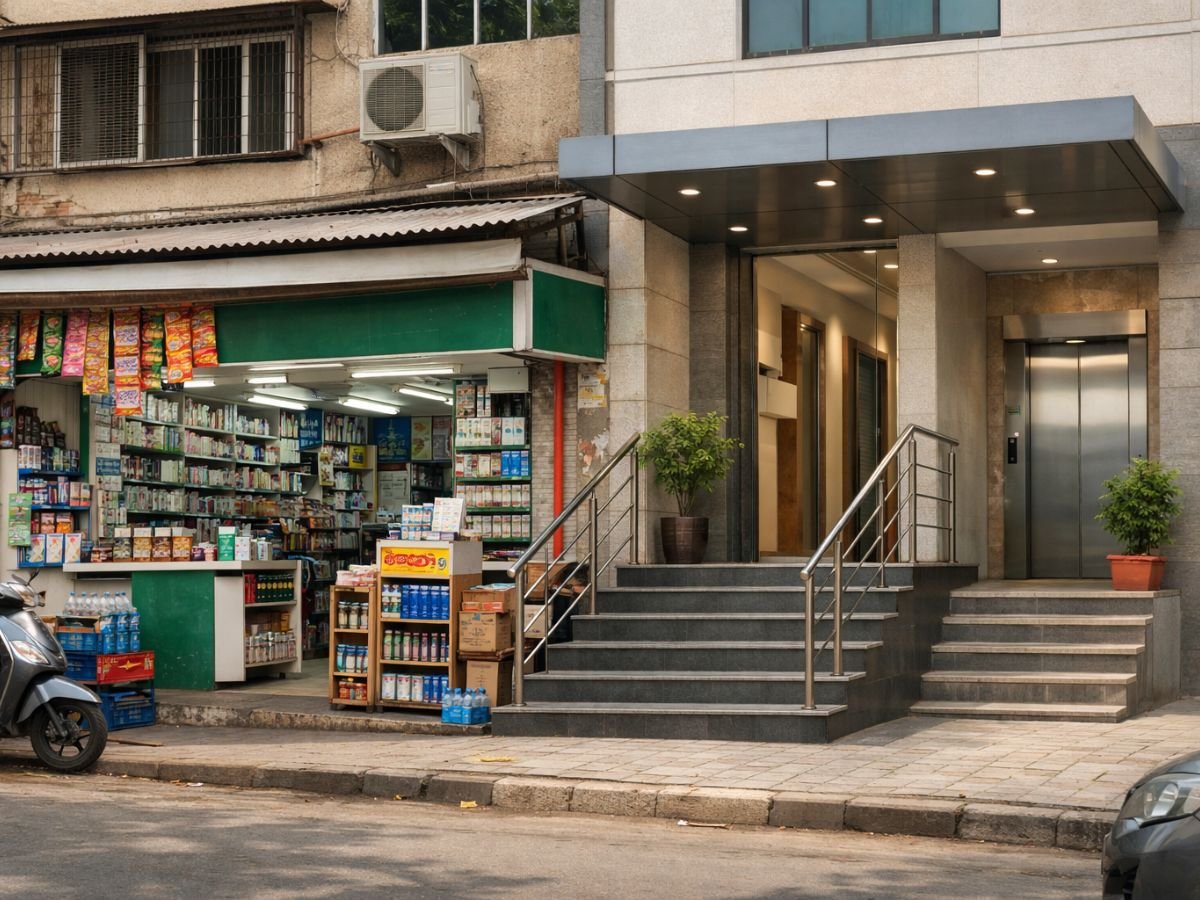
This is the section many buyers should read twice.
Shop logic
For most traditional retail shops, Old Panvel is usually stronger.
A shop needs:
- natural street visibility
- local movement
- pedestrian friction
- repeat neighbourhood demand
- immediate category relevance
Old Panvel delivers this better in many proven retail pockets. That is why premium street-level shops there can command higher approximate Q1 2026 market ranges, with broader Old Panvel commercial bands around ₹10,000 to ₹14,000 per sq. ft., and some prime frontage-led asks in strong streets going much higher depending on exact location, width, and building profile.
New Panvel can still work for shops, but the shop must match the pocket. Station-linked and active commercial stretches matter far more than internal sector roads.
Office logic
For most office formats, New Panvel is the better answer.
Office users care more about:
- access
- commute convenience
- staff comfort
- power backup readiness
- parking
- lower noise
- a more professional arrival experience
This gives New Panvel a practical edge. Approximate Q1 2026 market bands are lower too in many segments, with New Panvel East around ₹7,000 to ₹9,500 per sq. ft. and Khanda Colony around ₹6,500 to ₹8,500 per sq. ft. in broader terms, depending on building, road, frontage, and floor.
Mixed-use businesses that can work in either side
Some businesses can work in both, but with different conditions. For example:
- pharmacy: stronger near dense old-market movement, but also workable near a strong residential catchment in New Panvel
- coaching: works well in New Panvel near commuter and residential student catchment, but can also work in active Old Panvel pockets
- food outlets: QSR-type formats may benefit from station-side New Panvel movement, while local food counters can thrive in Old Panvel density
So the answer is not only area-based. It is format-based.
What kind of business works better where?
| Business Type | Old Panvel | New Panvel |
|---|---|---|
| Jewellery / traditional premium retail | Strong fit, especially old-market belts like Joshi Ali | Usually weaker unless very specific destination format |
| Daily-need retail | Strong fit | Good in residential-serving pockets |
| Hardware / utility / wholesale style trade | Strong fit | Selective |
| Professional office | Limited fit | Strong fit |
| Clinic / diagnostic / specialist consultation | Selective, depending on access | Strong fit, especially Khanda Colony-type pockets |
| Coaching / education | Moderate to strong in active zones | Strong fit in station-linked and residential catchment sectors |
| Branded retail / modern display-led use | Selective and frontage-sensitive | Works in better planned commercial pockets |
| QSR / commuter-serving quick retail | Some strong old-market pockets | Strong around station-side pass-through corridors |
| CA / law / consultancy | Usually weaker | Strong fit |
| Local service centre | Strong if density-driven | Strong if residential-serving and accessible |
For self-use commercial buying, which side is usually safer?
For most modern self-use buyers, New Panvel is usually safer. Not because Old Panvel is weak, but because daily operations are less stressful.
If you are buying for self-use, ask a harder question: can your business run comfortably here every day?
A self-use buyer should care about:
- where staff will come from
- whether customers can stop easily
- whether inventory can be loaded and unloaded
- whether signage is visible from real traffic flow
- whether the building suits your category
- whether ongoing taxes will affect your monthly economics
PMC property tax is not a small technical detail. It is an operational cost. The PMC uses a formula based on base value, built-up area, age factor, type of building, category of use, and floor factor. That means a prime ground-floor commercial unit can carry a much heavier recurring burden than an upper-floor office in the same wider market.
Self-use checklist before choosing either side
- Does your customer come by foot, bike, auto, or car?
- Do you need daily deliveries?
- Will staff rely on station or bus access?
- Is your business hurt by noise and congestion?
- Do you need parking for consultations longer than 20 minutes?
- Is the unit truly street-visible or only “visible on brochure”?
- Can the building handle your power, loading, and operating pattern?
If these questions point toward smoother operations and lower daily friction, New Panvel often wins.
For investment, where is the better risk-reward balance?
The better investment side depends on whether you want stable rentability or lower-entry appreciation potential.
Commercial rental yields in the broader Panvel region are currently estimated around 6% to 8%, which is meaningfully stronger than typical residential yields. But that does not make every commercial asset attractive.
When Old Panvel investment logic works
Old Panvel works better for investors who want:
- proven retail demand
- lower vacancy risk in strong market belts
- stable shop rentability
- premium value from irreplaceable frontage
This is especially true for ground-floor, high-visibility units in established lanes. But entry cost is higher, and building age or legal/structural review becomes more important.
When New Panvel investment logic works
New Panvel works better for investors who want:
- a lower entry ticket
- more organized office demand
- exposure to structured commercial growth
- patience for appreciation rather than only immediate shop premium
This is where office units, sector-based commercial stock, and peripheral growth-linked pockets can appeal more. But buyers must be careful. The airport and infrastructure narrative is already heavily priced into asking rates in many places. Buying purely for “airport boom” without present usability is risky.
Why planned area does not automatically mean better rentability
A planned building in a weak internal pocket can underperform a congested old-market shop. That is the truth.
Rentability depends on whether the tenant’s business can succeed there. If the tenant cannot operate well, your yield will not stay stable.
How do frontage, parking, road width, and walkability change the answer?
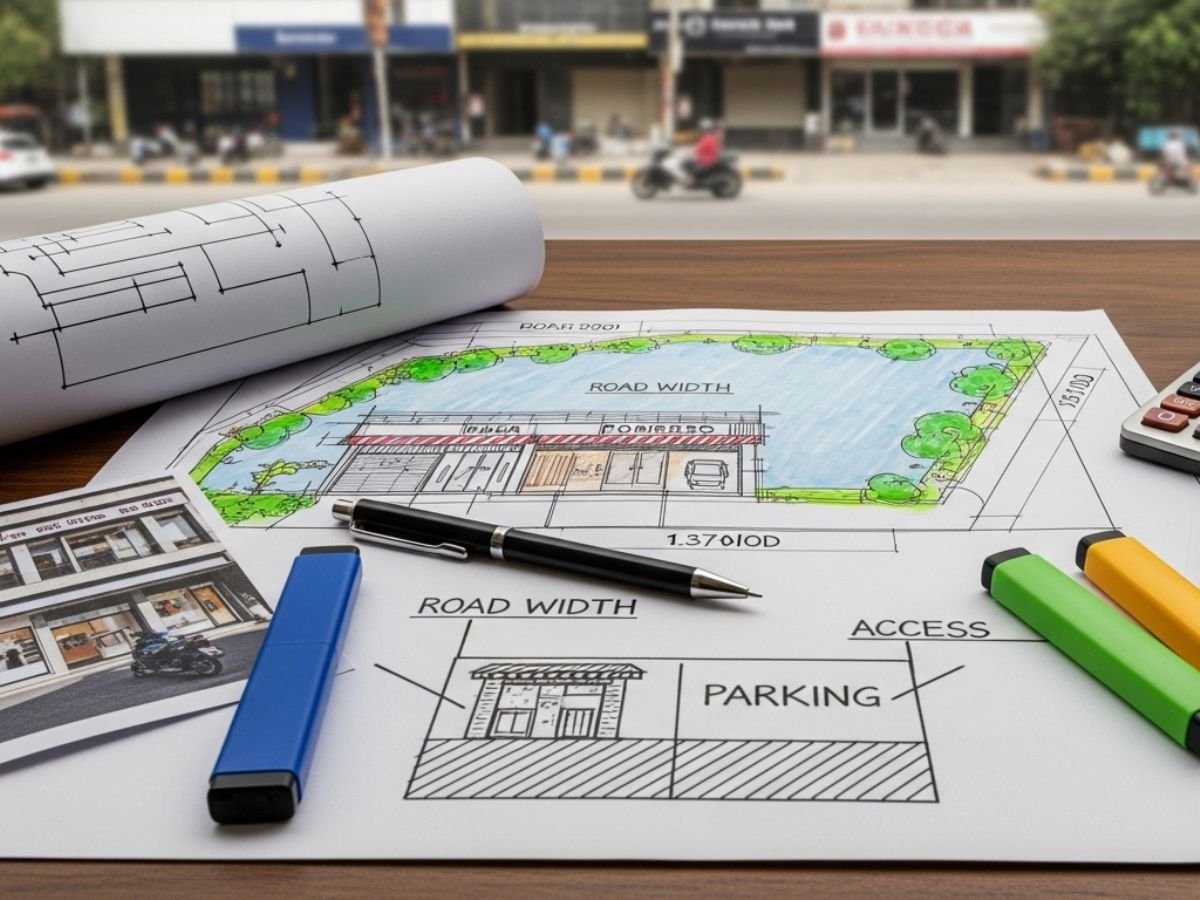
A lot.
Commercial property buyers often focus on square feet and ignore movement patterns. That is a mistake.
Old Panvel’s legacy roads are one of its greatest strengths for pedestrian retail and one of its biggest weaknesses for organized business operations. Under prevailing development rules and PMC realities, roads under 9 metres create serious redevelopment and parking limitations. And under commercial parking norms, mercantile buildings typically require at least 1 ECS per 100 sq. metres of built-up area.
That sounds technical, but the practical meaning is simple: many old-market properties cannot easily solve modern parking and expansion needs.
Caution box: The station footfall illusion
A large number of people passing your unit does not automatically create revenue.
A commuter rushing to catch a train may buy tea, snacks, or a newspaper. That same commuter is unlikely to stop for a sofa showroom, CA consultation, or premium clinic appointment. Match your investment to the mindset of the footfall, not just the volume.
Why station access and daily movement matter differently in Old Panvel and New Panvel
Station access matters, but not in the same way for every commercial use.
Panvel East, especially near the Sector 1, Orion Mall, and ST Depot axis, captures strong pass-through commuter movement. This is useful for:
- quick-service food
- fast retail
- ATM and convenience-led use
- selected coaching and service formats
Khanda Colony and New Panvel West behave differently. They are calmer and more destination-driven. That makes them more suitable for:
- clinics
- preschool and education-linked services
- offices
- professional consultations
- residential-serving neighbourhood commerce
Old Panvel, on the other hand, does not depend only on commuter movement. It depends on market behaviour. People intentionally go there to shop, compare, and buy within clusters.
Which buyers should choose Old Panvel, and which buyers should choose New Panvel?
| Buyer Type | Better Fit |
|---|---|
| Local family retailer | Old Panvel |
| Jeweller or category-cluster retailer | Old Panvel |
| Pharmacy in dense market environment | Old Panvel or edge of active New Panvel catchment |
| CA / law / consulting office | New Panvel |
| IT support / back-office user | New Panvel |
| Specialist clinic operator | New Panvel, especially calmer accessible pockets |
| First-time commercial investor with tighter budget | New Panvel or peripheral structured opportunities |
| Generational investor chasing stable high-street retail | Old Panvel |
| Coaching operator | New Panvel station-linked or strong residential-serving pockets |
| Buyer who wants lower daily friction | New Panvel |
Mistakes people make when comparing Old Panvel and New Panvel
The most common mistake is simple: people compare them emotionally, not commercially.
Here are the bigger traps:
- choosing New Panvel because it feels cleaner, even when the business needs dense retail friction
- choosing Old Panvel because it sounds more established, even when the business needs client parking and quieter access
- buying based on future airport optimism instead of present usability
- overpaying for frontage that does not convert
- buying an internal planned-sector shop and expecting old-market footfall
- treating shops and offices as the same investment category
- ignoring building age, title diligence, or municipal realities in older belts
- forgetting that PMC taxes affect actual operating economics
You should also read Who Should Buy Commercial Space in Panvel if you want to match the location with the right buyer profile.
Conclusion
There is no single winner between Old Panvel and New Panvel for business and commercial property. The right answer depends on what you are buying and why.
Choose Old Panvel if your business depends on dense local movement, category clustering, traditional market trust, and strong street-level retail visibility. This is where old-market commercial logic still beats cleaner planning.
Choose New Panvel if your business needs structured access, better parking possibility, office usability, calmer surroundings, or a cleaner client experience. This is usually the more sensible choice for offices, clinics, coaching, and many modern service businesses.
Wait or rethink the deal if you are buying only because of airport hype, broad Panvel branding, or a generic “future growth” story. In commercial property, present usability usually matters more than future narrative.
That is the real Old Panvel vs New Panvel answer. Not which area sounds better. Which area actually fits the business.
FAQs
Frequently Asked Questions