
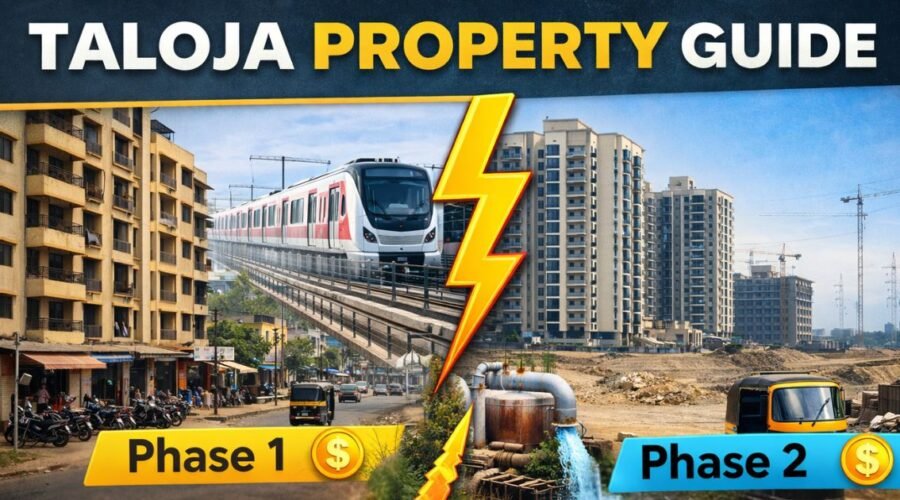
Taloja Property Guide 2026: Is Taloja Actually Worth Buying In Right Now?
Taloja makes sense in 2026 for buyers who want the lowest practical entry point into the Navi Mumbai region with Metro connectivity and future upside. It does not make sense for buyers expecting polished Kharghar-style livability today. That is the honest answer. Taloja is affordable, functional, and improving, but it still comes with daily friction like water dependence, uneven civic readiness, and last-mile travel issues that many glossy property pages ignore.
For many first-time buyers, that trade-off is exactly why Taloja is still on the shortlist. Prices are far below Kharghar, Seawoods, or Nerul. A Metro-linked location exists. The airport story is no longer theoretical. At the same time, the on-ground experience changes sharply from one pocket to another. One Taloja can feel usable today. Another can still feel like a promise.
This guide is built for that exact reality.
Why Taloja Matters in Navi Mumbai’s 2026 Property Market
Taloja is not important because it is perfect. It is important because it remains one of the last large-format residential areas around Navi Mumbai where a salaried buyer can still enter at a relatively low price band and get a realistic chance at a 1BHK or 2BHK.
That is why people search for it.
Usually, the buyer journey starts like this: Kharghar feels too expensive, Panvel is rising, Ulwe feels more speculative or location-specific, and then Taloja appears as the “maybe this is still possible” market. In 2026, that logic is even stronger because Taloja is no longer disconnected in the way it once was. The Belapur–Pendhar Metro line is operational, Navi Mumbai International Airport is already operational, and larger regional connectivity narratives are now real enough to influence sentiment.
But sentiment alone does not solve daily life. Governance here falls under Panvel Municipal Corporation, not NMMC. That matters. The civic standard, tax context, road execution, and maintenance expectations are not the same as mature CIDCO-planned, NMMC-governed nodes.
So Taloja should be seen correctly: not as “cheap Kharghar,” but as an affordable, evolving, high-volume entry market with uneven livability.
Is Taloja Good for Living in 2026?
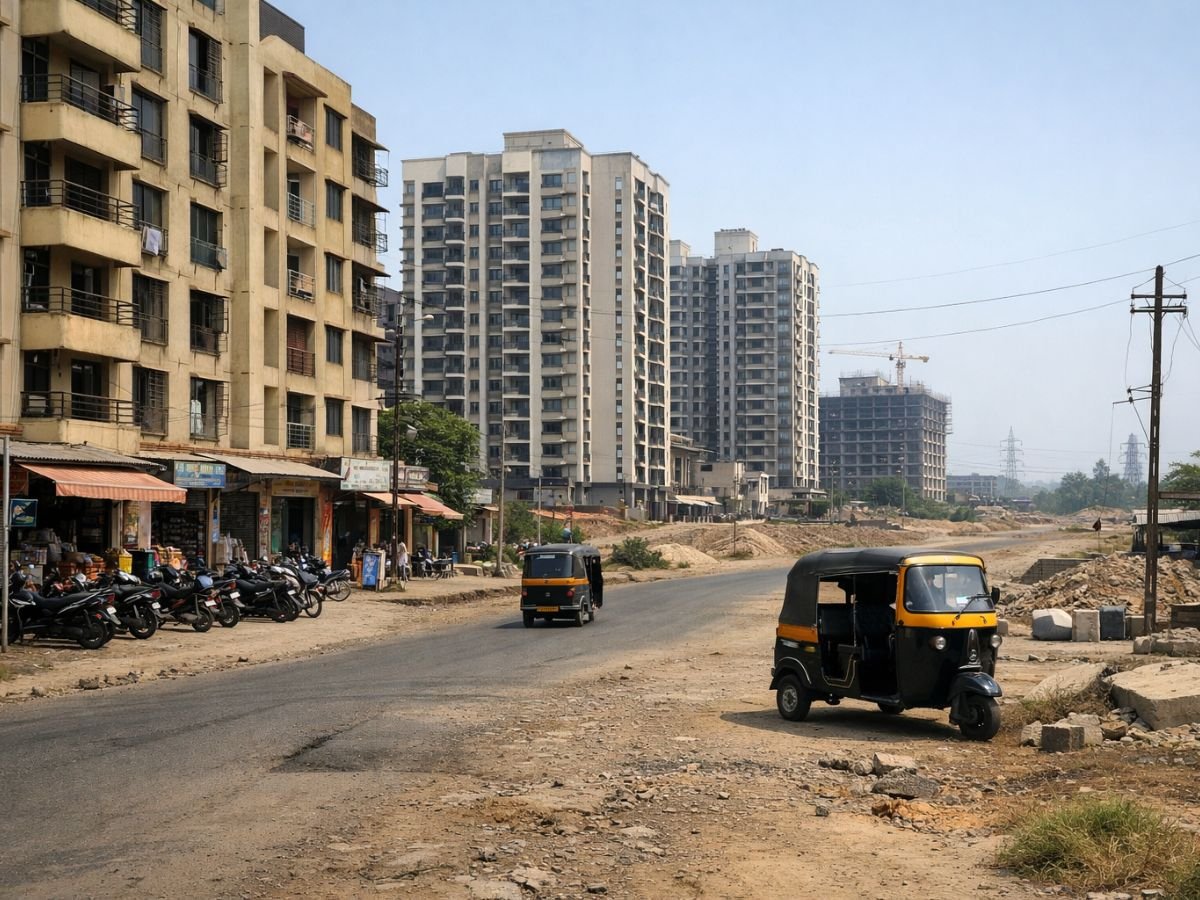
Taloja is livable in 2026 if your expectations match what the area actually offers. If your goal is to own a home instead of renting forever, keep commute costs manageable, and accept a still-developing environment, Taloja can work. If you expect mature social infrastructure, smooth internal roads everywhere, late-night convenience, and zero civic hassle, it may frustrate you.
This is where many articles become too soft. They say “great future potential” and stop there. The real question is simpler: can you live your daily life comfortably here right now?
In some parts, yes. In others, not fully.
The biggest mistake is assuming Metro connectivity automatically upgrades the full lifestyle experience. It does not. The Metro improves broader connectivity. It does not erase poor last-mile links, tanker dependence, or inconsistent neighborhood finish.
The real friction points buyers should understand
1. Last-mile travel still matters more than brochure distance
Many projects are marketed as Metro-connected, but the actual lived experience depends on how easily you reach Pendhar or related access points. In some locations, it is a manageable shared-auto trip. In others, it becomes a tiring daily layer of travel.
2. Water remains a serious practical filter
This is one of the most important on-ground checks in Taloja. Some societies are more dependent on tankers, especially in less stable or still-maturing pockets. That affects monthly costs, comfort, and resident satisfaction more than marketing brochures will ever admit.
3. Livability varies building to building, not just sector to sector
In Taloja, one completed society may feel reasonably settled with local shops, practical access, and occupancy, while the next project may still feel isolated. You cannot judge the area only from a map.
4. MIDC impact is both a strength and a caution
The employment base helps demand, especially from workers and business-linked residents. But being too close to industrial belts, especially sensitive chemical zones, is not a small issue. Buyers should not ignore environmental comfort while chasing lower prices.
Phase 1 vs Phase 2: The Most Important Taloja Comparison
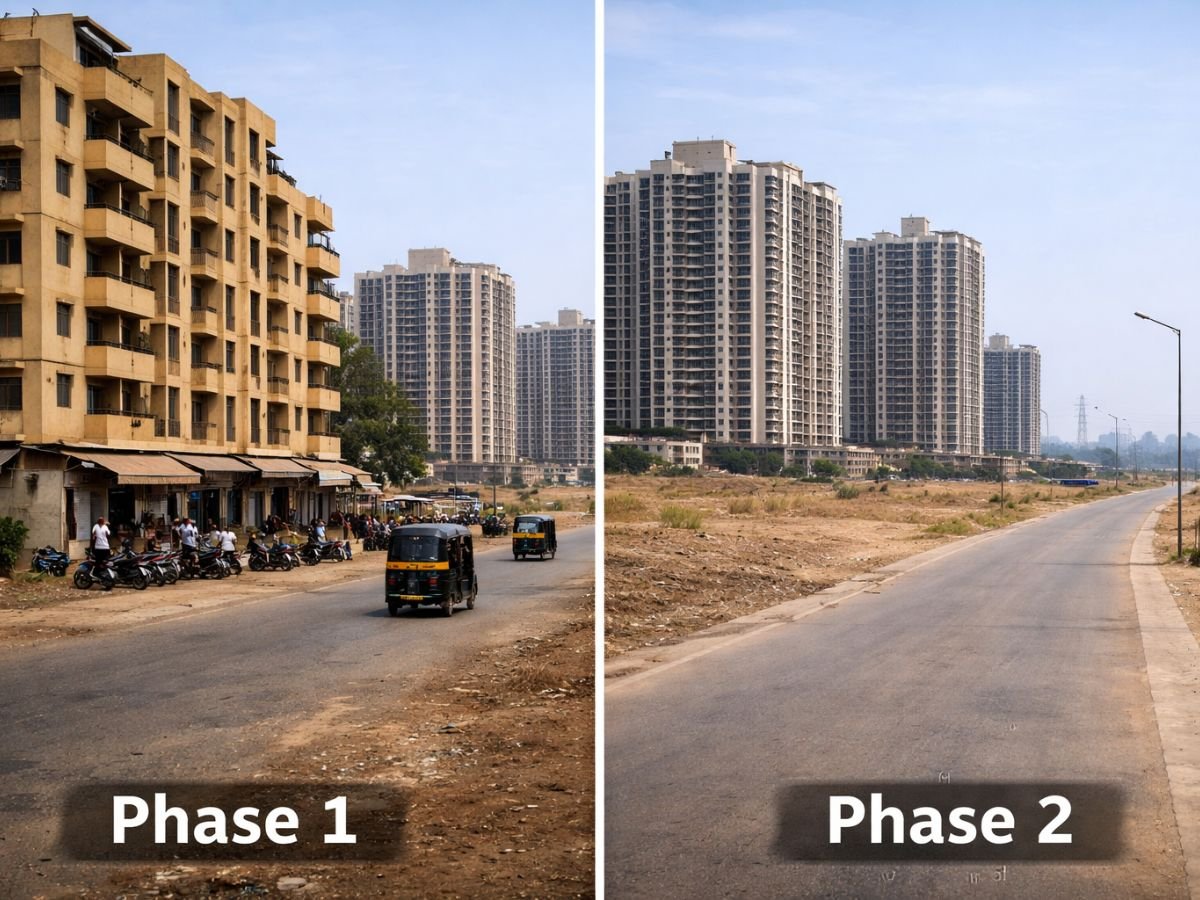
This is the core comparison in any serious Taloja property decision. Broadly speaking, buyers are not evaluating just one Taloja. They are evaluating two different experiences.
Taloja Phase 1: More Practical for Immediate Use
Phase 1 is usually the more practical choice for buyers who want to move in sooner or rent out without waiting too long for surrounding life to catch up.
It tends to feel more active, more integrated with older local movement patterns, and more useful for day-to-day living. Access to Taloja Panchanand railway-side logic, local market movement, and more immediate footfall can improve practicality. It may not always feel polished, but it often feels more usable.
This is why many end users prefer it, especially those who care more about function than visual planning.
Taloja Phase 2: Better Planning, But More Patience Needed
Phase 2 generally attracts buyers who like wider layouts, larger future-road logic, and the feeling of a more planned extension market. In some stretches, it can feel like the idea of a future residential district rather than a finished one.
That is attractive for investors and patient buyers.
But the gap between planning and daily convenience can still be wide. A cleaner layout on paper does not guarantee easier living right now. Some projects in these pockets depend more heavily on future road completion, better utility stability, and stronger occupancy.
Phase 1 vs Phase 2 Comparison Table
Taloja Prices in 2026: What Buyers Should Realistically Expect
In 2026, a broad working price band for Taloja is roughly ₹5,800 to ₹8,800 per sq ft. But treating that as a universal market rate would be a mistake. Taloja is highly uneven.
Prices change based on:
- whether the project is genuinely ready or still only “near possession”
- whether Occupancy Certificate status is clean
- the exact pocket and its practicality
- water and infrastructure reliability
- distance from useful transport access
- builder reputation and project finish
- actual resale demand versus listing expectations
In real life, the cheapest rate is not always the best value. A lower rate may hide weak access, poor occupancy, unfinished surroundings, missing approvals, or high ongoing inconvenience.
That is why Taloja should not be judged only by brochure affordability. The better question is this: what quality of daily life and legal comfort am I getting at this rate?
Taloja vs Kharghar vs Ulwe: Where Does It Stand?
Taloja remains the affordability play. Kharghar remains the stronger all-round end-user market. Ulwe often sits in between as a location that can attract airport-led and connectivity-led attention, but with its own micro-location differences.
Here is the practical difference:
A buyer hoping Taloja will simply “become Kharghar” is making the wrong comparison. Kharghar has long-established lifestyle anchors, stronger identity, and deeper social infrastructure. Taloja may improve and appreciate, but its role in the Navi Mumbai ecosystem is different.
What Is Driving Taloja Demand in 2026?
Taloja demand in 2026 comes from three strong forces.
1. Budget pressure from nearby markets
This is the biggest one. As prices rise in Kharghar, Panvel, and other better-established locations, buyers fall back to Taloja because it still leaves room to own.
2. Real transport legitimacy
The Metro story is no longer a future line in a brochure. That changes how buyers think. Also, NMIA being operational gives the larger region a different confidence level. Not every Taloja project benefits equally, but the regional psychology is stronger than before.
3. Industrial and work-linked demand
Taloja MIDC remains a real economic engine. That creates both end-user and rental logic. Many guides talk only in aspirational residential language and ignore this. That is a mistake. Taloja’s demand is not driven only by dream-home buyers. It is also driven by practical work-linked residents.
Who Should Buy in Taloja in 2026?
Taloja is not for everyone. But for the right buyer, it can still be a sensible move.
Taloja makes sense if:
- your budget is tight and nearby alternatives have already moved out of reach
- you want to buy rather than continue renting indefinitely
- you can hold for 7 to 10 years
- you work in or around Taloja, Kharghar, or nearby industrial/business belts
- you are comfortable with a developing-zone environment
- you are willing to verify project quality instead of buying blindly
Taloja may not make sense if:
- you expect a polished, settled neighborhood from day one
- you are very sensitive to water and civic inconsistency
- you depend heavily on seamless app-cab movement at odd hours
- you want instant premium lifestyle value
- you are buying only because a broker said “this will become Kharghar soon”
The Taloja Buyer Checklist Before Paying Token Money
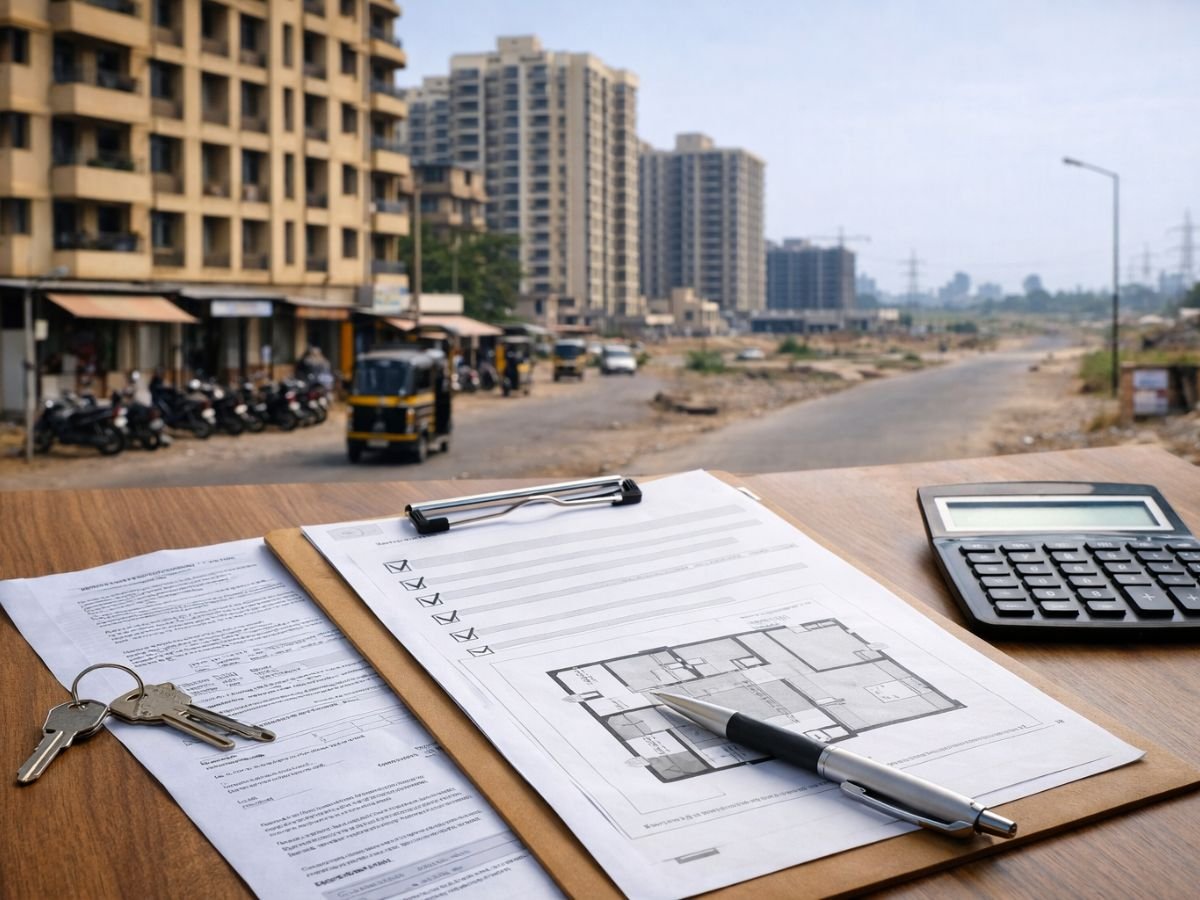
This is where many people go wrong. In Taloja, the difference between a smart purchase and a regret purchase often comes down to a few very basic checks.
A buyer in Taloja should physically inspect morning movement, evening movement, water setup, and surrounding activity. One site visit is not enough.
Common Buyer Mistakes in Taloja
Buying only on future promise
A future story is useful, but not enough. If daily life is too difficult, the low entry price stops feeling attractive very quickly.
Treating all Taloja pockets as equal
They are not. This is one of the biggest mistakes in online research.
Ignoring OC because the flat looks ready
This is a classic trap. A building can look usable but still carry serious practical and legal discomfort if the final status is not clean.
Assuming airport impact will lift every project equally
It will not. Regional growth does not reward every building in the same way. Good access, credible project quality, and functional surroundings still matter.
Conclusion
Is Taloja Worth It in 2026?
Yes, Taloja is worth considering in 2026, but only if you are buying with full awareness of what it is and what it is not.
Taloja is a value-trajectory market. It offers one of the most realistic ownership entry points around Navi Mumbai for buyers who have been priced out elsewhere. The Metro has improved its legitimacy. The airport being operational makes the larger growth story more real. MIDC-backed practicality gives it an economic base that many cheaper housing belts do not have.
But Taloja is not a smooth, premium, finished market. It is still a developing-zone decision.
So the best way to think about it is simple:
Buy in Taloja if you want affordability, can tolerate some civic friction, and are choosing carefully for a 7 to 10 year hold.
Skip Taloja if you want immediate lifestyle ease, mature infrastructure, and zero patience.
That is the real property guide answer. Not hype. Not dismissal. Just fit.
FAQs
Frequently Asked Questions