
Airoli Office Rents, Vacancy Signals and Market Trend
Airoli remains one of Navi Mumbai’s strongest office micro-markets in 2026, but the answer is not just “rents are rising.” In practical terms, Grade A campus-style office space is broadly holding around the mid-₹60s to mid-₹70s per sq ft range, vacancy is tight in better-managed institutional parks but patchier in older or fragmented stock, and the overall trend is a clear flight to quality rather than a uniform boom. Recent large leases at about ₹67 psf and ₹71 psf in Mindspace/Gigaplex support that reading, while broader Navi Mumbai data still points to healthy occupancy and limited future supply.
If you are checking Airoli for office leasing, expansion, or investment, that is the first thing to understand. Airoli is not behaving like one flat market. A large company looking for contiguous Grade A space faces a very different market from a small business hunting for a ready furnished unit in a strata building. That difference is where most articles become generic. This one should help you read the market more like a user, not like a brochure.
To place these numbers in proper context, Airoli Office Market Guide is a useful read alongside this page.
Airoli office
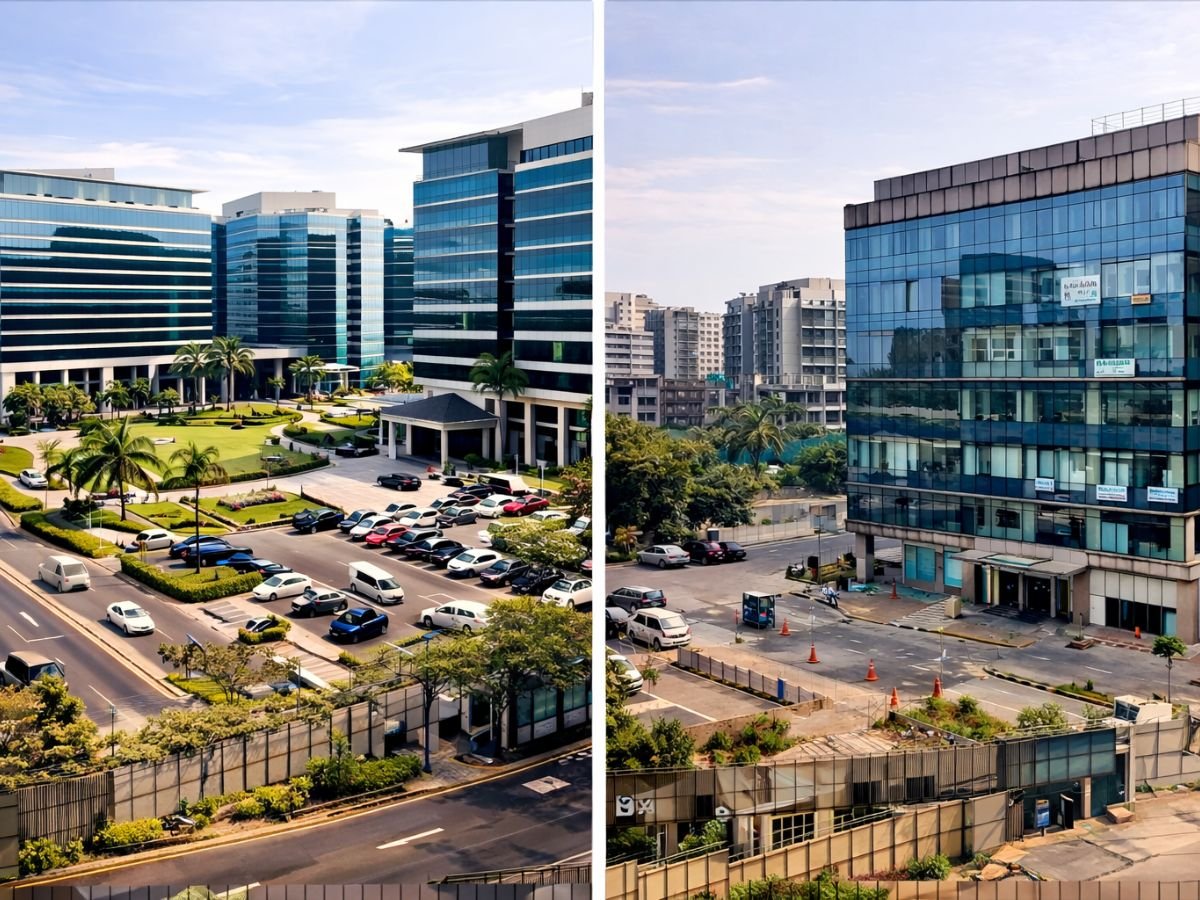
Airoli still works because it offers something very few office corridors in MMR can offer at the same time: relatively lower occupancy cost than core Mumbai, strong access to talent from Thane, Navi Mumbai, and the eastern suburbs, and a real ecosystem of business parks rather than isolated office buildings. Cushman & Wakefield’s late-2025 Navi Mumbai report places broader Navi Mumbai’s average quoted office rent near ₹70 psf, occupancy around 87%, and expected future supply at roughly 4 million sq ft through 2028, which supports the view that this is not a weak market.
But the market is also uneven. Premium campuses and institutional-grade parks are much tighter than they look from outside. At the same time, older standalone stock and some fragmented strata inventory can stay available for longer, especially where maintenance, compliance, parking, or floor efficiency are weaker. So when people ask about Airoli office rent, the honest answer is: the market is resilient, but the building matters almost as much as the location.
Quick Summary
| Metric | Practical reading for Airoli |
|---|---|
| Institutional Grade A rent | Usually around ₹65 to ₹75 psf/month for larger, managed stock |
| Smaller furnished strata units | Often higher on paper, sometimes around ₹75 to ₹110+ psf |
| Older/secondary stock | Usually more negotiable, often around ₹45 to ₹60 psf |
| Vacancy pattern | Tight in premium campuses, patchy in older fragmented buildings |
| Market direction | Stable to firm for better stock, more negotiable for weaker stock |
The rent bands above are not one official rate card. They are a practical reading based on the dossier, recent registered Airoli leases, and broader Navi Mumbai office-market evidence. Recent examples include Wipro at about ₹67 psf in Mindspace SEZ, Airoli and HERE Solutions at about ₹71 psf in Mindspace Airoli West/Gigaplex.
What are office rents in Airoli right now?
The simplest workable answer is this: if you are looking at institutional or campus-style Grade A office space in Airoli, a realistic broad market range today is usually in the ₹65 to ₹75 per sq ft band for larger warm-shell or bare-shell deals. That does not mean every office in Airoli leases there. Smaller ready offices, furnished units, and strata-titled stock often show much higher asking rates. Older buildings can quote much lower. The gap exists because the office market is pricing not only area, but also scale, management quality, fit-out status, and reliability. Recent registered leases by Wipro and HERE Solutions are a useful reality check because they show large Airoli campus transactions at around ₹67 per sq ft and ₹71 per sq ft respectively.
This is where many readers get confused. Broker quotation, portal asking rate, and actual deal value are not the same thing. A landlord may hold firm on the headline rent but give a rent-free fit-out period, more parking flexibility, or better interior handover terms. Another office may look cheaper on rent but become more expensive after CAM, higher power costs, fit-out burden, and parking charges. In practice, the number you should compare is not just the quoted rent. if is the total cost of occupancy
You may also want to read Leased Office vs Vacant Office in Airoli if you are judging market movement from an investor angle.
What changes the rent most in Airoli
The first big factor is the campus premium. Managed office parks command better rates because they reduce friction. Businesses are not paying only for square footage. They are paying for stable lifts, high-capacity HVAC, proper security, food courts, shared amenities, and better daily usability. Gigaplex’s own property listing highlights food plazas, ATMs, crèche, recreation and campus-level amenities, which helps explain why occupiers pay a premium for this kind of environment.
The second factor is the size of the deal. A company taking 1 lakh sq ft and signing a long lease usually gets a better base rent than an SME taking 2,000 sq ft ready-to-move space.
The third factor is fit-out status. A fully furnished office may look expensive at first glance, but for a smaller business it may still be the smarter deal because interior costs are high. A bare-shell office can be cheaper on rent and still cost more overall if you have to spend heavily before you even start operations.
Is vacancy in Airoli actually low?
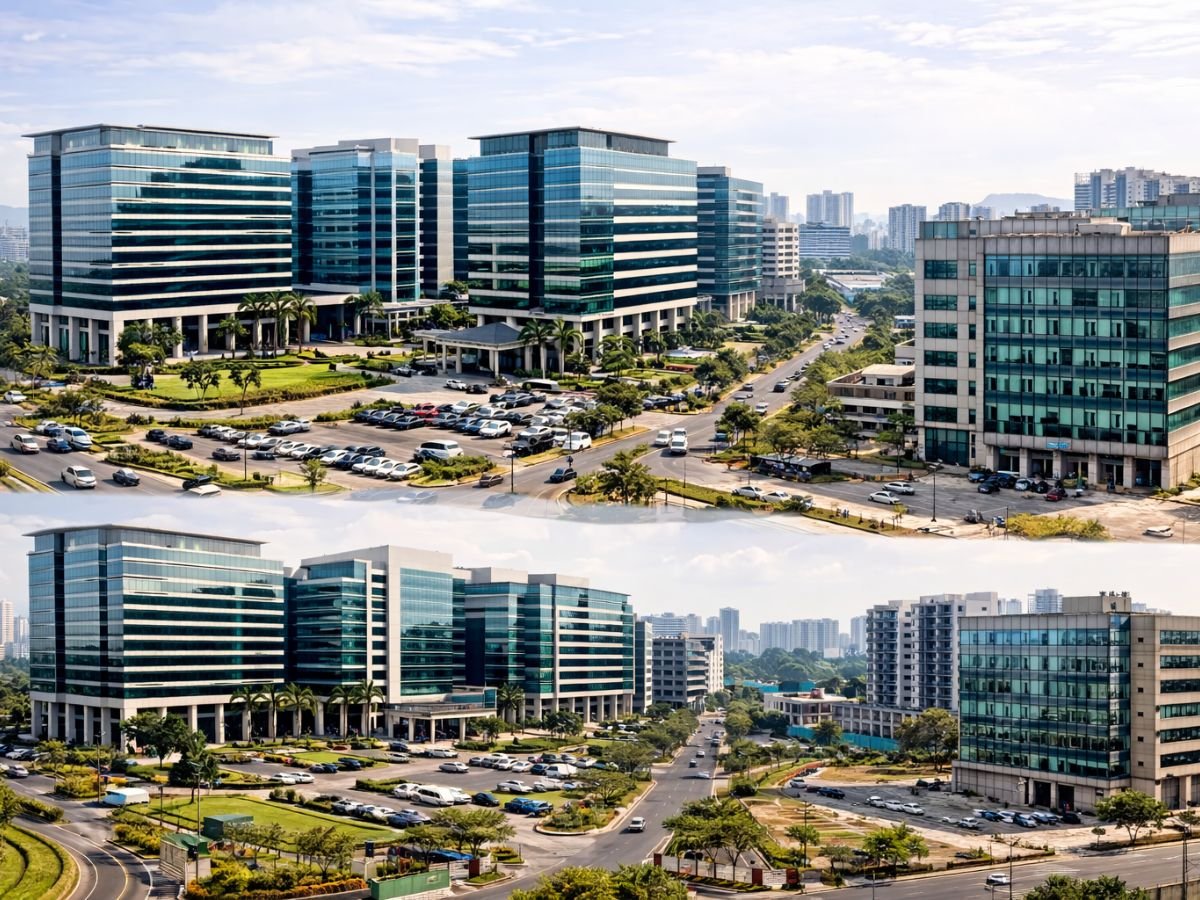
The short answer is: vacancy is low where occupiers actually want to be, but it is not low everywhere. That is the right way to read Airoli.
Broader Navi Mumbai office occupancy is around 87%, which signals healthy demand at the regional level. At the same time, the Mumbai office market has seen strong leasing momentum, and the Thane-Belapur Road belt led leasing share in both Q2 and Q3 2025 at about 28%, which matters because Airoli is one of the key office nodes within that corridor.
But vacancy in Airoli is not one clean number. In better institutional parks, available space gets absorbed faster, especially if the floor plate is efficient and the building is professionally managed. In older buildings, some inventory can sit for longer. This is why people sometimes feel the market looks soft when they see many listings online, even though the better stock is actually quite tight.
Healthy vacancy vs weak vacancy
Healthy vacancy is normal churn. A tenant exits, another comes in, and the floor gets absorbed in a reasonable period. That is not a danger sign. In fact, it often shows liquidity and real demand.
Weak vacancy is different. That is the kind of space that keeps circulating because something is off. The issue may be building age, odd floor layout, poor common-area maintenance, lower-grade fire safety confidence, weak parking, or simply a building that no longer matches how occupiers want to work.
This is the practical mistake many tenants make. They see a low rent and assume they found value. Sometimes they found the exact kind of stock the market is quietly moving away from.
Why Airoli keeps attracting occupiers even when rents move up
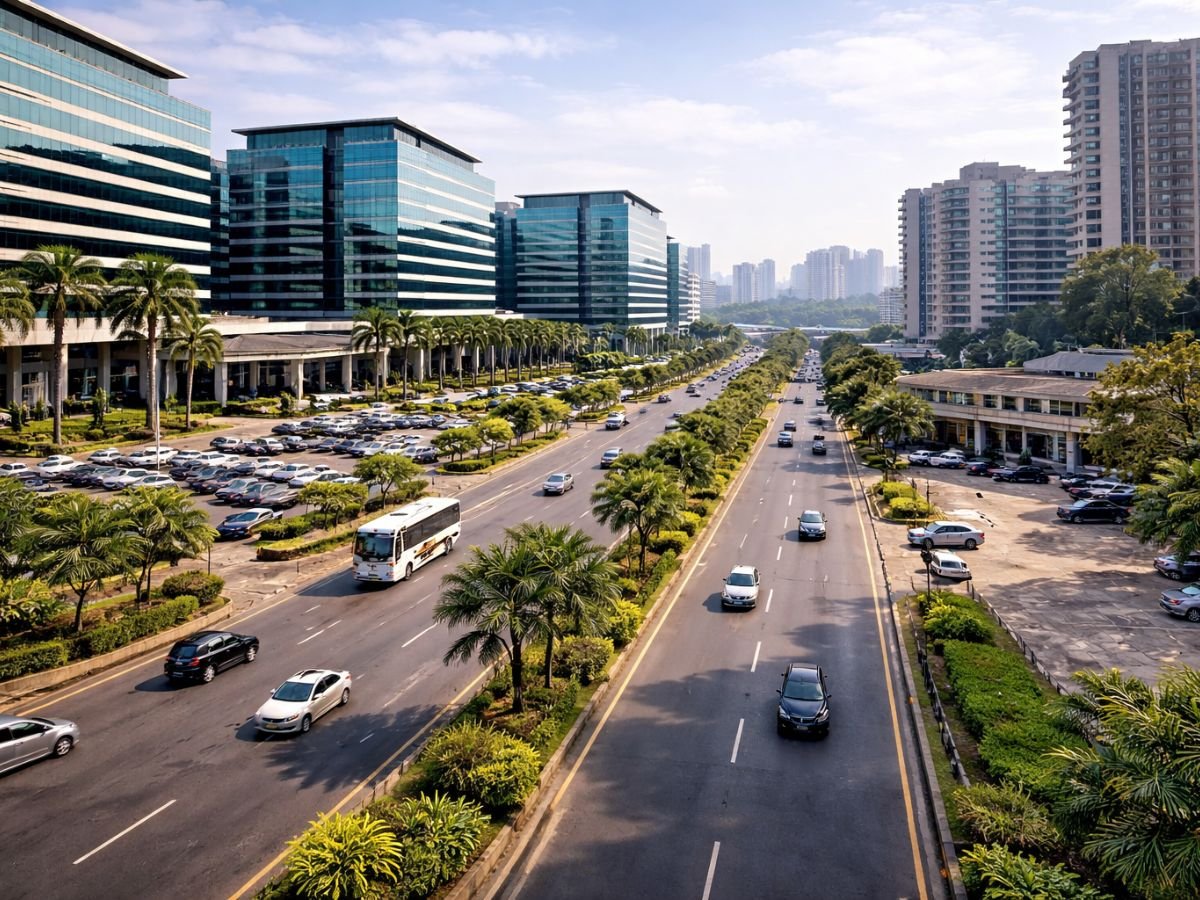
Airoli is no longer attractive only because it is cheaper than BKC or Lower Parel. It is attractive because it is usable. That sounds simple, but in office leasing it matters a lot.
Cushman & Wakefield’s Navi Mumbai report argues that the region’s appeal comes from cost-effective rentals, modern infrastructure, and access to a large talent base of roughly 150,000 graduates annually. The same report uses Airoli as a key travel-time benchmark within the Navi Mumbai growth story, which is important because it reinforces Airoli’s role as a real operating node, not just a spillover destination.
For companies, especially IT, engineering, GCC, and back-office operations, the question is not only rent. It is whether teams can reach the office, whether the building can handle growth, and whether the office helps retain people. Airoli scores well on that combination because it can pull workforce from Thane, Mulund, Ghansoli, Navi Mumbai and the eastern suburban side more comfortably than some southern Navi Mumbai nodes.
Talent catchment and commute logic
This is one of Airoli’s biggest strengths. It sits in a part of Navi Mumbai that connects more naturally with the Thane-Mulund side than many other nodes. That matters because office real estate is not just about where the building stands. It is about where employees are coming from every morning.
In local reality, a company may accept paying a slightly higher rent in a better Airoli building if that makes hiring, retention, and commute stability easier. That is one reason Airoli has remained a preferred office corridor instead of becoming just another low-cost alternative.
Why large occupiers prefer campus-style stock
Large occupiers want fewer surprises. A campus-style office environment allows easier scaling, more professional maintenance, more predictable services, and better internal movement for staff and visitors. It also gives confidence to multinational tenants who do not want building-level uncertainty every time they expand.
That is exactly why recent large transactions in Airoli have happened in managed parks and why broader national office demand continues to be supported by GCC and high-quality occupiers. Colliers’ Q4 2025 India office snapshot notes that demand continued to outpace supply nationally and rentals strengthened across major markets, while JLL’s Mumbai office update says 2025 leasing hit a six-year high and rents kept growing across submarkets.
Which parts of the Airoli office market feel stronger, and which parts need more caution?
Airoli works best when you read it in three practical buckets.
The first bucket is the institutional campus market. This is the strongest part of Airoli. It is where long-term occupiers, better quality tenants, and more stable rent behaviour are concentrated. If you are a serious corporate user, this is usually where your search starts.
The second bucket is the smaller strata-tech-park market. This can still work, especially for mid-sized firms and budget-sensitive occupiers, but management quality varies much more from one building to another.
The third bucket is older or operationally weak stock. This is where caution rises sharply. The rent may look attractive, but the daily experience and long-term leasing strength may not support it.
Simple comparison
| Building type | Rent pattern | Vacancy pattern | Who it suits | Risk level |
|---|---|---|---|---|
| Institutional Grade A campus | Usually strongest rent hold | Lower in better parks | MNCs, GCCs, large IT, serious occupiers | Lower |
| Strata-led tech park/furnished office | Higher asking rates possible for ready units | Mixed | SMEs, mid-sized firms, fast movers | Medium |
| Older standalone/secondary stock | Lower headline rent | Higher or stickier vacancy | Cost-first back offices | Higher |
Airoli’s market strength is clearly skewed toward managed, institutional assets. Even investment appetite reflects that. Recent reporting on the Capgemini Knowledge Park acquisition in Airoli by Panchshil Realty at around ₹550 crore supports the view that serious capital still wants stronger Airoli commercial assets rather than weak, fragmented stock.
What the latest Navi Mumbai office data suggests about Airoli’s market trend
The broader market trend is supportive, but it must be translated carefully into Airoli terms.
Cushman & Wakefield’s Navi Mumbai report shows around 23.8 million sq ft of grade A office stock in Navi Mumbai, about 87% occupancy, and only about 4 million sq ft of new supply expected through 2028. That matters because a limited pipeline usually supports rent resilience in stronger assets, especially when demand is still active.
At the Mumbai-region level, the picture is also constructive. Thane-Belapur Road led leasing share in recent quarters, and JLL says leasing activity in Mumbai hit a six-year high in 2025 while rents continued to show growth momentum.
What does that mean for Airoli specifically?
It means Airoli is not looking like a market heading toward a broad rent correction. It looks more like a market where:
- premium buildings keep their pricing better
- contiguous good-quality space becomes harder to secure
- weaker stock remains available longer
- negotiation still exists, but not equally across all buildings
That is a very different situation from saying “Airoli rents are rising everywhere.” They are not. The market is sorting itself by quality.
Are Airoli office rents likely to rise, stay stable, or become more negotiable?
For good buildings, the most realistic answer is: stable to slightly firm. For weaker buildings, more negotiable.
That is the cleanest reading from the dossier plus current market evidence. Limited future supply, healthy occupancy, and continued preference for quality all support rent resilience in stronger campus-style assets. On the other hand, secondary and older stock can still face more price pressure because occupiers are becoming choosier.
There is another practical reason for this. Fit-out costs are high. So a landlord offering a warm-shell or well-maintained ready office can defend rent better than a landlord offering raw space in an inefficient building. In many cases, the market is not rewarding “cheap.” It is rewarding “usable.”
This is also where infrastructure optimism should be handled carefully. Yes, better connectivity and airport-linked growth narratives support confidence around Navi Mumbai. But that does not automatically justify every quoted rate in Airoli. A building still needs to work operationally. That distinction matters.
Should you lease in Airoli now, negotiate harder, or wait?
For most serious occupiers, waiting for a big correction does not look like the smartest strategy. The better answer is to match your move to your requirement size and stock type.
If you need large institutional space, the case is stronger to act now and secure the right building. If you need a smaller office, you can still negotiate, especially in stock that has been circulating for some time.
Decision guide
| User type | Best move now | Why |
|---|---|---|
| SME taking 3,000 to 10,000 sq ft | Negotiate harder | More choice in smaller or secondary inventory |
| Large corporate user | Lease now and lock the right building | Good large-format stock is tighter |
| Investor seeking yield | Buy selectively, preferably pre-leased | Better-quality income assets remain more defensible |
| Investor chasing only appreciation | Be selective, not blind | Not every Airoli building benefits equally |
If you are an SME, focus less on the first quote and more on total deal structure. Ask for a rent-free period, fit-out support, better CAM clarity, and parking flexibility.
If you are a larger occupier, your risk is not usually that you pay ₹3 to ₹5 more. Your bigger risk is choosing a building that cannot scale with you or waiting until contiguous space disappears.
If you are an investor, Airoli still makes sense, but the old idea that “any commercial unit in a good area will lease out” is not safe enough anymore. Better buildings and better tenant profiles matter far more now.
What should tenants and investors verify before trusting any Airoli office rent quote?
This is where practical commercial real estate decisions are won or lost.
A rent quote in Airoli is only the opening line. The real decision comes after you check chargeable area, CAM, fit-out quality, power backup, parking, lease lock-in, escalation, and building usability. A ₹55 psf quote can turn out worse than a ₹70 psf building if the cheaper office loads too much common area, gives poor backup, or needs fresh interiors.
Use this simple checklist before moving ahead:
Airoli office lease checklist
- Ask for carpet area and chargeable area separately
- Check CAM clearly and what it includes
- Verify full power backup, not only lighting backup
- Check whether HVAC, lifts, and maintenance are professionally managed
- Ask how many parking slots are included and what extra parking costs
- Review lock-in, escalation, deposit, and rent-free period
- Check if the office is genuinely ready to use or only cosmetically furnished
- Visit during working hours and again in the evening
- Notice parking usage, cafeteria movement, and common-area upkeep
- Check whether the building feels occupied by serious businesses or only by temporary churn
- For investors, verify title and dues through the right records before committing
- Do not assume all Airoli stock has the same compliance comfort just because the area is strong
Airoli also needs to be read in its own planning context. Some properties sit in regulated industrial-commercial belts and operational zones where documentation, building history, and approvals matter more than many casual buyers realise. So for investment decisions, document checks are not optional.
Conclusion
Airoli office rents, vacancy signals and market trend in 2026 point to a market that is stronger than it looks on listing portals but more selective than many people assume. Good Airoli office stock is not cheap in the old “peripheral Navi Mumbai” sense anymore, because occupiers are paying for reliability, scale, and talent access. At the same time, this is not a one-direction market where every building can demand premium rent.
So the smartest way to read Airoli today is this: premium campus-style assets are holding firm, weaker stock is more negotiable, and the real opportunity lies in understanding the difference. If you are leasing, focus on effective occupancy cost, not only headline rent. If you are investing, buy quality, not just location. That is the real Airoli office market story right now.
FAQs
Frequently Asked Questions