
Best Data Center and Tech-Industrial Pockets in Airoli-Ghansoli: Which Areas Actually Work?
Airoli is usually the stronger choice for enterprise-tech campuses, backend teams, and built-to-suit data-center environments inside polished corporate ecosystems. Ghansoli, especially when read together with the Mahape-side TTC belt, usually works better where the requirement is heavier infrastructure, larger continuous land logic, hybrid tech-industrial operations, or future scale. There is no one universal winner here. The best pocket depends on whether the need is office-heavy, infra-heavy, or truly hybrid. Official policy and operator examples also support this split: Airoli already hosts major campus-style deployments, while the wider Ghansoli-Mahape belt carries deeper industrial tolerance and large-format infrastructure logic.
Best Data Center and Tech-Industrial Pockets in Airoli-Ghansoli: The Direct Answer
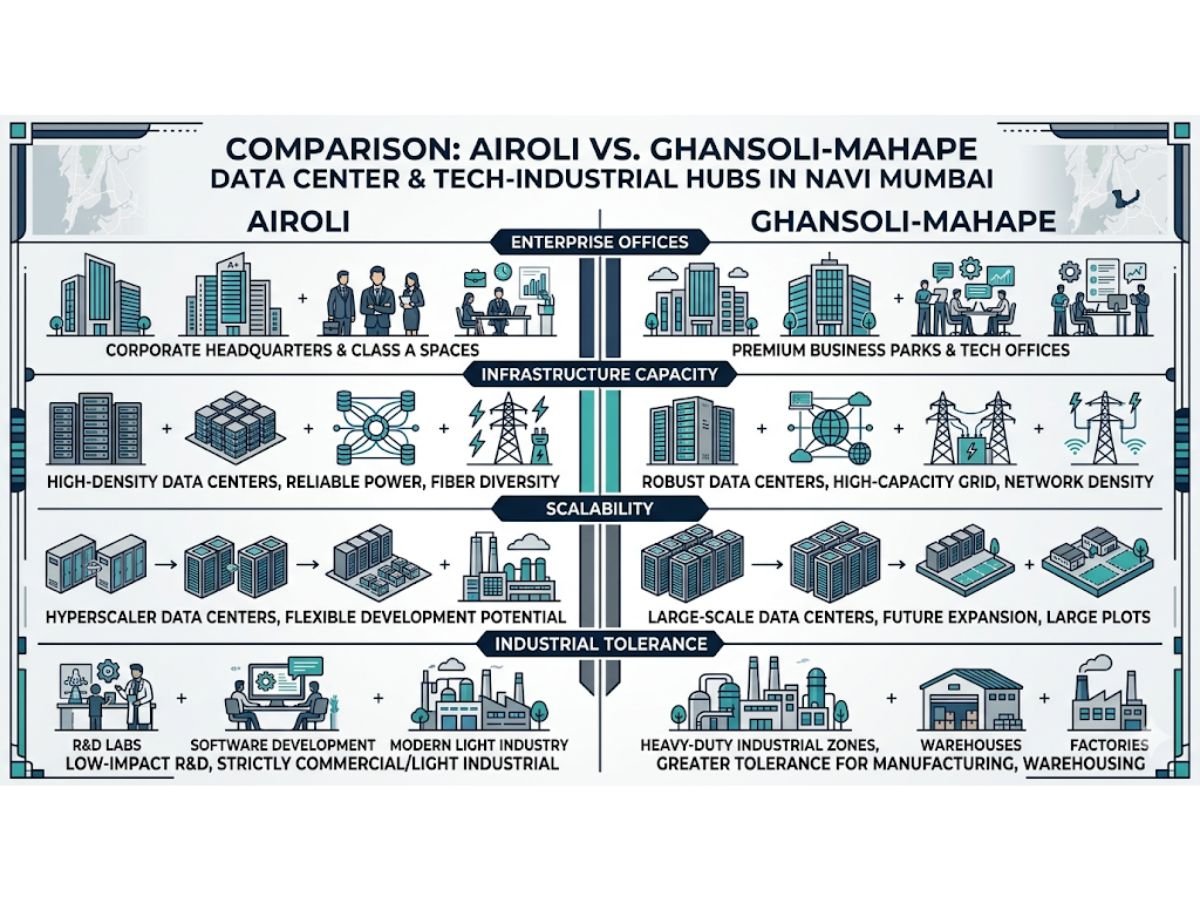
If the goal is a clean enterprise environment with strong backend reliability, Airoli’s Knowledge Park, Mindspace side, and Reliable Plaza belt usually come first. If the goal is larger-footprint infrastructure, heavier utility tolerance, hybrid hardware-software use, or a campus that behaves more like an industrial system than a corporate office park, the Ghansoli-Mahape side becomes more practical. That is the real answer.
Quick Summary
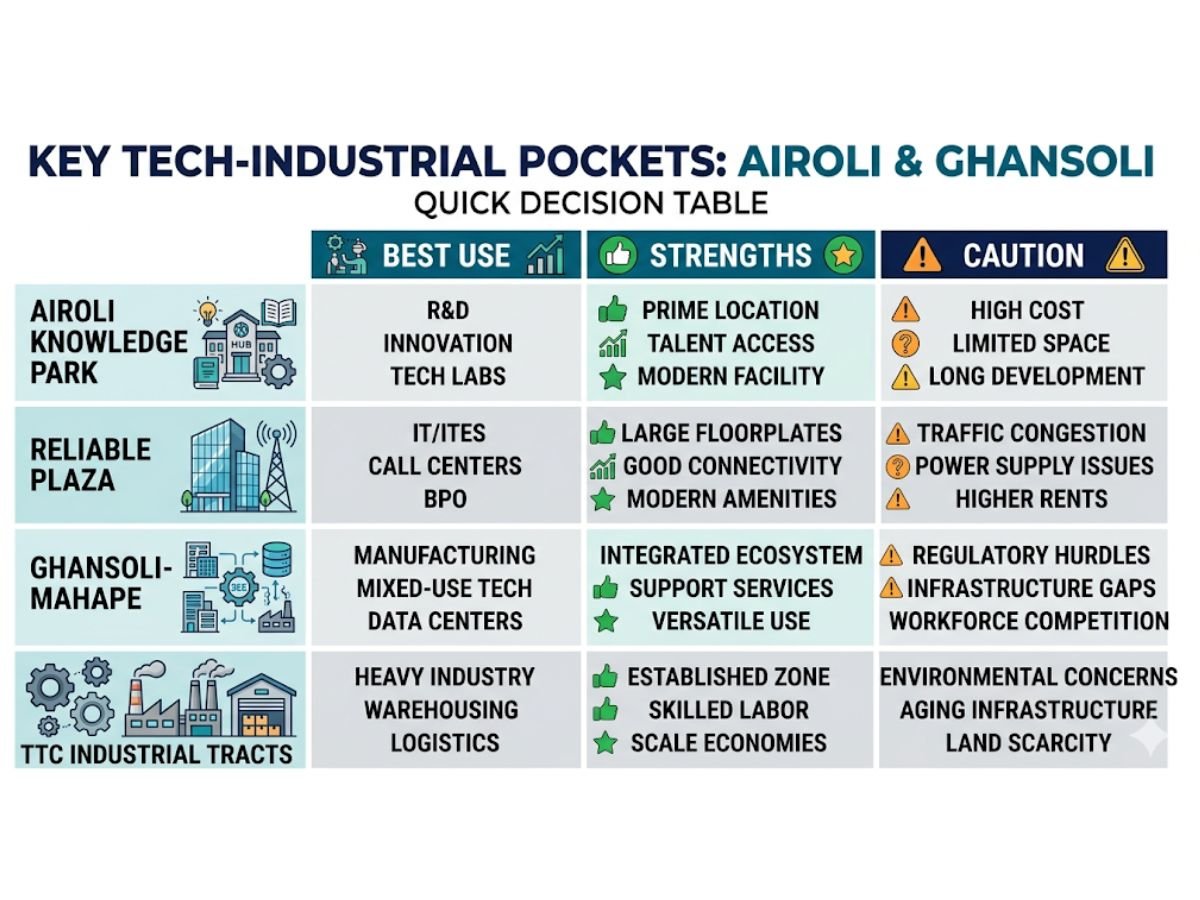
Airoli & Ghansoli: Best Micro-Pockets for Tech, Data & Infra Use (2026)
| Usually Best For | Why it Works | Main Caution | |
|---|---|---|---|
| Airoli Knowledge Park / Mindspace | Enterprise tech HQs, backend teams, data infrastructure | Mature campus ecosystem, strong enterprise presence | Not every “IT” building supports heavy infra needs |
| Reliable Plaza / Airoli TTC belt | Server-heavy setups, backend-critical operations | Data-center presence, industrial estate logic | Power approvals and specs need verification |
| Ghansoli–Mahape interface | Hyperscale, hybrid tech-industrial, large campuses | Stronger infra tolerance, larger footprint availability | Often misread as just cheaper office extension |
| Ghansoli TTC / industrial tracts | Labs, testing, hardware, assembly-light tech | Better for mixed-use than pure office stock | Branding weaker despite strong operational fit |
What Counts as a Real Data Center or Tech-Industrial Pocket in This Corridor?
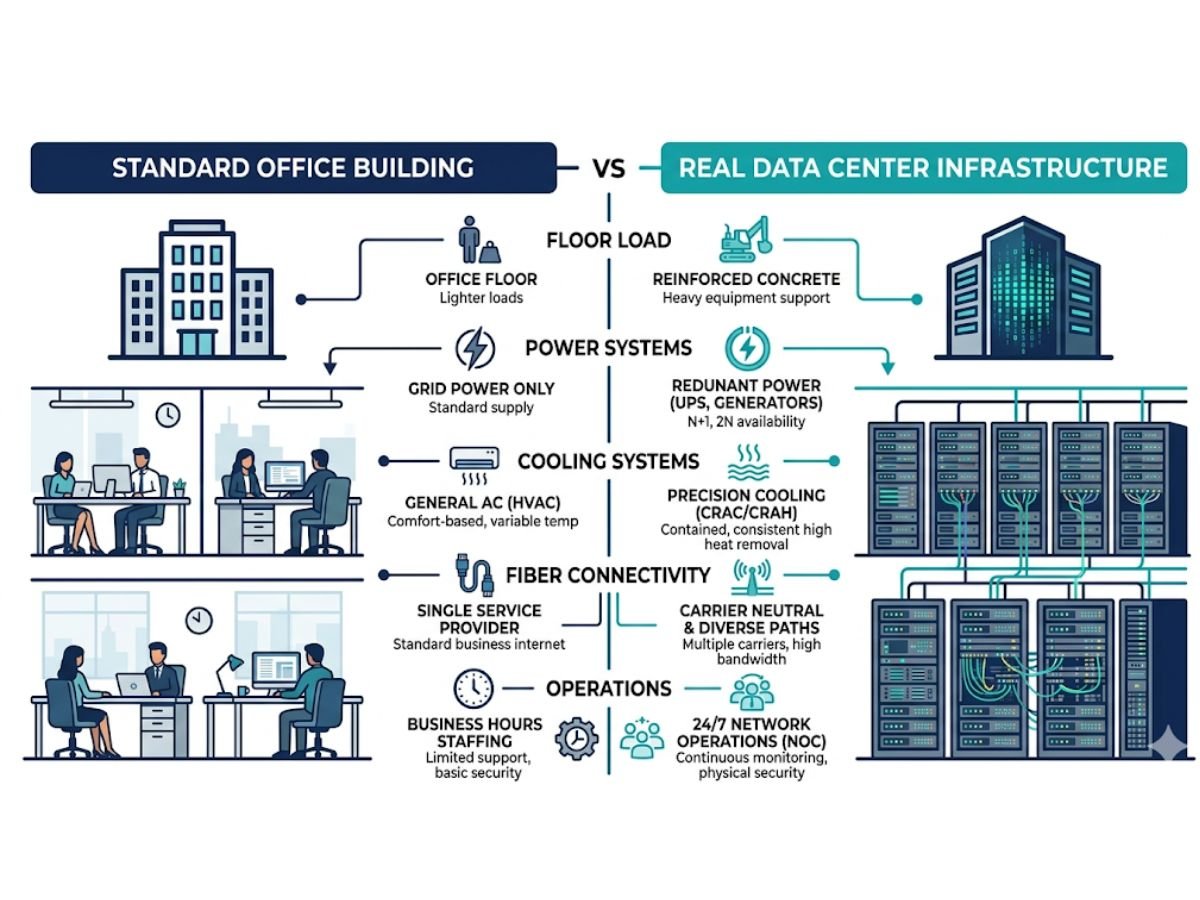
A real data-center-friendly pocket is not just a place with glass buildings, IT companies, and decent station access. It is a place where the physical asset can tolerate far heavier structural loads, far deeper power demand, multi-path fiber entry, uninterrupted service movement, and 24/7 machine-led operations. The difference is fundamental. Standard offices are built for people. Data centers and tech-industrial assets are built for dense equipment, cooling systems, backup systems, and uptime discipline.
That difference is not small. Typical office floor loading is far lower than what serious server infrastructure demands. CapitaLand’s Navi Mumbai 1 data center factsheet for Airoli publicly mentions a 220 kV GIS substation, 2,000 kg per sq m floor loading, and a much more infrastructure-led specification than a normal commercial office would need. NTT’s NAV1A in Navi Mumbai similarly highlights carrier-neutral design with four distinct fiber paths and advanced cooling methods such as liquid immersion and direct contact liquid cooling. Those are infrastructure signals, not brochure decoration.
So in practical property language, “tech-industrial” in this corridor should mean one of three things:
- the building can support real backend infrastructure, not just office seating
- the surrounding pocket can handle heavy service, utility, and operational movement
- the land or building format can scale without breaking on road width, fire access, or power constraints
If a building looks premium but behaves like a normal office block, it should not be treated as a genuine data-center or infra-tech location.
Which Airoli Pockets Actually Work Best for Enterprise-Tech and Infra-Led Users?
Airoli works best where corporate ecosystem and infrastructure depth meet. That is why broad Airoli is not the right way to think about this topic. The useful Airoli answer is micro-location based.
Airoli Knowledge Park and Mindspace side
This is the strongest Airoli answer for enterprise-tech users who still need serious backend reliability. It suits occupiers that want engineering teams, command centers, support operations, and infrastructure decision-makers in one polished environment.
This belt is already validated by serious operator activity. Princeton Digital Group says its Mumbai campus offers 150 MW across five buildings, and CapitaLand’s Airoli project is publicly positioned as a 108 MW development. That does not mean every nearby building is equally usable, but it does show that this part of Airoli has already been accepted by large infrastructure players.
Reliable Plaza and Airoli’s TTC-facing infrastructure belt
This is a more infrastructure-credible pocket than generic “Airoli office” language suggests. Sify’s Mumbai data center location is at Reliable Plaza in Airoli, and its published material shows that this is not a casual office-use asset. It is part of the corridor’s real data infrastructure fabric.
For occupiers, this matters because Reliable Plaza-type positioning sits closer to the logic that data and backend infrastructure need: industrial estate context, better tolerance for serious utility dependency, and a more believable operational base than a nice-looking office building with weak technical specs.
Where Airoli is strong and where it starts getting limited
Airoli is strongest when the requirement includes any combination of these:
- executive access
- enterprise-brand comfort
- backend teams sitting near infrastructure
- built-to-suit or campus-style deployment
- easier acceptance for premium tenants
Airoli becomes less ideal when the requirement starts moving toward very large raw footprints, heavy hybrid operations, or deep industrial tolerance. That is where the corridor naturally starts pulling demand southward toward Ghansoli-Mahape-style logic.
Which Ghansoli Pockets Make More Sense for Hybrid Tech-Industrial or Infrastructure Use?
Ghansoli is often misunderstood because many people read it through residential spillover or general office pricing. That misses the real point. For this topic, Ghansoli becomes important not because it is “cheaper than Airoli,” but because it sits closer to the heavy-lifting side of the corridor.
Ghansoli only makes full sense when read with Mahape
For data-center and tech-industrial logic, separating Ghansoli from Mahape is a mistake. NTT’s Navi Mumbai data center is in the Mahape Electronic Zone and publicly describes a 30 MW critical IT load, 5,000 racks, four distinct fiber paths, and advanced cooling. That is exactly the kind of infrastructure reality that changes how the Ghansoli side should be read.
This is why the Ghansoli-Mahape belt often works better for:
- larger continuous campuses
- hybrid hardware-software operations
- testing, lab, and backend infrastructure combinations
- operators that care more about utility depth than corporate shine
- future expansion logic
Where Ghansoli starts to look stronger than pure office markets
Ghansoli becomes stronger when the user is not chasing station-led office appeal, but infrastructure-led land and operations logic. If the use case needs bigger footprints, service access, cooling equipment tolerance, and a setting that can live with industrial traffic and 24/7 movement, this side often makes more sense than polished office-first micro-markets.
There is also a forward-looking reason. The Ghansoli-Airoli Palm Beach Road extension has moved ahead after environmental clearance and is widely positioned as a major connectivity upgrade for this side. Reported project details indicate a 3.47 km stretch with a 1.9 km bridge/elevated component, while recent NMMC budget reporting also points to the Palm Beach elevated road extension as an ongoing completion priority rather than a finished certainty. So the connectivity thesis is real, but timelines should still be treated as projected, not guaranteed.
Where the branding is better than the real operational fit
This is where many people go wrong. A corporate-looking building in Ghansoli is not automatically a better infra-tech asset than a more industrial-feeling site nearby. For this topic, appearance can mislead. The better question is simple: can the asset actually support power, cooling, fiber, load, fire access, and service movement at the level the occupier needs?
Airoli vs Ghansoli: Which Side Fits Which Type of Occupier?
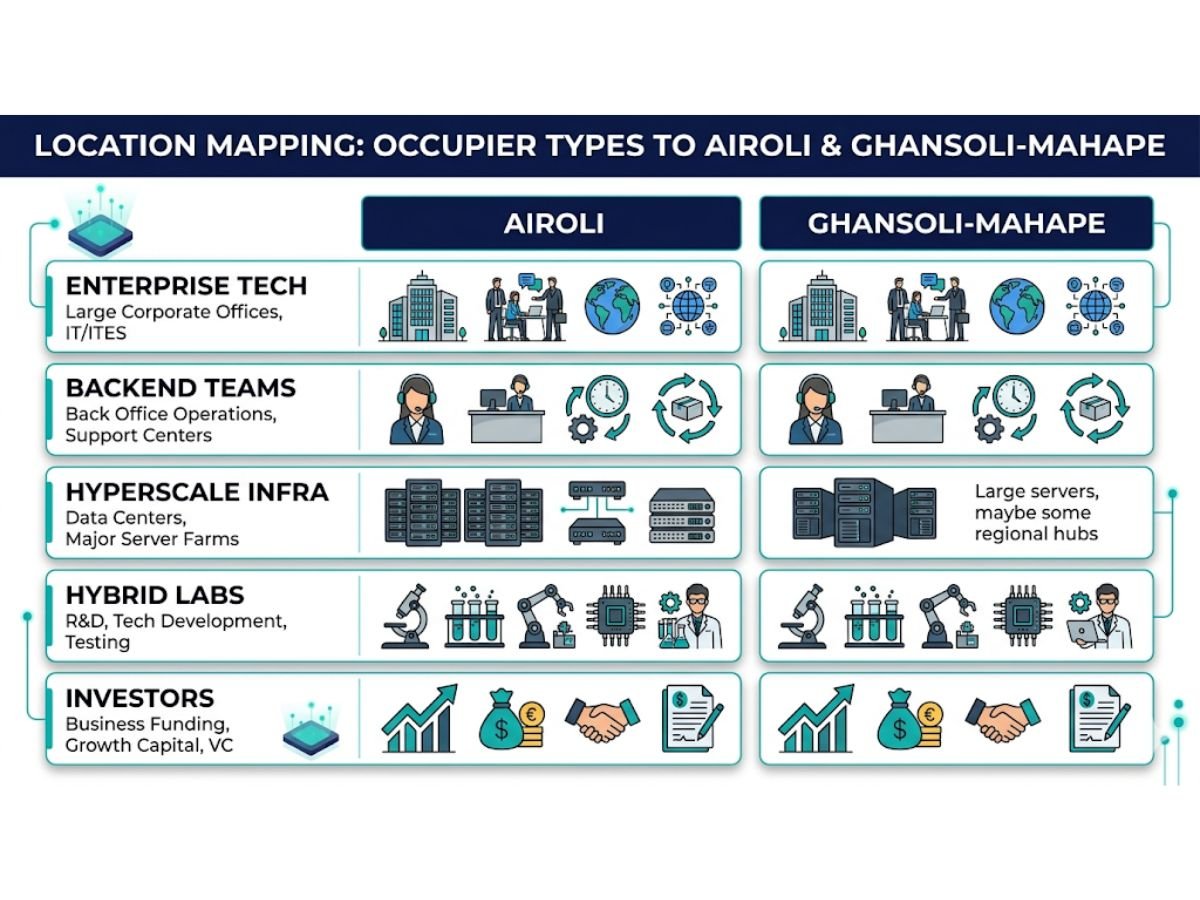
Airoli vs Ghansoli–Mahape: Best Fit by Occupier Type (2026)
| Occupier Type | Usually Better Side | Why |
|---|---|---|
| Enterprise tech office + backend mix | Airoli | Better corporate ecosystem, stronger executive comfort, mature campus setup |
| NOC, support, backend engineering teams | Airoli | Easier talent pull and better integration of people + systems |
| Built-to-suit hyperscale / premium infra campus | Airoli | Already validated by large institutional and data-center-style deployments |
| Large-format infra-heavy deployment | Ghansoli–Mahape side | Better heavy-infrastructure logic and larger footprint availability |
| Hybrid lab, testing, hardware operations | Ghansoli–Mahape side | More practical for mixed physical-digital use cases |
| Investors chasing infra-led growth | Ghansoli–Mahape side | Better long-term upside with infrastructure-driven expansion |
Which Micro-Factors Actually Decide Whether a Pocket Works for Data or Tech-Industrial Use?
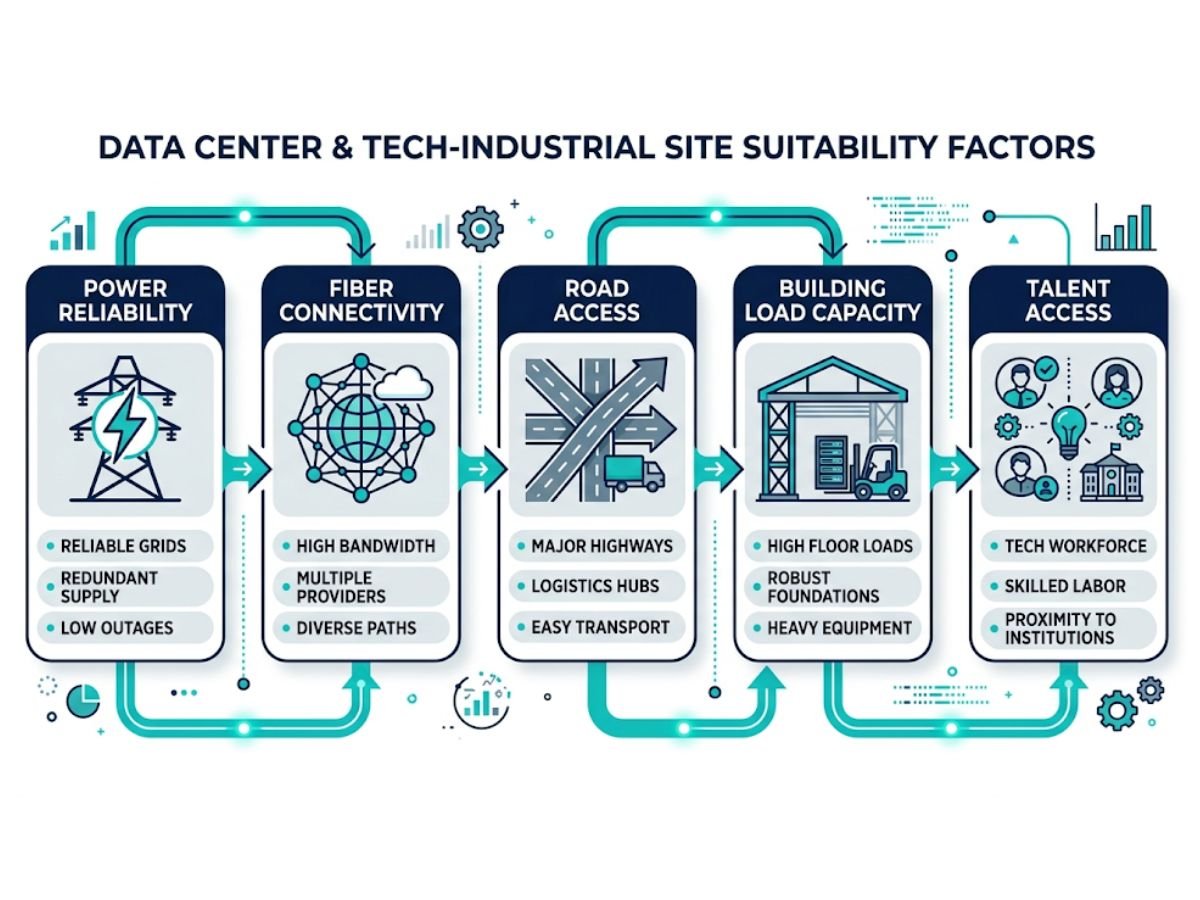
This corridor should be judged with a harsh checklist. Nice lobbies do not matter much if the building fails on infra basics.
1) Power reliability and redundancy
Data and heavy tech operations live or die on power quality and sanction depth. Airoli’s serious infrastructure projects publicly reference on-premise 220 kV GIS substations, while the Ghansoli-Mahape-side market is also tied to large utility-backed infrastructure logic through operator-led campuses. Building-level sanction still has to be verified each time.
2) Fiber and network depth
Carrier-neutral design and diverse fiber entry matter. NTT explicitly markets four distinct fiber paths for NAV1A. That is a very different level of resilience from normal broadband availability in a commercial office.
3) Road access and fire movement
MIDC rules matter here. The official CDCPR framework allows additional FSI up to 200 percent over the basic limit for certain park formats, but above 100 percent and up to 200 percent is tied to minimum 18 m access-road width. The same regulatory framework also contains 6 m movement requirements for firefighting vehicles in special building conditions. In plain language, a narrow-lane site can destroy an otherwise attractive development model.
4) Building format and load tolerance
This is where most fake “data-center-ready” claims collapse. A normal office plate and a true infra-ready plate are not the same. Structural tolerance, ceiling logic, equipment loading, service shafts, and cooling design all matter.
5) Talent access
This still matters, just not equally for every use case. For human-heavy NOCs, backend teams, and engineering support centers, Airoli’s access advantage remains real. For machine-heavy operations, road and utility logic often matter more than station romance.
Best Pockets by Use Case, Not by Brochure Category
Here is the sharper shortlist.
Best for enterprise tech office-backend mix
Airoli Knowledge Park / Mindspace side
This is the best answer when people, enterprise culture, and backend resilience need to coexist.
Best for infra-heavy or backend operations logic
Reliable Plaza belt in Airoli and the Mahape-facing side of the corridor
This works where technical credibility matters more than ordinary office appeal.
Best for hybrid tech-industrial use
Ghansoli-Mahape industrial-facing tracts
This is the better answer for mixed physical-digital operations, labs, testing, assembly-light functions, and larger service movement.
Best for investors looking for occupier resilience
Airoli for immediate premium tenant comfort, Ghansoli-Mahape for deeper long-term infra-led scale
That split matters. Airoli is usually easier to explain to a broad premium tenant base. Ghansoli-Mahape often holds the stronger heavy-infrastructure logic.
What Usually Gets Misread in the Airoli-Ghansoli Corridor?
The first mistake is the premium-glass fallacy. A polished commercial tower is not automatically infrastructure-ready. In fact, for server-heavy or utility-heavy setups, appearance can be less relevant than load, road, cooling, and fire movement.
The second mistake is station obsession. Station proximity matters strongly for BPO-style, people-heavy operations. It matters much less for machine-heavy facilities that need uninterrupted service access, equipment movement, and utility depth.
The third mistake is policy over-reading. Maharashtra’s IT-ITES policy is supportive and includes incentives such as stamp-duty support and electricity-duty benefits for the sector, but that does not turn every legal plot into a practical data-center location. Policy permission cannot replace power infrastructure, road width, or structural tolerance.
Should You Buy, Lease, or Just Track This Corridor for Now?
For normal enterprise tech occupiers, leasing usually makes more sense. It keeps flexibility high and avoids locking capital into a specialized asset before the long-term requirement is fully proven.
For serious data-center or hybrid tech-industrial operators, long built-to-suit structures or strategic acquisition logic become more relevant because the sunk cost in fit-outs, power systems, cooling systems, and uptime infrastructure is too high for casual short-term thinking.
For investors, the right answer depends on where the thesis sits. Airoli is stronger if the pitch is premium enterprise depth today. Ghansoli-Mahape is stronger if the thesis is infrastructure-led scale and corridor improvement over time. Just do not make the classic mistake of buying a small generic office unit and imagining a real data-center tenant will treat it as a substitute for a serious infrastructure asset.
What to Check Before Finalizing Any Airoli-Ghansoli Tech-Industrial Property
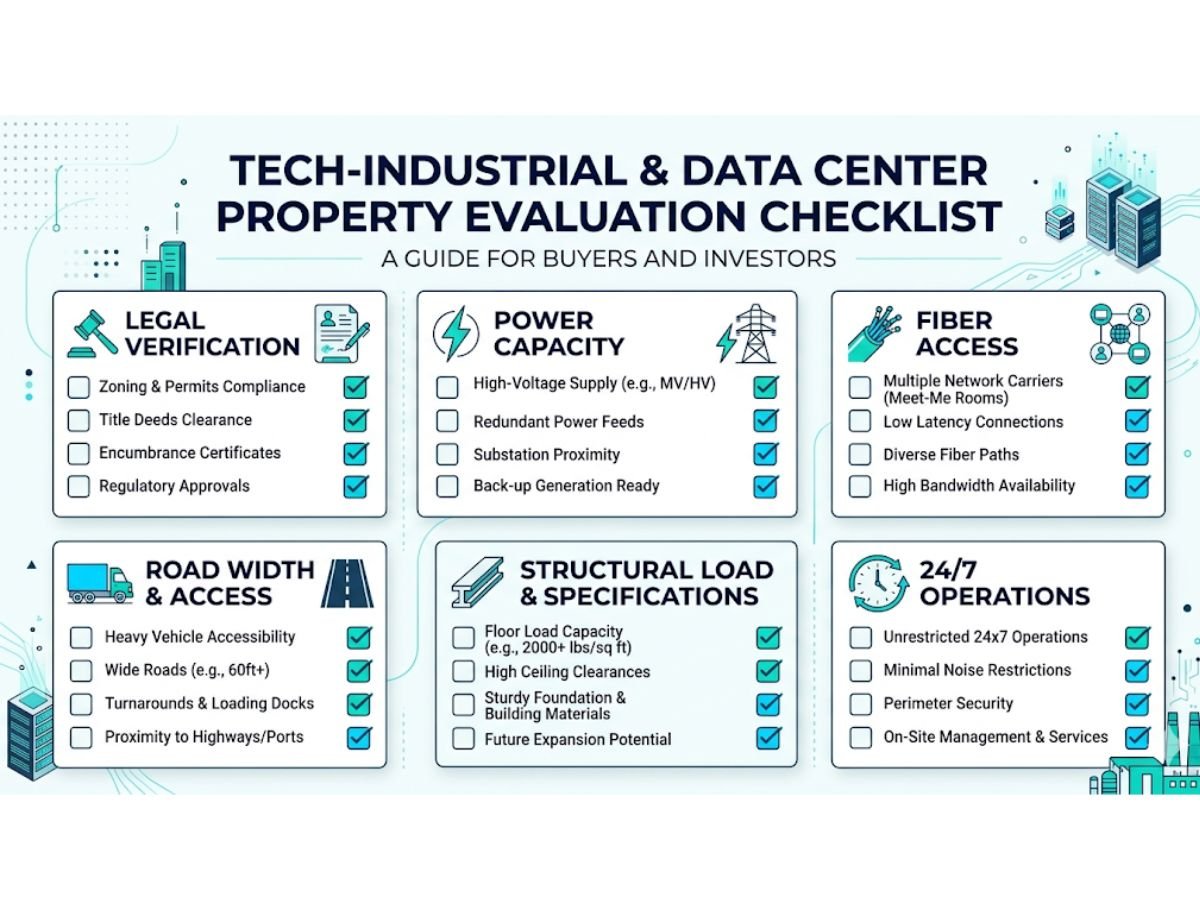
Before committing money, check these items properly:
- confirm whether the plot or building sits under the right MIDC or related authority context for the intended use
- verify the actual permitted use instead of relying on broker language
- check access-road width, especially if extra FSI assumptions are being used in the underwriting
- verify structural load capacity, not just carpet area and facade quality
- confirm real power sanctions, not vague “high power available” promises
- ask how many fiber entries are actually available and from which networks
- inspect service movement practicality for chillers, generators, maintenance vehicles, and emergency access
- confirm whether the asset is suitable for 24/7 operation in practice, not just in marketing copy
That checklist sounds basic, but this is where most expensive mistakes happen.
Conclusion
If the requirement is enterprise-tech plus backend reliability, Airoli is usually the better answer. If the requirement is heavier infrastructure, larger-format scale, hybrid tech-industrial operations, or a more industrially tolerant setup, the Ghansoli-Mahape side usually works better.
So the strongest practical answer is not “Airoli or Ghansoli?” It is this: choose Airoli for polished enterprise-integrated infrastructure, and choose Ghansoli-Mahape for deeper heavy-tech and expandable industrial logic. The corridor only becomes easy to understand once you stop treating it like one uniform IT market.
FAQs
Frequently Asked Questions