Who Should Target Airoli-Ghansoli: Data Center, Tech Infra or Light Industrial?
Airoli and Ghansoli are not interchangeable markets. Airoli usually works best for enterprise-tech teams, GCC-style back offices, and data-infra users who need a polished corporate ecosystem and easier commuter access. Ghansoli works better for larger-format tech-infra, selective R&D, and hybrid occupiers who need more structural practicality. Traditional light industrial users should stay careful, because high rents, use-case mismatch, and peak-hour truck restrictions can make this corridor logistically uncomfortable.
The direct answer: who should actually target Airoli-Ghansoli?
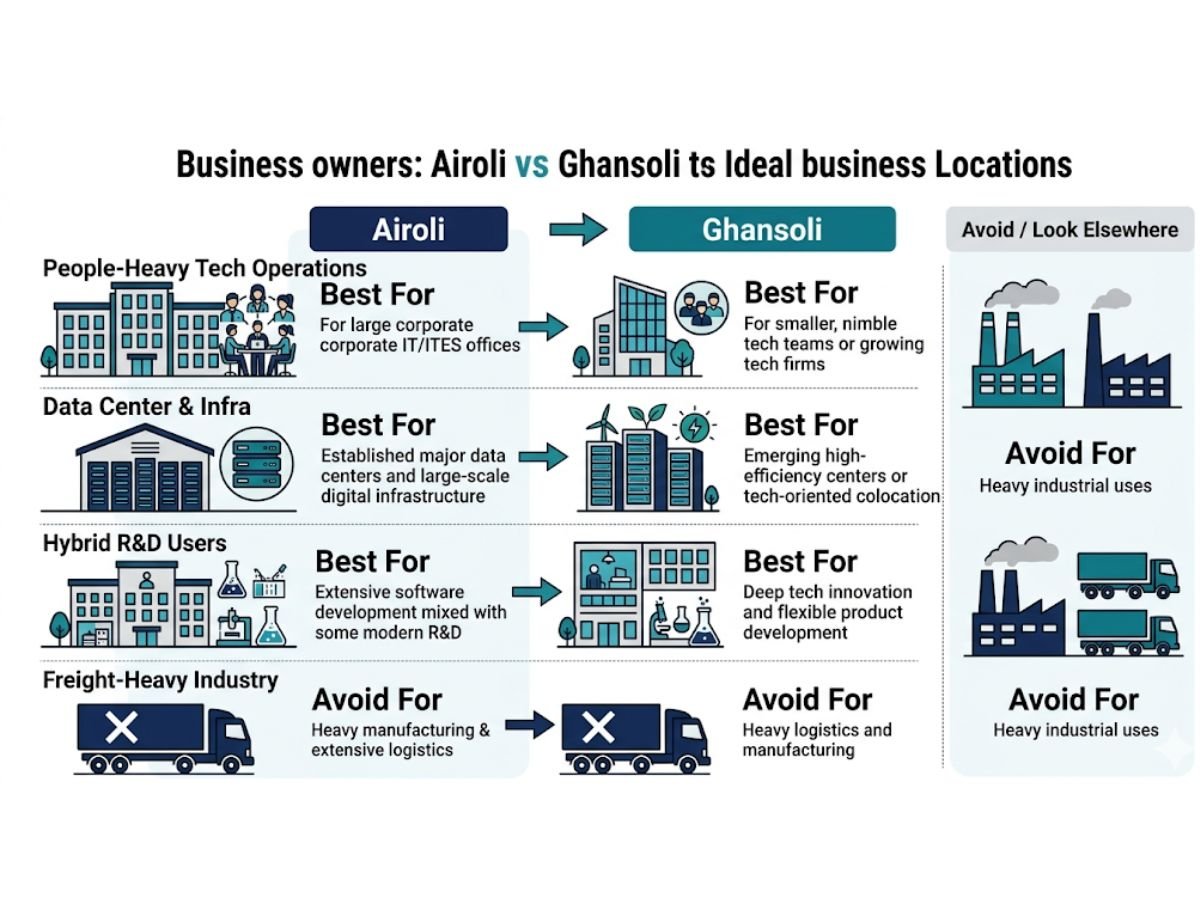
The simplest answer is this: Airoli is the better fit for people-heavy tech operations, Ghansoli is the better fit for hybrid tech-infra and larger-format digital infrastructure, and freight-heavy industrial users should usually look elsewhere.
That matters because many businesses still read this entire belt as one “industrial-tech” corridor. On the ground, that is too broad to be useful. The right decision depends on what your business moves every day: people, servers, equipment, test hardware, or physical goods.
Quick summary table
| User Type | Airoli Fit | Ghansoli Fit | Why It Works | Main Caution |
|---|---|---|---|---|
| Enterprise IT, GCC, BPO, BFSI backend | Excellent | Good | Airoli has stronger campus-grade office environment and better human-capital comfort. | Higher cost pressure in better-grade assets. |
| Data center, hyperscale, large infra-led users | Good | Excellent | Ghansoli has stronger large-parcel and deep infra story in the broader digital corridor. | Only select sites qualify; not every building is data-center ready. |
| Hybrid tech, R&D, testing, life-science style occupiers | Moderate to Good | Excellent | Ghansoli balances corporate usability with more hardware-friendly practicality in the broader belt. | Internal traffic friction can still hurt daily operations. |
| Light assembly, precision hardware, clean controlled ops | Selective | Selective to Moderate | Only works where freight needs are limited and building fit is right. | Industrial label does not guarantee industrial usability. |
| Heavy freight, heavy manufacturing, large-scale warehousing | Poor | Poor to Moderate | Peak-hour truck restrictions and corridor economics work against such users. | Usually better suited to peripheral belts like Taloja or Panvel. |
Why Airoli-Ghansoli should not be treated as one single industrial-tech market
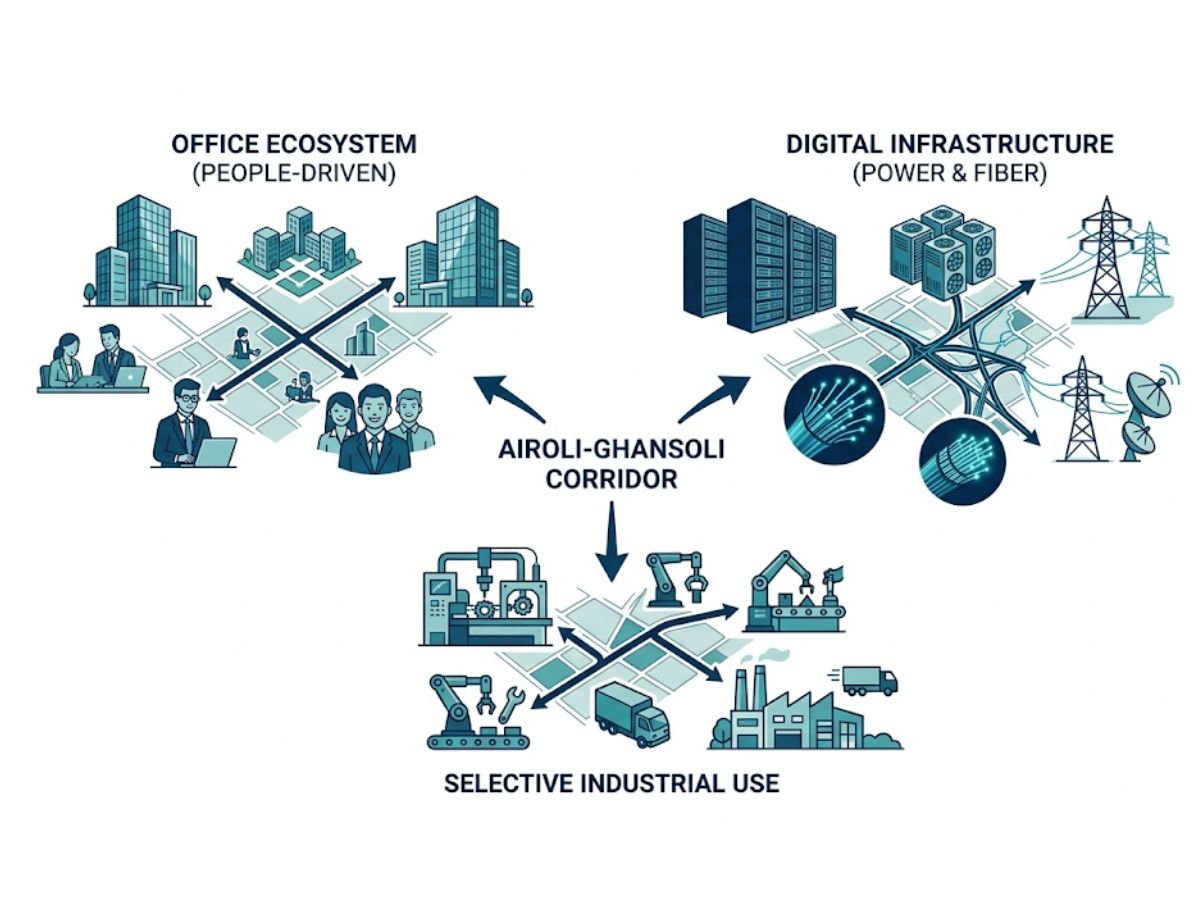
This is the biggest correction most readers need.
Airoli-Ghansoli sits inside the wider TTC industrial geography, but the operational reality is no longer one uniform industrial zone. The belt has split into micro-markets. Some parts now behave like polished enterprise office ecosystems. Some parts are becoming serious digital infrastructure territory. Some pockets still support controlled industrial use. But these are not the same thing.
A glass-façade IT building in Airoli may look modern and premium, but that does not automatically make it suitable for hardware-heavy testing, dense server deployment, or light assembly. In the same way, an older industrial structure in the Ghansoli-Rabale side may offer better floor tolerance or service practicality, but it may not work for a company that depends on white-collar hiring, client visits, and a polished office address.
That is why building specifications matter more than pin code branding.
Airoli-Ghansoli demand is not one story. It is a split story:
- one part is driven by human-capital comfort and office ecosystem quality
- one part is driven by power, fiber, and digital infrastructure
- one part still supports controlled industrial activity, but only selectively
If you miss that split, you can buy in the “right” corridor and still end up with the wrong asset.
Who should choose Airoli first?
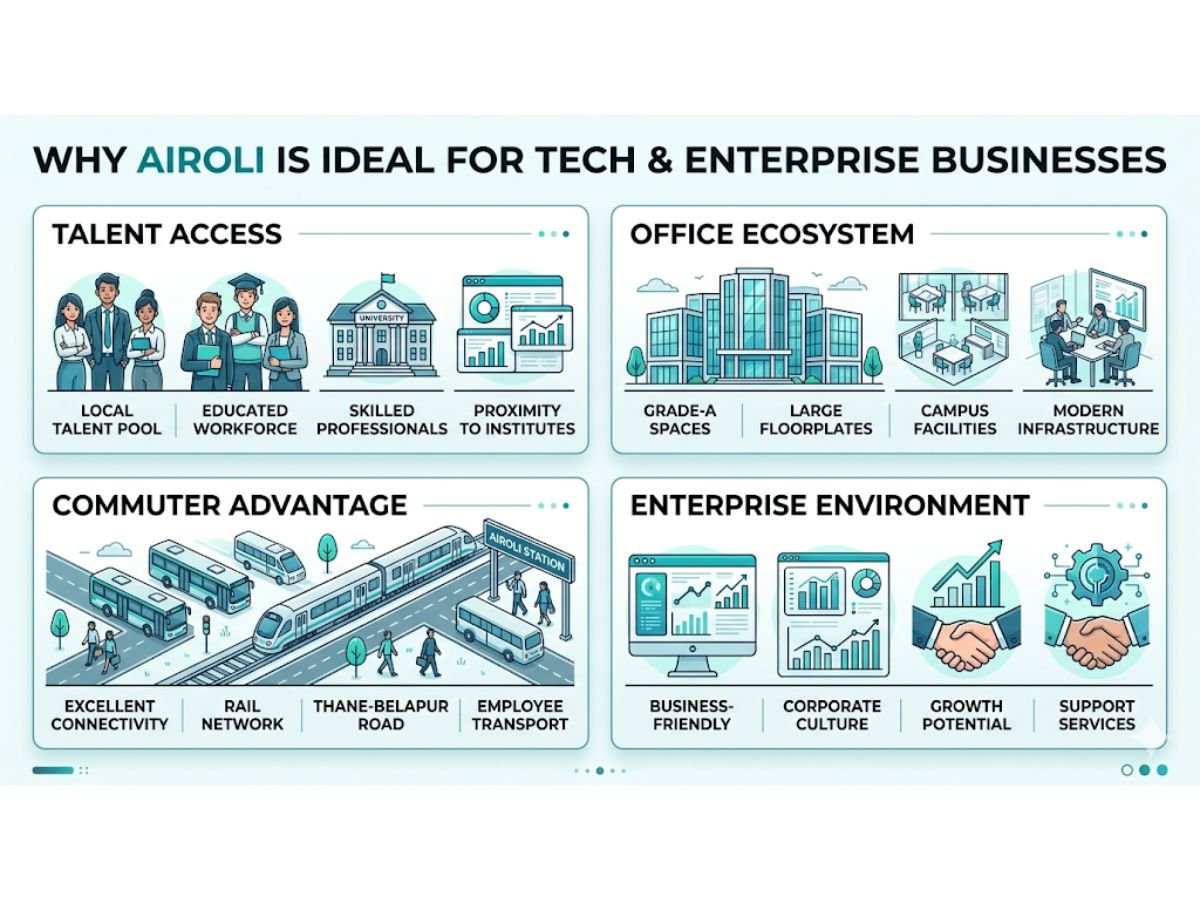
Airoli should usually be the first choice for occupiers whose business is driven more by people, screens, systems, and client-facing credibility than by freight movement.
Enterprise-tech and backend operations teams
Airoli makes more sense for enterprise-tech teams, GCC-style setups, BFSI back offices, BPOs, analytics teams, and backend support operations. These businesses need large, efficient office floors, good HVAC performance, comfortable staff movement, and a location that helps with recruitment and retention.
That is where Airoli’s office-led ecosystem becomes valuable. Recent market reports place North Corridor office rents around the ₹70 per sq. ft. range, though this varies sharply by building, asset quality, and exact location. Even then, it still gives many occupiers a cost advantage compared to Mumbai’s costlier prime office zones.
But the real value of Airoli is not just the rent line. It is the human operating environment.
Data and infra users that need a polished office-led ecosystem
Not every digital-infrastructure business needs a full hyperscale campus. Some need a strong office shell with serious backend support. That includes managed services teams, network operations centers, cloud support functions, infra-monitoring teams, and businesses that want enterprise-grade working conditions close to larger digital infrastructure activity.
For these users, Airoli can work very well. It already has proven institutional-grade tech presence, and large expansions in the area show that serious digital ecosystems are not theoretical here.
Users who depend heavily on commuter comfort and talent access
This point is more local than most generic blogs admit.
The Trans-Harbour line matters, but it is not a perfect answer for all employees. It relies heavily on slow trains, and staff coming from belts like Kalyan-Dombivli often face frustrating line changes around Thane. In real life, that creates hiring friction.
Airoli benefits because road access from the Thane-Mulund side is a practical advantage. The Mulund-Airoli side pull is real. For tech firms, backend operators, and client-facing office users, that daily commuting ease matters more than many people think.
Practical example
A 600-seat backend tech or BFSI operation choosing between an older industrial-style TTC asset and a better Airoli office campus is not just comparing rent. It is comparing attrition risk, manager commute comfort, hiring ease, visitor impression, and daily staff usability. In such cases, Airoli usually wins.
Who should choose Ghansoli first?
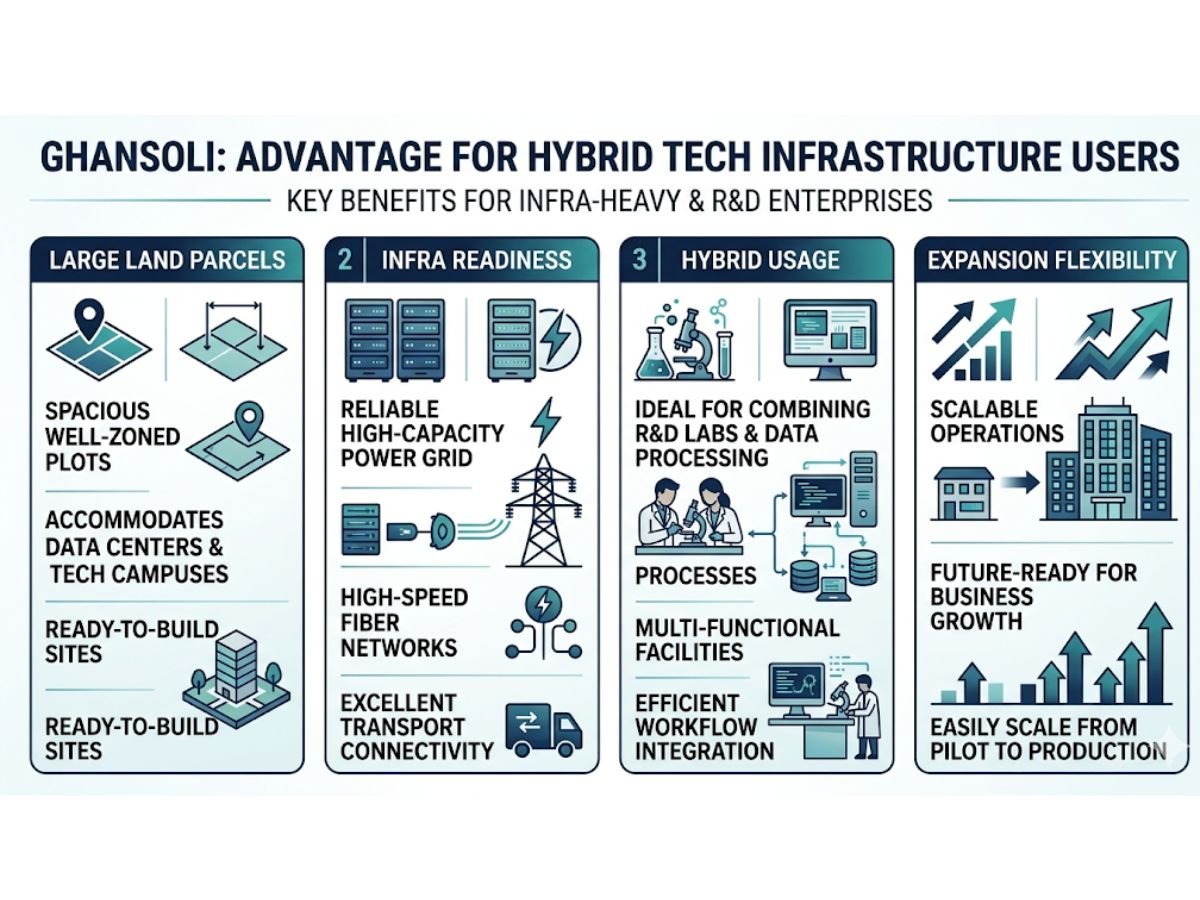
Ghansoli should usually be the first choice for occupiers who need more than just a polished office box. It suits users who want a corporate-compatible location but also need land depth, utility seriousness, or more hardware-friendly operational tolerance.
Premium extension users who want corporate presence without full Airoli logic
Some occupiers want to stay near the Airoli-Mahape digital ecosystem but do not need the exact same office-led setup as Airoli. Ghansoli works well for this group.
It functions as a premium extension corridor. In practical terms, it lets occupiers stay inside the broader corporate-tech geography while accessing sites and built forms that may be more suitable for expansion, hybrid usage, or larger infrastructure deployment.
This is one reason Ghansoli has seen strong attention from large digital infrastructure players. Large, contiguous land availability changes the answer.
Hybrid occupiers who need office capability with selective operational utility
Ghansoli is especially strong for hybrid users. That includes:
- R&D functions
- robotics or controlled testing
- life-science style labs
- hardware-heavy backend setups
- clean, high-value technical operations that need both office usability and structural practicality
These users often do not fit neatly into a standard IT park, but they also do not belong in a rough, freight-heavy industrial zone. Ghansoli gives them a middle path.
Users benefiting from the broader Mahape-Ghansoli-TTC influence
This is where local corridor logic matters.
Ghansoli benefits from its position relative to the Mahape-side ecosystem and the wider TTC network. That gives it a different kind of relevance from Airoli. It is not just a spillover location. It is increasingly a serious part of the larger digital and infra-led belt.
The expected Airoli-Ghansoli bridge and Palm Beach Road extension matter here too. The joint NMMC-CIDCO bridge project, targeted for September 2026, is important because it is expected to reduce Thane-Belapur Road congestion and improve internal corridor movement. That does not mean all access issues disappear overnight, but it does strengthen Ghansoli’s long-term case for tech-infra and enterprise extension demand.
Is Airoli-Ghansoli really suitable for data center users, or only for selective infra-led demand?
Yes, this corridor is genuinely relevant for data-center demand, but only in a very selective way.
That distinction matters because the market casually uses the term “data center” far too loosely. A building with a large server room is not a data center. A normal IT office with better cooling is not a hyperscale facility. And a vacant plot in Ghansoli does not automatically become data-center-ready just because the location sounds digital.
What true data-center suitability usually requires
A serious data-center location needs much more than a good address. It usually needs:
- high-voltage power depth and redundancy
- fiber density and multiple carrier routes
- structural readiness for heavy hardware loads
- cooling infrastructure feasibility
- land or built form that allows technical deployment at scale
- approvals and compliance comfort based on the exact asset
This is why the presence of deep power infrastructure like the 220kV Airoli Knowledge Park substation is so important. This is not brochure language. For true hyperscale or serious colocation activity, such infrastructure is part of the real selection logic.
What parts of the corridor support the idea better than others
The data-center story in this belt is supported by actual capital movement, not just speculation. Large investments and expansions by players like Blackstone-Panchshil, Princeton Digital Group, and Digital Edge show that the broader Airoli-Ghansoli digital corridor is already relevant to hyperscale and carrier-neutral infrastructure.
But these projects also prove the opposite point: serious operators are not choosing random stock. They are choosing purpose-built or deeply suitable sites.
In other words, the corridor is data-center-relevant, but it is not casually data-center-friendly.
When a site is only tech-infra friendly but not truly data-center ready
This is where many mid-sized businesses make a mistake.
A site may be perfectly good for:
- network operations
- cloud management teams
- infra monitoring
- backend digital support
- controlled server environments
But that does not mean it can support Tier III or Tier IV type infrastructure or large-scale colocation use.
If the site lacks redundancy, cooling tolerance, structural strength, or utility routing depth, it is a tech office with infra-friendly features, not a real data-center asset.
When does tech infra make more sense than light industrial in this corridor?
In most of Airoli-Ghansoli, tech infra makes more sense when your business depends more on people, data, and controlled technical systems than on continuous movement of physical goods.
That is the core dividing line.
Why the truck ban changes the answer
This is one of the most practical but ignored filters in the whole corridor.
Heavy vehicle movement across the Mumbai Metropolitan Region faces strict peak-hour restrictions, including 08:00–11:00 and 17:00–21:00. For freight-heavy businesses, that creates a seven-hour daily blackout window during the most useful working hours.
That one reality alone changes corridor suitability.
A tech-infra operation can survive because its main traffic is digital traffic and staff movement. A light industrial operation that depends on frequent dispatch, supplier timing, loading cycles, and truck-based movement feels that restriction every day.
Why office and infra users get a built-in advantage
Tech-infra users benefit because the corridor’s strongest advantages are:
- digital infrastructure depth
- road-led staff access
- enterprise-compatible environment
- higher-value use of expensive real estate
Light industrial users, on the other hand, need:
- easier truck entry and exit
- lower occupancy cost
- better loading practicality
- less daily traffic friction
- more forgiving industrial surroundings
That is why many light industrial businesses find this corridor more difficult than it looks on paper.
Comparison table: tech infra vs light industrial fit
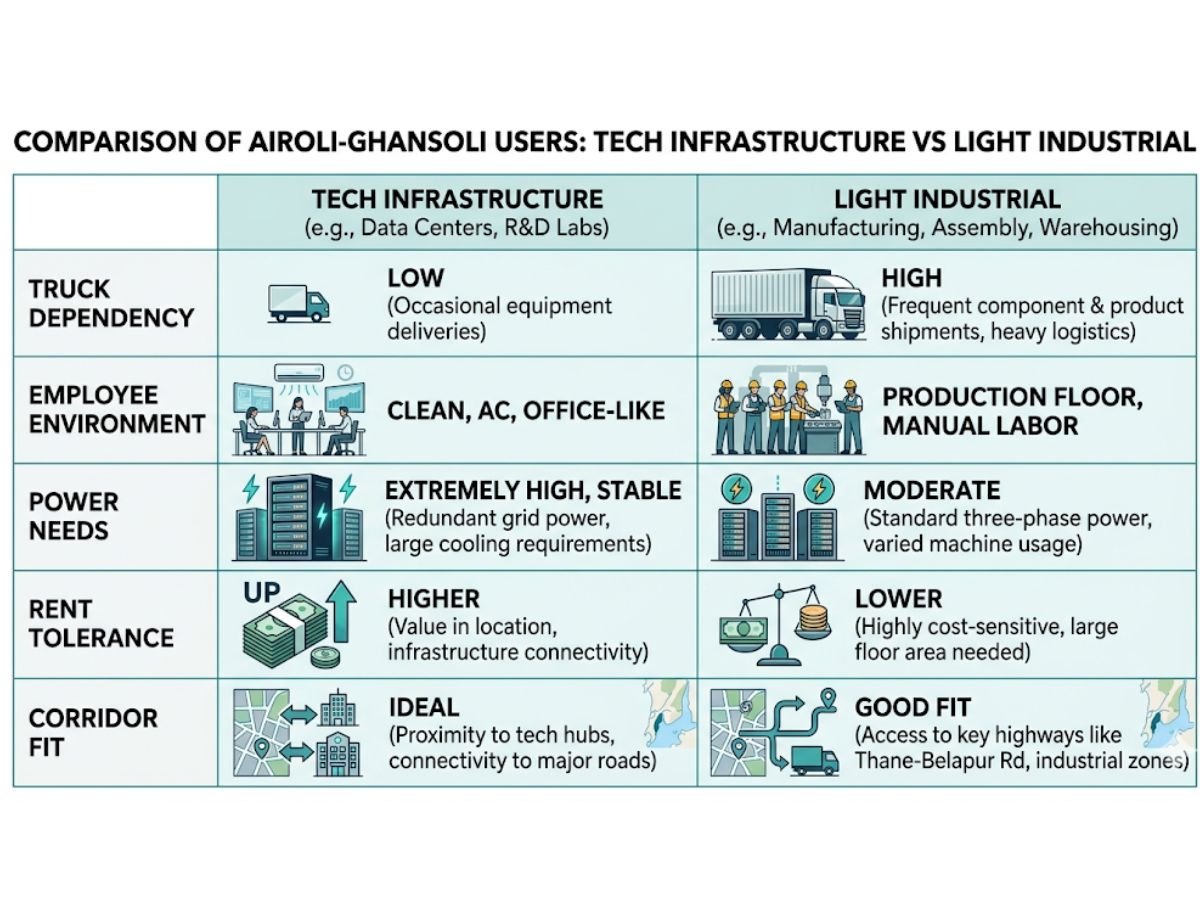
| Decision Factor | Tech Infra User | Light Industrial User |
|---|---|---|
| Daily dependence on truck movement | Low to Moderate | Moderate to High |
| Ability to tolerate peak-hour truck bans | Usually higher | Usually lower |
| Need for polished employee environment | High | Moderate |
| Importance of power and fiber depth | Very high | Varies by operation |
| Fit with rising corridor rents | Better for high-value operations | Worse for low-margin operations |
| Fit with gentrifying digital corridor | Strong | Often weak unless operation is controlled and high-value |
| Best match in Airoli-Ghansoli | Strong | Selective only |
Which light industrial users can still work here, and which ones should stay away?
Light industrial use is not completely dead in this corridor. But it is now a selective fit, not a default fit.
Light assembly, backend servicing, and controlled operational users
Some users can still work here, especially where the operation is:
- clean
- high-value
- low-noise
- low-freight
- technically oriented
- not dependent on all-day heavy dispatch cycles
Examples include precision electronics, testing environments, service-backend workshops, clean assembly, and controlled hardware-support functions. These businesses can sometimes use parts of the Ghansoli-Rabale-TTC side effectively if the building and access logic match the use.
Users likely to struggle with heavy truck movement or true industrial scale
Businesses should usually stay away if they depend on:
- regular heavy vehicle movement during the day
- high-volume storage
- continuous goods dispatch
- chemical or dirty industrial activity
- low-margin operations that need cheap large area
- full industrial flexibility without heavy compliance friction
For such users, peripheral nodes like Taloja, Pawne, or Panvel-side belts usually make more sense than Airoli-Ghansoli.
Why “industrial” on paper does not always mean operationally industrial
This is where many buyers get misled.
Because the wider TTC geography has an industrial legacy, many properties still carry an industrial association in people’s minds. But the economics and daily functioning of the corridor have changed. Rising rents, premium digital infrastructure demand, and policy support for IT and data-center development are steadily pushing the belt toward tech-led use.
So yes, some land or buildings may still be industrial in planning history or zoning language. But that does not automatically mean they are the right place for traditional industrial operations in 2026 and beyond.
What should occupiers check before buying or leasing in Airoli-Ghansoli?
Before you buy, lease, or even shortlist an asset here, check the building and compliance logic first. In this corridor, use-case mismatch is more expensive than location mistake.
Practical due-diligence checklist
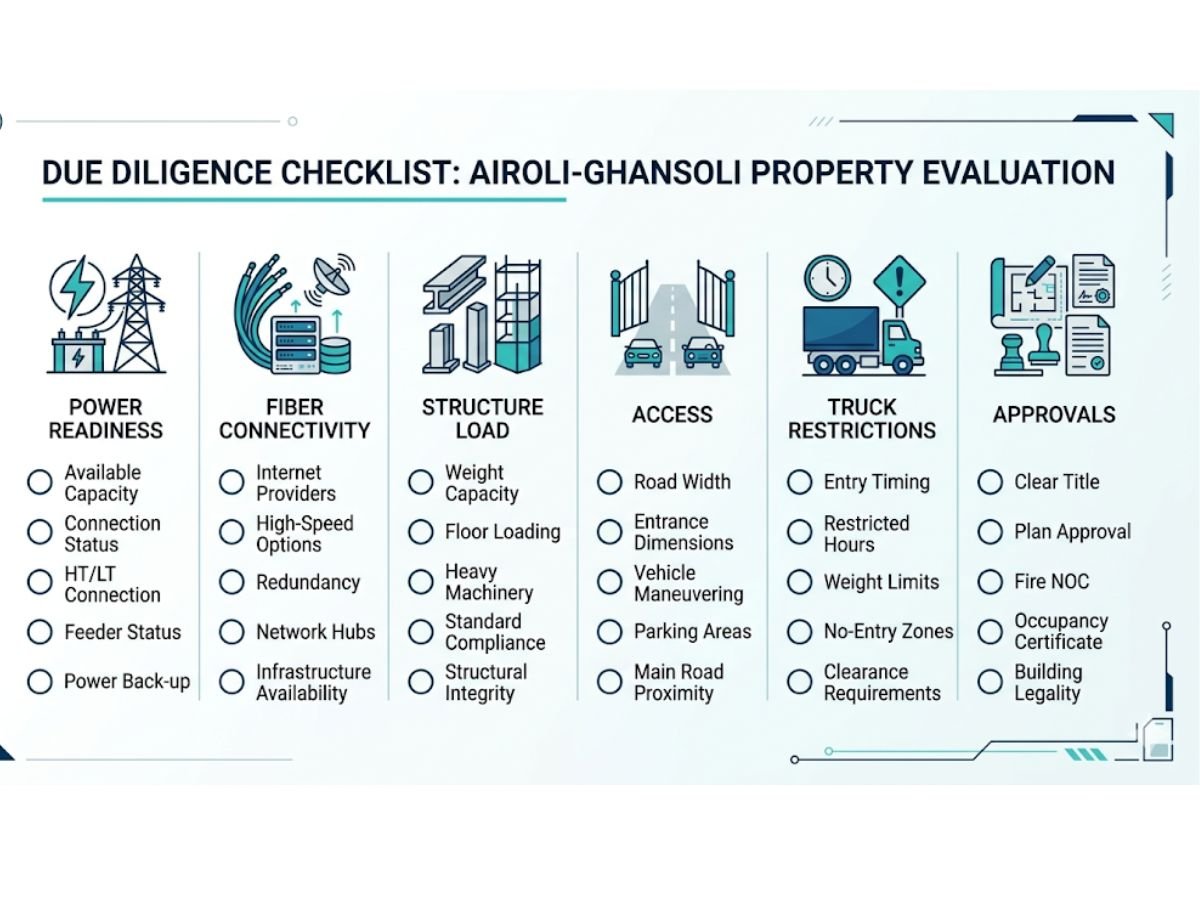
- Power readiness: Is the site only getting normal commercial supply, or does it have true industrial-grade or redundant power suitability?
- Fiber redundancy: Are there multiple carrier options and robust digital routes, or only basic office-grade connectivity?
- Floor loading and structure: Is the building designed for desks and HVAC, or can it actually tolerate heavier technical infrastructure?
- Internal access: Can loading, servicing, staff entry, and internal movement happen practically every day?
- Truck dependency: Can your operation survive peak-hour heavy vehicle restrictions?
- Use-case approval: Is your intended use consistent with the exact permissions and asset type?
- MIDC/CIDCO/NMMC overlay: Which authority controls what, and what does that mean for use, transfer, taxes, and approvals?
- Leasehold realities: If the land has CIDCO-linked leasehold history, have transfer conditions, NOCs, and premiums been checked properly?
- Property tax assumptions: Do not assume MIDC-zone property is free from NMMC tax burden. Carrying cost needs real verification.
This is where Navi Mumbai-specific authority understanding matters.
The corridor can involve a complicated overlap between MIDC, CIDCO, and NMMC. MIDC may control industrial land-use logic and rules like the 80/20 industrial-support split under CDCPR 2023. CIDCO may still matter in leasehold transfer history or premium-linked issues. NMMC can still matter for taxation and civic regulation. A buyer who checks only the building brochure and ignores this authority triangle can walk into delays, cost surprises, or use-case restrictions later.
Which type of investor should target this corridor, and which type should be careful?
This corridor can reward the right investor, but not every investor type should touch it.
Occupier-led investors
The best fit here is usually the occupier-led investor or long-horizon buyer who understands tenant quality and real use-case fit. These investors do better because they are buying into actual demand drivers: enterprise office need, digital infrastructure growth, or serious hybrid technical use.
They are not just buying a label like “TTC industrial belt.” They are buying a corridor whose best assets are increasingly aligned to tech-led demand.
Yield-focused buyers
Yield-focused buyers can also look here, but only with care. Market analyses often place gross commercial yields in the roughly 4.0% to 5.5% range depending on asset class, tenant stability, and exact property type. That can work for investors who prioritise stable occupiers and understand asset quality.
But yield here is not just about location. It is about whether the tenant’s business model genuinely fits the building.
Buyers relying only on branding or broad corridor hype
This is the risky profile.
Small investors buying outdated or poorly specified “industrial” units because they assume all Airoli-Ghansoli property will benefit equally from data-center growth may face tenant replacement problems later. The corridor is becoming more selective, not less.
If your thesis is only “this area is growing fast,” that is not enough. You need a view on who will actually occupy your asset and why.
The biggest mistake buyers make in Airoli-Ghansoli
The biggest mistake is buying the corridor story instead of buying the correct use-case fit.
People hear words like IT belt, industrial belt, data center corridor, digital hub, or premium node, and they assume that all demand is one demand. It is not.
A company that needs freight movement and rugged industrial usability can destroy money by buying into a premium office-led environment that fights its daily operations. A white-collar tech employer can also make a poor decision by taking an older industrial asset that saves rent but hurts recruitment, staff comfort, and brand image.
The best location is not the location with the strongest buzz. It is the location with the least operational friction for your exact business model.
That is the real filter.
Final verdict: choose Airoli, choose Ghansoli, or look elsewhere?
Choose Airoli if your business is people-heavy, office-led, and talent-sensitive. It is usually the stronger answer for GCCs, enterprise-tech teams, BFSI back offices, BPOs, and digital support functions that need a polished environment and easier commuter pull from Thane-Mulund-side talent belts.
Choose Ghansoli if your business needs a more hybrid answer. It is usually the stronger choice for data-center-linked thinking, large-format tech infrastructure, R&D, controlled testing environments, and corporate users who need more hardware tolerance than a standard office ecosystem usually provides.
Look elsewhere, usually toward peripheral industrial belts such as Taloja or Panvel-side locations, if your operation depends on regular truck movement, low-cost industrial area, continuous freight cycles, or traditional manufacturing logic.
In simple words: Airoli is the human-capital play, Ghansoli is the hybrid infra play, and freight-heavy industry should usually not force itself into this corridor.
Conclusion
If the goal is clarity, the answer is not complicated. Do not target Airoli-Ghansoli because the corridor sounds modern, digital, or industrial. Target it only if your business fits the building, the power logic, the access pattern, and the daily operational reality.
That is why Airoli usually wins for enterprise-tech and people-led operations. Ghansoli usually wins for hybrid tech-infra and larger digital infrastructure ambition. And traditional industrial users should stop assuming this corridor is automatically built for them just because of its TTC legacy.
In Airoli-Ghansoli, the smartest decision is not choosing the most famous node. It is choosing the least mismatched operational environment.
FAQs
Frequently Asked Questions