
Airoli Office Market Guide: Rent, Demand, Best Pocket
Airoli is one of Navi Mumbai’s strongest office micro-markets, especially for enterprise, technology, BFSI, GCC, and back-office demand. But it is not automatically right for every office buyer or every business model. It works best when Thane-side access, station-linked commuting, large campus-grade buildings, and operational efficiency matter more than prestige address. The right decision depends on your office purpose, team commute, building type, budget, and exit strategy.
Is Airoli actually one of Navi Mumbai’s strongest office markets today?
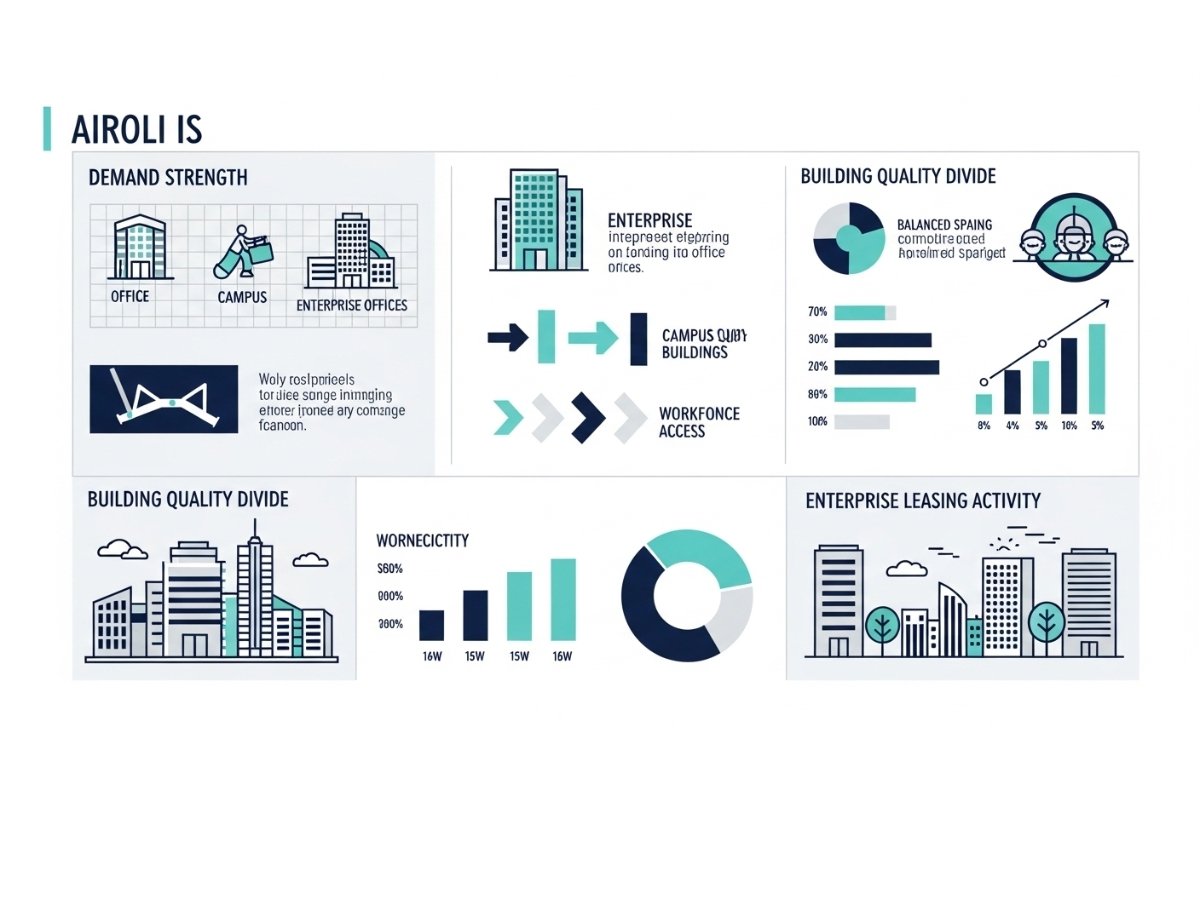
Yes, Airoli is clearly one of the stronger office markets in Navi Mumbai today, but the strength sits mainly in the right kind of buildings.
That distinction matters. A lot of generic pages talk about Airoli as if the whole node performs equally. It does not. In 2026, the real Airoli story is the divide between institutional campus-style stock and weaker fragmented stock. The first attracts serious occupiers. The second often survives on hopeful pricing, broker language, and smaller buyers who assume every office in Airoli will ride the same demand wave.
Airoli’s importance is not theoretical. Recent large deals show that this is still a working enterprise market, not a forgotten spillover zone. Princeton Digital Group’s 10 lakh sq ft lease at Gigaplex, HDFC Bank’s 4.16 lakh sq ft lease in Airoli West, HERE Solutions leasing at around ₹71 psf, and Wipro taking space in Mindspace Airoli East at around ₹67 psf all point to the same thing: large occupiers still trust Airoli when the building and use case are right.
If you want the bigger market context before focusing only on Airoli, Office Space in Navi Mumbai: Complete Guide for Buyers, Investors and Businesses is worth reading.
Quick summary
| Market question | Practical answer |
|---|---|
| Is Airoli a serious office node? | Yes, especially for enterprise and large-team occupiers |
| Is all office stock equally strong? | No, campus-grade stock and ordinary strata stock behave very differently |
| What drives real demand? | Corporate scale, commuter convenience, and building quality |
| Is Airoli prestige-first? | No, it is more operations-first than image-first |
| Is it good for investors? | Yes in selected pre-leased institutional-grade assets, not by default |
What makes Airoli’s office demand different from many other Navi Mumbai office locations?
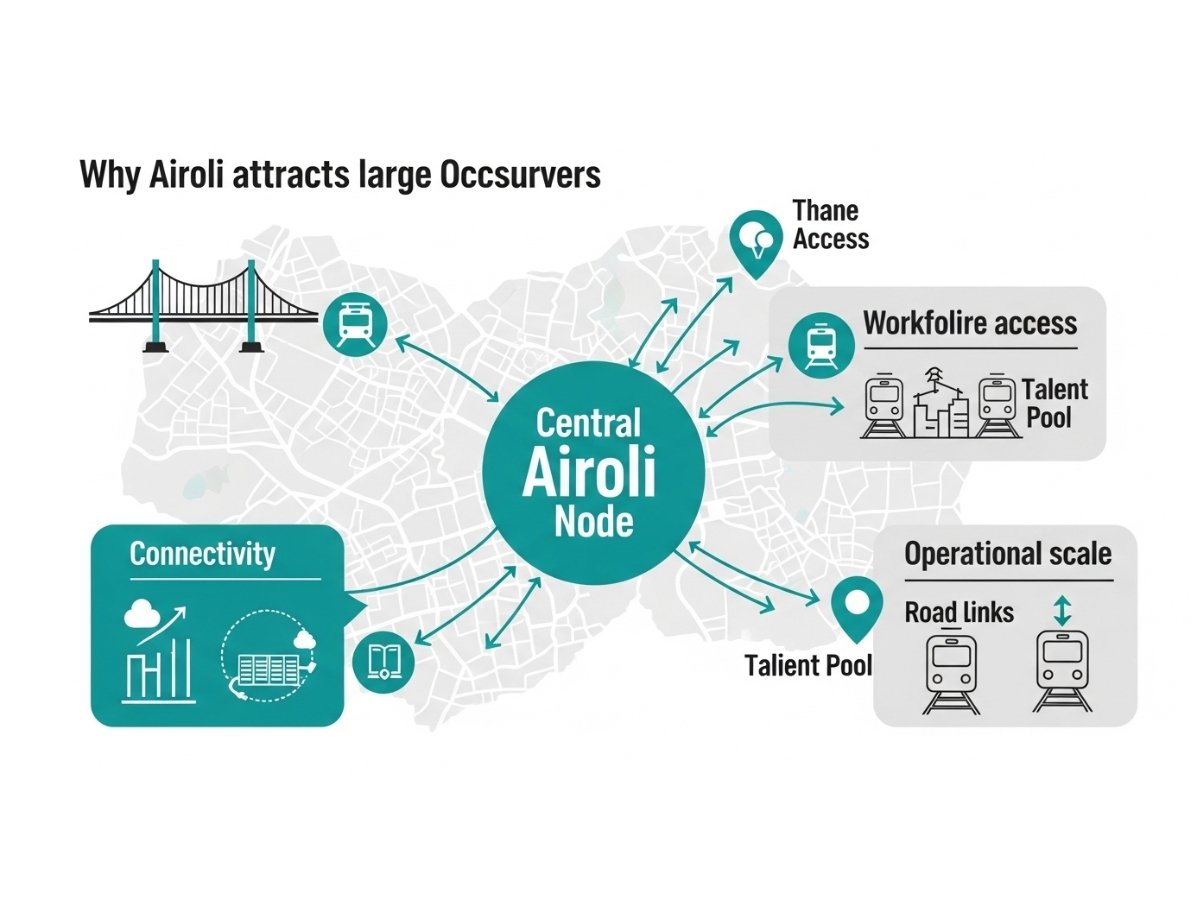
Airoli wins because companies come here for operational scale, not just for a cheaper rent line.
This is a very important difference. Vashi has visibility. Belapur has administrative and business relevance. Some other nodes have mixed commercial demand. But Airoli’s office demand is closely tied to the ability to run large teams efficiently.
How Thane access changes the Airoli office story
Airoli benefits from something many buyers underestimate: it can serve Navi Mumbai and the Thane-side catchment at the same time.
The Mulund-Airoli bridge, Thane-Belapur Road, and wider eastern suburban connectivity make Airoli attractive for companies hiring from Thane, Mulund, and beyond. That is one reason why large occupiers continue to value it. A location that improves hiring comfort and daily attendance usually performs better than one that only looks good on a map.
Why station-linked commuting matters more here than people assume
Train connectivity is not a side benefit in Airoli. It is part of the core office story.
Airoli East especially benefits from stronger station-linked logic. When a large workforce depends on rail access, office desirability changes quickly depending on walkability, last-mile convenience, and how much daily friction employees face between station and desk.
Why campus-grade office stock changes occupier confidence
Airoli’s stronger demand is deeply linked to integrated office parks like Mindspace and Gigaplex.
These campuses offer large floor plates, better facility management, stronger power backup, better security, and more predictable operational comfort. That reduces risk for occupiers. It also explains why not every office building in Airoli enjoys the same leasing depth just because it shares the same pin code.
Which kinds of businesses and teams usually fit Airoli best?
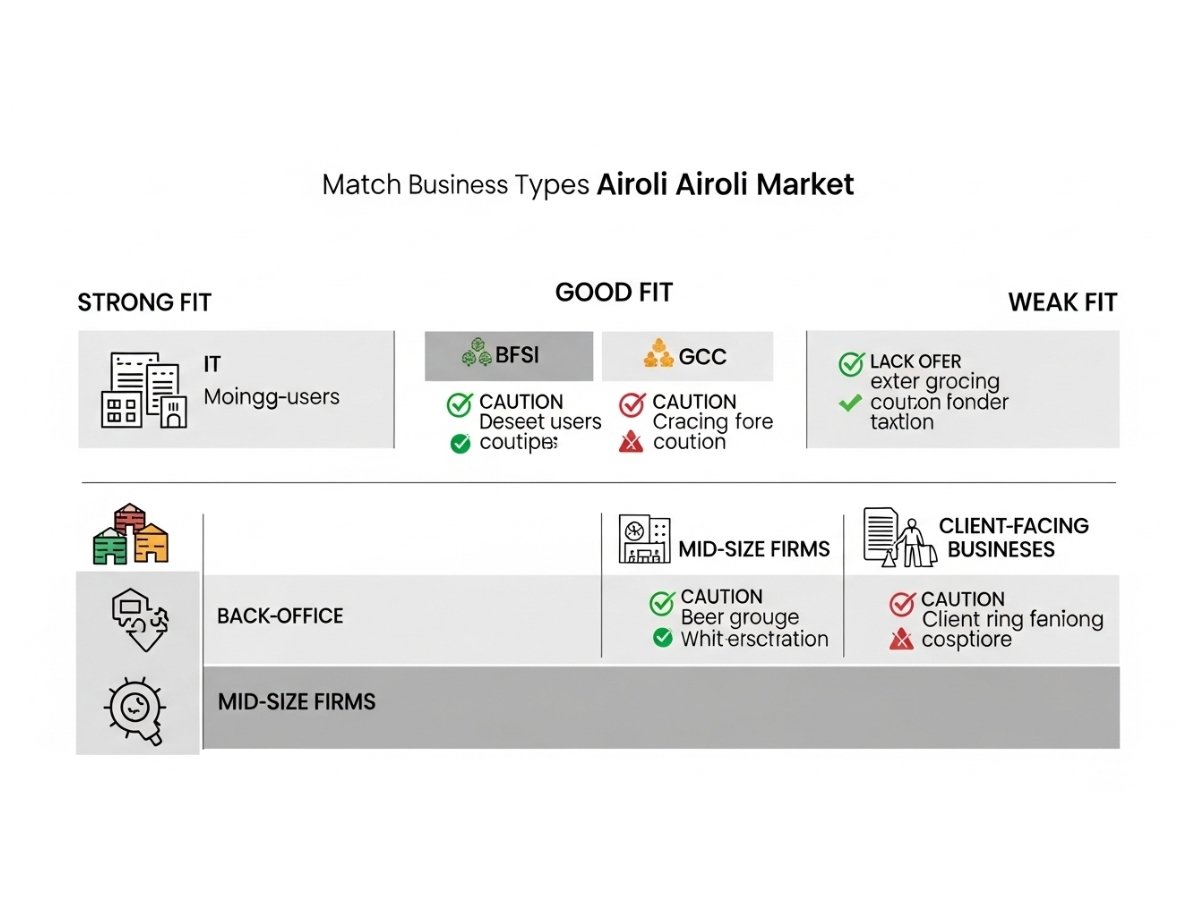
Airoli suits businesses that need scale, process efficiency, and dependable commuter logic.
IT, GCC, BFSI, back-office and operations teams
This is the strongest fit segment.
Airoli works very well for IT and ITeS firms, GCCs, BFSI support teams, engineering backends, analytics operations, and process-led businesses that require bigger teams and stable operating environments. These occupiers usually care less about glamour and more about floor plate efficiency, power, campus ecosystem, and access to a wider talent pool.
A good example is HDFC Bank taking large back-office space in Gigaplex. That is classic Airoli logic. The node supports scale, process movement, and long-term operational visibility.
Mid-size companies needing scale without BKC-level cost
A growing tech company, outsourcing firm, digital operations team, or enterprise services unit can also fit Airoli well if the management wants a serious business environment without paying purely for address branding.
For these occupiers, Airoli often gives a more rational office decision than a higher-cost prestige-led location.
When Airoli may not suit client-heavy prestige-led office use
This is where weak articles usually become vague. The truth is simple: Airoli is strong, but not for every front-office use case.
If your business depends on premium client meetings, high-street visibility, or daily brand signaling, Vashi or some Thane locations may feel more suitable. A boutique law practice, wealth management office, luxury-facing advisory, or image-heavy consulting brand may not get the full benefit of the Airoli model.
Business fit table
| Business type | Airoli fit | Why |
|---|---|---|
| GCC / IT / ITeS | Strong | Large floor plates, campus ecosystem, talent access |
| BFSI back-office | Strong | Scale, process efficiency, predictable commute logic |
| Data, engineering, enterprise ops | Strong | Tech-ready environment, institutional stock |
| Mid-size scaling company | Good | Better value than prestige-driven nodes |
| High client-meeting office | Mixed | Functionally fine, but not always the best perception fit |
| High-street retail or walk-in business | Weak | Airoli is not built around footfall-first office demand |
Which parts of the Airoli office market should readers separate before making a decision?
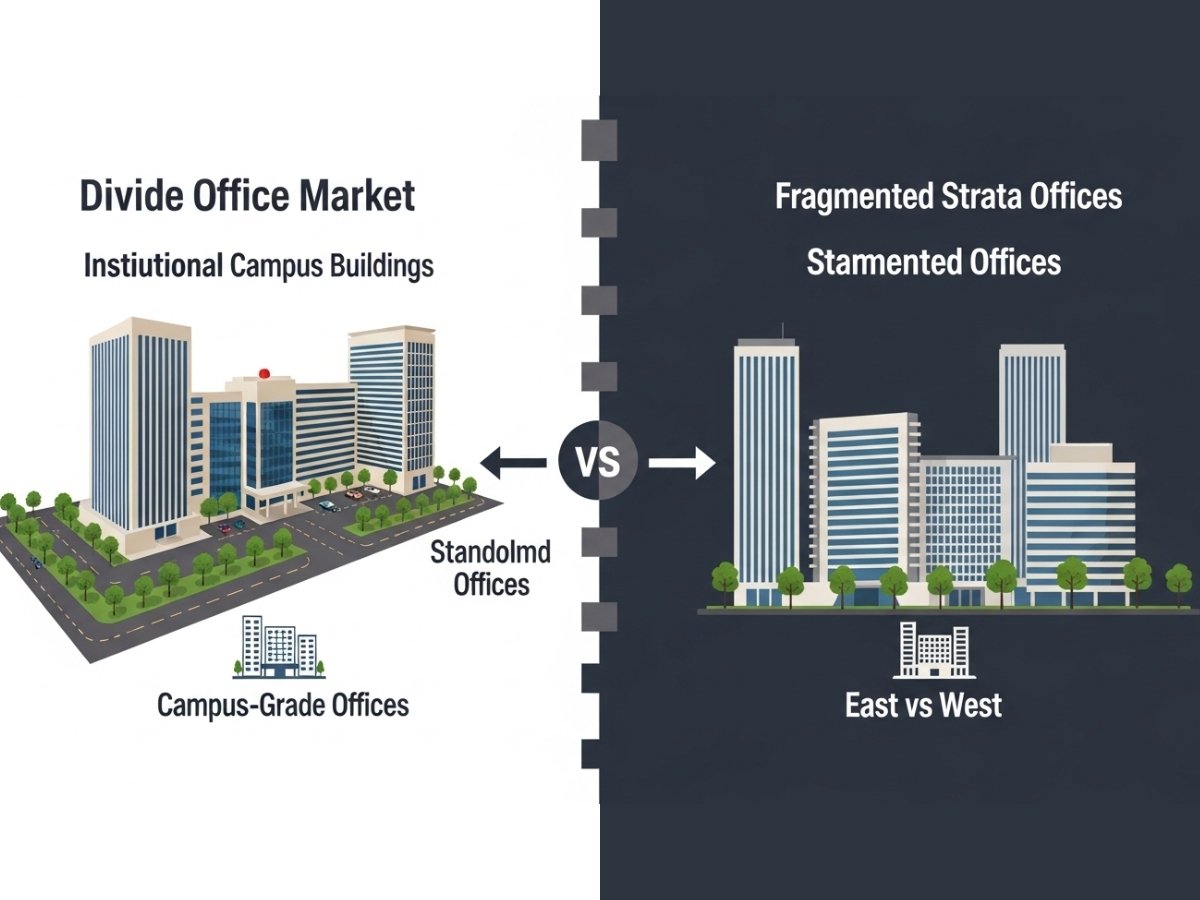
You should never evaluate Airoli as one flat market. It has internal layers, and the wrong assumption here causes expensive mistakes.
Mindspace / Gigaplex / large campus-style stock
This is the part of Airoli that creates the node’s real office reputation.
Mindspace Airoli East acts as the institutional anchor, with strong station-linked convenience and legacy occupier confidence. Gigaplex and the broader Airoli West or Knowledge Park side represent the newer enterprise frontier, with fresher stock and strong road-linked value for companies drawing talent from Thane and the eastern corridor.
Smaller standalone commercial buildings and strata offices
This segment needs much more caution.
Smaller offices in older or fragmented buildings may look attractive because the ticket size is lower. But they can suffer from silent vacancy, weak CAM management, outdated layouts, lift and power limitations, and lower-quality tenant demand. This is where many retail investors get misled by the broad “Airoli is booming” story.
Large occupier demand does not automatically make every resale office a good investment.
East vs West and the role of last-mile movement
Airoli East generally wins on station-linked convenience and mass-transit practicality. Airoli West often wins on newer enterprise stock and stronger road-side logic, especially for Thane-linked commuter movement.
But the West side also carries a last-mile issue. From Airoli station, many office-goers still depend on shared autos or private shuttle systems. In practical terms, that means a cheaper headline rent may still produce a tougher daily commute.
Should you lease office space in Airoli or buy one?
For most occupiers, especially growing businesses, leasing is the smarter starting point in Airoli.
When leasing is smarter
Leasing makes sense when team size may change, growth is uncertain, or management wants capital flexibility. It also works better when the company wants access to campus-grade buildings without locking a large amount of money into owned space.
In Airoli, this matters even more because better office quality often sits inside managed environments where leasing gives access to scale and flexibility.
When buying is smarter
Buying can make sense for stable SMEs, self-use professional firms, or long-term occupiers who are confident about office size, location, and holding period. But even here, the buyer has to choose carefully. Buying the wrong building in Airoli can destroy resale comfort later.
Where small buyers make expensive mistakes
The most common mistake is buying an older strata office because the base price looks attractive, without factoring in building age, tenant profile, maintenance quality, or future exit difficulty.
A second mistake is ignoring Total Cost of Occupancy. A cheap office can become expensive after CAM, tax, fit-out, parking limitations, and poor building relevance are factored in.
Buy vs lease decision checklist
- Do you need flexibility over the next 3 to 5 years?
- Is your team likely to expand or shrink materially?
- Are you buying a building that another serious occupier would also want?
- Have you calculated CAM, tax, stamp duty, registration, and fit-out costs?
- Is ownership being driven by logic, or by the feeling that rent is “wasted money”?
If those answers are unclear, leasing is usually safer.
Is Airoli a good market for leased-office investors?
Airoli can be a good leased-office investment market, but only when the building and the tenant are both strong.
Historical gross commercial yields in this market generally sit in the 5.5% to 7.0% range, but that range alone is not enough to judge quality.
What kind of leased office is easier to hold
The safer version is a pre-leased office in institutional-grade stock with a credible tenant covenant, sensible lock-in, and reasonable rent sustainability. A 5.5% to 6% gross yield on a strong building with a stable tenant is often safer than a higher-looking yield in a weak building.
What makes exit harder even in a strong market
Exit becomes difficult when the asset depends too much on one tenant, sits in an older building, or carries rent that is hard to sustain after the present lease ends. This is the “flight to quality” effect in real life. The market is willing to reward strong buildings and punish weaker ones.
Why tenant quality matters more than headline yield
A 7% yield is not impressive if the tenant is weak, the building is aging badly, and re-leasing is uncertain. In commercial investing, what matters is not just current income. It is the probability that the next tenant will also want the same space.
How should readers think about rents, pricing, vacancy, and office quality in Airoli?
You should think in ranges, by asset type, not by a single Airoli average.
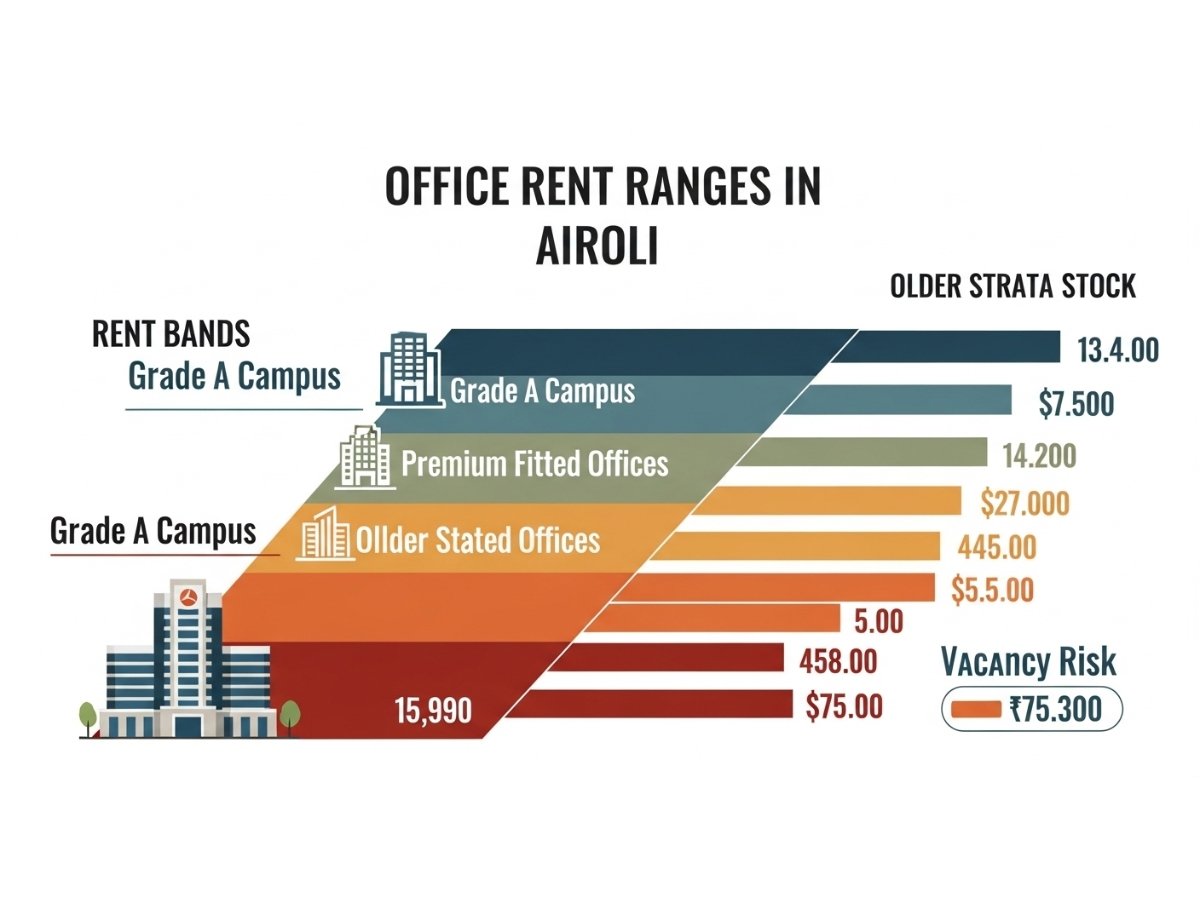
Institutional Grade A campus space is currently transacting roughly in the ₹65 to ₹75 psf monthly bandwidth. Premium fitted standalone space can ask for roughly ₹75 to ₹110+ psf because interiors and prior capex are already built in. Older or weaker strata stock may sit around ₹45 to ₹60 psf, often with more negotiation and more silent vacancy.
Why one Airoli rent number is misleading
Because you are not comparing the same product. A fitted office in a decent building, a bare shell in a Grade A campus, and a 10-year-old strata unit are not part of one simple average.
You should also read Airoli Office Rents, Vacancy Signals and Market Trend to understand how pricing and demand are moving on the ground.
What usually pushes rent up
Rent tends to rise when the building offers strong management, better fit-outs, larger efficient floor plates, campus amenities, parking quality, and better staff convenience. But sometimes headline rent is protected by landlord incentives.
Wipro’s Mindspace lease, for example, included a substantial rent-free period. That means registered rent is real, but effective rent paid over the term is lower.
What causes silent vacancy or weak resale
Poor building management, outdated layouts, low-grade common areas, weak lift and power support, and a bad last-mile experience all hurt occupancy. This is why some smaller offices in strong micro-markets still underperform. The pin code is not enough. The product itself must remain relevant.
How much do station access, road movement, and daily commute affect office value in Airoli?
In Airoli, commute is a primary value driver, not a side feature.
Staff commute reality
Airoli works well when the employee base comes from Navi Mumbai, Thane, Mulund, and the wider eastern suburban belt. That is a major part of its strength. But if the chosen office is hard to reach after the train ride or bridge crossing, daily friction builds quickly.
Visitor and client convenience reality
Airoli is strong for working efficiency, but it is not always the easiest choice for prestige-led visitor traffic. That does not make it weak. It simply makes it more function-led than image-led.
Parking, pickup-drop, and internal approach issues
This is especially important in Airoli West. Shared autos, traffic around Thane-Belapur Road, and peak-hour congestion near the Mulund-Airoli bridge can increase the real cost of a location. Many serious occupiers end up arranging private transport support through corporate shuttles or feeder routes.
The operationalization of Digha Gaon station has improved commuter logic for the West side, especially for employees coming from the Thane and Kalyan-Dombivli belt. That is a real local shift. But last-mile planning still matters.
When does Airoli make more sense than Vashi, Ghansoli, or Thane?
Airoli does not beat every node for every user. It wins in specific situations.
| Node comparison | When Airoli wins | When the other node wins |
|---|---|---|
| Airoli vs Vashi | When you need enterprise scale, campus stock, and stronger operational efficiency | Vashi wins for client-facing business convenience, visibility, and a more traditional commercial core |
| Airoli vs Ghansoli | When you want a more mature office ecosystem and stronger established occupier confidence | Ghansoli can appeal when budget is tighter and occupier needs are slightly lighter |
| Airoli vs Thane / Wagle Estate | When you want stronger MNC-style office ecosystem, better intercity positioning, and campus depth | Thane works better for some SME ecosystems, different brand pull, and selected yield plays |
A simple way to think about it: choose Vashi for visibility, choose Airoli for operational scale, choose Ghansoli for a lighter-budget corridor play, and choose Thane when your business ecosystem is already more Thane-anchored than Navi Mumbai-anchored.
What should you verify before finalising an office in Airoli?
This is where a lot of buyers and tenants become careless. In Navi Mumbai commercial real estate, legal and recurring-cost checks matter almost as much as location.
Sanction, OC, title, and building-document checks
Verify sanctioned plans, Occupancy Certificate, title chain, and actual permitted use. In Airoli, do not rely on broker comfort alone. If the office is in a project registered under MahaRERA, check the filing. If it is a resale asset, use registration data carefully as a document reference, not as the full market truth.
Also understand the CIDCO angle. Much of Navi Mumbai’s older land framework is tied to CIDCO leasehold logic. Recent transfer fee hikes in April 2025 have made commercial resale friction much worse in some cases. Depending on the exact property and allotment history, the ongoing shift toward freehold options can materially improve future liquidity, but that must be checked case by case.
Lease structure and CAM review
In leased space, study CAM terms carefully. In commercial buildings, CAM is not a minor add-on. Standalone buildings may charge roughly ₹4 to ₹8 psf, while Grade A campuses can go roughly ₹15 to ₹25 psf because they provide higher-grade facility management and full backup support.
Lock-in period, escalation, maintenance scope, parking rights, power charges, and fit-out clauses should all be reviewed properly.
Resale and exit checks for investors
Investors should ask one blunt question: if the current tenant leaves, who is the next likely tenant and why? If that answer is weak, the asset is weak.
Also understand NMMC property tax properly. Commercial tax is roughly 68.33% to 68.45% of the Rateable Value, not of capital value. Rateable Value is broadly based on expected annual rent minus a 10% deduction. That recurring burden affects holding economics and must be modeled before purchase.
So who should choose Airoli, and who should avoid it?
Airoli should be chosen by companies that need scale, efficient commuting from the eastern belt, stronger campus-grade office environments, and long-term operational logic. It is one of Navi Mumbai’s best office nodes for GCCs, IT and ITeS companies, BFSI back-office teams, data-led operations, engineering support centres, and selected investors buying strong pre-leased assets.
Airoli should be avoided, or at least approached much more carefully, by businesses that depend on prestige address, high-street client movement, or speculative buying in older fragmented stock. It is also a bad market for buyers who think every office unit inside a strong node automatically becomes liquid.
Conclusion
Airoli is not a generic commercial location. It is a segmented office market where building quality, commuter logic, and occupier fit decide everything.
If you want large-team efficiency, institutional office ecosystems, and access to the Thane-Mulund-eastern suburban talent pool, Airoli makes a lot of practical sense. If you want glamour, easy walk-in visibility, or a shortcut investment in weak strata stock, it does not. In Airoli, the winning decision is rarely about the cheapest space. It is about choosing the right stock in the right micro-location for the right business model.