Navi Mumbai Industrial Real Estate Guide: Areas, Asset Types, and Legal Checks
Navi Mumbai industrial real estate is not one single market, and that is the first thing a buyer, tenant, or investor must understand. TTC-side belts suit established industrial and tech-industrial users, JNPA-Dronagiri side works better for port-linked and freight-support logic, and Panvel-Kalamboli-Taloja side is more relevant for expansion, land-led growth, and highway access. The right decision depends far more on use case, asset type, legal clarity, and day-to-day usability than on future-growth marketing.
If you treat all industrial property in Navi Mumbai as the same, you will almost certainly shortlist the wrong locations. A warehouse user, a fabrication unit, a chemical operator, a small gala buyer, and an investor looking for rental yield are not solving the same problem. This guide is built to help you separate those decisions properly.
To understand how the JNPA, Uran and Dronagiri belt fits into the larger industrial property market, start with our Navi Mumbai Industrial Real Estate Guide.
Navi Mumbai industrial real estate makes sense
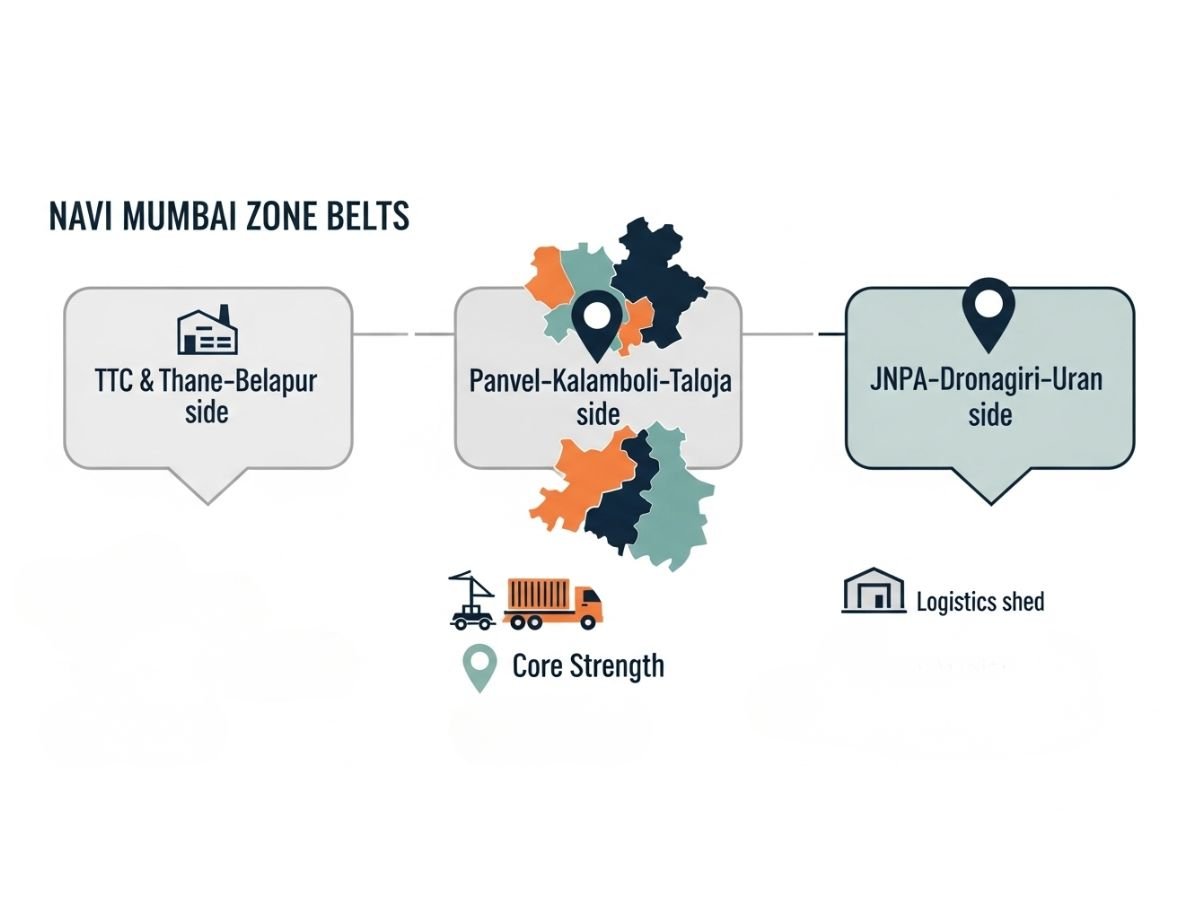
The market becomes much clearer once you stop searching by city name and start thinking in belts. In practical terms, Navi Mumbai industrial real estate can be understood through three broad zones: the TTC and Thane-Belapur side, the Panvel-Kalamboli-Taloja side, and the JNPA-Dronagiri-Uran side.
Each belt has a different operational logic, a different authority context, and a different type of occupier demand. That is why two properties with similar size can behave completely differently in rent, resale, daily movement, and tenant fit.
| Belt | Best suited for | Core strength | Main caution |
|---|---|---|---|
| TTC and Thane-Belapur side | Engineering users, MSMEs, tech-industrial occupiers, back-end operations, data-center ecosystem support | Established belt, better city integration, strong industrial legacy, service ecosystem | Limited prime land, higher entry cost, not every building is operationally modern |
| Panvel-Kalamboli-Taloja side | Expansion-led users, highway-linked businesses, manufacturing, storage, mixed industrial needs | Larger growth runway, affordability compared to tighter TTC pockets, strong regional movement logic | Flooding risk in some stretches, variable last-mile quality, legal and utility checks matter heavily |
| JNPA-Dronagiri-Uran side | Port-linked warehousing, freight support, customs and EXIM-driven operations | Port relevance, large-format warehouse logic, MTHL and freight advantage | Port dependence, not every nearby parcel is automatically a good industrial buy |
One major market signal behind the southern belt is JNPA’s importance in India’s container trade. That matters because genuine port-linked warehousing and freight-support demand is real. But readers should be careful here: strong port economics can support a location thesis, not replace property-level due diligence.
Which industrial belts in Navi Mumbai suit which kind of buyer, tenant, or business
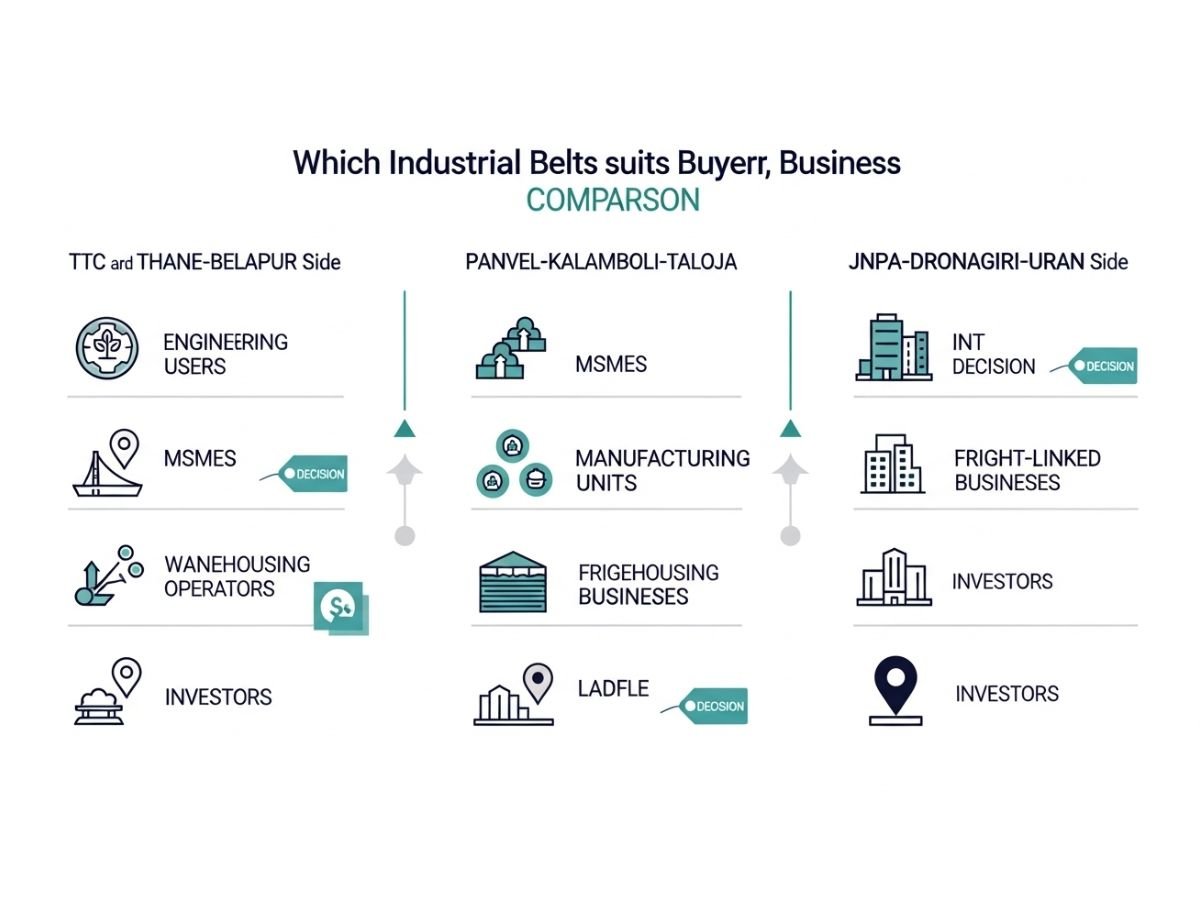
This is where most generic articles fail. They list areas, but they do not explain who each area actually suits.
TTC and Thane-Belapur side for established industrial and tech-industrial users
The TTC belt remains one of the most important industrial corridors in the region. Airoli, Rabale, Mahape, Koparkhairane, and Turbhe sit inside a long-established ecosystem where industrial use, business support services, and better urban integration come together.
For many occupiers, TTC works best when the business needs a serious industrial address but also cares about staff movement, engineering support, corporate access, or tech-adjacent infrastructure. This side has also changed over time. It is no longer just a factory belt. In several pockets, it now includes a mix of manufacturing, IT parks, data-center-led infrastructure, storage, and vertically designed industrial stock.
Rabale and Mahape usually make the most sense for engineering-heavy operations, fabrication, structured industrial buildings, and users who value stronger road frontage and mature industrial surroundings. In many cases, ready industrial structures here command a premium because land is tighter and occupier demand is stronger.
Turbhe and Koparkhairane are different. These pockets are especially relevant for MSME-style users, industrial galas, smaller warehouses, and businesses that need workable city-side distribution without shifting too far outward. The rise of vertical industrial developments in this side is important because it shows how scarce land is being used more intensively.
Still, TTC should not be romanticized. Older stock can look attractive on paper but fail in practice because of low height, poor loading design, outdated internal planning, limited parking, or difficult heavy-vehicle movement. A prime address does not fix a weak industrial building.
Panvel-Kalamboli-Taloja side for expansion-led, highway-linked, and mixed industrial needs
This side of the market is usually where people start looking when they want more space, a lower entry barrier, or a growth-led industrial position. Panvel, Kalamboli, and Taloja do not behave identically, but together they represent the broader expansion side of Navi Mumbai industrial real estate.
Taloja remains one of the most important industrial engines in the city-region, especially for manufacturing, chemical, and food-processing activity. Pricing has generally stayed more accessible than many tighter TTC pockets, which is why it attracts budget-conscious industrial buyers and users who need more area for the same capital outlay.
But this is exactly where a reader needs to stay practical. Taloja’s affordability is not a free lunch. Flood risk has been a real operational issue in some parts, especially during heavy monsoon periods when drainage failures and low-lying stretches affect manufacturing continuity. For some units, that means damaged raw material, disrupted dispatch, insurance complications, and lost working days. So a buyer saving money at acquisition may actually be buying operational fragility.
Kalamboli and Panvel-side logic is slightly broader. This side matters for highway-dependent movement, regional distribution, trucking-led businesses, and occupiers who are planning for future scaling rather than only present-day city-side access. It also becomes relevant when airport-related or corridor-led narratives enter the conversation. Those narratives can support interest, but they should never replace current access quality, sanction checks, or business fit.
JNPA-Dronagiri-Uran side for port-linked and freight-support logic
Dronagiri and the wider JNPA-linked belt are best understood through freight, logistics, and port dependence. This is not the part of Navi Mumbai where every normal industrial buyer should rush. But for the right user, it can be exactly the right geography.
If the business depends on container movement, import-export logistics, customs-bonded warehousing, or large-format storage close to port-led activity, this side deserves serious attention. Modern Grade A warehouses in the belt reflect that logic, with higher clear heights, trailer-friendly access, loading design, fire systems, and large floor plates built around modern logistics requirements.
For investors, the attraction is obvious. Rental yields in stronger logistics formats can look appealing. But the dependency is equally obvious. Occupancy and rent growth here are much more tied to freight flows, trade cycles, and logistics demand than a normal mixed industrial belt. That is why the right question is not “Is Dronagiri growing?” The right question is “Does my business or investment thesis truly need port-linked positioning?”
For businesses focused on exports, cargo movement and port connectivity, the role of port-led industrial and export infrastructure in Navi Mumbai becomes especially important in this corridor.
What type of industrial property are you actually buying or leasing
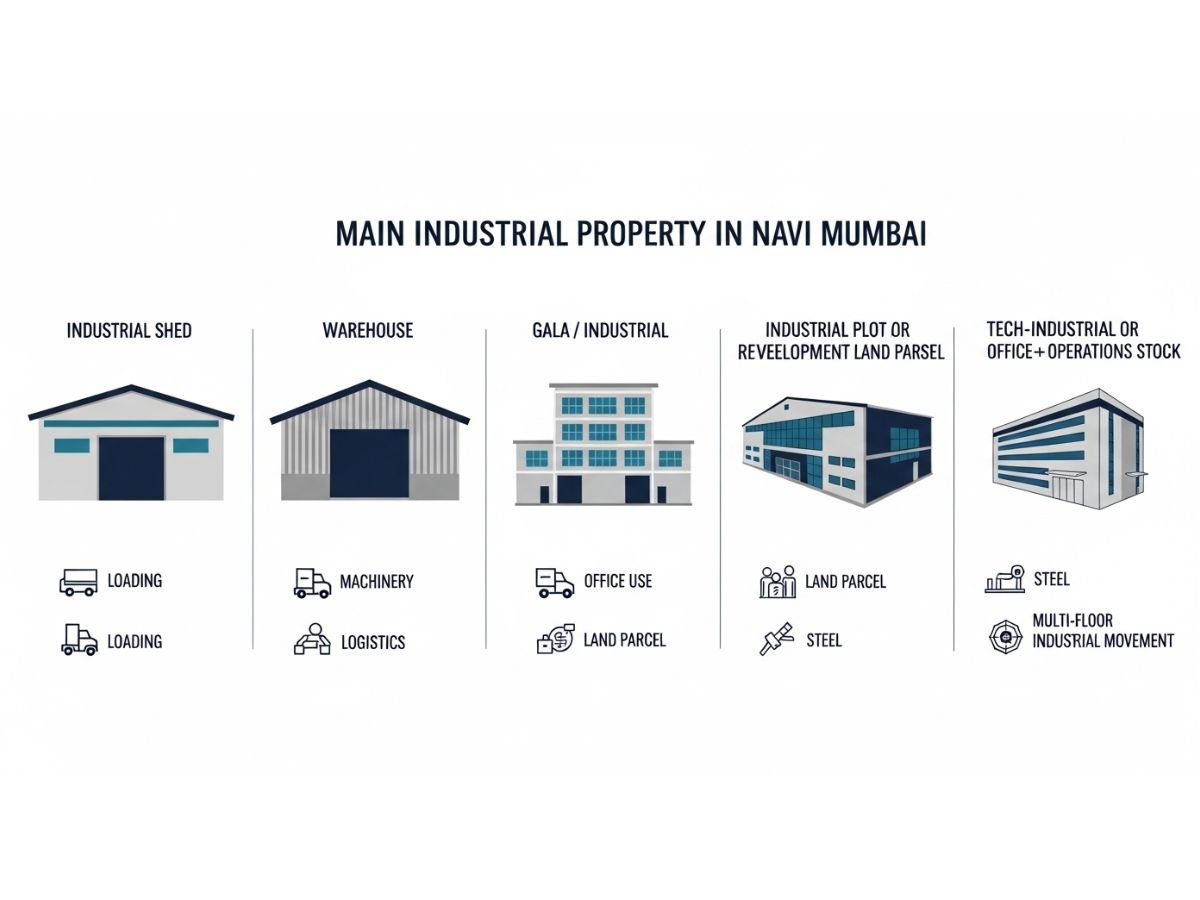
Location matters, but asset type matters just as much. Many mistakes happen because the buyer is clear about area but confused about the actual format they need.
Industrial shed
A shed usually makes the most sense for users who need ground-level operations, production movement, machinery handling, better loading flexibility, or semi-heavy industrial use. It can work well for engineering, fabrication, assembly, or light manufacturing depending on structure, height, power, and sanction.
The mistake is assuming every shed is industrially sound. Some older sheds have awkward columns, poor turning approach, weak flooring, insufficient electrical load, or legal mismatches between actual use and sanctioned use.
Warehouse
A warehouse is not just a big room with a shutter. Proper warehousing depends on height, loading systems, flooring, fire compliance, truck access, yard circulation, and efficiency of movement. Port-linked and distribution-led users should care about clear height, dock design, and road access much more than decorative frontage.
In Dronagiri and JNPA-side markets, Grade A warehouse logic is much more relevant than in many smaller industrial pockets. But a warehouse asset only works if it supports actual freight flow.
Gala or small industrial unit
The industrial gala has become one of Navi Mumbai’s most practical SME formats. In areas such as Turbhe, Koparkhairane, and some TTC-linked clusters, galas serve manufacturing, storage, trading, and workshop-style users who do not need massive land parcels but still need industrial utility.
Modern galas can be technically capable if they offer sufficient height, floor load capacity, goods lifts, heavy-duty access, and workable power provisions. But many buyers underestimate the vertical logistics challenge. A multi-floor industrial gala without proper loading movement becomes a daily bottleneck.
Industrial plot or redevelopment-led land parcel
Industrial plots suit buyers who want long-term control, larger future flexibility, redevelopment potential, or custom-built operations. But plots are where legal discipline becomes even more important. MIDC or CIDCO transfer conditions, development timelines, minimum FSI utilization rules, non-utilization charges, and transfer premiums can completely change the economics.
Plots are not for casual buyers. The upside can be strong, but so can the legal and holding-cost risks.
Tech-industrial or office-plus-operations stock
In the TTC corridor especially, some stock no longer fits old industrial labels neatly. There are buildings that work better for back-end operations, tech-support functions, hardware, server-related ecosystems, service workshops, light industrial administration, or mixed office-plus-operations use.
These assets can suit certain modern occupiers very well. But they should not be confused with true manufacturing-ready industrial stock. The building can be excellent and still be wrong for the business.
Should you buy or lease industrial property in Navi Mumbai
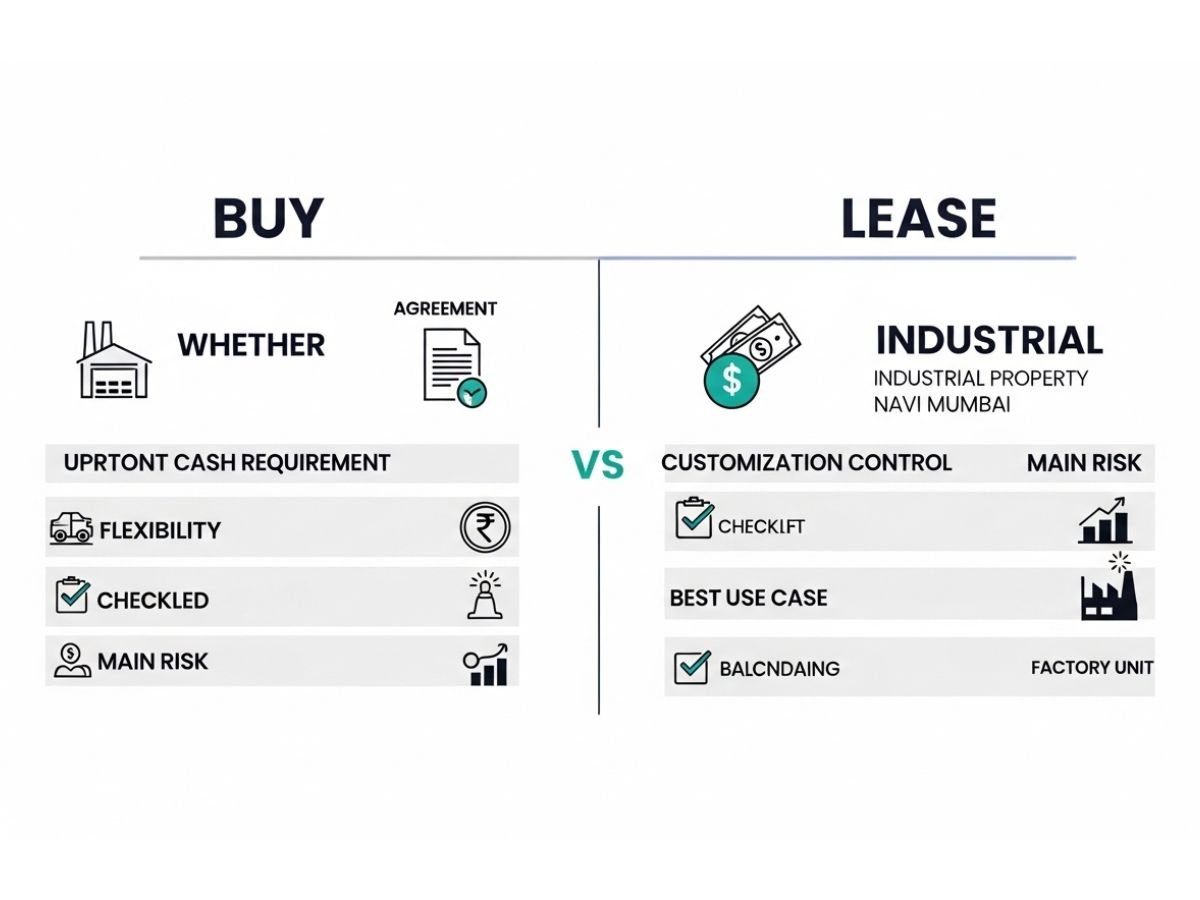
There is no universal answer here. The right answer depends on time horizon, capital strength, operational stability, and flexibility needs.
Buying usually makes more sense when the business has a stable long-term location strategy, needs customization, wants to hedge against rent escalation, or sees strategic value in owning industrial real estate as an operating asset. Ownership also gives better control over upgrades, internal planning, and long-term cost visibility.
Leasing is often the smarter route when the business is still scaling, capex must remain available for operations, expansion direction is uncertain, or the occupier does not want to get trapped in a wrong location. A lease also protects a business from being stuck with an illiquid industrial asset if the use case changes.
| Decision factor | Buy | Lease |
|---|---|---|
| Upfront cash requirement | High | Lower |
| Flexibility | Low to moderate | High |
| Customization control | Strong | Limited to lease terms |
| Best for | Stable long-term users, owner-occupiers, conviction-based investors | SMEs in growth mode, testing locations, users with uncertain expansion plans |
| Main risk | Capital lock-in and exit difficulty | Annual escalations and less control |
| Works better when | Business model is proven and location fit is clear | Business needs speed, liquidity, or short-to-medium horizon adaptability |
A simple way to think about it: if your operation is still changing, lease first. If your process, staffing pattern, and logistics logic are already stable, buying becomes more defensible.
How do you choose the right location when the same square footage can perform very differently
This is where industrial real estate becomes real. On paper, two units may both show 10,000 square feet. In practice, one may run smoothly and the other may become an operational headache from day one.
Truck movement and loading practicality
This is one of the biggest ignored filters. A unit can be “near highway” and still fail because the approach road is too tight, turning radius is poor, container movement is awkward, or loading happens by compromise rather than design.
A 16,000 sq ft warehouse with wide road access, proper loading edge, and trailer movement space can outperform a similar-size property in a tighter lane every single day. That difference may never show properly in brochure language, but it affects actual business performance.
Staff access and station-road dependence
Many occupiers focus only on cargo movement and forget people movement. In TTC-side locations, this matters a lot because staff commute can influence attendance, retention, and shift planning. A property with excellent freight logic but painful employee access can still become inefficient.
That is why a unit closer to Thane-Belapur Road or better-linked urban access may suit one operator more than a cheaper property deeper inside an industrial pocket.
Power, water, drainage, and operational continuity
For manufacturing and engineering users, sanctioned power load is not a side issue. It is central. The same goes for water supply, drainage reliability, flooring strength, and internal industrial utilities. Buyers often discover these realities too late, after token payment or negotiation-stage excitement.
Monsoon, low-lying stretches, and movement disruption risk
This matters more in Navi Mumbai than many outsiders assume. Some locations are operationally vulnerable during heavy rainfall. Taloja is the most obvious example in the current industrial conversation because flood risk has affected real units and disrupted business movement.
A cheaper industrial property in a low-lying belt can become more expensive over time once downtime, damage, insurance, and movement friction are accounted for.
Which authorities and approvals matter before you trust any industrial deal in Navi Mumbai
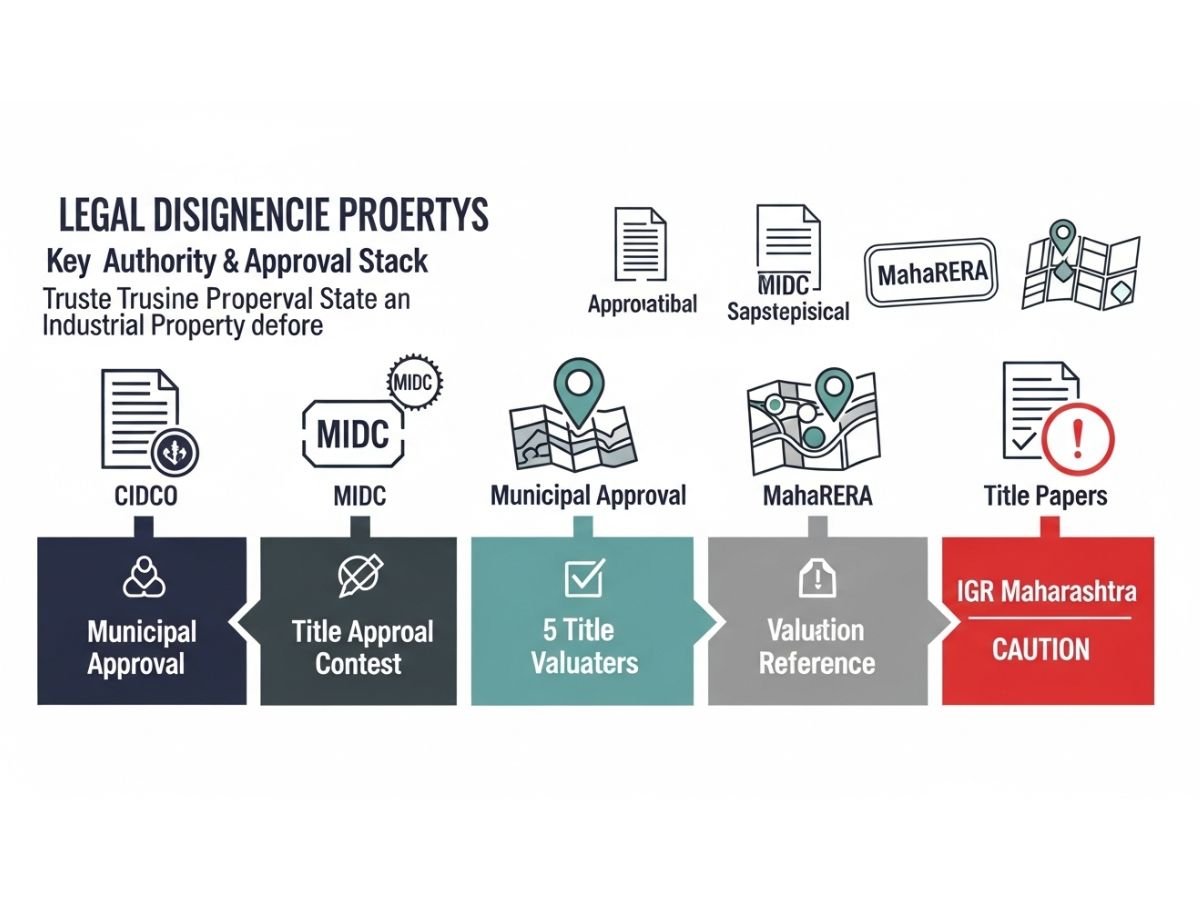
Navi Mumbai industrial due diligence is layered. There is no single shortcut.
CIDCO and development permission logic where relevant
Where CIDCO is the planning or estate authority, buyers should verify development permissions, approved plans, transfer conditions, and NOC requirements carefully. CIDCO also has an official development permission system for Navi Mumbai and Khopta, so document verification should go through official paths wherever relevant.
CIDCO transfer charges are not a minor detail. They are part of the real acquisition cost, especially in industrial, warehousing, and service-industry plots. That soft cost must be built into decision-making, not discovered later.
MIDC-side context and estate logic where relevant
MIDC land is typically leasehold, not freehold in the simple way many first-time buyers assume. Plots are generally allotted on long leases, and development obligations matter. For plots allotted after June 2019, minimum FSI utilization rules can trigger non-utilization charges if compliance is not met.
Transfer fees also change depending on how much FSI has been consumed. So before buying any MIDC plot or structure, the buyer must understand the allotment trail, development status, transfer eligibility, and premium implications.
MahaRERA, if the asset is in a registered project context
MahaRERA should be used intelligently, not mechanically. If the asset is inside a registered commercial or mixed-use project structure, RERA checks can help verify plans, timelines, and project disclosures. But not every industrial asset falls under the same RERA logic, especially in notified industrial areas. So this layer is important, but only where applicable.
NMMC or Panvel-side approval and occupancy context where relevant
Municipal approval paths matter when the property falls under the relevant local jurisdiction. Readers should not casually mix CIDCO, MIDC, NMMC, and Panvel-side approval logic as if they are interchangeable. They are not.
Where municipal records apply, sanctioned plan, CC, and OC trail should be checked through official systems. Occupancy and building-status verification can become critical in resale and older-building transactions.
IGR Maharashtra as a valuation anchor, not transaction truth
IGR Maharashtra eASR can help as a broad value reference. That is useful. But it should never be treated as full market truth or full legal truth. Ready reckoner rates are indicative anchors, not a substitute for actual transaction analysis, title review, or usability assessment.
What are the biggest mistakes people make in Navi Mumbai industrial real estate
The biggest mistake is buying the story instead of the asset.
People hear “near airport,” “near port,” “future corridor,” or “industrial growth zone” and forget to ask the harder questions. Is the use sanctioned? Is the structure legally supported? Can a truck actually enter and turn? Is drainage reliable? Is the power load enough? Does the title trail support transfer? Is this a real warehouse, or just a building being marketed that way?
Another common mistake is confusing industrial, warehouse, and commercial logic. A well-located unit may still be wrong if its format does not match the business.
A third mistake is over-trusting rate benchmarks. Ready reckoner references, quoted market buzz, or random broker comparisons do not tell you whether the asset is operationally efficient, legally clean, or future-proof.
One more mistake needs emphasis: redevelopment and corridor-change stories in older TTC-side areas should be treated carefully. Some pockets may benefit over time, but it is not universal upside. A weak industrial building does not become a strong asset just because the surrounding narrative sounds exciting.
If you are shortlisting now, here is the fastest way to narrow the market correctly
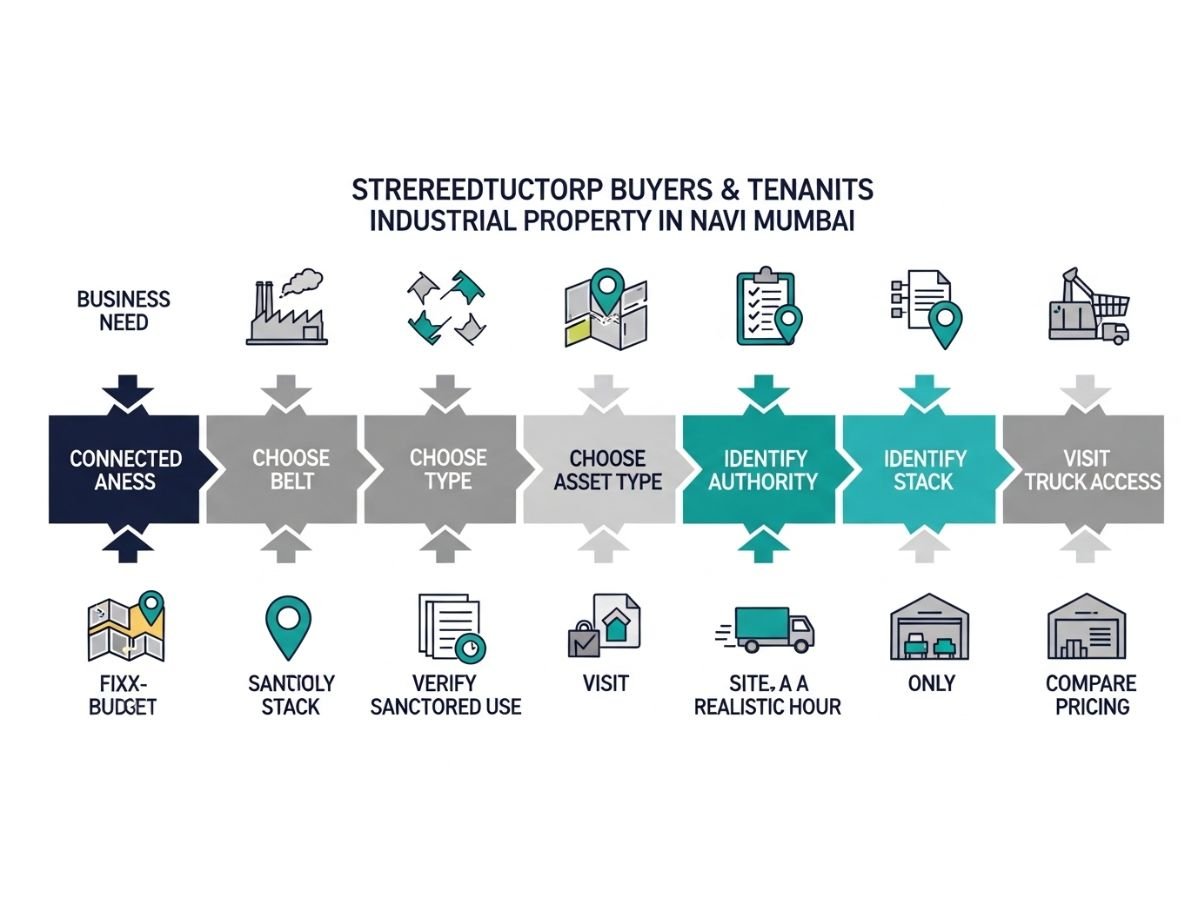
Use this order. It saves time and prevents bad visits.
1. Define the business need first. Manufacturing, warehousing, gala-based SME work, land banking, tech-industrial support, or freight-linked storage are different journeys.
2. Fix budget honestly, including transfer charges, fit-outs, deposits, taxes, and compliance cost.
3. Choose the belt, not the random building. TTC, Panvel-Kalamboli-Taloja, and JNPA-Dronagiri solve different problems.
4. Choose the asset type next. Shed, warehouse, gala, plot, or office-plus-operations stock.
5. Check operational fit before rate negotiation. Road width, loading space, power, drainage, commute, and monsoon exposure.
6. Identify the authority stack. MIDC, CIDCO, municipal, or registered project context.
7. Verify sanctioned use, plan trail, occupancy status, and transfer conditions before paying token.
8. Visit the site at a realistic hour, not just in ideal conditions. Industrial property should be judged during movement, not silence.
9. Only then compare pricing, rent, or yield.
That sequence is far more reliable than starting with “Which area is hot right now?”
Conclusion
Navi Mumbai industrial real estate is one of the most practical and important business property markets in the MMR, but only for people who read it correctly. TTC-side locations work best for mature industrial and tech-industrial users. Panvel-Kalamboli-Taloja side works better for expansion, affordability bands, and highway-led industrial logic. JNPA-Dronagiri side is strongest when the thesis is genuinely freight- and port-linked.
The smartest decision is not to chase the loudest narrative. It is to match the right belt with the right asset, verify the right authority trail, and inspect the property as an operating business tool, not just as square footage. That is what separates a workable industrial decision from an expensive mistake.
FAQs
Frequently Asked Questions