Uncategorized

How to Choose the Right Real Estate Developer in Vashi | Buyer Guide

Vashi is one of the most mature and expensive nodes of Navi Mumbai. It has strong commercial activity, established residential sectors, good road connectivity, railway access, retail hubs, educational institutions, hospitals, and proximity to business areas such as APMC Market, Sector 17, Sector 30A, Palm Beach Road and nearby Sanpada.

Because of this maturity, buying property in Vashi is not a casual decision. A 2 BHK flat can require a major investment, and in many cases, buyers are comparing ready-to-move homes, redevelopment projects, resale flats, and under-construction towers. Some properties are in old cooperative housing societies, some are on CIDCO-origin leasehold land, and some may involve redevelopment permissions, conveyance, NMMC approvals and Occupancy Certificate checks.

The safest way to choose a real estate developer in Vashi is to verify legal documents, completed projects, pricing clarity, and buyer feedback before paying token money. A reputed developer is not always the right developer if the project has unclear approvals, delayed possession, hidden charges, weak construction quality, or poor after-sales support.

For broader comparison, readers can also refer to [real estate developers in Navi Mumbai](ADD INTERNAL LINK HERE) and [Vashi real estate guide](ADD INTERNAL LINK HERE).

Quick Summary: How to Choose the Right Real Estate Developer in Vashi

What to Check Why It Matters in Vashi What Buyer Should Do
MahaRERA registration Confirms basic regulatory registration and declared project details Search the exact project and promoter name on the MahaRERA website
NMMC Commencement Certificate Shows that construction permission is granted for sanctioned floors Ask for the NMMC CC and check whether your floor is approved
Occupancy Certificate Confirms the building is legally fit for possession Do not accept possession without final OC in ready projects
CIDCO land and transfer documents Vashi has CIDCO-origin land and leasehold-related concerns Check leasehold, freehold, transfer charges and NOC status
Completed projects Shows actual delivery quality, not brochure promises Visit buildings delivered by the same developer 5+ years ago
Construction quality Coastal weather and monsoon can expose weak work Check basement, terrace, seepage, facade, lifts and common areas
All-inclusive pricing Prevents cost shock after token payment Demand a signed cost sheet before booking
Society handover and conveyance Important in older and redevelopment properties Verify society formation, corpus handover and conveyance status
Buyer reviews and resident feedback Reveals after-sales issues and repeated complaint patterns Speak to existing residents, not only the sales team

Builders and Developers in Vashi

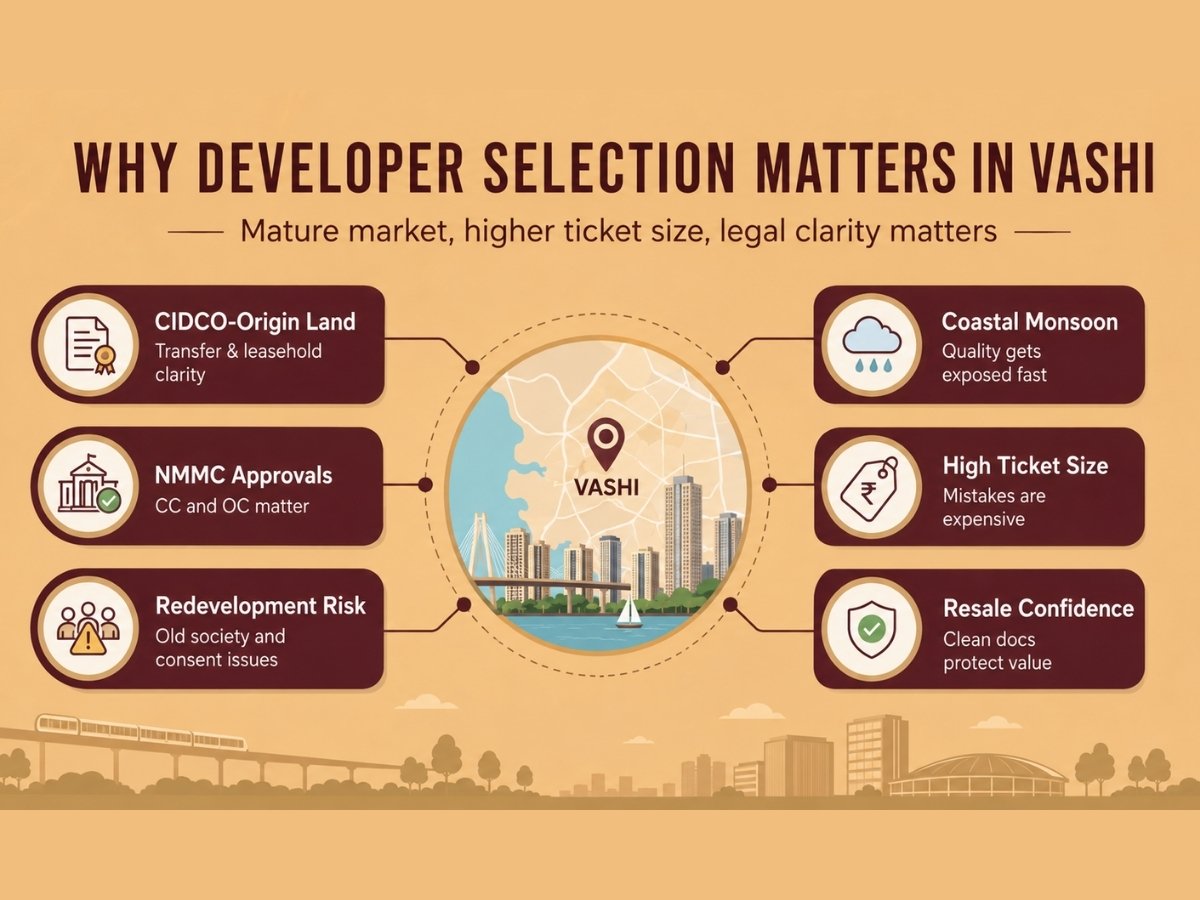
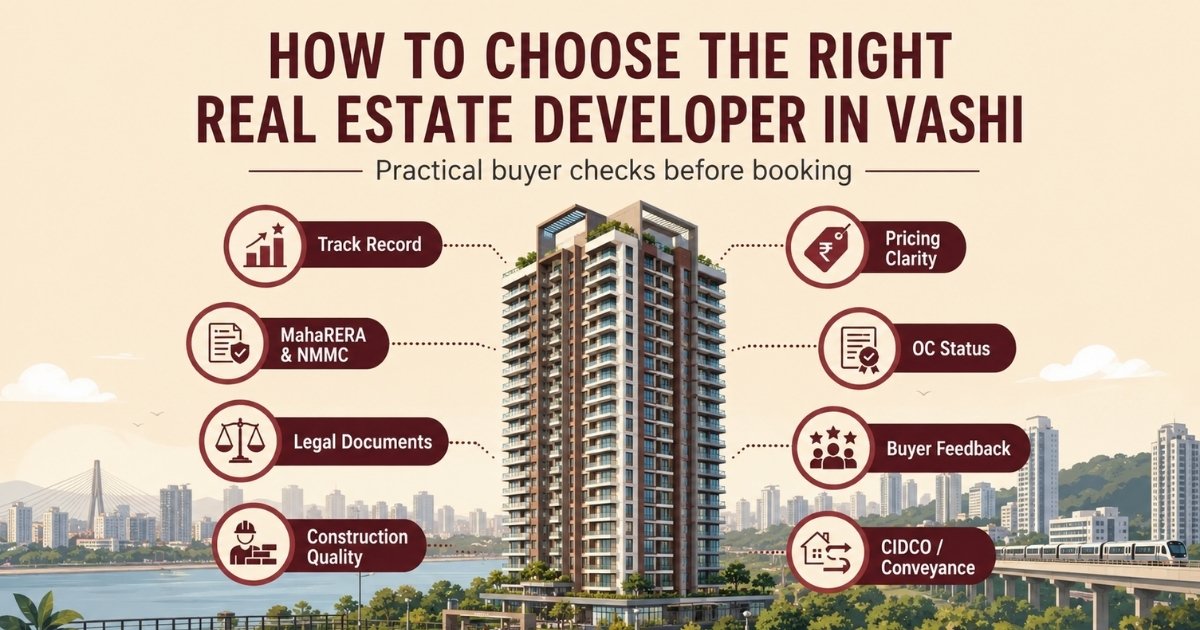
Why Choosing the Right Real Estate Developer Matters in Vashi

Why Choosing the Right Real Estate Developer Matters in Vashi is visible in this image.

Check Completed Projects Before Trusting New Launches

New launches are often sold on future promises. In Vashi, especially around premium pockets such as Palm Beach Road, Sector 17, Sector 30A and central residential sectors, new projects may command high pricing because of location strength.

But buyers should not trust a new launch only because the location is strong.

Visit at least two completed projects by the same developer. If possible, choose projects that are at least five years old. A newly handed-over building may look good, but a five-year-old building shows how the construction has handled monsoon, regular use, maintenance pressure and resident occupancy.

Check:

  • Exterior paint condition
  • Cracks and damp patches
  • Basement or stilt parking watermarks
  • Lift maintenance
  • Lobby quality
  • Terrace waterproofing
  • Society complaints
  • Security and housekeeping standards
  • Whether amenities are functional or only shown in marketing

A serious buyer should treat old projects as the developer’s real resume.

Visit Older Buildings Developed by the Same Builder

Vashi and nearby coastal parts of Navi Mumbai face heavy monsoon, humidity and saline air impact. Poor waterproofing, weak external plaster, bad drainage and basement leakage can become visible after a few rainy seasons.

When visiting older buildings, do not only look at the entrance lobby. Lobbies can be maintained well while deeper problems remain hidden.

Inspect:

  • Basement and parking areas
  • Terrace and top-floor leakage complaints
  • Common passage walls
  • External facade condition
  • Pump room and water system
  • Drainage slope
  • Fire safety areas
  • Lift breakdown frequency

If residents repeatedly mention seepage, poor maintenance, broken promises, or delayed defect repairs, treat it as a warning.

Speak to Existing Residents and Buyers

Existing residents often tell you what sales teams will not. Speak politely to owners, tenants, society committee members, security staff and local brokers.

Ask practical questions:

  • Was possession given on time?
  • Was OC received before people moved in?
  • Did the developer complete promised amenities?
  • Was the society formed smoothly?
  • Was the corpus fund handed over clearly?
  • Are there leakage issues during monsoon?
  • Does the developer respond to complaints after possession?
  • Are there unresolved legal or maintenance issues?

A good developer will usually have consistent positive feedback, not only online praise. A weak developer may have repeated complaints across projects.

Check MahaRERA Registration and Project Transparency

MahaRERA registration is a basic requirement for eligible real estate projects. It improves transparency by requiring the promoter to declare project details, approvals, carpet area, timelines, litigations and other information.

For buyers, MahaRERA is a starting point, not the final proof of trust.

Always ask for the exact MahaRERA registration number of the project. Do not accept vague statements such as “RERA approved” or “RERA compliant.” Search the project yourself on the MahaRERA website.

Why MahaRERA Is Important for Vashi Buyers

MahaRERA matters because it gives buyers an official place to check project declarations. It also requires financial discipline, including the use of a dedicated account for project funds as per regulatory requirements.

In a high-value market like Vashi, this is important because buyers are often investing large amounts and may be paying through construction-linked plans, loans or staged payments.

MahaRERA helps buyers check:

  • Registered project name
  • Promoter name
  • Declared possession date
  • Project status
  • Litigation details
  • Carpet area
  • Approved plans uploaded by promoter
  • Quarterly progress updates
  • Extension history, if any

For Vashi buyers, MahaRERA reduces blind dependence on brochures and sales agents.

What to Verify on the MahaRERA Website

MahaRERA Detail What Buyer Should Check
Project name It should match the exact project being sold
Promoter name Check whether the developer, landowner or SPV is listed
Possession date Compare official date with sales team promise
Carpet area Check RERA carpet area, not only saleable or built-up claims
Approvals uploaded Look for relevant plans, title report and certificates
Litigation tab Check if disputes are disclosed
Project updates See whether progress updates are regular
Extension history Repeated extensions may indicate delay risk

A common issue is that the sales team may verbally promise an earlier possession date, while the official RERA timeline may be much later. The written and registered documents matter more than verbal commitments.

Why MahaRERA Alone Is Not Enough

MahaRERA registration is important, but it should not be treated as the only proof of developer quality.

MahaRERA does not automatically guarantee:

  • Excellent construction quality
  • No leakage
  • No delay
  • Clear CIDCO transfer status
  • Smooth society handover
  • Transparent maintenance fund transfer
  • Good after-sales support
  • Final OC without issue

A project can be registered and still face delay, litigation, approval complications, cost escalation or construction quality complaints. Buyers must combine MahaRERA verification with legal document review, site visits, completed project inspection and independent professional advice.

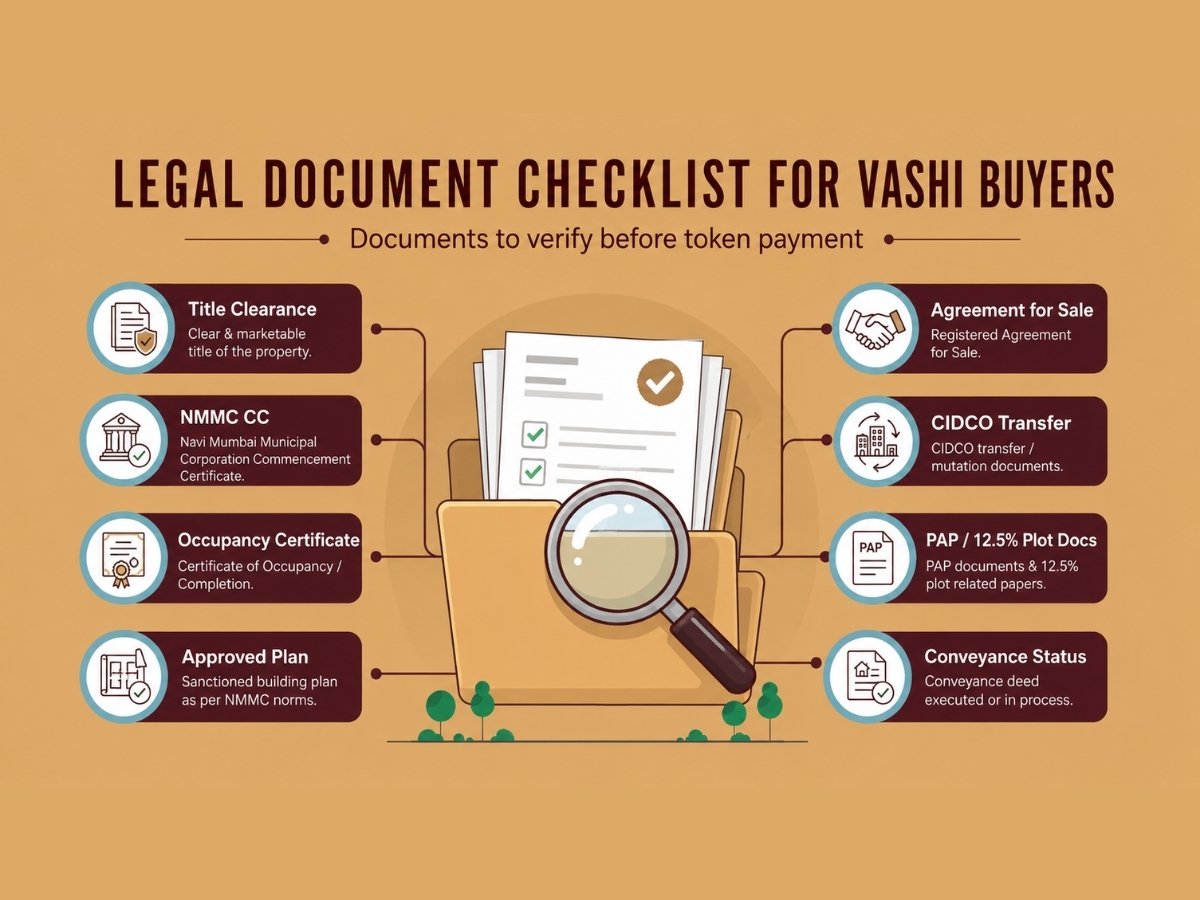
Check Legal Documents Before Booking a Flat

Check Legal Documents Before Booking a Flat in Vashi is visible in this image.

Title Clearance Certificate

The Title Clearance Certificate helps confirm whether the land has clear ownership and is free from serious encumbrances or ownership disputes.

In Vashi redevelopment projects, title clarity is especially important because old societies may have earlier agreements, previous developer arrangements, pending dues, incomplete conveyance, or member disputes. Buyers should not rely only on the developer’s statement. A lawyer should examine the title chain.

Commencement Certificate

The Commencement Certificate, commonly called CC, is permission to start construction as per sanctioned plans. In Vashi, building permissions are generally linked to NMMC approvals.

Buyers should ask for the NMMC Commencement Certificate and check whether the floor being sold is legally approved. Sometimes a project may have approval only up to a certain floor while higher floors are marketed subject to future approval. This must be verified before booking.

Occupancy Certificate

The Occupancy Certificate, or OC, confirms that the building is completed as per approved plans and is fit for legal occupation.

For ready-to-move property in Vashi, OC is critical. Buyers should not accept “fit-out possession” as a substitute for legal possession. Fit-out possession may sound convenient, but without final OC, the buyer can face utility, safety, loan, resale and legal complications.

A valid OC is one of the strongest safety signals in a completed project.

Approved Building Plan

The approved building plan shows what has actually been sanctioned by the authority. Buyers should compare the approved plan with the brochure, layout, parking claims, amenities and floor details.

If the sales team promises additional amenities, extra usable area, merged flats, open space conversion or parking arrangements, check whether those are legally approved and mentioned in documents.

Agreement for Sale

The Agreement for Sale is not a formality. It is the main legal contract between buyer and developer.

Before signing, check:

  • RERA carpet area
  • Payment schedule
  • Possession date
  • Delay penalty clause
  • Taxes and charges
  • Parking details
  • Maintenance and corpus charges
  • OC condition
  • Defect liability clause
  • Cancellation terms
  • CIDCO transfer or future premium liability, if applicable

For more clarity, readers can refer to [agreement to sale vs sale deed](ADD INTERNAL LINK HERE).

CIDCO Transfer and Leasehold Clarity

This is one of the most important Navi Mumbai-specific checks.

Unlike many parts of Mumbai, much of Navi Mumbai was planned by CIDCO. In many cases, land has leasehold origins, and transfers may require CIDCO permissions, transfer charges, NOCs or conversion-related clarity.

Buyers should check:

  • Is the land leasehold or freehold?
  • Has any freehold conversion been done?
  • Are CIDCO transfer charges pending?
  • Who will pay future CIDCO transfer charges?
  • Is there a CIDCO NOC?
  • Are previous transfers properly recorded?
  • Is the project on PAP or 12.5% scheme land?

Do not leave CIDCO charges to verbal understanding. The liability should be written clearly.

Vashi-Specific Documents Buyers Should Check Before Booking

Vashi buyers should not use a generic Mumbai property checklist. Navi Mumbai has its own legal and planning background. Along with MahaRERA and NMMC approvals, CIDCO-origin land documents can become important depending on the project.

CIDCO Allotment and Transfer Documents

Ask whether the plot was originally allotted by CIDCO and whether all transfers are properly recorded. If previous transfer charges are unpaid or documents are incomplete, it can affect future ownership clarity and resale.

A developer or seller should be able to show the allotment chain, transfer documents and relevant NOCs where applicable.

PAP Plot or 12.5% Scheme Plot Clarity

Some Navi Mumbai plots are linked to PAP or 12.5% Gaothan Expansion Scheme allotments. These plots require careful title checking because the land may have moved from original allottee to developer through specific agreements.

Buyers should verify:

  • Letter of allotment
  • Final order
  • Tripartite agreement involving CIDCO, allottee and developer, where applicable
  • Transfer permissions
  • Title search report

If the developer cannot explain the plot title clearly, do not proceed without legal review.

NMMC, PMC or CIDCO Approval Relevance

For Vashi, civic permissions are generally under NMMC jurisdiction. PMC applies to Panvel areas, not Vashi. CIDCO may still matter for land, leasehold, transfer and planning-origin documents.

A simple way to understand it:

  • NMMC: building permissions, civic approvals, CC, OC in Vashi
  • CIDCO: land origin, leasehold, transfer, allotment and planning-related documents
  • MahaRERA: project registration and promoter disclosures

Buyers should check the right authority for the right document.

Society Formation and Conveyance Status

For resale flats and older buildings in Vashi, society formation and conveyance status are very important.

If a society does not have conveyance or deemed conveyance, redevelopment can become difficult. The builder may still retain land-related control, or the society may struggle to negotiate with a new developer.

Before buying in an older Vashi building, ask:

  • Is the cooperative housing society registered?
  • Has conveyance been completed?
  • Is deemed conveyance obtained?
  • Are redevelopment discussions already happening?
  • Are there disputes among members?
  • Are society dues clear?

This is especially relevant in older residential sectors where redevelopment may become a future value driver.

Compare Construction Quality and Actual Site Progress

A good developer should not only have documents. The project must also show disciplined execution and durable construction quality.

Vashi’s coastal climate, humidity and monsoon conditions can expose weak construction faster than dry-weather locations. Poor waterproofing, weak plaster, low-grade fittings, drainage issues and basement seepage can create long-term maintenance problems.

Visit the Actual Construction Site

If the project is under construction, visit the site personally. Do not depend only on sample flat photos or sales lounge presentations.

Check:

  • Is construction moving actively?
  • Are workers present?
  • Is the site organized?
  • Are safety measures visible?
  • Does progress match the promised timeline?
  • Are materials stored properly?
  • Is the project delayed compared to RERA timeline?
  • Is the developer willing to show site progress transparently?

If the developer avoids site visits or gives vague answers, treat it as a caution signal.

Compare Sample Flat and Real Flat Specifications

Sample flats are designed to look larger and more attractive. They often use better lighting, premium furniture, false ceiling, mirrors, imported fittings and interior styling that may not be part of the actual handover.

Ask for the standard specification sheet and compare:

  • RERA carpet area
  • Ceiling height
  • Bathroom fittings
  • Kitchen platform
  • Flooring brand
  • Door and window quality
  • Electrical points
  • Wall finish
  • Balcony and utility area
  • Actual view and ventilation

Do not assume the sample flat is the delivered flat.

Check Lift, Lobby, Parking and Common Area Quality

In Vashi, parking and common areas matter strongly because many older sectors already face space pressure. For high-value projects, poor parking design can affect daily living and resale value.

Check:

  • Entry and exit width
  • Basement ventilation
  • Flooding risk
  • Lift brand and capacity
  • Fire staircase accessibility
  • Lobby finishing
  • Garbage handling area
  • Security room
  • Visitor parking
  • Society office space

A developer who compromises on common areas may also compromise on invisible construction quality.

Check Monsoon Performance and Leakage Issues

Monsoon performance is one of the most practical checks in Navi Mumbai.

In completed projects, ask residents about:

  • Terrace leakage
  • Bathroom seepage
  • Basement flooding
  • External wall dampness
  • Window leakage
  • Drainage overflow
  • Lift shutdown during rains
  • Waterlogging near entrance

If possible, visit an older project during or after monsoon. It will reveal more than a brochure ever can.

Understand Pricing, Hidden Charges and Payment Terms

Pricing in Vashi can be complicated because the market is mature and property values are high. A project may look affordable at base price level, but the total acquisition cost can become much higher after adding statutory charges, parking, GST, maintenance, corpus, floor-rise and other costs.

Ask for an All-Inclusive Cost Sheet

Before paying token money, ask for a signed all-inclusive cost sheet.

It should clearly mention:

  • Basic flat cost
  • GST, if applicable
  • Stamp duty
  • Registration
  • Parking charge
  • Floor-rise charge
  • PLC, if applicable
  • Maintenance deposit
  • Corpus fund
  • Legal charges
  • Society formation charges
  • CIDCO transfer or NOC-related charges, if applicable
  • Any infrastructure or development charges

Readers can also use a [stamp duty calculator](ADD INTERNAL LINK HERE) to understand the larger cost picture.

Check Parking, Floor-Rise, PLC and Maintenance Charges

In premium Vashi projects, floor-rise and Preferential Location Charges can increase cost significantly. Units with creek view, open view, road-facing location, higher floors or better orientation may come with extra charges.

Parking should also be clarified in writing. Ask whether it is open, covered, basement, stilt or mechanical parking. Also check whether the parking allocation will be mentioned properly.

Understand GST, Stamp Duty and Registration Cost

For under-construction property, GST may apply as per applicable rules. Stamp duty and registration are separate from the basic agreement value.

Do not compare projects only on per-square-foot rate. Compare the final all-inclusive cost.

For example, a project with a slightly lower base price may become costlier if it has high parking charges, heavy floor-rise, unclear maintenance deposits, or future transfer costs.

Avoid Verbal Price Commitments

Never rely on verbal pricing.

If the sales team says, “Sir, this is all included,” ask them to write it on the official cost sheet. If they say, “This charge will not come later,” ask for written confirmation.

In real estate, what is not written is difficult to enforce.

Check Developer Reputation Beyond Online Reviews

Google reviews can help, but they are not enough. Some reviews may be genuine, some may be emotional, and some may be influenced by marketing.

Use online reviews to identify patterns, not to make the final decision.

Read Google Reviews Carefully

Do not only look at star rating. Read negative reviews carefully and check whether complaints are specific.

Specific complaints matter more than generic criticism.

Look for repeated mentions of:

  • Possession delay
  • OC not received
  • Leakage
  • Poor maintenance
  • Corpus fund issues
  • Bad after-sales support
  • Parking disputes
  • False promises
  • Society handover problems

One negative review may be personal. Repeated complaints across multiple projects can indicate a real pattern.

Look for Repeated Complaint Patterns

A developer’s reputation should be judged across multiple projects, not just one project.

If many residents complain about the same issue in different buildings, such as leakage, delayed handover or maintenance fund problems, buyers should be cautious.

Speak to Local Brokers and Residents

Experienced local brokers, residents and society committee members often know which developers deliver properly and which developers create problems after possession.

But do not depend fully on one broker. Speak to multiple sources and cross-check with documents.

Check Litigation or Delay History Where Possible

Buyers should check whether the project or promoter has disclosed litigations on MahaRERA. They can also ask a lawyer to check major legal records where required.

In redevelopment projects, litigation can arise from dissenting society members, land title disputes, old dues, CRZ-related issues, or disagreement over redevelopment terms.

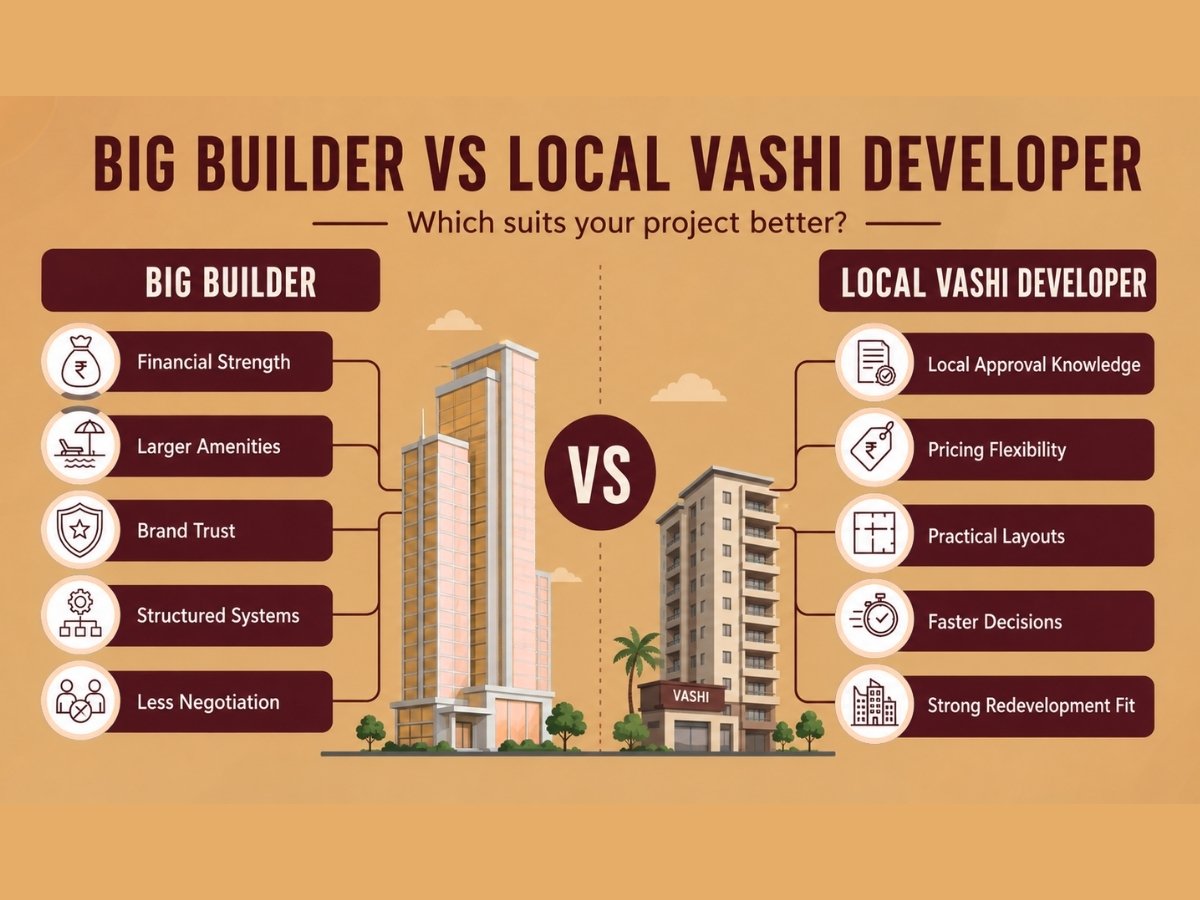
Big Builder vs Local Builder: Which Is Better in Vashi?

Big Builder vs Local Builder in Vashi is visible in this image.

There is no universal answer. In Vashi, a big builder is not automatically better, and a local developer is not automatically risky. The right choice depends on project type, approval clarity, track record, construction quality, pricing and legal transparency.

Factor Big Builder Local Vashi Developer What Buyer Should Do
Financial strength Usually stronger with better capital access Varies depending on project and cash flow Check delivery history and funding confidence
Pricing flexibility Usually less negotiable May offer better negotiation Compare all-inclusive cost, not only base rate
Local approval knowledge May need strong local legal team Often understands CIDCO/NMMC process better Verify actual approvals, not reputation alone
Amenities Usually stronger lifestyle amenities May offer practical standalone buildings Pay only for amenities you will actually use
Redevelopment ability May avoid small society projects Often active in single-building redevelopment Check redevelopment track record carefully
After-sales support Structured but sometimes slow Can be accessible but depends on ethics Speak to existing residents
Brand trust Higher initial confidence Trust depends on local reputation Judge by documents and completed projects

Advantages of Big Real Estate Developers

Big developers may offer stronger financial backing, better design teams, structured processes, branded facility management and better amenities. They may be safer in large projects if the legal documents and approvals are clean.

Advantages of Local Vashi Developers

Local developers may understand Vashi’s plot constraints, society redevelopment dynamics, CIDCO documents and NMMC approval processes better. They may also offer better pricing flexibility and practical layouts.

When a Smaller Developer Can Be a Better Choice

A smaller local developer can be a better choice when:

  • The project has clean title
  • CC and approvals are clear
  • Past projects are well maintained
  • Existing residents speak positively
  • Pricing is transparent
  • Possession timeline is realistic
  • Society handover history is good

When a Big Brand May Still Be Safer

A big brand may be safer when:

  • The project is large and capital-intensive
  • Amenities and long-term maintenance matter strongly
  • The buyer wants institutional execution
  • The developer has clear approvals and a clean RERA record
  • The pricing premium is justified by quality and delivery confidence

Check Location Fit Before Choosing the Developer

Developer selection should match the location. A developer good at large township projects may not automatically be best for a restricted redevelopment plot in Vashi. Similarly, a local redevelopment developer may not be ideal for large greenfield projects in emerging nodes.

Mature Nodes Like Vashi, Sanpada, Nerul and Seawoods

In mature nodes, the market is mostly shaped by redevelopment, resale, premium standalone towers, limited land availability and high buyer expectations.

In these areas, buyers should focus on:

  • Legal title
  • Society consent
  • Deemed conveyance
  • OC status
  • Parking planning
  • Construction quality
  • Maintenance handover
  • Resale value

Growth Nodes Like Kharghar, Ulwe, Panvel, Pushpak Nagar and Dronagiri

Growth nodes may offer larger projects, future appreciation potential, and comparatively wider choices. But buyers must evaluate infrastructure readiness, possession timeline, water supply, road connectivity, and developer financial strength.

Vashi is different. It is already mature, so the question is less about future livability and more about legal clarity, redevelopment strength, construction quality and price justification.

Why Location Quality and Developer Quality Must Be Checked Together

A good location cannot save a bad project. A reputed developer cannot fully compensate for unclear approvals or poor micro-location.

In Vashi, buyers should evaluate both together:

  • Is the sector suitable for living or investment?
  • Is the project legally clean?
  • Is the developer experienced in similar Vashi conditions?
  • Is the pricing justified by location and quality?
  • Will the property remain easy to resell?

Questions to Ask a Developer Before Paying Token Money

Never pay token money only because the sales team says inventory is limited. Before paying, ask direct questions and demand proof.

Question Why It Matters Ideal Proof
Is the project registered on MahaRERA? Confirms basic regulatory registration Exact MahaRERA number and project listing
Can you share the approved plan, CC and legal documents? Confirms legal construction status NMMC CC, approved plan and legal file
Is the quoted price fully all-inclusive? Prevents hidden cost shock Signed cost sheet
What is the written possession timeline? Avoids verbal timeline confusion Draft Agreement for Sale and RERA date
What happens if possession is delayed? Clarifies buyer protection Written delay penalty clause
Is the OC already received or expected later? Confirms legal possession status Final OC for completed projects
What is the CIDCO plot status? Clarifies leasehold/freehold and transfer liability CIDCO documents, NOC or transfer papers
Has society conveyance been completed? Important in resale and redevelopment Conveyance deed or deemed conveyance order

Is the Project Registered on MahaRERA?

Ask for the exact MahaRERA registration number. Check it yourself. Do not rely only on a screenshot or brochure mention.

Can You Share the Approved Plan, CC and Legal Documents?

A transparent developer should not hesitate to share basic legal documents for buyer review. If documents are delayed, vague or avoided, be careful.

Is the Quoted Price Fully All-Inclusive?

Ask whether the price includes GST, stamp duty, registration, parking, floor-rise, PLC, maintenance, corpus and legal charges. If not, ask for the full final amount.

What Is the Written Possession Timeline?

The written timeline matters more than the verbal promise. Compare the sales team’s promise with the MahaRERA possession date and draft agreement.

What Happens If Possession Is Delayed?

The agreement should mention what compensation or interest applies if possession is delayed. Do not accept one-sided clauses.

Is the OC Already Received or Expected Later?

For ready-to-move flats, ask for OC proof. For under-construction projects, ask when the final OC is expected and whether possession will be given only after OC.

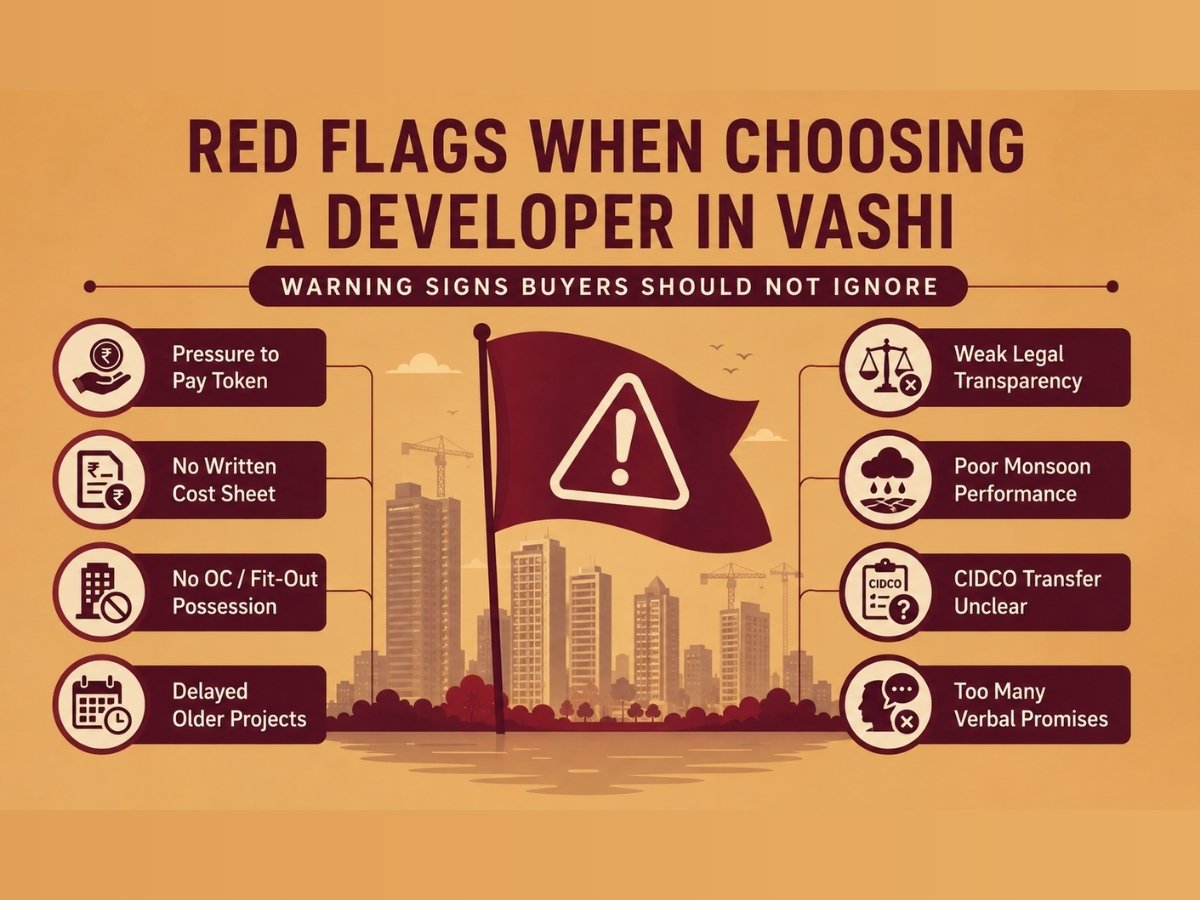
Red Flags When Choosing a Real Estate Developer in Vashi

Red Flags When Choosing a Real Estate Developer in Vashi is visible in this image.
Red Flag What It May Mean What Buyer Should Do
Pressure to pay token quickly Sales team may be blocking due diligence Do not pay before document review
No written clarity on charges Hidden costs may appear later Demand signed all-inclusive cost sheet
Delayed older projects Current project may also face delay Check past MahaRERA and resident feedback
Poor maintenance in completed buildings Weak after-sales or low construction quality Visit old projects and speak to residents
Weak legal transparency Title or approval issues may exist Ask lawyer to review documents
Too many verbal promises Promises may not enter agreement Get every commitment in writing
Fit-out possession without OC Building may not be legally ready Refuse possession without OC
Unclear CIDCO transfer liability Buyer may face unexpected future charges Clarify in agreement before booking

Pressure to Pay Token Money Quickly

If the sales team says the price is valid only for today, or another buyer is waiting, slow down. Genuine projects can withstand basic due diligence.

No Written Clarity on Charges

If pricing is only discussed verbally, it is a red flag. A serious developer should provide a proper cost sheet.

Delayed Older Projects

If the developer has a history of delays, ask why. One delay may have a reason. Repeated delays show a pattern.

Poor Maintenance in Completed Buildings

Poor common area maintenance, unresolved leakage and weak society handover can reduce long-term property value.

Weak Legal Transparency

If the developer avoids sharing title, CC, OC, CIDCO or RERA documents, do not proceed casually.

Too Many Verbal Promises

Verbal promises about possession, charges, parking, view, area or future approvals should be written into the agreement.

Real Estate Developer Shortlisting Scorecard

Use this simple scorecard before finalizing a developer in Vashi. Give each factor a score out of 10.

Evaluation Factor What to Check Score
Past Delivery Record On-time delivery and completed projects /10
Legal Transparency Willingness to share title, CC, OC, RERA and CIDCO documents /10
Construction Quality Condition of 5+ year old projects /10
Pricing Clarity All-inclusive cost sheet and no vague charges /10
Location Suitability Developer experience in Vashi or similar mature nodes /10
After-Sales Support Complaint handling, defect repairs and handover process /10
Buyer Feedback Pattern Resident reviews and broker feedback /10

A developer scoring poorly on legal transparency or OC clarity should not be selected only because of discount or branding.

Common Mistakes Buyers Make While Choosing Builders in Vashi

Trusting Only Brand Name

A known brand can still face project-level issues. Always check the exact Vashi project, not only the company’s overall reputation.

Ignoring Legal Document Verification

Legal checks are not optional. Title, CC, OC, approved plan, agreement, CIDCO documents and conveyance status can directly affect ownership and resale.

Booking Only Because of Discount or Offer

Discounts are useful only when the project is legally clear and construction quality is good. A cheaper flat with hidden risks can become expensive later.

Not Visiting Completed Projects

Many buyers visit only the sample flat and sales office. This is a mistake. Completed projects show the developer’s real work.

Depending Fully on Broker or Sales Team Promises

Brokers and sales teams can help with information, but the buyer must verify everything independently. The final decision should be based on documents and written terms.

How to Verify a Real Estate Developer Before Final Decision

Step 1: Check MahaRERA Details

Search the project on the MahaRERA website. Check promoter name, possession date, litigations, carpet area, approvals and updates.

Step 2: Visit the Project Site

Check whether actual site progress matches the sales pitch. Look for activity, safety, organization and realistic construction speed.

Step 3: Visit Completed Projects

Visit older projects by the same developer. Speak to residents and inspect leakage, basement, common areas and maintenance quality.

Step 4: Review Legal Documents with an Expert

Hire a qualified property lawyer, especially for redevelopment, resale, CIDCO-origin land, PAP/12.5% scheme plots, or high-value purchases.

Step 5: Compare Total Cost with Other Projects

Compare all-inclusive pricing, not just base price per square foot. Include taxes, parking, maintenance, corpus, registration, stamp duty and transfer charges.

Step 6: Take Final Decision Only After Written Clarity

Proceed only when all important promises are written in the cost sheet, agreement or official documents. Do not depend on verbal assurances.

Final Checklist Before Choosing a Real Estate Developer in Vashi

Use this checklist before paying token money or signing an agreement.

  • Verify the exact MahaRERA registration number.
  • Check project possession date and litigation details on MahaRERA.
  • Ask for the NMMC Commencement Certificate.
  • Confirm whether your booked floor is sanctioned.
  • For ready-to-move flats, demand final Occupancy Certificate.
  • Review approved building plan and compare with brochure.
  • Ask for a 30-year title search or title clearance report.
  • Check CIDCO leasehold, freehold, transfer or NOC status where applicable.
  • Verify PAP or 12.5% plot documents if relevant.
  • Check society formation and conveyance status in older buildings.
  • Visit at least two completed projects by the developer.
  • Speak to existing residents about leakage and after-sales service.
  • Ask for a signed all-inclusive cost sheet.
  • Confirm parking, floor-rise, PLC, maintenance and corpus charges.
  • Review the draft Agreement for Sale with a lawyer.
  • Refuse fit-out possession without valid OC.
  • Take final decision only after written clarity.

For related buyer guidance, read questions to ask before buying a flat in Navi Mumbai and Navi Mumbai property investment guide.

Conclusion

Choosing the right real estate developer in Vashi is a serious financial decision. The area is mature, well-connected and valuable, but that also means mistakes are expensive. Buyers should not choose only by brochure, discount, sample flat or brand name.

The right developer is the one who can prove legal transparency, past delivery, construction quality, pricing clarity and after-sales responsibility. In Vashi, buyers must be especially careful about MahaRERA details, NMMC approvals, OC status, CIDCO land documents, conveyance, redevelopment risks and monsoon performance.

Final verdict: choose a developer only after checking documents, visiting completed projects, speaking to residents, comparing all-inclusive cost and getting every important promise in writing.

FAQs

Frequently Asked Questions

How do I choose the right real estate developer in Vashi?

Choose the right real estate developer in Vashi by checking MahaRERA registration, NMMC approvals, CIDCO-related documents, completed projects, construction quality, pricing clarity, OC status and buyer feedback before paying token money. A reliable developer should share documents transparently and have a clean delivery record.

What documents should I check before booking a flat in Vashi?

Before booking a flat in Vashi, check MahaRERA registration, NMMC Commencement Certificate, approved building plan, Title Clearance Certificate, draft Agreement for Sale, Occupancy Certificate for ready projects, CIDCO transfer documents where applicable, and society conveyance status in older buildings.

Is MahaRERA registration enough to trust a builder?

No. MahaRERA registration is important, but it is not enough to fully trust a builder. Buyers should also check construction quality, past delays, legal title, NMMC approvals, CIDCO documents, OC status, pricing transparency and resident feedback.

Should I visit completed projects before booking?

Yes. Visiting completed projects is one of the best ways to judge a developer. A five-year-old building can reveal construction quality, leakage issues, maintenance standards, society handover quality and after-sales support better than a sample flat

Is a big builder always better than a local builder?

No. A big builder may offer better financial strength and amenities, but a good local Vashi developer may have stronger understanding of CIDCO, NMMC, redevelopment and local plot conditions. The right choice depends on project documents, track record, pricing and construction quality.

Developers in Vashi

Leave a Reply

Your email address will not be published. Required fields are marked *