

Fintech Hub Third Mumbai Real Estate: Impact, Areas and Buyer Due Diligence Guide
Fintech Hub Third Mumbai real estate can create long-term demand around Panvel, Uran, Pen, Ulwe, Dronagiri, Pushpak Nagar and NAINA-linked belts. But buyers should not invest only because a broker says “Third Mumbai” or “future fintech hub.” Before paying token money, verify authority jurisdiction, 7/12, 8A, title chain, zoning, NA/development permission, MahaRERA, CRZ/CZMP risk and road access.
What Is the Fintech Hub Third Mumbai Real Estate Story?
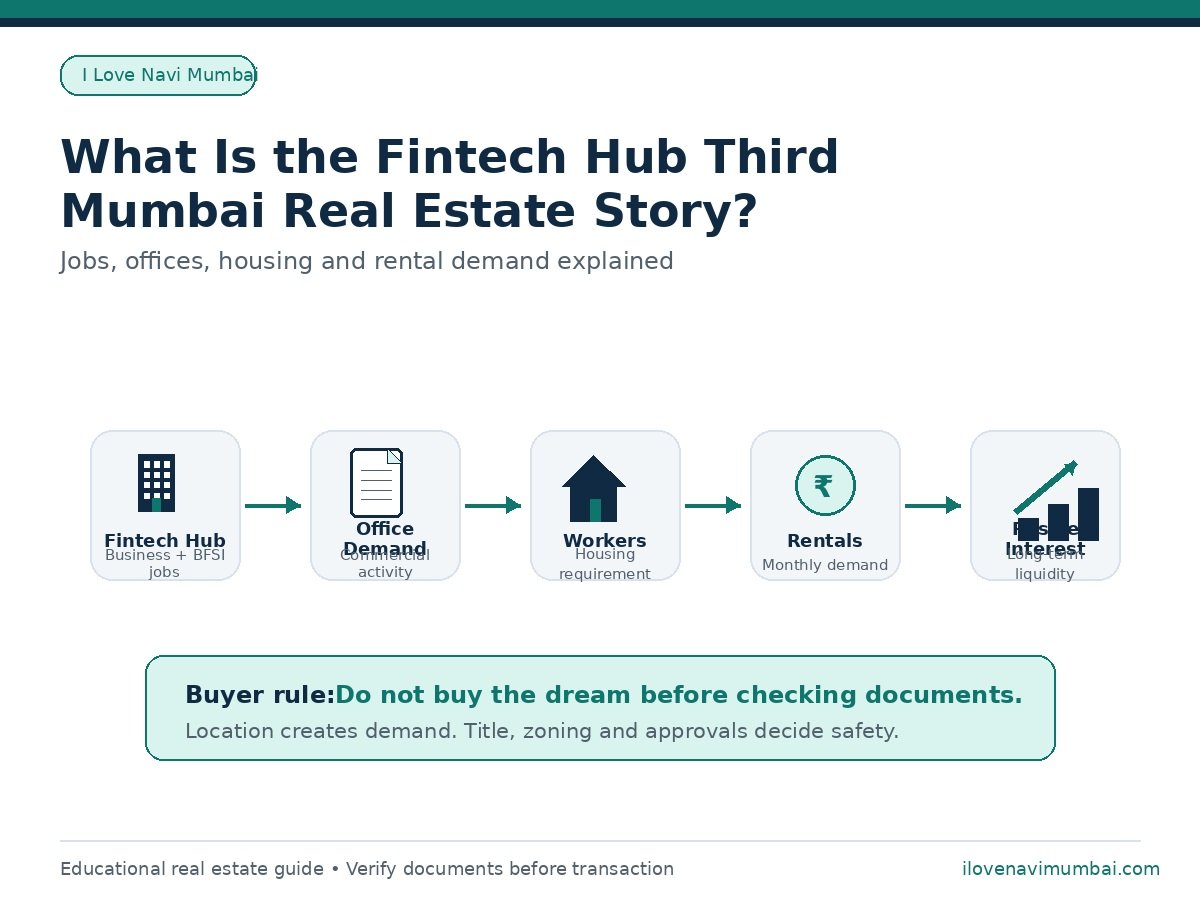
Third Mumbai is not just a casual broker term anymore. The formal planning conversation is linked to KSC New Town, which is being developed in the influence area of Atal Setu and the wider Navi Mumbai airport growth belt.
As per official MMRDA information, KSC New Town covers villages across Uran, Panvel and Pen tehsils in Raigad district. MMRDA has been appointed as the New Town Development Authority for this notified area.
This matters for real estate because employment hubs usually change the property market in stages.
The chain is simple:
jobs → offices → workers → rentals → retail demand → resale interest
If fintech companies, BFSI offices, data centres, logistics firms, aviation-linked services and support businesses actually grow in this belt, nearby residential and commercial demand can improve over time.
But this does not mean every nearby plot, flat or gaothan property is automatically a safe investment.
That is where buyers need to be careful.
Why Buyers Should Not Fall for “Future Hub” Hype
In Navi Mumbai and Raigad property markets, infrastructure stories are often used to sell land before the buyer understands the documents.
Common sales lines include:
- “This is near Third Mumbai.”
- “Airport ke paas hai.”
- “Fintech hub aane wala hai.”
- “NA conversion ho jayega.”
- “Ye gaothan plot safe hai.”
- “Token do, warna rate badh jayega.”
Some of these locations may genuinely have long-term potential. But potential and legal safety are two different things.
A property can be in a promising location and still have:
- unclear title
- wrong zoning
- no legal road access
- CRZ or mangrove restriction
- pending mutation
- family ownership dispute
- no valid development permission
- no MahaRERA registration where required
- mismatch between survey number and actual site
Location can create demand. Documents decide safety.
For a deeper understanding of employment-led demand, this article should internally link to Navi Mumbai employment hubs real estate impact as the parent pillar page.
Which Areas May See Third Mumbai Real Estate Impact?
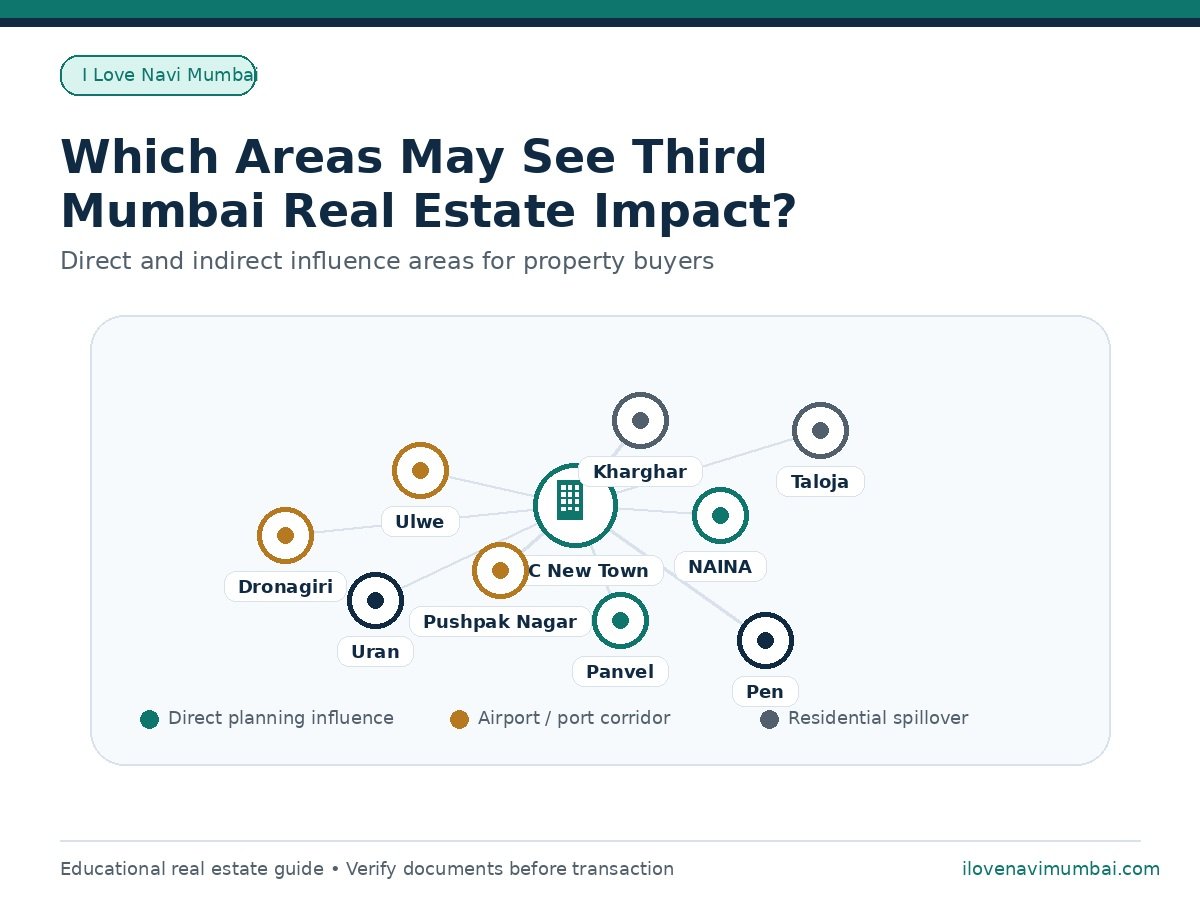
The impact will not be equal everywhere. Some areas may see direct planning impact, while others may benefit indirectly through housing, rental and commute demand.
| Area | Possible Impact | Best Suited For | Risk Level |
|---|---|---|---|
| Uran | Direct KSC / port / logistics influence | Long-term investors, land buyers | High for land deals |
| Pen | KSC New Town and Raigad expansion influence | Long-hold land investors | High |
| Chirner / Sai / Karnala belt | Planning and infrastructure influence | Experienced investors | High |
| Panvel / New Panvel | Residential and rental demand | End-users, investors | Medium |
| Ulwe | Airport and Atal Setu-linked housing demand | End-users, rental investors | Medium |
| Pushpak Nagar | Airport-side growth corridor | Long-term buyers | Medium |
| Dronagiri | Port, logistics and Uran-side influence | Investors, end-users | Medium to high |
| Kharghar | Mature residential node with better social infra | End-users, IT professionals | Lower than raw land |
| Taloja | Industrial, metro and affordable housing influence | Budget buyers | Medium |
Existing job hubs like Airoli, Ghansoli, Rabale, Mahape and Turbhe show how employment corridors can influence rental demand and resale liquidity. That is why this topic should also connect with Airoli IT Park real estate impact, Ghansoli IT corridor real estate impact and Rabale MIDC property impact.
Real Estate Impact by Property Type
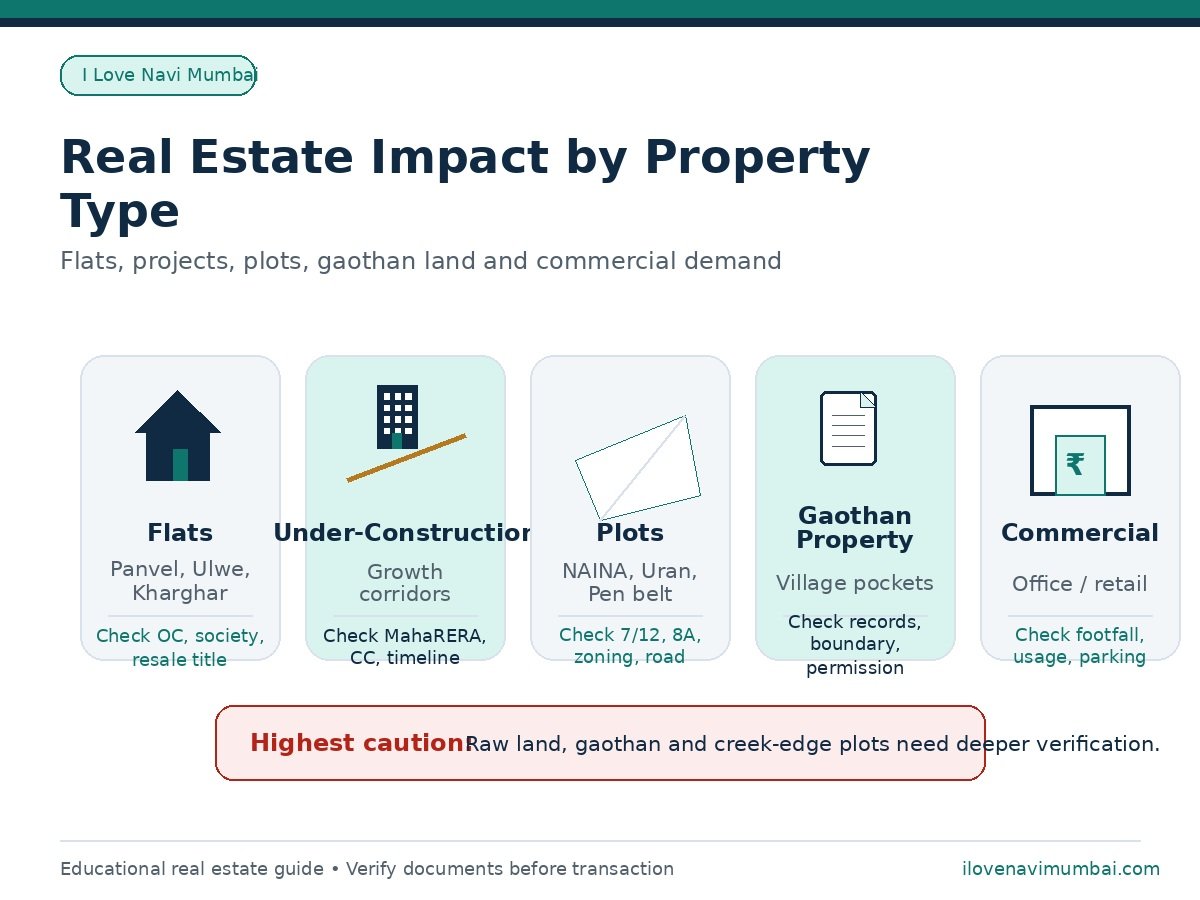
Flats in Panvel, Ulwe and Kharghar
Flats are usually easier for normal buyers to understand compared to raw land.
In Panvel, Ulwe, Pushpak Nagar, Kharghar and Dronagiri, buyers should focus on:
- project registration
- builder track record
- Commencement Certificate
- Occupancy Certificate
- society formation
- resale title chain
- maintenance dues
- actual connectivity
A flat in a legally clear project may be safer than a cheaper plot with unclear title.
For working professionals, areas like Kharghar, Ulwe, Panvel, Airoli and Ghansoli should be compared based on commute, rent, school access, station access and future job hubs. A suitable internal link here is best areas for IT professionals in Navi Mumbai.
Under-Construction Projects Near Growth Corridors
Under-construction projects near Third Mumbai influence areas may look attractive because entry prices are usually lower than ready properties.
But buyers must verify MahaRERA details.
Check:
- project registration number
- promoter name
- sanctioned plans uploaded
- project timeline
- litigation disclosures
- lapsed or revoked status
- approvals and land title documents uploaded by promoter
- actual construction progress
MahaRERA registration supports verification, but it should not be treated as a full guarantee of title, delivery or investment return.
Plots, Gaothan Property and NAINA Land
Plots can give high returns, but they also carry the highest risk.
This is especially true in:
- NAINA areas
- gaothan and gaothan-extension pockets
- Uran and Pen village belts
- Dronagiri-side land
- creek or mangrove-edge areas
- agricultural land marketed as “future NA plot”
For land and plot deals, 7/12 is important, but 7/12 alone is not complete title proof.
A buyer must verify title chain, mutation entries, zoning, road access, NA/development permission, CRZ risk and authority jurisdiction.
A strong internal link here is NAINA property verification in Navi Mumbai or property verification in Navi Mumbai.
Commercial Property and Future Office Demand
The fintech hub narrative may create demand for office space, retail units and commercial investment.
But small investors should be careful.
Do not assume every shop or office unit near a future growth corridor will get high rent. Commercial returns depend on:
- footfall
- road visibility
- parking
- building occupancy
- business density
- actual office leasing
- maintenance cost
- legal usage permission
A future hub can support commercial demand, but only when real businesses start operating in the area.
Documents to Check Before Paying Token Money
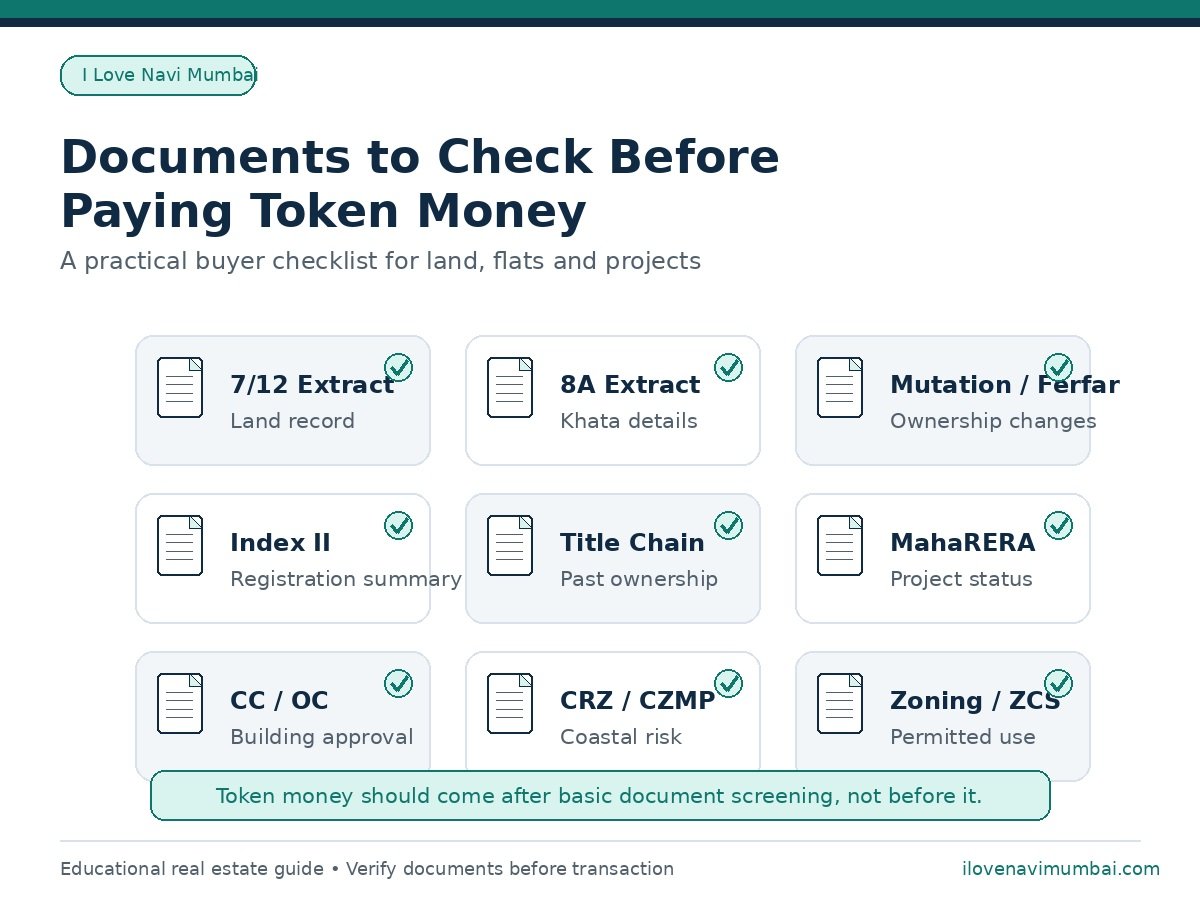
Before paying token money for Fintech Hub Third Mumbai real estate, use this document table.
| Document | What It Helps Verify | Important Warning |
|---|---|---|
| 7/12 extract | Land survey details, holder name, land type | It supports verification but does not fully prove ownership |
| 8A extract | Khata/account holder details | Must match ownership story |
| Mutation entry / Ferfar | Ownership changes in revenue record | Pending mutation can create risk |
| Property card | Urban property record | Useful for city survey areas |
| Sale deed | Registered transfer document | Must be checked by lawyer |
| Index II | Registration summary of transaction | Supports registered transaction verification |
| Title chain | Past ownership history | Most important for legal due diligence |
| NA / development permission | Legal land-use or development approval position | Verify with planning authority |
| DP zoning / ZCS | Permissible land use | Critical in NAINA and planning areas |
| MahaRERA record | Project registration and disclosures | Required for eligible projects |
| CC / OC | Construction and occupancy approvals | OC is important before safe occupation |
| CRZ / CZMP check | Coastal, creek, mangrove restrictions | Important near Uran, Dronagiri and coastal belts |
| Road access proof | Legal access to plot | Avoid landlocked plots |
How to Verify a Third Mumbai or NAINA Property
Step 1: Confirm the Exact Location and Authority
First, confirm which authority controls the property.
It may fall under:
- MMRDA / KSC New Town
- CIDCO / NAINA
- Panvel Municipal Corporation
- Gram Panchayat area
- revenue jurisdiction of Uran, Panvel or Pen
- MCZMA / CRZ-sensitive zone
- MIDC or port influence belt
This step is important because the approval process changes depending on the authority.
Step 2: Match the Seller Name With Records
The seller’s name should match the land record and title documents.
Check:
- 7/12 holder name
- 8A details
- mutation entries
- registered sale deed
- Index II
- legal heir documents, if inherited property
- Power of Attorney, if seller is not the original owner
If the seller says, “Naam baad mein chadhega,” do not ignore it. Pending ownership updates can become a serious problem later.
Step 3: Check Zoning Before Believing “Future Residential” Claims
Zoning decides what can legally be done on land.
In NAINA and other planning areas, check:
- Development Plan
- ZCS, meaning Zone Confirmation Statement
- DCPR, meaning Development Control and Promotion Regulations
- Town Planning Scheme details, if applicable
- road reservation
- public purpose reservation
- green zone or no-development restrictions
A broker’s verbal statement is not a zoning approval.
Step 4: Understand NA Permission Carefully
NA means Non-Agricultural use.
In simple words, it relates to whether land can be used for non-agricultural purposes such as residential, commercial or industrial use.
Maharashtra has changed the NA permission framework after 2025. In many planned areas, separate Collector NA permission may not be required where the use is permissible under the Development Plan or Regional Plan and the planning authority grants development permission or building plan approval.
But this does not mean every agricultural plot is automatically safe for construction.
Before buying, verify:
- land-use zoning
- planning authority approval
- building permission
- development permission
- premium or conversion requirement, if any
- latest government position
For land conversion, always verify before transaction with the revenue office, planning authority or property lawyer.
Step 5: Check CRZ, Creek and Mangrove Risk
CRZ means Coastal Regulation Zone.
This is important in parts of Uran, Dronagiri, creek-side belts, mangrove-edge land and some coastal influence pockets in Raigad and Navi Mumbai.
If a plot is near creek, mangroves, wetlands or coastal water bodies, check the approved CZMP map and official restrictions.
Never buy such land only based on a site visit.
A plot can look open and usable, but legally it may fall under restricted coastal or environmental zones.
A relevant internal link here is CRZ property risk in Navi Mumbai.
Red Flags in Fintech Hub Third Mumbai Property Deals
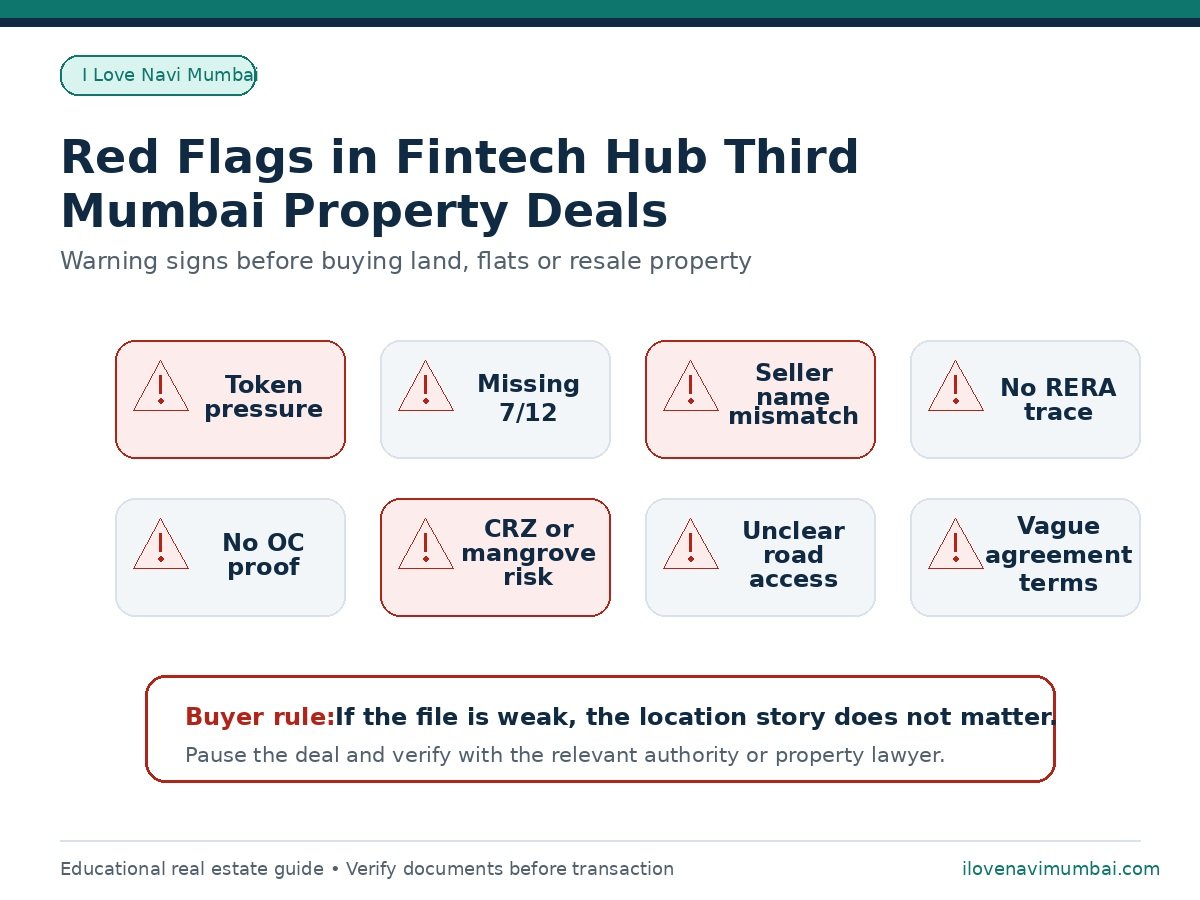
Avoid or pause the deal if you see these warning signs:
- Seller or broker refuses to share survey number.
- Token is demanded before document checking.
- 7/12 name does not match seller name.
- Mutation entry is pending or disputed.
- Plot is sold as “NA plot” but no authority approval is shown.
- Land is near creek or mangroves but no CRZ/CZMP check is done.
- Project claims “Third Mumbai location” but actual distance is unclear.
- MahaRERA number is missing for an eligible project.
- OC is claimed but not verifiable.
- POA seller avoids meeting the actual owner.
- Road access is only informal or through another private land.
- Agreement terms are vague.
- Broker says, “Lawyer ki zarurat nahi hai.”
If the seller pressures you to pay token before verification, treat it as a serious warning.
Common Mistakes Buyers Make
Mistake 1: Buying Only Because of Third Mumbai Branding
Third Mumbai can become a major growth story, but branding alone does not make a property safe.
A weak-title plot in a future corridor is still a weak-title plot.
Mistake 2: Treating 7/12 as Ownership Proof
7/12 is a revenue record. It helps verify land details and holder names, but full ownership verification requires title chain, registered documents, mutation entries and legal review.
Mistake 3: Ignoring Authority Jurisdiction
A property may be marketed as Navi Mumbai, Panvel, NAINA, CIDCO, MMRDA or Raigad depending on what sounds more attractive.
Buyers must check the actual authority.
Mistake 4: Paying Token Without Written Conditions
Token money should be paid only after basic document screening.
If token is paid, the receipt or written understanding should clearly mention refund conditions if title, approvals or records are not satisfactory.
Mistake 5: Assuming NA Reform Removes All Risk
NA process changes may simplify some approvals, but they do not remove the need for zoning, title, road access, planning permission and authority verification.
What to Check Before Paying Token Money
Use this checklist before paying even a small amount.
| Checkpoint | Status |
|---|---|
| Exact location verified on map and site | Pending / Done |
| Survey number or plot number received | Pending / Done |
| 7/12 checked | Pending / Done |
| 8A checked | Pending / Done |
| Mutation entries checked | Pending / Done |
| Seller name matched | Pending / Done |
| Sale deed and title chain reviewed | Pending / Done |
| Index II checked | Pending / Done |
| Authority jurisdiction confirmed | Pending / Done |
| DP zoning or ZCS checked | Pending / Done |
| NA / development permission position verified | Pending / Done |
| MahaRERA checked, if applicable | Pending / Done |
| CC / OC checked, if applicable | Pending / Done |
| CRZ/CZMP checked, if relevant | Pending / Done |
| Road access verified | Pending / Done |
| Lawyer review completed | Pending / Done |
| Token terms written clearly | Pending / Done |
Navi Mumbai Example Scenario
A buyer is offered a 2-guntha plot near the Panvel-Uran side. The broker says:
“Ye Third Mumbai fintech hub ke paas hai. Airport, Atal Setu aur KSC New Town ke baad rate double ho jayega.”
The buyer should not start with price negotiation.
The buyer should first ask:
1. What is the survey number, gut number and hissa number? 2. Is the seller name visible on 7/12 and 8A? 3. Are mutation entries complete? 4. Does the land fall under NAINA, KSC New Town, Gram Panchayat or another authority? 5. What is the zoning? 6. Is there legal road access? 7. Is the land near creek, mangroves or CRZ-sensitive area? 8. Is there any approved layout or development permission? 9. Has a property lawyer checked the title chain?
If these answers are not clear, the buyer should not pay token money.
The opportunity may be strong. But the file must be stronger.
conclusion
Yes, Fintech Hub Third Mumbai real estate is worth studying for long-term buyers and investors.
But it is not a blind-buy market.
For end-users, flats in Panvel, Ulwe, Kharghar, Pushpak Nagar and Dronagiri may be easier to verify compared to raw land. For investors, NAINA, Uran, Pen and KSC New Town influence areas may offer long-term potential, but document risk is higher.
The safest approach is simple:
Buy the document, not the dream.
If the title is clean, zoning is suitable, authority approvals are traceable, road access is legal and the price is realistic, the property may be worth considering. If the deal depends only on “future fintech hub” storytelling, pause and verify.
Near the conclusion, link readers to property verification in Navi Mumbai as the next step.
FAQs
Frequently Asked Questions