
Navi Mumbai Air Quality by Locality: AQI Guide for Property Buyers
Quick Summary
Navi Mumbai air quality is not the same in every locality. Areas near heavy construction, MIDC belts, major roads, truck routes, redevelopment pockets, and infrastructure work may face higher dust and pollution exposure. Before buying or renting, check CPCB/SAMEER AQI data, visit the site at different times, inspect nearby dust sources, and speak to residents.
Why Air Quality Matters Before Buying Property in Navi Mumbai
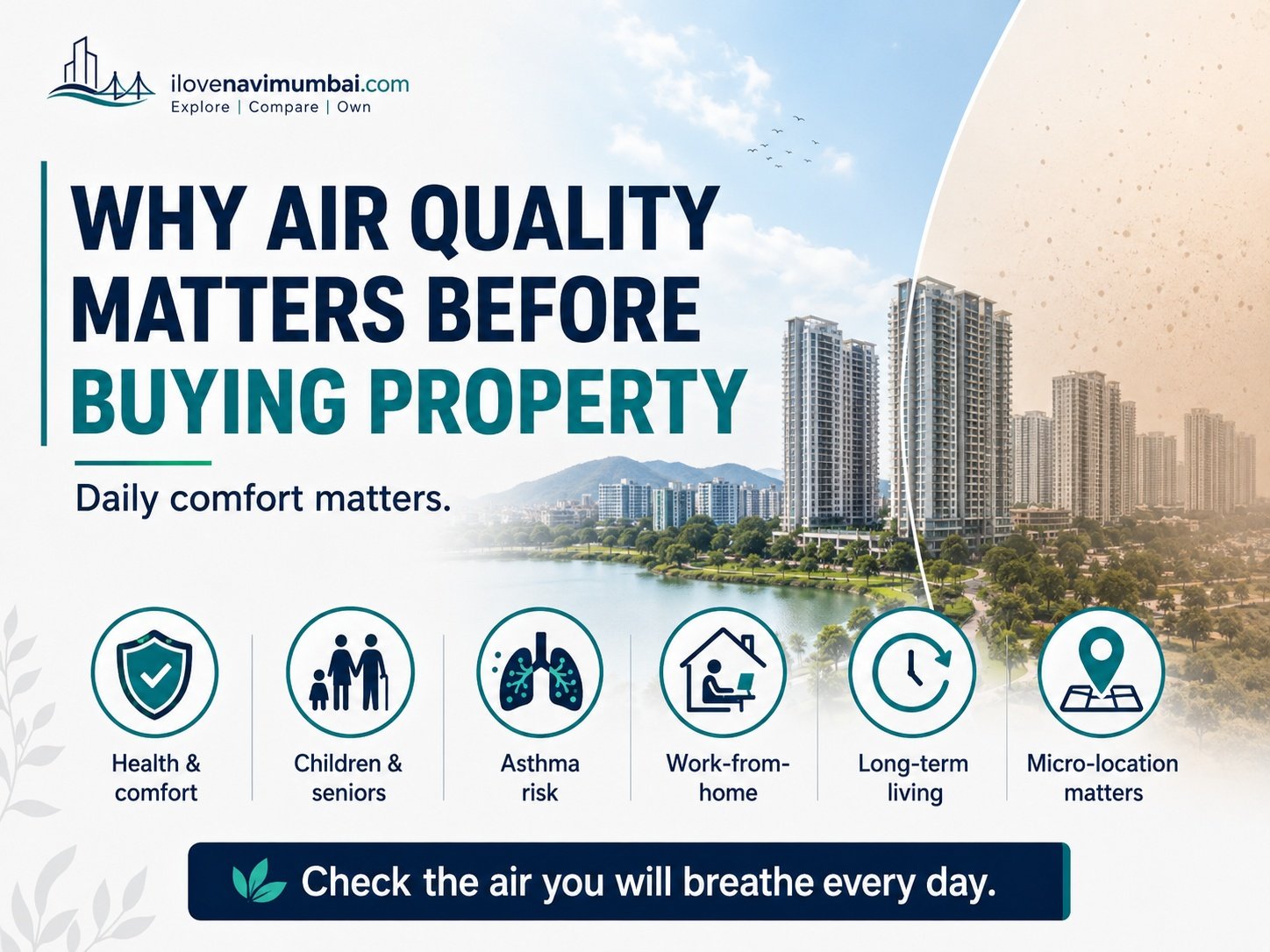
Buying a home is not only about carpet area, price, amenities, and connectivity.
Air quality also affects daily comfort.
A flat may look premium on paper. But if it faces a dusty road, construction site, RMC plant, highway, or industrial belt, daily living can become uncomfortable.
This matters more for:
- Senior citizens
- Children
- People with asthma or allergies
- Work-from-home families
- Buyers planning long-term residence
- NRIs buying without visiting the site often
Navi Mumbai has some excellent residential pockets with open spaces, creeks, hills, and planned infrastructure. But it also has industrial belts, port-linked roads, construction-heavy zones, and fast-growing nodes.
So the real question is not only, “Is Navi Mumbai good for living?”
The better question is:
“Is this exact micro-location good for daily living?”
For a wider environmental-risk understanding, connect this article with Navi Mumbai Pollution Guide.
How AQI Works in India
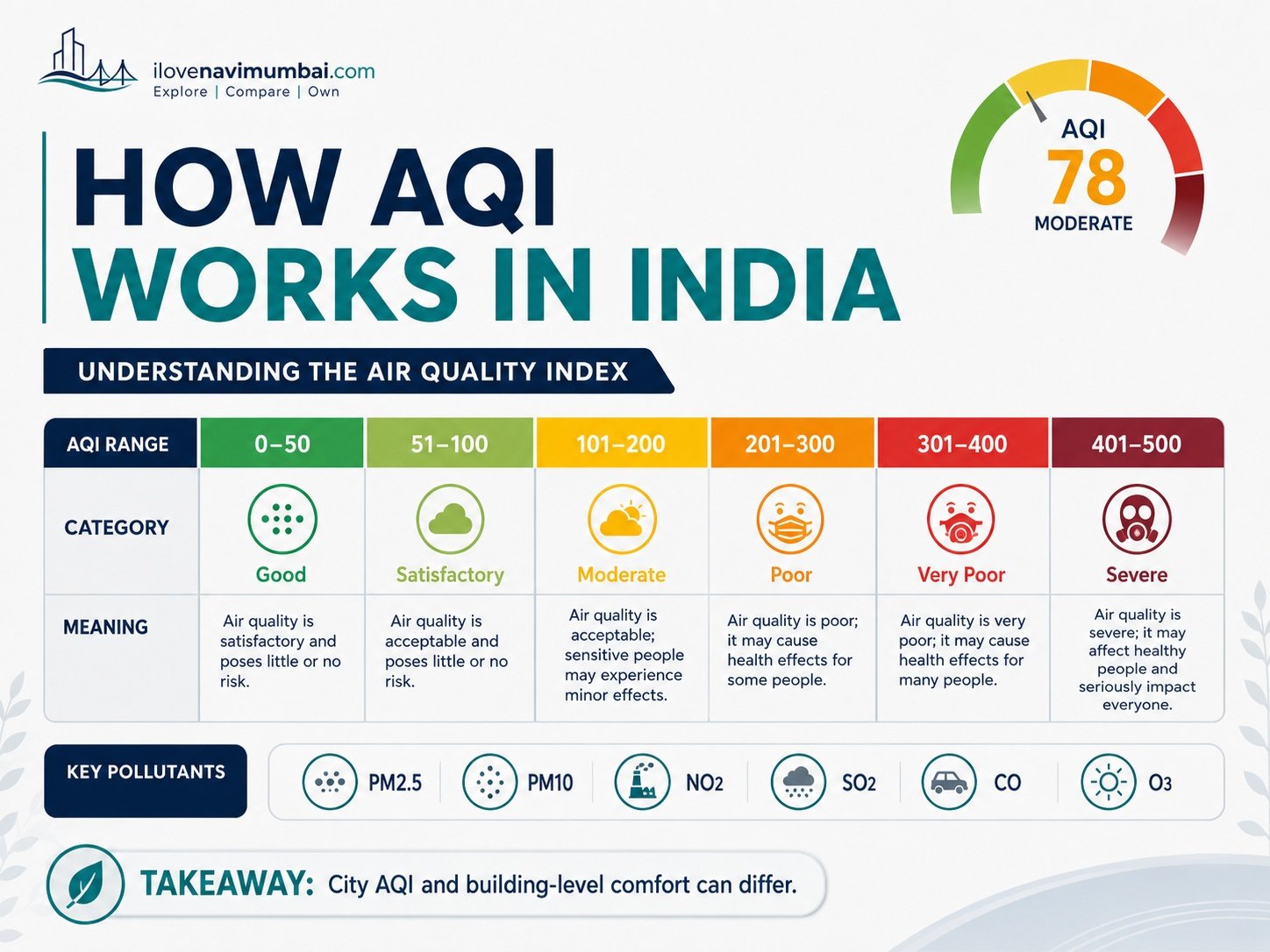
AQI means Air Quality Index.
It converts pollution data into a simple category so normal users can understand air quality quickly.
In India, CPCB uses AQI categories such as:
| AQI Category | General Meaning for Buyers |
|---|---|
| Good | Usually comfortable for most people |
| Satisfactory | Acceptable, but sensitive people may still notice discomfort |
| Moderate | Children, elderly people, and people with breathing issues should be cautious |
| Poor | Long exposure may create discomfort, especially for sensitive groups |
| Very Poor | Outdoor exposure should be reduced |
| Severe | Serious health concern; avoid unnecessary outdoor activity |
AQI includes pollutants such as PM2.5, PM10, NO2, SO2, CO, O3, NH3, and Pb as per CPCB’s AQI framework.
For property buyers, two terms matter the most:
PM2.5
PM2.5 means very fine particles that can enter deep into the lungs. It is usually linked with combustion, traffic, industrial emissions, and fine suspended pollution.
PM10
PM10 includes larger dust particles. In Navi Mumbai, this can be connected with road dust, construction dust, uncovered soil, debris movement, and infrastructure work.
A locality may have decent city-level AQI, but one building can still feel dusty because of its immediate surroundings.
That is why micro-location checking is important.
Navi Mumbai Air Quality by Locality
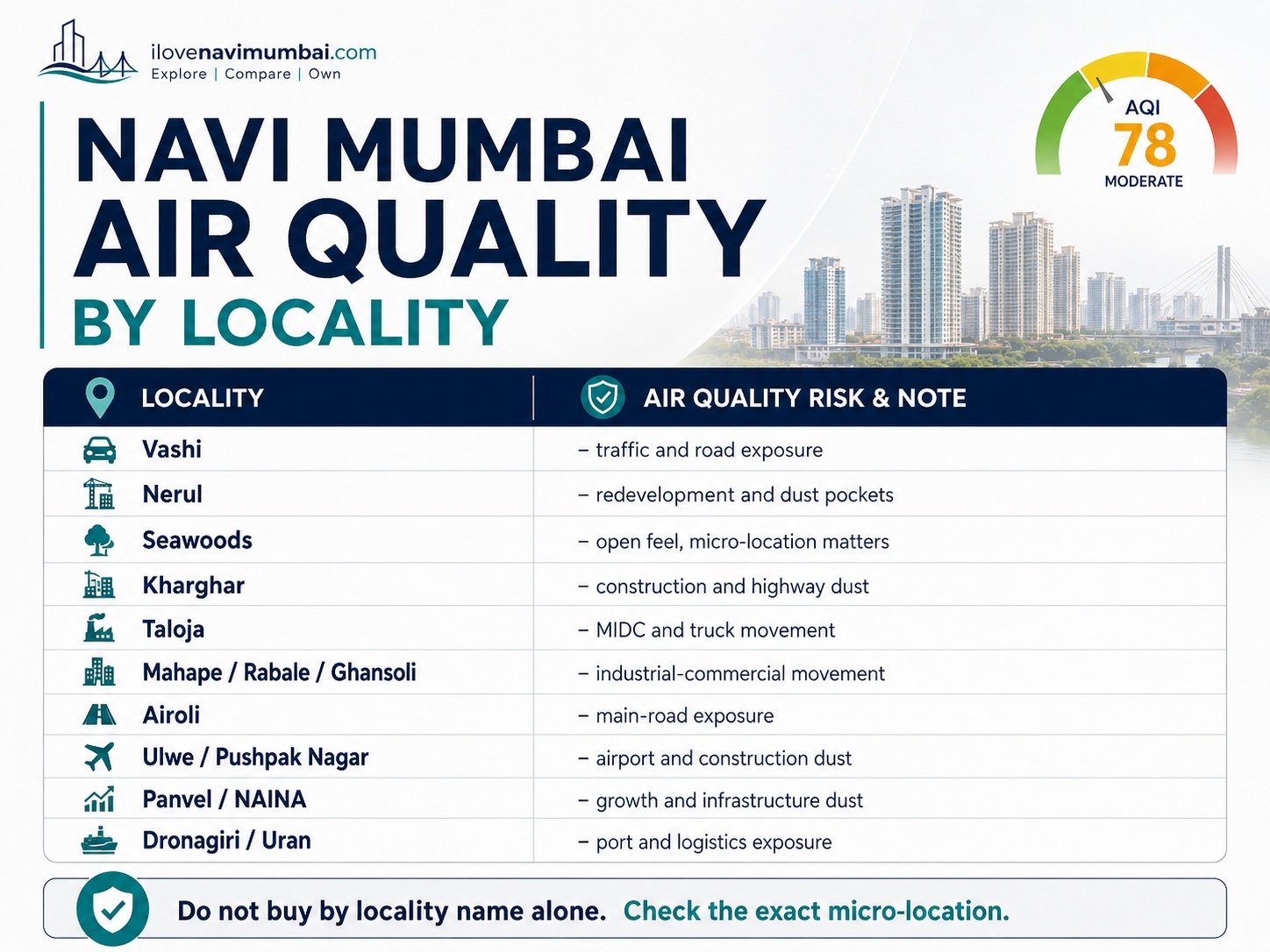
Do not treat this table as a fixed AQI ranking.
AQI changes by season, wind, rain, construction work, traffic, and monitoring location. Use this as a practical buyer-risk guide.
| Locality / Belt | What Buyers Should Check | Practical Property View |
|---|---|---|
| Vashi | Traffic, commercial density, redevelopment dust, main-road exposure | Strong convenience, but road-facing flats need closer inspection |
| Sanpada | Construction activity, traffic, dust, seasonal AQI spikes | Good connectivity, but check site surroundings carefully |
| Nerul | Road dust, redevelopment, traffic, construction pockets | Strong residential node, but avoid assuming every pocket has clean air |
| Seawoods | Road exposure, construction pockets, creek-side variation | Some pockets feel more open, but micro-location matters |
| Kharghar | Construction dust, hill-side dust, highway-linked movement, quarry influence in some pockets | Good open-space advantage in some sectors, but inspect active construction nearby |
| Taloja | MIDC influence, truck movement, industrial smell, road dust | Affordable and growing, but buyers must verify pollution exposure carefully |
| Mahape / Rabale / Ghansoli | MIDC belt, traffic, industrial-commercial movement | Better for work access; residential buyers should inspect air and smell at different times |
| Airoli | Office traffic, Thane-Belapur Road exposure, industrial-side pockets | Good connectivity, but main-road-facing units need caution |
| Ulwe / Pushpak Nagar | Airport-linked development, construction dust, road work | Strong growth market, but check dust, future traffic, and airport-related liveability |
| Panvel / NAINA Belt | Construction, road expansion, logistics movement, developing infrastructure | Good long-term potential, but project-level and locality-level checks are essential |
| Dronagiri / Uran Belt | Port-linked traffic, JNPT/JNPA road movement, industrial/logistics exposure | Useful for investment and logistics-linked growth, but residential comfort should be checked carefully |
The takeaway is simple:
Do not buy only because the locality name is popular. Buy after checking the exact road, surroundings, wind direction, construction activity, and daily dust level.
Main Pollution Sources Buyers Should Check
1. Construction Dust
This is one of the biggest practical issues in fast-growing Navi Mumbai nodes.
Dust can come from:
- Excavation
- Road cutting
- Cement mixing
- Debris movement
- Uncovered construction material
- Poor barricading
- Unpaved internal roads
If there are multiple under-construction towers near the project, visit the site during working hours.
A project that looks peaceful on Sunday may feel completely different on a weekday afternoon.
2. Traffic and Main-Road Exposure
Properties near major roads may face more dust and emissions.
Check exposure near:
- Sion-Panvel Highway
- Palm Beach Road
- Thane-Belapur Road
- JNPT/JNPA Road
- Uran-Dronagiri logistics routes
- Internal high-traffic node roads
A flat inside the same locality can feel cleaner if it faces a garden, internal lane, or open side.
A road-facing flat may get more dust, noise, and heat.
For road-linked living concerns, connect this with Living Near JNPT Road and Navi Mumbai Traffic Guide.
3. MIDC and Industrial Belts
Navi Mumbai has important industrial zones.
Buyers should be more careful near:
- Taloja MIDC
- Mahape MIDC
- Rabale
- TTC Industrial Area
- Turbhe
- Pawne
- Kopar Khairane industrial-side pockets
- Ghansoli industrial-side pockets
This does not mean every property near these belts is bad.
But it means you should check:
- Smell in the evening and early morning
- Truck movement
- Dust on windows and balconies
- Nearby factories or warehouses
- Distance from industrial roads
- Resident complaints
For deeper due diligence, link this section to Living Near MIDC Navi Mumbai, Living Near Taloja MIDC, and Living Near Mahape MIDC.
4. RMC Plants, Debris Routes, and Open Soil
Ready-mix concrete plants, debris dumping points, and uncovered soil can create heavy local dust.
This can affect even a good project.
Before buying, check what is located within a 500-metre to 1-km radius.
Look for:
- RMC plants
- Stone-crushing activity
- Large excavation
- Dumped construction debris
- Open plots used for material storage
- Unpaved access roads
5. Airport and Infrastructure Construction
Ulwe, Pushpak Nagar, Panvel, and nearby growth corridors may see construction-related dust due to airport-linked and road infrastructure development.
This is not always permanent.
But buyers should not ignore it.
If you are buying near the airport influence zone, also read Navi Mumbai Airport Noise Zone Guide.
Documents and Data to Check
For an AQI article, “documents” does not mean only ownership papers.
It means official data, project approvals, and authority records that help you understand risk.
Official AQI Sources
Check:
- CPCB National AQI dashboard
- SAMEER app by CPCB
- CPCB AQI data repository
- MPCB air quality reports
Use CPCB and MPCB as primary sources.
Third-party AQI websites can be useful, but their numbers may differ because of sensor type, location, and methodology.
Project and Approval Checks
For under-construction projects, check:
- MahaRERA project page
- Commencement Certificate
- Building permission
- Occupation Certificate, if available
- Environment Clearance, where applicable
- Local authority permissions
MahaRERA helps buyers verify whether a real estate project is registered and what details have been uploaded by the promoter.
For large projects, environmental clearance status may also be relevant.
NAINA, CIDCO, and Developing Belt Checks
If the property is in NAINA, Panvel, Ulwe, Pushpak Nagar, Dronagiri, gaothan-adjacent, or developing village land areas, do not check only AQI.
Also verify planning and land status.
Important records may include:
- 7/12 extract
- 8A extract
- Mutation entries
- Property card, where applicable
- Development permission
- NA or land-use status, where applicable
- CIDCO / NAINA planning permission, where relevant
7/12 is a Maharashtra land record that shows land details such as survey number, area, occupant details, and crop/land-use-related entries. It supports verification, but it should not be treated as final proof of ownership by itself.
For land and title matters, connect this article with Property Verification in Navi Mumbai and Title Search in Navi Mumbai.
This is an educational guide. Verify the latest position with the relevant authority or a property lawyer before making a transaction.
Red Flags Before Paying Token Money
Watch for these signs during a site visit.
Visible Red Flags
- Thick dust on parked vehicles
- Dust on balcony grills and windows
- Construction debris near the project
- Open cement, sand, or aggregate storage nearby
- Frequent truck movement
- Strong chemical or industrial smell
- Burning smell in the evening
- Poorly maintained approach road
- Black dust on window tracks
- Residents keeping windows closed most of the day
Location Red Flags
- Flat directly facing a highway
- Project beside a busy service road
- Multiple under-construction towers nearby
- RMC plant close to the building
- Industrial units within short distance
- Nullah, dumping-prone land, or open debris plot nearby
- No green buffer between the building and road
- Heavy traffic below the tower
Builder Communication Red Flags
Be careful if the sales team says:
- “Dust is temporary” but cannot explain the source
- “All approvals are done” but does not show documents
- “OC will come soon” without clarity
- “This area will become clean later” without real evidence
- “No pollution issue here” even when visible dust is present
Never ignore what you can physically see during a site visit.
How to Verify AQI Before Buying
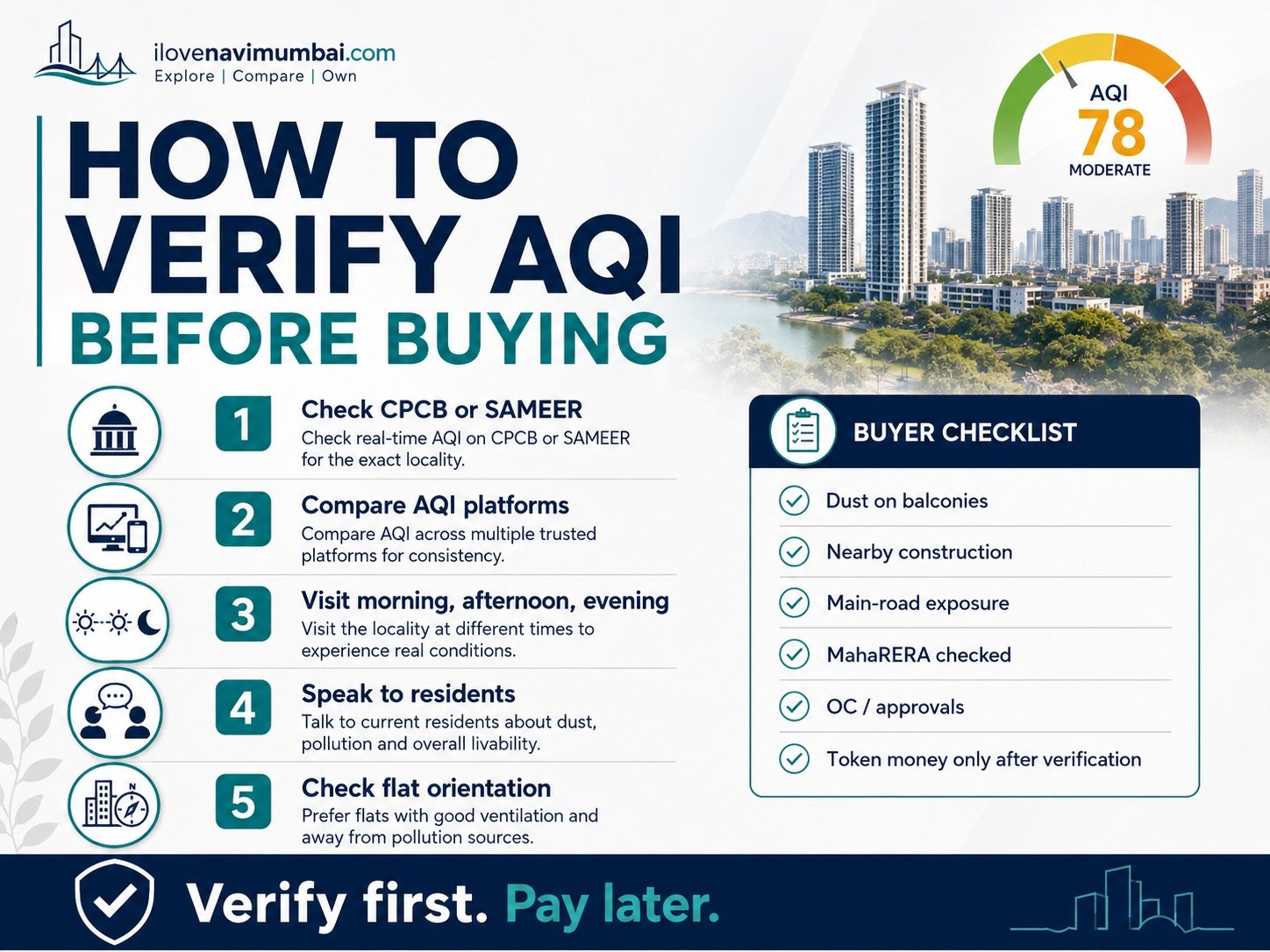
Step 1: Check CPCB or SAMEER
Start with official AQI sources.
Check the nearest available AQI station and city-level AQI.
But remember: the nearest station may not exactly represent your building.
Step 2: Compare With Other AQI Platforms
You can also check AQI.in, IQAir, AccuWeather, or other AQI platforms for additional context.
Use them as supporting references, not final legal or official proof.
Step 3: Visit the Site at Different Times
Visit at least three times:
| Time | What to Observe |
|---|---|
| Morning | School/office traffic, dust settling, smell |
| Afternoon | Construction activity, road dust, heat |
| Evening | Peak traffic, industrial smell, visibility |
If possible, visit once on a weekday and once on a weekend.
Step 4: Speak to Residents
Ask direct questions:
- Does dust enter the home daily?
- Are balconies usable?
- Do people keep windows closed?
- Is there smell from nearby industrial areas?
- Does pollution increase in winter?
- Has the society complained to NMMC, MPCB, or builder?
- Are senior citizens or children facing discomfort?
Residents usually give more practical answers than sales brochures.
Step 5: Check Flat Orientation
Two flats in the same tower can have different comfort levels.
A flat facing a main road, construction site, or industrial side may feel dustier.
A flat facing an internal garden, open space, creek-side view, or lower-traffic side may feel better.
Also connect this with Navi Mumbai Parks and Open Spaces if open-space living is a priority.
Common Buyer Mistakes
Mistake 1: Checking Only City-Level AQI
City-level AQI does not show exact building-level air quality.
Navi Mumbai is large. Vashi, Taloja, Ulwe, Kharghar, Nerul, Airoli, and Panvel do not have the same daily exposure.
Mistake 2: Assuming Premium Price Means Cleaner Air
A costly project can still face dust if it is near a major road or construction belt.
Do not judge air quality by price alone.
Mistake 3: Visiting Only Once
One visit is not enough.
A site can look clean after rain or on Sunday morning.
Visit during real activity hours.
Mistake 4: Ignoring Industrial Wind Direction
If a project is near MIDC or industrial movement, check wind direction and smell during morning and evening.
Odour complaints often appear at specific times.
Mistake 5: Ignoring Senior Citizen and Child Needs
If the home is for elderly parents or children, do not compromise on air quality.
A slightly better micro-location can be more valuable than a bigger clubhouse.
Mistake 6: Trusting Only the Sales Office
Sales teams sell benefits.
Your job is to verify risks.
Always check official data, residents’ feedback, and physical surroundings.
What to Check Before Paying Token Money
Use this checklist before paying token money for a flat, plot, or under-construction property.
| Check | Why It Matters | Status |
|---|---|---|
| CPCB/SAMEER AQI checked | Gives official AQI reference | Pending / Done |
| Site visited during weekday | Shows real traffic and construction activity | Pending / Done |
| Site visited in evening | Helps detect smell, traffic, and dust | Pending / Done |
| Dust on balconies/windows checked | Shows daily exposure | Pending / Done |
| Nearby construction checked | Identifies future dust risk | Pending / Done |
| Nearby MIDC/industrial belt checked | Important for Taloja, Mahape, Rabale, Turbhe, Ghansoli pockets | Pending / Done |
| Main-road exposure checked | Helps assess dust and noise | Pending / Done |
| Residents spoken to | Gives practical living feedback | Pending / Done |
| MahaRERA checked | Verifies project registration and uploaded details | Pending / Done |
| OC / approval status checked | Important for legal possession and safety | Pending / Done |
| Land/title records checked if plot or NAINA property | Important for legal due diligence | Pending / Done |
| Lawyer consulted if unclear | Prevents costly transaction mistakes | Pending / Done |
Do not pay token money only because the price looks attractive. First check the air, surroundings, documents, and authority records.
Conclusion
Before buying a flat, plot, or under-construction property in Navi Mumbai, do not check only price and location.
Check the air you will breathe every day.
Review AQI, visit the site at different times, speak to residents, verify project documents, and understand nearby pollution sources.
If you are comparing projects, the next smart step is to review Builders and Developers in Navi Mumbai and shortlist only those projects where location, documents, approvals, and daily liveability all make sense.
FAQs
Frequently Asked Questions