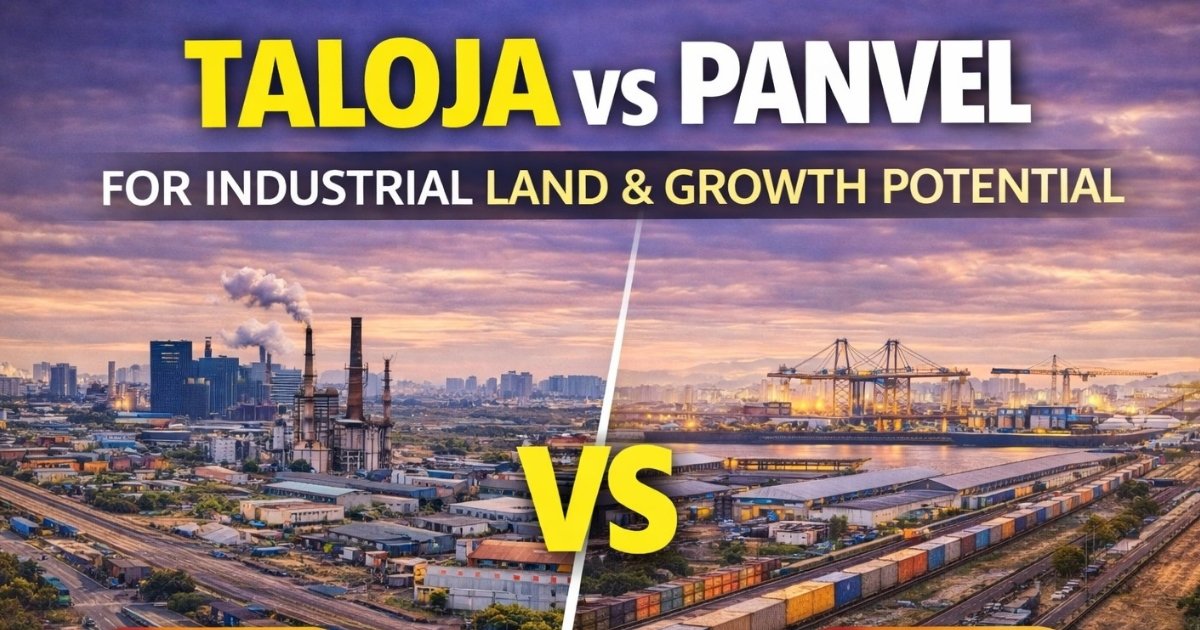
Taloja vs Panvel for Industrial Land and Growth Potential: Which Is Better?
Taloja usually makes more sense for buyers who need an already working industrial ecosystem and land tied to real manufacturing demand. Panvel usually makes more sense for buyers betting on longer-term corridor growth, logistics expansion, and infrastructure-led appreciation. That is the practical answer. But it is not one-size-fits-all. The right choice depends on your use case, holding period, title comfort, and whether you want operational readiness now or future upside with more variation. If you compare Taloja vs Panvel for Industrial Land only on map distance or quoted land rates, you will almost certainly read the market wrong. These are not twin industrial markets. Taloja is a more structured industrial environment with MIDC discipline, industrial history, and operational relevance. Panvel is broader, looser, and more fragmented. It carries bigger corridor logic, but also bigger pocket-level variation. Taloja or Panvel: which is the better bet for industrial land today? For most actual industrial users, Taloja is the better bet today. For many patient investors and logistics-led buyers, Panvel can be the better long-horizon bet. Here is the fast comparison: Factor Taloja Panvel Best fit Manufacturing, engineering, chemical, pharma, industrial users Logistics, cold chain, distribution, patient land investors Current industrial ecosystem Strong and already established Uneven, depends heavily on pocket Growth style Ecosystem-led Infrastructure-led and corridor-led Operational readiness Better for real industry, but with utility stress Better for freight movement in the right belts, but not uniformly ready Title and zoning clarity Usually easier to understand under MIDC structure Requires much deeper plot-level verification Risk type Utility deficits, traffic, MIDC transfer rules Title risk, zoning confusion, wrong-pocket buying Better for short-term passive land banking Usually no More possible, but only with careful legal filtering Better for immediate factory setup Yes, in most cases Only selectively That table alone settles most confusion. Taloja is stronger when you want land that already behaves like industrial land. Panvel is stronger when you are reading the future of the corridor and are willing to accept slower, more complex, more selective upside. Why this is not really a simple location comparison This comparison is not just Taloja versus Panvel. It is also MIDC-regulated industrial land versus a wider mix of CIDCO-side, NAINA-side, and private land situations. That changes everything. In Taloja, the land logic is stricter. MIDC leasehold land comes with clearer industrial intent, clearer regulatory structure, and clearer use expectations. But it also comes with lock-ins, transfer premiums, and a basic message from the authority: use the plot for industry, do not simply sit on it forever. In Panvel, the upside looks wider because the geography is wider. NMIA is operational from December 25, 2025. The Kalamboli junction upgrade is reshaping freight movement. NAINA planning has changed how people think about land. But wider upside does not mean every Panvel-side plot is equally useful for industry. It absolutely is not. So the real question is not, “Which area is better?” The real question is, “Do you want structured industrial land with existing relevance, or flexible corridor-led opportunity with more verification work?” What kind of buyer usually fits Taloja better, and who usually fits Panvel better? Different buyers should not read these two markets in the same way. Buyer type Better fit Why Main caution SME manufacturer Taloja Industrial zoning, existing ecosystem, practical manufacturing relevance Water, power, traffic stress Chemical or pharma unit Taloja CETP-backed industrial ecosystem and red-category relevance Effluent capacity and compliance limits matter Engineering or fabrication user Taloja Easier industrial fit and supplier ecosystem Some older stock may need heavy capex 3PL or e-commerce logistics player Panvel Highway logic, airport-region freight relevance, expansion corridors Entry cost and pocket selection matter Cold chain operator Panvel Broader logistics alignment and future corridor logic Must verify actual land use permissions Patient land investor Panvel No MIDC build-pressure in the same way, more corridor-led appreciation angle Title, zoning, and gestation risk Passive short-term speculator Neither, usually Taloja punishes passive holding; Panvel punishes lazy due diligence Wrong strategy can destroy returns Buyers who usually fit Taloja Taloja fits businesses that need to actually run industry. Manufacturing units, engineering workshops, process industries, chemical users, and pharma-linked occupiers usually understand the value of an ecosystem where industrial activity is normal, approvals are industrial in character, and surrounding land use supports operations. This matters more than many buyers admit. A cheap plot with a big future story is not useful if your business needs to start real industrial activity in a reasonable timeline. Buyers who usually fit Panvel Panvel fits people who are reading freight, corridor growth, and land optionality. That includes logistics operators, distribution-led businesses, land bankers, and investors who are comfortable waiting through infrastructure gestation and doing deep legal checks before buying. Panvel also fits those who do not need a heavy industrial setup from day one. Clean assembly, packaging, storage, and network-led business models can align better here than chemical or effluent-heavy industry. Buyers who should slow down before choosing either If you are not prepared for plot-level due diligence, both markets can punish you for different reasons. In Taloja, the mistake is assuming you can treat MIDC land like passive land banking. In Panvel, the mistake is assuming all land near a big infrastructure story is industrially valuable. Neither assumption is safe. If the goal is actual industrial use, which side makes more sense? For actual industrial use, Taloja usually wins. Existing industrial ecosystem and surrounding use pattern Taloja already has the industrial identity many occupiers want. The ecosystem is not theoretical. It is built around working industrial plots, established plant activity, and a long industrial track record. That reduces one major uncertainty: whether the surrounding area truly supports industrial use. Panvel, by contrast, is much more mixed. Some pockets can work very well for logistics and light operational use. But Panvel as a whole should not be read as a ready-made industrial zone in the same way. Manufacturing, processing, warehouse, and yard suitability Taloja is stronger for manufacturing, chemical processing, pharma, fabrication, and engineering-linked users. It
Read More