
NAINA City (Navi Mumbai Airport Influence Notified Area) – 2025 Update
NAINA = Navi Mumbai Airport Influence Notified Area. It is a large, planned urban region around the Navi Mumbai International Airport (NMIA), with CIDCO as the Special Planning Authority since 2013. The notified footprint evolved from ~560 km² (270 villages) to ~372 km² (174 villages) and, after 2023 handovers, to an active core of ~226 km² (94 villages). Development is being executed via 12 Town Planning Schemes (TPS) using a 60:40 land pooling model that returns 40% serviced plots to landowners with FSI up to 2.5.
2025 pivot: With Atal Setu (MTHL) and Metro Line-1 operational, and NMIA nearing launch, CIDCO has initiated a Comprehensive Mobility Plan (CMP) to 2054 and floated tenders for a 667-acre Navi Mumbai Aerocity. Execution is moving from plans to on-ground infrastructure (roads, utilities, tenders across multiple TPS).
At a Glance

What is NAINA? A planned region around the new international airport at Navi Mumbai, managed by CIDCO since 2013 to steer growth into a sustainable, well-serviced urban expansion rather than unplanned sprawl.
Initial vs. current footprint:
- ~560 km² / 270 villages (2013) → ~372 km² / 174 villages (post-2020) → ~226 km² / 94 villages (2023) after transfers to other agencies.
Villages & talukas: Concentrated in Raigad district—primarily Panvel with a couple in Uran. Early drafts had parts of Pen, Karjat, Khalapur; these were later excluded.
Land pooling: 60:40 model—CIDCO retains ~60% for roads/amenities and monetization, returns 40% as serviced plots to original owners with FSI up to 2.5.
Key corridors: Atal Setu (MTHL), Multi-Modal Corridor (MMC), JNPT, Suburban Rail, and Navi Mumbai Metro frame NAINA’s accessibility.
Latest policy thrust (Aug–Sep 2025):
- CMP to 2054 initiated to stitch together airport, Aerocity, metro extensions, and regional roads into one network.
- Aerocity master plan tender floated for ~667 acres to fast-track a business+hospitality hub at NMIA’s doorstep.
In short: NAINA is making the jump from paperwork to pavements.
Latest Update (Aug–Sep 2025)

Comprehensive Mobility Plan (CMP) – Initiated 31 July 2025
What it is: A long-horizon, integrated transport strategy for Navi Mumbai + NAINA planning to 2054.
What it covers:
Current and future mass transit (metro extensions toward NMIA; proposals that link airport, Aerocity, corporate parks, and education/innovation clusters).
Road hierarchy upgrades, last-mile connectivity, cycling/walking networks.
Regional coordination with MMRDA, suburban rail, and the planned Multi-Modal Corridor.
Why it matters: Unlocks federal/state funding for big-ticket transit and aligns private development with public infrastructure. Residents welcome the intent while urging lessons from past delays—e.g., Navi Mumbai Metro Line‑1’s long gestation—are embedded in execution.
Aerocity Master Plan – Tenders Floated (Aug 2025)
What’s proposed: A ~667‑acre mixed-use district next to NMIA—hotels, corporate offices, convention venues, retail avenues, logistics-adjacent uses, and lifestyle amenities—often called an aerotropolis.
Planning approach: Consultant-led master plan, zoning for business, logistics, recreation, and residential pockets; PPPs and land monetization envisaged for phasing.
Why it matters: Creates an immediate economic engine tied to the airport; complements NAINA’s residential and institutional clusters.
Navi Mumbai Metro Line‑1 – Operational (since 17 Nov 2023)
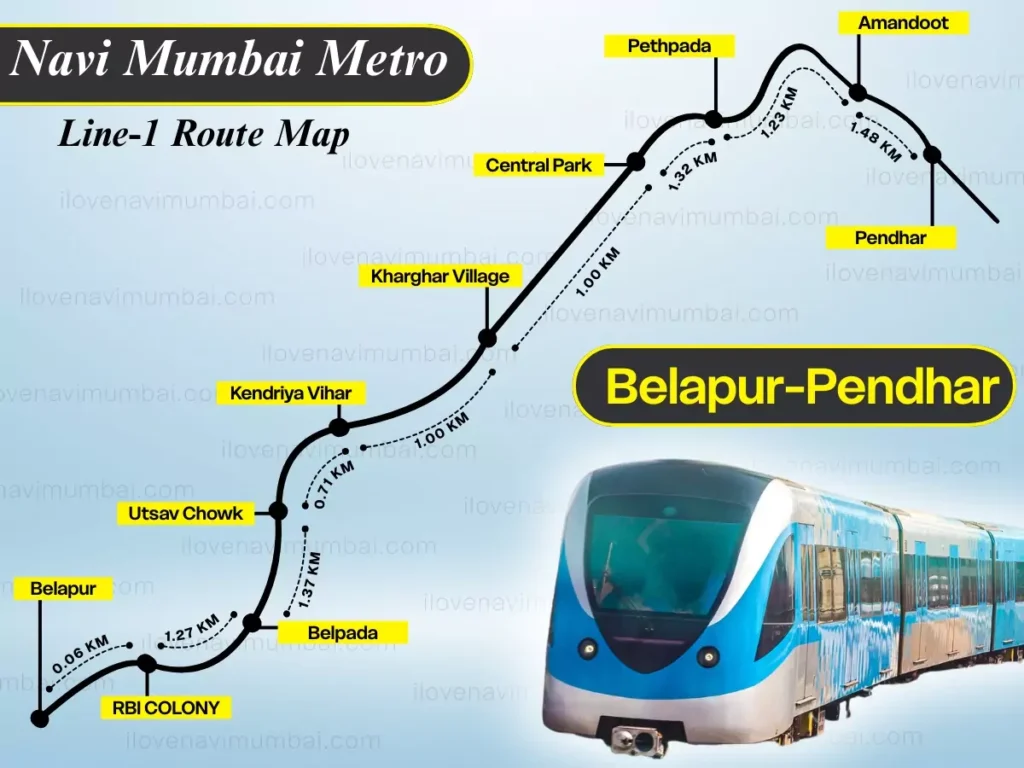
Line: Belapur – Kharghar – Taloja – Pendhar (~11.1 km).
Implications for NAINA: Brings rapid transit adjacent to NAINA’s core, with planned extensions toward Khandeshwar/NMIA improving airport catchment connectivity and catalyzing development in Kharghar–Taloja.
Atal Setu (MTHL) – Opened (12 Jan 2024)
Bridge: 21.8 km sea link—the country’s longest.
Travel-time impact: South Mumbai ↔ Navi Mumbai in roughly 20–30 minutes under typical conditions.
NAINA effect: Direct linkage to the third-Mumbai growth belt is already spurring land interest and early project pipelines near interchange zones.
NMIA – First Phase Timing
Status: Terminal works in finishing stages; runway and airside systems largely ready.
Target window (as discussed publicly in 2024–25): From an initial Dec 2024 aspiration, the first flights are widely expected in 2025—with milestones and trial regimes steering exact dates.
Relevance: NMIA is the anchor that sequences roads, utilities, and land release inside the TPS areas; multiple tenders and on-ground works are clustered to meet the airport-ready horizon.
Change log: Updated Sep 2025 with CMP launch and Aerocity plan; corrected metro status to “operational”; expanded land pooling details with a worked example; added a timeline of area changes.
What is NAINA and why was it created?

NAINA stands for Navi Mumbai Airport Influence Notified Area, a planned region surrounding NMIA, created to prevent haphazard growth and channel development into serviced neighborhoods with proper roads, utilities, and civic amenities. The Government of Maharashtra notified NAINA in Jan 2013, appointing CIDCO as Special Planning Authority (SPA).
The Longer Story (In Plain Language)
Large infrastructure like international airports are magnets for unplanned construction. Without a framework, settlements crop up around access roads, wetlands get filled, and services lag, creating future slums and bottlenecks.
The state anticipated this risk and notified ~560 km² as a controlled planning zone around the upcoming NMIA. Rather than acquiring every parcel, the idea was to pool land, re‑lay it into a street-and-amenities grid, and return serviced plots to original owners, so villagers become partners in city-building, not bystanders.
NAINA is not a separate municipality. It’s a planning jurisdiction under CIDCO, similar to how Navi Mumbai’s nodes were created in the 1970s. Over time, as population consolidates, municipal management may align with Panvel Municipal Corporation or other urban bodies, but the founding blueprint comes from CIDCO’s layouts, regulations, and TPS awards.
Because of its scale and purpose, people often call it “Third Mumbai”, envisioned as a relief valve to the first two (Mumbai and Navi Mumbai), built with modern infrastructure, institutional zones, and transit-first planning.
How big is NAINA today—and why do figures vary?
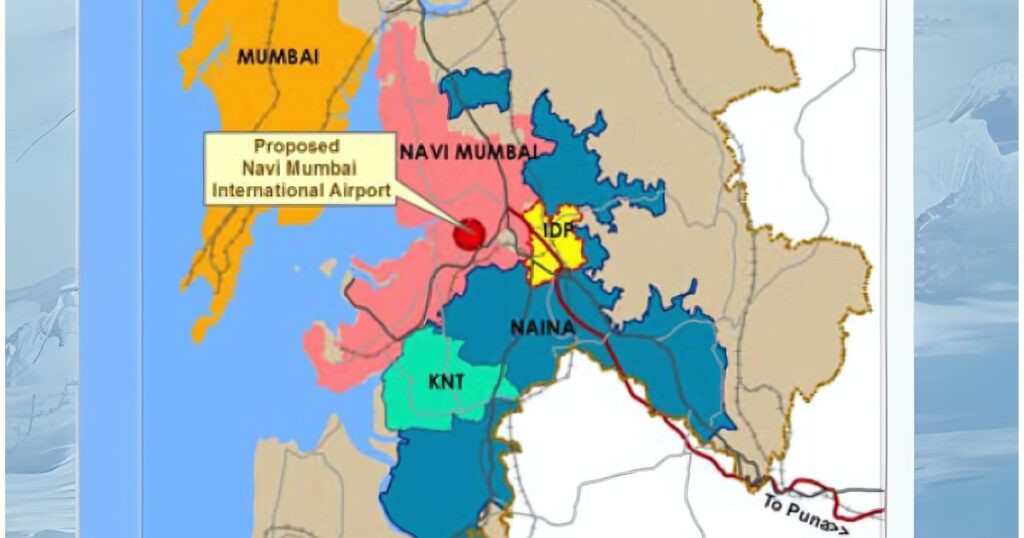
The area changed in phases as jurisdictions were re-assigned:
2013: ~560 km², 270 villages (initial notification).
2017–2020: scope trimmed; 174 villages / ~372 km² became the core planning footprint.
Mar 2023: 80 villages moved to MMRDA and the separate Khopta New Town (33 villages) assigned to MMRDA → ~226 km² / 94 villages under CIDCO’s NAINA focus today.
Timeline With Context
2013 – Initial Notification.
The government notified 270 villages totaling roughly 556–560 km² under NAINA. Most were in Raigad district (Panvel, Uran, Karjat, Khalapur, Pen) with 14 villages in then‑Thane (now in MMR). The intention was to draw a wide ring around the airport to prevent piecemeal, permit-led growth.
2017–2018 – Scope Reduction.
As parallel state projects (such as the Multi‑Modal Corridor) took shape, some villages were placed under MSRDC/MMRDA planning to streamline execution. Media and official notes from this period cite ~224 villages / ~474 km² at one point, and by 2020 a refined NAINA core of ~372 km² / 174 villages.
2020 – Interim Development Plan (IDP).
CIDCO prioritized 23 villages (~36.8 km²) nearest Panvel/NMIA for early works through Town Planning Schemes (TPS). The broader 174‑village plan remained the long-horizon frame.
Mar 2023 – Handover to MMRDA.
To coordinate MTHL (Atal Setu) landing zones and adjacent corridors, 80 villages were shifted to MMRDA. The separately proposed Khopta New Town (33 villages) also moved to MMRDA, leaving 94 villages under NAINA (almost all Panvel, with two in Uran). The active planning area commonly cited since: ~225–230 km².
Why it matters: When reading about NAINA, always check the date and phase. A 2014 “560 km²” story describes the original envelope; a 2024 or 2025 note likely refers to the ~226 km² core. For buyers and residents, this difference is practical—it signals where CIDCO is actually laying roads and issuing permissions now.
How the 60:40 Land Pooling & FSI Work (With a Simple Calculator)
NAINA uses a land pooling model: landowners contribute their land; CIDCO returns 40% of that as a serviced, build‑ready plot and retains 60% for roads, utilities, open spaces, and saleable plots to fund infrastructure. Returned plots get FSI up to 2.5, allowing landowners to build more floorspace than they could before—often equaling or exceeding what the entire original holding could have permitted at low FSI.
The Mechanics—Step by Step
Eligibility & Grouping.
Early policy iterations set a minimum contiguous parcel (e.g., 10 hectares) for pooling eligibility. Owners below this threshold can form groups and pool collectively. Discussions to flex this threshold have occurred to include smaller owners.
Pooling (No Cash Compensation Upfront).
Owners sign consent agreements under the TPS. Land is reconstituted (not sold), so there’s no upfront cash from CIDCO. Compensation is the serviced land returned, which can be self-developed, sold, or JV‑developed.
60% to Public Purpose & Monetization.
CIDCO uses ~45% of total pooled land for on-ground infrastructure (roads, drains, water/sewer plants, substations, schools/health/parks). Around ~15% becomes saleable plots to raise funds for these works.
40% Back as Serviced Plots.
Owners receive 40% of their original area as freehold, buildable plots within the new layout—ideally near their original lands—with roads and utilities in place.
FSI Uplift (Up to 2.5).
Returned plots carry higher FSI than earlier rural caps, enabling mid‑rise to high‑density typologies depending on sub‑zone and regulations.
A Worked Example (Keep this handy)
You contribute 10,000 m² to pooling.
You get 4,000 m² back as a serviced plot (40%).
With FSI 2.5, you can build 10,000 m² of floorspace.
Interpretation: Even after giving up 60% land, your buildable area equals the entire original parcel at 1.0 FSI—with better marketability because the plot sits in a planned city grid with roads, drainage, water, and power.
Concerns & Responses (From the Ground)
Livelihoods: Farmers worry about losing agricultural continuity. Response: higher land value, urban‑use viability, and assurances around gaothans and compensation where required.
Financing Construction: Not everyone can exploit FSI 2.5 alone. Response: JV models with developers, staggered phases, or sale of part/whole plot.
Fairness: Fear that the state “invests nothing” while residents part with land. Response: cross‑subsidy via monetization of 15% saleable plots plus public works fund the whole city framework; gaothans remain protected; reservations on original land do not reduce the 40% entitlement.
Bottom line: The model works if infrastructure really arrives and permissions flow. 2023–25 tenders and on‑ground works are, for many villagers, the first visible proof that NAINA is moving beyond maps.
Which Villages Are In—and How They’re Organized (12 TPS)
After 2023 revisions, NAINA = 94 villages in Panvel (Raigad) plus two in Uran. Development is sequenced via 12 Town Planning Schemes (TPS). TPS‑1 to TPS‑4 are final‑sanctioned; TPS‑5 to TPS‑7 are in arbitration/finalization; TPS‑8 to TPS‑12 are in draft/arbitration stages.
Why TPS?
NAINA’s scale is too large to build at once. TPS breaks it into manageable clusters (3–10 villages each), allowing CIDCO to:
Lay arterial roads and backbone utilities in phases.
Engage village groups in design and objections.
Monetize stepwise, aligning private investment with public works.
Status by Scheme (Bird’s-Eye View)
TPS‑1 – Akurli, Belavali, Chikhale
Status: Final Scheme Sanctioned; infrastructure underway; final award (2020).
TPS‑2 – Vihighar (part), Devad (part), Chipale (part), Belavali (part), Sangade (part)
Status: Final Scheme Sanctioned; land reconstitution complete; road tenders floated.
TPS‑3 – Koproli, Vihighar, Chipale, Nere & Nerepada, Moho
Status: Final Scheme Approved; implementation initiated; sanctions by 2023.
TPS‑4 – Adai, Akurli, Pali (Devad), Newale/Nevali, Shilottar‑Raichur
Status: Final Scheme Approved; interim works prioritized due to pressure near Panvel/New Panvel; final awards in late 2023.
TPS‑5 – Bonshet, Vichumbe, Moho (part), Bhokarpada, Devad (remaining), Shivkar
Status: Draft Sanction; Arbitrator appointed; hearings ongoing (2023–25).
TPS‑6 – Chikhale (remaining), Moho (remaining), Shivkar, Pali Khurd
Status: Draft Sanction; under arbitration/final award; owners’ meetings held.
TPS‑7 – Devad (remaining), Vichumbe, Usarli Khurd, Kolkhe, Shivkar (part)
Status: Draft Sanction; preliminary award stage; arbitration in process.
TPS‑8 – Pali Khurd (part), Moho (part), Chikhale (part), Belavali (part)
Status: Draft Prepared; arbitration hearings running into 2025.
TPS‑9 – Belavali (remaining), Borle, Sangade, Kon, Chikhale (remaining)
Status: Draft Prepared; arbitration announced for 2024–25.
TPS‑10 – Kon (remaining), Chikhale, Shivkar (remaining), Kolkhe (remaining), Deravali
Status: Draft Prepared; Arbitrator appointed (2024); hearings active.
TPS‑11 – Palaspe, Shirdhon, Nandgaon, Vadavali, Kudave, Turmale, Deravali (remaining)
Status: Draft Prepared; objections heard; arbitration ongoing (late 2023 onward).
TPS‑12 – Kondale, Vakadi, Morbe, Umroli, Usarli BK, Mahalunge, Ritghar, Chinchavali (Waje)
Status: Draft Published; state sanction in process (from Mar 2024).
Note: Villages often split across multiple TPS (e.g., Chikhale appears in 1, 6, 8, 10). TPS‑1 to 4 abut existing urban nodes (Panvel, Karanjade, New Panvel) and moved faster; outer rings feature in TPS‑8 to 12.
How This Plays Out on the Ground
Sequence: Early TPS bring arterials and trunk utilities. Then internal streets, storm drains, and plot demarcations follow.
Readiness: By late 2024/2025, CIDCO reports tendering and works for multiple TPS (roads, drains, water, power ducts).
Owner Interface: CIDCO hosts owners’ meets and arbitration sessions TPS‑wise. Your TPS number dictates when survey, allocation letters, and possession of serviced plots occur.
What’s New in 2025 (CMP, Aerocity, NMIA Timelines) – Why It’s a Pivot Year
CMP 2054: Long-term mobility blueprint aligning airport, Aerocity, metro, MMC, expressways, and last‑mile across Navi Mumbai + NAINA.
Aerocity Tender: ~667 acres next to NMIA for corporate, hospitality, convention, retail, and lifestyle districts.
MTHL Open; Metro Running: Atal Setu (Jan 2024) and Metro Line‑1 (Nov 2023) have changed accessibility math.
NMIA: First-phase operations targeted for 2025, sequencing TPS works to airport readiness.
The Details That Matter
Airport as Catalyst. Once airside and terminal crossover into trials and soft ops, all surrounding infrastructure, from approach roads to utility corridors, presses for completion. NAINA’s nearer TPS are synced to that timeline.
CMP as the Glue. A strong CMP prevents NAINA from becoming a car‑dependent sprawl. Expect metro/bus priority, feeder networks, interchange hubs, and non‑motorized corridors to be hard‑wired into layouts.
Aerocity as the Job Market. Offices, hotels, convention centers, and aviation‑linked industries can seed employment right by the runway. That creates day‑one demand for housing, retail, and services in adjoining TPS zones.
MTHL’s New Geography. With 20–30 minute South‑Mumbai access on good days, investors recalibrate what “too far” means. Areas around MTHL interchanges and NH‑4/Old Mumbai‑Pune Highway junctions emerge as hotspots.
Historical MoUs & The Reality Check (2016 vs. Now)
Then: During Make in India (Feb 2016), CIDCO signed 11 MoUs ~₹30,000 crore for NAINA, which included townships, logistics hubs, and more. Big names included Wadhwa, Marathon, Paradise, and others.
Now: Many of those were intentions, contingent on planning milestones. The true pipeline in 2024–25 is being set by TPS sanctions, CIDCO auctions/allotments, and private aggregation aligned to airport/MTHL timelines. Treat 2016 MoUs as context, not commitments.
Real Estate Opportunities & Outlook (2025-2030)
Where Value May Emerge First
Airport Arc: Plots close to NMIA and Aerocity edges, where access roads and utilities come first.
MTHL Influence Zone: Land near interchanges and corridors feeding into Atal Setu.
Metro‑Proximate: Extensions toward Khandeshwar/NMIA that shorten commutes.
Institutional Clusters: Edu‑City, Medi‑City, Innovation/Knowledge hubs, when notified, can anchor surrounding housing demand.
Typologies to Expect
Residential: From affordable (via CIDCO schemes) to private mid‑segments and townships; plotted redevelopment in serviced grids.
Commercial/Industrial: Warehousing, SME parks, e‑commerce logistics (leveraging JNPT and freight corridors), corporate offices in Aerocity.
Mixed‑Use: High‑street retail plus residential towers in metro‑connected micro‑centers.
Green & Blue Infrastructure
Open space reserves and amenity ratios in IDP/TPS can deliver parks, playgrounds, and urban forests.
Wetlands/hills buffers near areas like Karnala create scope for eco‑recreation if plans are enforced.
Market Signals (Cautious Optimism)
Price Movement: Agricultural plots that were ₹50–₹60/sq.ft a decade ago are reported ₹200+/sq.ft in some belts post‑MTHL and TPS sanctioning. Post‑NA conversion and possession, serviced plots may see step‑ups.
Absorption Hinges on Jobs: As analysts note, a city is not just roads; employment nodes must come early. That’s why Aerocity and corporate parks matter.
Execution Pace: 5–6 years for first mature pockets is realistic; outer rings follow into the early 2030s.
Investor takeaway: Align with TPS status, verify CIDCO approvals, and prefer plots with clear reconstitution and utility timelines over speculative raw tracts.
Smart‑City Amenities: Automation, IoT Homes, Renewables & EV Charging
Why this matters now: As NAINA shifts from plan to pavement, early decisions about utilities and building systems will lock in operating costs and quality of life for decades. The smart‑city layer is not a gimmick, it’s the invisible infrastructure that makes a young city livable from day one.
City Operating System (City‑OS) & Digital Twin
Integrated Command & Control: A central nerve‑centre to monitor water pressure, power load, traffic flow, rainfall intensity and flood risk, integrating feeds from pumps, substations, STPs, CCTV, and emergency services.
GIS‑first planning: Every road, drain, plot, tree and utility mapped; work orders and maintenance tracked against this “single source of truth.”
Digital twin: A live simulation model to test scenarios—e.g., where to place an extra feeder bus, how a new flyover changes queue lengths, or how a 150 mm rainfall event will behave in a given basin.
IoT Homes & Smart Buildings
Smart meters (electricity + water) with app dashboards; time‑of‑day tariffs nudge off‑peak usage.
Leak detection & shut‑off valves prevent water loss in towers and row houses; alerts trigger within minutes rather than days.
Smart HVAC & IAQ (indoor air quality): CO₂ sensors in lobbies/classrooms, variable‑speed ventilation to save energy while keeping spaces healthy.
Access control (RFID/QR), visitor logs, EV‑bay access, and fire‑stairwell door monitoring for safety compliance.
Renewable Energy & Storage
Rooftop solar on public buildings, schools and housing societies; net‑metering for common‑area loads.
Battery energy storage at sub‑stations and large campuses to shave peaks and provide backup during grid faults.
Solar‑ready guidelines: Standardized mounting, conduit pathways, inverter rooms, and fire safety clearances baked into building bylaws to reduce retrofit cost.
EV Ecosystem: Chargers, E‑Buses, Last‑mile
Public fast chargers at town centres, metro stations and Aerocity parking structures; slow/AC chargers on every society block (1 for ~10–15 parking bays in early phases).
Depot chargers for e‑buses and municipal fleets; priority lanes on certain corridors to make transit faster than private cars for common trips.
Smart tariffing: Lower rates overnight to encourage off‑peak charging; roaming and UPI billing.
Water, Waste & Flood Resilience (Blue‑Green City)
Dual plumbing in large buildings: STP‑treated water for flushing and landscaping; SCADA monitors plant performance.
Source segregation with MRFs (material recovery facilities) per TPS; organic waste to biogas/compost; dry waste to recycling supply chains.
Storm‑water design using bio‑swales, detention ponds and permeable paving; lake rejuvenation with measured spillways to absorb cloudbursts.
Safety, Privacy & Civic Tech
CCTV with privacy‑by‑design: Anonymized analytics for traffic counts and crowding; strict data retention and access controls.
Emergency call‑boxes and AEDs at parks and transit hubs; women‑safety corridors with better lighting and patrol frequency.
Open data (non‑personal) for mobility, air, water and waste dashboards so residents can hold the system accountable.
Housing Segmentation: From Affordable to Luxury (and Who Buys What)
NAINA will not be a one‑product market. Different precincts and timelines create multiple, parallel housing stories.
Affordable & Attainable Housing (EWS/LIG/MIG)
Who it suits: First‑time city entrants, municipal employees, service staff, gig‑economy workers.
Formats: 1RK, compact 1BHK/2BHK in mid‑rise blocks, often in walkable distance of bus or metro feeders.
Policy hooks: Allotments/auctions under CIDCO norms; cross‑subsidy via mixed‑income projects; rent‑to‑own pilots are plausible as the market matures.
Mid‑Market Family Apartments
Who it suits: Navi Mumbaikars upgrading from older stock; families prioritizing schools, parks, and commute time.
Formats: 2BHK/3BHK with clubhouses, society offices, daycare spaces; EV‑ready parking and rooftop solar become standard USPs.
Student Housing & Co‑Living (Edu‑City Edge)
Why it matters: Education clusters drive year‑round occupancy.
Formats: Managed hostels, studio apartments, and co‑living with furnished rooms, shared kitchens, high‑speed internet, study lounges.
Upside: Typically higher gross yields vs. family rentals; operator quality is key to avoid churn.
Senior‑Living & Assisted‑Care
Demand drivers: Quieter environment, medical access, barrier‑free design, social programming.
Formats: Age‑friendly 1.5/2BHKs with elevators, railings, panic buttons, on‑call nursing; community kitchens and hobby clubs.
Premium/Luxury Living
Where likely: Aerocity‑adjacent grids and metro‑proximate ridges with views/green buffers.
Formats: Larger 3–4BHKs, penthouses, low‑density villa streets; concierge, wellness spas, private work‑lounges.
Rental Yield—Quick Orientation
Emerging‑node family rentals: often ~3–4.5% gross initially, improving as social infra fills in.
Student/co‑living: ~5–8% gross with professional operators and high occupancy.
Senior‑living (leased): ~4–6% gross, stable tenures; service quality drives renewals.
Tip: Yield improves with walkability, transit proximity, compact layouts, and furnishing (for students/young professionals).
Named Developers & Investment Landscape (Indicative)
Context, not endorsement: In 2016, large MoUs signalled intent—e.g., Wadhwa, Marathon, and others explored township/industrial footprints in the broader NAINA belt. In the Navi Mumbai–Panvel market, players such as Space India (budget/mid‑market focus in and around Panvel/Karjat belts) and MJ Realty have been active historically.
Today’s reality: Participation in NAINA TPS plots depends on CIDCO’s auctions/allotments, title clarity, and infrastructure phasing. Expect a diverse mix—from township specialists to niche co‑living and senior‑care operators—once successive TPS final awards translate into build‑ready land banks.
Always verify: Current approvals, plot provenance (returned 40% vs CIDCO‑saleable), and execution track record before treating any brand as a signal of project certainty.
Retail & Entertainment Hubs (Malls, Multiplexes, High‑Streets)
Aerocity Retail Spine
What to expect: Airport‑linked retail streets, hospitality clusters, flagship showrooms, MICE‑friendly dining.
Formats: Mixed podiums with multiplexes, food courts, experiential retail (kids’ edutainment, esports arenas), and rooftop leisure.
TPS Town Centres
Neighbourhood high‑streets at each TPS, anchored by supermarkets, clinics, bakeries, pharmacies, and casual dining.
Weekly haats & night markets: Designated plazas with utilities (power, water, sanitation) for pop‑ups and cultural fairs.
Entertainment & Culture
Multiplex norms integrated into DCPR, acoustically treated; performing arts black‑boxes for local theatre and school events.
Open‑air amphitheatres in parks for concerts, film screenings, and festival gatherings.
Education & Healthcare: Why Families Will Prefer NAINA
Schools & Colleges
Education clusters with sites reserved for K‑12, junior college, professional institutes (engineering, design, hospitality), and research centres.
Safe access: Wider sidewalks, zebra crossings, speed‑calming near school zones; school buses integrated with City‑OS route planning.
Healthcare Network
Hospitals: Multi‑speciality and mother‑and‑child hospitals sited near arterials; trauma‑care golden hour planned via e‑ambulance routing.
Primary care: Polyclinics, diagnostics and pharmacies within a 10–15 minute walk/cycle of most homes; tele‑health kiosks at community centres.
Family Quality‑of‑Life Hooks
Parks and playgrounds within short walking radii; clean air from green buffers; predictable commutes via metro/bus priority.
After‑school life: Libraries, sports coaching, arts workshops; safe routes encourage independent mobility for teens.
Green Parks & Leisure: Central Park Concept & Everyday Recreation
Central Park‑scale greens in early TPS, with lawns, botanical groves, themed gardens and lily‑ponds doubling as storm‑water detention.
Walking & cycling loops: Continuous shade trees, drinking fountains, repair stations; loops connect town centres, schools and lakes.
Sports districts: Multi‑sport arenas, synthetic tracks, futsal/basketball courts, skating bowls; community bookings via app.
Lakefront promenades with non‑motorised boating where ecologically safe; bird‑watch towers at wetlands with protected buffers.
Urban forestry: Miyawaki patches on awkward parcels and utility ROWs to reduce heat‑island effect.
Social & Cultural Fabric: The People Make the Place
Festivals: Ganeshotsav, Navratri, Eid, Christmas melas—designed plazas with power/water points and noise‑control windows so celebration and sleep can coexist.
Community centres: Reading rooms, senior clubs, maker‑spaces; weekend classes (music, coding, dance) with subsidised slots for local youth.
Multicultural mix: Original Raigad village communities blending with professionals, students and entrepreneurs; food streets celebrate this diversity.
Civic volunteering: Lake clean‑ups, tree drives, blood donation camps; society apps double as notice‑boards for such initiatives.
Challenges (Explained Simply)
1) Land
What’s hard: Many small parcels, inheritance disputes, and boundary overlaps.
Why it slows things: Re‑plotting needs clear titles and consent; arbitration takes time.
What helps: Early title clean‑up, group pooling, and transparent award calculations everyone can check.
2) Environment
What’s hard: Wetlands, mangroves, floodplains and hills need protection; CRZ/forest permissions are precise and slow.
Why it matters: Shortcutting nature backfires—floods, heat, and poor water quality.
What helps: Blue‑green design, enforce buffers, monitor with sensors, and publish data.
3) Labour & Skills
What’s hard: Large projects need steady worker housing, safety oversight, and skilled trades.
Why it matters: Without it, costs spike and timelines slip.
What helps: On‑site dorms with sanitation, skill‑training tie‑ups, digital muster and safety audits.
4) Governance & Coordination
What’s hard: Multiple agencies (CIDCO, MMRDA, PWD, utilities) must align.
Why it matters: Misaligned projects dig up the same road twice.
What helps: CMP as the master schedule; one window for clearances; shared GIS.
5) Affordability & Inclusion
What’s hard: If homes get too pricey too soon, workers live far away.
Why it matters: Long commutes hurt productivity and family life.
What helps: Mixed‑income mandates near jobs and transit; rental housing and dorms in town centres.
Rental Opportunities (SEO: NAINA rental returns / yield)
Where the Rentals Work Best
Airport & Aerocity Arc: Business travellers, aviation staff, and MICE demand.
Metro‑adjacent Micro‑markets: Short commutes for young professionals; reliable occupancy.
Edu‑City Perimeter: Students, visiting faculty, exam‑coaching cohorts.
Logistics & SME Belts: Shift workers prefer walk‑to‑work rentals and co‑living.
Indicative Gross Yield Bands (Residential)
Family 1/2BHK near transit: ~3.0–4.5% initially; can rise as schools/retail mature.
Furnished co‑living/studio: ~5–8% with strong operators and >90% occupancy.
Senior‑friendly apartments (leased): ~4–6% with stable tenures and services.
Note: These are directional ranges seen in comparable, early‑stage urban extensions. Actuals depend on micro‑location, unit size, furnishing, and society fees.
Simple Pro‑Forma (Illustrative)
Buy price: ₹60 lakh (compact 1BHK in a metro‑adjacent TPS)
Monthly rent (furnished): ₹22,000
Annual rent: ₹2,64,000
Society + maintenance: ₹36,000/yr
Property tax + insurance: ₹12,000/yr
Net before vacancy: ₹2,16,000
Assume 5% vacancy/repairs: ₹10,800
Net: ₹2,05,200 → ~3.4% net (before financing).
How to lift yield:
Prioritise walkability and transit over carpet alone.
Offer furnished units with Wi‑Fi; target students/young pros.
Keep compact plans (450–650 sq ft 1BHK) to optimise rent per lakh invested.
Explore co‑living tie‑ups for guaranteed occupancy.
Risks to Watch
Over‑supply in a single product (e.g., too many studios in one block).
Amenity lag delaying tenant uptake—bridge this with shuttle services and society‑run basics.
HOA restrictions on short‑term rentals—read society by‑laws before purchase.
Practical Guide: Buying, Verifying, and Timing
1) Title & TPS Reality Check
Confirm the TPS number, stage (Draft/Final), and whether the plot is a returned 40% or a CIDCO‑auctioned parcel.
Cross‑verify plot codes against CIDCO TPS maps and award documents.
2) Permissions & Plans
Building approvals in NAINA are under CIDCO—not Gram Panchayats.
Ask for Commencement Certificates (CC), IOD, Layout Sanctions, and any NOC dependencies (forest, CRZ, aviation where relevant).
3) Infrastructure Phasing
Read tender notices for roads, drains, water, power ducts in your TPS. Possession of a plot is meaningful when approach roads and utility connections are time‑bound.
4) Financing Strategy
If you can’t build to FSI 2.5 alone, structure JVs, phased wings, or sell a portion.
For retail buyers, prefer projects with live permissions and visible site works.
5) Red Flags
“Too early” resales of agricultural land that assume a future 40%—without clear TPS math.
Non‑CIDCO approvals presented for buildings inside NAINA.
Inconsistent village listings—remember, some villages moved to MMRDA.
What 2027–2030 Might Look Like (Scenarios)
Scenario A – On‑Schedule Airport + Aerocity + Metro Extensions
Aerocity lights up with first hotels and offices; metro feeder and express bus lines knit TPS‑1 to TPS‑4; first large residential clusters get OC; resale and rentals stabilize; schools and clinics open within walking or cycling distance.
Scenario B – Airport Opens; Transit Lags
Car‑dependence spikes; arterial congestion around interchanges; early buyers push for CMP acceleration; developers pivot to phased amenity delivery inside townships as a stop‑gap.
Scenario C – Phased but Steady
Mixed signals each year, but TPS‑by‑TPS upgrades keep momentum. By 2030, a recognizably new urban expanse sits south‑east of Navi Mumbai—still growing, but livable in multiple pockets.
Appendix: Land Pooling—Pocket Calculator
Input: Your land area in m².
Returned serviced plot: Area ÷ 2.5
Permissible floorspace (FSI 2.5): Returned area × 2.5
Example: 1,000 m² in → 400 m² out → 1,000 m² buildable.
Closing Note
For years, NAINA lived on maps and in committee rooms. 2025 is different. Bridges and metros are running. Airport gates are coming into view. Tenders for roads and drains are translating drawings into asphalt and concrete. Villagers are seeing survey markers and hearing arbitrators’ awards.
This is the messy, vital middle—where visions meet backhoes. If CIDCO keeps the CMP honest, aligns Aerocity and TPS timelines, and keeps faith with original landowners, the third Mumbai can take shape not as a slogan, but as a city that works.
FAQs
Frequently Asked Questions
What is NAINA, and why was it created?
What is the NAINA land pooling scheme, and how does it benefit landowners?
What infrastructure developments are planned under NAINA?
Disclaimer: This Information are as per different reports, our opinions or views are not expressed in this blog.



Ram Krishna Panigrahi
November 23, 2025 at 12:32 pmI want to invest one 2BHK flat,
Please send details area of flats and payment conditions
Mukund Choudhary
November 27, 2025 at 12:20 pmSorry, but we don’t hold the authority to advice about real estate investment. Also, we don’t hold the exact information of the flats and payment conditions.