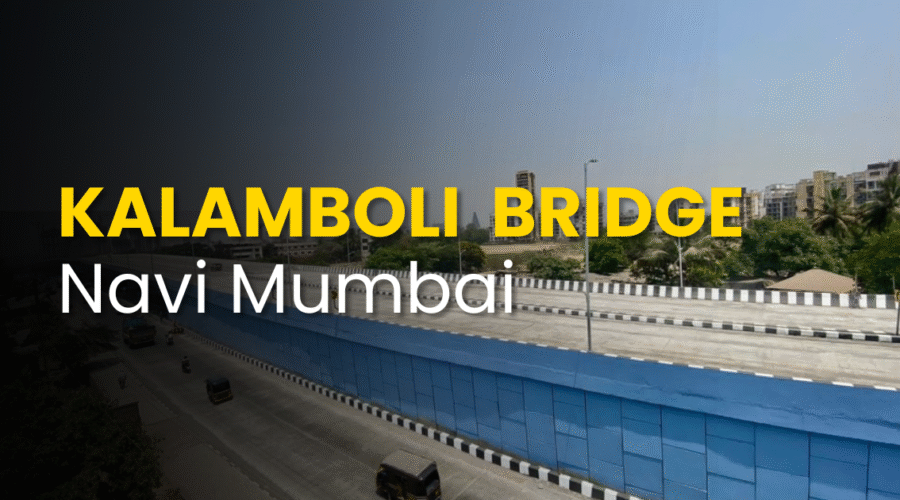
Kalamboli Bridge Navi Mumbai
On the junction front, the MSIDC and the National Highway Authority of India (NHAI) have launched the signal-free interchange plan at Kalamboli. The approved cost is ~₹482 crore for the core works; the broader sanction is ~₹770.49 crore covering a 15.53 km stretch. The region’s infrastructure fabric is undergoing a defining change and the Kalamboli Bridge lies at the very heart of it. The Mumbai–Pune Expressway (MPEW), which begins at Kalamboli, is slated for a monumental upgrade. The MSRDC has put forth a plan to expand the current expressway into a 10-lane superhighway by 2030.
This expansion, estimated at about ₹14,260 crore with a construction component of ~₹8,440 crore, aims to tackle the steady 5-6% annual traffic growth on the corridor (~65,000 vehicles on weekdays, over 100,000 on weekends).
Why does this matter for the Kalamboli Bridge? Because the bridge is effectively the gateway between Navi Mumbai and this expanding expressway. If the expressway capacity is scaled up, the entry point must not become the new bottleneck. Thus, Kalamboli Bridge’s redevelopment is not a standalone project; it is linked inextricably to the expressway’s future.
The design features eight flyover arms and two underpasses (some reporting seven flyovers, but eight arms are cited in many sources) to improve movement across multiple directions at the five-arm traffic circle.
In short: The Big News is that Kalamboli Bridge’s redevelopment is not just a local upgrade, it’s a linchpin in an entire corridor transformation.
Current Traffic Status & Repair Updates
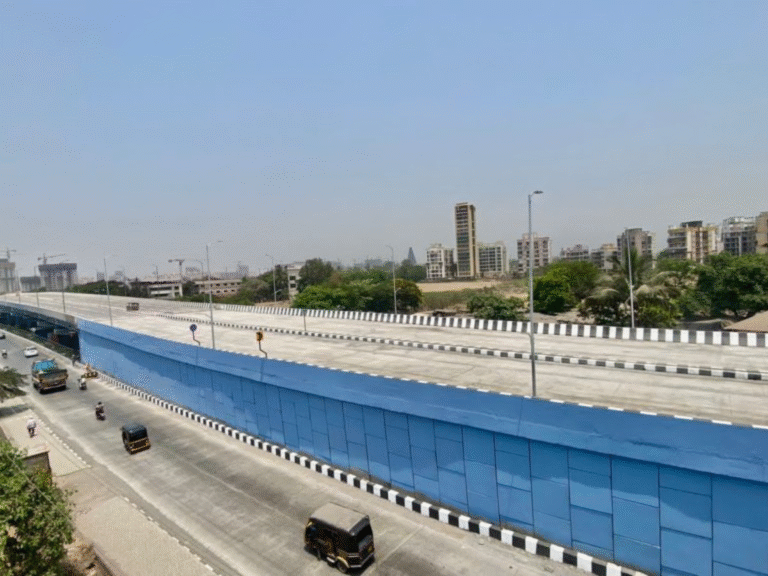
If you commute through Kalamboli Bridge regularly, here are the latest actionable updates (as of October 2025):
- The project design allows for phased construction with minimal full closures. That said, in early 2025, the exit from Panvel via Kalamboli was reported closed for six months in the initial diversion plan.
- Tree-relocation works have begun: Over 690 trees including varieties like umbad, coconut, peepal, gulmohar are scheduled to be transplanted in the vicinity of the Kalamboli junction, road stretches from JNPA to MGM hospital and Steel Market Yard.
- No major prolonged traffic shutdowns have been publicly declared for October 2025, but commuters are advised to check local traffic alerts due to ongoing piling and foundation works by MSIDC.
- The junction continues to see heavy truck and container flows via the steel market and port linkages; therefore, even with upgrades, some level of congestion remains during peak hours though the upgrade aims to reduce that significantly.
- Local service roads and feeder lanes remain subject to pothole complaints, water-logging in monsoon, and lighting issues; residents are advised to report through PCMC or CIDCO depending on location (as the governance matrix shows overlapping responsibility).
- As construction continues, lane diversions may temporarily reduce capacity; commuters may want to adjust travel times slightly or choose alternate routes during high-volume hours.
In effect: The bridge is under active upgrade. It is functional. But expect construction-phase dynamics until full completion.
More Than Concrete: A Local’s Perspective on the Bridge’s Journey
So when we speak of Kalamboli Bridge, let’s remember that it is more than concrete and steel. It is a silent witness to change, growth, patience and the ordinary magic of mobility.I remember one evening, just after office hours, driving from Kharghar toward Panvel. The day had been long. Traffic crawled. At the curve leading onto the Kalamboli Bridge I felt a small lift in mood, maybe the road felt smoother. The view opened up: steel yards shimmering in the distance, railway tracks parallel, rising and falling lights. That moment stuck with me.
It was not just a drive. It was a tiny signal of progress.
Crossing the bridge on a crisp winter morning, I noticed a line of trucks doing precision turns into the steel market. Contrasting that with earlier years, when the same entrance meant chaos, honking, lost time, I realized the bridge had shifted from being a pain point to a bit of relief.
But life here is messy too. I’ve sat in traffic jams at the base of the circle, engine idling, wondering which signal keeps restarting that trap. I’ve seen service-road potholes, water puddles after a heavy rain, and lights dim at night. Because for all the high-end plans, everyday reality remains.
Still, each time I pass by the construction barricades, the piling rigs working at dawn, the signage announcing the interchange upgrades, I feel optimism. Optimism for fewer horns, fewer stops at grade, fewer minutes lost.
This bridge is woven into people’s routines: school drop-offs, commuting to work, trucks leaving at dawn, buses heading into the city. It carries hopes, frustrations, triumphs and small victories. The slow climb of the ramp, the open view from the flyover top, a scooter rider merging into the flow all tell the story of this bridge as part of many lives.
Kalamboli Bridge: The Economic Lifeline of Navi Mumbai
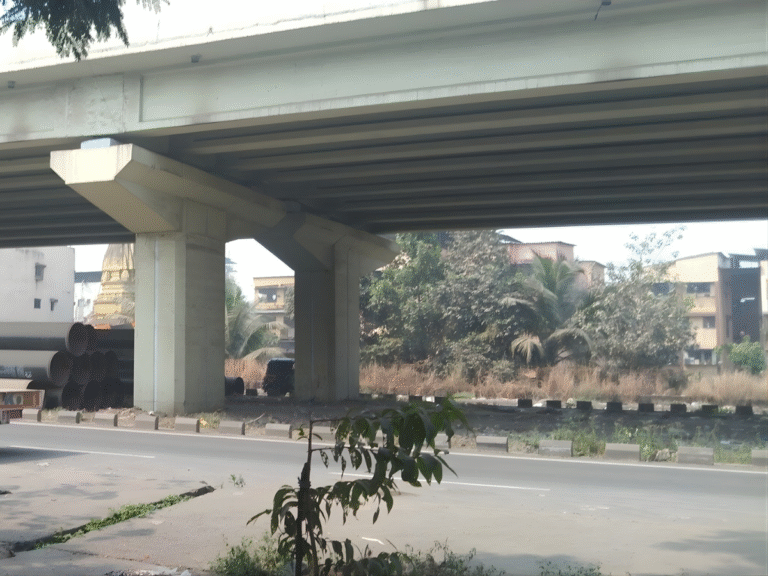
When a city thrives, infrastructure pushes it forward. Kalamboli Bridge is that push.
Because this bridge isn’t simply carrying commuters it is carrying commerce.
The roads that converge at Kalamboli feed the steel market yards, container carriers heading to India’s busiest seaport (JNPA), industrial warehouses in Taloja, logistics hubs and the future airport in Ulwe. Each of these sectors depends on timely movement.
Imagine a truck loaded with steel plates waiting hours because the junction is jammed. Fuel wasted, man-hours lost, costs stack up. Now imagine smoother flow that means cheaper freight, faster availability, better business margins. That is the lifeline function of the bridge.
The redevelopment project recognises this. The stack-interchange design aims to segregate traffic types: through-traffic flows (especially heavy vehicles) will have flyover arms; local and merging traffic will utilize appropriate service roads/underpasses. This separation reduces conflict and improves throughput.
In short, the bridge is a pivot in the regional economic engine. As Navi Mumbai expands, as the airport and metro lines come up, as industries cluster, the efficiency of this bridge will ripple out into productivity, growth and urban quality.
For the businessperson, the commuter, the resident alike the bridge matters because movement matters.
Which Neighborhoods Depend on the Bridge?
Kalamboli Bridge doesn’t serve just one area, it serves many.
To the west lie residential hubs like Kamothe and Kharghar, whose populations commute daily toward Panvel, Mumbai or other parts of the city. To the south and east are industrial zones such as Taloja MIDC, Warehousing corridors near Kalamboli and the Steel Market Yard. On the northern flank, feeder roads bring traffic from Roadpali and Panvel.
I recall driving from Roadpali to Kalamboli early in the morning, noticing how the bridge gave me that elevated transition away from the slow service roads and into faster movement. On that ride I realized how the bridge was more than an exit; it was a connector of lifestyles.
When the project completes, the expectation for all these neighborhoods is smoother commutes, less noise at grade, better service-road access, improved lighting and safer crossings. Real estate developers already refer to this as a marker of future value.
Thus, whether you live in a new high-rise in Kharghar, work in Taloja’s industrial unit, or simply travel via Panvel toward the airport, Kalamboli Bridge plays a part in your journey.
A Missing Perspective: Pedestrian Safety

While the spotlight often shines on vehicles, it’s worth asking what about pedestrians?
The Kalamboli Bridge and its interchange feed thousands of daily foot commuters: workers from the steel market, students, and local residents who still prefer to walk or bike. The ongoing redevelopment plans should ideally include dedicated Foot Over Bridges (FOBs), better lighting, and safe pedestrian zones, ensuring people don’t have to navigate through high-speed traffic or unstable service roads.
If the city’s goal is inclusive infrastructure, safety for those on foot must walk alongside mobility for those on wheels
Final Thoughts
The story of Kalamboli Bridge is multi-layered: It is one of engineering ambition, of regional growth, of daily human moments. The news is clear the junction is being transformed into a signal-free, flyover-rich interchange. The status is live construction is ongoing, diversions in place, enabling works underway. And on the ground, people like you and me traverse it, witness its evolution and carry hope for better mobility.
If you ever find yourself in your car, watching the road curve up toward the flyover, take a breath and let it register: this is not just a commute. It is a change in motion. Because when the bridge works, the city moves. When the bridge is smooth, business moves. When the bridge connects neighborhoods without conflict, lives expand. Kalamboli Bridge is that journey.
FAQ's
Frequently Asked Questions