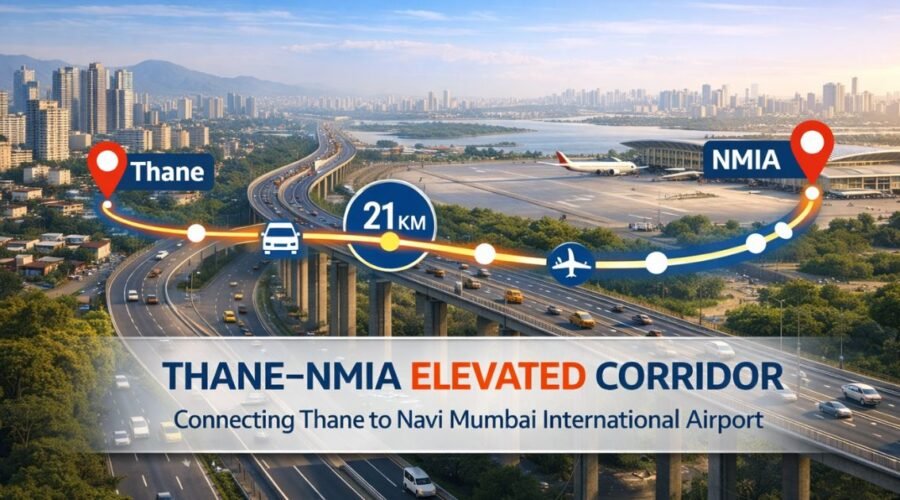
Proposed Thane–NMIA Elevated Corridor: Connecting Thane to the New Airport
For years, Thane has been physically close to Navi Mumbai and yet frustratingly far from its biggest upcoming asset. The Navi Mumbai International Airport (NMIA) changed the conversation, but for Thane residents, one question kept coming back again and again. How do we actually reach the airport without spending half our life on the road?
In 2026, that question has a serious answer on the table. The proposed Thane–NMIA Elevated Corridor is not just another road idea floating in government presentations. It is a planned expressway designed specifically to connect Thane directly to the new airport, cutting through one of the most congested travel belts in the Mumbai Metropolitan Region.
I want to be clear from the start. This corridor is still in the planning and approval phase. Construction has not begun yet. But the intent, alignment logic, and impact potential are strong enough that this project already deserves attention, especially from daily commuters, frequent flyers, and real estate watchers in Thane.
Fast Facts: What You Need to Know
- Project Name: Thane–NMIA Elevated Corridor (Proposed Expressway)
- Proposed Length: Approximately 25 to 26 kilometres
- Design Concept: 6-lane elevated expressway
- Starting Point: Digha and Nirankari Chowk area in Thane
- End Point: Navi Mumbai International Airport approach zone
- Estimated Cost: ₹6,500 to ₹8,000 crore
- Current Status: DPR prepared; awaiting statutory and environmental approvals
- Primary Objective: Reduce Thane to NMIA travel time to around 30 minutes
Project Concept: A Direct Elevated Link from Thane to NMIA
The core idea behind the Thane–NMIA Elevated Corridor is simple but powerful. Create a fast, signal-free, access-controlled road that allows vehicles to move from Thane directly to the airport without getting stuck in city traffic, industrial bottlenecks, or port-bound congestion.
CIDCO, which is spearheading multiple NMIA-linked infrastructure projects, has proposed this corridor as a dedicated airport access route for Thane and its surrounding micro-markets. Unlike existing options that force travelers to loop through Vashi, Belapur, or the MTHL alignment, this expressway aims to provide a straight, predictable drive.
From a planning perspective, this corridor acknowledges a reality that many commuters already feel. Thane is one of the largest residential and employment hubs in the MMR, yet airport access has always been its weak link. This project attempts to correct that structural gap.
Cost and Execution Model
Current estimates place the project cost between ₹6,500 crore and ₹8,000 crore, depending on final alignment, land acquisition requirements, and structural complexity.
Execution could follow a Public-Private Partnership (PPP) or Hybrid Annuity Model (HAM), both of which are commonly used for large urban expressways. The final model will depend on traffic projections, toll feasibility, and state policy decisions at the time of tendering.
Synergy with Other Major Corridors
One of the strengths of this proposal is how it fits into a larger regional network. The corridor is expected to integrate smoothly with NMIA’s internal road system and could potentially connect with other major projects such as the Airoli–Katai Naka Freeway.
It also complements the coastal road and Atal Setu network by offering an alternative northern access point to the airport. Together, these corridors create multiple entry paths, reducing dependency on any single route.
Thane’s Infrastructure Growth Story
This expressway is not an isolated project. It is part of Thane’s broader infrastructure transformation. Metro expansion plans, including Line 12 and future loop connections, aim to integrate Thane more tightly with Navi Mumbai and the rest of the MMR.
By 2030, Thane is expected to be part of an extensive metro network exceeding 400 kilometres. When combined with direct road access to NMIA, this positions Thane as one of the best-connected urban regions in the state.
Real Estate and Economic Impact
Improved airport connectivity almost always affects property dynamics. Areas such as Kalwa, Airoli, and Rabale could see increased interest as commute times to NMIA reduce dramatically.
For commercial zones like Mahape and the DAKC belt, faster airport access improves business efficiency, especially for IT services, logistics firms, and export-oriented industries. Over time, this could translate into higher office absorption and residential demand nearby.
Challenges and Risks
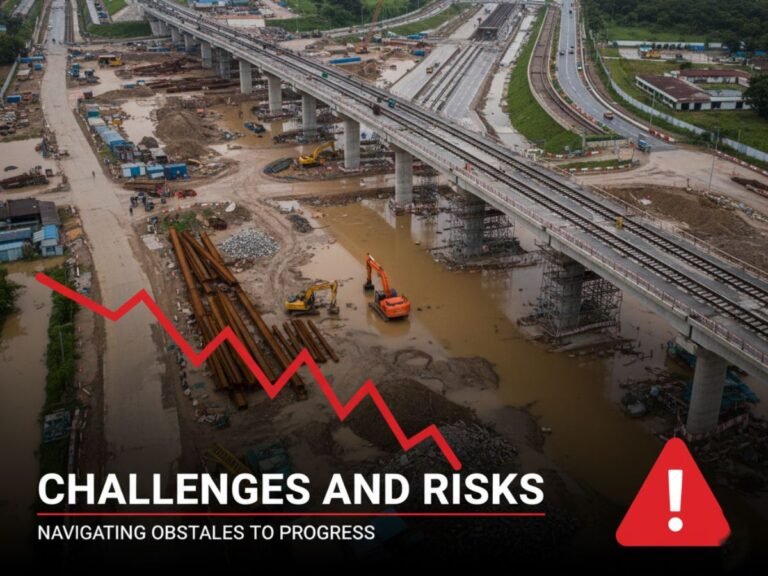
No major infrastructure project is without hurdles. Land acquisition through industrial belts, environmental clearances near creek zones, and coordination between CIDCO, TMC, MIDC, and state authorities are all potential challenges.
Delays are possible, and timelines may shift. Acknowledging these risks is important, especially for readers tracking the project for investment decisions.
The Thane–NMIA Elevated Corridor is still a proposal, but it is a serious one. Its logic is sound, its benefits are clear, and its impact could be far-reaching. For Thane residents, it represents something rare. A direct, predictable connection to an international airport.
As NMIA becomes fully operational and regional travel patterns evolve, projects like this will define which cities truly benefit from the airport. Thane, quietly and steadily, is positioning itself to be one of them.
FAQs
Frequently Asked Questions