
Stamp Duty in Navi Mumbai: What Buyers Actually Need to Pay and Check
Quick Summary
| Topic | What you need to know in Navi Mumbai (2026) |
|---|---|
| Effective stamp duty rate | 7% (male) and 6% (female) for standard residential transactions within NMMC and PMC limits |
| What makes the 7% | It is a composite of Base Stamp Duty + Local Body Tax (LBT) + Metro Cess |
| Registration charges | 1% up to ₹30 lakh, then capped at ₹30,000 above ₹30 lakh |
| Ready Reckoner rule | Duty is payable on the higher of agreement value or ASR/Ready Reckoner value |
| Biggest “hidden” cost in many nodes | CIDCO transfer charges + 18% GST on CIDCO administrative fees for leasehold assignments |
| Online payment system | Maharashtra uses GRAS e-challan, with district selection (Thane vs Raigad) being a critical step |
| Extra compliance for ₹50L+ deals | Buyer may have 1% TDS obligation (Form 26QB) based on consideration or stamp duty value |
| Women concession reality | 1% rebate applies only when the buyer is solely female (or woman+woman), not when any male co-owner exists |
Stamp Duty in Navi Mumbai
Stamp duty is the state tax you pay to make a property document legally valid and enforceable. In Navi Mumbai, a standard residential purchase in urban limits typically results in 7% total stamp duty for male buyers and 6% for female buyers, because the total includes add-ons like LBT and Metro Cess.
Your payable duty is not calculated only on your negotiated deal value. It is calculated on the true market value, which practically means the higher of your agreement value or the Ready Reckoner (ASR) valuation for that locality and unit details.
What Is Stamp Duty? Simple Meaning for Home Buyers
Stamp duty exists because property ownership in Maharashtra is not “official” just because you paid money or signed a paper. The state recognises ownership transfer when the instrument is properly stamped and then registered, which is why stamp duty is treated as a core compliance cost.
Many Navi Mumbai buyers confuse stamp duty with registration charges. Stamp duty is a tax under the Maharashtra Stamp Act, while registration is the government service fee for recording the deed under the Registration Act, both normally apply in a purchase.
What Determines Stamp Duty in Navi Mumbai?

In 2026, the final amount depends on the document type, the property category, and the jurisdiction in which the property falls. A flat in a mature NMMC node like Vashi or Nerul may feel “more expensive” in stamp duty simply because the ASR base is higher, even though the percentage is similar.
Navi Mumbai also has a unique market structure where many transfers are effectively assignments of leasehold rights due to CIDCO’s role as lessor. So even after you pay stamp duty and register the sale deed, additional compliance like CIDCO transfer charges can appear in many resale transactions.
Current Stamp Duty Rates in Navi Mumbai
For properties within NMMC and PMC urban limits, the research-backed composite structure for 2026 is clear: 7% for male purchasers and 6% for female purchasers in standard residential transactions. This composite includes Base Stamp Duty, Local Body Tax (LBT), and Metro Cess.
The “Metro Cess” in particular is no longer viewed as a temporary add-on in the market narrative. Buyers should treat it as embedded into closing costs, especially for nodes connected to ongoing transport infrastructure funding logic across the MMR.
Rate Composition Table (Urban Limits, 2026)
| Component | Male | Female | Notes |
|---|---|---|---|
| Base Stamp Duty | 5% | 4% | 1% rebate for eligible female ownership |
| Local Body Tax (LBT) | 1% | 1% | Collected for NMMC/PMC |
| Metro Cess | 1% | 1% | Transport infrastructure surcharge |
| Total | 7% | 6% | Standard residential urban cases |
Stamp Duty Calculator for Navi Mumbai: Step-by-Step Logic

The correct way to estimate stamp duty is not “percentage of my deal price.” It is: check the agreement value, calculate the Ready Reckoner valuation, take whichever is higher, then apply the applicable stamp duty rate and add registration charges separately.
A practical local reality is that floor level, terraces, and certain open areas can change the government valuation. In high-rise markets like Kharghar and newer Panvel-side towers, floor rise premiums can noticeably push the taxable base up, even when your negotiated price feels stable.
Ready Reckoner Rate (ASR) in Navi Mumbai: The Rule That Drives Everything
Ready Reckoner is the government’s annual benchmark for “true market value” calculation. Under the valuation rules, the duty is payable on the higher of agreement value or ASR value, which is why under-valued deals often backfire at the registration stage.
In 2025–26, Navi Mumbai saw ASR revisions tied to infrastructure momentum, with growth nodes like Ulwe, Kharghar, and Panvel seeing steeper increases compared to saturated nodes. This is one reason buyers get surprised when the “discounted” purchase still attracts duty on a higher base.
Online Stamp Duty Payment in Navi Mumbai: GRAS Process (2026)
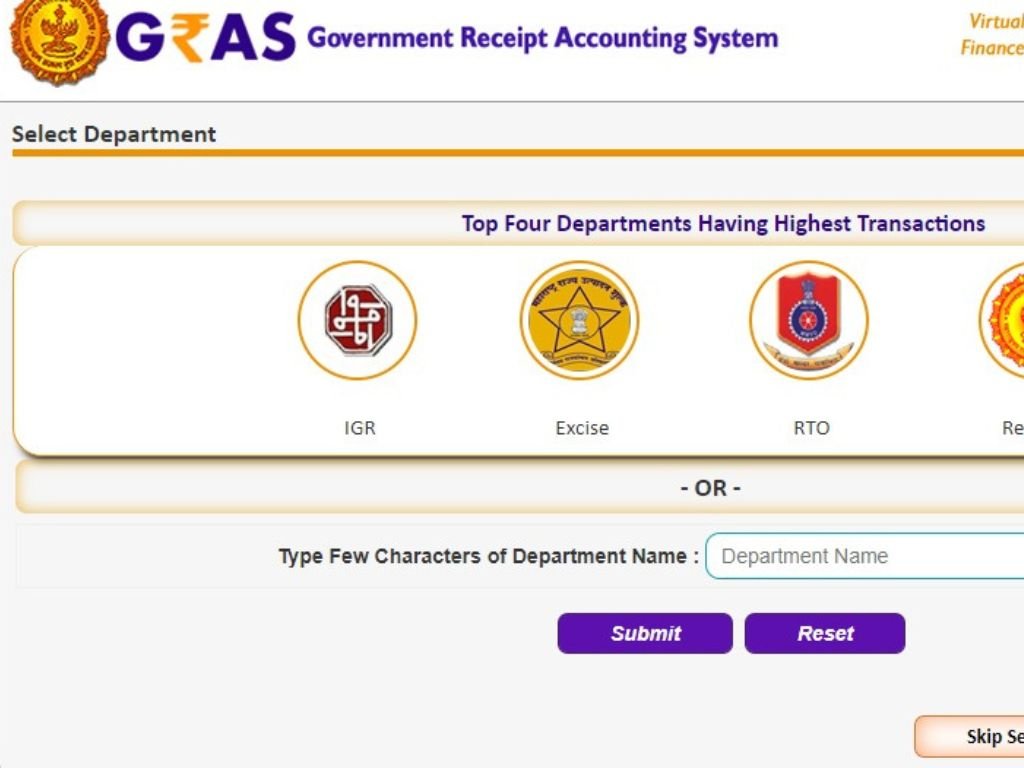
Maharashtra’s payment workflow is now heavily digital, and GRAS (Government Receipt Accounting System) is the standard path for stamp duty payments. The most important step is selecting the correct district and office mapping, because a wrong district can invalidate the challan and create a refund headache.
For Navi Mumbai, the district logic is a common trap in real transactions. Many NMMC nodes map to Thane district, while Panvel-side nodes map to Raigad, and your GRAS selection must match your jurisdiction and Sub-Registrar Office before you generate the e-challan.
Payment Modes: e-Stamping vs Franking vs eSBTR vs GRAS
Most buyers only hear “online payment,” but the market uses multiple instruments. GRAS e-challan is common, while eSBTR is still preferred by some practitioners because it outputs a secure bank treasury receipt that feels similar to stamp paper handling.
Franking and e-stamping discussions matter because they affect how the document is executed and presented for registration. The best choice depends on your lawyer’s workflow, your SRO practice norms, and whether you need a system that reduces mistakes in document printing and verification.
Registration Charges in Navi Mumbai (2026): The Cap Mechanism

Stamp duty is an ad valorem tax, but registration fee is a service fee with a structure that is unusually favourable to higher-value transactions. As per the 2026 slabs, it is 1% up to ₹30 lakh, and then a fixed cap of ₹30,000 above ₹30 lakh.
This is why a Karanjade or Taloja buyer may feel registration “hurts more” in proportion terms than a premium Palm Beach Road buyer. In a practical advisory sense, you should budget registration as a fixed ₹30,000 once your value crosses ₹30 lakh, plus small scanning or handling fees.
NMMC vs PMC vs Peripheral Areas: Why Location Changes the Base Value
Within Navi Mumbai’s functional market, jurisdiction splits the buyer experience. NMMC nodes like Airoli, Ghansoli, Vashi, Sanpada, Nerul, Seawoods, and Belapur generally sit on higher ASR values because the infrastructure maturity is visible on the ground.
PMC nodes like Kharghar, Kamothe, Kalamboli, New Panvel, and many Taloja residential pockets follow the same headline stamp duty rates, but the Ready Reckoner base and locality-specific valuation tables can change the absolute outgo. Peripheral areas can have village-wise variations that require IGR checks before you assume the final payable.
CIDCO Transfer Charges: The Cost Most Resale Buyers Miss
In many Navi Mumbai transactions, what you call a “sale” is legally an assignment of leasehold rights because CIDCO is the underlying lessor. That is why, beyond stamp duty and registration, buyers may need CIDCO NOCs and must pay transfer charges before society transfer procedures are completed.
For 2025–26, CIDCO transfer charges saw an enhancement trend, with estimated transfer charges varying by carpet area and category, and buyers must also account for 18% GST on CIDCO administrative fees and transfer charges. This becomes a meaningful closing-cost addition in resale deals.
Estimated CIDCO Transfer Charges (Residential, 2026 Range)
| Carpet Area | Indicative Transfer Charge Range |
|---|---|
| Up to 20 sq m | ₹27,000 to ₹30,000 |
| 21 to 30 sq m | ₹41,000 to ₹45,000 |
| 31 to 40 sq m | ₹96,000 to ₹1,06,000 |
| 41 to 50 sq m | ₹1,38,000 to ₹1,52,000 |
| 51 to 60 sq m | ₹1,88,000 to ₹2,07,000 |
| 61 to 70 sq m | ₹2,34,000 to ₹2,58,000 |
| Above 100 sq m | ₹4,00,000+ |
Women Stamp Duty Concession in Navi Mumbai
The 1% benefit for women is one of the most searched topics because it can save meaningful money. In 2026, the effective difference is visible at the base duty level, resulting in 6% total for eligible female purchasers instead of 7% for male purchasers in urban limits.
The most important rule is ownership structure. If a male name appears as a co-owner, even as a minor share holder, the concession does not apply in the standard interpretation described, which is why couples should plan ownership carefully before booking and documentation.
The “Deal Below Ready Reckoner” Trap
When your agreement value is below ASR, you may pay stamp duty on the higher ASR value anyway. This can feel unfair in distressed sales, but that is how the statutory “true market value” framework operates at registration.
The second risk is income tax exposure in certain cases, because valuation mismatch can trigger tax treatment when the difference crosses thresholds. In practical terms, if you are buying below ASR, your first move should be legal consultation, not celebration, because the cost can show up in unexpected places.
Stamp Duty on Different Transactions in Navi Mumbai
Not every transaction is a simple sale deed. Gift deeds, power of attorney, mortgage-related instruments, and leave-and-license agreements have their own duty logic, and many families in Navi Mumbai face these use cases during inheritance planning and loan processes.
For example, gifting property to specified close relatives can attract a nominal duty in certain conditions, while a power of attorney that effectively enables sale can attract a heavier duty because it is treated like a deemed conveyance in revenue logic. The right document choice matters as much as the payment.
If the Deal Cancels: Is Stamp Duty Refundable in Navi Mumbai?

Refund and cancellation queries usually come up after token money is paid or after an agreement is drafted. In Navi Mumbai’s high-compliance environment, refunds are not a “simple request,” they are process-driven, time-bound, and sensitive to how the instrument was executed.
The practical takeaway is this: avoid paying stamp duty until your names, jurisdiction, document type, and loan readiness are aligned. A wrong district selection on GRAS, or a wrong instrument choice, can lead to corrective processes that cost time and require paperwork that buyers usually do not keep ready.
Extra Charges People Confuse With Stamp Duty: Navi Mumbai Reality Check

Stamp duty is not your full closing cost. In resale cases, you may face society transfer charges, CIDCO-related charges in leasehold properties, documentation fees, and bank process costs that do not show up in your initial stamp duty estimate.
In under-construction purchases, GST can also apply depending on affordability category and project specifics, and this changes the “all-in” burden for buyers who only planned for stamp duty. The smartest budgeting approach in 2026 is to plan for total transaction cost, not only the 7% headline.
TDS for Property Above ₹50 Lakhs: The Compliance Buyers Forget
If your property value crosses ₹50 lakh, the buyer often has a TDS obligation. The responsibility is on the buyer to deduct and deposit it using the prescribed form workflow, and mistakes can attract interest and penalties that show up months later.
This matters in Navi Mumbai because a large portion of mid-segment inventory in nodes like Seawoods, Nerul, Vashi, and even newer projects in Kharghar quickly crosses that threshold. It is a paperwork task, but it affects payment scheduling and seller expectations.
Income Tax Benefit on Stamp Duty and Registration: The 2026 Update You Should Know

Many buyers still assume stamp duty and registration can be “fully claimed” as tax benefit. In the 2026 context described, the deduction logic is limited by the overall cap, and the provision has shifted under the new Income Tax Bill structure, which impacts how advisors refer to it.
The real-world outcome is simple: most salaried buyers already exhaust the limit through EPF and other instruments, so stamp duty rarely creates additional tax relief. You should treat tax benefit as a small offset, not as a reason to ignore careful cost planning.
Common Mistakes Navi Mumbai Buyers Make (And How to Avoid Them)

The most common mistake is paying stamp duty under the wrong jurisdiction or document type. In Navi Mumbai, district selection mistakes on GRAS, especially Thane vs Raigad confusion, create delays that are avoidable with a basic address and SRO confirmation.
The second mistake is assuming concessions apply based on “first holder name” rather than actual ownership structure. The safest habit is to freeze ownership, eligibility, and loan structure before you pay any duty, because post-payment corrections are painful and time-consuming.
Buyer Checklist Before Paying Stamp Duty in Navi Mumbai
A good checklist is not about more paperwork, it is about reducing expensive errors. Confirm the exact jurisdiction, compare agreement value with ASR valuation, verify names and PAN matching, and ensure your document type is correct before generating the challan or eSBTR.
Also confirm CIDCO leasehold status early, because transfer charges can change your final budget materially. If a property is already converted to freehold, your post-registration burden may reduce, and that single detail can change your closing-cost planning.
Final Summary: What a Smart Navi Mumbai Buyer Should Do
In 2026, the stamp duty conversation in Navi Mumbai is not just about the “7% rate.” It is about understanding the composition, the Ready Reckoner base, and the jurisdiction-specific workflow that decides whether your payment is accepted smoothly.
If you want a clean purchase experience, treat stamp duty as a compliance project. Confirm ASR valuation, ownership eligibility, Thane vs Raigad mapping, and CIDCO leasehold status early, then pay using the correct GRAS route and preserve proof for registration day.
FAQ's
Frequently Asked Questions