
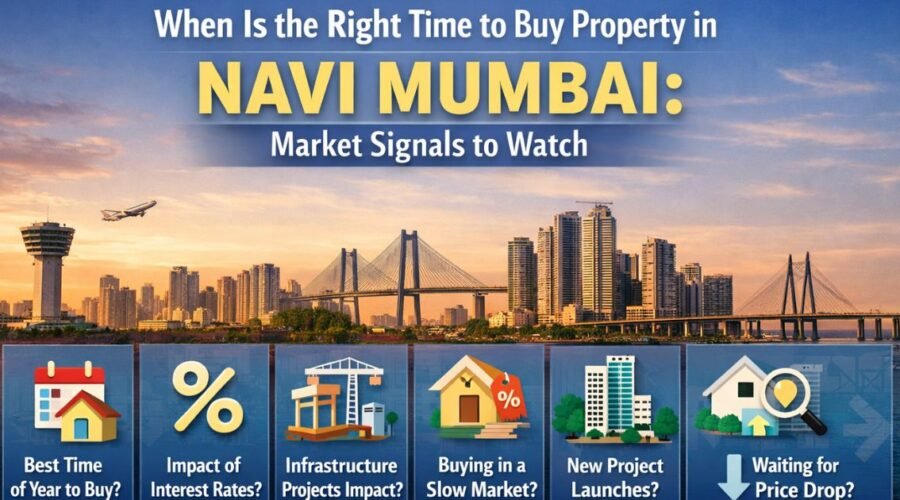
Best Time to Buy Property in Navi Mumbai in 2026: Market Signals, Buy Now or Wait?
The best time to buy property in Navi Mumbai is not one fixed year, one festive offer, or one builder scheme. It is the right time only when your budget is comfortable, the node you are targeting is at the right stage, and the growth trigger you are betting on is already visible on the ground, not just in brochures. In early 2026, that usually means being practical about infrastructure execution, EMI cost, legal readiness, and area-specific livability.
Navi Mumbai is not one market. Vashi, Nerul, Seawoods, Kharghar, Panvel, Ulwe, Taloja, and Dronagiri do not move for the same reasons, and they do not carry the same risk. That is why many buyers make timing mistakes here. They hear “airport”, “metro”, or “Atal Setu” and assume the answer is simple. It is not. Some areas have already absorbed a large part of the future story into prices. Some are still in a genuine growth window. Some still require patience.
Quick Summary: Buy Now, Wait, or Walk Away?
| Situation | Timing reading | Practical action |
|---|---|---|
| You want a ready flat in a usable node with manageable EMI | Risk is lower and utility is immediate | Buy now |
| You are targeting a growth corridor but infrastructure is still catching up | Upside may remain, but waiting can reduce execution risk | Wait selectively |
| The project has legal doubt, weak RERA health, or the area has serious livability stress | Cheap entry may become expensive later | Walk away |
In simple terms, Navi Mumbai is a buy-now market only for some buyers, some properties, and some nodes. Anyone asking “Should I buy property in Navi Mumbai now?” should first ask a better question: buy what, where, and for what purpose?
What Does “Good Timing” Actually Mean in Navi Mumbai?
Good timing does not always mean the lowest price. In property, the lowest price often comes with the highest uncertainty. In Navi Mumbai, good timing usually means entering when the area is usable enough to support demand, but not so fully matured that most of the upside is already gone.
That is why this topic should be seen as risk-adjusted timing, not “cheap vs expensive”. A buyer in Panvel may accept a slightly higher price today because the area already has multi-directional demand drivers. A buyer in an earlier corridor may wait because internal civic quality is still catching up with the macro story.
The real question is this: Are you paying for future possibility, or are you buying into visible reality? That difference changes the answer.
Which Market Signals Actually Matter Before You Buy?
1) Is the infrastructure already changing daily life, or is it still a future promise?
This is the biggest signal in Navi Mumbai.
The Navi Mumbai International Airport has already crossed the pure-announcement phase. Adani says the airport was inaugurated in October 2025 and commercial operations began on December 25, 2025. That means buyers in airport-influence nodes like Ulwe, Panvel, and parts of Kharghar are no longer buying a rumour. They are buying after the first major milestone has already happened.
The Mumbai Trans Harbour Link, or Atal Setu, is also operational, and MMRDA says the reduced toll for cars continues till December 31, 2026. That matters because a connectivity benefit that is already in use is far more valuable than a connectivity benefit still waiting for approvals.
The Panvel-Karjat suburban corridor is another strong timing signal. Recent reporting says it is about 85% complete, which usually means execution risk is much lower than it was earlier, even though the final price reaction may still not be fully over.
Navi Mumbai Metro Line 2 has also moved from long-pending discussion to a fresh state approval with a ₹5,575 crore allocation in March 2026. That makes it more meaningful than a generic proposal, but still earlier-stage than an already-operational route.
Practical takeaway: Buyers should rank infrastructure like this:
- Operational and already usable
- Near completion and visibly progressing
- Approved and funded
- Announced but still abstract
The earlier the stage, the more caution you need.
2) Are prices rising because of real demand or just launch pricing and hype?

Navi Mumbai has already seen meaningful rate movement. 99acres currently places the city’s broad pricing band around under ₹12,500 per sq ft for affordable stock, ₹12,500 to ₹19,000 for mid-segment, and above that for premium stock. Current area trend pages also show Panvel around ₹13,800 per sq ft, Ulwe around ₹10,893 per sq ft for flats, Kharghar around ₹15,540 per sq ft for flats, and Nerul around ₹28,000 per sq ft for flats. These are directional market indicators, not guaranteed deal values, but they are useful for timing decisions.
What matters here is not just that prices have gone up. The real question is whether they are being supported by:
- actual end-user movement,
- better commuting convenience,
- stronger office demand,
- or only marketing-led launch inflation.
Recent coverage saying Navi Mumbai is attracting businesses because office rents are lower than major Tier-1 alternatives suggests that the city’s growth story is not only residential hype. That improves the quality of demand over time.
Practical takeaway: Rising prices are not automatically a “missed the bus” signal. Sometimes rising prices simply mean the market has moved from speculation to proof.
3) Are home loan rates and EMI conditions helping or hurting your entry?
The RBI held the repo rate at 5.25% in February 2026, while SBI’s current home loan page shows rates starting from 7.25% p.a. onward, effective from December 15, 2025.
For many normal buyers, this means one thing: the market is not waiting for you to get a magical financing window. Rates may move, but hoping for a dramatic drop is often not a sound timing strategy if the property you want keeps getting costlier meanwhile.
A more useful rule is this: If your EMI is still comfortable without depending on future salary jumps, then stable rates are usually good enough. If the EMI is already stretching your monthly cash flow, then timing is wrong even if the market looks attractive.
4) Are ready-possession homes offering better value than fresh launches right now?
For first-time buyers and end-users, this matters a lot.
Ready or near-ready stock gives you three benefits:
- better visibility of the product,
- lower construction-delay risk,
- immediate use or rental possibility.
Under-construction buying can still make sense in selected growth corridors, but only if you are consciously buying the execution phase, not blindly buying a launch discount. In Navi Mumbai, that distinction is crucial because some nodes are growing quickly while internal services still remain uneven.
5) Are legal and regulatory checks clean enough to justify entry now?

Timing is wrong the moment the legal profile is weak.
MahaRERA’s public portal remains one of the most important filters here, especially for checking registration, updates, and extensions. Its public lists also make it clear that lapsed, revoked, or problematic project statuses are real risks, not rare exceptions.
If a project has repeated delays, weak progress disclosure, or unclear compliance history, that is not a “good opportunity”. It is often a trap disguised as timing.
For resale, CIDCO-linked transfer mechanics and freehold conversion status can also materially change timing. Recent reports note CIDCO’s leasehold-to-freehold conversion scheme for eligible residential plots and projects, and that is important because title quality and future transfer ease affect both resale liquidity and buyer confidence.
Why the Right Time Is Not the Same in Every Navi Mumbai Node
Panvel: One of the more balanced timing cases right now
Panvel continues to stand out because it is not dependent on only one story. It benefits from airport-side relevance, rail and road positioning, and expanding logistics and mobility advantages. Current price trends still look lower than many mature premium nodes, while the broader infrastructure base is already meaningful. The Panvel-Karjat corridor progress strengthens this case further.
Timing view: For end-users and medium-term investors, Panvel still looks like one of the cleaner buy-now zones if the specific property is sound.
Kharghar: Good timing depends heavily on sector and building
Kharghar is no longer an early-stage bet. It already has metro utility, educational pull, and strong recognition. But that also means timing here is less about catching raw upside and more about choosing the right micro-pocket and the right building. Current price trends show a wide sector spread, which proves that Kharghar cannot be read as one flat market.
There have also been water-supply related concerns in parts of the CIDCO belt, including crackdowns on illegal booster pumps and periodic shutdown notices. That does not make Kharghar a bad market. It means buyers should stop assuming that every premium-looking tower has equally reliable daily utility quality.
Timing view: Buy in established, well-functioning pockets. Wait or negotiate harder where utility reliability is still a concern.
Ulwe: Still attractive, but not equally safe for every buyer
Ulwe remains a strong airport-influence and connectivity story. But the moment airport operations became real, the easy speculative part started fading. Also, water-supply disruption has been a real issue in CIDCO nodes including Ulwe during shutdown periods.
Timing view: Good for patient buyers and selective investors. Less ideal for someone who wants zero daily friction immediately.
Vashi, Nerul, Seawoods, Belapur: Timing here is more about quality than upside
In mature nodes, the “best time to buy property in Navi Mumbai” question changes. You are usually not chasing dramatic appreciation there. You are buying for lifestyle stability, better social infrastructure, stronger tenant depth, and lower uncertainty. Nerul and Belapur pricing trends clearly sit in a much more mature bracket than Panvel or Ulwe.
Timing view: Buy when the right resale or redevelopment opportunity appears. Waiting for a big price correction is usually not the central strategy here.
Taloja and very early corridors: Timing needs extra caution
Taloja still attracts buyers because of lower entry cost and metro-related narratives. But affordability alone is not good timing. There have been long-running pollution concerns around the Taloja industrial belt, and earlier legal and administrative attention has existed around obnoxious gas complaints in the area.
Timing view: Only suitable for buyers who understand the trade-off clearly. Budget alone should not decide the purchase.
Your Answer Changes Depending on What Kind of Buyer You Are
First-time buyer with a stretched budget
If your EMI will feel uncomfortable from month one, it is not the right time. Simple. For this profile, ready or near-ready stock in a usable node is usually safer than trying to save base cost in a riskier under-construction project.
End-user who wants to move in within 1 year
You should care more about present livability than future headlines. Water reliability, commuting time, access roads, daily services, and building quality matter more than future brochures.
Investor looking for appreciation
You should not buy at the earliest possible stage and call it smart timing. Better timing is often when infrastructure has moved into the visible-execution stage but not yet fully converted into mass end-user pricing.
Investor focused on rent
You should care less about “future potential” and more about tenant behaviour. Mature or well-connected nodes often win here because rent follows usability, not only headlines.
Should You Wait for a Rate Cut, a Festival Offer, or More Launches?
Usually, no.
A small rate cut can help EMI math a little, but not enough to justify indefinite waiting if your target area is steadily getting costlier. The same goes for festive offers. Many are real marketing tools, not real timing advantages.
A much more immediate timing factor in Maharashtra right now is the expected Ready Reckoner revision from April 2026. Recent reporting says the state is likely to raise RR rates by over 5% from April 1, 2026. Since stamp duty and registration calculations depend on the higher of agreement value or government valuation, that can increase transaction cost even if the apartment price itself does not move much.
Practical reading: If you are already financially ready and have identified the right property, delaying only for a slightly better mood in the market may not help you.
Signs That It May Be the Right Time to Buy Now in Navi Mumbai

- Your EMI is manageable without stress.
- The property is ready or very close to possession.
- The project’s RERA position is clean and current.
- The area’s main infrastructure trigger is already operational or clearly progressing.
- The node already has usable daily life support, not just future promise.
- The pricing still makes sense relative to more mature nearby nodes.
- You are buying after checking CIDCO or title-related practicalities where relevant.
Signs That You Should Wait 6 to 12 Months
- Your EMI is only workable if rates fall sharply.
- The area story is strong, but the internal livability is still not convincing.
- The project is too early in construction.
- The appreciation narrative is already priced in, but the local ecosystem is still incomplete.
- You do not yet understand the transfer, title, or freehold position in a CIDCO-linked resale.
- You are being rushed by a launch offer rather than persuaded by property quality.
Red Flags That Mean You Should Walk Away
| Red flag | Why it matters |
|---|---|
| Lapsed, revoked, or suspicious RERA profile | Legal risk overrides timing story |
| Weak title clarity or messy resale transfer path | Exit and resale can become painful |
| Serious daily livability stress | Cheap purchase can become expensive ownership |
| Pure brochure-led pricing with little ground proof | You may be paying peak hype |
| Builder track record is weak or delay pattern is visible | Timing cannot fix a weak developer |
A Simple Buy-Now / Wait / Walk-Away Framework
| If this is your situation | What it usually means | Likely action |
|---|---|---|
| Ready flat in Panvel, Kharghar, Nerul, Belapur, or a strong micro-pocket with manageable EMI | Usability is visible and risk is lower | Buy now |
| Under-construction property in a growth corridor where infrastructure is improving but still uneven | Upside may remain, but patience matters | Wait selectively |
| Project has legal doubt, weak compliance, or the area’s daily quality is still too unreliable | Low entry price may hide future loss | Walk away |
Conclusion
The right time to buy property in Navi Mumbai is now only when the property is financially comfortable, legally clean, and located in a node whose story is visible on the ground. It is not the right time just because someone says airport, metro, or “prices will double”.
For most normal buyers, the best timing in Navi Mumbai today is not the earliest stage. It is the stage where major infrastructure has moved beyond promise, but the specific micro-market has not become blindly overpriced yet.
So do not ask only, “Should I buy now?” Ask this instead:
Is this the right property, in the right node, at the right stage, for the right reason?
That is the real timing question. And in Navi Mumbai, that question is far more valuable than any one-line market prediction.
FAQs
Frequently Asked Questions