
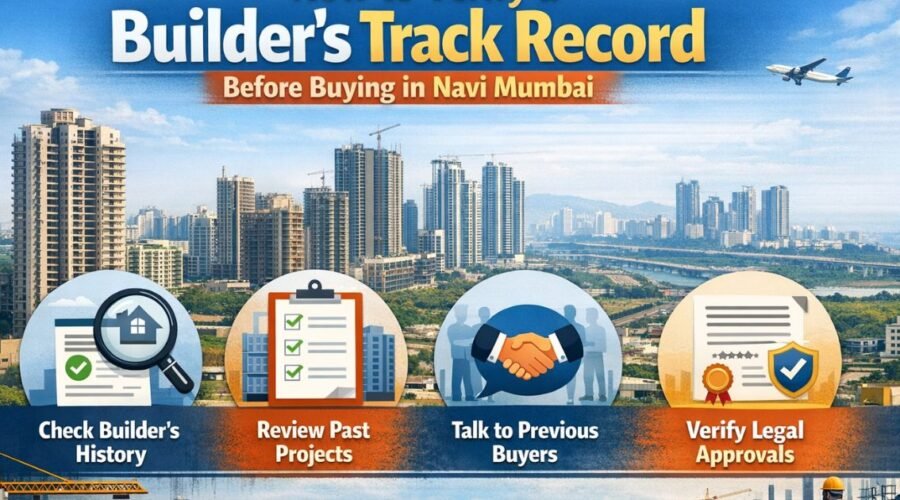
How to Verify a Builder’s Track Record Before Buying in Navi Mumbai
To verify a builder’s track record in Navi Mumbai, you cannot trust the brochure. You must cross-reference MahaRERA records with CIDCO/NMMC approvals and ground-level resident feedback. Check the builder’s completed projects, possession history, complaints, and OC and CC status in earlier buildings. In Navi Mumbai, this matters even more because land, approvals, water supply, and authority control can change from one node to another.
| What to check | Where to check | Why it matters | Red flag |
|---|---|---|---|
| Builder’s past projects | Builder website, site visits, resident feedback | Shows actual delivery and quality history | Old projects already showing poor finish, seepage, lift issues |
| Project registration and promoter details | MahaRERA portal | Confirms legality and disclosure trail | No RERA number, lapsed status, repeated delays |
| Construction progress vs claim | MahaRERA Quarterly Progress Reports | Helps compare sales pitch with real work | Builder says “almost ready” but portal shows low completion |
| CC and OC in older projects | NMMC or PMC side records, project documents | Tells you whether earlier buildings became legally habitable on time | Possession given before OC |
| Complaints and litigation | MahaRERA orders, court references, buyer discussions | Shows pattern of disputes | Many delay compensation orders or repeated buyer fights |
| Land and transfer position | CIDCO records where applicable | Very relevant in leasehold and 12.5% scheme projects | No clear transfer order, no tri-party document where required |
| Utility reality | Existing residents, society office, local visit | Ground reality can be very different from brochure promises | Tanker dependence, construction meter electricity, unstable water |
What a builder’s track record actually means before you buy
A builder’s track record is not just about how famous the name is. It is also not about how many projects they advertise on billboards near Palm Beach Road, Kharghar, or Panvel.
What this really means is much more practical. A good track record usually has five parts together: legal transparency, timely delivery, construction quality, smooth handover, and fewer serious buyer disputes after possession.
This is where many buyers get confused. A builder may have a strong reputation in one part of the region and still have a weak or delayed project in another. A developer who delivered properly in Vashi or Nerul may still face land transfer issues, approval delays, or utility problems in Ulwe, Taloja, or a 12.5% scheme project. So when checking builder reputation before booking a flat, buyers should judge project history, not only brand recall.
In simple words, track record means this: when the builder promised something earlier, did they actually deliver it in the real world?
The fastest way to check if a builder is worth considering at all

You do not need to spend two full days on every project at the start. A quick first filter can save a lot of time.
Start with the builder’s profile on MahaRERA. Check whether the promoter has multiple registered projects and whether any of them show delay patterns, expired completion dates, or lapsed status. Then look at the site itself. A legally active project should normally have a building information board showing approval details. If basic questions about RERA, CC, or earlier projects are being avoided from day one, that itself is a warning.
For a fast first-level screening, check these six things:
- Does the project have a valid MahaRERA registration number?
- Does the builder have completed projects you can actually visit?
- Are earlier promised possession dates matching reality?
- Are there repeated complaints or delay orders against the same promoter?
- Can the sales team clearly explain the land and approval position?
- Do local residents speak reasonably well about handover and maintenance?
If two or three of these look weak at the first stage, slow down. There is no shortage of projects in the Navi Mumbai belt. The bigger risk is booking too early with incomplete information.
Check the builder’s completed projects, not just the new launch brochure
The brochure is meant to sell aspiration. The older project is where the truth usually lives.
The best way to check builder past projects in Navi Mumbai is to visit one or two completed buildings by the same developer, especially those handed over around five to seven years ago. That is enough time for quality issues, maintenance weaknesses, and false promises to become visible.
Look for actual handover history
Ask a simple question: when did the builder promise possession, and when did people actually start living there legally?
A project may look completed from the outside, but that is not the same as a proper handover. In many cases, buyers receive keys or temporary possession before the full legal and utility position is in place. That is why older projects are so useful. Residents can tell you whether the builder finished strong or only created a polished site-visit impression.
Compare promised timeline vs real possession
This part matters because delay patterns usually repeat. A one-time delay due to a genuine project issue is different from a builder who repeatedly overpromises and then extends timelines.
When you visit an earlier project, compare three things: the launch promise, the actual completion, and when buyers got normal life conditions such as functional lifts, water, society functioning, and stable services. A builder may hand over keys but leave residents dealing with incomplete common areas, poor fire compliance follow-up, or unclear paperwork for months.
If an older project in Kharghar or Taloja already shows broken external finish, seepage, poor basement management, or missing amenities that were originally marketed, that says more than any current sample flat.
Use MahaRERA to verify the builder and project history
MahaRERA is one of the strongest official checks available to buyers. But many people use it only halfway.
Do not stop at confirming that the project exists on the portal. Go further. Check the promoter details, the proposed completion date, project disclosures, litigation information, and the Quarterly Progress Reports.
What details MahaRERA can show you

MahaRERA can help you verify whether the project is registered properly, who the promoter is, what the declared completion date is, and what documents have been uploaded. It also helps you check whether the project is being sold under proper disclosure.
The Quarterly Progress Reports are especially useful. They can show how much of the physical work is actually done. This matters because site sales teams sometimes say “final stage,” “almost ready,” or “possession soon” very loosely.
What repeated changes and delays may indicate
One extension is not always a deal-breaker. Repeated extensions, poor progress against sales, or a project drifting into lapsed status is a very different story.
If a builder has multiple projects where the promised date has already passed and the project is still not completed, treat that as a real track-record issue. If the portal also shows litigation or repeated orders related to delay compensation, that is another layer of concern. This is how to check project delivery delays in a useful way, not just emotionally.
For buyers, the main question is not whether there was ever a delay. The real question is whether delay is a pattern.
Check whether earlier projects got OC and CC on time
This is one of the most practical checks and one of the most misunderstood.
A Commencement Certificate, or CC, allows the builder to start construction as per approved plans. An Occupancy Certificate, or OC, means the building is considered ready for occupation from the authority side. Buyers often mix these up, and some sales teams use that confusion.
In Navi Mumbai, this matters more than people think. Recent municipal disclosures have drawn attention to more than two thousand buildings functioning without OC in the NMMC region. That should immediately tell buyers one thing: a building can be occupied in real life and still have serious compliance gaps.
What this means for you is simple. Do not ask only whether the project is “almost complete.” Ask whether earlier buildings by the same builder received OC on time and whether possession was given before full approval. You can check the OC status of older buildings on the NMMC or PMC official websites under the “Town Planning” or “Building Permission” search tabs by entering the Sector and Plot number.
A caution here is necessary. Completion of physical construction is not the same as legal readiness for occupation. If a builder handed over flats in earlier projects before OC, residents may have faced higher charges, utility complications, or long uncertainty. That is not a small issue. It is a track-record issue.
Search for complaints, litigation, and recurring buyer disputes

Every builder may face some complaint at some point. The smarter question is whether the builder has a pattern of similar complaints.
Complaints against a builder in Maharashtra matter most when they repeat around the same themes: delayed possession, refund problems, hidden charges, changes in layout, poor quality, society handover disputes, or land-title issues. In Navi Mumbai, certain disputes can become more complex where leasehold land, transfer charges, or 12.5% scheme backgrounds are involved.
What kind of complaints matter most
Not every complaint deserves the same weight. A random argument over parking markings is not equal to multiple orders related to delay, title dispute, or possession without proper compliance.
Look more carefully at complaints involving: delay compensation orders, repeated buyer refund issues, land challenges, OC problems, hidden possession costs, and unresolved society handover matters. These are the complaints that can affect your risk directly.
One complaint vs repeated pattern
One isolated issue may happen even in a decent project. But if you see the same type of dispute appearing again and again, that is the builder’s operating style showing up.
This is where many buyers make a mistake. They hear “all builders have complaints” and stop checking. That is too casual. A builder with repeated dispute history is not just unlucky. There may be an underlying problem in finances, approvals, project management, or ethics.
Visit one or two older projects by the same builder if possible

A physical visit can reveal what online portals never fully show.
Go to an older building, not the current sample flat. Look at the entrance, lobby, basement, parking design, external walls, lift condition, waterproofing signs, and how the society feels after a few years of use. Does the place still look reasonably solid, or does it already feel tired much earlier than it should?
This is especially useful in Navi Mumbai because some buildings look premium during launch but age badly due to poor materials, weak finishing, or shortcuts in services. A society in Seawoods or Nerul that still holds up well after handover usually says something positive. A building in a growth belt that already shows leakage, patch repairs, or unresolved common-area issues says something too.
Ask one resident these five direct questions:
- Was possession given on time or much later than promised?
- Did the builder hand over the society and paperwork properly?
- Is the water supply regular or are tankers still common?
- Were any big hidden charges demanded at possession time?
- Has the builder responded properly after handover when issues came up?
That five-minute conversation can be more valuable than one hour in the sales lounge.
Speak to existing flat owners, not only the sales team
Sales teams are trained to manage objections. Existing owners are living the outcome.
When speaking to flat owners, avoid vague questions like “How is the builder?” Ask direct, practical questions. Was the corpus fund handed over? Was the maintenance handover smooth? Did the builder delay lift servicing, society formation, or conveyance-related steps? Were there surprise charges around parking, club access, or documentation?
This is also where local ground reality becomes important. In some Navi Mumbai nodes, the larger issue is not the flat finish but daily livability. Water supply can be the real story. A buyer may be shown landscaped visuals and rooftop amenities, but residents may still be depending heavily on tankers. In areas linked to CIDCO-side water stress, that question is not optional.
Resident feedback is also useful for testing builder credibility against online reviews. Reviews alone are weak evidence. Resident experience is much stronger.
In Navi Mumbai, land title and authority context also matter
This is where Navi Mumbai becomes different from a generic real estate guide.
A lot of land in Navi Mumbai is leasehold in nature with CIDCO playing a major role as landowner or planning authority in many locations. That means the builder’s track record is not only about construction. It is also about whether land transfer, permissions, and project structure are being handled properly.
Area differences matter too. NMMC and PMC do not function identically. Vashi, Nerul, Seawoods, and Belapur sit in a different administrative reality compared to Kharghar, Kamothe, Ulwe, Taloja, or Panvel-side projects. Buyers should understand which authority zone the project falls under before assuming that every approval process works the same way.
This becomes even more important in 12.5% scheme or Gaothan-linked projects. These are not automatically unsafe, but they must be handled correctly. In 12.5% scheme plots, ensure there is a Tripartite Agreement signed by CIDCO, the builder, and the original villager; without this, the builder does not have clear rights to sell the flat to you. If a project is based on such land, the buyer should understand whether the proper tri-party and transfer position exists. If the builder cannot clearly explain this, that is not a technical issue. It is a buyer-risk issue.
A local example helps here. Some projects in Taloja are marketed in a way that makes them sound like “Upper Kharghar.” But governance, utility position, and land context can be different. Buyers should check the actual authority structure and on-ground utility reality, not just the marketing name.
Red flags that should make you slow down before booking
Some warning signs are strong enough that buyers should pause immediately.
These red flags deserve serious caution:
- The project is being sold without a valid MahaRERA registration number
- The sales team cannot clearly show CC, land papers, or promoter details
- The builder has repeated delay patterns across multiple projects
- Earlier projects were occupied before proper OC
- A Gaothan or 12.5% scheme project is being sold without clear supporting transfer structure
- The team avoids direct answers on water source, fire compliance, or possession readiness
Another practical warning is payment pressure. If the builder is asking for more than a basic legal comfort level before the formal Agreement for Sale stage, slow down and verify more. Pressure tactics are often used when the paperwork story is weaker than the marketing story.
A simple builder verification checklist for buyers in Navi Mumbai

By this stage, the full process should feel clearer. The easiest way to use it is as a sequence.
First, check whether the project and promoter look clean on MahaRERA. Second, study one or two completed projects by the same builder. Third, check whether earlier buildings got proper OC and whether possession history looks clean. Fourth, ask residents about quality, water, hidden charges, and post-handover support. Fifth, where relevant, understand the CIDCO or local authority angle properly before paying a booking amount.
This is the final takeaway: if a project has no proper RERA trail, weak completion history, unclear approval answers, or residents from older projects are telling the same negative story, that is not a minor doubt. That is the builder’s track record speaking.
Conclusion
To verify a builder’s track record before buying in Navi Mumbai, buyers should combine official checks with ground reality checks. Start with MahaRERA, then verify completed projects, older OC and CC history, complaint pattern, land and authority context, and real resident feedback. In this market, brochures sell promise, but past delivery shows character.
If the builder’s earlier projects were delayed, legally messy, poorly handed over, or still causing trouble for residents, take that seriously. If the builder is transparent, older projects hold up well, residents speak reasonably well, and the approval trail is clean, your risk is lower. That is the real goal here. Not finding a perfect builder, but avoiding a predictable mistake before your money gets locked in.
FAQ's
Frequently Asked Questions