
How to Register a Sale Deed in Navi Mumbai: Process, Documents, Fees, and Office Steps
To register a sale deed in Navi Mumbai, you usually need to clear title and dues first, finalise the deed draft, check valuation and stamp duty through Maharashtra’s registration system, enter document details in PDE, book a slot through e-StepIn, visit the correct Sub-Registrar office for biometric and execution formalities, and then collect the registered record and Index II. The exact path can change if the property is in a society, a builder project, or on CIDCO-linked leasehold land.
That is the short answer. The practical answer is a little more layered, especially in Navi Mumbai.
This is because Navi Mumbai is not one simple registration zone. A flat in Vashi does not always follow the same practical route as a flat in Kharghar. A resale society flat does not behave like a builder-delivered unit. And a CIDCO-linked property should never be treated like a standard freehold transaction just because the sale deed draft looks normal on paper.
If you understand that one point early, the whole process becomes less confusing.
Before understanding the registration process itself, buyers should first be clear on Agreement to Sale vs Sale Deed, because the legal role of both documents is not the same.
Quick Summary
| Stage | What happens | Why it matters |
|---|---|---|
| 1 Pre-check | Title chain, old deeds, Index II search, dues, tax, society/CIDCO status are checked | This decides whether the deal is actually safe |
| 2 Draft | Sale deed is drafted with correct names, area, consideration, boundaries, and property details | Small drafting errors can derail registration |
| 3 Valuation and payment | ASR/Ready Reckoner value is checked and stamp duty plus registration fee are paid | Underpayment or wrong value logic causes trouble |
| 4 PDE entry | Core document data is entered into the IGR system and a token/DEN is generated | This is the digital base of the registration |
| 5 e-StepIn booking | Appointment slot is booked at the correct Sub-Registrar office | Wrong office or wrong slot wastes the visit |
| 6 SRO visit | Buyer, seller, witnesses, IDs, original deed, and payment proof are verified | This is where biometric and execution formalities happen |
| 7 Post-registration | Index II, registered copy, mutation, society update, and CIDCO follow-up are handled | Registration is not the end of the work |
How sale deed registration in Navi Mumbai actually works, step by step

In Maharashtra, sale deed registration is now a hybrid process, not a fully old-style walk-in system and not a fully faceless resale system either. The state registration department’s workflow is built around valuation and pre-registration tools first, then PDE, then e-StepIn booking, and then appearance at the Sub-Registrar office with the required papers.
What this means in plain English is simple: the office visit is only the last visible part. The real work starts earlier.
A normal Navi Mumbai registration flow usually looks like this:
1. Verify title, past records, dues, and whether the property is standard or non-standard.
2. Get the sale deed drafted properly.
3. Check the government value through ASR and calculate the payable duty.
4. Pay stamp duty and registration fee through the approved system.
5. Enter the document data in PDE and generate the 11-digit number.
6. Use that number to book the appointment through e-StepIn.
7. Appear before the correct Sub-Registrar office with the deed, IDs, payment proof, and witnesses.
8. After registration, secure Index II and complete post-registration updates.
That sequence matters because many buyers wrongly assume the lawyer’s draft is the process. It is not. The draft is only one part of the pipeline.
If you want to see where sale deed registration fits within the broader legal process, go through this property buying checklist documents in Navi Mumbai guide.
Before you draft anything, what should buyer and seller verify first
Before the sale deed is prepared, the transaction should be checked for readiness. This is where many avoidable problems begin.
Title chain, old deeds, and Index II search
The first check is the chain of title. You should know who owned the property earlier, how it moved from one owner to another, and whether the link documents are complete. Maharashtra’s registration ecosystem also allows Index II search and deeper document search mechanisms.
In practice, that means do not rely only on what the seller says. Check the previous document trail.
For a resale flat, missing parent documents are not a small paperwork issue. They can become a transaction issue.
Stamp duty and registration cost are often influenced by the Ready Reckoner Rate, which is why buyers should check this carefully before finalising the deed.
Pending dues, society records, and property tax checks
The next check is dues. In Navi Mumbai, this is not one single authority question.
If the property is on the NMMC side, the property tax record should be checked through the municipal system. If it is on the PMC side, the UPIC-linked property record becomes important. These are not formalities. They help expose unpaid taxes, identity mismatches, and record confusion early.
For a society flat, ask for the share certificate, no-dues position, and whether any transfer-related issue is pending.
Why CIDCO-linked and leasehold cases should not be treated as standard
This is one of the biggest Navi Mumbai-specific caution points.
If the property sits on CIDCO-controlled land or comes through a CIDCO-linked chain, do not assume the sale deed alone solves ownership transfer in practical terms. CIDCO’s estate-side controls can involve separate transfer, NOC, and lease-related requirements.
So if the flat is in a CIDCO-heavy node and the chain includes lease deed, allotment, tripartite structure, or transfer-order history, get that checked first. A sale deed can be registered, yet the property can still get stuck later in mutation, society transfer, or future resale if the CIDCO side is weak.
Which documents are usually needed to register a sale deed
At the Sub-Registrar stage, the usual checklist includes the original document with proper stamp duty, payment proof, identity documents of parties, identifiers’ documents, category-specific papers, PDE details if used, and e-StepIn receipt if booked.
In a Navi Mumbai sale deed case, think about documents in three layers.
Universal documents almost every sale deed case needs
- Original signed sale deed
- Proof of stamp duty and registration fee payment
- PAN and photo identity documents of buyer and seller
- Aadhaar-backed identity documents of witnesses and parties present at execution
- PDE number and pre-registration summary, if PDE was used
- e-StepIn booking receipt, if time slot was booked
- Power of attorney papers, if any party acts through POA
Property papers commonly needed
- Previous sale deed or parent title documents
- Index II copies
- Property card or relevant ownership record where applicable
- Payment trail between buyer and seller
- Society share certificate in case of society flat
- Society NOC or transfer-related paperwork, where applicable
- Occupancy-related builder papers in builder-delivered stock
- Project verification details in case the unit is linked to a recent or under-construction project
Extra papers that often matter in Navi Mumbai
- CIDCO NOC, transfer letters, or estate-side approvals where the property is leasehold or CIDCO-linked
- UPIC-linked property details in Panvel-side municipal follow-up cases
- Local tax-clearance readiness before handing over the property
A good rule is this: if the property type is not plain freehold resale, assume there is an extra paper layer.
How stamp duty, registration fee, and property value are checked in Maharashtra
The value for registration is not decided only by the deal price typed into the deed. Maharashtra uses the Annual Statement of Rates, commonly called Ready Reckoner or ASR.
So the working principle is straightforward: duty is usually computed on the higher of the actual consideration and the applicable government market value logic.
As of 2026, buyers in Navi Mumbai commonly budget sale-deed stamp duty at around 7% for male sole buyers or mixed male-female joint ownership, and around 6% for sole or all-female ownership of qualifying residential units, while registration fee is generally calculated at 1% subject to the applicable cap for higher-value conveyances. The 1% female concession is tied to women purchasers, and simply adding a male co-owner does not preserve that concession for the whole transaction. These figures should still be rechecked on the official calculator and current notifications before payment.
The practical mistake here is not only underestimating the amount. It is also assuming the broker’s number is final. It is not.
Check the value first, then pay.
How the deed draft and online data entry are handled before appointment
The draft and the digital entry are two different things.
The deed draft is the legal document your lawyer or document writer prepares. The PDE entry is the registration department’s digital pre-entry system where the buyer, seller, and property details are fed into the state database. It generates an 11-digit Data Entry Number, and that number is then used for e-StepIn booking.
That is why a neat draft alone is not enough. If the digital entry has the wrong district, wrong office logic, wrong property description, or name mismatch, the office visit becomes risky.
The IGR system also keeps model deed formats available. These are useful as reference points, but they are not a substitute for case-specific legal drafting, especially in resale, CIDCO, POA, or mixed-title situations.
Which Sub-Registrar office should you choose in Navi Mumbai
This is where Navi Mumbai becomes truly local.
Mumbai city and Mumbai suburban districts now have flexibility across offices under a newer notification. But Navi Mumbai properties do not become “anywhere registration” just because people casually say they are buying in Navi Mumbai. Navi Mumbai properties continue to sit within Thane-side and Raigad-side office logic.
That means office choice depends on jurisdiction, not your convenience.
A practical node-to-SRO working map
| Navi Mumbai Area | Practical District Side | Common SRO Route |
|---|---|---|
| Vashi, Sanpada | Thane side | Jt. Sub Registrar Thane-3, Sector 19, Vashi |
| CBD Belapur | Thane side | Jt. Sub Registrar Thane-6, Konkan Bhavan, CBD Belapur |
| Kopar Khairane, Ghansoli, Airoli | Thane side | Jt. Sub Registrar Thane-8, Kopar Khairane |
| Nerul, Seawoods | Thane side | Jt. Sub Registrar Thane-11, Nerul |
| Panvel, New Panvel, Kharghar, Kamothe, Kalamboli, Ulwe, Taloja, Dronagiri | Raigad side | Jt. Sub Registrar Panvel 1 to 5 |
The official office directory confirms major Navi Mumbai-facing offices such as Thane-3 in Vashi, Thane-6 in CBD Belapur, Thane-8 in Kopar Khairane, Thane-11 in Nerul, and Panvel 1 to 5 in the Panvel and New Panvel belt. Exact allocation should still be verified by the property’s actual sector, village, and office routing before booking the slot.
This is the simple practical takeaway: buying in Kharghar and working in Vashi does not mean you can register in Vashi.
What happens on the day of registration
On registration day, the office is not there to help you figure everything out from scratch. By then, the document should already be ready, the payment should already be in order, and the office should already be correctly chosen.
In practical terms, keep these day-of-visit rules in mind:
- Buyer, seller, or valid POA holder must be ready to appear
- Witnesses should carry original ID, not just a photo on the phone
- Names should match across Aadhaar, PAN, deed, and payment records
- The printed deed should be checked one last time before entering the office
- Do not assume a payment made very recently has fully reconciled if the system is lagging
- Reach on time because slot discipline matters in busy offices
The most irritating failures are often tiny ones: spelling mismatch, area mismatch, wrong page sequence, missing witness ID, or last-minute discovery that the property was routed to the wrong office.
Which Navi Mumbai cases follow a different path
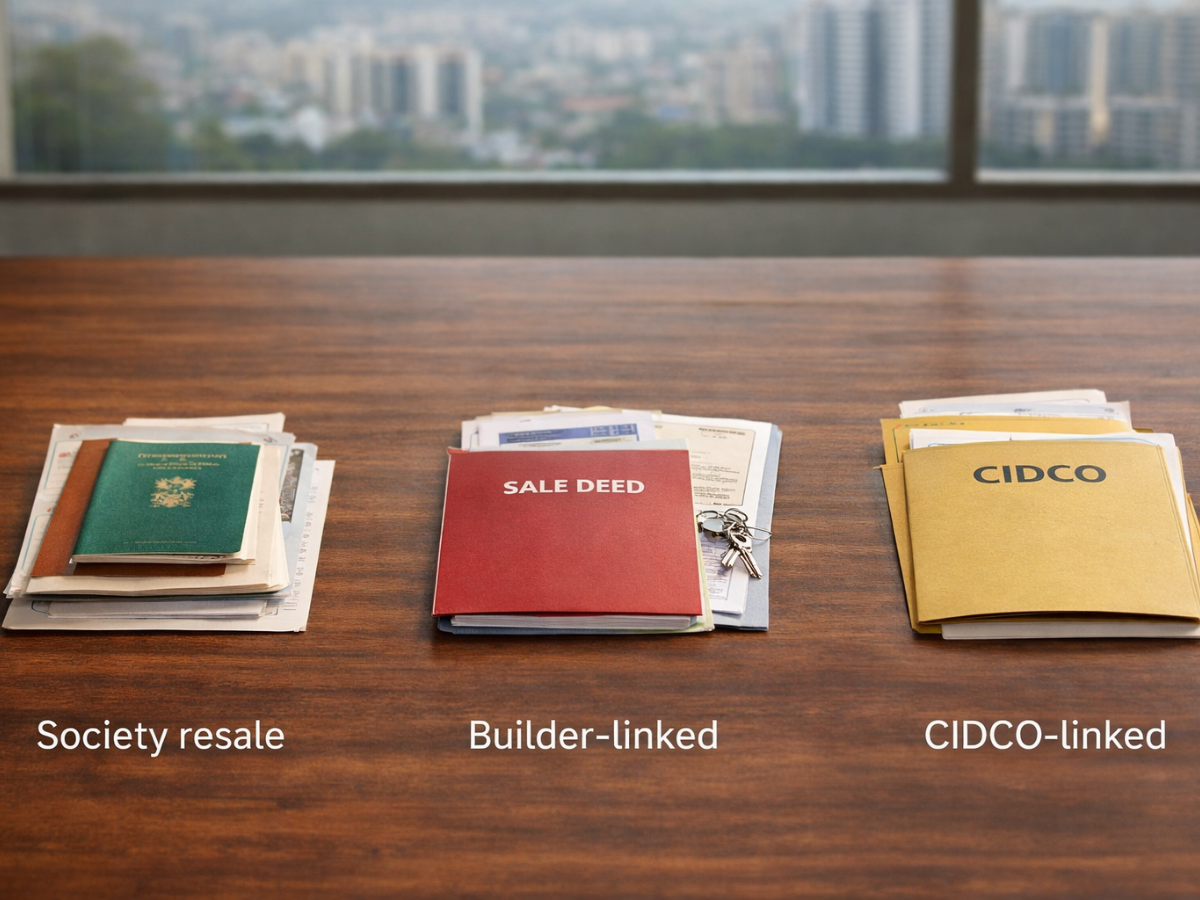
Not every sale deed case in Navi Mumbai is equal.
A standard freehold resale is one thing. A society flat is another. A CIDCO-linked leasehold asset is something else entirely.
Resale society flat
This is the most familiar resale pattern. But even here, do not reduce the case to only buyer-seller deed execution. Share certificate, no-dues status, transfer paperwork, and society record alignment matter.
Builder-delivered or recently completed property
If the unit comes from a developer or from a recent project, project-side legal hygiene matters. MahaRERA helps buyers check project registration and promoter-side details before the final transfer stage. That does not replace legal due diligence, but it is an important official verification layer.
CIDCO or leasehold property
This is where many outsiders to Navi Mumbai make mistakes. CIDCO’s estate-side controls can introduce NOCs, transfer charges, lease conditions, and later transfer orders. If the chain is weak, the registration may happen, but the property can still remain messy in practical control terms.
So if the property is in places where CIDCO legacy is strong, slow down and verify more.
Why sale deed registration gets delayed, objected to, or derailed
Most delays are not dramatic legal battles. They are avoidable mismatches.
Common triggers include:
- Name mismatch between deed and identity documents
- Wrong flat number, wrong sector, wrong area, or wrong boundary description
- Missing parent documents
- Unpaid property tax or society dues
- Wrong jurisdictional office
- Wrong assumptions in CIDCO-linked cases
- Seller presenting incomplete title chain
- Buyer assuming “PDE ho gaya, so everything is done”
One more point matters in Navi Mumbai: local administration is split. The property may be called Navi Mumbai casually, but the registration and post-registration consequences still move through different district and civic systems. That is why generic Mumbai advice is often not enough here.
What to collect and update after registration
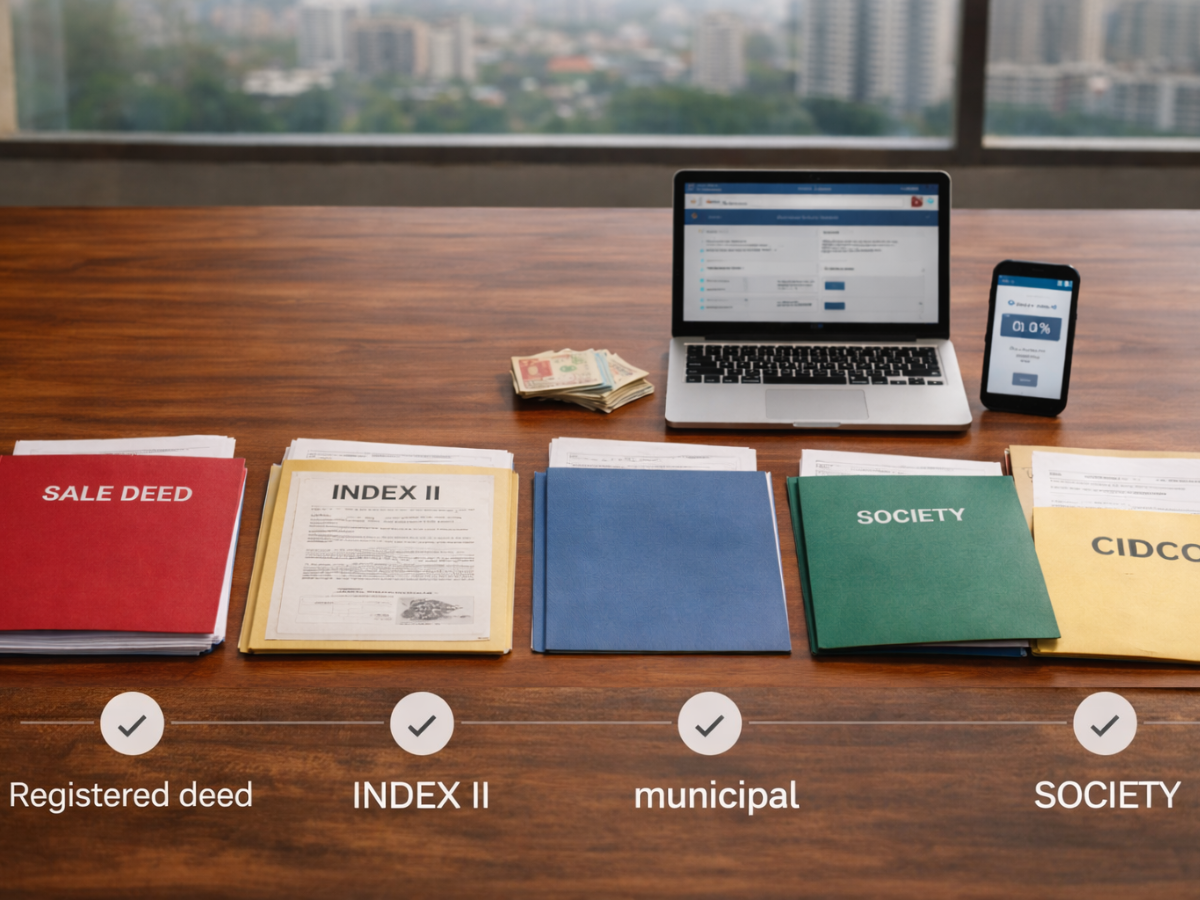
Registration is not the last step. It is only the legal transfer event.
The first document to secure after registration is Index II. After that, think in three separate tracks.
1) Registration proof track
- Download or obtain Index II
- Keep the registered deed safely
- Apply for certified copy later if required for loan, dispute, or record purposes
- Preserve payment proof and registration receipt
2) Municipal track
On the NMMC side, the dossier indicates a manual property-tax transfer route with a transfer-fee framework that should be checked with the ward office before filing. On the PMC side, the practical advantage is the UPIC-driven system, and correct UPIC entry during registration can support automated ownership update.
3) Society or CIDCO track
If it is a society flat, submit the registered papers and Index II so the society records and share certificate transfer can move. If it is CIDCO-linked, follow the separate transfer-order or estate compliance path that applies to that property type.
A lot of future resale pain begins because buyers stop after registration and never clean up the follow-up records.
Conclusion
If you want to register a sale deed in Navi Mumbai smoothly, do not think of registration as one office visit. Think of it as a pipeline.
The safest way is to verify title and dues first, understand whether the property is standard or CIDCO, society, or project-linked, check the value and payable charges correctly, complete PDE and e-StepIn carefully, go only to the correct jurisdictional office, and then finish the post-registration work properly.
That is what separates a clean transfer from a stressful one.
In Navi Mumbai, this matters even more because the city works through a Thane-Raigad split, NMMC-PMC differences, and CIDCO realities that generic property blogs usually ignore. If the article helps you remember just one thing, let it be this: a registered sale deed is powerful, but only a properly verified and properly followed-through registration becomes practically safe.
FAQ's
Frequently Asked Questions