
Construction Quality Disputes in Navi Mumbai: Buyer Rights, Builder Liability, and Complaint Process
A construction quality dispute in Navi Mumbai usually means a fight over real defects in structure, workmanship, waterproofing, fittings, services, or promised finishing, not just small new-flat snagging. The right remedy depends on three things: when you found the problem, whether the project is MahaRERA-registered, and whether the defect is inside your flat, in common areas, or linked to handover and approvals. In this subject, evidence matters more than anger.
For many buyers, the panic starts the same way. You take a flat in Kharghar, Ulwe, Taloja, Panvel, Ghansoli, or Seawoods. Within weeks, seepage appears. Tiles sound hollow. A bedroom wall shows a diagonal crack. The lobby looks far below brochure quality. The builder says it is “small work” and asks you to stop overreacting.
That is exactly where confusion begins.
Not every defect should be treated as a major legal battle. But not every defect is a harmless finishing issue either. In Navi Mumbai, this matters even more because local ground conditions, monsoon exposure, coastal air, hurried handovers, and mixed authority realities can turn a “small problem” into a serious one much faster than buyers expect.
Quick Summary: Where Your Dispute Usually Belongs
| Situation | Best first move | Main risk if you mishandle it |
|---|---|---|
| Minor paint, polish, alignment, small finish issues | Record in a snag list and get written acknowledgment at possession | Delaying possession unnecessarily over cosmetic issues |
| Seepage, repeated leakage, widening cracks, faulty plumbing, electrical failure | Send written notice with photos/video and demand rectification | Accepting verbal promises with no record |
| Possession pressure with defects still pending | Take a careful call, document everything, and sign only with a written defect annexure if proceeding | Refusing blindly or withholding payment without legal advice |
| Common area defects like podium leakage, lift trouble, terrace waterproofing, basement flooding | Push builder formally; do not assume society must pay from maintenance | Shifting builder liability onto residents too early |
| Registered project where builder ignores written notice | Escalate through MahaRERA or conciliation route if appropriate | Filing emotional complaints without documents |
| Older resale building issues | Check age, society records, past repairs, and structural audit position | Treating an old-building problem like a fresh builder-defect case |
What Counts as a Construction Quality Dispute in Navi Mumbai, and What Is Just Minor Snagging

The first practical step is to separate a snag from a real construction quality dispute.
A snag is a minor finishing issue that is common in new handovers. Think of uneven paint touch-up, a loose door stopper, a chipped tile edge, silicone finishing that looks untidy, a latch that needs adjustment, or cabinet alignment that is slightly off. These are worth recording, but by themselves they are usually not the heart of a legal-quality dispute.
A true construction quality dispute starts when the problem affects durability, safety, usability, or what was actually promised. Examples include chronic seepage, waterproofing failure, repeated plumbing leakage, major tile hollowing across areas, faulty electrical points, recurring drainage issues, concrete spalling, serious crack patterns, missing or downgraded amenities, or common areas delivered far below committed specifications.
This is where many buyers make the wrong move. They fight aggressively over small cosmetic defects, but ignore early signs of structural stress or water ingress. That is risky.
In Navi Mumbai, the distinction matters even more because some locations on the Panvel-Uran side and wider Navi Mumbai coastal belt sit in areas known for soft marine clay conditions and aggressive coastal exposure. That does not mean every crack is structural. But it does mean settlement, seepage, corrosion, and waterproofing failures should not be dismissed too casually.
Is Your Problem Before Possession, On Possession Day, or After Handover? That Changes the Remedy
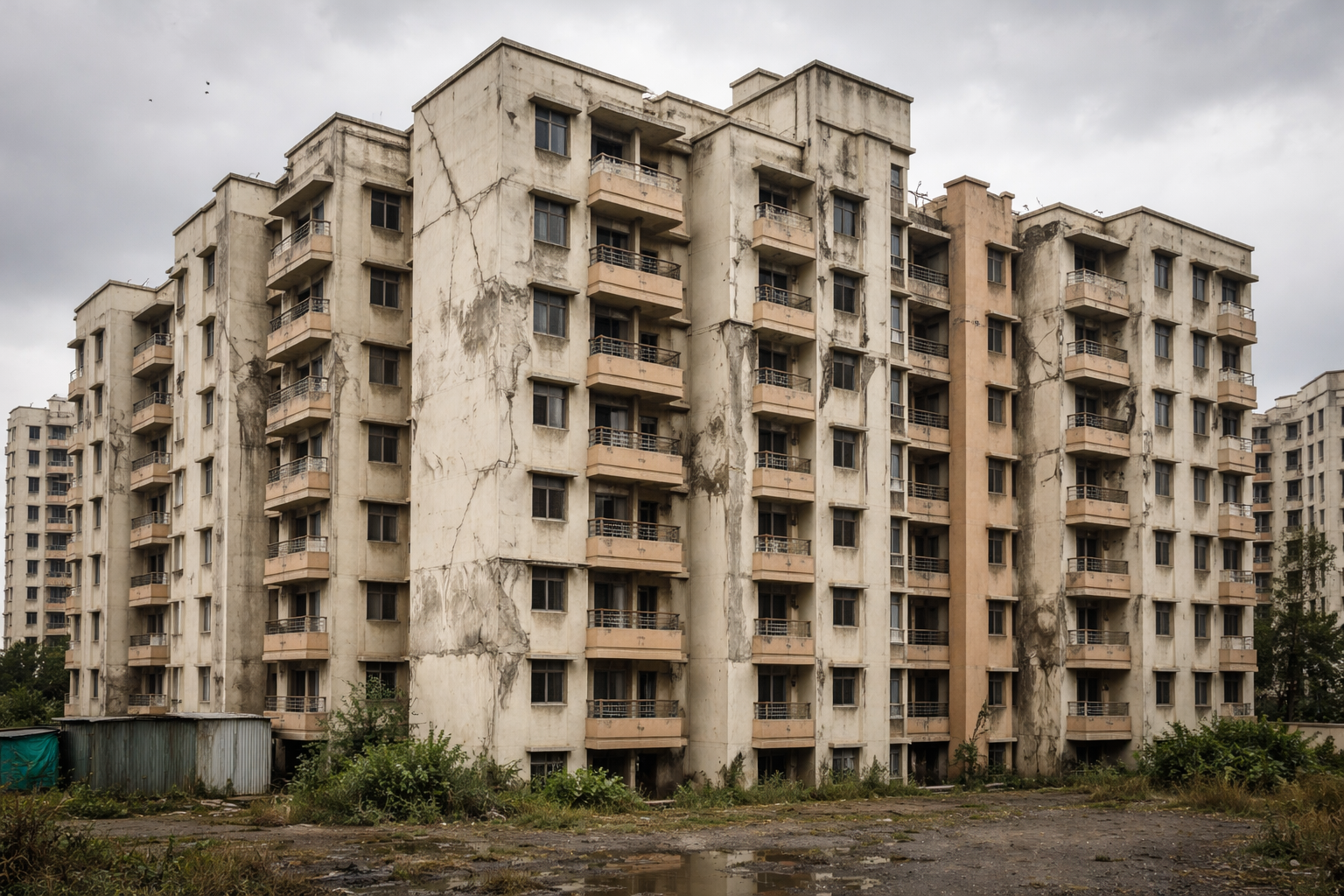
This is the most important decision point in the entire article.
Before possession
Before possession, your leverage is strongest in practical terms because the builder still wants closure, final payment completion, and a clean handover. This is the stage to inspect properly, photograph defects, compare actual delivery against the agreement and promised specifications, and raise a written defect list.
Do not rely only on a site engineer saying, “Sir, this will be fixed.” If it is not written, it is weak.
On possession day
Possession day is where many buyers lose control. They are tired, the family wants to move on, the builder’s team creates urgency, and defects get brushed aside as “normal.” This is the stage where documentation matters most.
Under RERA, the five-year defect-liability window is tied to the date of handing over possession, not the date when the project got its OC and not the date when the society later formed. That is why the possession date is so important.
After handover
After handover, the route becomes more formal. You now need written notices, a proper evidence trail, and a cleaner distinction between issues inside your flat, common area defects, and maintenance problems created by wear and tear.
If the project is MahaRERA-registered, Section 14(3) becomes central here. That is the provision buyers must understand properly.
Which Defects Usually Justify Escalation, and Which Ones Builders Often Dismiss as “Small Issues”

Builders often use one standard line: “This is normal in every project.” Sometimes that is true. Often it is just a delay tactic.
Seepage, leakage, and waterproofing failure
This is one of the biggest practical dispute triggers in Navi Mumbai. Monsoon exposure, terrace issues, wet-area execution, podium waterproofing failure, and poor sealing around windows can create repeated seepage in new towers.
If the same wall becomes damp again after one repair, this is no longer a simple touch-up issue. It points to root-cause failure, not surface finish.
Structural cracks versus harmless settlement marks
Not every crack is a structural crisis. But repeated diagonal cracks, stepped cracks in masonry, widening cracks, horizontal cracks, or cracks accompanied by water ingress should never be casually ignored.
In a place like Ulwe, Taloja, or Panvel-side growth corridors, buyers should be especially careful about crack patterns because local ground conditions can make differential settlement a more serious concern than people assume.
Flooring, doors, windows, and alignment defects
One hollow tile is annoying. A large patch of hollow flooring, repeated tile debonding, door frame misalignment, window leakage, or badly executed balcony slope is a construction quality problem.
Ask one question: is this cosmetic, or does it affect function and durability? If it affects use, repeat performance, or future damage risk, escalate it.
Plumbing, drainage, electrical, and service failures
Concealed pipe leakage, non-working drain slopes, repeated tripping, faulty DB panels, or bathroom backflow are not “small finishing” matters. They directly affect habitability and repair cost.
Unfinished common areas and promised amenities
If the project promised certain common facilities, lift specifications, delivery quality, or amenity standards and the actual handover is visibly downgraded, that can become a dispute too. This is especially relevant after MahaRERA’s 2024 amenities order and newer agreement formats, which tightened the treatment of promised facilities.
Builder Delay and Bad Construction Quality Are Not the Same Dispute

A delayed possession claim and a poor construction quality claim are related in real life, but legally and practically they are not the same thing.
Delay is mainly about the builder not giving possession as agreed. Quality dispute is about what was delivered and whether it is defective.
Many buyers make a drafting mistake here. They write one emotional complaint mixing delay, interest, seepage, amenity downgrade, parking confusion, and finishing issues into one unstructured story. That weakens the case.
A better approach is this:
- if your problem is delay, frame delay clearly
- if your problem is defects, frame defects clearly
- if both exist, separate them properly in the notice and evidence bundle
That makes your complaint cleaner, stronger, and harder to dismiss.
Can You Refuse Possession, Withhold Final Payment, or Sign Under Protest if Quality Is Poor?
This is where buyers need caution, not bravado.
Blindly withholding final payment can be dangerous. Under Section 19(6), allottees are expected to make payments as per the agreement. MahaRERA decisions have shown that persistent payment default can backfire badly on buyers.
So no, “just stop payment” is not safe advice.
When taking possession is risky
Refusing possession may be more defensible if the builder does not have a valid Occupancy Certificate covering your unit, or if the flat is fundamentally not ready for habitation in a basic sense. In such cases, the issue is bigger than finishing quality.
When possession may still be practical but evidence must be preserved
If the project is otherwise legally ready but defects remain, many buyers are better protected by documenting defects properly, paying according to legal advice and agreement obligations, and accepting possession with a clear written record rather than starting a payment-default problem.
A practical script many buyers use in this situation is along these lines:
> “I am taking physical possession of Unit [X] subject to unresolved defects recorded in the attached defect list/annexure. This acceptance does not waive my rights regarding pending rectification.”
Do not treat that as magic wording. Treat it as part of a larger documentation strategy.
What Proof Should You Collect Before You Email, Visit the Site Office, or File a Complaint
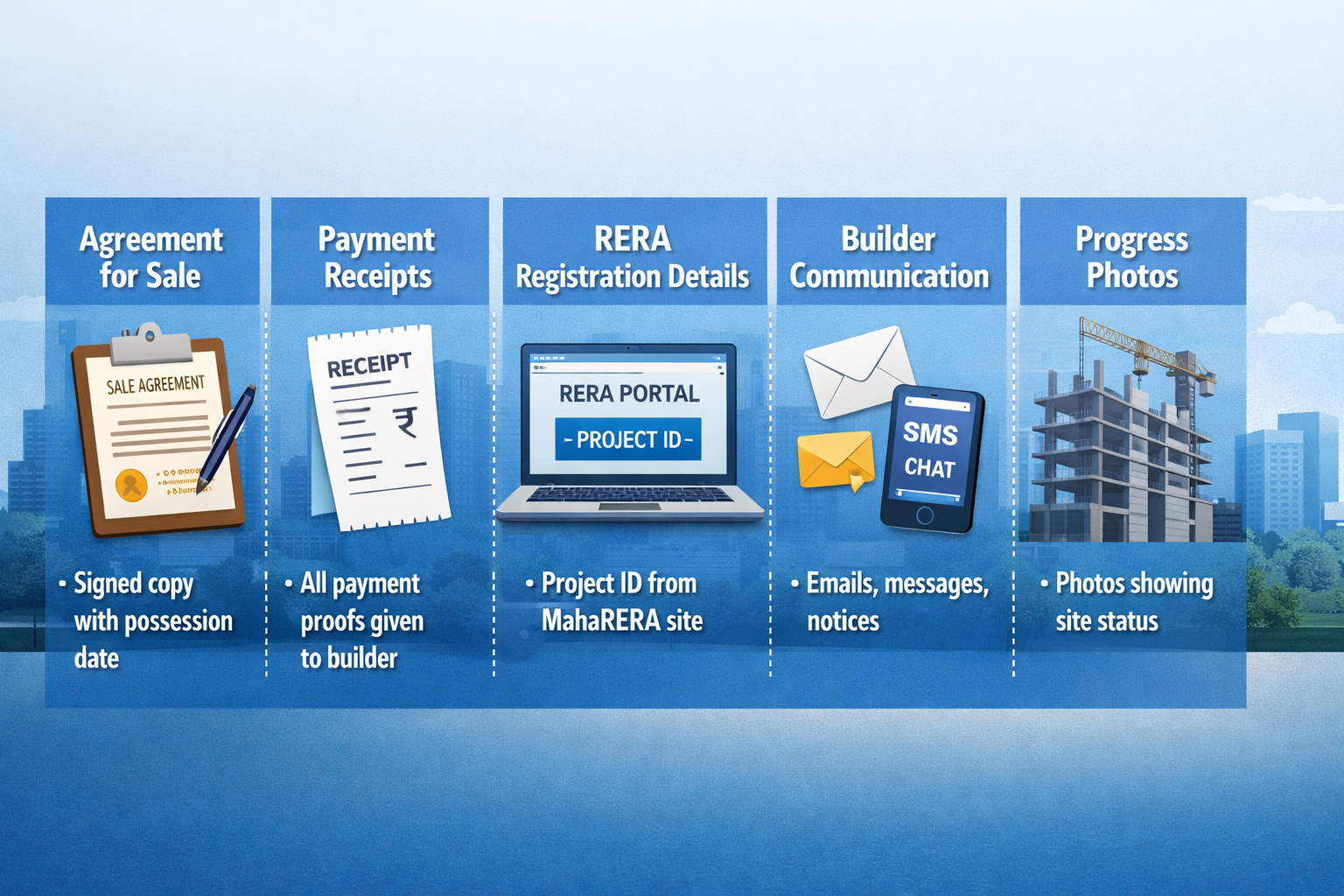
This is where strong cases are built.
Evidence Checklist
- Agreement for Sale
- possession letter or handover communication
- payment receipts and demand letters
- Occupancy Certificate status and relevant project documents
- timestamped photos and videos of each defect
- room-wise written defect list
- email trail with builder, CRM, and site team
- written acknowledgment from builder, if any
- engineer or snagging report if the defect looks serious
- records showing repeat failure after earlier repair
- society communication, if the issue affects common areas
- brochure, amenities commitment, or specification sheet where relevant
A few practical points matter here.
First, WhatsApp alone is weak. It may support your case, but do not rely on it as the main record.
Second, builder app tickets are not enough by themselves. Use email.
Third, if the issue is serious, get a technical report. A structural engineer, architect, or professional snagging report can change the entire quality of your complaint.
When Does MahaRERA Help in a Navi Mumbai Construction Quality Dispute?
MahaRERA helps most clearly when the project is registered and the dispute falls within the rights and obligations covered by the Act.
For defect cases, Section 14(3) is the key provision. It says that if a structural defect, workmanship defect, quality defect, service defect, or another relevant promoter obligation is brought to the promoter’s notice within five years from handing over possession, the promoter must rectify it without further charge within 30 days. If the promoter fails, compensation can be sought in the manner provided under the Act.
That is the practical backbone of many new-project defect disputes.
At the time of writing, the MahaRERA FAQ also lists the individual complaint fee at Rs 5,000 plus applicable charges. The portal also offers a conciliation option, and MahaRERA’s conciliation framework has been operated as a lower-cost route for settlement-focused cases. Always check the current portal before filing because process details can change.
MahaRERA is also more useful now than many buyers realize because quality-related disclosures have become stricter. The public system includes project-stage guidance, possession-stage checks, updated agreement forms, and annual Form 2A quality assurance disclosures by engineers. That means buyers should not only complain after damage appears. They should also compare the delivered reality with what the project publicly disclosed.
One more important point: separate complaints are generally expected. Group complaints are typically entertained where there is common relief, especially common amenities or common-area issues. So if the whole tower has terrace seepage or podium leakage, collective action can make sense.
When the Issue Is Not Only Inside Your Flat: Common Areas, Society Handover, Water Ingress from Above, and Tower-Level Defects

Many of the ugliest disputes in Navi Mumbai are not about one bedroom wall. They are about the whole building.
Think of terrace waterproofing failure in a new Kharghar tower. Or basement flooding in a Ghansoli project during monsoon. Or lift issues, lobby finishing mismatch, podium leakage, shaft seepage, and firefighting or service-area defects in a recently handed-over building.
These matters often create confusion because once the society starts functioning, residents assume the builder is out and the society must pay. That is not always correct.
If the building is still within the defect-liability window and the issue is really a construction or quality problem, the builder cannot escape simply because a society now exists. The society should not casually spend maintenance money on core construction failures that properly belong to the promoter’s liability period.
Also remember that some “inside flat” issues are actually tower-level issues. Water ingress from the terrace, faulty rainwater movement, external wall cracking, and repeated leakage from service shafts are not personal flat-owner problems in the normal sense.
What Changes in Resale Flats, CIDCO-Linked Properties, and Older Buildings
This section is where generic articles usually fail.
New project buyer versus resale buyer
A resale buyer does not step into the exact same position as an original allottee in every respect. But if the flat is resold within the original five-year post-possession period, the remaining defect-liability window may still matter against the promoter for covered defects.
That is why resale buyers should ask for the original possession date, not just the seller’s purchase year.
CIDCO and leasehold-linked practical caution
CIDCO-linked properties can have a different practical route because land, approvals, leasehold conditions, and housing-scheme structures are not always the same as a normal private freehold apartment project. If the problem is a housing scheme or CIDCO-administered issue, the grievance route may involve CIDCO’s own online grievance system and housing-side escalation, apart from any wider legal route that may still apply.
Also, do not mix up approval disputes with physical defect disputes. A CIDCO or planning-approval issue can delay handover or create document trouble. That is different from a physical seepage or structural-quality problem.
Why older-building defects cannot always be pushed back to the original builder
If you are buying an older flat in Vashi, Nerul, Belapur, or an early-phase Navi Mumbai building, do not write as if every defect is still a builder defect. Many older-building issues are age, maintenance, repair history, or structural-condition matters.
This is where NMMC’s structural-audit regime becomes important. Buildings over 30 years old fall under a structural audit requirement, and the city has recently identified hundreds of dangerous buildings in its surveys. For older resale purchases, that is not a side issue. It is core due diligence.
Navi Mumbai Ground Realities That Make These Disputes Worse
This topic is not identical in every city.
Navi Mumbai has local realities that make construction quality disputes sharper and more technical.
The first is monsoon exposure. A superficial repair may look fine in March and fail badly in July.
The second is coastal and creek-side exposure. Salt-laden air and moisture are harder on poor materials, weak external plaster systems, balcony elements, and badly protected reinforcement.
The third is soft-ground and marine-clay sensitivity in parts of the wider Panvel-Uran and JNPT-side belt. This does not make every new project defective. But it means good engineering, proper execution, and careful reading of cracks and settlement signs matter more.
The fourth is handover pressure in high-growth corridors. Airport, MTHL, metro, and infra-led market momentum can create a rush to close possession. Buyers should be especially careful when wet areas, terraces, podiums, and common services are not fully stabilized.
A Practical Action Plan: What a Buyer in Navi Mumbai Should Do in the First 7 Days, First 30 Days, and Before Escalation

Days 1 to 7
Inspect the flat properly. Do not do a token visit.
Make a room-wise defect list. Photograph and video every issue. Send one clean email to the builder attaching the list. If possession is happening, record the defects formally at that stage.
If the issue looks technical, bring in a professional early.
Days 8 to 30
Monitor what the builder actually rectifies.
Do not just hear assurances. Re-check each repair. If seepage returns after one rain or one usage cycle, update the record. If the same defect repeats, that strengthens your case because it shows failed rectification, not only first discovery.
Before escalation
Send a final written communication summarizing:
- defect history
- dates
- prior emails
- pending unresolved items
- demand for rectification under the applicable legal and contractual framework
Then choose the correct route:
- builder rectification
- MahaRERA complaint or conciliation for registered projects
- society-led collective push for common defects
- consumer or other forum if the matter sits outside the clean registered-project defect route
When Should You Bring in an Engineer, Architect, Society Office-Bearer, or Property Lawyer?
Bring in a structural engineer when cracks look repeated, widening, stepped, horizontal, or linked to water ingress or visible distress.
Bring in an architect or snagging professional when the issue is widespread quality failure, amenity mismatch, slope defects, tile debonding, waterproofing trouble, or repeated finishing defects across the unit.
Bring in society office-bearers when the issue affects common areas, more than one flat, the terrace, basement, podium, shaft, lifts, or drainage lines.
Bring in a property lawyer when the builder threatens cancellation, you are being pushed into unsafe payment tactics, the defect bundle is substantial, or you are moving from complaint to formal adjudication.
The mistake is not getting expert help. The mistake is waiting until the evidence has already gone cold.
Conclusion
Construction quality disputes in Navi Mumbai are not solved by one angry site visit. They are solved by classifying the defect properly, understanding the stage of the project, preserving evidence, and choosing the right authority route.
The smartest practical rule is this: document first, escalate second.
If the issue is minor snagging, close it quickly and move on. If it is seepage, structural-looking cracking, repeated service failure, or common-area quality breakdown, do not let the builder reduce it to a “small issue.” In Navi Mumbai, where monsoon stress, coastal exposure, rapid handovers, and mixed local authority realities all matter, early clarity can save both money and years of unnecessary dispute.
FAQs
Frequently Asked Questions