
Should You Buy CIDCO Flat or Private Builder Flat in Navi Mumbai?
If you want more usable space, simpler pricing logic, and a practical home in a planned node, a CIDCO flat can be the smarter buy. If you want newer towers, better amenities, modern parking, and a more lifestyle-driven living experience, a private builder flat usually wins. In Navi Mumbai, the right choice depends less on branding and more on budget, leasehold or freehold status, building age, carpet efficiency, transfer rules, and where exactly you are buying.
Many buyers compare these two categories in the wrong way. They compare brochure price, building looks, and maybe the area name. But in Navi Mumbai, that is not enough. A CIDCO flat and a private builder flat can behave very differently in legal process, maintenance burden, resale ease, and even actual living space.
This is exactly why the answer is not one-size-fits-all. A family looking for long-term end use in a mature node may make a very different decision from an investor targeting rental demand near airport-driven growth corridors.
CIDCO flat or private builder flat in Navi Mumbai: which one is better for most buyers?
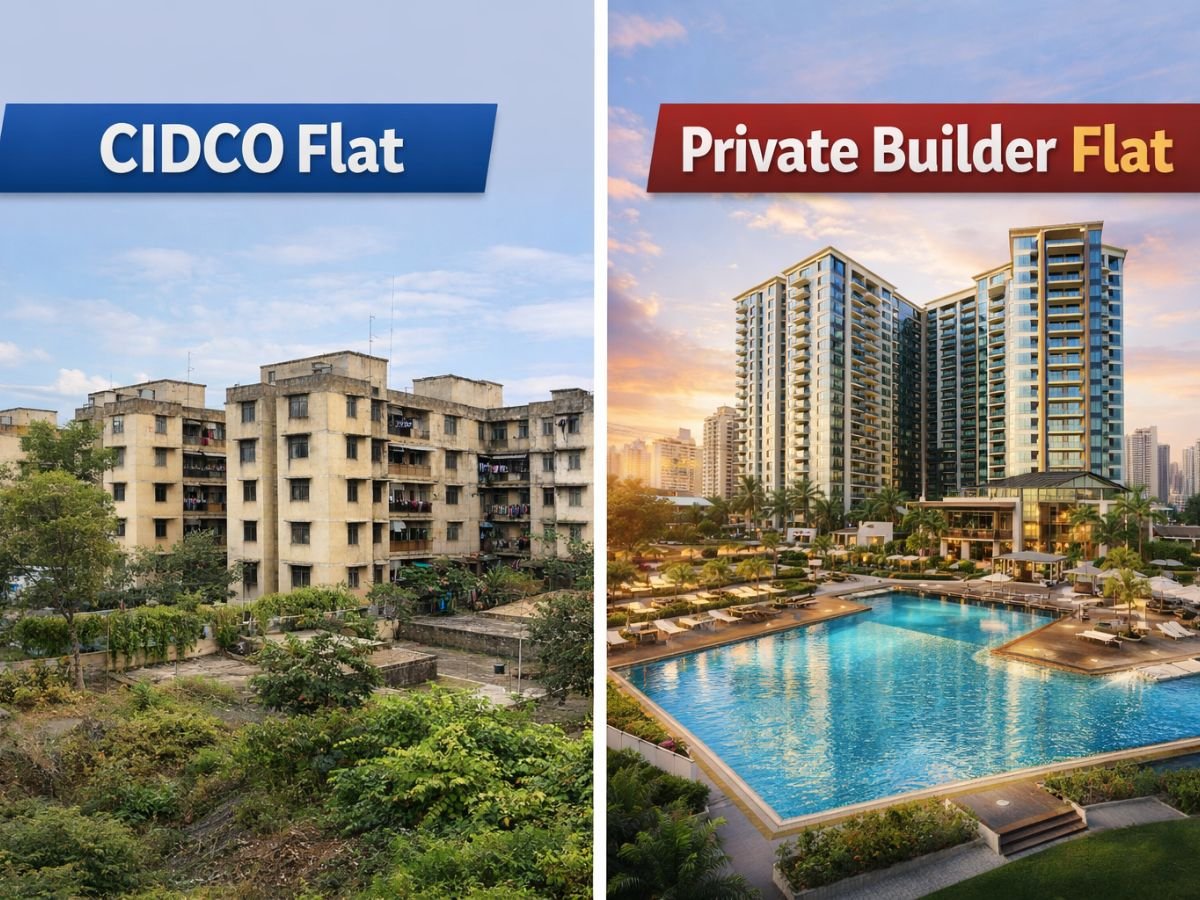
For most practical buyers, a CIDCO flat is better when the priority is carpet area, planning discipline, and price control. A private builder flat is better when the priority is modern living, convenience, amenities, and newer construction.
Here is the fast answer.
| Buyer priority | CIDCO flat usually works better | Private builder flat usually works better |
|---|---|---|
| More usable space for the money | Yes | Usually no |
| New tower feel and modern amenities | No | Yes |
| Lower entry budget in many resale cases | Yes | Usually no |
| Easier lifestyle appeal for tenants and young families | Sometimes | Yes |
| Lower loading confusion | Yes | No |
| Lower paperwork friction | Not always | Sometimes yes, but not automatically |
| Mature node practicality | Often yes | Depends on project |
| Parking, clubhouse, tower facilities | Usually weaker | Usually stronger |
The biggest mistake buyers make is thinking a private flat with a shiny tower automatically gives better value. In the Mumbai Metropolitan Region, private projects can carry an average loading factor of around 43 percent. That means a flat sold on a much larger super built-up number may deliver much less actual usable space than the buyer assumes.
A CIDCO flat, by contrast, is often far more direct in space efficiency. That does not make it automatically better. It just means the comparison has to start with real carpet area, not brochure comfort.
What really changes when the flat is CIDCO-built versus privately developed?
The real difference is not just government versus private. It is also about land structure, age, layout logic, common facilities, and long-term ownership friction.
Ownership and land structure can change the whole risk profile
Many Navi Mumbai properties sit on leasehold land patterns linked to CIDCO’s planning framework. This is where buyers get confused. A flat may be built by a private developer, but the underlying plot may still have CIDCO-linked lease conditions unless converted to freehold.
So the safe shortcut is this: do not assume that a private builder flat is automatically freehold or legally simpler. Check the actual land status, transfer conditions, and whether any conversion has already happened.
Building age, layout style, and daily living can feel very different
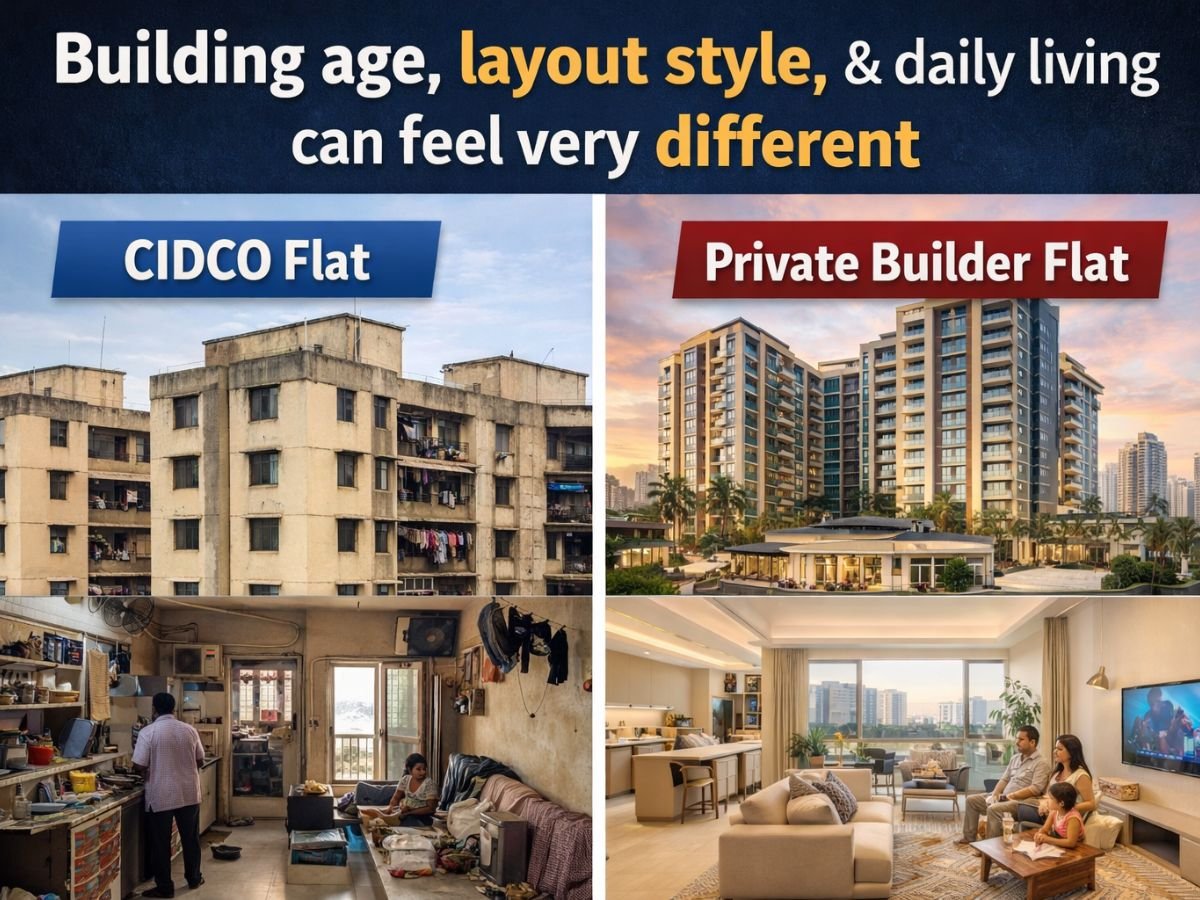
Older CIDCO flats were designed for functional city living. Many have efficient rooms, lower loading, and practical neighborhood planning. But some older stock also comes with obvious limitations: no lift, tighter parking, older wiring, structural fatigue, and societies that need repairs.
Private builder flats usually offer:
- newer lifts
- gated entry
- better lobby finish
- podium or designated parking
- more polished common areas
- lifestyle positioning
But that lifestyle comes at a cost. Sometimes a big one.
Amenities, maintenance, and common charges are not the same
This is where many buyers shift their opinion. A private tower may offer everything a modern family wants: security, gym, children’s play area, clubhouse, CCTV, landscaped podium, and better visitor impression.
A CIDCO flat usually wins less on glamour and more on practical living. But in old buildings, maintenance can become uneven, especially where repair funds are weak or building age is high.
So the real comparison is this: CIDCO often gives better space efficiency. Private builder housing often gives better daily convenience.
Price is only the starting point: where CIDCO flats can save money and where they can cost more later
A lot of buyers think a CIDCO flat is automatically the cheaper option. Sometimes it is. Sometimes it is only cheaper at first glance.
A resale CIDCO flat may come at a lower entry price than a private tower in the same wider zone. But the true cost of ownership can rise once you add transfer charges, renovation work, society repair contribution, plumbing replacement, older flooring, electrical upgrades, and possible waterproofing.
As of the 2025-2026 cycle, CIDCO transfer charges increased again, and in developed nodes these can range from modest amounts for smaller areas to well over ₹11 lakh in higher slabs. Registered society flats can face additional cost impact too. For budget buyers, this can disturb the entire deal after token money is already paid.
Lower entry price does not always mean lower total cost
A 25 to 30-year-old CIDCO flat in Vashi, Nerul, or similar mature nodes may look attractively priced. But if you then spend heavily on:
- kitchen replacement
- bathroom upgrades
- plumbing lines
- electrical rewiring
- society repair fund
- transfer charges
the original bargain can weaken fast.
That is why CIDCO flats should be judged on total ownership cost, not just agreement value.
A caution buyers often miss
A cheap CIDCO flat can become expensive in real life if:
- the building is structurally tired
- the title chain is incomplete
- prior transfer compliance is not clean
- the society has upcoming major repairs
- parking is poor
- freehold conversion has not happened and future transfer costs remain
This does not mean avoid CIDCO stock. It means buy only after proper math.
Where private builder flats usually pull ahead and where they can disappoint
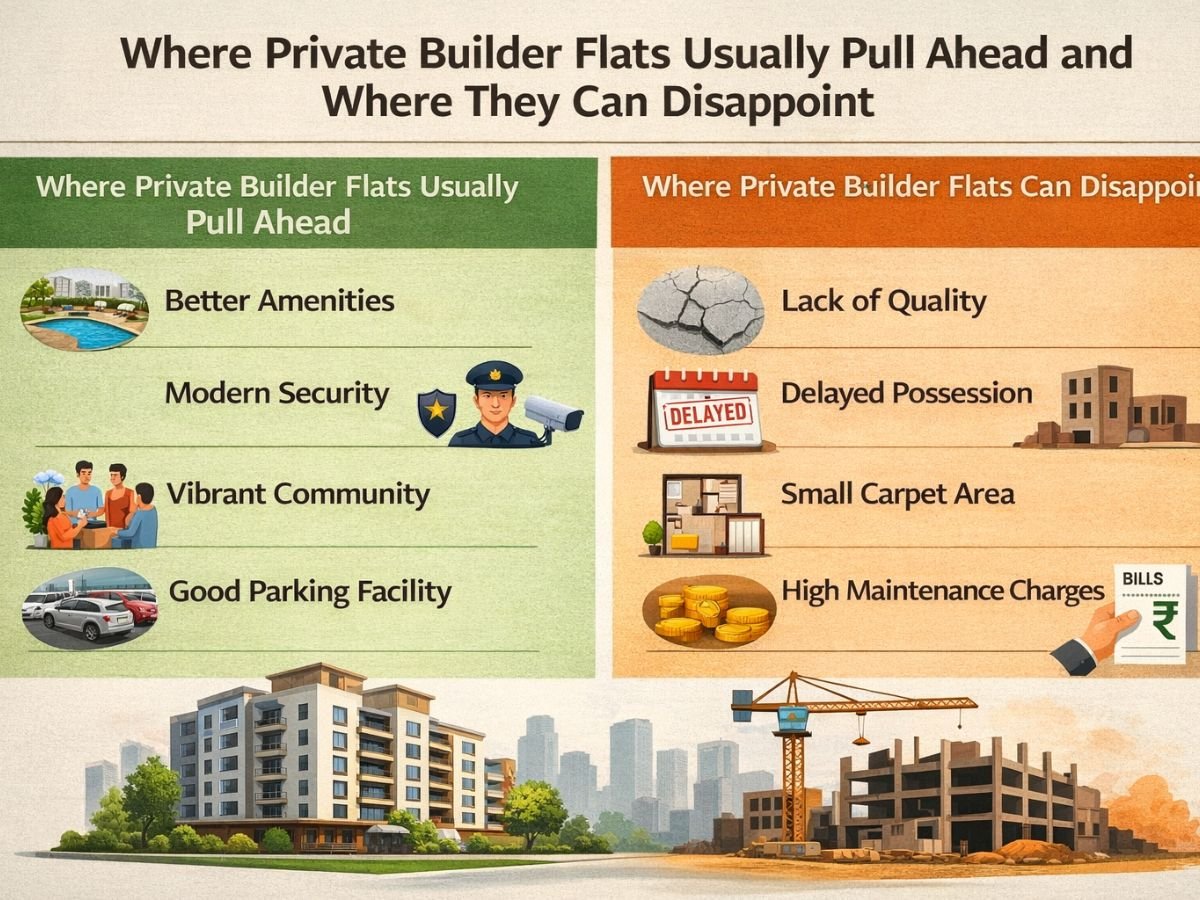
Private builder flats usually win on presentation, convenience, amenities, and immediate family comfort. For many end users, that is a very real advantage.
A newer private building in Kharghar, Panvel side, Ulwe, or a developing belt can give:
- better lift infrastructure
- proper parking
- cleaner common areas
- more modern flat layouts
- stronger appeal for tenants
- easier lifestyle positioning for resale
But the downside is equally real.
Newer amenities and layouts do improve liveability
A young family with two cars, school-going children, elderly parents, and a preference for lift access may find a private builder flat more suitable even at a higher price. The daily friction is often lower. That matters.
In dense nodes, old CIDCO planning may still feel solid at neighborhood level, but the building itself may not serve modern lifestyle expectations.
Loading, premium pricing, and growth-corridor risk can disappoint
This is where buyers need discipline. A private flat may look larger on paper but deliver much less usable carpet area because of heavy loading. If the average loading is around 43 percent, a 1,000 sq. ft. super built-up flat may effectively give only about 570 sq. ft. of carpet area.
That changes the comparison completely.
| Comparison point | CIDCO example | Private builder example |
|---|---|---|
| Advertised purchase size | 1,000 sq. ft. | 1,000 sq. ft. |
| What buyer actually gets | Close to full usable area logic | Around 570 sq. ft. carpet if loading is 43% |
| Price logic | More direct | Often brochure-driven |
| Buyer confusion risk | Transfer/legal | Size/loading/amenity premium |
Also, in growth corridors like Ulwe, Dronagiri, and Panvel-side locations, builders often price future infrastructure benefits into current rates. So buyers may be paying today for airport, bridge, metro, or connectivity value that may take time to fully mature on the ground.
Leasehold, freehold, and transfer rules: the comparison most buyers ignore
This is one of the most important sections in this entire decision.
Historically, many Navi Mumbai properties work within a leasehold land framework connected to CIDCO. A freehold property is generally easier in future transfer and ownership flexibility. But not every private project is automatically freehold, and not every leasehold property is a bad buy.
Why CIDCO-linked properties need more document reading
In a CIDCO resale, a buyer should not depend only on a society NOC. That is not enough. The key practical issue is whether the seller has a proper transfer chain and the necessary final transfer compliance.
If an earlier owner skipped transfer charges or transfer order formalities, the current buyer can inherit a dirty title problem. In real life, this can affect loan approval, resale, and legal comfort.
When freehold status becomes a major advantage

The leasehold-to-freehold conversion scheme, extended until December 31, 2026, matters a lot here. If a society or plot has successfully converted to freehold by paying the applicable premium linked to Ready Reckoner Rates, future CIDCO transfer charges can be permanently eliminated.
That is a major value add.
A CIDCO-linked flat that has already moved into a cleaner freehold position can become much more attractive than buyers expect.
Do not assume private means simple
A private tower built on a CIDCO tender plot may still carry leasehold-linked realities if conversion has not happened. So the correct question is not “CIDCO or private?” The better question is “what is the actual land and title structure of this exact property?”
Which option works better in different parts of Navi Mumbai?
The answer changes by node. This is where many generic articles fail badly.
Older planned nodes
In mature nodes like Vashi, Nerul, and similar established areas, older CIDCO stock can still make strong sense for buyers who value location, rail access, daily convenience, and neighborhood planning. These areas also have redevelopment potential in some cases, especially where older buildings sit on wider roads and become attractive under UDCPR 2020 FSI incentives.
This creates an unusual opportunity. Sometimes an old CIDCO flat is not just an old flat. It is a redevelopment play.
Kharghar and mixed-stock locations
Kharghar is one of the clearest mixed-stock markets. Here, both CIDCO and private options can be serious contenders. A CIDCO flat may offer more practical space logic and planned node strength. A private tower may offer better amenities, better family appeal, and stronger immediate lifestyle comfort.
There is no default winner in Kharghar. The building-level decision matters more than the category label.
Taloja, Panvel side, and newer growth belts
In growing belts, location governance matters as much as the building. This is especially true in the Taloja side, where buyers often fail to distinguish between more planned CIDCO-administered areas and fringe pockets with weaker civic performance. Water, roads, municipal follow-through, and commuter convenience can differ sharply.
In such zones, a private builder flat with polished interiors may still be a weaker real-life purchase if the external civic environment is lagging.
For end use, rental income, and resale, the right answer is not the same

A self-use buyer, investor, and budget end-user should not all buy the same kind of property.
Best fit for self-use families
A family that wants long-term occupation, more usable internal space, and practical neighborhood living may do very well with a good-quality CIDCO flat in a mature or well-connected location, especially if documentation is clean and the building is still physically sound.
Best fit for rental-focused buyers
Tenants usually care more about:
- station or commute access
- lift
- parking
- security
- cleaner tower feel
- modern washrooms and kitchen
- society appearance
Because of this, private builder flats can perform better in rental appeal, especially for white-collar tenants in airport, logistics, IT, and service-linked demand pockets.
Best fit for resale and appreciation-minded buyers
This is more case-specific. Private towers in good demand zones may show stronger lifestyle-led resale appeal. But old CIDCO stock in mature nodes can hold surprising liquidity in budget-friendly segments, and in some cases redevelopment can completely change the upside story.
Do not assume that appreciation is guaranteed in either category. By 2025-2026, some infrastructure expectations are already priced into many private launches.
When a CIDCO flat is the smarter buy
A CIDCO flat is usually the smarter buy when:
- your budget is tight but you still want a proper location
- carpet area matters more than clubhouse lifestyle
- you prefer mature nodes with proven daily convenience
- the documentation chain is clear
- the building has acceptable structural condition
- the society has already converted to freehold, or the buyer fully understands the leasehold implications
- you are patient enough to handle some administrative friction
A very practical example is a family buying a well-maintained older CIDCO flat in a mature node instead of stretching for a glossy tower in an outer growth belt. On paper, the private flat may look more premium. In daily life, the CIDCO flat may give better space use, better routine convenience, and lower lifestyle mismatch.
When a private builder flat is the smarter buy
A private builder flat is usually the smarter buy when:
- you want newer construction and modern finishes
- lifts, parking, security, and family amenities are non-negotiable
- you are buying mainly for rental appeal or young-family convenience
- you want a cleaner move-in experience with less renovation
- the carpet area is clearly disclosed and the loading still works for your budget
- the project has strong legal and execution visibility
- you value convenience more than space efficiency
A simple example is a buyer with stable income choosing a nearly ready or ready private project in a well-performing micro-market rather than spending months fixing an old resale flat.
What to verify before paying token money for either option
This is where mistakes become expensive.
Checks that matter more in a CIDCO-linked flat
Before paying token money, verify:
- original allotment letter
- unbroken chain of agreements
- final transfer order or transfer compliance status
- whether any past transfer charges are unpaid
- leasehold or freehold position
- whether society records match ownership documents
- whether the flat falls under any lock-in restriction if it originated from a recent CIDCO scheme
Checks that matter more in a private builder flat
Before paying token money, verify:
- MahaRERA details and declared carpet area
- commencement certificate where relevant
- title clarity and encumbrance position
- occupation or completion-related status depending on project stage
- maintenance terms and parking allocation
- whether the project land is freehold or still carries CIDCO-linked lease terms
Quick due diligence checklist before token payment
| Check | CIDCO-linked resale flat | Private builder flat |
|---|---|---|
| Carpet area reality | Important | Very important |
| Allotment letter | Critical | Usually not central |
| Chain of agreements | Critical | Important |
| Final Transfer Order | Critical | Not usually central |
| MahaRERA details | Limited relevance in old resale | Critical in active/recent projects |
| Leasehold/freehold status | Critical | Critical |
| Repair burden and age | Very important | Important |
| Parking and amenities reality | Important | Very important |
Final decision framework: choose based on budget, risk, and holding period
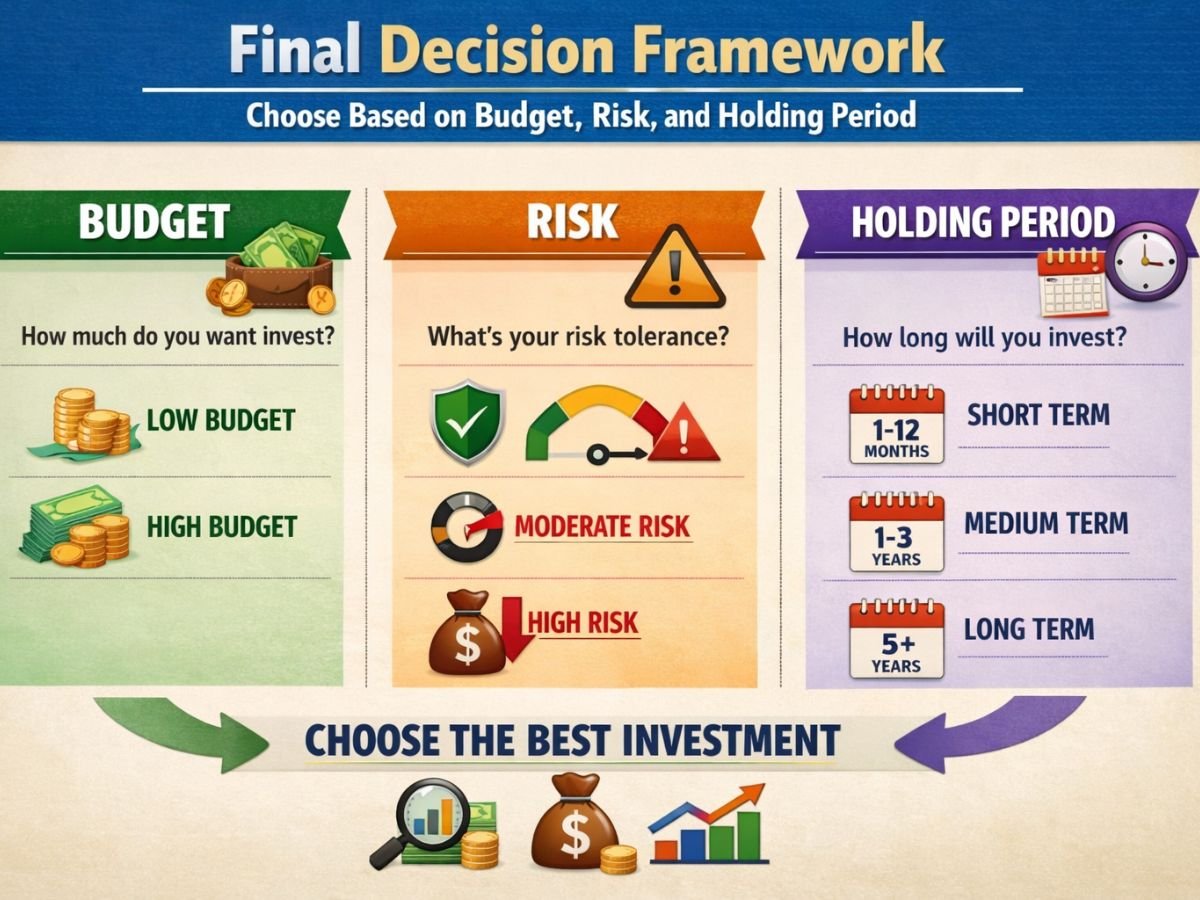
Use this simple framework.
If your top priority is space and capital discipline, lean toward a CIDCO flat.
If your top priority is modern living and convenience, lean toward a private builder flat.
If your top priority is lower legal friction, do not choose by category alone. Choose by actual title clarity and land status.
If your top priority is long-term family use in a mature node, a good CIDCO flat can be excellent.
If your top priority is tenant appeal or newer tower demand, a private builder flat may serve better.
The most practical final verdict is this: buy a CIDCO flat when you are optimizing for usable space, planning logic, and value discipline. Buy a private builder flat when you are optimizing for comfort, amenities, and modern liveability. But in Navi Mumbai, never decide from brochure appearance alone. Decide only after checking carpet area, transfer structure, land status, building age, and the exact local context of the node.
Conclusion
There is no permanent winner between a CIDCO flat and a private builder flat in Navi Mumbai. The better buy depends on what you are solving.
Choose a CIDCO flat when you want honest space, mature planning, and stronger value discipline.
Choose a private builder flat when you want newer living standards, better amenities, easier daily comfort, and stronger tenant-facing appeal.
But whatever you choose, do not compare only by rate per square foot or tower appearance. In Navi Mumbai, the smarter buyer compares carpet area, title chain, transfer burden, land status, age, and exact node reality before paying even a token amount.
FAQs
Frequently Asked Questions