
Housing Society Share Certificate in Navi Mumbai: Legal Guide
In Navi Mumbai, a housing society share certificate is the document that proves your membership in the cooperative housing society that owns or leases the building and land. It is not the same as the sale deed. The sale deed proves the property transaction, while the share certificate proves that the society recognizes you as its member. It becomes legally important during resale, society transfers, inheritance cases, duplicate certificate requests, and many bank loan processes. However, its absence does not always mean the flat is illegal, especially in newer projects where societies are still being formed.
After understanding that core idea, the next question becomes more practical: when does this document actually matter, and when is it simply part of due diligence?
A share certificate is only one part of the ownership-verification process, so buyers should also read this property buying checklist documents in Navi Mumbai to understand the full set of documents they need to check.
Quick Summary: Share Certificate in Navi Mumbai
| Scenario | Is Share Certificate Expected? | Is It Legally Important? | What Buyers Should Check |
|---|---|---|---|
| Resale flat in an existing housing society | Yes | Usually required for society transfer | Seller’s original certificate and society records |
| Inheritance or nominee transfer | Yes | Required to update society membership | Legal heir documents or nomination |
| Newly completed project where society is not formed yet | Not always | May be issued later | Sale deed, allotment letter, builder records |
| Flat in CIDCO leasehold node | Yes, but after CIDCO transfer | Important for society endorsement | CIDCO transfer order and NOC |
| Renting a flat | No | Not required for tenants | Leave and license agreement |
What a Housing Society Share Certificate Actually Proves in Navi Mumbai

A housing society share certificate is issued by a cooperative housing society under the Maharashtra Co-operative Societies Act, 1960. It confirms that the person named on the certificate holds a certain number of shares in the society.
In most residential societies in Maharashtra, the standard allotment is:
- 10 shares
- ₹50 per share
- Total paid-up share capital: ₹500
That ₹500 amount is symbolic. The real value of the certificate is that it proves membership in the legal entity that manages the building and land.
This is where many buyers misunderstand the document.
A registered sale deed proves the purchase of the property from the seller or developer. But the share certificate proves that the cooperative society officially recognizes the buyer as a member who:
- Has the right to occupy the flat
- Can vote in society meetings
- Can participate in managing committee elections
- Can legally transfer the flat through society records later
In simple terms:
- Sale deed = transaction record
- Share certificate = society membership proof
Without the certificate being transferred to your name, the society may still consider the previous owner as its official member.
When Is a Share Certificate Legally Required, and When Is It Only Practically Important?
The share certificate becomes important in several real-life situations involving a housing society. But it is not required in every type of property transaction.
In a Resale Transfer Within an Existing Cooperative Housing Society
This is the most common situation.
When a flat is sold in a cooperative housing society, the buyer must apply for membership transfer. The original share certificate is surrendered by the seller and endorsed by the society in the buyer’s name.
Under the Maharashtra Cooperative Societies rules:
- The society must process the transfer after receiving proper documents
- The maximum society transfer premium is capped at ₹25,000
Any demand above that amount is illegal.
During this process the society usually checks:
- Registered sale deed
- Original share certificate
- Transfer forms (Appendix 20 and 21)
- Society dues clearance
Only after approval does the society endorse the certificate in the new owner’s name.
If you are checking a resale flat or society-held property, this Navi Mumbai property due diligence checklist will help you understand how the share certificate fits into the wider legal and ownership check process.
In Nominee, Heir, or Post-Death Membership Transfer
If a flat owner passes away, the society must update membership records.
Two common situations arise:
1. Nominee exists
If the owner had registered a nominee with the society, the transfer is usually straightforward. The nominee submits documents and the society updates the share certificate.
2. No nominee
If there is no nomination, the process becomes more complex and may require:
- Legal heir certificate
- Indemnity bonds
- Consent affidavits from heirs
- Sometimes a succession certificate from court
The share certificate is then transferred to the rightful heir.
For Duplicate Issue, Correction, or Record Update Inside the Society
Share certificates are sometimes lost or damaged.
To obtain a duplicate certificate, societies usually require:
- Police complaint or non-cognizable report
- Affidavit declaring loss
- Indemnity bond
- Public notice in newspapers
- Managing committee approval
This process may take one to two months.
When It Is Commonly Asked for but Not the Only Deciding Document
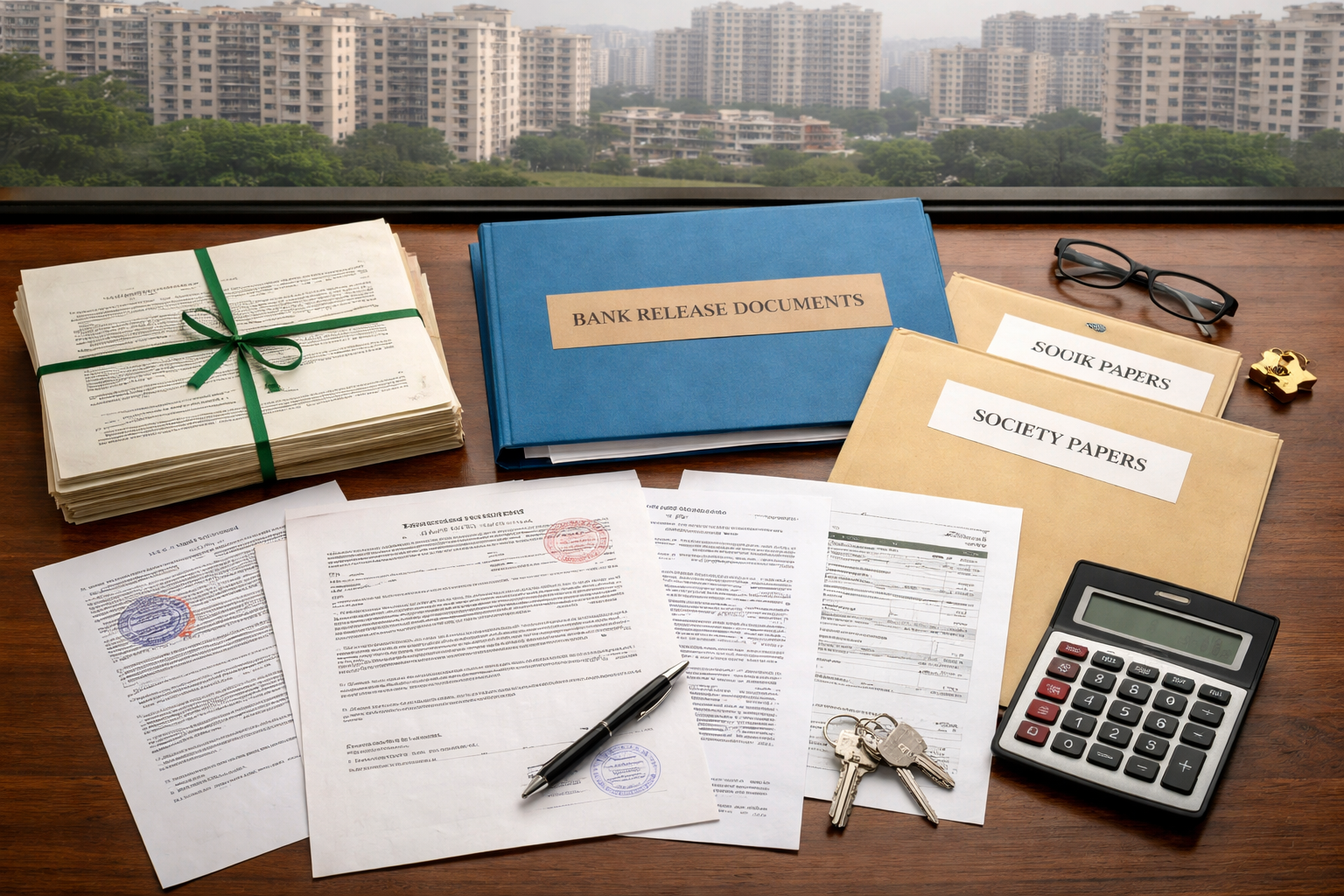
In some situations the certificate is requested but not always mandatory.
Examples include:
- Bank loan scrutiny
- Redevelopment approvals
- Municipal mutation processes
- Society record verification
In such cases, the sale deed and other documents still play a major role.
Can a Flat in Navi Mumbai Still Be Genuine if There Is No Share Certificate Yet?
Yes, sometimes. But the reason matters.
The absence of a share certificate can fall into two very different categories: normal delay or potential red flag.
Newer Projects Where Society Formation Is Still Pending
In many new projects across Ulwe, Taloja, Dronagiri, and parts of Panvel, the cooperative housing society may not yet be formally formed.
Under MahaRERA rules, the builder must form the society within a short period after:
- Receiving the Occupancy Certificate, or
- When 51% of flats are sold
Until the society is formed, share certificates may not exist yet. Buyers usually rely on:
- Allotment letter
- Registered sale agreement
- Builder records
Once the society forms, certificates are issued later.
Cases Where Sale Deed Exists but Society Records Are Incomplete
Sometimes a resale happens, but the seller never updated the society membership earlier.
For example:
- A flat may have changed hands informally years ago
- Society records were never updated
- Share certificate still carries an old owner’s name
In such cases, the transfer must first correct the society records before issuing a new certificate.
Cases Where No Certificate Is Normal vs Suspicious
Normal situations include:
- Newly completed projects
- Society formation still pending
- Certificate printing delay
Potential warning signs include:
- Seller cannot show the certificate or explain why it is missing
- Society records do not match the seller’s name
- Multiple historical transfers without documentation
These cases require deeper verification.
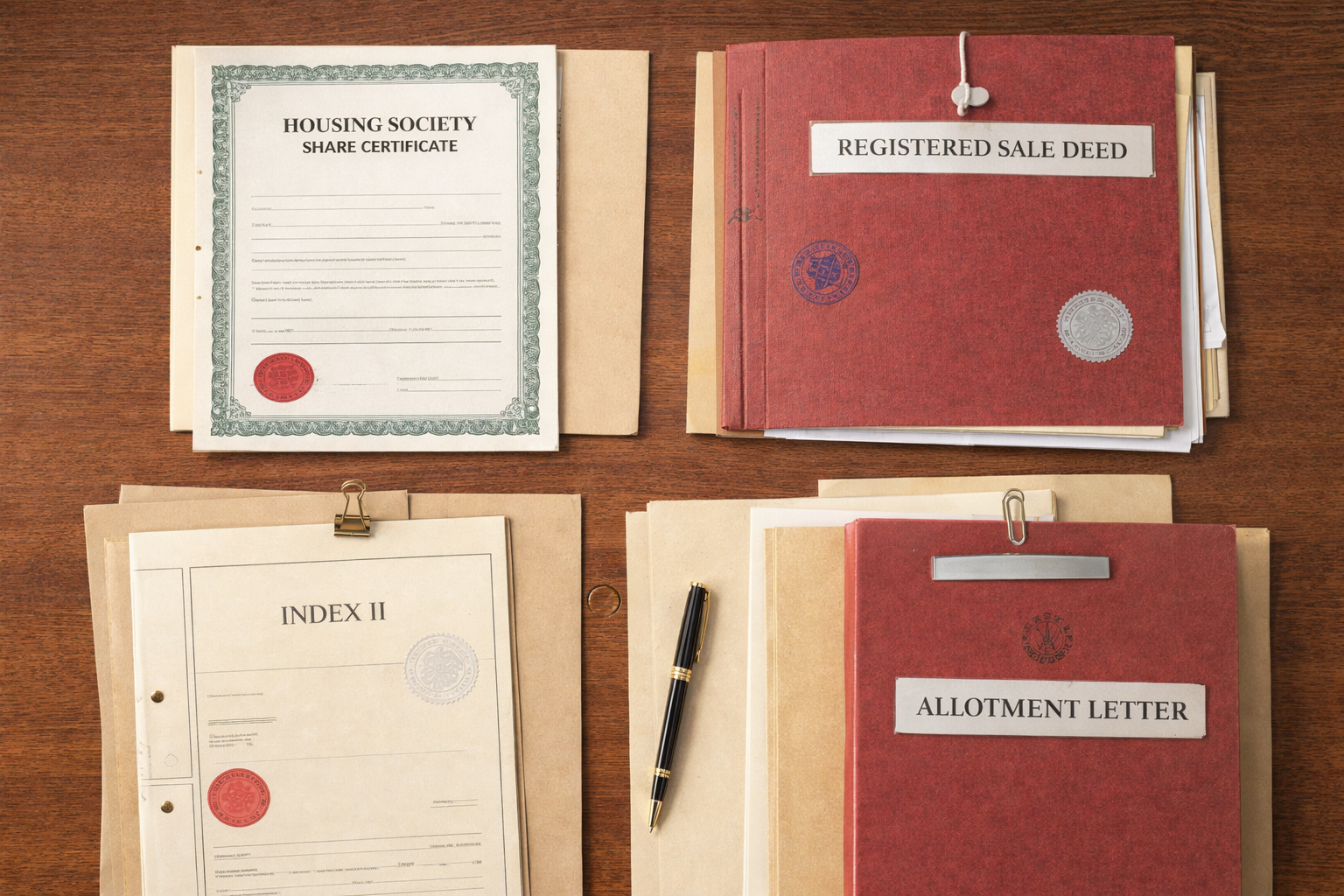
Share Certificate vs Sale Deed vs Index II vs Allotment Letter: Which Document Does What?
Many buyers confuse these documents. Each serves a different purpose.
| Document | Issued By | What It Proves | When It Is Used |
|---|---|---|---|
| Share Certificate | Housing society | Membership and shareholding in the society | Society transfer, AGM rights |
| Sale Deed | Sub-Registrar office | Legal property transaction | Ownership record |
| Index II | IGR Maharashtra | Official summary of registered sale | Property verification |
| Allotment Letter | Builder or authority | Initial allocation of flat | Early purchase stage |
The key takeaway is simple:
No single document replaces the others. Each plays a different role in the property ecosystem.
If the Seller Says the Share Certificate Is Missing, What Should the Buyer Check Before Paying Token?
This situation appears surprisingly often in resale deals.
Before paying any token amount, the buyer should verify a few important points.
Questions to Ask the Seller and Society Office
- Does the society recognize the seller as the current member?
- Is the share certificate issued in the seller’s name?
- If lost, has a duplicate application started?
A quick visit to the society office can clarify most of these questions.
Documents That Can Temporarily Support the Case
If the certificate is lost but the case is genuine, the seller may show:
- Registered sale deed
- Society maintenance receipts
- Society membership records
- Duplicate certificate application
These help establish legitimacy while the duplicate process continues.
Red Flags That Should Slow the Deal Down
Buyers should be cautious if:
- Society refuses to confirm membership
- Seller cannot explain the missing certificate
- Past transfers were never regularized
- Multiple owners appear in different records
In such cases, professional legal advice is advisable.
What Changes in Older Navi Mumbai Society Flats, CIDCO-Linked Flats, and Newer Panvel-Side Towers?
Navi Mumbai’s property structure is unusual compared to many cities because of CIDCO’s role as the development authority.
This affects how share certificates function in different areas.
Older Co-op Flats in Vashi, Nerul, Belapur, Seawoods, Sanpada, and Airoli
These nodes were developed earlier under CIDCO planning.
In many societies:
- The land is still CIDCO leasehold
- The housing society acts as the lessee
- Individual flat owners are members of the society
In such areas, the society may require a CIDCO transfer order before endorsing the share certificate during resale.
CIDCO-Linked or Older Planned-Node Society Situations
CIDCO transfer charges can vary significantly depending on:
- Flat size
- Node category
- Property usage
These charges can be far higher than society transfer fees.
The society transfer premium itself is capped at ₹25,000, but CIDCO transfer charges may run into lakhs depending on the property.
Newer Towers in Kharghar, Ulwe, Taloja, and Panvel Areas
In newer growth nodes:
- Society formation may still be pending
- Builder control may continue temporarily
- Share certificates may be issued later
In some Panvel Municipal Corporation freehold zones, CIDCO transfer may not apply at all, making transfers simpler.
What Is the Usual Society-Side Process After Sale, Loss, Death, or Name Correction?
Resale Transfer into Buyer’s Name
Typical steps include:
1. Submit transfer forms to society 2. Provide registered sale deed 3. Submit original share certificate 4. Pay transfer premium (up to ₹25,000) 5. Committee approval 6. Endorsement of buyer’s name on certificate
Duplicate Share Certificate if Original Is Lost
Typical process:
1. File police complaint 2. Publish public notice in newspapers 3. Submit indemnity bond 4. Society committee approval 5. Issue duplicate certificate
Nominee or Heir Update After Death
If a nomination exists, the society transfers shares to the nominee.
Without nomination, heirs may need:
- Legal heir certificate
- Affidavits
- Indemnity bonds
- Court succession certificate in some cases
Joint Holder or Associate Member Name Confusion
Some flats have:
- Joint owners
- Associate members
- Co-owners
Societies must clearly update share certificate records to avoid future disputes.
What This Document Does Not Do, and the Wrong Assumptions Buyers Make
Many myths circulate around share certificates.
Myth 1: Share certificate alone proves ownership
Not correct. The sale deed remains the primary legal record of the property transaction.
Myth 2: Without share certificate you cannot sell a flat
Not always true. But society transfer may become complicated.
Myth 3: Societies can charge any transfer fee they want
Incorrect. Under Maharashtra law, the transfer premium is capped at ₹25,000.
Myth 4: Tenants need a share certificate
Tenants only require a registered leave and license agreement.
Conclusion
A housing society share certificate in Navi Mumbai is not just another property paper. It is the document that proves your official membership in the cooperative society that controls the building and land. While the sale deed records the property transaction, the share certificate confirms that the society recognizes you as its rightful member.
For buyers and owners in Navi Mumbai, the key is understanding the context. In older CIDCO-linked societies, share certificate transfers often follow a CIDCO approval process. In newer projects, certificates may be issued later after society formation. And in some Panvel-side areas, the process may be simpler due to freehold structures.
The safest approach is always practical: verify the certificate, confirm society records, and understand the transfer process before committing to a property deal.
FAQ's
Frequently Asked Questions