
How to Transfer a CIDCO Plot or Flat to a Family Member in Navi Mumbai
Yes, a CIDCO plot or flat in Navi Mumbai can usually be transferred to a family member, but the correct process depends on four things: whether the owner is alive or has passed away, whether the property is still leasehold or has been converted to freehold, which legal document is being used, and whether CIDCO, the society, and the municipal tax records have all been updated properly. That is where most families get stuck.
In many Navi Mumbai cases, the transfer is not complete just because a deed is registered or the society changes the name on the maintenance bill. A proper transfer often moves through four layers: the registered document, CIDCO compliance if the property is still leasehold, the cooperative housing society record, and the NMMC or PMC tax mutation. CIDCO’s official portal itself shows that citizen services are handled through its online service channels, including Online CFC and RTS-linked service routes.
Quick summary: which route usually applies in which situation?
| Situation | Usual legal route | Core documents | CIDCO step likely? | Most common mistake |
|---|---|---|---|---|
| Owner is alive and wants to transfer to spouse, child, or parent | Gift Deed | Registered Gift Deed, ID proof, relationship proof, title papers | Yes, if still leasehold; not usually if already freehold-converted | Registering the deed but not updating CIDCO |
| Joint heirs want one member to keep the property | Release or Relinquishment Deed | Registered Release Deed, heirship proof, title papers | Usually yes for leasehold cases | Using only a family understanding or notarized letter |
| Owner has died and left a Will | Testamentary succession route | Death certificate, Will, indemnities, sometimes probate depending on facts | Usually yes in leasehold cases | Assuming the Will alone updates ownership everywhere |
| Owner has died without a Will | Legal heir or succession route | Death certificate, legal heirship or succession papers, heir NOCs or affidavits | Usually yes in leasehold cases | Relying only on nomination or society record |
Why CIDCO family transfer is different from a normal flat transfer
A normal freehold family transfer in many cities is mostly about the deed, registration, and municipal mutation. A CIDCO-origin property is often more layered.
That is because many older Navi Mumbai properties were created under CIDCO’s leasehold structure. In practical terms, the family may be dealing with a registered title document, a cooperative housing society, and CIDCO as the original lessor at the same time. So even when the transfer is between close relatives, the family should not assume that one update automatically fixes the entire ownership chain.
This matters most in older CIDCO-linked stock in places like Vashi, Nerul, Belapur, and some Panvel-side areas where old allotment history, lease papers, transfer orders, and society records all still matter.
There is also one major recent shift. CIDCO has rolled out freehold conversion for eligible residential leasehold plots, which can materially change future transfer handling because once the property is converted to freehold, CIDCO’s regulatory hold over later transfers is reduced in a big way. Coverage of the scheme has consistently described it as a way to convert eligible residential leasehold plots into freehold on payment of a premium tied to Ready Reckoner values.
If the owner is alive and wants to transfer voluntarily
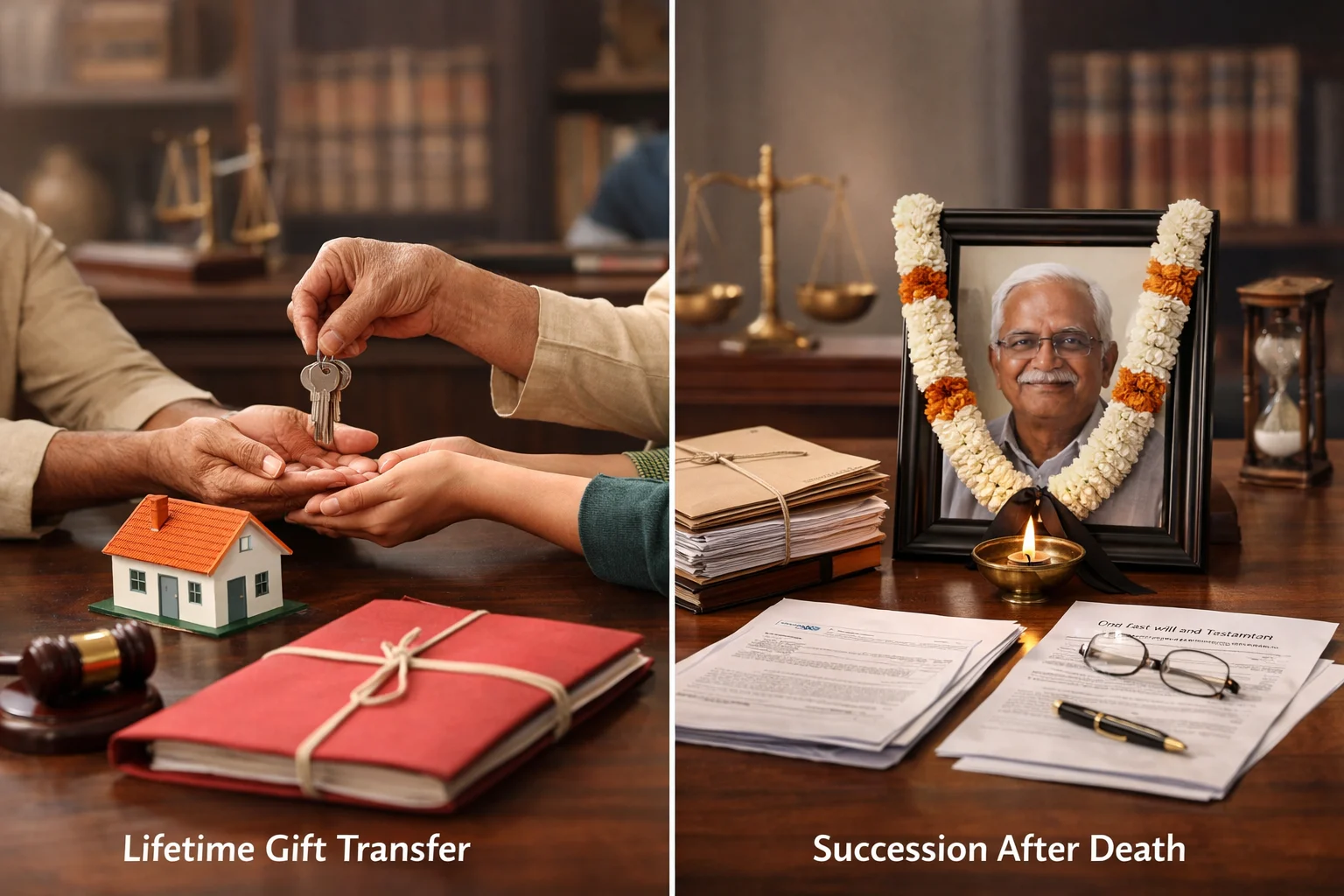
This is usually the cleaner path. A parent can gift a flat to a son or daughter. A husband can gift a share to his wife. A mother can transfer a CIDCO-linked property to her child during her lifetime and avoid future succession complications.
In most practical family cases, the main document is a Gift Deed. If there are multiple co-owners or heirs surrendering rights to one person, a Release Deed or Relinquishment Deed may be the better route.
The big advantage of acting while the owner is alive is control. The donor can sign, clarify intent, register the document, and move the records forward properly. Families often save months of confusion by doing this early.
If the original owner has died
This becomes a succession matter, not a simple voluntary transfer.
If there is a Will, the family still has to establish title through the proper succession route and then update the downstream records. If there is no Will, legal heirs usually need heirship or succession documentation before CIDCO and the society will comfortably process the transfer.
This is where many Navi Mumbai families make a costly mistake. They update the maintenance bill, the society starts taking charges from one heir, and everyone assumes ownership is settled. Legally, that is often not enough.
Which document is usually used for family transfer?
The right document depends on the family situation, not just the relationship.
Gift Deed
For a lifetime transfer to close family, a Gift Deed is usually the cleanest and most practical route.
Under Maharashtra’s registration framework, gift documents are specifically recognized in the registration fee structure, and ad valorem registration fees apply subject to the stated ceiling. The official fee table includes Gift and Transfer of lease by way of assignment among the documents covered, with the maximum registration fee capped at ₹30,000.
Your Step 2 dossier also correctly highlights the major Maharashtra concession used in close-family gift cases: a nominal ₹200 stamp duty for eligible close blood-relative transfers of residential or agricultural property, along with registration charges that usually work on the statutory formula. In real life, this is why many families prefer a Gift Deed over waiting for future succession issues.
Release or Relinquishment Deed
This is common after the death of parents where three siblings inherit a property but only one sibling will finally keep it.
A verbal family understanding is not enough. A notarized side letter is also not enough. If one heir is giving up a legal share in immovable property, the release should usually be properly documented and registered.
Will and succession follow-up
A Will can guide the transfer, but it does not automatically rewrite CIDCO, society, and tax records by itself.
Some families assume that because the Will is clear, the property is automatically settled. In practice, authorities and societies still want the proper record trail.
Nomination is useful, but it is not the final ownership answer
This is one of the biggest myths in Navi Mumbai housing.
A nominee helps the society know whom to deal with after a member’s death. But that does not mean the nominee becomes the final absolute owner against all legal heirs. The Supreme Court’s position in the Shakti Yezdani matter is the reason this myth should be handled very carefully. The practical result is simple: nomination helps administration, not final title by itself.
Does CIDCO permission or NOC matter in every family transfer?
No, not in every case. But in many leasehold CIDCO-origin cases, it still matters a lot.
If the property is still under the old CIDCO leasehold framework, the family should assume that CIDCO-side compliance may still be required. Your Step 2 dossier refers to CIDCO’s MTS-4 route for transfer by gift deed or heirship, and that fits the broader reality that CIDCO continues to run citizen service channels through its official online systems.
If the property has already been validly converted to freehold under the eligible conversion scheme, the future transfer picture becomes easier because CIDCO’s transfer permission layer may no longer sit in the middle in the same way.
So the first practical question is not “Is this a family transfer?” The first question is: Is this property still leasehold under CIDCO, or has it moved to freehold?
Step-by-step process to transfer a CIDCO plot or flat to a family member
Step 1: Identify the property status and title chain
Check whether the property is:
- still leasehold,
- already converted to freehold,
- held through an old allotment chain,
- mortgaged with a bank,
- carrying society dues or municipal dues.
Collect the base title set first: allotment papers, old agreement or sale deed, share certificate, latest tax bill, ID proofs, and dues status.
Step 2: Decide the correct transfer route
Do not draft the document first and think later. First decide the route:
- Gift Deed for lifetime transfer,
- Release or Relinquishment Deed for co-heir consolidation,
- legal heirship or succession path after death.
This single decision changes cost, papers, and timeline.
Step 3: Check lender NOC, dues, and restrictions
If there is a home loan, the bank’s NOC is not optional. Many families forget this because they are not “selling” the property. But a transfer of an encumbered asset without handling lender consent can become a serious problem later.
Also clear society dues, CIDCO dues where relevant, and municipal dues before starting the record-update chain.
Step 4: Prepare and register the deed or heirship papers
The document should be drafted properly, stamped correctly, and registered at the Sub-Registrar level.
IGR Maharashtra publicly provides draft document categories such as Gift Deed, Will, Conveyance Deed, and Transfer deed for flat or unit, which is useful for understanding what kind of instrument applies.
Step 5: Complete CIDCO-side compliance if the property is still leasehold
This is the step many families miss.
A registered family document may still not be enough if CIDCO’s transfer record has not been updated in a leasehold case. The family should use the applicable CIDCO online service route and keep all receipts and acknowledgments.
Step 6: Update society records and share certificate
Once the registered transfer basis and CIDCO step are in order, the society record should be updated.
The society can process the membership side, endorse the share certificate, and change its member register. But the society should not be treated as the only transfer authority.
Also remember another important point from your dossier: family transfers through gift or inheritance are not supposed to be treated like ordinary resale transfers for premium-charging purposes at society level.
Step 7: Update municipal ownership or tax records
This is the final operational step.
For NMMC-side properties, your Step 2 research says the revised policy effective from October 1, 2025 capped mutation fees for blood-relative family transfers at ₹500 and introduced delay penalties linked to RBI lending rate plus 3 percent. For PMC-side areas such as Kharghar, Kamothe, Kalamboli, Taloja, and Panvel, the practical reality is different because registration-linked and UPIC-linked systems are increasingly being used, though offline verification is still common. The available PMC property-tax material does show UPIC-based property search, name-transfer history visibility, and integration capability with other systems, which supports the dossier’s operational direction.
What documents are usually needed?
| Document group | Usually required papers |
|---|---|
| Base property papers | CIDCO allotment letter or lease papers, previous sale deed or agreement chain, share certificate, latest property tax receipt, ID and PAN of parties |
| For lifetime family transfer | Registered Gift Deed or Release Deed, proof of relationship, photos, witnesses, NOC if lender involved |
| For post-death transfer | Death certificate, Will if any, legal heirship or succession papers, heir affidavits or NOCs, indemnity where needed |
| Society and CIDCO layer | Society application, no-dues certificate, copy of registered document, CIDCO application acknowledgment or transfer order where applicable |
| Mutation layer | NMMC or PMC application basis, tax bill copy, UPIC or property identification details, updated ownership proof |
What costs should families expect?
This should be understood as a cost ecosystem, not one single charge.
First, there is the stamp and registration side. For close blood-relative gift transfers, your dossier identifies the important Maharashtra concession: ₹200 stamp duty plus registration fee on the statutory basis, usually capped at ₹30,000 for relevant value-based documents. The official registration fee table supports the fee-cap structure and confirms that gift documents fall within the value-based fee schedule.
Second, there can be CIDCO-side administrative charges in leasehold cases. These are not the same thing as standard commercial transfer premiums.
Third, the society may collect only nominal administrative or entrance-type charges in family transfer situations, not treat it like a full resale premium case.
Fourth, there may be mutation-related charges at the municipal level. On the NMMC side, the dossier’s October 2025 cap of ₹500 for blood-relative cases is a major practical point.
So no family should budget only for stamp paper and then act surprised later.
Common family-transfer situations in Navi Mumbai

Parent transferring to son or daughter
This is the most straightforward example. A parent in Vashi or Nerul may decide to transfer a flat during lifetime through a Gift Deed. This is often the cleanest route because it avoids future heirship disputes and takes advantage of the concessional family-transfer structure.
Husband-wife transfer
This is often done for family planning, estate planning, or loan structuring. But even here, the title chain, lender consent, and society update still matter.
Sibling transfer after parents’ death
This is where errors multiply. If three legal heirs inherit and only one sibling will finally hold the property, the others should not disappear from the story informally. Their rights usually need to be properly released through a registered instrument.
Legal heirs dealing with an old CIDCO allotment
This is common in older Navi Mumbai and Panvel-side CIDCO-origin assets. The property may still sit on old leasehold papers, and the family may discover that society records, CIDCO records, and legal-heir documents do not yet speak to each other cleanly.
Biggest mistakes families make
The most common mistakes are very avoidable:
- changing only the society name and assuming title is settled,
- treating nomination as ownership,
- ignoring an active home loan,
- using an unregistered family arrangement for immovable property,
- forgetting CIDCO compliance in leasehold cases,
- delaying NMMC-side mutation in cases where timelines matter,
- assuming all CIDCO-origin properties still follow the same old process even after freehold conversion changes.
This is exactly why so many “done at society level” transfers fail years later when a bank checks the file during resale.
How to know the transfer is actually complete
A family transfer is usually complete only when all the relevant layers match the new owner’s name.
As a practical checklist, the family should ideally hold:
- the registered deed or succession document,
- CIDCO transfer order or compliance proof if the property is still leasehold,
- updated society record and share certificate endorsement,
- latest NMMC or PMC tax record reflecting the changed ownership basis.
If only one of these has changed, the transfer may be only partially complete.
Conclusion
If you want the simplest practical answer, it is this: a CIDCO plot or flat can be transferred to a family member, but the safest route is to first identify whether the property is still leasehold, then choose the correct legal instrument, then complete the record chain in the right order.
In Navi Mumbai, that usually means thinking beyond just one deed. The real transfer is complete only when the registration side, CIDCO side where applicable, society side, and municipal side are all aligned. If the owner is alive and the family arrangement is clear, acting early through the correct registered document is usually far smoother than leaving the property for heirs to sort out later.
FAQs
Frequently Asked Questions