

Kharghar vs Ulwe: Which Has Better Long-Term Investment Potential in Navi Mumbai?
For most buyers, Kharghar is the better long-term investment if the goal is lower risk, steadier appreciation, stronger rental demand, and easier resale. Ulwe can still outperform on pure upside, but only for buyers who accept more volatility, sharper micro-location risk, and a more timing-sensitive entry. In simple words, Kharghar is usually the safer compounding market, while Ulwe is the higher-beta airport-region bet.
That is the real answer, and it matters because these two nodes are often discussed as if they are in the same investment stage. They are not.
As of early 2026, Ulwe is no longer just a “future” story. The Navi Mumbai International Airport has already started commercial operations, and Atal Setu has already changed how South Mumbai capital looks at the eastern seaboard. Kharghar, on the other hand, is not a static mature suburb either. It already benefits from the Belapur-Pendhar Metro corridor, the Kharghar-Turbhe Link Road is under construction, and CIDCO has moved ahead with a major International Corporate Park push in Kharghar.
So the smarter question is not “Which area is better?” The smarter question is: do you want safer compounding with stronger end-user depth, or do you want higher upside with more risk and more entry discipline?
Kharghar or Ulwe: what is the smarter long-term bet right now?
The smart bet depends on what kind of investor you are.
| Investment lens | Kharghar | Ulwe |
|---|---|---|
| Best for | Lower-risk long-term investors | Growth-seeking investors with patience |
| Core strength | Mature demand, rental depth, easier exit | Airport-region upside, lower entry in selected pockets |
| Risk profile | Low to moderate | Moderate to high |
| Growth driver | Metro support, established social infrastructure, commercial expansion | NMIA, Atal Setu, airport-linked economic activity |
| Holding comfort | Higher | More uneven |
| Resale comfort | Stronger | More selective |
| Ideal holding style | 5 to 10+ years | 7 to 10 years with strict project selection |
If somebody wants wealth preservation, easier tenant finding, and lower regret, Kharghar usually makes more sense. If somebody wants to capture the longer airport-led transformation curve and can tolerate short-term unevenness, Ulwe may deliver stronger percentage upside.
Why this comparison is not as simple as “developed vs future growth”
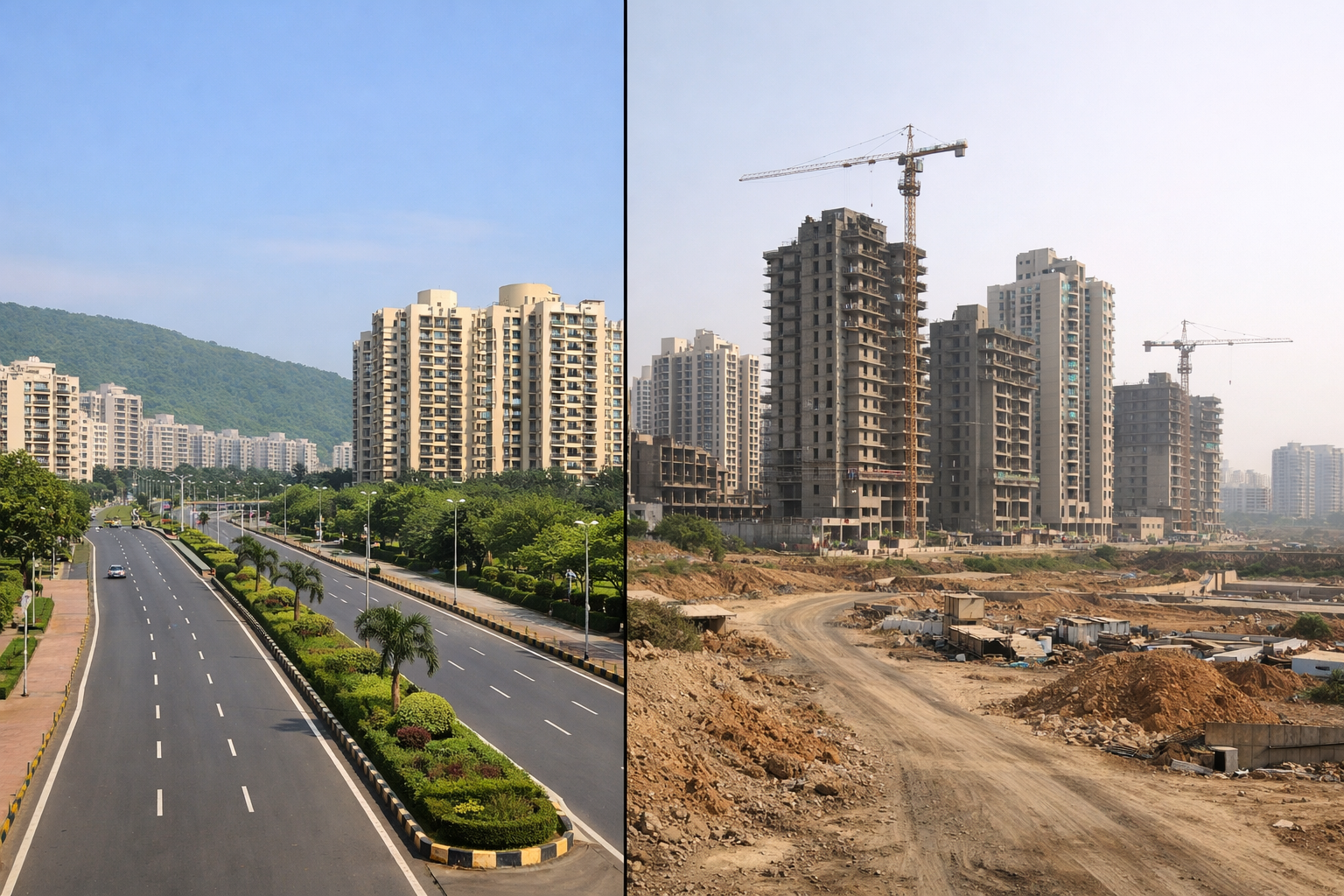
A lot of weak articles reduce the whole debate to one lazy line: Kharghar is developed, Ulwe is developing.
That is too shallow for 2026.
Ulwe is not “early” in the old sense anymore. The airport premium has already been partially priced in after the strong run-up seen between 2021 and 2025. Buyers entering Ulwe now are not buying a hidden story. They are buying into a story that the market already knows. That does not make Ulwe a bad investment, but it changes the maths. The easy money phase is smaller now than many late buyers assume.
Kharghar also should not be treated as a market with no future upside left. Its value is no longer only residential maturity. It is also about better internal liveability, metro-backed movement, and growing commercial relevance. The current KTLR construction and CIDCO’s International Corporate Park push matter because they strengthen Kharghar’s long-term demand quality, not just its image.
That is the real difference. This is not a comparison between an old market and a future market. It is a comparison between a mature compounding market and an infrastructure-led optionality market.
What long-term investment potential actually means in Kharghar and Ulwe
Long-term investment potential is not just about future rate appreciation.
In Navi Mumbai, especially in markets like these, a good property investment usually has four pillars:
- capital appreciation
- rental strength
- resale liquidity
- holding comfort
If even one of these becomes weak, the investment quality falls.
For example, a flat may show strong paper appreciation in an airport belt, but if tenant demand is thin, maintenance is high, water tanker costs keep rising, and too many investor-owned units come to market together, the actual benefit becomes weaker than the brochure promise.
That is why this comparison has to go beyond “which area will grow faster.” The real question is which area will still feel liquid, rentable, and sensible after 5 to 10 years.
Where Kharghar has the stronger long-term case
End-user demand is deeper and more durable
Kharghar’s biggest strength is not only price performance. It is the quality of the people who keep demanding housing there.
Families, students, faculty, professionals, and salaried buyers already understand the node. It has an established daily-life ecosystem. That matters because long-term price stability usually comes from real end-users, not only investor excitement.
When a market has steady family demand and practical self-use value, resale becomes easier. Even if appreciation is not explosive, capital is usually protected better.
Social infrastructure supports price stability
Kharghar has what many investors underestimate: familiarity and habitability.
Schools, colleges, large societies, Central Park-side appeal, Golf Course Road prestige, metro-linked pockets, and a more recognized address value together create a market that does not depend on one single mega-project to justify pricing.
That does not mean every sector in Kharghar is equally strong. It is not. Upper Kharghar and peripheral belts behave differently from central sectors. But the node as a whole has a stronger self-sustaining ecosystem than Ulwe.
Metro, schools, and commercial expansion improve exit comfort
The Belapur-Pendhar Metro corridor already supports Kharghar’s movement logic, and the Kharghar-Turbhe Link Road is expected to reduce travel time sharply once completed. CIDCO’s current International Corporate Park push also strengthens the future employment case around Kharghar.
That combination matters for investors. A buyer entering Kharghar is not only betting on nicer surroundings. They are betting on a market where future housing demand can be supported by both lifestyle and work-related pull.
A practical example helps here. A 2 BHK in a well-connected, established Kharghar pocket may not double overnight, but it is usually easier to rent, easier to explain to an end-user buyer, and easier to exit without heavy discounting.
If Kharghar is still your stronger preference, it also helps to compare Kharghar vs Panvel and understand which broader node suits your budget, lifestyle, and long-term plans better.
Where Ulwe can outperform Kharghar over a long holding period
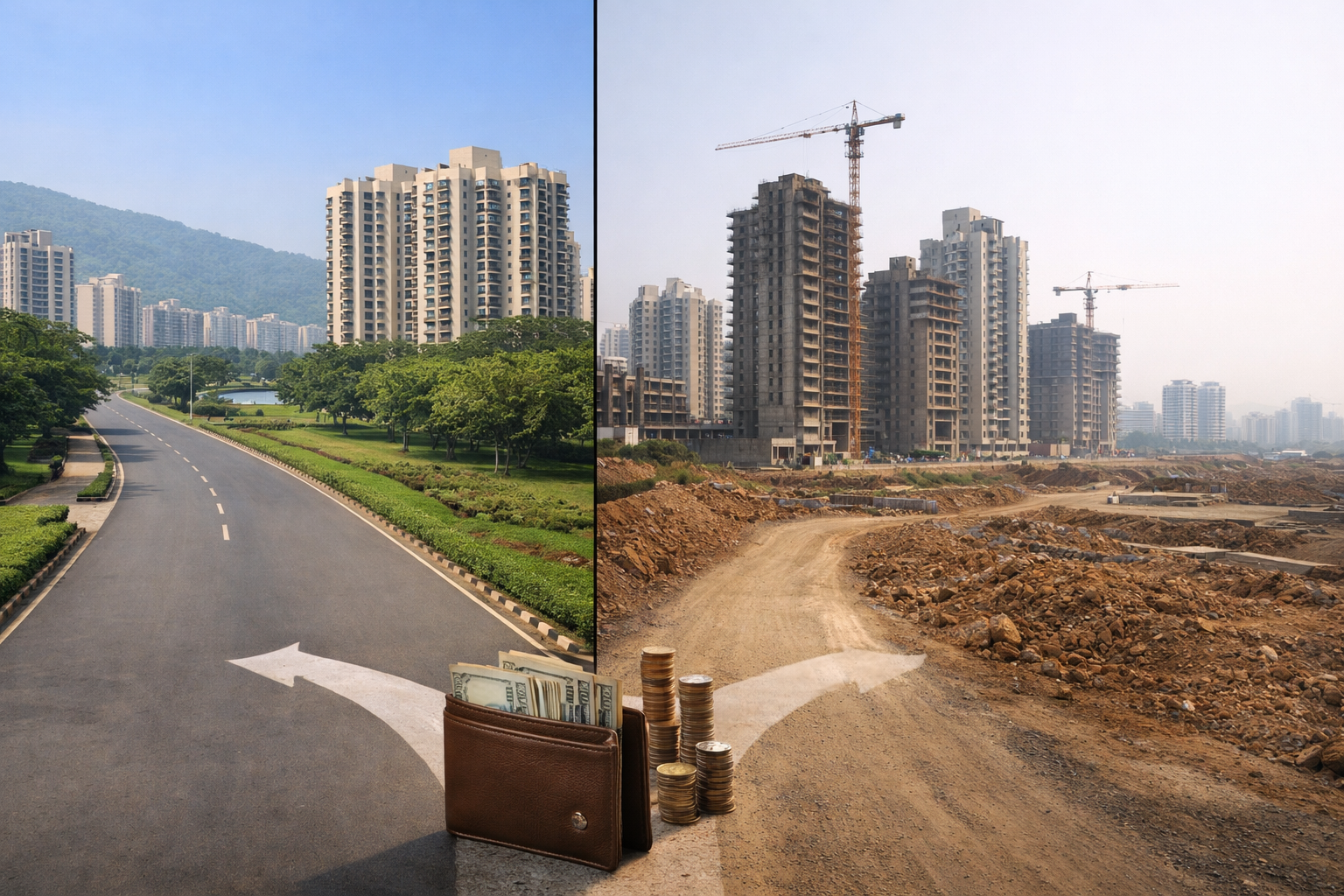
Airport-region positioning changes the upside equation
Ulwe’s strongest case is simple: it sits in the direct influence zone of Navi Mumbai International Airport, and the airport is no longer theoretical. Commercial operations began on December 25, 2025. That changes the conversation from promise to execution.
Airports do not only move passengers. They create layers of jobs in aviation, logistics, warehousing, hospitality, transport, support services, and commercial real estate. Over time, that can create strong housing demand.
Lower entry in some pockets can create better percentage growth
Even after the run-up, Ulwe still offers lower entry than premium Kharghar pockets in many micro-markets.
That means percentage appreciation can still look better in the right sector, at the right project, at the right entry price. For a patient investor with a 7 to 10 year horizon, that is the attraction.
Atal Setu adds to this by shrinking the psychological and physical distance between Mumbai and the Ulwe-Uran side. The bridge was completed in January 2024 and gives direct Mumbai-Navi Mumbai connectivity on a 21.8 km corridor. That has changed buyer imagination in a big way.
But the upside is not equal across all sectors or projects
This is where many investors make mistakes.
Ulwe is not one flat, uniform market. Coastal road influence, station access, airport access, sector maturity, project quality, and daily civic reality can change the investment case sharply.
A good Ulwe buy is usually a selective buy. A weak Ulwe buy can easily become a holding headache.
A buyer who enters a better-located, better-built project at a sensible rate may still do very well. A buyer who enters a generic investor-heavy building in a weaker micro-pocket after the hype phase may not get the same result.
Price vs future upside: are you paying for safety in Kharghar or potential in Ulwe?
In 2026 working market bands, Kharghar usually sits at a premium to Ulwe. Broadly, Kharghar operates around the ₹12,000 to ₹18,000 per sq ft zone depending on sector and product, while Ulwe often ranges around ₹9,000 to ₹14,500 per sq ft depending on sector, project stage, and exact location.
That difference is important, but price alone does not settle the decision.
| Metric | Kharghar | Ulwe |
|---|---|---|
| Current entry character | Paying more for maturity and demand depth | Paying less in some pockets, but not always “cheap” anymore |
| Appreciation logic | Steadier compounding | More upside if entry is disciplined |
| Market support | End-user backed | More infrastructure and investor narrative driven |
| Common mistake | Overpaying just because it is established | Buying post-hype and assuming airport = guaranteed returns |
| Best use of capital | Conservative or hybrid investor | Patient growth investor |
So yes, in Kharghar you may be paying for safety. But safety has value in real estate.
And yes, in Ulwe you may be buying potential. But potential only helps when the entry is not already inflated and the project is actually in a usable or credible location.
Which market has stronger rental demand and easier resale after 5 to 10 years?
Kharghar is stronger on rental depth and resale comfort.
Its tenant base is wider. Students, professionals, families, and people working across the Navi Mumbai belt understand the location already. That reduces vacancy risk. Absolute rents are also stronger in many parts of Kharghar, even if gross yield percentages do not always look dramatic.
Ulwe’s rental story is emerging, not weak. Airport staff, logistics-linked workers, and people using new connectivity can support demand. But the rental market is still more selective because a lot of supply is investor-owned. When many similar units compete together, landlords lose pricing power.
The same logic affects resale.
A strong resale market needs real end-user confidence. Kharghar already has that at a deeper level. Ulwe may reach stronger exit depth over time, but that depends on how the airport region’s commercial ecosystem scales and how many investors try to exit together.
In plain words, if your holding plan includes “I may need to sell without too much friction,” Kharghar is usually the safer choice.
What local risks most buyers underestimate in Kharghar and Ulwe
The biggest mistake is looking only at future price and ignoring holding pain.
In both nodes, civic reality matters. Water availability, tanker dependence, society maintenance, access roads, and daily usability can directly affect yield and buyer satisfaction. This is especially important in taller buildings and peripheral pockets, where civic infrastructure often lags behind real estate marketing.
The second risk is project risk.
MahaRERA’s enforcement drive matters a lot here. Maharashtra suspended 4,812 lapsed projects and froze related bank accounts, with Raigad among the highest-count districts at 465 projects. That does not mean every under-construction project is unsafe. But it does mean buyers should not casually buy into a “future growth” story without checking current compliance and delivery credibility.
The third risk is overpaying for the story.
In Kharghar, that means paying too much just because the address feels safe.
In Ulwe, that means paying a post-hype rate for a location that still lacks enough real daily-life support.
Who should choose Kharghar and who should choose Ulwe?
Kharghar is usually the better choice for:
- conservative long-term investors
- NRIs who want lower active management
- buyers who may self-use later
- investors who care about rent plus resale, not just upside
- people who want stronger end-user-backed stability
Ulwe is usually the better choice for:
- patient growth investors
- buyers comfortable with more volatility
- investors specifically targeting airport-region transformation
- people who understand sector-level selection and can avoid weak pockets
- buyers who can hold through uneven intermediate years
If someone asks for one simple rule, it is this:
Choose Kharghar for safer long-term compounding. Choose Ulwe for higher upside only when you are very disciplined about entry, project, and patience.
For buyers who have broadly shortlisted Ulwe over Kharghar, this a more specific Ulwe comparison can help narrow the decision further.
How to judge the right project before calling either location a good investment
Before buying in either node, check these points properly:
- Verify MahaRERA status and current compliance
- Check builder delivery history, not only marketing promises
- Confirm whether the building relies heavily on tankers
- See the approach road and actual surroundings in person
- Compare possession-ready value versus under-construction discount honestly
- Ask what kind of tenants or end-users realistically choose that exact pocket
- Study maintenance burden, not just EMI
- Treat sector and micro-location as more important than the node name alone
This one step can save more money than any market prediction.
Conclusion
Kharghar has the better overall long-term investment potential for most normal buyers because it is easier to hold, easier to rent, and easier to resell. Its future is supported not only by reputation, but by real end-user demand, metro-backed movement, and growing commercial relevance.
Ulwe has the better upside case for investors who can tolerate risk, avoid bad micro-locations, and hold patiently as the airport-region economy matures.
So the cleanest final verdict is this:
- Best for safety and steady compounding: Kharghar
- Best for higher upside potential: Ulwe
- Best for rental depth and resale comfort: Kharghar
- Best for patient airport-led appreciation: Ulwe
If you want the lower-regret choice, Kharghar usually wins. If you want the more aggressive long-term bet and can handle the uncertainty, Ulwe can still be the better play.
FAQs
Frequently Asked Questions