
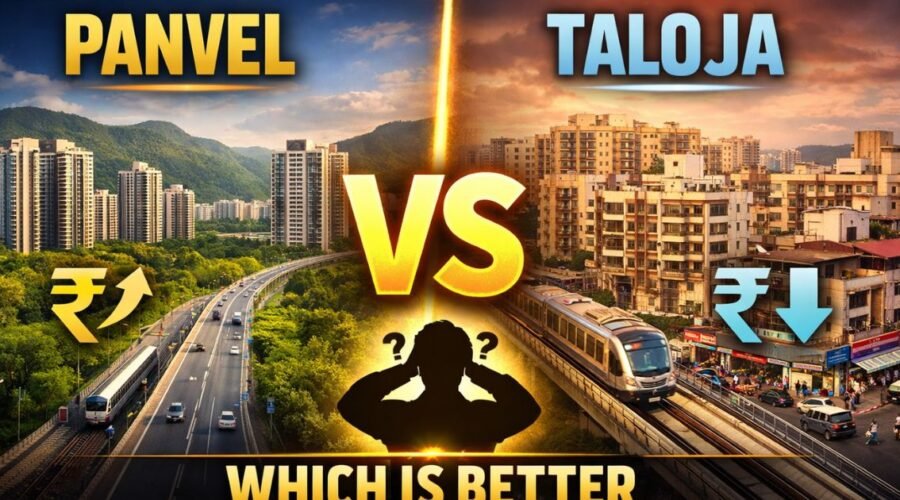
Panvel vs Taloja: Which Is Better for Budget Homebuyers in Navi Mumbai?
For most budget homebuyers, Taloja usually makes more sense when the budget is tight and the main goal is getting the maximum carpet area at the lowest entry price. Panvel usually makes more sense when the buyer can stretch the budget a little for better day-to-day convenience, stronger rail and road connectivity, easier resale, and a more settled living environment. So the right answer depends on your budget band, commute pattern, and tolerance for on-ground unevenness.
This is why the Panvel vs Taloja comparison is not really a simple price battle. It is a practical decision between two different kinds of housing life in Navi Mumbai. One gives you more space for less money but asks for patience. The other asks for more money but gives you a smoother daily routine.
A lot of buyers searching this question are not investors sitting far away. They are first-time salaried people, families moving out of rent, or buyers trying to avoid making a costly mistake in the ₹35 lakh to ₹75 lakh range. For them, the main issue is not only “where is property cheaper?” The bigger issue is “where will this decision still feel right after one year of actual living?”
Panvel or Taloja: What Is the Better Choice for a Budget Homebuyer?
The short answer is this:
- Choose Taloja if your budget is strict, especially under ₹45 lakh, and you want a newer flat with more usable space.
- Choose Panvel if your budget can stretch into the ₹50 lakh to ₹75 lakh range and you care more about smoother commuting, stronger social infrastructure, and better long-term comfort.
- Be careful in both markets if the project is in a weak micro-location, has poor civic support, or depends too heavily on future promises.
Quick Summary
| Comparison Point | Panvel | Taloja |
|---|---|---|
| Best for | Buyers who can stretch budget for better daily life | Buyers who need lowest entry price and more carpet area |
| Budget strength | Better from roughly ₹50L to ₹75L | Strongest below roughly ₹45L to ₹60L |
| Commute advantage | Strong railway and highway connectivity | Better internal metro support, weaker external rail practicality |
| Living comfort | More mature and settled in core pockets | Uneven, improving, but still patchy in many parts |
| Resale comfort | Usually stronger | Good mainly in better Phase 1 pockets |
| Risk level | Moderate, but varies by micro-location | Higher if buying in weak or non-CIDCO pockets |
Why This Comparison Is Not Just About Lower Prices
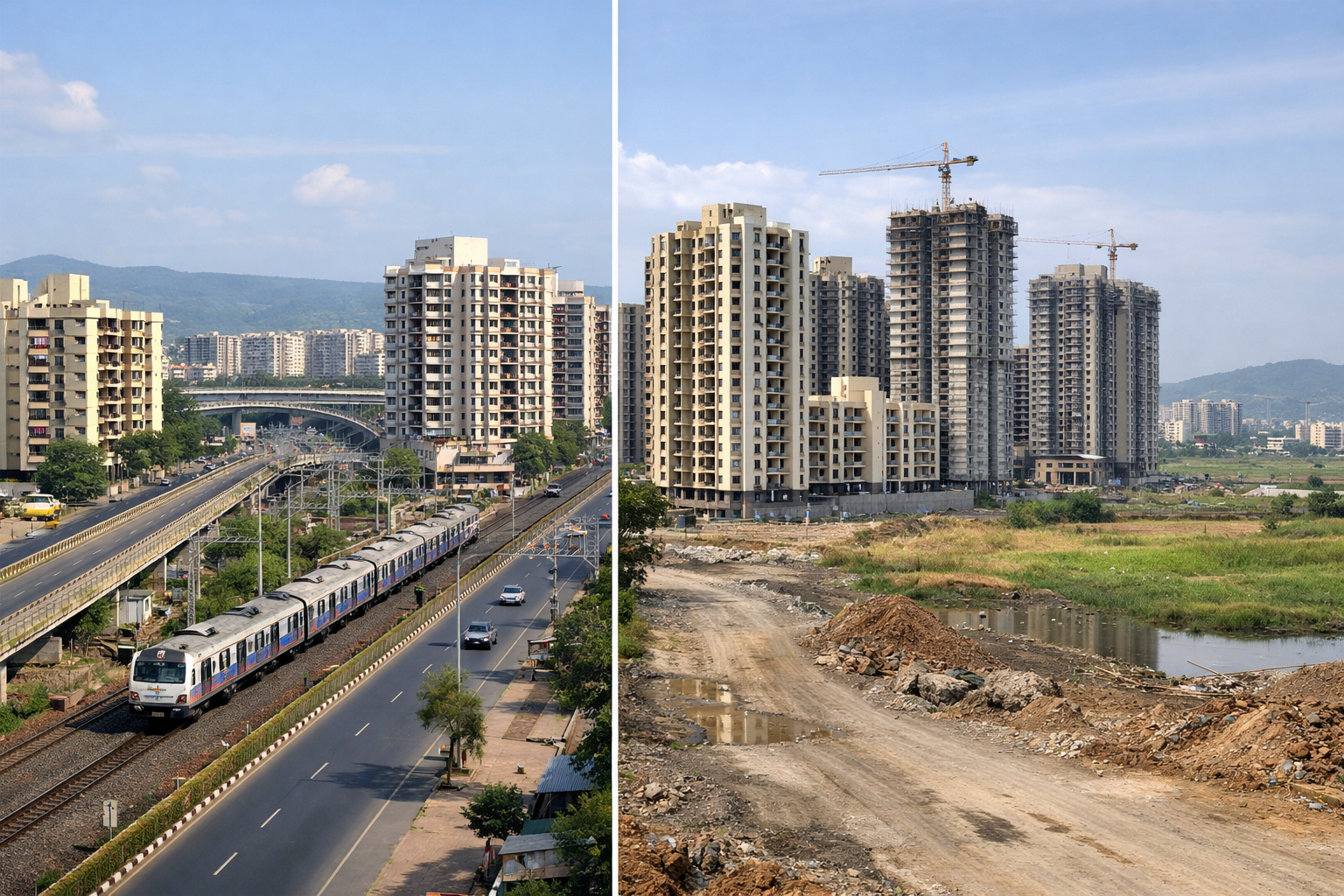
A cheaper flat is not always a cheaper housing decision. This is the biggest mistake budget buyers make in Navi Mumbai.
If a buyer saves ₹6 lakh or ₹8 lakh at the time of purchase but then spends more every month on feeder travel, private transport, tanker dependence, longer commute time, or rent plus EMI because of delay, the “cheap” decision can become expensive very fast. Real affordability is not just the flat price. It is the total monthly burden.
That burden includes EMI, maintenance, travel cost, fuel or auto cost, water-related society stress where applicable, and the time lost in daily commuting. In some cases, it also includes the hidden emotional cost of living in a place that still feels under-built.
Budget Buying in Navi Mumbai Often Fails at the Monthly Burden Stage
This is where brochure affordability and practical affordability separate.
A project may look affordable because the 1BHK fits within loan eligibility. But if the area needs two daily mode changes, has weak station connectivity, or puts the buyer in a delayed project, the monthly experience becomes harder than expected. Budget buyers usually do not have much room for repeated mistakes. So these details matter more, not less.
Bigger Carpet Area Does Not Always Mean a Better Budget Decision
Taloja often gives more carpet area for the same money. That is real, and for many buyers it is the deciding advantage.
But larger carpet area only helps if the surrounding life is workable. A slightly smaller flat in a more practical Panvel pocket can still be the better budget decision if it saves time, gives easier school or hospital access, and reduces friction in daily travel. This is especially true for families and train-dependent commuters.
> Caution: Never judge Panvel vs Taloja only by price per sq. ft. The better question is: what will this flat cost me every month in money, time, and stress?
Where Does Your Budget Stretch More in Panvel and Where Does It Stretch More in Taloja?
This is the section most buyers actually need. General locality averages do not help much. Budget buyers think in slabs.
Also, these are approximate Q1 2026 market bands based on listed market patterns and local ranges. Actual deal values vary by project age, possession stage, exact sector, floor, and negotiation.
| Budget Band | Panvel Reality | Taloja Reality | Better Fit |
|---|---|---|---|
| Under ₹45 lakh | Mostly older 1RKs, compact resale 1BHKs, or weaker fringe options | Better choice of 1BHKs, especially in Phase 2 and some peripheral pockets | Taloja |
| ₹45 lakh to ₹60 lakh | Decent 1BHKs in Old Panvel or some New Panvel/Karanjade-type options | Strong range of ready 1BHKs and compact 2BHK options, especially in better parts of Phase 1 | Depends on commute and lifestyle |
| ₹60 lakh to ₹75 lakh | Panvel becomes much stronger, especially for comfortable end-use buying | Taloja still offers size advantage, but Panvel starts winning on balance | Panvel |
Under ₹45 Lakh: What Is Realistically Available
If your budget is below ₹45 lakh, Taloja is usually the stronger market. This is where it clearly beats Panvel for entry affordability.
In this bracket, Panvel core areas do not offer much that feels comfortable or future-proof. Buyers often end up looking at older resale stock, compact units, or locations that sound like Panvel in ads but are actually much weaker fringe areas. Taloja, especially Phase 2 and surrounding affordable pockets, gives more real options in this range.
That does not mean every under-₹45 lakh deal in Taloja is automatically good. Some of the cheapest options come with heavy trade-offs in road quality, water stability, or local maturity. Still, for strict-budget buyers, Taloja remains the more realistic entry point.
₹45 Lakh to ₹60 Lakh: Where Choice Improves
This is the most interesting middle band. Here the answer becomes less obvious.
In Taloja, this budget can unlock a much better standard of product: newer 1BHKs, some ready-possession stock, and even compact 2BHKs in stronger parts of Phase 1. In Panvel, the same budget can start opening up more stable end-use options in Old Panvel, some New Panvel pockets, or nearby practical zones depending on stock quality and building age.
This band is where buyer profile matters most. A commuter with office travel pressure may prefer Panvel. A young couple wanting a newer flat with better carpet efficiency may still prefer Taloja.
₹60 Lakh to ₹75 Lakh: When Panvel Starts Making More Sense
Once the budget reaches ₹60 lakh and above, Panvel usually becomes the better all-round buy for many homebuyers.
This is because the buyer is no longer forced into the weakest stock. Panvel starts offering more comfortable 2BHK possibilities, better surroundings, more settled societies, easier access to schools and healthcare, and much stronger transit confidence. Taloja can still offer more area in this budget, but Panvel often gives a better full-life package.
If Daily Commute Matters, Which Place Creates Less Stress?
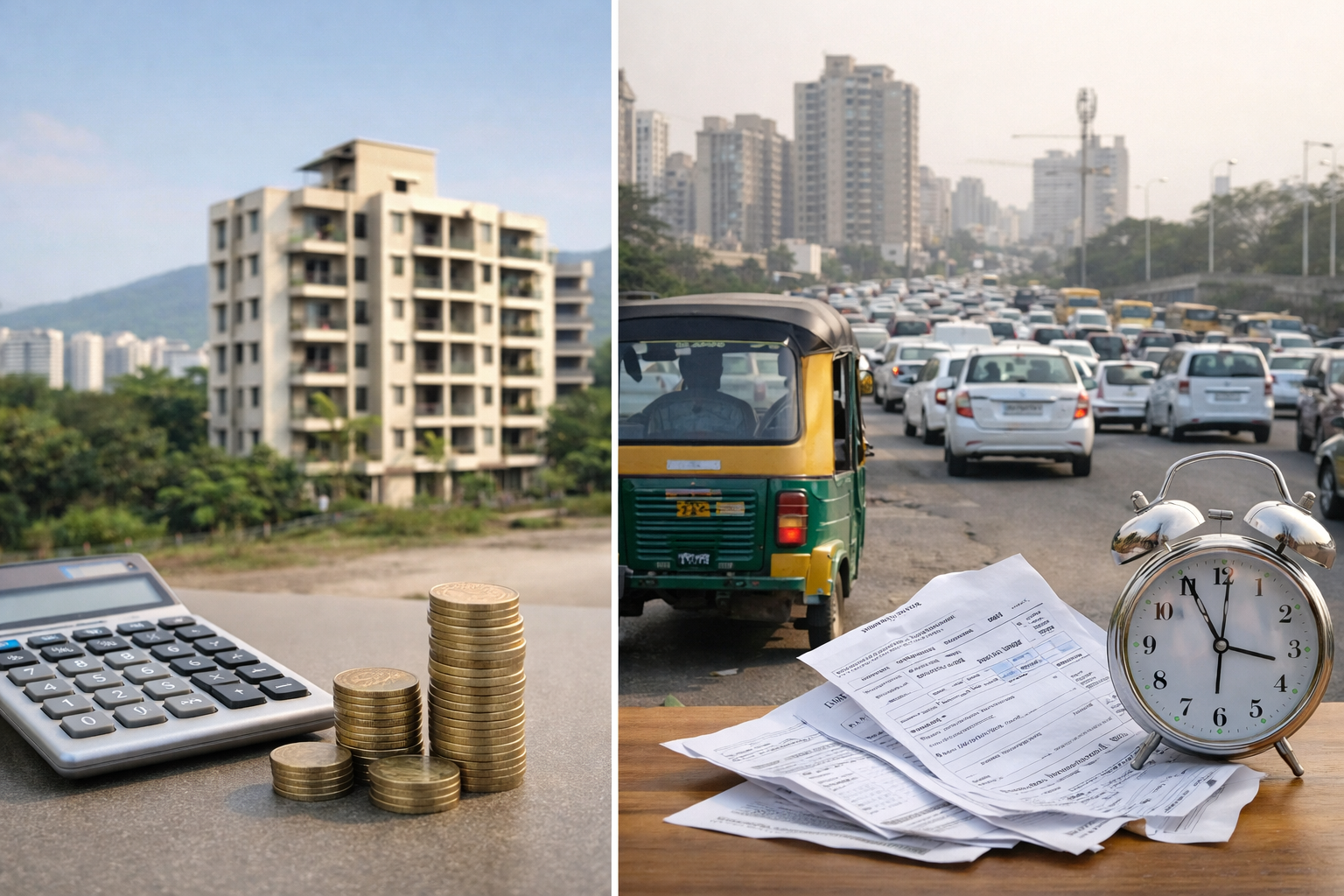
If commute is a major part of your decision, Panvel is usually the safer answer.
This is one of the clearest differences between the two markets. Panvel functions like a true transport hub. Taloja does not. Taloja has improved a lot because of Navi Mumbai Metro Line 1, but that does not automatically make it easier for every commuter.
Rail and Station Practicality
Panvel has a major advantage for train-dependent buyers. Panvel Junction connects into important railway movement patterns and works far better for people commuting regularly toward Mumbai, Thane, or other major directions.
Taloja’s biggest confusion comes from the presence of Taloja Panchanand station on the map. Many buyers assume this means easy local train life. In practice, that is not how most daily commuters experience it. The train frequency there is too limited to be dependable for a typical office routine. That is why many Taloja residents still depend on buses or shared autos to reach Kharghar station.
So for a buyer who must catch regular local trains and reach office on time every day, Panvel creates much less commuting stress.
Highway and Road-Side Movement
Panvel also benefits from stronger road logic. It connects more naturally into the Mumbai-Pune Expressway, the Sion-Panvel route, and the wider regional network. For road commuters, this matters a lot.
Taloja’s road movement is more mixed. Some parts work decently, but congestion, industrial vehicle movement, and local connector pressure can make travel slower and less predictable. This is especially felt in peak hours.
Why Internal Last-Mile Reality Matters More in Budget Housing
This is where many buyers misjudge Taloja. The metro is a real advantage, especially for Phase 1 and selected nearby pockets. But not every Taloja home has truly easy station or metro access. Some still need bus or auto dependence for basic daily movement.
That is why the better question is not “Does this area have metro?” but “How many changes will I make from home to office?” In budget housing, last-mile friction can decide whether a location feels practical or tiring.
Which Market Is Easier for Real Living, Not Just for Booking a Flat?
For ready everyday life, Panvel usually feels easier. Taloja feels more mixed.
This is not an insult to Taloja. It is just the difference between a more mature node and a still-developing one. Panvel already has the rhythm of a working urban zone. Taloja is still in transition, and that affects what daily life feels like outside the flat.
Daily Convenience, Schools, Hospitals, and Routine Services
Panvel has stronger social infrastructure in practical terms. Families usually find more comfort here because schools, healthcare, shopping, and daily errands feel less experimental. The ecosystem is already functioning.
Taloja Phase 1 is better than many outsiders assume. It has improved and is no longer just a speculative address on paper. But once you move deeper into weaker parts of Phase 2 or non-CIDCO-linked edges, the gap becomes obvious. Construction activity, patchy surroundings, and a still-growing retail environment can affect quality of life.
Where On-Ground Maturity Changes the Answer
The most useful local point here is this: all Panvel is not the same, and all Taloja is not the same.
New Panvel and stronger established pockets behave differently from fringe “Panvel” projects marketed under airport influence. In the same way, Taloja Phase 1 behaves differently from more stressed or peripheral pockets. CIDCO-planned areas usually offer more structured roads, better layout logic, and a more predictable future than weaker PMC-governed parcels.
Quick Living Checklist
Before saying yes to either Panvel or Taloja, check these basics:
- Is the flat in a CIDCO-planned pocket or a weaker fringe area?
- Is grocery and daily shopping practical without a vehicle?
- How far is the real usable station or metro access, not just the map point?
- Is the society occupied and functioning, or still half-settled?
- How stable is water supply in that exact micro-location?
- Does the surrounding road network feel ready for actual family use?
Are You Buying a Home or Buying Future Hope? This Is Where Panvel and Taloja Split
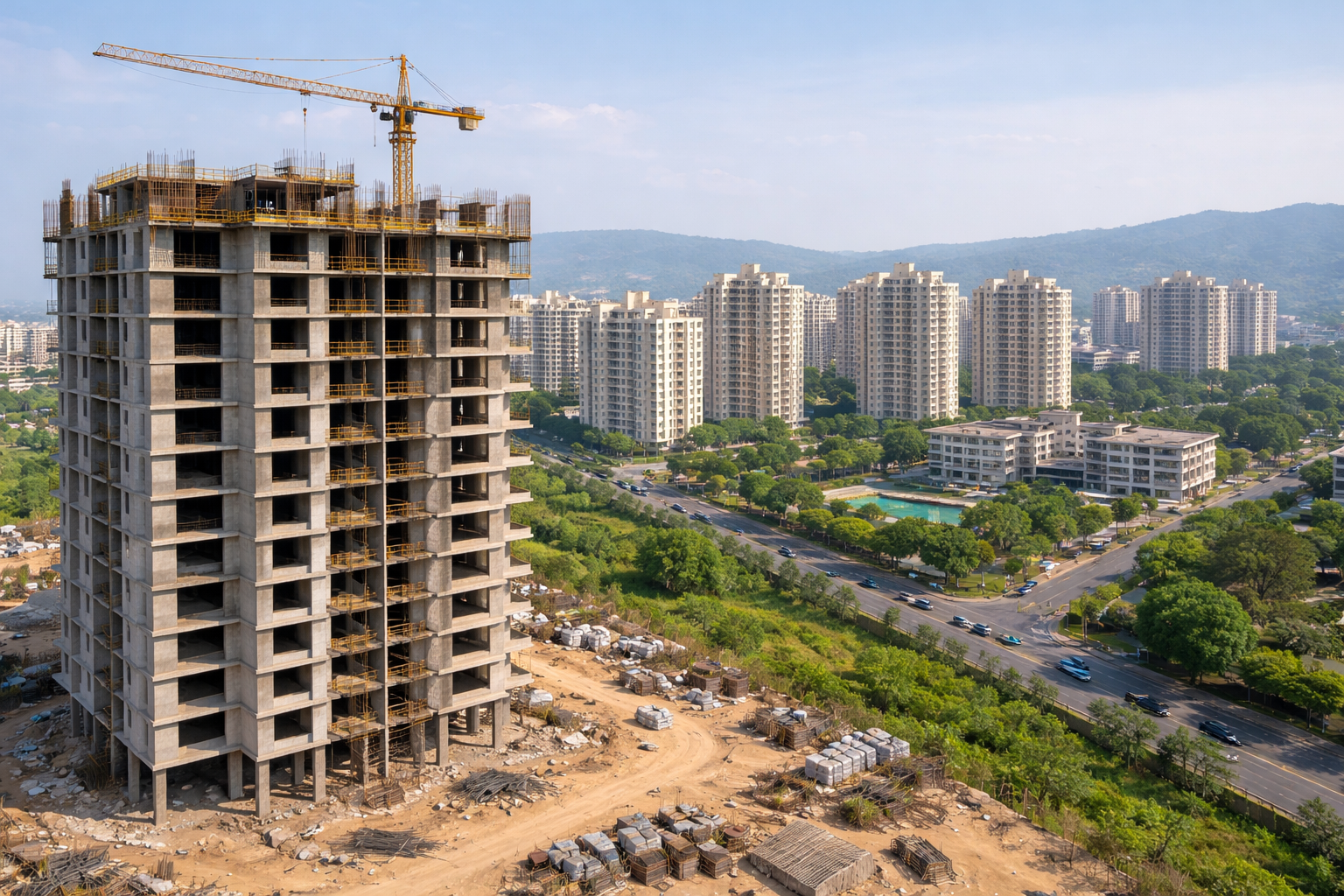
This is the real difference between the two.
A purchase in Panvel is usually a buy into a place that already functions. A purchase in Taloja is more often a bet that the area will keep improving and reward patience. That does not make Taloja wrong. It just changes who it suits.
Taloja’s Affordability Advantage
Taloja’s biggest strength is simple: it lets buyers enter the market. It gives many middle-class households their first workable chance to own a flat in the Navi Mumbai region.
It also has real growth logic, especially where metro access and CIDCO planning support the residential side. But buyers need to be honest about what they are accepting. In many pockets, the area is still catching up. You are not only buying a home. You are buying into an evolving environment.
Panvel’s Maturity and Broader Buyer Comfort
Panvel feels more balanced for homebuyers who want less daily negotiation with the city. The area has stronger transit strength, deeper social infrastructure, and a broader sense of settled living.
Even where Panvel asks for a premium, that premium often buys something useful: predictability. For many families, that is worth more than extra carpet area.
> Example: A buyer with a ₹58 lakh budget may get a newer and larger option in Taloja, but an older, more settled 1BHK in Panvel could still be the better life decision if the family needs simpler commute, school access, and stronger fallback resale.
Which One Usually Gives Better Resale Comfort and Exit Flexibility?
Panvel usually gives better resale comfort. That is the more practical answer.
Budget buyers should care about resale even if they plan to stay long term. Jobs change. Family size changes. Loan pressure changes. A flat that is easy to exit gives more safety.
Panvel generally has a wider buyer pool because it is already known as a transport-friendly and mature market. That helps resale confidence. Taloja’s resale story is more selective. Good Phase 1 stock can do well, especially near practical transit support. But weaker Phase 2 pockets and non-CIDCO areas do not offer the same comfort.
Why Resale Is Not the Same as Appreciation on Paper
A location can show future growth potential and still be harder to sell at the right time. That is especially true when lots of fresh under-construction stock keeps entering the market.
In Taloja, resale sometimes competes with brand-new launches. That can slow exit unless the flat is well located or priced attractively. In Panvel, the market is usually easier to understand for end-use buyers, which helps resale movement.
There is also one more practical issue. Resale buyers in CIDCO-linked areas must account for transfer charges, and these affect total deal cost. From March 2026, CIDCO transfer charges were increased by 5%, which can materially affect resale transaction budgeting. A buyer ignoring this can end up underestimating acquisition cost.
> Caution: Never assume a flat is “good for resale” only because the area is popular. Check age of building, surrounding new supply, transfer charges, and how many similar flats are already available nearby.
For Rental Support and Fallback Income, Which Market Is Safer?
Both markets can work for rental support, but in different ways.
Panvel is usually safer for steadier rental comfort and wider tenant appeal. Taloja can offer stronger yield logic relative to lower buying cost, especially in better-connected pockets.
Panvel tends to attract a broader renter profile because of stronger overall connectivity and a more mature living setup. Taloja Phase 1 benefits from demand linked to the MIDC belt, nearby working populations, and people priced out of neighboring higher-cost nodes. So Taloja is not weak on rental demand. It is just different.
If your fallback plan is “I may need to rent this flat out later,” then Panvel usually feels safer. If your plan is “I want lower entry cost and decent rental percentage on capital,” then Taloja can still work well, especially in stronger pockets.
What Risks Do Budget Homebuyers Usually Miss in Both Markets?
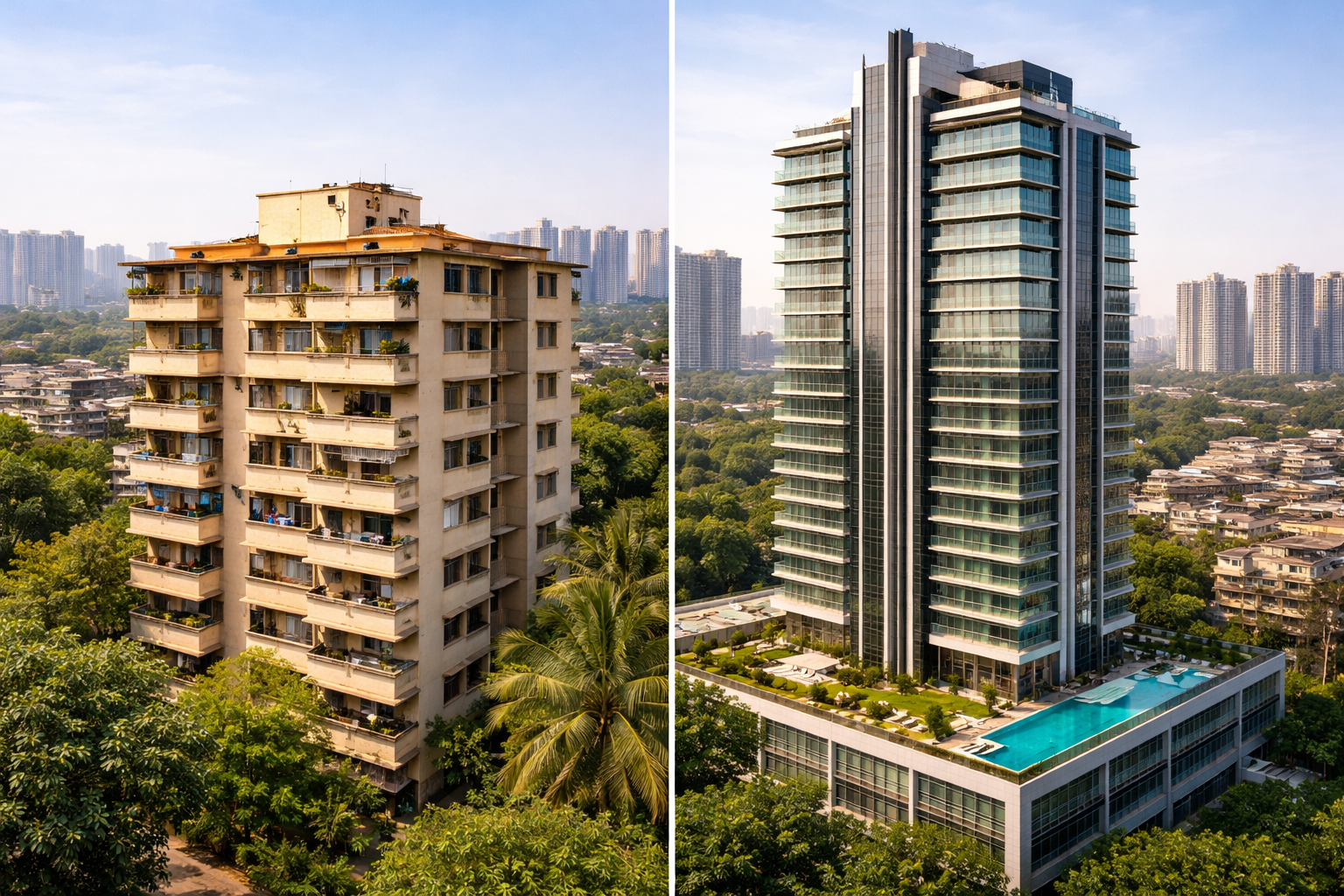
This is the section many buyers should read twice.
A bad property decision in this price segment usually does not happen because the buyer did not compare enough brochures. It happens because the buyer missed one hard local reality.
If you are also evaluating another Panvel-side growth option, this Panvel vs Ulwe comparison will help you understand which corridor fits better.
Project-Stage Risk
Under-construction projects can still be risky, especially in emerging markets. Buyers should never treat registration alone as a full safety guarantee. MahaRERA history, possession progress, and developer execution track record matter.
The Clan City case in Taloja became a major warning because it showed how long delays can damage buyers. That does not mean every under-construction project in Taloja is unsafe. It means budget buyers must verify more carefully, not less.
Micro-Location Mismatch
This is one of the biggest Navi Mumbai mistakes. Buyers talk about “Panvel” and “Taloja” as if both are single, uniform markets. They are not.
A CIDCO-planned sector and a weaker PMC-governed fringe can feel like completely different worlds in road quality, water reliability, civic order, and long-term comfort. In Taloja, this difference is especially important. In Panvel too, airport-influence marketing can pull buyers into much weaker fringe areas that do not offer core Panvel advantages.
Overstretching for a “Better Area”
Some buyers know Panvel is more mature and then overstretch badly just to get the address. That can be a mistake too.
A weak cash-flow situation is dangerous. If the EMI becomes too high, the family may suffer even in a better location. A well-chosen Taloja purchase can still be smarter than a strained Panvel purchase.
Buying Only on Future-Infrastructure Promises
This applies to both markets but especially to weakly marketed fringe stock. Future airport impact, future growth, future roads, future appreciation these can all sound attractive. But a family lives in the present.
If the flat is in a place where daily life is still not working, then future upside should not be the main reason to buy.
> Local caution box: Water supply is not a small issue. Taloja, especially in weaker pockets, has seen major complaints and protests around irregular supply. Some Panvel-side pockets also face seasonal summer stress. Never assume stable water just because the sales pitch sounds polished.
Which Buyer Should Choose Panvel, and Which Buyer Should Choose Taloja?
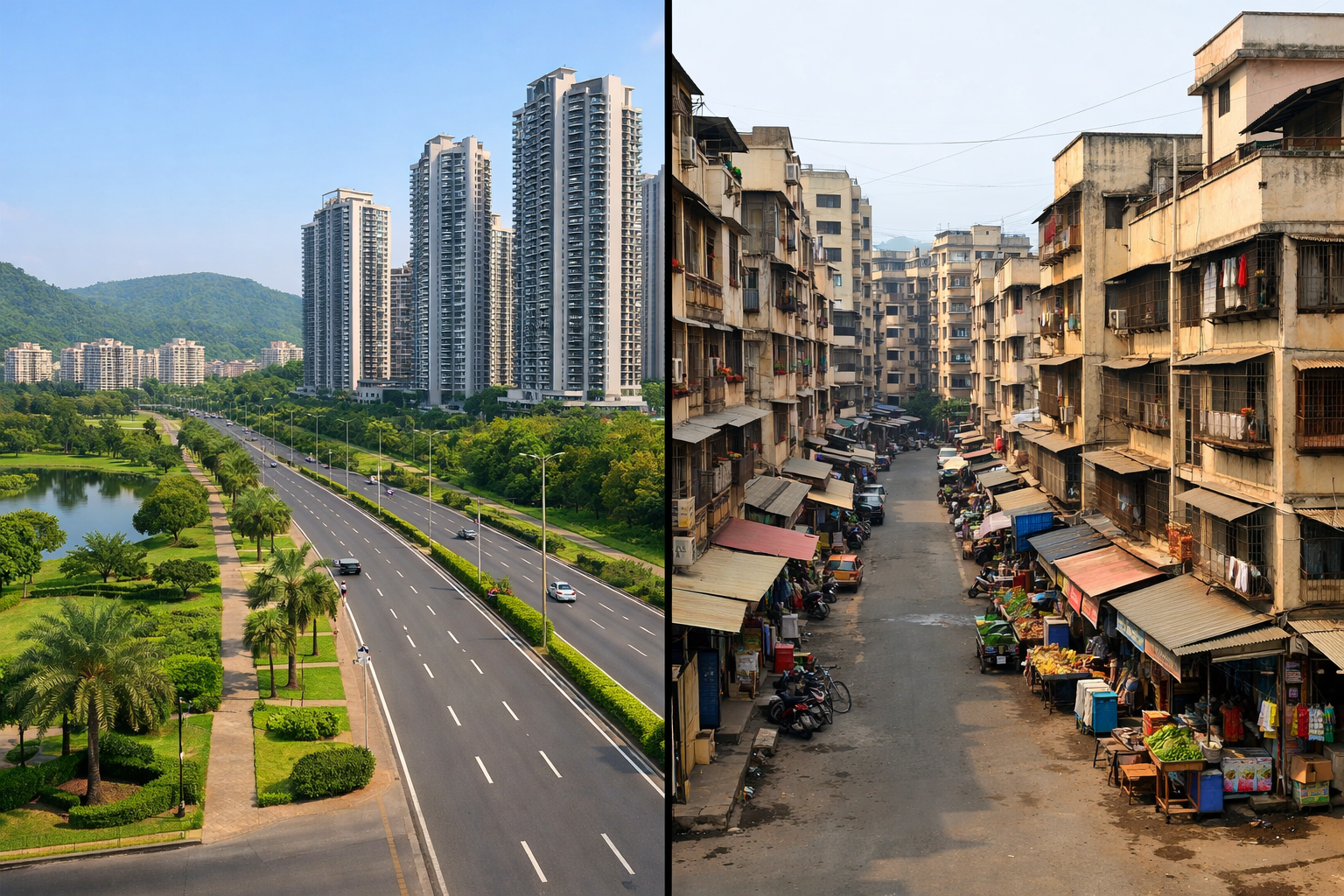
This is the most useful decision filter.
Choose Taloja If
Choose Taloja if most of these points sound like you:
- Your budget is strict, especially below ₹45 lakh
- You want maximum carpet area for the money
- You are okay with a developing neighborhood if the flat itself is better
- Your work is within Navi Mumbai-side zones like Belapur, Kharghar, or Taloja-side industrial areas
- You can handle metro, bus, or feeder-based commuting
- You are patient about area maturity over the next few years
Choose Panvel If
Choose Panvel if most of these points sound like you:
- Your budget can stretch to roughly ₹60 lakh to ₹75 lakh
- Daily train commuting matters a lot
- Family living comfort matters more than extra carpet area
- You want quicker access to schools, hospitals, and daily retail
- You prefer a stronger resale safety net
- You want a more established and easier-to-understand end-use market
If Panvel is still under serious consideration, it also helps to compare Kharghar vs Panvel and see whether a more mainstream end-user market suits you better.
Avoid Both for Now If
Wait before buying if these points apply:
- You have zero tolerance for water irregularity
- You are relying on a very fragile monthly income situation
- You are choosing only on the basis of launch offers
- You have not checked whether the exact project is in CIDCO, PMC, or fringe NAINA-type context
- You are not able to physically test the actual commute before booking
The Final Decision in Simple Words
The practical answer is not that one is good and the other is bad.
Taloja is the better market for buyers who need affordability first. It works especially well for people who want their first home, need better carpet area, and can accept a still-evolving neighborhood in exchange for lower entry cost.
Panvel is the better market for buyers who can stretch their budget and want a stronger total-life package. It is usually easier for commuting, more comfortable for family living, and safer for resale and long-term flexibility.
Final Comparison Summary
| If your priority is… | Better Choice |
|---|---|
| Lowest entry price | Taloja |
| More carpet area for the money | Taloja |
| Easier daily commute | Panvel |
| Better railway practicality | Panvel |
| More settled family living | Panvel |
| Better resale comfort | Panvel |
| Better rental yield on lower capital | Taloja |
| Lower-risk end-use buying | Panvel |
| Strong value under ₹45 lakh | Taloja |
| Better all-round balance from ₹60 lakh to ₹75 lakh | Panvel |
Conclusion
If you are a strict budget buyer and the main goal is owning a larger or newer flat without stretching beyond your limits, Taloja usually wins. If you can stretch your budget and want a smoother everyday life with stronger connectivity, better civic maturity, and easier exit comfort, Panvel usually wins.
In simple words, Taloja is the stronger affordability play. Panvel is the stronger balance play. For most buyers, the right decision is not the one with the lower ticket size. It is the one that still feels manageable after the excitement of booking is gone.
FAQs
Frequently Asked Questions