

Vashi vs Seawoods: Which Is Better for Premium Residential Living in Navi Mumbai?
For most buyers looking for polished premium residential living in Navi Mumbai, Seawoods is usually the better choice. It generally offers a more contemporary environment, stronger lifestyle convenience, better managed premium towers, and a smoother day-to-day experience. Vashi still makes strong sense for buyers who value centrality, bigger older homes, legacy prestige, and faster road-led access toward Mumbai. In simple words, Seawoods is the more modern premium choice, while Vashi is the more established premium choice.
That difference matters because “premium” does not mean the same thing in both places. In Seawoods, premium usually means newer towers, better clubhouse culture, Nexus Seawoods / Seawoods Grand Central convenience, and a more polished residential feel. In Vashi, premium often means bigger layouts, older but respected sectors, strong business convenience, and the comfort of living in one of Navi Mumbai’s most established nodes.
So if the question is purely Vashi vs Seawoods for premium residential living, the direct answer is this: choose Seawoods if you want low-friction modern living; choose Vashi if you want legacy value, central practicality, and larger space.
Quick Summary
| Comparison Point | Vashi | Seawoods |
|---|---|---|
| Overall premium feel | Legacy premium, central, established | Polished premium, newer, more lifestyle-led |
| Building stock | Larger older apartments, mixed redevelopment potential, some new luxury supply | More contemporary premium towers, better managed modern inventory |
| Daily lifestyle | Strong high-street convenience, mature markets, practical city access | Mall-integrated lifestyle, cleaner premium presentation, stronger “contained” convenience |
| Family comfort | Better for senior citizens and families who like walkable old grids | Better for younger premium families who want gated modern societies |
| Mumbai road access | Usually stronger for road-heavy commuters and business users | Good, but more lifestyle-first than central-first |
| Station + transit ecosystem | Strong, but not as integrated as Seawoods TOD experience | Major advantage because of Seawoods Grand Central integration |
| Environmental comfort | Good in many pockets, but some northern belts face odour/smog complaints linked to TTC MIDC | Usually perceived as airier and more open, especially near Palm Beach side |
| Resale comfort | Strong because of trust, location recall, and centrality | Strong because of modern appeal and future-facing infrastructure |
| Best for | Business families, traditional upgraders, bigger-home buyers | NRIs, young HNIs, polished-lifestyle buyers, premium renters |
What does “premium residential living” actually mean in Vashi and Seawoods?
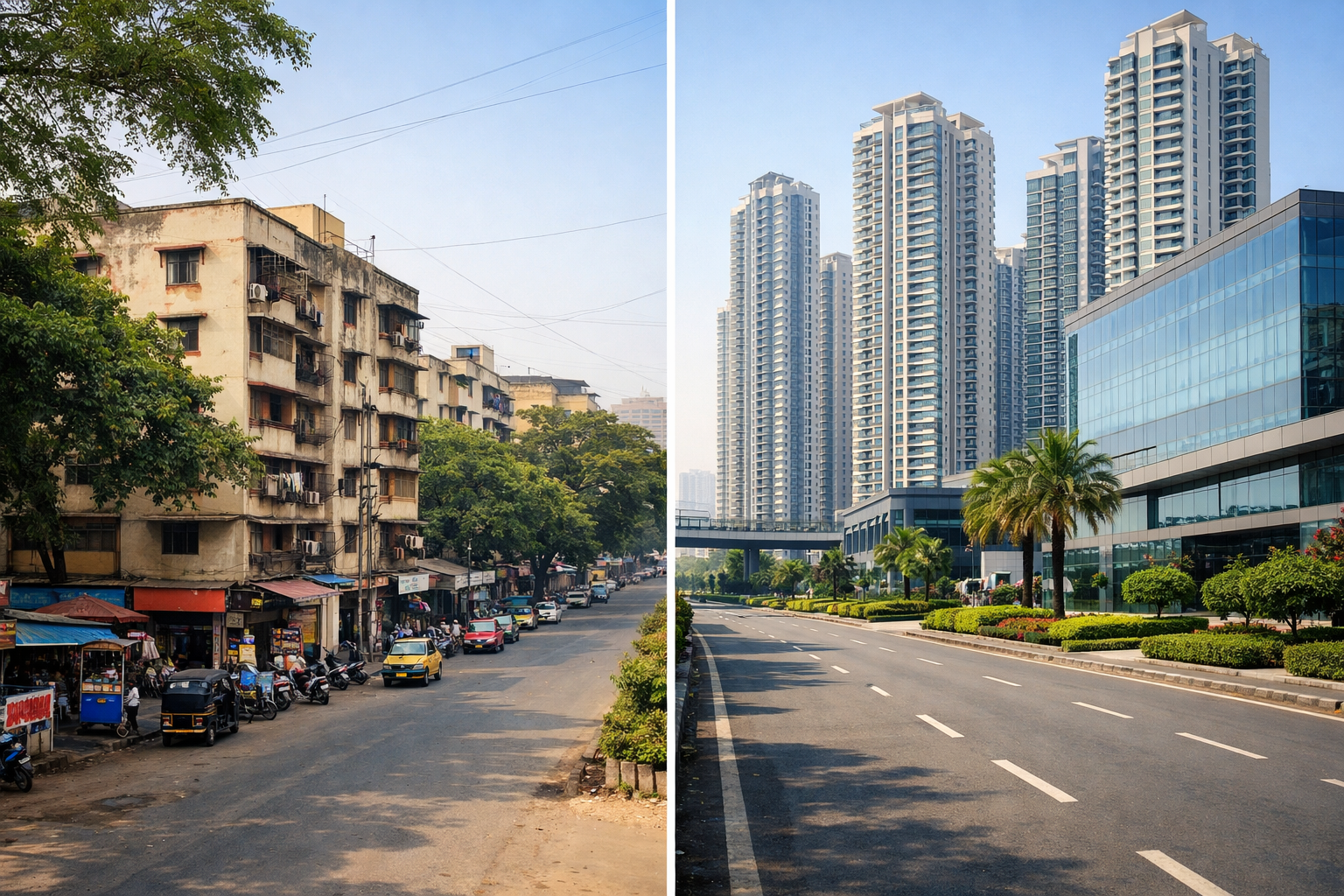
Premium living in Navi Mumbai is not the same as premium living in South Mumbai or Bandra. Here, buyers are not only paying for a famous pin code. They are paying for a mix of usable space, civic quality, road width, society profile, station access, lifestyle convenience, and how smooth daily life feels after moving in.
That is why many buyers get confused. A flat can cost several crores in both Vashi and Seawoods, but the reason for that price is not always the same. In Vashi, the premium often comes from location memory, larger apartment sizes, central business relevance, and the fact that some sectors still carry long-standing respect in Navi Mumbai. In Seawoods, the premium is more experience-led. The buyer is paying for a more curated environment, stronger modern presentation, and transit-oriented convenience around Seawoods station and Nexus Seawoods.
Premium does not mean the same thing in both nodes
This is the most important decoding point in the entire comparison.
In Vashi, premium can mean:
- bigger carpet area
- old but high-value sectors
- practical access to markets, hospitals, and Mumbai routes
- social trust built over years
In Seawoods, premium can mean:
- modern towers and better-managed complexes
- cleaner lifestyle packaging
- better “arrival feel” for new-age buyers
- less daily friction between home, retail, office, and station
So the real comparison is not simply Vashi price versus Seawoods price. It is legacy premium versus polished premium.
Which node feels more premium on the ground today?
On pure visual and experiential impact, Seawoods usually feels more premium today.
That is because Seawoods presents itself better to the modern buyer. The roads around the better residential pockets, the Palm Beach Road influence, the station-mall-office integration, and the newer premium towers all create a more finished upper-end impression. Nexus Seawoods itself is positioned as India’s largest transit-oriented development, with around 1.0 million sq ft of leasable area, high occupancy, and very large shopper traffic, which directly strengthens the premium ecosystem around it.
Vashi still feels premium, but in a different way. It feels settled, respected, and central rather than glossy. In some of its better sectors, the roads, older societies, established commercial activity, and mature civic layout give a long-tested “this area works” feeling. Many local buyers still trust Vashi more instinctively because it has been a premium Navi Mumbai address for a long time.
Why Seawoods often feels more polished now
Seawoods suits the premium buyer who wants everything to feel more ready on day one. That includes:
- better baseline tower aesthetics
- stronger clubhouse and amenity culture
- a more managed premium-society environment
- easier blending of work, leisure, and commuting
There is also a psychological factor. A new premium buyer, especially an NRI or someone moving from a polished Mumbai suburb, often responds faster to Seawoods because it “looks the part” immediately.
Why Vashi still feels premium in a different way
Vashi’s premium value is not shallow. It is just older in expression.
Its advantage is that it does not depend only on façade or tower branding. It depends on:
- centrality
- known sectors
- established mixed-use convenience
- older residential confidence
- better familiarity for business families and long-time Navi Mumbai residents
That still matters. A premium address is not only about how fresh the tower looks. It is also about how strong the area remains after ten years.
Vashi vs Seawoods on building stock: older premium character or newer polished living?
This is one of the biggest decision points.
Vashi’s premium housing stock is still heavily shaped by older apartments, larger floor plates, and established co-operative societies. Many such homes give better usable area for the money, but buyers often underestimate what comes next: renovation, waterproofing, plumbing upgrades, electrical rewiring, lift condition, parking quality, and common-area aging.
Seawoods is generally easier for the buyer who wants a more plug-and-play premium home. The tower may give less absolute carpet area compared to an old Vashi flat at a similar total ticket size, but it often gives better finish, stronger amenities, better security, and lower immediate renovation stress.
What age of building means in real life
In Vashi, a larger older premium apartment may still be a smart buy. But only if the buyer is mentally and financially ready for what can follow. In many cases, the smarter financial comparison is not just purchase price versus purchase price. It is:
purchase price + renovation reserve + maintenance adjustment + long-term redevelopment uncertainty
For many premium Vashi homes, keeping a renovation reserve of roughly ₹15 lakh to ₹25 lakh is not irrational at all. That is not decorative renovation. That is often what it takes to bring an older premium flat up to the standard expected at a multi-crore price point.
This matters even more because older society stock in Maharashtra is increasingly entering redevelopment conversations under the UDCPR framework, and redevelopment itself carries legal and timing complexity. A recent MahaRERA position also underlined that rehabilitation-component disputes in redevelopment do not automatically fall within RERA’s jurisdiction, which is an important caution for buyers who are treating old society redevelopment as a simple future bonus.
Which is better for family living at the premium end?
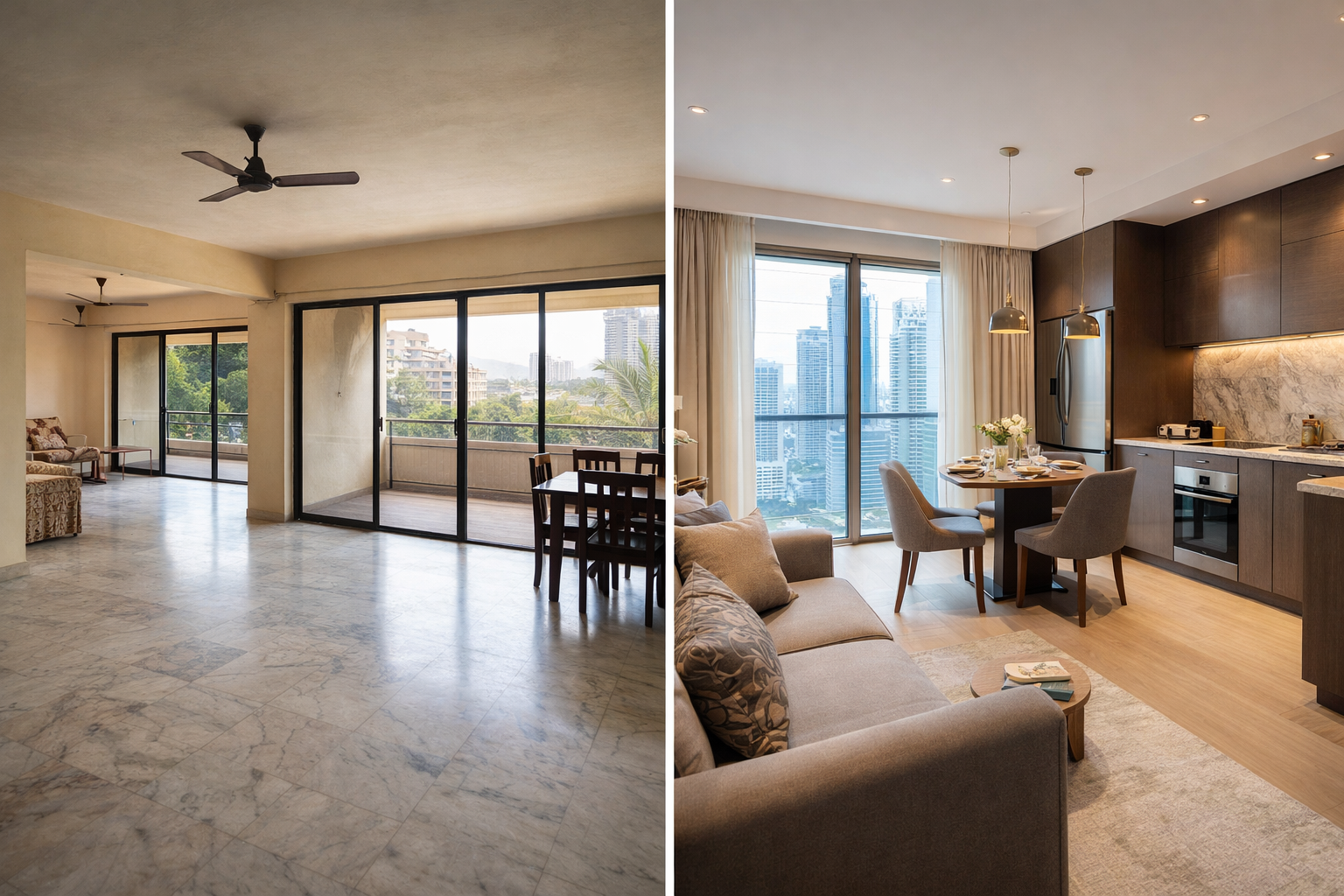
For younger premium families, Seawoods is usually the better fit. For traditional multi-generational families, Vashi can still be the smarter choice.
That split happens because family comfort is not one thing. A family with young children often wants a secure modern society, better clubhouse culture, cleaner internal recreation, and lower friction between home and lifestyle. Seawoods often wins that test.
But a family with parents or senior citizens may think differently. They may care more about street-level convenience, old-school market comfort, easier familiarity, and a less tower-dependent lifestyle. In those cases, Vashi can feel more humane.
Practical family living checklist
| Family Need | Better Fit |
|---|---|
| Modern gated premium society living | Seawoods |
| Child-focused modern amenities | Seawoods |
| Senior citizen walkability and familiar ground-level life | Vashi |
| Bigger usable space inside the home | Usually Vashi |
| Lifestyle convenience without depending on long drives | Seawoods |
| Traditional family setup with known local comfort | Vashi |
In short, Seawoods is stronger for the buyer who defines premium family living through a managed society experience. Vashi is stronger for the buyer who defines family living through space, familiarity, and mature local infrastructure.
Which node works better if Mumbai access and central convenience matter more?
If Mumbai road access and central convenience are high on your list, Vashi usually wins.
This is one reason Vashi has held its premium relevance despite the rise of newer polished nodes. It sits in a more naturally strategic position for people who still move frequently toward Mumbai for business, meetings, logistics, or day-to-day commercial reasons. The operational Atal Setu has further strengthened Navi Mumbai-Mumbai regional connectivity, and that helps both nodes, but Vashi still benefits from being the more naturally central gateway-style location in daily road logic.
That does not mean Seawoods is badly connected. Not at all. Seawoods is very strong for the buyer whose life is rail-plus-lifestyle oriented or who wants smoother access to the wider future-facing infrastructure story. But when the question becomes, “Which premium node causes less road-commute friction toward Mumbai?” Vashi remains difficult to ignore.
A simple way to think about it
- If your life is road-heavy, meeting-heavy, business-heavy, Vashi becomes more attractive.
- If your life is lifestyle-heavy, station-linked, and ecosystem-driven, Seawoods becomes more attractive.
That is the real divide.
Is Seawoods Grand Central changing the premium-living equation?
Yes, very clearly.
Many generic articles treat Seawoods Grand Central like it is only a big mall. That misses the point. Its real impact is not retail alone. Its real impact is that it compresses daily urban friction. Nexus Seawoods is directly tied to the station ecosystem and operates as a large transit-oriented asset with substantial retail scale, high occupancy, and strong footfall. That changes how nearby residents live.
A premium resident in Seawoods can often combine home life, train access, dining, shopping, and office movement with far less friction than in a traditional node. That is not a brochure line. That is a real lifestyle advantage.
When this matters and when it does not
This matters a lot if you are:
- an NRI buyer
- a premium tenant
- a working couple
- a buyer who values convenience more than extra carpet area
- someone who wants a more “global” style of suburban living
It matters less if you:
- prefer quieter old-grid living
- do not care about mall-linked daily life
- want bigger interiors more than better ecosystem design
- spend more time driving than using integrated transit and nearby leisure
So yes, Seawoods Grand Central does change the equation. But only for buyers who actually want the kind of life that such an ecosystem supports.
Which node gives better long-term residential satisfaction, not just status?

For many end users, Seawoods has the edge in long-term satisfaction. For some established families, Vashi still delivers deeper comfort.
This section matters because premium buyers often confuse social prestige with future happiness. Those are not always the same. A home can impress guests and still tire its owner after three years.
Seawoods often scores better on long-term satisfaction because the overall environment feels more contemporary, more open in premium pockets, and more aligned with present-day expectations of urban living. Vashi scores better where the buyer values rootedness, bigger homes, known neighbourhood patterns, and the confidence of an old established node.
There is also an environmental angle that should not be ignored. Some Vashi-side and TTC-adjacent belts have seen recurring complaints around odour and air-pollution nuisance linked to the TTC MIDC area. A CPCB status report filed before the National Green Tribunal specifically noted complaints related to odour nuisance from TTC MIDC, including issues connected to the effluent conveyance system. Separately, residents in some Vashi sectors and nearby belts have also reported episodes of choking smog and industrial emissions. This does not make Vashi broadly unlivable, but it is absolutely something serious buyers should physically test during repeat site visits at different times of day and season.
That is why Seawoods often feels easier for the buyer who wants long-term comfort with fewer surprises.
Vashi vs Seawoods for resale comfort and premium rental demand
Both Vashi and Seawoods are strong, liquid premium micro-markets by Navi Mumbai standards. Neither is a weak exit market.
Vashi’s resale comfort comes from recognition, trust, and location memory. Buyers know Vashi. Business users respect Vashi. Long-time Navi Mumbai families understand what Vashi stands for. That gives it durable resale logic.
Seawoods’ resale comfort comes from newer premium appeal, stronger lifestyle packaging, and better alignment with how the next generation of premium buyers thinks. It is easier to “explain” Seawoods to an NRI, a corporate tenant, or a polished end user because the value proposition is more visible.
Portal trend pages in March 2026 show Seawoods and Vashi both already sitting in premium territory, while the more premium Seawoods sub-pockets such as Seawoods East and Sector 58A are materially higher than node-level averages. That gap itself proves the point: in Seawoods, micro-location and premium inventory quality matter a lot.
One more practical point: these are not “double-your-money quickly” markets. At this stage, both Vashi and Seawoods are better understood as wealth-preservation and lifestyle-upgrade markets, not aggressive speculative bets. Also remember that CIDCO transfer fees were increased from April 1, 2025, including a 5% to 10% rise across property categories and higher charges depending on size and type, which affects resale economics in both nodes.
For some buyers, especially executives who may not stay beyond a few years, premium renting in these two nodes can actually be more rational than buying.
Which buyer should choose Vashi, and which buyer should choose Seawoods?
This is where the decision becomes simple.
Choose Vashi if…
- you want stronger road-led access toward Mumbai
- you are comfortable buying an older premium home and upgrading it
- you value bigger layouts more than polished tower presentation
- you prefer established sectors and practical city convenience
- you have senior citizens at home who prefer familiar, ground-linked neighbourhood life
- you like legacy prestige more than lifestyle packaging
If you are still considering another mature residential alternative alongside Vashi, this Vashi vs Nerul comparison will help you see how Vashi stacks up against a more balanced end-user node.
Choose Seawoods if…
- you want a more contemporary premium residential experience
- you prefer managed towers, amenities, security, and lower renovation stress
- you are an NRI, premium tenant, or new-age end user
- you value mall-station-office integration and smoother daily life
- you want a premium address that feels more future-ready on day one
- you care about polished environment more than maximum carpet area
If this comparison is making you more curious about Nerul as a residential option, it also helps to review Kharghar vs Nerul before deciding which strong end-user node suits you better.
Avoid both if…
- your main goal is rapid speculative appreciation
- your budget is too tight for genuine premium stock
- you are comparing only headline rates without counting renovation, transfer charges, and holding cost
- you are not clear whether you want self-use comfort or investment safety
Mistakes premium buyers make when comparing these two nodes

The biggest mistake is comparing only price per sq ft.
That is not enough here. A multi-crore Vashi flat and a multi-crore Seawoods flat can be “similar” in price but completely different in lived reality. One may give more space but demand major updating. The other may give less carpet but far better daily experience.
The second mistake is ignoring hidden cost. In Vashi, that can mean renovation. In both nodes, that can mean transfer-fee impact, society outgoings, parking issues, or premium maintenance expectations. CIDCO’s revised transfer-fee structure from April 2025 is one of those practical costs buyers should not leave for the last stage of the deal.
The third mistake is romanticising future redevelopment without understanding risk. Some buyers treat older Vashi stock like an automatic jackpot because of redevelopment potential. That is too simplistic. Redevelopment can unlock value, but it can also bring uncertainty, disruption, and legal complexity.
The fourth mistake is ignoring physical visits at different times. This matters especially in Vashi-side pockets where environmental comfort can vary more than brochures suggest.
Conclusion
If the buyer is asking for the best overall answer for premium residential living, Seawoods usually comes first in 2026.
It is better for the majority of modern premium buyers because it feels more complete, more polished, and more aligned with what upper-end end users now expect from a multi-crore home. The advantage is not only the building. It is the full lifestyle equation: society quality, convenience, presentation, transit-oriented logic, and lower immediate friction.
But Vashi is not second-best in a weak way. It remains one of Navi Mumbai’s strongest premium residential addresses for a very specific buyer: the person who values centrality, larger homes, mature local trust, and practical Mumbai-facing convenience more than shiny new packaging.
So the cleanest way to say it is this:
- Choose Seawoods for polished premium living.
- Choose Vashi for legacy premium living.
And if you are serious about buying in either, do not decide from photos, rate charts, or brochures alone. Visit the exact sector, building, access road, and surrounding pocket more than once. In premium real estate, the final difference is often not the brochure. It is the daily life.
FAQs
Frequently Asked Questions