
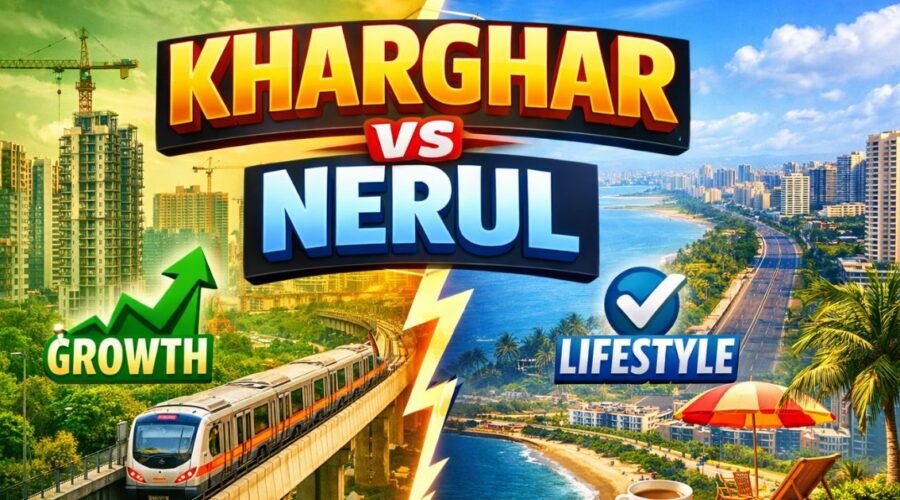
Kharghar vs Nerul: Growth Potential vs Established Lifestyle in Navi Mumbai
For most end-use buyers, Nerul is usually the better choice because it offers a more settled lifestyle, stronger daily convenience, and less civic friction. Kharghar usually makes more sense for buyers who are willing to accept some current rough edges in exchange for bigger future growth logic, better space value, and stronger long-term upside. The real answer depends on why you are buying: self-use, family comfort, rental return, or long-horizon investment.
A lot of buyers compare Kharghar and Nerul as if they are just two names on a property portal. That is not how this decision works in real life.
This is really a choice between two different stages of Navi Mumbai. Nerul feels like a finished urban product. Kharghar still feels like an expanding one. One gives you comfort now. The other may reward patience later.
Kharghar vs Nerul: the direct answer before the detailed comparison
If your priority is smooth daily living, strong social infrastructure, quick access to older established parts of Navi Mumbai, and fewer civic surprises, Nerul usually wins.
If your priority is larger space, newer supply, infrastructure-led upside, stronger rental yield potential, and a broader 7 to 10 year growth story, Kharghar usually becomes more attractive.
Quick summary
| Comparison point | Nerul | Kharghar |
|---|---|---|
| Best for | End-use buyers, families, risk-averse buyers, wealth preservation | Growth-focused buyers, long-horizon investors, buyers seeking more space |
| Core identity | Established lifestyle | Growth potential |
| Civic setup | Under NMMC, more mature urban services | CIDCO-planned but PMC civic reality affects daily life |
| Approximate property rate band (March 2026) | ₹19,000 to ₹28,000 per sq ft | ₹14,000 to ₹21,000 per sq ft |
| Five-year growth pattern | Steadier, more stable | Faster, more aggressive |
| Rental yield pattern | Lower percentage yield but stronger premium tenant profile | Better percentage yield in many practical segments |
| Daily routine comfort | Usually better | Depends heavily on sector and project |
| Main pain point | Older building stock and structural age risk | Water supply gaps and uneven civic maturity |
| Best one-line summary | Better present | Bigger future |
So no, this is not just a premium node versus a cheaper node. It is a comfort-now versus upside-later decision.
What does “growth potential” in Kharghar actually mean, and what does “established lifestyle” in Nerul actually mean?
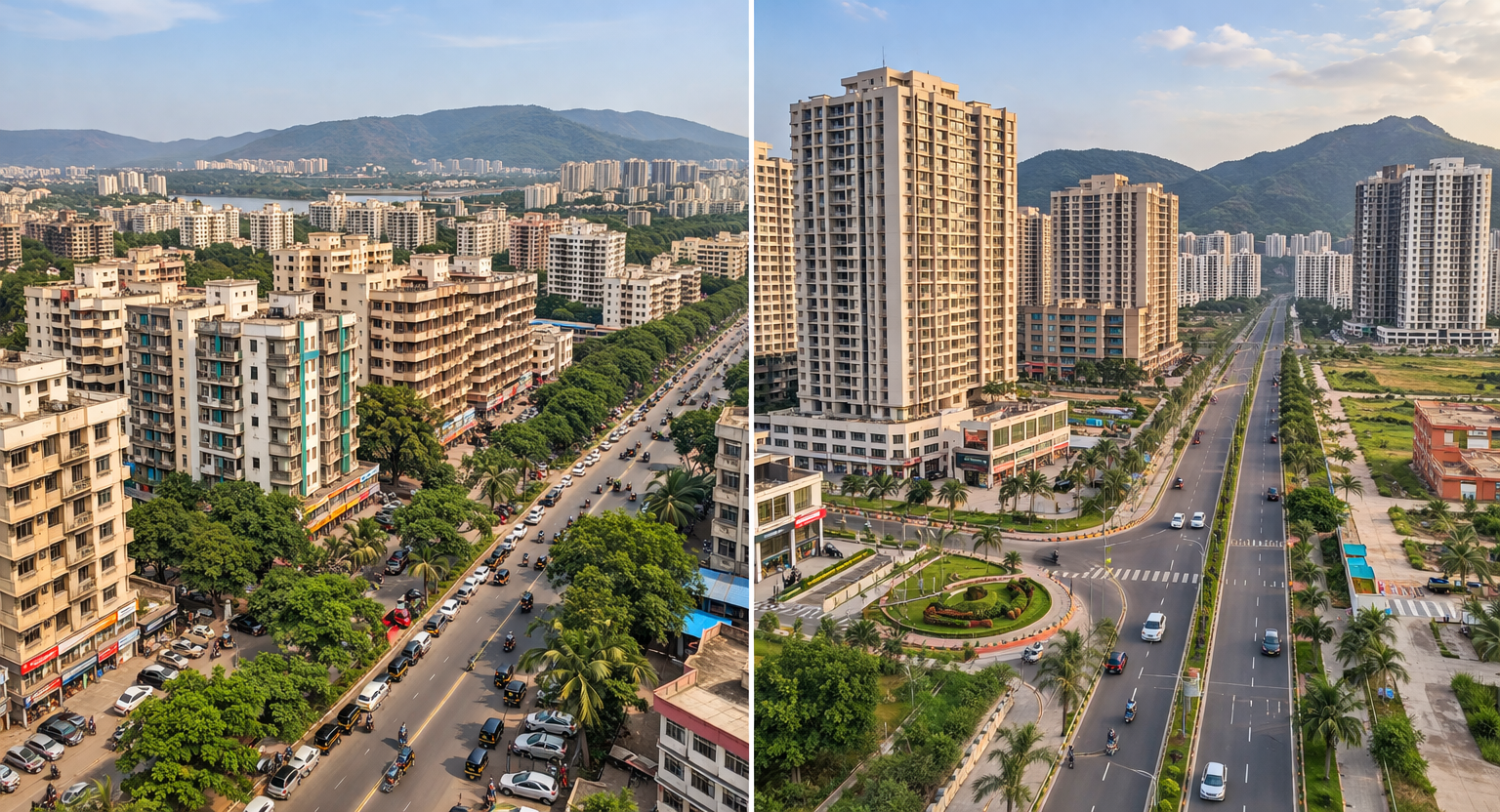
Where Kharghar’s upside story comes from
In Kharghar, growth potential is not just a vague marketing line. It is tied to real infrastructure and employment-side expectations.
That includes the Navi Mumbai International Airport becoming operational in late 2025, the broader commercial expectations around the proposed International Corporate Park, Metro Line 1 support, and future road connectivity improvements. In simple words, Kharghar’s value story is linked to what the area is becoming, not just what it already is.
But that does not mean every part of Kharghar will automatically benefit equally. A project near stronger access routes, better sectors, and more usable infrastructure will behave very differently from a project in a still-maturing edge pocket.
What makes Nerul feel more settled on the ground
Nerul’s established lifestyle is easier to understand once you spend time there. It means denser everyday convenience, more mature roads, older but reliable social infrastructure, closer integration with the rest of Navi Mumbai, and a more finished urban rhythm.
This is where Nerul feels strong. Schools, hospitals, station access, Palm Beach Road influence, existing retail, and mature neighborhoods all create a place that feels easier to live in immediately. You are not buying only a flat. You are buying into an already functioning ecosystem.
That is why Nerul tends to attract buyers who do not want to wait for a locality to become comfortable.
If you are buying for self-use, which node usually makes more sense?
For pure self-use, Nerul usually makes more sense.
That is the blunt answer.
When a family is actually going to live in the flat, glossy future stories matter less than water supply, school routes, medical access, internal roads, grocery convenience, and commute predictability. This is where Nerul usually feels more stable.
Who feels more comfortable in Nerul
Nerul is usually the safer self-use choice for:
- families with school-going children
- households with elderly parents
- buyers who want stronger station-side practicality
- people with rigid daily schedules
- buyers who do not want civic uncertainty after possession
Nerul’s big strength is not drama. It is routine. That matters more than many buyers admit.
Who still prefers Kharghar despite Nerul’s maturity
Kharghar still makes good self-use sense for some buyers, especially those who value:
- bigger modern layouts
- newer towers and amenities
- open-space feel
- educational ecosystem around major institutions
- long-term upside along with current use
But in Kharghar, self-use buying must be more careful. A premium tower does not automatically mean friction-free living. Buyers need to ask very direct questions about water source, summer tanker dependence, access roads, and real last-mile convenience. This matters because Kharghar’s project quality and area reputation can look stronger than the daily civic reality in some pockets.
Which one works better for family living, daily routine, and long-term comfort?
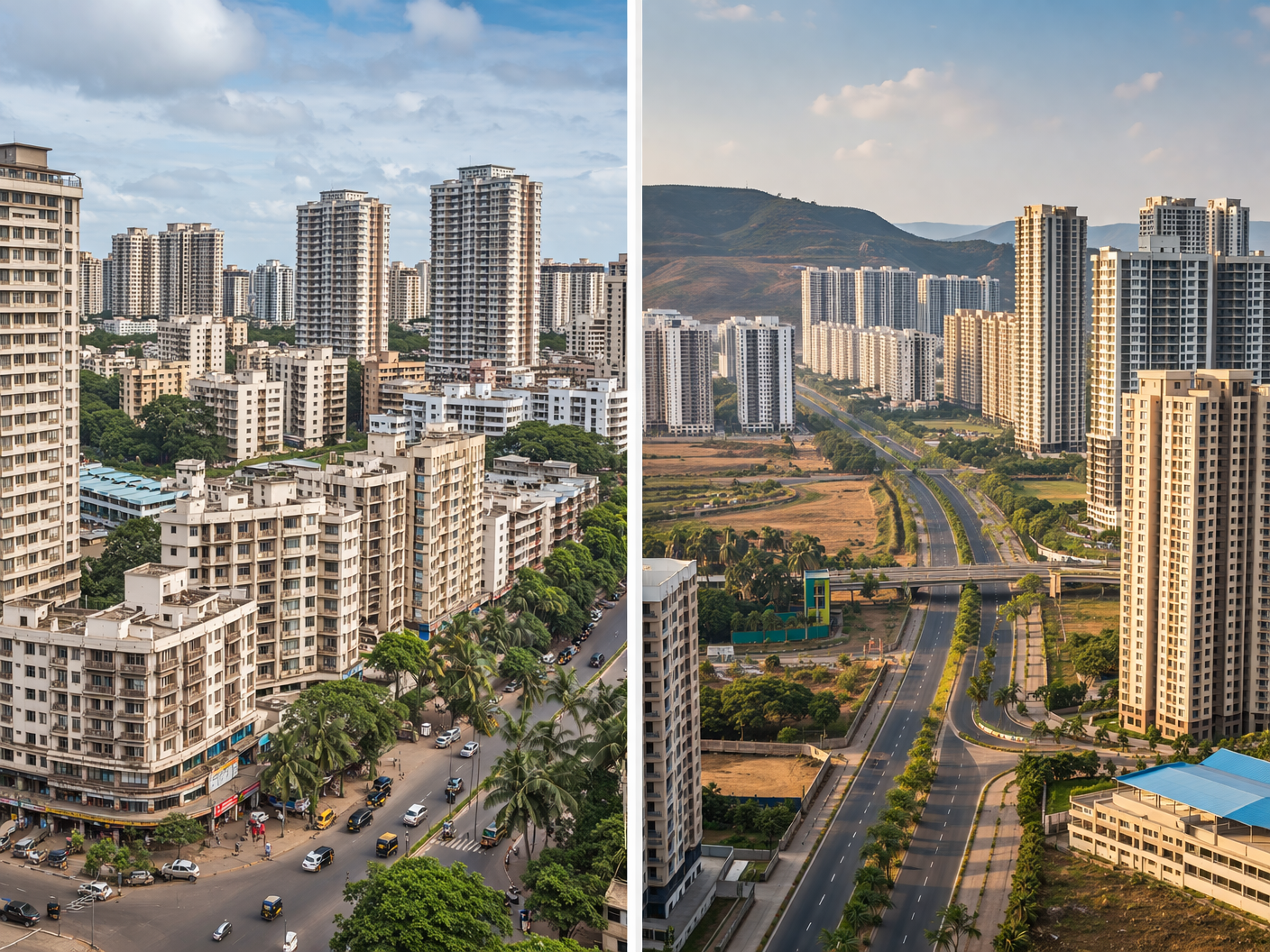
For weekday family life, Nerul usually works better. For larger-space living and open-space lifestyle, Kharghar can feel more attractive.
That is the real split.
Nerul’s family strength comes from compact convenience. Kharghar’s family strength comes from scale.
Schools, open-space feel, and daily convenience
Nerul benefits from a more clustered urban layout. In many practical family situations, that means shorter school runs, easier hospital access, more immediate retail convenience, and less day-to-day movement stress. That is a major advantage for busy families.
Kharghar, on the other hand, offers a very different kind of family appeal. Central Park, the golf course zone, hill-facing environment, wider roads in many stretches, and larger modern residential formats make it attractive for families who want breathing room. It also has strong educational presence of its own.
So the better question is not “Which one is more family friendly?” The better question is: Do you want family efficiency or family spaciousness?
Where commute stress changes the answer
Commute changes this comparison a lot.
If your work or routine depends heavily on easier rail-led movement and better access to older central Navi Mumbai zones, Nerul often feels simpler. If your movement is more car-based, future-oriented, or linked to emerging airport-side and newer corridor logic, Kharghar becomes easier to justify.
This is one of the biggest mistakes buyers make. They compare brochure quality, not movement logic.
Which node feels stronger for investment: upside, rent, or easier resale?
There is no single investment answer here because investment means three different things: appreciation, rental yield, and resale comfort.
Kharghar generally looks stronger for upside and better rental yield logic. Nerul generally looks stronger for stability and easier resale comfort.
Kharghar’s appreciation logic
Kharghar’s investment case is built on future demand expansion. That includes airport influence, metro support, new corporate ecosystem expectations, and the fact that buyers can still enter at lower pricing bands than Nerul in many segments.
Approximate March 2026 pricing bands from the research dossier place Kharghar around ₹14,000 to ₹21,000 per sq ft depending on sector, project age, and product quality. That lower base itself changes the appreciation equation.
It also helps rental yield. The research dossier indicates approximate gross rental yield patterns of 3.5% to 5.0% in Kharghar, which is stronger than many premium mature-node comparisons. For practical investors, that matters.
Nerul’s stability and exit comfort
Nerul is less about aggressive upside and more about established demand. It works better as a wealth-preservation market.
Because it is a more mature, more expensive market, percentage rental yields tend to be lower. But resale comfort is often stronger because the buyer base for a good Nerul property is deeper and more immediate. That does not mean every Nerul property is a safe buy. It means a well-chosen Nerul asset usually has more predictable exit logic.
If the goal is “park capital in a mature node and avoid speculative behaviour,” Nerul is easier to defend.
A caution that matters here
Do not confuse higher price with better investment. And do not confuse future buzz with guaranteed appreciation.
A premium flat in Nerul can still underperform if the building is aging badly. A Kharghar flat can still disappoint if it is in a weak micro-location with poor access and civic issues.
Price alone can mislead this comparison: what buyers should compare instead

This is where many buyers go wrong.
They compare one number, usually price per sq ft, and think they have understood the market. They have not.
In Kharghar and Nerul, the smarter comparison is total value, usable space, transaction burden, building age, and post-purchase friction.
Older premium stock vs newer project premium
Nerul often has older but better-located housing stock. Kharghar often has newer towers with larger amenity packages. But newer is not automatically better, and older is not automatically safer.
An older Nerul flat may offer better usable layout efficiency and stronger location value. A newer Kharghar tower may offer more amenities but higher loading, bigger monthly maintenance, or local civic friction.
So the buyer should ask: what am I paying for? More carpet? Better address? Better amenities? Better daily comfort? Better future potential?
Carpet area, maintenance burden, and livability
A flat that looks cheaper on agreement value can become more expensive after stamp duty, registration, society costs, transfer charges, parking, and future repairs.
This is especially important in Navi Mumbai because resale transactions may involve CIDCO-related transfer realities depending on title structure. The 2026 freehold conversion push has made this even more important. A property already converted to freehold may carry a premium, but it can reduce future transfer friction. A leasehold-linked resale flat can come with cost and process complexity that many buyers ignore until the last stage.
That is why a serious buyer should compare total acquisition cost, not just quoted price.
Why micro-location matters more than the node name in both Kharghar and Nerul
This comparison breaks down if you treat both nodes as one uniform market.
They are not.
A strong sector in Kharghar and a weak sector in Kharghar can feel like two different suburbs. The same is true in Nerul.
Not every Kharghar pocket carries the same growth logic
Central and more established parts of Kharghar behave differently from more edge-side developing belts. Some pockets already function well for self-use. Others are still better suited to buyers who can tolerate dust, incomplete surroundings, weaker walkability, or more dependence on future infrastructure.
This is why saying “Kharghar has growth potential” is not enough. Which part of Kharghar? Near what? With what access? Under what civic condition?
Not every Nerul pocket gives the same lifestyle quality
Nerul has mature lifestyle value, but even that varies by sector, building type, and age profile. Better-located premium pockets behave very differently from older low-rise stock in sectors where parking, maintenance, and building age are becoming bigger issues.
So the practical rule is simple: the wrong sector in the right node can still be the wrong buy.
If you want to compare other mature upper-end Navi Mumbai options beyond these two nodes, it also helps to review Vashi vs Seawoods before making a final residential choice.
What buyers usually get wrong about Kharghar
Kharghar is easy to romanticize.
That is exactly why buyers make mistakes there.
The first mistake is assuming all future infrastructure is already reflected as daily convenience. It is not. Infrastructure can be real and still not be fully integrated into ordinary life yet.
The second mistake is assuming all sectors will appreciate equally. They will not. Access quality, water reliability, metro proximity, road maturity, and project quality all change the investment outcome.
The third mistake is buying a lifestyle tower without checking civic basics. In Kharghar, a buyer should directly verify:
- water source and summer dependence on tankers
- exact access road condition
- liveability beyond the sample flat
- real distance to useful transport links
- whether the project’s location is practical now or only promising later
What buyers usually get wrong about Nerul
Nerul is easy to over-trust.
That is its buyer trap.
The first mistake is assuming a mature node automatically means a safe building. It does not. Nerul has older housing stock, and building age matters a lot.
The second mistake is overpaying for the pin code without checking structural condition, society finances, maintenance realities, parking problems, and future repair burden. A premium address cannot protect a weak building forever.
The third mistake is expecting high rental yield simply because the area is expensive. In reality, high capital values often compress percentage yield. So buyers chasing cash flow may misread Nerul badly.
So who should choose Kharghar, and who should choose Nerul?

At this point, the answer should be clearer.
But here is the practical final split.
| Buyer type | Better fit | Why |
|---|---|---|
| First-time buyer wanting more space at a lower entry band | Kharghar | Better space value and stronger future growth logic in the right sectors |
| Family with children and elderly parents | Nerul | More settled daily ecosystem, easier logistics, mature convenience |
| Long-horizon investor with 7 to 10 year patience | Kharghar | Better appreciation story and stronger rental-yield logic in many segments |
| Risk-averse buyer preserving capital | Nerul | Better maturity, stronger immediate liveability, easier resale comfort |
| Buyer wanting modern towers and bigger layouts | Kharghar | Wider newer supply options |
| Buyer wanting smooth daily life from day one | Nerul | Less dependence on future execution |
If Nerul is still looking stronger for your needs, this Vashi vs Nerul comparison is the next practical step for judging how Nerul performs against another mature mainstream node.
The cleanest final verdict
Choose Nerul if your main goal is established lifestyle, immediate comfort, family practicality, and lower tolerance for uncertainty.
Choose Kharghar if your main goal is future-led upside, more space, newer product options, and you can accept that some parts of the value story still depend on execution and area maturity.
What to verify before booking in either node
A good comparison article should not stop at “which area is better.” It should also help you avoid a bad transaction.
So before booking in either Kharghar or Nerul, verify these things properly.
MahaRERA, registration, and document checks
For under-construction property, check the project on MahaRERA. Do not rely only on the sales team. Verify project registration, promoter record, declared timelines, and any visible compliance issues.
Also budget properly for stamp duty and registration. As per the research dossier, the effective stamp duty in Navi Mumbai works out higher than many buyers casually assume, because additional local components apply. Registration charges also need to be factored in, not treated as a side issue.
Civic and access checks during site visits
For Kharghar:
- ask about municipal water versus tanker dependence
- visit in daytime and evening, not just once
- check actual road approach, not map appearance
- verify how practical the location feels without future assumptions
For Nerul:
- ask building age clearly
- check whether structural audits or major repair liabilities are relevant
- understand society condition, parking, water, lifts, and maintenance health
- do not buy only because the locality name sounds premium
Conclusion
If you want the shortest honest answer, here it is: Nerul is the better present, and Kharghar is the stronger future bet.
That is why this comparison feels difficult.
Nerul gives you a more finished life. Kharghar gives you a bigger growth story. Nerul is usually better for families, self-use buyers, and buyers who want immediate comfort with less civic uncertainty. Kharghar is usually better for buyers who want more space, stronger appreciation logic, and a longer runway for value creation.
So the right choice is not about which node sounds better in conversation. It is about which one matches your real life, your budget, and your patience.
FAQs
Frequently Asked Questions