
Share Certificate From a Housing Society: When It Is Legally Required in Navi Mumbai
A housing society share certificate is not the same as a sale deed. In Navi Mumbai, it is usually legally relevant for society membership, transfer of shares, inheritance updates, duplicate issuance, and internal society rights, but it does not replace registered title documents. For resale buyers, this matters a lot because the sale deed proves the property transaction, while the share certificate proves membership and shareholding inside the co-operative housing society.
In simple terms, one document tells the outside legal system that a transfer happened. The other tells the society who its lawful member is. That difference is where many buyers, sellers, and families get stuck.
A share certificate is important in society-based resale deals, but it should always be reviewed along with the wider Navi Mumbai property documents and legal checks before treating the title as clean.
What a housing society share certificate actually proves in a Navi Mumbai flat
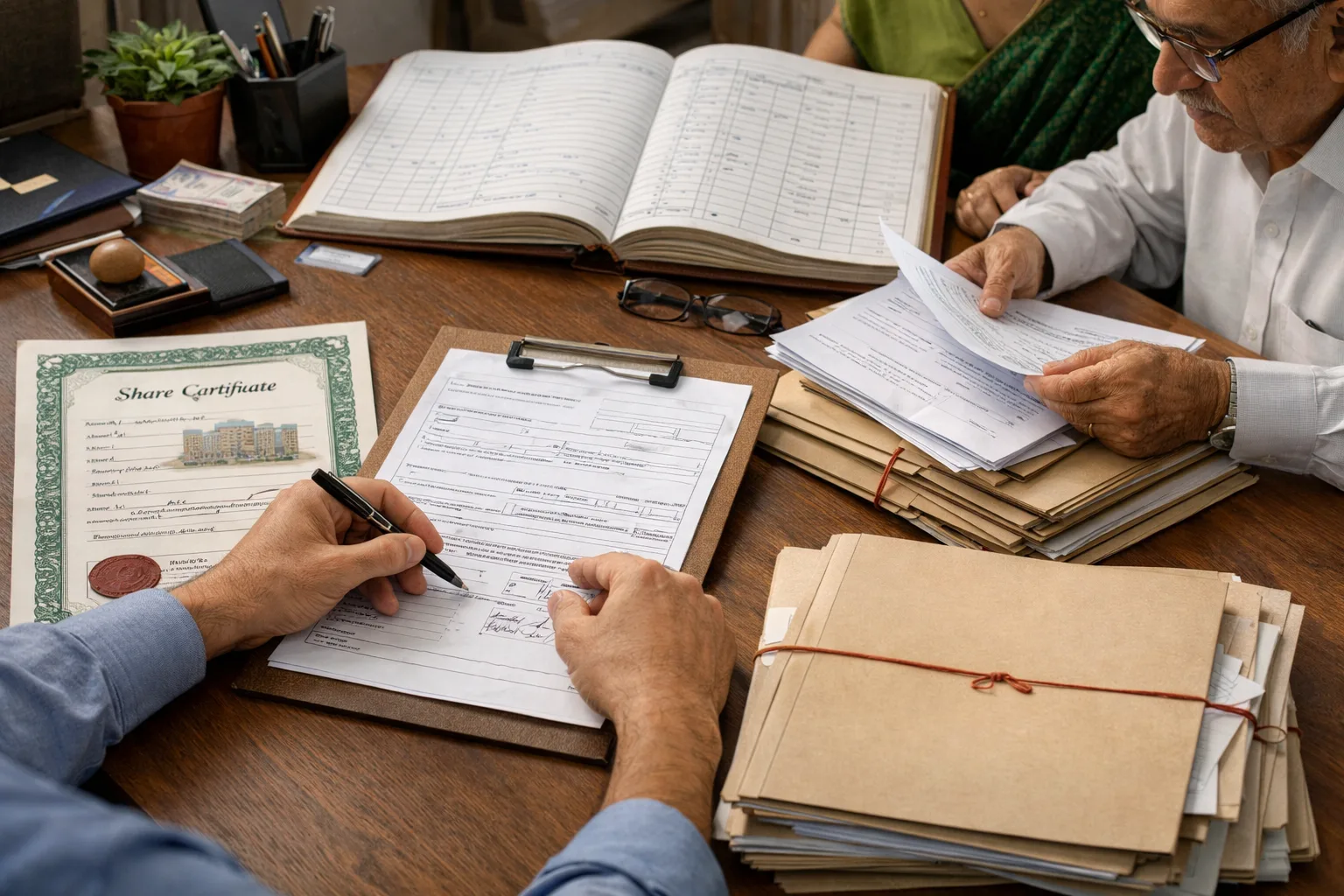
A housing society share certificate proves that the person named on it is an admitted member of the co-operative housing society and holds the relevant shares linked to that flat. In Maharashtra’s co-operative housing structure, this is not small paperwork. It is the society-side proof that the member has rights and responsibilities inside that building ecosystem.
It does not replace the sale deed, agreement for sale, or other registered title documents. That is the most important distinction in this entire topic. The registered document proves the transfer of property rights. The share certificate proves society membership and shareholding.
In practice, a valid share certificate should reflect the society’s details, the member’s name, share numbers, folio details, the official society seal, and the required signatures of the authorised office bearers. In many Navi Mumbai resale cases, especially in older societies, this certificate becomes the first document that reveals whether the internal records are clean, outdated, or messy.
Quick definition box
A share certificate from a housing society is:
- proof of membership in the co-operative housing society
- proof of allotted shares in that society
- linked to a specific flat and occupancy rights inside the society system
- not a substitute for the registered sale deed or title chain
Is a share certificate legally required, or only practically important?
The honest answer is that it depends on the stage of the transaction.
For property registration, the registered sale deed and registration-side documents matter more. But for society transfer, record updates, inheritance handling, and internal rights, the share certificate becomes legally and practically important. In Navi Mumbai, where many flats sit inside older co-operative societies and CIDCO-linked leasehold structures, ignoring it can create serious trouble later.
Many buyers wrongly assume that a share certificate alone proves full ownership, which is why it is important to understand Agreement to Sale vs Sale Deed as well.
When it is legally relevant inside society process
Inside the society’s own legal process, the share certificate is usually central. If a flat is being transferred through resale, inherited after the owner’s death, or updated in the society register, the certificate is not just helpful. It is part of the core society-side paperwork.
The same applies in duplicate issuance cases, voting rights, redevelopment rights, and membership disputes. The society does not treat the share certificate as decorative paperwork. It treats it as part of the legal record of who the member is.
When registered property documents matter more
If the issue is pure title proof, then the registered sale deed, agreement chain, and Index II side of the transaction matter more. That is the title track. The share certificate cannot replace that.
This is why a buyer should never hear “share certificate hai, so title clear hai” and relax. That is the wrong way to read the file.
Why buyers still treat it as an important resale document
In real Navi Mumbai transactions, resale buyers care about the share certificate because it affects:
- society transfer
- loan processing on resale flats
- future resale ease
- internal record clarity
- redevelopment eligibility and member rights
- peace of mind that the society recognises the seller properly
That is why the correct answer is not “mandatory” or “not mandatory” in one line. It is title proof on one side, society proof on the other side.
Quick summary table
| Situation | Is it legally required? | Is it practically important? | What else must be checked? |
|---|---|---|---|
| Registration of sale deed | No, not as the main registration document | Moderate | Sale deed, Index II, identity proof |
| Society membership transfer after resale | Yes, usually central to the society process | Very high | Transfer forms, society records, dues, CIDCO-related transfer where applicable |
| Inheritance or death-case record update | Yes, usually needed for society-side mutation | Very high | Death certificate, nomination, legal heir papers, succession documents where needed |
| Bank loan on resale flat | Depends on lender policy | Usually very high | Full title chain, society NOC, dues status |
| Redevelopment, voting, internal rights | Yes, highly relevant | Very high | Member register, redevelopment records, rehabilitation documents |
Share certificate vs sale deed vs agreement for sale vs society NOC
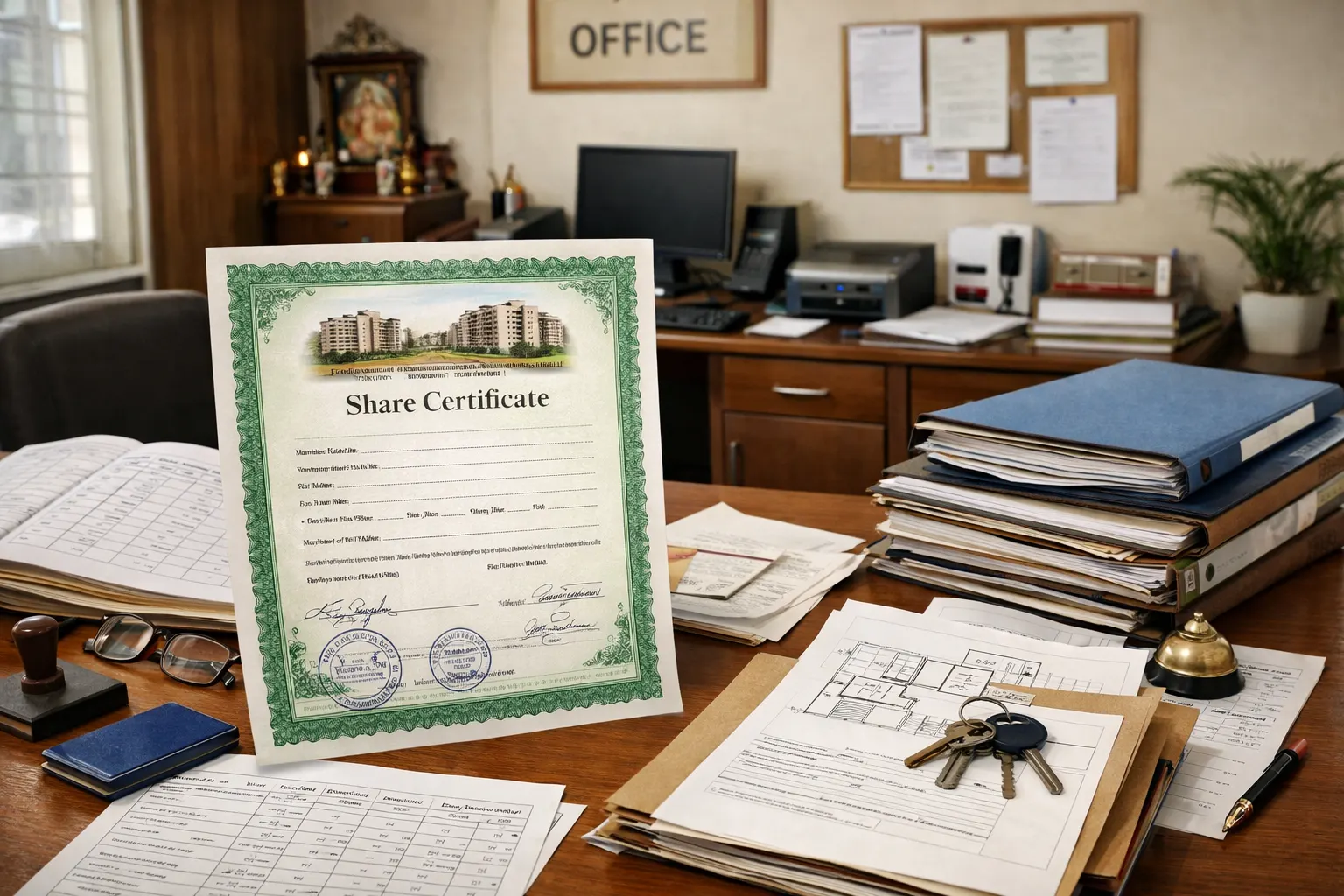
This is where most confusion starts, and weak articles usually get it wrong.
Which document proves title
The registered sale deed is the main document for proving that a property transaction took place and ownership rights were transferred. It is the strongest title-side document in the buyer’s file.
An agreement for sale is also important, but it is not the same as a final registered sale deed. It may govern the terms of the transaction, especially in builder or pre-completion situations, but it does not replace the final transfer record where a sale deed is required.
Which document proves society membership
The share certificate proves that the society has recognised the person as a member holding the relevant shares. This is the society-side recognition linked to the flat.
If the sale deed says one thing and the society records say another, the buyer is not holding a clean, comfortable file. That mismatch is exactly what causes delays and disputes.
Which document helps in transfer but does not replace ownership proof
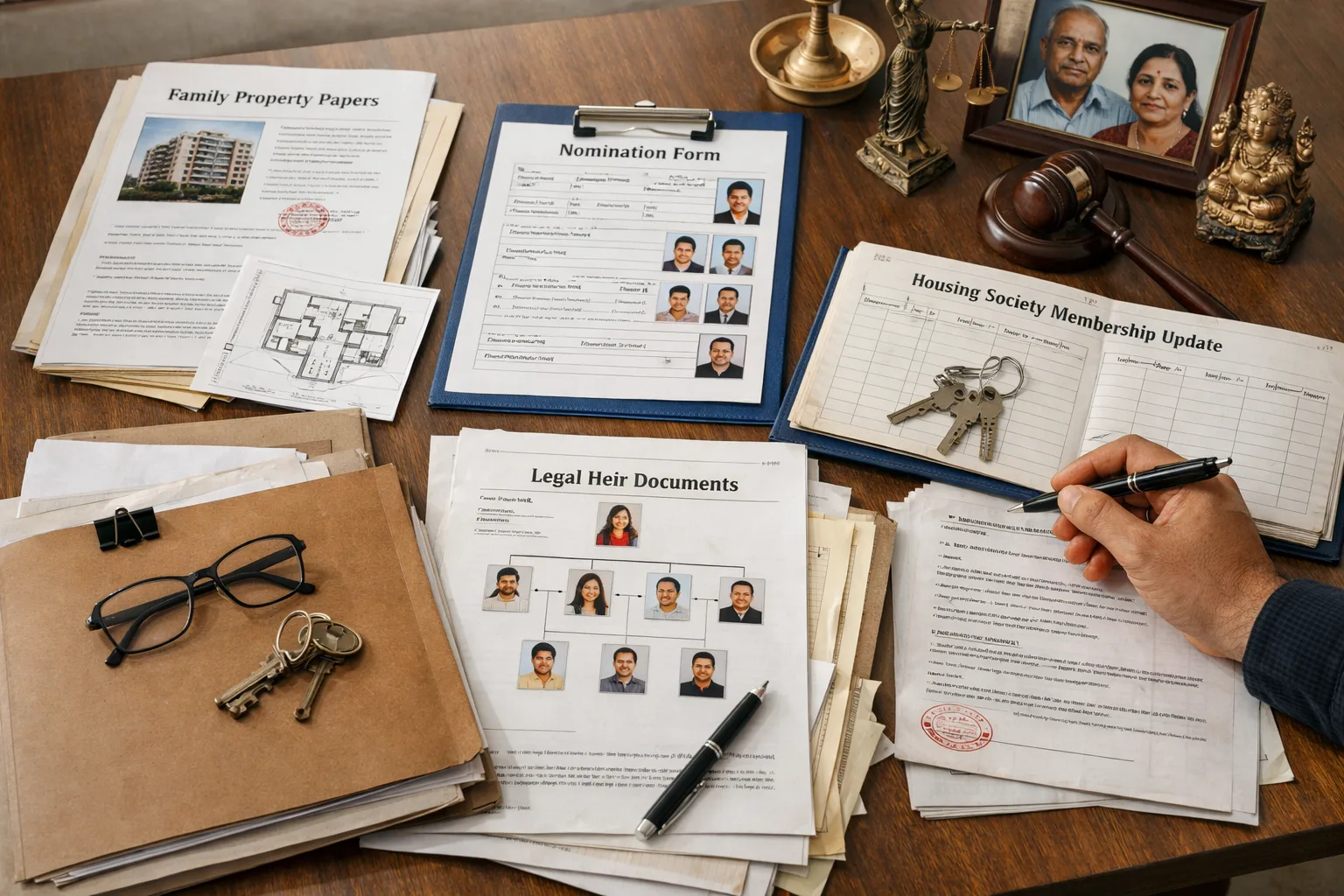
A society NOC is useful, but it is not a permanent substitute for the share certificate. It is generally a clearance or no-objection document for a particular transaction stage. It does not replace the sale deed, and it does not replace the society’s formal shareholding record either.
Comparison table: what each document actually does
| Document | What it mainly proves | Who handles it | Can it replace the others? |
|---|---|---|---|
| Registered Sale Deed | Transfer of property rights through registered transaction | Sub-Registrar / registration system | No |
| Agreement for Sale | Contract terms and transaction structure | Buyer and seller / builder and buyer | No |
| Share Certificate | Society membership and shareholding | Co-operative housing society | No |
| Society NOC | Society clearance for a transaction stage | Co-operative housing society | No |
A buyer should ask for all of them based on context, not assume one document makes the rest irrelevant.
In which Navi Mumbai situations does the share certificate become most important?
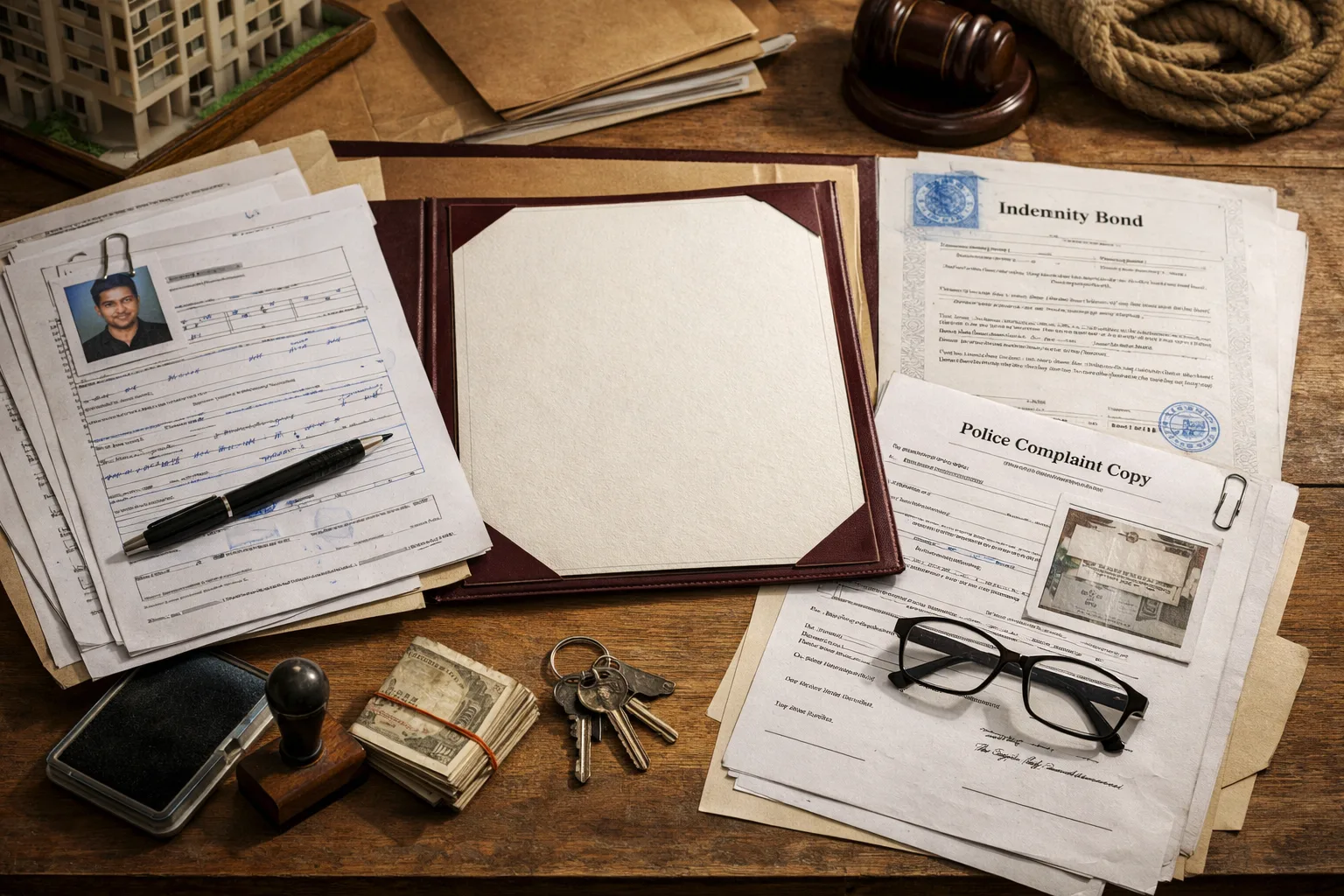
This document becomes most important when a flat moves from being a passive asset to an active society file.
Resale of a flat in an existing co-operative housing society
In an older resale flat, the original share certificate often becomes a central handover document. The society uses it to process the transfer of shares and update its member records. This is common in older nodes such as Vashi, Nerul, Belapur, Seawoods, and older parts of Kharghar, where flats may have changed hands multiple times.
If the certificate is missing, damaged, or inconsistent, the resale process slows down immediately.
Transfer after death, nomination, or family settlement
This is one of the most emotionally messy areas. Families often assume that if one child is shown as nominee, the matter is automatically settled. It is not that simple.
A nominee is typically a trustee for society purposes, not automatically the absolute owner for all succession purposes. If the original owner has died, the society may still ask for nomination records, heir consent, release documents, or succession-related papers before the file becomes clean enough for future sale or transfer.
Loan processing, society transfer, and record update
Banks and housing finance companies usually prefer a complete document set in a resale flat file. Lending policy varies, so this should not be stated in absolute terms, but missing share certificate issues often trigger more scrutiny, delay, or conditions.
On the society side, transfer becomes difficult if the certificate is unavailable or the society records do not match the seller’s claim.
Redevelopment, voting, and internal society rights
In older Navi Mumbai buildings moving toward redevelopment, the share certificate matters because member identity matters. Voting rights, rehabilitation rights, and internal society recognition are not abstract issues in redevelopment. They affect who is counted, who signs, and who gets what.
Real-world scenario box
A family in an older Nerul society wants to sell a flat that changed hands twice over the last 25 years. The sale deed chain looks available, but the share certificate is laminated, old endorsements are unclear, and the seller has maintenance arrears. On paper, the flat looks sellable. In practice, the society transfer can get stuck until the certificate issue and dues issue are resolved. That is exactly why buyers should not treat the share certificate as a minor paper.
Can you buy a resale flat in Navi Mumbai if the share certificate is missing?
Yes, sometimes. But you should not proceed casually.
The right question is not just “Is it missing?” The right question is why it is missing.
Missing but traceable
If the certificate is missing because it is currently held by a bank against an active home loan, that is usually a manageable case. The seller should be able to show the loan linkage and the bank’s custody of the original paper. That is a document-location issue, not necessarily a danger signal.
Lost and duplicate needed
If the seller says the certificate is lost, the risk rises immediately. This is where the buyer should slow down and stop treating verbal reassurance as enough.
A lost certificate should normally push the seller into the duplicate issuance process. Until that process is underway or completed, the buyer should be careful with final payment and final commitment. A lost document can be innocent, but it can also point to sloppy records, hidden pledge issues, or future society friction.
Never issued or society records unclear
If the society never issued the certificate, the problem is different. This usually signals administrative failure, delayed society process, or incomplete record management. In newer Navi Mumbai zones such as Ulwe, Karanjade, or Dronagiri, this can happen because society formation and handover are still evolving. In older areas, it is usually a deeper warning sign.
In such cases, the buyer should ask for a formal society letter confirming the seller’s membership status and clarifying whether certificates are pending for all members or whether this is a specific defect in this flat’s file.
Caution box: when to slow the deal
Treat the file as higher risk if:
- the seller cannot explain why the certificate is missing
- the society says the document was issued long ago but the seller cannot produce it
- the certificate is laminated and cannot be endorsed
- the seller has large maintenance dues or CIDCO-related dues
- the seller is a nominee but legal heir consent is unclear
- the society register does not match the seller’s claim
What buyers in Navi Mumbai should check before relying on a share certificate
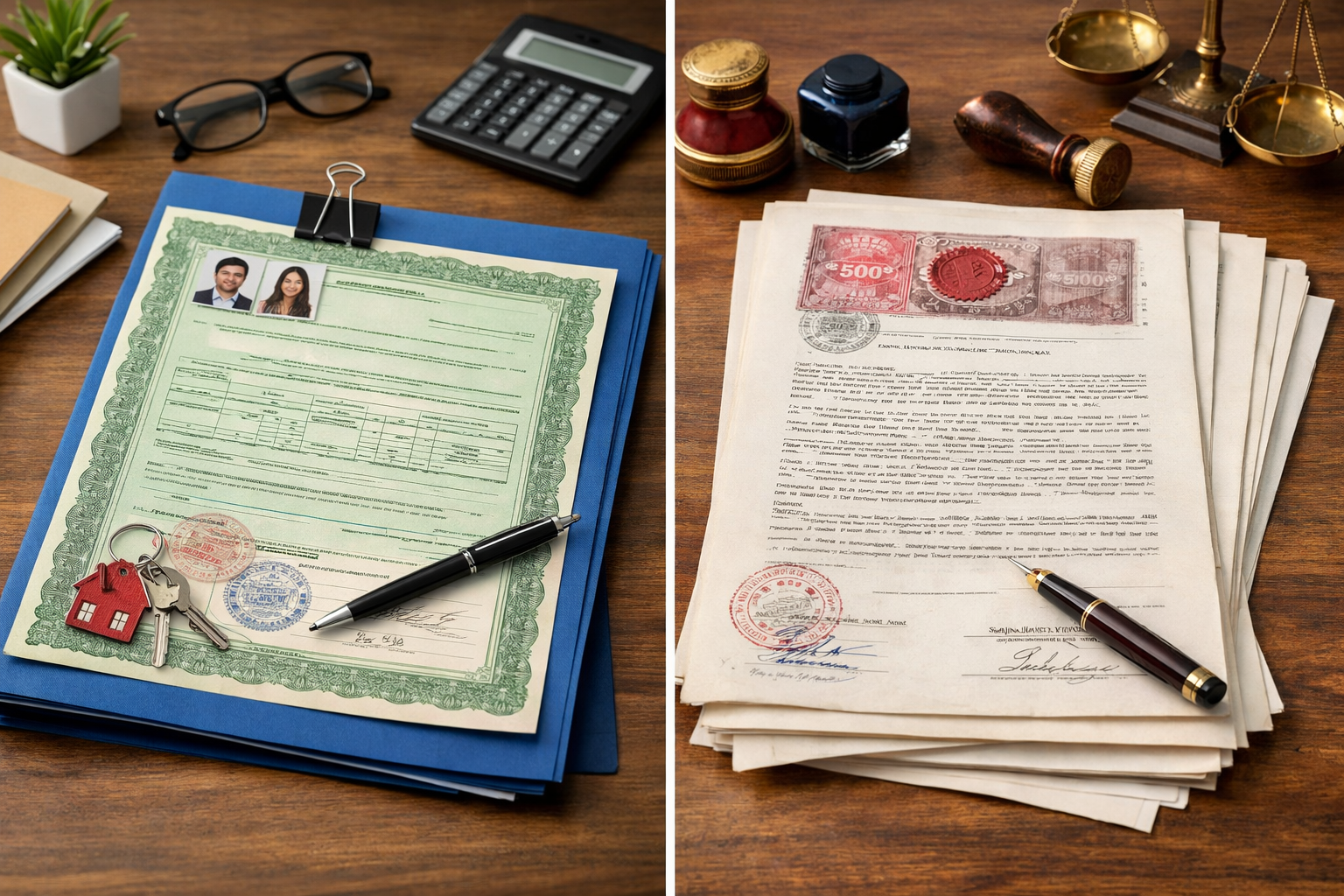
A physical share certificate is helpful, but it should not be trusted blindly.
In older Navi Mumbai societies, especially in Vashi, Nerul, Belapur, Kharghar, and Panvel-side resale stock, the smart check is not “certificate dikha diya.” The real check is whether that certificate fits cleanly into the whole paper trail.
Buyer checklist
- Check whether the name on the certificate matches the seller’s name on the registered sale deed and PAN
- Check whether the flat number, society name, share numbers, and folio details are consistent
- Check the reverse side for past transfer endorsements if the society follows that format
- Check whether the society’s internal member register matches the certificate
- Check whether maintenance dues, repair dues, or CIDCO-linked dues are pending
- Check whether nomination exists and whether the seller is selling as nominee or direct owner
- Check whether the certificate appears altered, overwritten, damaged, or suspicious
- Check whether the society is willing in writing to process the transfer after document submission
The lamination trap
This is a practical mistake many owners do not think about. They laminate the original share certificate for safety. Later, when the flat is sold, the society may need to endorse the transfer on the reverse side. A laminated certificate can create an avoidable problem and may push the owner into a duplicate issuance process.
It sounds small. In a resale timeline, it is not small at all.
What if the seller says the sale deed is available but the share certificate is not?
This is one of the most common anxiety points in resale deals.
A clean sale deed is good, but it is not enough to ignore the missing share certificate. Once the seller says “sale deed hai, certificate missing hai,” the buyer should move from negotiation mode to verification mode.
Ask for a written clarification from the society on three things:
1. Was the certificate issued to the seller? 2. Does the society register show the seller as the recognised member? 3. What exact process will the society require before transfer to the new buyer?
If the society confirms the certificate was issued but is unavailable, the seller should start the duplicate process before the buyer releases final payment. If the society says the certificate was never issued, the buyer should ask why and what documents the society will accept meanwhile.
The biggest mistake here is emotional urgency. Buyers often think, “Title document clean hai, baaki baad mein ho jayega.” That approach creates future pain.
How duplicate share certificates are usually handled in Maharashtra societies
The duplicate process is meant to reduce fraud, not just replace paper. That is why it is more formal than people expect.
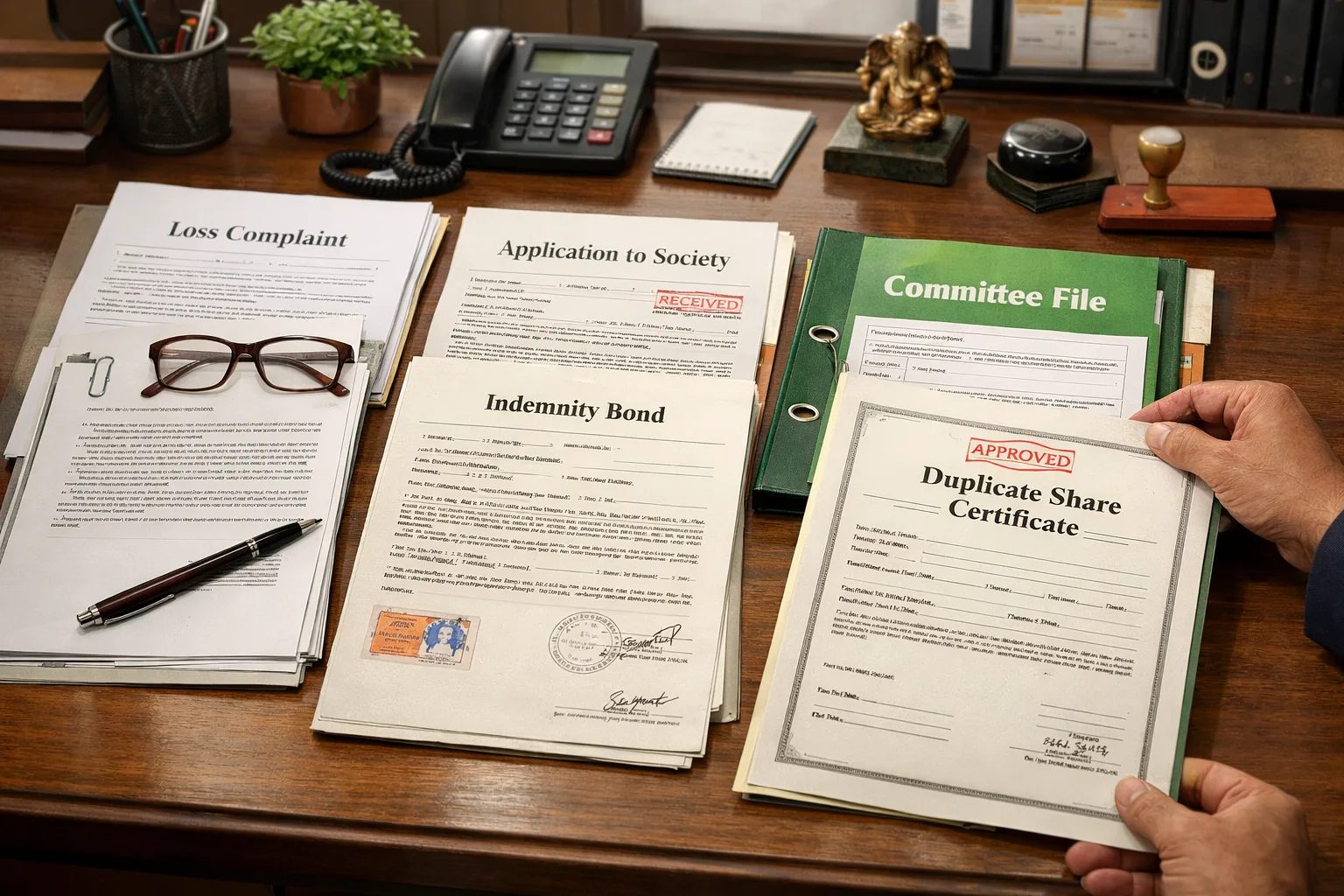
In practice, the usual path includes a police complaint about the loss, an application to the society, and an indemnity bond. The plain-English meaning of an indemnity bond is simple: the member promises to protect the society if the original document later reappears and creates a dispute.
The committee then reviews the request. In real society practice, especially in risk-sensitive cases, public notice may also be required before the duplicate is issued. A waiting period is usually involved.
Usual duplicate flow
- file police complaint or NC/FIR for loss
- submit application to society
- submit indemnity bond and supporting papers
- committee passes a resolution
- public notice may be issued
- waiting period for objections
- duplicate certificate is issued if no valid objection comes
This is why buyers should not assume that a lost certificate can be fixed in two days. Even where the process is straightforward, it still takes time, society cooperation, and clean records.
Older co-operative housing societies in established nodes
In Vashi, Nerul, Belapur, Seawoods, and older parts of Kharghar, the bigger issue is usually historical paperwork. Flats may have changed hands several times since the 1980s or 1990s. Some certificates are old, some are missing, some transfers were handled casually, and some CIDCO-linked papers may also be incomplete.
Here, the share certificate matters because it helps expose broken paper trails.
Newer builder inventory where society formation may still be evolving
In Ulwe, Karanjade, Dronagiri, or similar developing belts, the issue may not be loss of certificate. The issue may be that the society is still not fully formed, or certificates have not yet been generated for members. In such cases, the buyer’s reliance shifts more toward the registered agreement for sale, builder allotment records, possession documents, and project-level compliance.
So the absence of a share certificate means different things in a newer project and in a 30-year-old Nerul society. That distinction matters.
Panvel-side and CIDCO-influenced resale cases where document chains need extra care
Panvel-side and CIDCO-influenced files often need more patience because multiple layers may matter together: builder-side records, society-side records, municipal records, and CIDCO transfer conditions. In many Navi Mumbai resale cases, the transfer is not just buyer and seller. It can also involve lessor-side rules and society sequencing.
That is why generic Maharashtra advice often feels incomplete in Navi Mumbai. The city’s leasehold and society structure makes the paperwork more layered.
Who issues it, who updates it, and who cannot replace it?
The housing society issues it. The society updates it. The society handles its duplicate process.
The Sub-Registrar does not issue the share certificate. The registration office handles sale deed registration and title-side record work. That is a different function.
CIDCO also does not issue the share certificate. CIDCO may matter in transfer approval or leasehold history, but it is not the issuer of society membership papers. Similarly, once the society is formed and running, the builder’s internal allotment or ledger papers do not replace the society’s own share certificate.
This is important because buyers often waste time approaching the wrong authority. If the certificate is lost, the first meaningful approach is usually to the society office, not the registration office and not CIDCO.
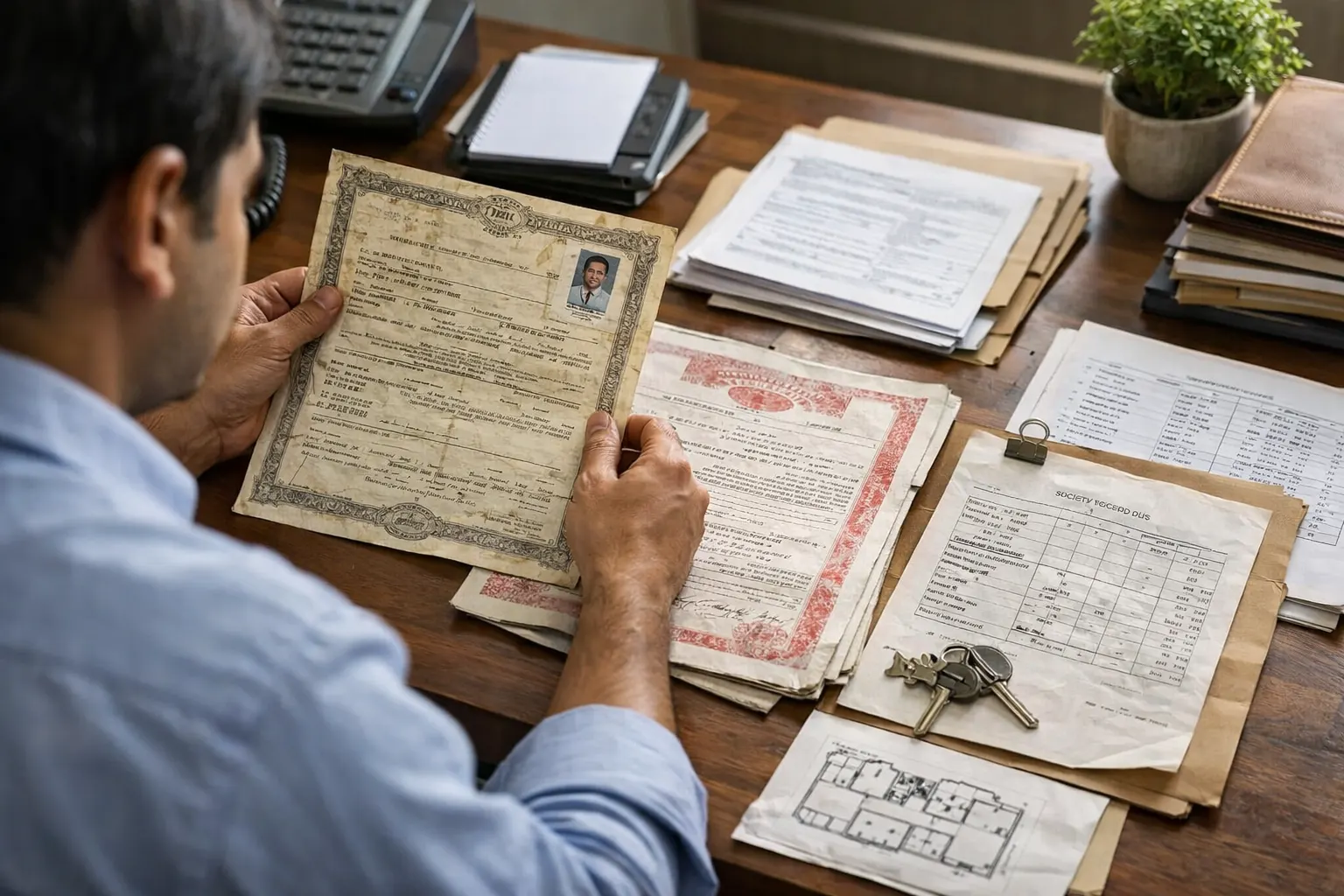
A simple document hierarchy for buyers: what to trust first, second, and together
The honest answer is that it depends on the stage of the transaction.
For property registration, the registered sale deed and registration-side documents matter more. But for society transfer, record updates, inheritance handling, and internal rights, the share certificate becomes legally and practically important. In Navi Mumbai, where many flats sit inside older co-operative societies and CIDCO-linked leasehold structures, ignoring it can create serious trouble later.
Resale buyers often ask which paper matters most. The better answer is that the papers work together. Still, this order helps.
Practical document hierarchy
1. Registered sale deed and full title chain This is the first layer. Without title clarity, the file is weak from the start.
2. Index II and registration-side verification This supports the registered transfer trail.
3. Original share certificate This gives society-side membership clarity.
4. Society transfer records and no-dues position This tells you whether the society will actually complete the transfer smoothly.
5. Nomination, release deed, heir consent, or succession documents where needed This matters especially if the prior owner is deceased.
6. CIDCO transfer clarity where applicable In many Navi Mumbai files, this is not optional background noise. It is part of the real transfer picture.
A transaction missing item 1 is dangerous. A transaction missing item 3 may still be curable, but it becomes more stressful, slower, and riskier. A clean purchase usually needs both title proof and society proof to line up.
Conclusion
A housing society share certificate is not just old society paperwork, and it is not a replacement for a sale deed either. In Navi Mumbai, the safest way to understand it is this: the sale deed proves the property transaction, but the share certificate proves your place inside the society that governs that flat.
So if you are buying a resale flat, do not ask only one question: “Is the sale deed available?” Ask three:
- Is the title trail clean?
- Is the society membership trail clean?
- Is the Navi Mumbai transfer trail, including CIDCO-side reality where relevant, clean enough to complete the deal smoothly?
When those three lines match, the transaction usually feels far safer.
FAQs
Frequently Asked Questions