
Ulwe Property Guide: Best Sectors, Airport Impact and Buying Tips
Ulwe is still a strong place to buy property in 2026, but not in the old “buy anywhere and wait” way. The right decision now depends on sector choice, station access, water reliability, society quality, and whether the airport premium is already built into the price you are paying. The airport has made Ulwe more real, not automatically better everywhere. That is why buying in Ulwe today requires sector-level judgment, not broad hype.
Ulwe has changed fast. The airport is operational, the Atal Setu is active, and the area is no longer just a future story people kept repeating for years. It is now a functioning, high-density residential belt with real commuters, real end users, rising occupancy, and stronger rental movement. But that also means the easy speculative phase is over. Buyers now need to be much sharper about location, price, and paperwork.
Is Ulwe a good place to buy property right now?
Yes, Ulwe can still be a smart buy, especially for long-term end users, MTHL-side commuters, and investors looking for stable rental demand rather than dramatic short-term flipping. But it only works well when the sector, building, and final acquisition cost make sense together.
What has changed is the market stage. Ulwe has already seen major price expansion in the last few years, largely due to the airport and wider connectivity story. So the question is no longer whether Ulwe has a future. The question is whether the exact flat you are considering gives you practical value at today’s price.
Quick Summary
| Buyer question | Practical answer |
|---|---|
| Is Ulwe still worth considering? | Yes, but only with careful micro-location selection |
| Is the airport story still relevant? | Yes, but much of the announcement premium is already absorbed |
| Are all sectors equally good? | No, sector quality changes livability, rentability, and resale strength |
| Is Ulwe better for flipping? | Usually no |
| Is Ulwe better for long-term use or holding? | Usually yes |
| What matters most now? | Station access, water resilience, society quality, legal clarity, and real deal price |
A buyer paying portal-level aspirational rates without checking actual registration trends can easily overpay. That is now one of the biggest risks in Ulwe.
Why Ulwe cannot be judged as one single market
This is where many buyers go wrong. They treat Ulwe as if it is one clean property zone with one growth story and one price logic. It is not.
A flat near a stronger commuter pocket and established retail belt behaves very differently from a flat in a peripheral stretch with dust, weak walkability, and lower day-to-day convenience. Even when both are called “Ulwe,” the daily experience, tenant demand, and resale confidence can be completely different.
The biggest dividing factors are practical ones:
- distance to Bamandongri or Kharkopar station
- internal road quality and actual walking comfort
- society occupancy and maintenance standards
- local market and school ecosystem
- monsoon resilience
- whether the project is truly possession-ready or only looks good on paper
This is also where the airport story gets misunderstood. Airport-linked demand does not erase basic urban realities. A building still needs good approach roads, working water systems, manageable maintenance, and a location that people can live in comfortably.
In simple words, the gap between an average deal and a strong deal in Ulwe is often not glamour. It is everyday practicality.
Which sectors in Ulwe usually make more sense for different buyers?
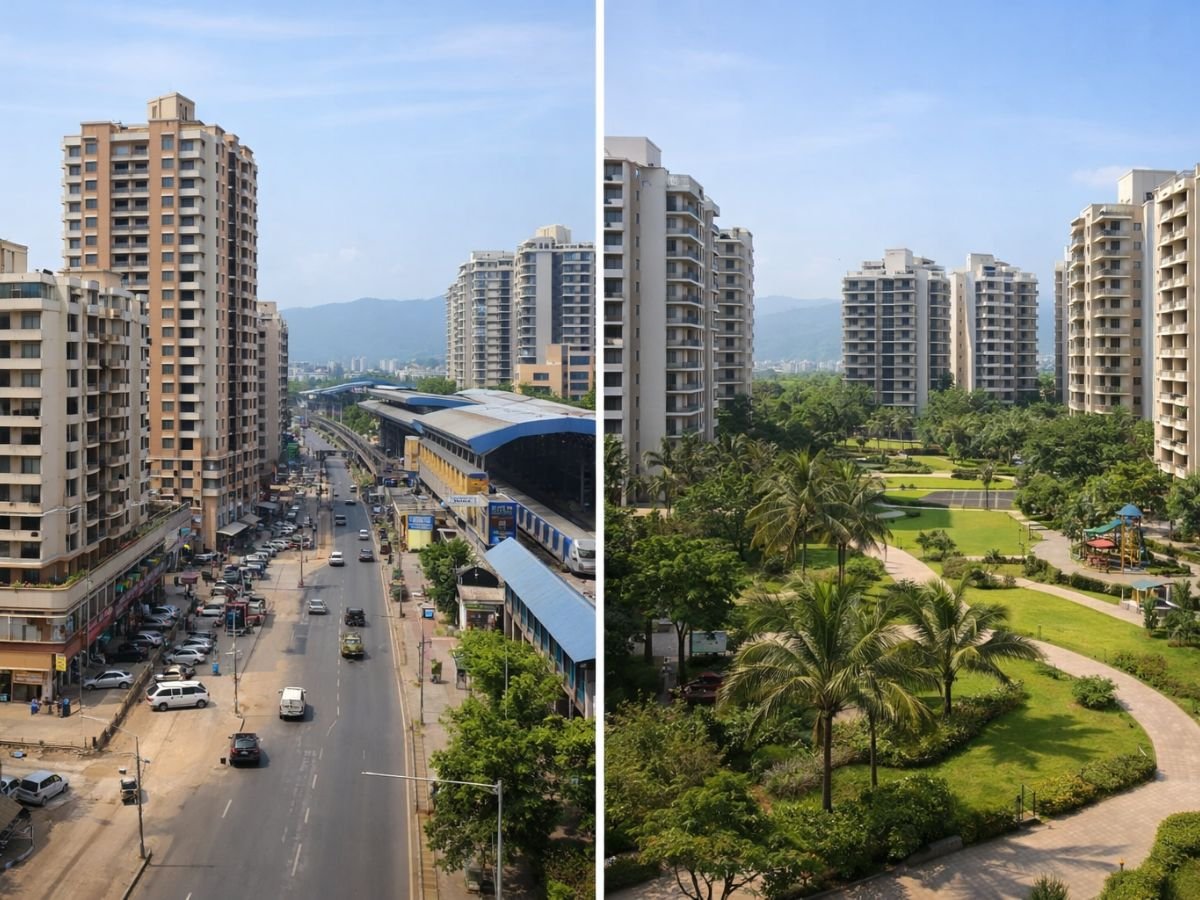
There is no single best sector in Ulwe for everyone. The right sector depends on why you are buying.
Sectors that work better for station-linked convenience
The commuter core is usually around Sectors 19B and 20, where Bamandongri station access and a more active retail ecosystem make daily life easier. These pockets tend to hold demand better because rail access is not a cosmetic advantage here. It directly affects rentability, daily comfort, and future resale confidence.
Sector 17 is also important because it balances Kharkopar station access with useful road connectivity. For some buyers, especially those thinking in terms of movement toward the MTHL side, this balance matters a lot. The caution here is that building quality can vary more, so selection has to be sharper.
Sectors that work better for quieter end-user living
Sector 9 usually feels stronger for settled family living, especially where the project quality and surrounding environment are good. This is the kind of pocket where larger 2 BHK family use starts making more sense. Layout comfort, a more stable environment, and better day-to-day livability matter more here than pure low entry price.
This does not mean every building in Sector 9 is automatically premium. It means the sector logic is stronger for end users who value settled surroundings over just speculation.
Sectors where buyers should be extra selective
Sectors 23 and 24, along with more peripheral belts such as Jawle and Wahal-side pockets, can offer lower entry points. But lower entry alone should not be confused with higher value.
These are usually better for patient buyers or long-hold investors who understand that immediate convenience, tenant pull, and daily market comfort may be weaker. A budget buyer can enter here, but only with clear expectations. These are not the sectors to choose if you want the strongest walkable daily ecosystem from day one.
How much does the airport really change Ulwe property demand?
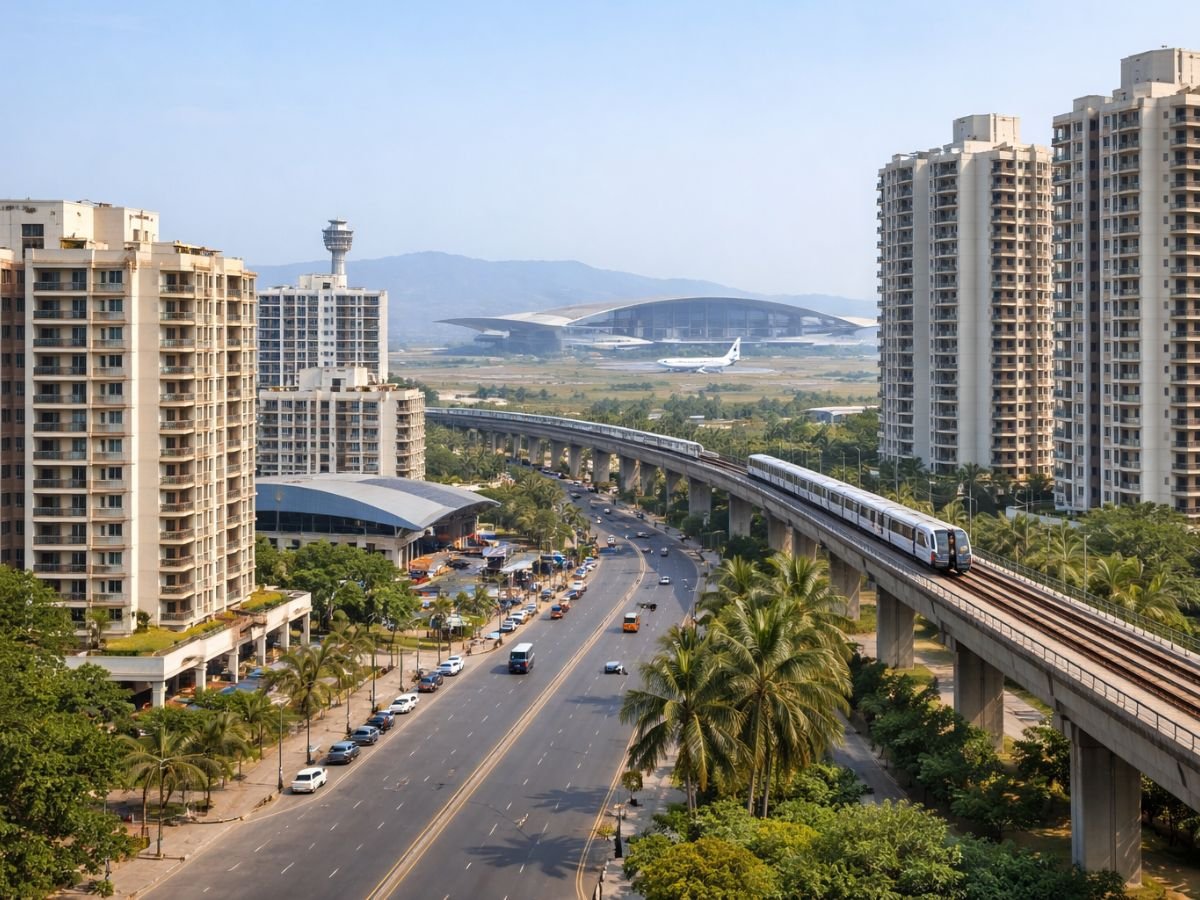
The airport matters a lot. It has moved Ulwe from a promise-led conversation to a real operating geography. That change is important. But it is still only one part of the buying decision.
What the airport improves
The airport strengthens Ulwe in three real ways.
First, it improves the long-term economic credibility of the location. Ulwe is no longer being sold only through future tense.
Second, it supports rental demand from aviation, logistics, and linked workforce movement. That is one reason rental yields in the area are being discussed more seriously now.
Third, it increases wider visibility. More buyers across the Mumbai Metropolitan Region now see Ulwe as a real residential option, especially with the Atal Setu reducing the psychological and travel distance to mainland Mumbai.
What the airport does not automatically fix
The airport does not fix weak sector planning, poor internal roads, bad monsoon performance, or a weak building. It also does not automatically justify every seller’s quoted rate.
And there is another reality many softer articles ignore: airport-led growth also brings compliance and livability questions. Height-related compliance is not a theoretical issue. Buyers in taller buildings must verify whether the project has proper aviation-related approvals and whether any superstructure-related non-compliance issue exists.
Noise is another point. As airport operations deepen, especially with round-the-clock activity, some parts of the wider area may feel the impact more than buyers expect. So airport proximity is not only a growth factor. It can also become a livability filter.
When airport hype becomes buying risk
Airport hype becomes dangerous when buyers:
- pay portal quotes as if they are final market truth
- assume every sector deserves the same premium
- ignore building-specific and society-specific checks
- buy for short-term flipping after most of the easy story is already priced in
The smarter way to read the airport effect is this: it secures Ulwe’s long-term relevance, but it does not protect you from a weak purchase decision.
Is Ulwe better for end users, investors, or future-demand buyers?
Ulwe is now much better suited to some buyer types than others.
Buyer-fit snapshot
| Buyer type | Does Ulwe make sense? | Why |
|---|---|---|
| Long-term end user | Yes, often | Better if buying in stronger, practical sectors with liveability today |
| Commuter using rail or MTHL logic | Yes | Connectivity now matters in daily life, not just in brochures |
| Yield-focused long-hold investor | Selectively yes | Rental demand is more believable now than before |
| Short-term flipper | Usually no | Easy speculative upside is largely over |
| Budget buyer chasing only low entry price | Only selectively | Cheap entry in weak sectors can become weak liquidity later |
| Township-style lifestyle buyer | Usually no | Ulwe is more plot-based and dense, not a giant township market |
For end users, the strongest case for Ulwe is practical location plus long-term stability. For investors, the case is no longer “buy and double quickly.” It is more about rental support, corridor maturity, and a five-to-ten-year view.
Ulwe also gains from the wider economic direction around the Raigad side and the approved Third Mumbai policy framework. But this should be seen as a medium-to-long-term support factor, not an overnight transformation story.
Should you buy a new project or a resale flat in Ulwe?

This is one of the most important decisions in Ulwe, and the answer is not as simple as comparing base price per sq. ft.
A resale flat gives you something very valuable: possession clarity. You can see the actual building, actual road, actual neighbourhood, and actual occupancy. In a market where some portal narratives are still ahead of reality, that visibility matters.
But resale in Ulwe also comes with serious friction. Many buyers underestimate the cost and process around CIDCO transfer, especially after the sharp increase in transfer charges effective from April 2025. On top of that, there can be title-chain complexity, especially in buildings connected to the 12.5% gaothan scheme history.
An under-construction flat may look cheaper at entry and may offer newer amenities or layouts. But under-construction in any market should never be judged only by brochure quality or an active sales team. In Ulwe, buyers need to check whether the project is properly registered, whether the developer’s compliance is current, and whether the project is free from regulatory stress signals.
New project vs resale in Ulwe
| Factor | New project | Resale flat |
|---|---|---|
| Entry price | Sometimes lower on paper | Often looks reasonable until transfer and compliance costs are added |
| Possession certainty | Lower unless near-ready | Higher |
| Legal process | Need strong MahaRERA checking | Need CIDCO transfer and title-chain checking |
| Amenities | Often better on brochure and in new stock | Depends on building age and maintenance |
| Ground reality visibility | Limited before possession | High |
| Risk type | Execution and delivery risk | Transfer cost, document chain, and society-quality risk |
In Ulwe, resale is not automatically safer and new is not automatically smarter. The decision depends on whether you value certainty more than upfront price optics.
What should you check before buying in Ulwe sector by sector?
This is the section buyers should actually save.
Ulwe buying checklist
- Check whether the deal price matches recent registration reality, not just the seller’s asking rate.
- For under-construction property, verify the MahaRERA registration, and do not stop there. Check whether the project is filing updates properly and is not on any suspension or compliance problem track.
- For resale, check the full title chain, especially if the property comes from a 12.5% scheme-linked background.
- Confirm who is paying the CIDCO transfer charges and calculate that cost before finalising the deal.
- Check whether the building has proper aviation height clearance / relevant NOC support where applicable.
- Demand PMC property tax clearance for resale flats.
- Check actual water infrastructure inside the society, not just area-level promises. Strong underground and overhead storage matters.
- Visit the location in practical conditions: peak evening, after rain if possible, and via the actual walking route to station or main road.
- Check occupancy levels and maintenance discipline. A flashy standalone tower with weak occupancy can become expensive to maintain.
- Ask bluntly about tanker dependence, recent water cuts, and monsoon trouble.
This is also where local Ulwe reality matters more than generic property advice. The broader Hetawane water project is a positive infrastructure milestone, and the December 2025 tunnel breakthrough clearly matters. But that does not mean every society is already water-secure. Until the wider network fully stabilises, building-level storage and management remain critical.
What are the biggest buying mistakes people make in Ulwe?
The first big mistake is price anchoring to portal listings. Buyers see quoted rates and assume that is the fair going market. In reality, quoted rates and actual clearing rates can differ sharply.
The second mistake is buying only the airport story. A buyer hears that the airport is running and assumes any flat in Ulwe is safe. It is not. A weak society in a weak stretch remains a weak purchase even in a stronger macro market.
The third mistake is ignoring monsoon and drainage reality. Lower-lying belts and sectors affected by river diversion and reverse seawater flow during high tide need extra caution. This matters especially in and around sectors such as 19, 20, and 21, where local drainage behaviour can change how the area feels in real life.
The fourth mistake is assuming sale deed registration completes everything. In leasehold-linked contexts, buyers can make the error of completing the registration but failing to complete the CIDCO-side transfer formalities properly. That can create a serious future resale problem.
The fifth mistake is trusting “walking distance” blindly. A brochure may say five minutes to station. But buyers need to test the actual route, surface, lighting, and rainy-season usability.
Who should buy in Ulwe and who should look elsewhere?
Ulwe is a good fit for:
- buyers who want a mid-segment entry into a now-functional airport-linked corridor
- commuters who can use rail or MTHL-side movement logic
- long-term end users who value utility over glamour
- investors comfortable with rental-led and infrastructure-led medium-term holding
Ulwe is a weaker fit for:
- buyers expecting a giant township experience with huge open campuses
- people wanting instant premium polish like mature top-end nodes
- aggressive short-term flippers
- buyers who dislike dense, plot-by-plot urban environments
A simple way to think about it:
If you are a mainland commuter who wants better strategic positioning and can buy in a good sector near real connectivity, Ulwe can make strong sense.
If you are a family wanting a more settled 2 BHK environment, better parts of Sector 9 or similar stronger residential pockets may work well.
If you are a budget buyer attracted only by a lower base ticket in far peripheral sectors, slow down. Low entry is not enough by itself.
If you are a township seeker looking for large integrated development with broad open-space feel, Panvel or Kharghar may suit you better.
Conclusion
Ulwe is a smart buy in 2026 when you are purchasing with discipline, not excitement. It works best when you choose a practical sector, verify the true market price, check water and monsoon resilience, and fully understand the legal and transfer mechanics.
For end users, Ulwe makes the most sense in stronger commuter or settled residential pockets where station access, daily convenience, and society quality are already visible on ground.
For investors, Ulwe still works, but the strategy has changed. This is no longer a market for lazy speculation. It is a market for measured entry, realistic yield expectations, and long holding periods.
So the real answer is simple: Ulwe is not a bad buy. A careless Ulwe purchase is. Sector choice, building quality, and total acquisition math now matter more than the airport headline.
FAQs
Frequently Asked Questions