
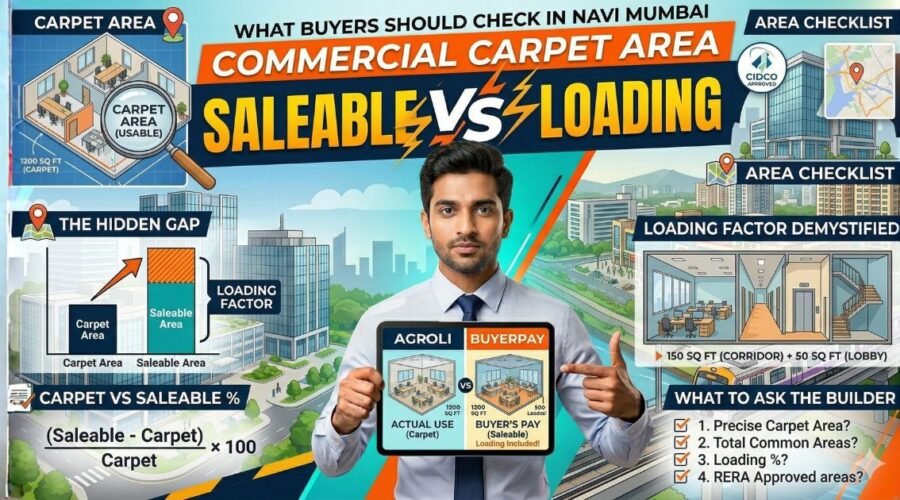
Commercial Carpet Area vs Saleable Area vs Loading in Navi Mumbai: What Buyers Should Check
In commercial property, carpet area is the actual usable space inside your unit, saleable area is the charged area after adding walls and a share of common areas, and loading is the percentage gap between them. The safest way to compare any office, shop, showroom, or gala is not the brochure ₹/sq ft rate. It is the effective price per carpet square foot. Miss this, and you can overpay by lakhs for space your business will never really use.
This matters even more in Navi Mumbai because commercial stock is not sold in one clean format. A resale office in Vashi may still be discussed in built-up terms. A newer office in Airoli or Mahape may be sold on saleable area. A shop in a mixed-use project may look cheap on paper but feel tight once shutters, depth, columns, and circulation are examined properly.
So this is not a theory article. It is a buyer-protection article.
Commercial carpet area, saleable area, and loading: what is the real difference?

The easiest way to understand this is simple: carpet area is what your business uses, saleable area is what pricing is often built on, and loading is the extra you are paying beyond the usable unit area.
Quick summary
| Term | What it means | What it usually includes | Why it matters |
|---|---|---|---|
| Carpet Area | Net usable area inside the unit | Internal partition walls are included | This is the most important area for real comparison |
| Saleable Area | Charged area used by many developers and sellers | Built-up area plus share of common areas like lobbies, lifts, staircases and similar spaces | This can make a quote look cheaper than it really is |
| Loading | The percentage gap between carpet and saleable area | Extra area created by common-area allocation | This decides how much “non-usable” area is built into your price |
What carpet area means under RERA
Under Section 2(k) of the Real Estate (Regulation and Development) Act, carpet area means the net usable floor area of the unit, excluding external walls, service shafts, exclusive balconies or verandahs, and exclusive open terraces, but including the area covered by internal partition walls.
For a commercial buyer, that one definition changes everything.
It means the real legal benchmark is not the glossy brochure number. It is the area that actually sits inside the unit and can be used for workstations, display racks, conference tables, reception space, storage, service counters, or machinery setup depending on the asset type.
What saleable area usually includes in commercial projects
Saleable area, often called super built-up area, is a pricing construct. It usually adds the unit’s built-up footprint and then adds a proportionate share of common spaces such as:
- main lobby
- lift lobbies
- staircases
- common corridors
- shafts and service areas
- in some building types, larger shared infrastructure zones
This is why two units with the same carpet area can be sold with very different saleable areas.
How loading is calculated in simple terms
Loading is the difference between saleable area and carpet area, expressed as a percentage of carpet area.
In plain English, if your carpet area is 1,000 sq ft and the saleable area is 1,400 sq ft, the extra 400 sq ft is the loaded portion. That means the loading is 40%.
This does not automatically mean the deal is bad. But it does mean you must stop comparing brochure rates blindly.
Which area number should you trust when comparing two commercial properties?

Trust carpet area first.
That is the number that gives you the cleanest comparison between one office and another, one shop and another, or one gala and another. Everything else can be distorted by design style, common-area allocation, or old listing habits.
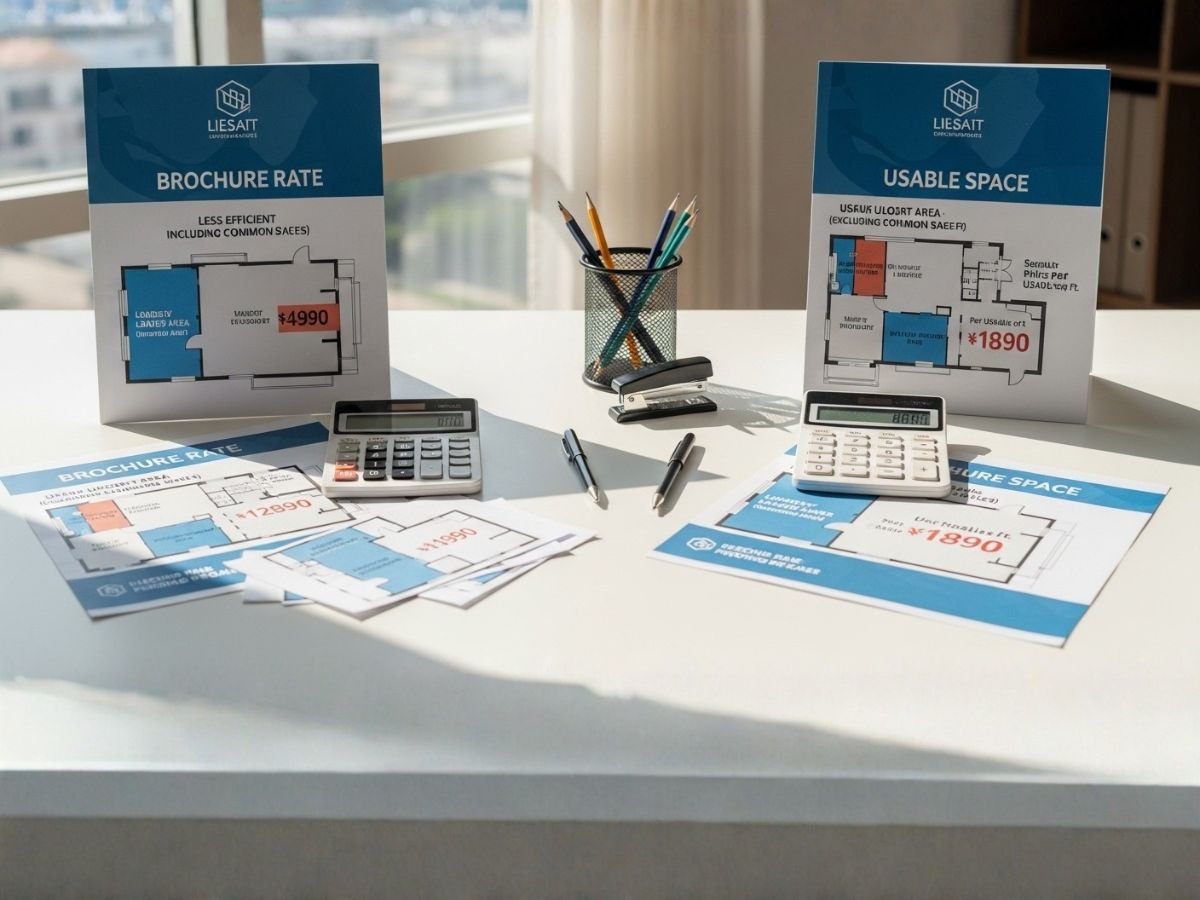
A very common mistake is this: a buyer receives two quotes and compares only the quoted ₹/sq ft number. The lower quote feels like the better deal. But if one project has much higher loading, that apparently cheaper rate may actually be equally expensive or even worse once converted back to carpet area.
So the rule is firm:
Do not compare commercial property on saleable-area rate. Compare on effective carpet-area rate.
That one habit will protect you from a lot of bad math.
This is especially important in Navi Mumbai. Older resale office stock in hubs like Vashi or CBD Belapur may still be casually discussed in built-up terms. Newer towers in Airoli, Ghansoli, or Mahape may be pushed on saleable-area pricing. If you do not normalize both to carpet area, your comparison is already broken.
How to convert any commercial quote into the real price per usable square foot
The formula is simple:
Effective carpet rate = Total cost of unit ÷ Carpet area
That is the number you should use when judging a deal.
If you want to know the loading:
Loading % = (Saleable area – Carpet area) ÷ Carpet area × 100
Worked example: same budget, different loading, same real cost
| Scenario | Property A: Standalone Office | Property B: IT Park Office |
|---|---|---|
| Location style | Older standalone commercial building, Vashi-type market | Newer corporate tower, Airoli/Mahape-type market |
| Carpet Area | 1,000 sq ft | 1,000 sq ft |
| Loading | 30% | 50% |
| Saleable Area | 1,300 sq ft | 1,500 sq ft |
| Quoted rate on saleable area | ₹11,538/sq ft | ₹10,000/sq ft |
| Total cost | ₹1.5 Cr | ₹1.5 Cr |
| Effective rate on carpet area | ₹15,000/sq ft | ₹15,000/sq ft |
Now look at what happened.
Property B looked cheaper because the quoted saleable-area rate was lower. But once both units were converted to carpet-area rate, both cost exactly the same per usable square foot.
That is why brochure rate alone is dangerous.
Worked example for a shop unit
Suppose a retail shop is being sold for ₹90 lakh.
- Saleable area: 600 sq ft
- Carpet area: 420 sq ft
At first glance, the seller says the rate is ₹15,000 per sq ft. That sounds attractive.
But the real effective carpet-area rate is:
₹90,00,000 ÷ 420 = ₹21,429 per carpet sq ft
That is a completely different deal.
And for a shop, this matters even more because frontage, visibility, and internal layout often matter more than a bloated headline area number.
Is the loading normal for this type of commercial building or is it too high?
There is no one magic number for all buildings.
In the Mumbai Metropolitan Region, commercial loading often sits in a rough market band of around 30% to 50%, and premium Grade-A corporate buildings can go even higher. But this is a market pattern, not a legal cap. High loading is not automatically illegal, and lower loading is not automatically better.
The real question is this:
Are you paying for useful building infrastructure, or are you paying for dead denominator expansion?
Why there is no one ideal number for every project
A basic retail plaza, a corporate tower, and an industrial-commercial building are not designed the same way.
A modern office tower may have:
- large lift banks
- double-height entry lobby
- central air-conditioning plant
- refuge areas
- wider corridors
- bigger core services
All this can push loading up. In some cases, that shared infrastructure genuinely adds value for tenants, staff movement, corporate image, and safety.
What usually pushes loading up in commercial buildings
Loading often rises because of:
- oversized common lobbies
- too many lifts or large lift cores
- wide but underused corridors
- inefficient floor plates
- podium-heavy design
- mall-style common circulation
- premium common amenities that sound good in sales presentations but do little for actual daily business operations
Red flags that suggest poorly explained loading
Be careful when:
- the seller refuses to give carpet area in writing
- the quote keeps changing between carpet, built-up, and saleable terms
- the building is very basic, but the loading is pitched like a Grade-A tower
- the unit feels cramped despite a large paper area
- the sales pitch focuses only on the low ₹/sq ft number, not the usable area
In short, loading should be judged by value, not by sales language.
What changes between an office, a shop, and a gala when you read area numbers?

The same area logic does not work equally for every commercial asset. That is where many generic pages fail.
Offices in towers and business parks
For offices, carpet area is critical because it affects:
- workstation count
- cabin planning
- meeting room layout
- pantry and server placement
- circulation inside the office
A slightly higher loading can still make sense if the building gives you real shared value such as better access control, bigger lift capacity, stronger corporate environment, and better common infrastructure. This is why Airoli, Ghansoli, and Mahape office stock can carry higher loading without automatically becoming a bad deal.
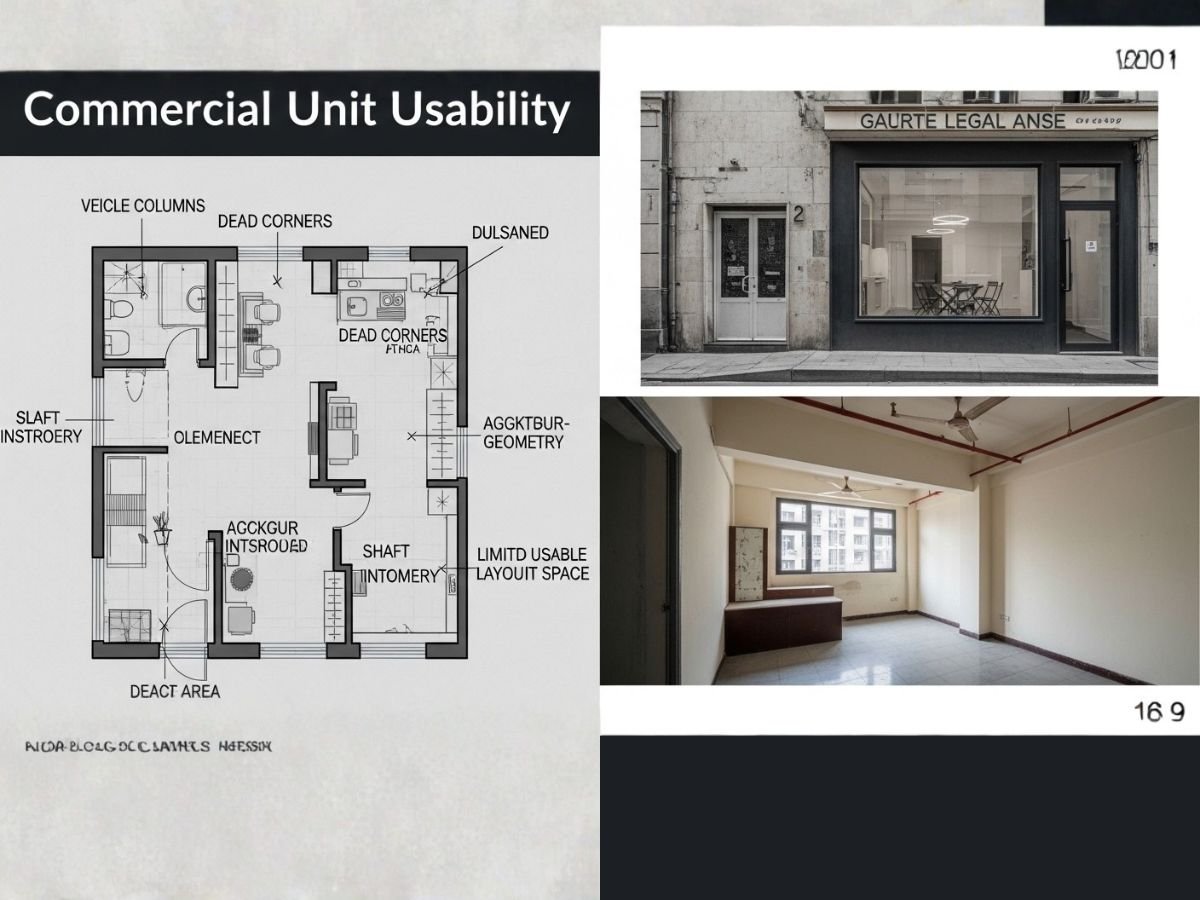
But even then, the internal floor plate must work. A 1,000 sq ft office with awkward columns and dead corners can behave like an 800 sq ft office in real business use.
Shops in mixed-use or retail buildings
For shops, carpet area alone is not enough. Frontage and depth matter enormously.
A 500 sq ft shop with a strong frontage can outperform a 500 sq ft shop with weak visibility and a long tunnel-like shape. For retail, high loading is usually harder to justify unless you are inside a mall or a tightly managed high-footfall retail format where wide common circulation actually supports business.
So for a shop, ask not just “How much carpet area?” but also:
- What is the shutter width?
- How deep is the unit?
- Is the frontage clean and visible?
- Is the common-area share actually helping footfall?
Galas and industrial-commercial units
Galas in Taloja, Rabale, or Pawne need a different lens.
Here, floor loading capacity, clear span, ceiling height, service movement, and legal sanction of mezzanine floors matter a lot. A gala can look larger on paper, but if the mezzanine is not sanctioned properly, that added space may not carry the legal standing or usability value the buyer assumes it does.
For this category, area should never be read in isolation.
Where Navi Mumbai buyers get confused most: carpet quotes, built-up quotes, and brochure math
This is where local ground reality really changes the answer.
Navi Mumbai’s commercial market is not one uniform data environment. A listing on a portal, a broker WhatsApp forward, and a project brochure may all describe area differently.
Resale listings often use different area labels
In older commercial belts such as Vashi, CBD Belapur, and parts of Nerul, resale inventory is still often discussed in older habits. One office may be called 1,000 sq ft built-up. Another nearby unit may be listed as 780 sq ft carpet. A third may be shown as 1,150 sq ft super area.
A normal buyer sees three numbers. The market sees three different denominators.
That is exactly why raw portal comparison is risky.
Brochure pricing can look cheaper because the denominator is bigger
Newer offices in Airoli, Ghansoli, or Mahape often come with stronger common infrastructure and therefore higher loading. That does not make them wrong. But it does mean their headline rate may look attractively low because the denominator is larger.
This is brochure math. It is not always false. But it can be misleading if you do not convert it.
Why older standalone stock and newer amenity-heavy stock should not be compared casually
An older standalone office in Vashi and a newer business-park office in Airoli are not sold on the same logic. One may have lower loading but weaker common infrastructure. The other may have higher loading but stronger corporate environment.
So do not ask only, “Which one is cheaper?”
Ask:
- Which one is cheaper on carpet-area basis?
- Which one works better for actual use?
- Which common areas add value and which are just extra weight in the deal?
Also remember one more local angle: recurring costs can suffer too. In Navi Mumbai, civic charges and CAM usually hurt more when the built-up footprint is larger. So excessive loading can affect not just the purchase math but also the long-term holding cost.
What documents should you ask for before paying token money?

This is where buyers must become strict.
Brochures, 3D images, and verbal claims are not enough. Before token money, ask for these in writing:
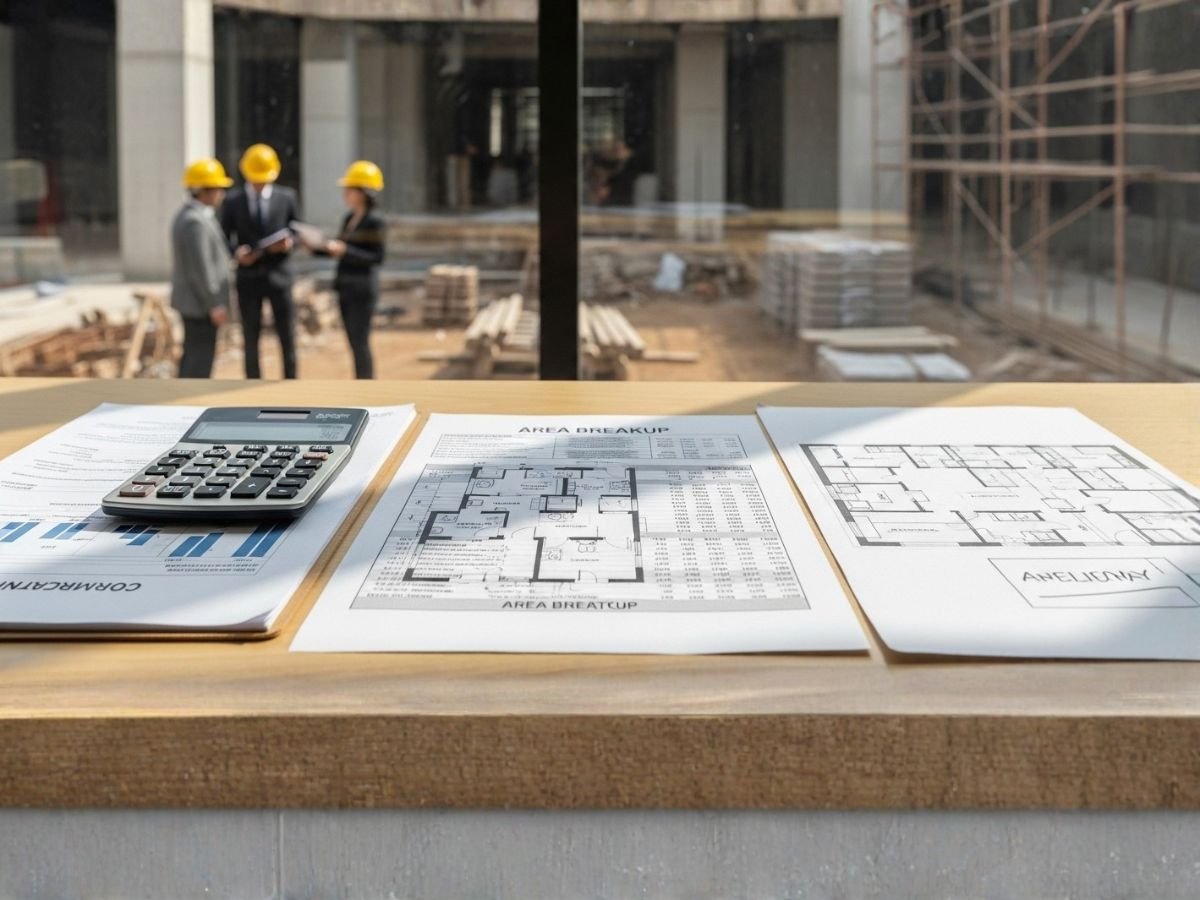
- Area breakup sheet showing carpet area, built-up area if applicable, and saleable area if used in the sales presentation
- Draft agreement for sale or at least the commercial terms sheet showing how area is being represented
- Approved unit plan and floor plan
- MahaRERA registration details, where applicable
- Uploaded sanctioned plans and area-related documents on the MahaRERA portal
- Project land and approval structure, especially if the project is on CIDCO leasehold land
- If buying a gala or retail unit with mezzanine, proof that the mezzanine is sanctioned
A very important practical point: do not stop at seeing “MahaRERA registered” on a brochure. Go to the portal and check the uploaded documents yourself. Registration is not the same as blind approval of every sales line.
If the project is in Navi Mumbai on CIDCO-linked land, the approval and document chain matters even more. The buyer should understand what exactly is being sold and how the unit area is being recorded in the paperwork.
What should you check on the actual floor plan and site visit, not just on paper?

A unit can be legally correct on paper and still be poor in real use.
This is the gap between paper carpet area and usable business area.
Columns, dead corners, shafts, and odd geometry
A 1,000 sq ft office with two badly placed columns, an intrusive shaft, and irregular corners may lose major practical efficiency. You may still legally own 1,000 sq ft of carpet area, but your workstation layout, cabin planning, or retail movement may suffer badly.
Shutter width, depth, ceiling height, pantry and washroom placement
For shops, a bad frontage-to-depth ratio can kill usability. For offices, awkward pantry or washroom positions can break layout logic. For galas, clear height matters more than many buyers realise.
These are not small design details. They change business performance.
Lift lobby share, corridor spill, and real entry visibility
Some units are technically fine but suffer because of approach logic. A shop hidden after a turn, an office with weak lift-to-unit transition, or a unit that loses visibility because of corridor spill can all feel worse than the paper suggests.
That is why site visits should never be treated as a formality.
When should you renegotiate and when should you walk away?
Renegotiate when the deal still has value but the numbers are not being presented honestly enough.
For example, if the location is strong, the building quality is good, and the common infrastructure genuinely adds business value, but the loading is high, use that fact to negotiate harder on rate.
Walk away when basic transparency is missing.
That includes situations where:
- carpet area is not shared clearly in writing
- the sales team keeps switching between built-up and saleable terms
- the documents do not match the pitch
- the unit plan reveals obvious usability loss that was never explained
- an unsanctioned mezzanine is being sold like full legal carpet area
- urgency and FOMO are being used to push token money before document clarity
Your leverage is highest before token payment. Use it there, not after.
If you remember only one thing, remember this:
In commercial property, you should not judge a deal by the quoted ₹/sq ft number. You should judge it by the effective price per carpet square foot, the actual usability of the unit, and the written area breakup backed by proper documents.
Carpet area tells you what your business can really use. Saleable area tells you how the deal is being packaged. Loading tells you how much extra area has been built into the price.
In Navi Mumbai, this matters a lot because older resale markets, newer IT corridors, and industrial-commercial belts all speak slightly different area languages. If you compare them casually, you will get misled.
So before you pay token money, do three things:
- normalize every quote to carpet area
- check the plans and area breakup in writing
- visit the unit like an occupier, not like a brochure reader
That is how commercial buyers avoid paying for space that looks big on paper but works small in real life.