
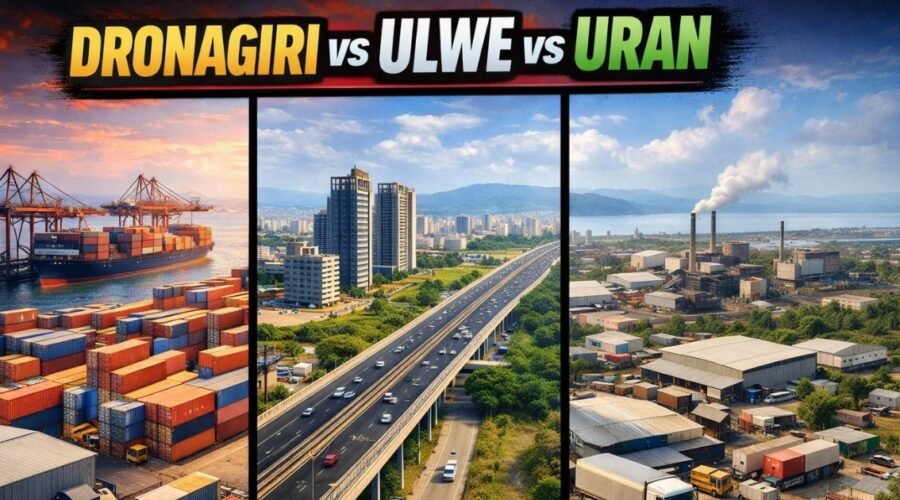
Dronagiri vs Ulwe vs Uran for Port-Linked Industrial Growth
If your question is purely about port-linked industrial growth, Dronagiri is usually the strongest practical choice, Uran is the wider long-term corridor bet, and Ulwe is usually the weakest fit for heavy industrial use. That is the short answer. Dronagiri is built around port logistics and SEZ activity, Uran matters more as a future land-and-corridor story, and Ulwe’s growth is far more urban, airport-linked, and high-value than freight-led.
That does not mean one area is “good” and the others are “bad.” It means they solve different problems. If you want direct EXIM movement, container-linked warehousing, truck staging, or port-side industrial support, the answer usually shifts toward Dronagiri. If you want a patient, higher-risk land story tied to future logistics infrastructure, Uran becomes relevant. If you are thinking about last-mile commerce, corporate spillover, airport-support demand, or urban appreciation, Ulwe starts looking stronger, but that is not the same thing as pure port-led industrial growth.
Quick summary: which area wins on what?
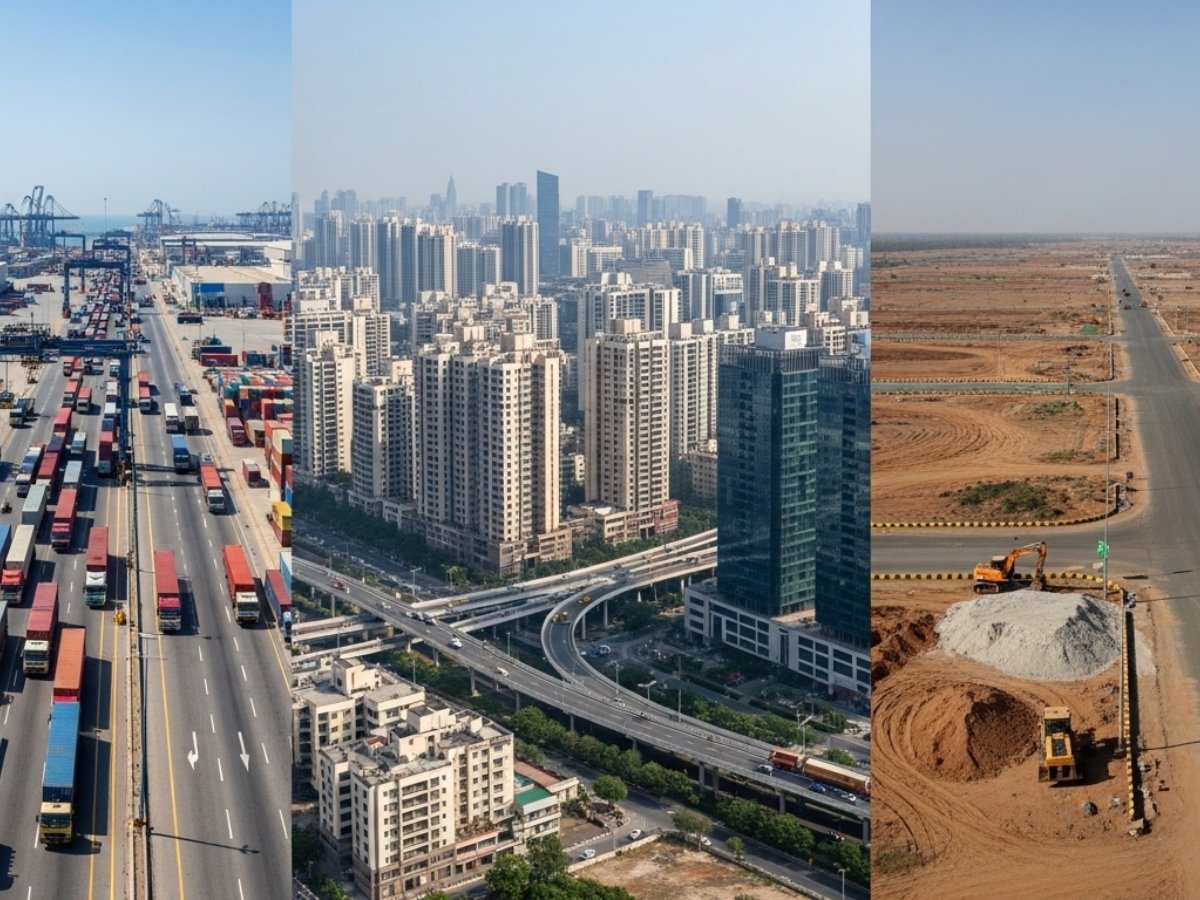
| Area | Best suited for | What it does well | Main weakness | Practical verdict |
|---|---|---|---|---|
| Dronagiri | Port-linked warehousing, CFS support, EXIM-driven activity, heavy truck movement | Direct logistics relevance, SEZ support, operational fit | CRZ/environment-linked project risk in parts of the node | Best fit for direct port-led industrial use |
| Ulwe | Urban-commercial spillover, airport-linked office and last-mile demand | Stronger urban growth story, higher-value development | Too expensive and too urban for heavy logistics at scale | Not the clean choice for heavy industrial growth |
| Uran | Long-hold land banking, future logistics corridor play, selective open-yard potential | Large-scale future corridor relevance | Land, acquisition, planning, and timing risk are much higher | Stronger as a long-term strategic bet than a plug-and-play industrial answer |
This is the core mistake many buyers make: they hear “near JNPA” and assume all three belts behave the same. They do not. Even within the same broad geography, the planning authority, land use, road type, density pattern, and freight usability change the answer completely.
What does “port-linked industrial growth” actually mean here?
In this comparison, port-linked industrial growth should not be treated as one vague boom story. It has at least three different layers.
Direct port-dependent demand
This is the most serious industrial layer. It includes container-linked warehousing, CFS-type activity, customs-support ecosystems, heavy trucking, yards, bulk handling, and EXIM-oriented operations that need regular access to port-side movement. This layer needs infrastructure that can tolerate commercial abuse every day, not just nice roads on paper. Dronagiri is much closer to this logic because the JNPA SEZ is already operational, spreads across 277.38 hectares with about 163 hectares leasable, and is designed for manufacturing, warehousing, and food-processing use with a single-window clearance framework.
Logistics corridor spillover demand
This is the second layer. It includes secondary processing, truck parking, support warehousing, cold-chain or break-bulk spillover, and businesses that benefit from being near the port corridor without needing to sit right inside a direct customs environment. This is where both Dronagiri and parts of the wider Uran side can enter the conversation, depending on land, access, and time horizon. The coming Virar-Alibaug Multimodal Corridor is relevant here because it is being built as an access-controlled multimodal route, with Phase 1 planned from Navghar to Balavali under MSRDC, and it can reshape freight movement across large parts of the wider belt over time.
Support-economy and land-holding demand
This is the layer many pages confuse with industrial growth. Worker housing, transport offices, support-commercial demand, airport-led office spillover, and long-term land banking can all rise around industrial corridors. But they are not the same as direct industrial usability. Ulwe fits this layer far more naturally than the first one. Uran can also fit this layer, especially for patient investors willing to wait through planning transitions and land-use uncertainty.
Dronagiri vs Ulwe vs Uran at a glance: which belt wins on what?
| Decision factor | Dronagiri | Ulwe | Uran |
|---|---|---|---|
| Direct port linkage | Strongest practical fit | Indirect at best | Selective and uneven |
| Heavy warehousing suitability | Strong | Weak for large, low-yield formats | Potential in the long term |
| Urban pressure | Moderate | High | Varies sharply by pocket |
| Near-term operational readiness | Best among the three | Good for urban-commercial uses, not heavy logistics | Uneven and slower |
| Long-term land upside | Moderate to strong, but not clean in every pocket | Strong urban value story, not industrially efficient | High upside potential, but highest patience required |
| Core risk | CRZ and clearance risk | Overpaying for the wrong use case | Title, acquisition, and execution uncertainty |
Recent market indicators reinforce why this split exists. Ulwe’s prices have moved into much higher urban territory, with current estimates often discussed in the roughly ₹11,000 to ₹14,500 per sq ft range, while Dronagiri has remained far cheaper as a mixed industrial-support and logistics-influenced node. That pricing gap alone changes what is practical. A space-intensive warehouse or yard needs a completely different land economics model from a residential or office tower plot.
Why Dronagiri often feels more industrially logical than Ulwe
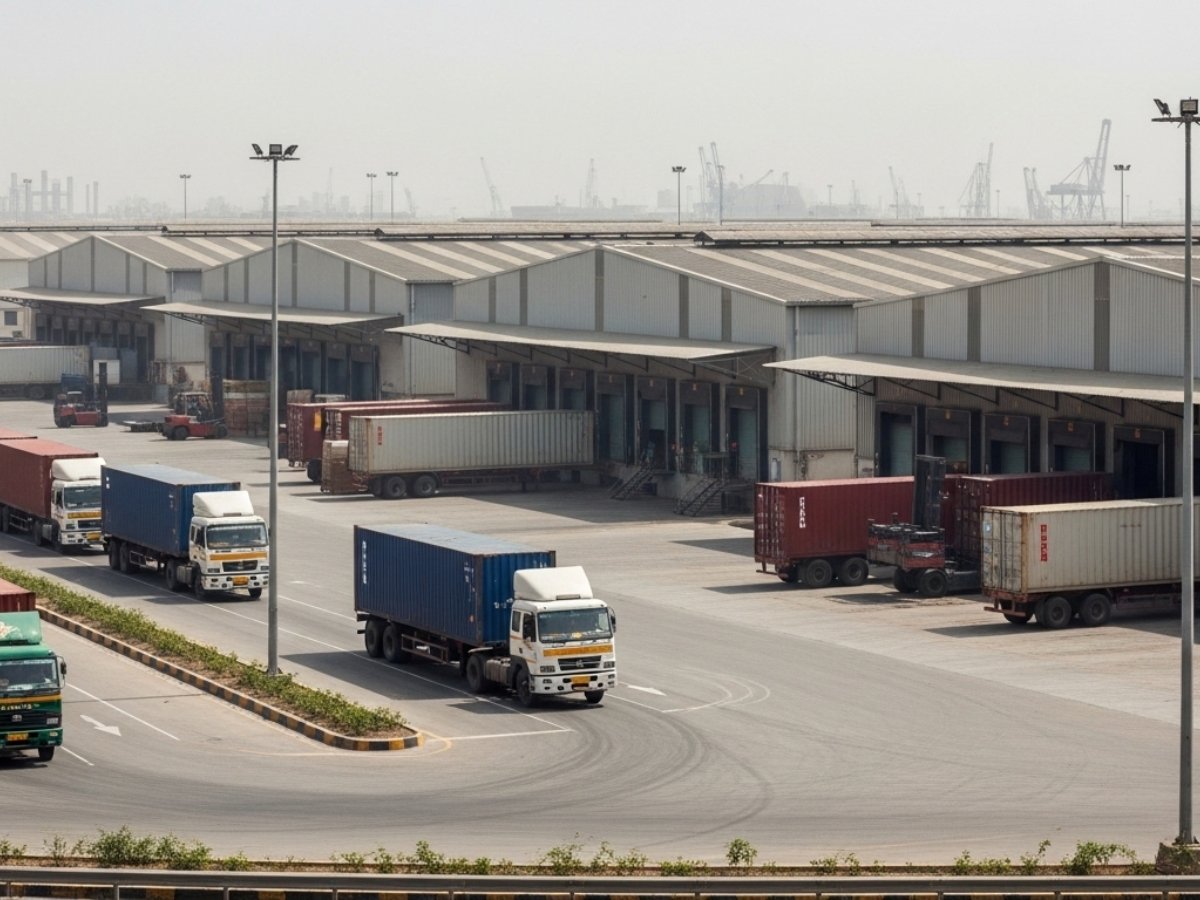
Dronagiri’s biggest advantage is simple: it was shaped around port-side utility, not around becoming a premium urban skyline. That matters more than many buyers realize.
The strongest proof is the JNPA SEZ itself. It is operational, it is port-linked, and it exists specifically to support industrial and logistics use with easier approval handling than a normal fragmented municipal process. In practical terms, that means Dronagiri has a more believable industrial ecosystem than a location whose land values are already being pulled upward by residential and airport narratives.
There is also a fresh movement-side reason why Dronagiri matters more in 2026. Mumbai’s new traffic rules from February 1, 2026 tightened heavy-vehicle movement, including peak-hour restrictions and stronger zone-based controls. That pushes more staging, cross-docking, and freight-handling logic toward peripheral, logistics-friendly belts outside the old city pattern. Dronagiri sits much more naturally inside that shift than Ulwe.
But Dronagiri is not a clean, risk-free story. This is where many glossy articles become misleading. Around 94 projects in Dronagiri were reported as stuck for want of Occupancy Certificates because of CRZ-related issues and pending environmental clearances. That does not mean the whole node is unusable. It does mean buyers cannot lazily assume that CIDCO-side paperwork alone solves everything. In Dronagiri, clearance quality matters.
A practical caution in Dronagiri
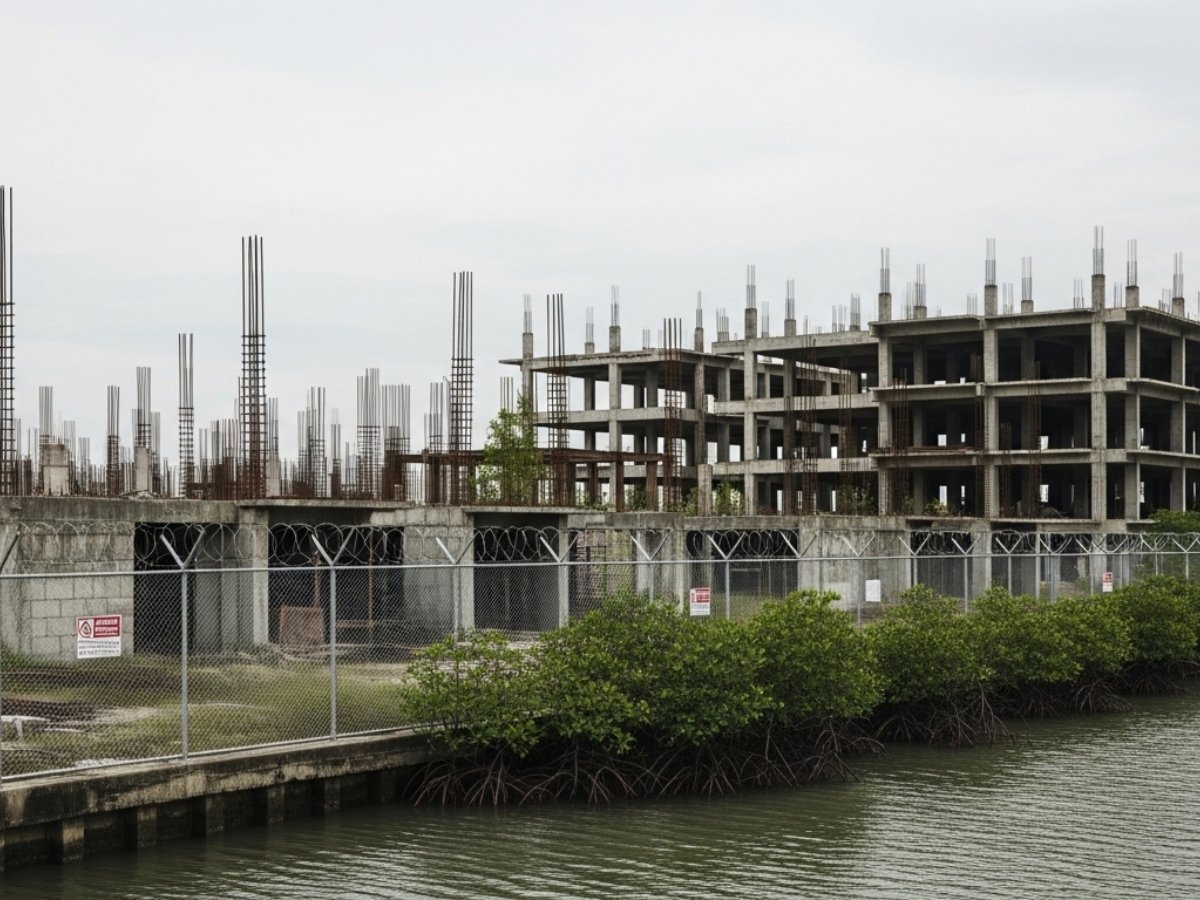
If you are buying into Dronagiri for industrial or commercial use, do not stop at “port proximity” or “CIDCO node” as your comfort signal. You need to verify the exact project or parcel context, especially where CRZ boundaries, mangrove buffers, environmental approval history, and final occupiability become material. For direct operators, Dronagiri often still wins. For careless investors, it can become an expensive legal trap.
Why Ulwe may grow strongly, but not mainly as a pure port-linked industrial belt
Ulwe is important. It is just important for a different reason.
Its strongest growth story is no longer “future industrial node near the port.” It is an airport-linked, high-density urban node. The big shift came when AAI relaxed the earlier height cap around the Navi Mumbai airport influence area, allowing buildings up to around 160 metres, roughly 46 to 48 floors depending on project design and approvals. That one policy change pushed Ulwe further into a vertical urban-growth story.
Once a location moves in that direction, heavy logistics starts losing economic logic. Warehousing and open yards usually want larger footprints, lower land cost, easier truck geometry, and less conflict with dense residential movement. Ulwe is moving the other way. It is becoming more expensive, more urban, more residential-commercial, and more tied to airport-support demand than to freight-intensive industrial use.
That does not mean Ulwe has no logistics relevance at all. It can still support lighter formats such as urban distribution, last-mile support, office demand tied to the airport region, and white-collar commercial spillover. But that is not the same thing as saying Ulwe is a strong answer for port-linked industrial growth. For most heavy industrial buyers, that conclusion would be weak.
Where Uran fits in this story: wider corridor relevance, selective industrial potential, and long-term patience
Uran is the most misunderstood of the three because people talk about it as if it is one simple market. It is not.
The wider Uran side matters because large future logistics and planning overlays are aimed at this belt. MMRDA’s KSC New Town notification covers 124 villages across Uran, Panvel, and Pen tehsils, making the Uran hinterland part of a much bigger planning canvas than the older simple-node comparison many people still use. At the same time, the Virar-Alibaug Multimodal Corridor is designed to reshape freight and regional connectivity across this side over the longer term.
There is also the proposed Integrated Logistics Park angle in the Uran hinterland, which is exactly why long-term land players keep watching this geography. But this is where patience and caution become non-negotiable. The dossier’s warning about PAP resistance, acquisition friction, and planning transition is the right one. Uran may become very important in the long run, but for many buyers it is still a post-2030 style corridor story, not a ready industrial plug-and-play solution.
One positive in Uran’s favor is improving workforce connectivity. The Uran rail corridor now has 50 daily suburban services after additional services were approved in late 2025, which strengthens labour and commuter access. Useful, yes. But passenger rail improvement alone does not automatically solve industrial land-readiness, title clarity, or large-format execution risk.
If your goal is warehousing, EXIM, transport, or industrial land holding, which area should you choose?
| Buyer / operator profile | Primary recommendation | Why |
|---|---|---|
| Heavy EXIM / CFS / container-linked operator | Dronagiri | Best direct fit with port-side logistics, SEZ ecosystem, truck movement logic |
| Warehouse occupier wanting near-term functional use | Dronagiri | Stronger ready-use logic than the other two |
| E-commerce / light urban distribution / airport-support commercial | Ulwe | Better urban catchment and commercial spillover fit |
| Long-term land aggregator with high risk appetite | Uran | Better corridor-scale future upside, but much slower and riskier |
| Support-economy or worker-housing-linked investor | Dronagiri or selective Ulwe, depending on workforce type | Blue-collar industrial support suits Dronagiri more; white-collar airport-office support leans Ulwe |
This is where many local comparisons fail. They compare “future appreciation” in the abstract. But an EXIM operator, a 3PL user, a truck-terminal investor, and a land banker are not solving the same problem. A location can be bad for one and excellent for another.
Which area is stronger for near-term usability, and which one is more of a future bet?
Dronagiri is usually the strongest answer for near-term industrial usability. The reason is not hype. The reason is operational reality. The JNPA SEZ is active, the port-side logic is already present, and freight displacement away from Mumbai strengthens the case for peripheral logistics belts that can function today.
Ulwe is also near-term in one sense, but not in the same way. It is near-term for urban and airport-linked demand, not for large heavy industrial deployment. That is a very important distinction.
Uran is the bigger future bet. It may reward patience if the multimodal corridor, broader planning regularisation, and logistics-park ambitions turn into grounded execution. But a future bet is still a bet. Buyers should not mistake a future freight geography for a ready industrial geography.
What local signals should you check before trusting the growth story in any of these three belts?
Before you buy into any “port-linked growth” narrative here, check these points:
- Is the exact parcel or project actually usable for the intended industrial purpose?
- Which authority really controls the zone today: CIDCO, JNPA-related structure, or the MMRDA KSC New Town framework?
- Is the demand occupier-led, or mostly broker-led future storytelling?
- Can trucks, staff, and support services actually move the way your use case needs?
- If it is Dronagiri, have CRZ and environmental risks been checked properly?
- If it is Uran, is the land situation, demarcation, and planning status genuinely clear?
- If it is Ulwe, are you paying urban prices for a use case that needs industrial economics?
That last point is especially important. Some of the most expensive mistakes in Navi Mumbai happen when buyers choose a story first and a use case later.
The biggest buying mistakes people make when comparing Dronagiri, Ulwe, and Uran
The first mistake is buying Ulwe for heavy industrial logic just because it is visible, well-known, and close to major infrastructure. Visibility is not the same as industrial fit.
The second mistake is buying Dronagiri without treating CRZ and occupiability as serious issues. This is the classic case of assuming a location is industrially strong, so every project inside it must be safe. That is not true.
The third mistake is buying Uran as if all land there is one straightforward future goldmine. Uran is a broad, mixed, politically sensitive geography. Timing, authority, title, and corridor maturity matter much more there than in a normal node-level purchase.
The fourth mistake is mixing up airport growth and port-linked industrial growth. They can overlap geographically. They are still not the same demand engine.
Conclusion
If most readers are asking one practical question which belt makes the most sense for port-linked industrial growth? then the answer is this:
- Choose Dronagiri if your priority is direct logistics, EXIM support, warehousing, truck movement, or serious port-led industrial use.
- Choose Uran carefully if your priority is patient land banking and long-term corridor-led upside, and you can handle delay, ambiguity, and planning risk.
- Choose Ulwe only selectively if your actual thesis is airport-led urban-commercial growth, lighter distribution, or support-economy demand not heavy industrial freight.
So no, Dronagiri, Ulwe, and Uran are not the same story with three different names. In Navi Mumbai’s port-airport belt, the real winner depends on what exactly you are trying to do. For pure port-linked industrial growth, Dronagiri usually stays in front.
FAQs
Frequently Asked Questions