
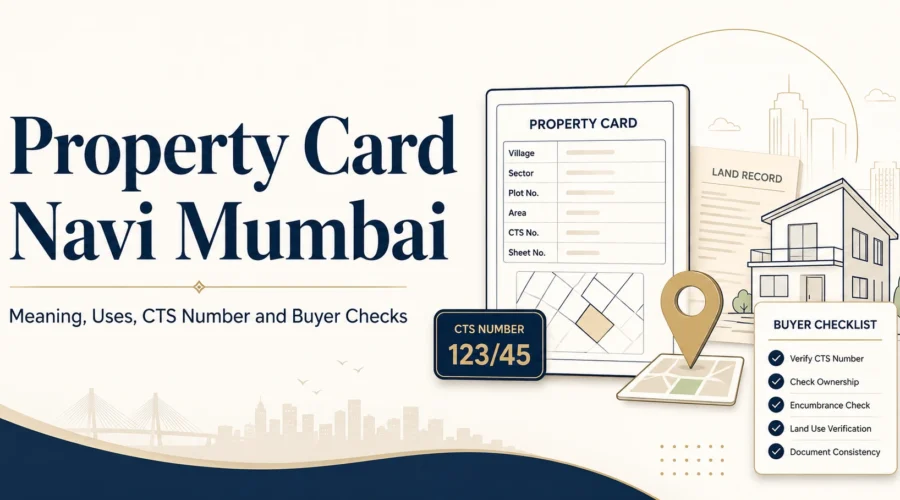
Property Card Navi Mumbai: Meaning, Uses, CTS and Buyer Checks
Property Card Navi Mumbai: Meaning, Uses, CTS Number and Buyer Checks
A property card is an important land-record document in Maharashtra, especially for urban land, old buildings, plots, gaothan properties, city survey records, and redevelopment cases. In Navi Mumbai, buyers may hear terms like property card, Maalmat Patrak, CTS number, city survey number, mutation entry, 7/12 extract, title search, and property tax record.
These documents are connected, but they are not the same.
This guide explains what a property card means, what it can show, what it cannot prove, and how Navi Mumbai buyers should use it before paying token money for a flat, plot, gaothan property, CIDCO-related property, redevelopment property, or land parcel.
For related checks, buyers should also read Navi Mumbai Land Records Guide, 7/12 Extract Guide, Mutation Entry Guide Navi Mumbai, Land Title Search Guide, and Property Documents Checklist Navi Mumbai.
Direct Answer
A property card in Navi Mumbai is an urban land-record document that helps identify a property by CTS number or city survey number, area, tenure, holder details, and record changes where available. It is useful for due diligence, but buyers should not treat it as complete proof of clear ownership without checking sale deed, Index II, title chain, tax records, and legal opinion.
Quick Summary
| Point | What Navi Mumbai Buyers Should Know |
|---|---|
| Common name | Property Card / Maalmat Patrak / Malmatta Patrak |
| Mainly used for | Urban land, city survey property, plots, old buildings, redevelopment, gaothan or surveyed areas |
| Key number | CTS number / City Survey number |
| What it may show | Holder name, property area, tenure, mutation entries, remarks and property identity |
| Does it prove clear ownership? | No. It is a supporting land-record document, not a full title-clearance certificate |
| Must be matched with | Sale deed, Index II, title chain, mutation entry, tax record, society record and authority records |
| Important for | Plot buyers, old-building buyers, gaothan buyers, redevelopment societies, CIDCO-related property buyers |
| Main caution | Name, area, CTS number, tenure or remarks mismatch should be checked before token payment |
| Buyer action | Verify official records and consult a qualified property lawyer before signing or paying |
What Is a Property Card in Maharashtra?
A property card is a land-record document used mainly for urban or city-survey properties. In Maharashtra, it is also commonly known as Maalmat Patrak or Malmatta Patrak.
It helps identify a property through city survey records. Depending on the location and record type, a property card may show details such as:
- CTS number or city survey number
- Property area
- Holder or occupant details
- Tenure or occupancy type
- Mutation or record-change entries
- Remarks or restrictions where applicable
- Property identification details
For Navi Mumbai buyers, the property card becomes important when the property is linked to urban land records, city survey records, old buildings, redevelopment, plots, gaothan property, or certain authority-controlled land cases.
However, a property card should not be treated as a complete ownership certificate. It is one document in the due-diligence process.
What Is CTS Number in Property Card?
CTS means City Survey number. It is used to identify an individual land parcel in city survey records. A property card is generally connected with the city survey number of a land parcel.
For buyers, the CTS number is important because it helps match the property shown in the sale deed, title documents, property card, city survey record, municipal record, and physical location.
If the CTS number in the property card does not match the sale deed or other documents, buyers should pause the transaction and get written clarification.
Do not rely only on a broker’s explanation or seller’s verbal assurance.
What Details Are Usually Shown on a Property Card?
A property card may show different details depending on the property, location, record status, and official format. Buyers should not assume that every property card will show every detail in the same way.
Common details may include:
- CTS number or city survey number
- Property description
- Land area
- Holder name or recorded person/entity
- Tenure or occupancy class
- Mutation entries or record-change references
- Remarks, restrictions, reservations or government interest where applicable
- Survey-related details
The buyer should carefully compare these details with the registered sale deed, Index II, title chain, tax record, society records, CIDCO records where applicable, and a lawyer’s title search.
Is Property Card Proof of Ownership?
A property card is important, but it is not complete proof of clear ownership by itself.
This is the most important point for Navi Mumbai buyers.
A property card may support the ownership-verification process, but it does not replace:
- Registered sale deed
- Previous title chain
- Index II
- Mutation entry
- Property tax record
- Society share certificate
- CIDCO transfer or NOC records where applicable
- Encumbrance or lien check
- Legal title search report
- Lawyer’s written opinion
A safer way to understand it is:
A property card helps identify and verify property-record details. It does not automatically prove that the seller has clear, marketable and dispute-free title.
If the property card is updated but the title chain is weak, buyers should not proceed without legal review.
Property Card vs 7/12 Extract
Property card and 7/12 extract are both land-record documents, but they are generally used in different contexts.
A property card is more relevant for urban or city-survey property. A 7/12 extract is more relevant for village land, agricultural land, rural land, and land parcels recorded under revenue records.
In Navi Mumbai and nearby areas, buyers may need one or both depending on the property type.
For example:
- A city-survey plot may need property card verification.
- Village land may need 7/12 extract verification.
- Gaothan property may need property card, village records, or both depending on survey and authority records.
- NAINA land may need 7/12, mutation, village map, zoning and planning checks.
- Redevelopment property may need property card, conveyance/deemed conveyance, society records and title report.
For deeper understanding, read 7/12 Extract Guide and Village Land Buying Checklist.
Property Card vs Sale Deed
A sale deed is a registered transfer document. It records the transfer of property between seller and buyer.
A property card is a land-record document. It helps identify the property in city survey or land records.
These two documents must match, but they are not the same.
A buyer should check:
- Does the seller name in the sale deed match the title chain?
- Does the property description match the property card?
- Does the CTS number match?
- Does the area match?
- Are there old owners or unexplained entries?
- Are there remarks or restrictions on the property card?
- Does the Index II match the registered document?
If the sale deed and property card do not match, do not ignore it. Get the mismatch checked by a qualified property lawyer and the relevant authority.
Property Card vs Mutation Entry
Mutation entry, also called Ferfar in Maharashtra, records changes in land or property records after events such as sale, inheritance, gift, partition, correction, or court order.
A property card may show mutation-related entries or changes where applicable. But mutation does not cure a defective title.
For example, if a transaction itself has legal issues, merely updating a property card or mutation record does not make the title fully safe.
Buyers should read this page along with Mutation Entry Guide Navi Mumbai.
Property Card vs Property Tax Record
Property card and property tax record are different.
A property card is a land or city survey record. A property tax record is a civic record used for municipal tax assessment and payment.
A property tax receipt may show who is paying property tax, but it does not prove clear ownership.
This mistake is common in resale transactions and old-building deals. Buyers sometimes assume that because the seller’s name appears in property tax records, ownership is clear. That is not enough.
Before purchase, check:
- Sale deed
- Index II
- Title chain
- Property card
- Property tax record
- Society record
- Encumbrance or lien
- Authority transfer records where relevant
For civic checks, refer to Property Tax Name Transfer Guide Navi Mumbai when available.
When Property Card Matters in Navi Mumbai
Property card does not matter equally in every transaction. Its importance depends on the property type.
For Flat Buyers
For a regular flat buyer, the property card may be more relevant at the land or building-plot level than at the individual flat level.
Flat buyers should mainly verify:
- Registered agreement or sale deed
- Index II
- Chain of agreements
- Society share certificate
- Society NOC or no-dues record where applicable
- OC and CC
- Property tax record
- Loan closure or bank NOC where applicable
- MahaRERA details for relevant projects
- Title report where needed
Still, the property card can be useful when checking the land parcel, CTS number, redevelopment risk, conveyance status, or old-building title.
Also read Society Share Certificate Guide, Resale Flat Document Checklist Navi Mumbai, and OC and CC Certificate Guide Navi Mumbai.
For Resale Flat Buyers
In resale flat deals, the property card may not always show the current flat seller’s name. This does not automatically mean the transaction is wrong.
But buyers must check the seller’s ownership through:
- Sale deed chain
- Index II
- Society share certificate
- Society transfer record
- Property tax record
- No-dues certificate
- Bank NOC if the flat was mortgaged
- Lawyer title verification
If the seller refuses to provide these documents, treat it as a red flag.
For Plot Buyers
For plot buyers, the property card can be very important.
A plot buyer should match:
- CTS number or city survey number
- Plot area
- Holder name
- Tenure
- Mutation entries
- Remarks
- Sale deed description
- Approved layout where applicable
- Authority records
If the plot is in a CIDCO, NAINA, gaothan, village or redevelopment-linked area, do not rely only on the property card. Check all authority and planning records.
Also refer to How to Verify Plot Ownership, Land Title Search Guide, and NA Permission Guide Navi Mumbai.
For Gaothan Property Buyers
For gaothan property, record verification can be more complex. Depending on the location, the property may involve property card, village records, 7/12 extract, tax records, old title documents, construction permission, or local authority records.
Buyers should verify whether the specific gaothan property has a property card, whether the name and area match, and whether the structure or land has clear authority records.
Do not assume old possession or local recognition means clear title.
For this topic, also read Gaothan Property Guide Navi Mumbai.
For Urban Land Buyers
For urban land, the property card is usually a key document.
Buyers should check the property card with:
- City survey map
- Sale deed
- Title chain
- Mutation entries
- Property tax record
- Encumbrance check
- Development plan reservation where applicable
- Acquisition or government-interest remarks
- Lawyer title report
Any mismatch in area, CTS number or holder name should be clarified before token payment.
For Redevelopment Society Members
Property card is important in redevelopment because it helps identify the land parcel, holder details, area and remarks.
However, redevelopment cannot depend only on property card. Societies should also verify:
- Conveyance or deemed conveyance
- Society registration
- Title report
- Property tax records
- Development agreement
- Member consent
- Building approvals
- MahaRERA applicability where relevant
- OC and CC
- Existing litigation or disputes
For this, read Navi Mumbai Redevelopment Guide, Conveyance and Deemed Conveyance Guide, and Society Documents Guide.
For CIDCO Leasehold or Transfer-Related Property
Some Navi Mumbai properties may involve CIDCO leasehold rights, allotment letters, transfer permissions, NOCs, service charges, or estate department records.
In such cases, property card is not enough.
Buyers should separately verify:
- CIDCO allotment or lease documents
- Transfer permission
- NOC where required
- Service-charge dues
- Society records where applicable
- Sale deed or transfer deed
- Authority record status
Use CIDCO Transfer and NOC Guide and CIDCO Leasehold vs Freehold Property for related verification.
For NAINA and Village-Land Cases
In NAINA or village-land areas, property card may or may not be the primary document. Many cases need 7/12 extract, mutation entries, village map, NA permission, zoning, ZCS, DP reservation, road reservation, TPS status, and title verification.
A NAINA plot should never be judged only from property card or 7/12 extract.
For NAINA-specific checks, use NAINA Plot Document Checklist, NAINA Zone Check Before Buying Land, and NAINA ZCS Before Buying Land.
How to Read a Property Card Before Buying
When checking a property card, do not read it casually. Read it like a buyer-risk document.
1. Check the CTS Number
The CTS number or city survey number should match the sale deed, Index II, city survey record, approved plan, tax record and other property documents.
If the CTS number is different, ask why.
2. Check the Holder Name
Check whose name appears in the record. If an old owner or unknown person appears, check whether mutation or transfer is pending.
Do not assume the seller has clear title only because the seller says records will be updated later.
3. Check the Area
The area in the property card should be compared with sale deed, layout, city survey map, tax record and physical boundaries.
Area mismatch is a serious due-diligence point.
4. Check Tenure or Occupancy Type
Tenure-related entries may affect transfer, permission, authority approval or buyer risk. If the tenure or occupancy class is unclear, take written clarification from the authority and a legal opinion.
5. Check Mutation Entries
Mutation entries show record changes. They may reflect transfers, inheritance, corrections or other changes.
Check whether the entries are complete, certified and consistent with the title chain.
6. Check Remarks
Remarks may indicate restrictions, government interest, acquisition, reservation, correction, encumbrance, or other issues depending on the record.
If there is any remark you do not understand, do not ignore it.
7. Check Digital Verification
If using a digitally signed property card, verify its authenticity through the official verification method. Do not rely only on screenshots, WhatsApp forwards or edited PDFs.
8. Check with Other Documents
A property card should never be checked alone. It should be compared with the full purchase file.
Property Card vs Other Documents: What Buyers Should Understand
| Document | What It Shows | What It Does Not Prove | When Buyer Should Check It |
|---|---|---|---|
| Property Card | CTS number, city survey identity, area, holder details, tenure, mutation references or remarks where available | Complete and dispute-free ownership by itself | Plots, old buildings, redevelopment, gaothan, urban land and city-survey properties |
| 7/12 Extract | Village or agricultural land record, survey/gut number, landholder details and rights entries | Full legal title by itself | Village land, agricultural land, NAINA land, peripheral plots and land-conversion cases |
| Sale Deed | Registered transfer between seller and buyer | Whether previous title chain is fully clean | Every purchase |
| Index II | Registration summary of a registered document | Full transaction terms or full title history | To match sale deed and registration details |
| Mutation Entry / Ferfar | Revenue record change after transfer, inheritance, partition or correction | Validity of underlying title if documents are defective | After sale, inheritance, partition, correction or transfer |
| Property Tax Receipt | Municipal tax payment and dues record | Ownership or clear title | Resale flats, old buildings and municipal properties |
| Society Share Certificate | Society membership/share record | Registered ownership by itself | Resale flats and society-transfer cases |
| Title Search Report | Lawyer’s review of ownership chain and risks | Absolute guarantee if records are incomplete | Before token money, especially for old buildings, plots, gaothan, CIDCO, NAINA and redevelopment cases |
Documents to Check Along With Property Card
Before buying, ask for and verify these documents where applicable:
- Registered sale deed
- Index II
- Previous title documents
- Property card
- 7/12 extract where applicable
- Mutation entry or Ferfar
- City survey or CTS details
- Property tax receipt
- Society share certificate
- Society NOC or no-dues certificate where applicable
- CIDCO transfer / NOC / lease documents where applicable
- Encumbrance or lien check
- Loan closure letter or bank NOC where applicable
- Building approval, CC and OC where relevant
- Conveyance or deemed conveyance in society/redevelopment cases
- Lawyer title report
A genuine buyer should not feel shy to ask for these documents. A genuine seller should not avoid basic verification.
Common Buyer Mistakes
Mistake 1: Assuming Property Card Alone Proves Ownership
This is the biggest mistake. Property card is important, but it is not the final proof of clear title.
Mistake 2: Ignoring CTS Number Mismatch
If the CTS number in the sale deed, property card or city survey record does not match, the buyer should pause and investigate.
Mistake 3: Not Checking the Title Chain
A current property card entry does not explain the full history of ownership. Old agreements, inheritance documents, partition documents, gift deeds or court orders may still matter.
Mistake 4: Confusing Property Card With Property Tax Record
A tax receipt is not a property card. A property card is not a tax receipt. Both are different records.
Mistake 5: Confusing Property Card With 7/12 Extract
7/12 extract is generally used for village or agricultural land records. Property card is generally used for city survey or urban property records. Some cases may require both.
Mistake 6: Ignoring Mutation Entries
If property records have not been updated after sale, inheritance or transfer, the buyer should understand why.
Mistake 7: Not Checking CIDCO Transfer Records
For CIDCO-related property, property card is not enough. CIDCO transfer, NOC, lease and service-charge records may also matter.
Mistake 8: Not Checking Society Records
For resale flats, society share certificate, no-dues, transfer record and society membership must be checked separately.
Mistake 9: Paying Token Money Too Early
Do not pay token only because the seller sends a property card screenshot. Ask for complete documents first.
Mistake 10: Not Taking Legal Opinion
Old buildings, plots, gaothan property, redevelopment property, CIDCO leasehold and NAINA land should be reviewed by a qualified property lawyer.
Red Flags in Property Card Verification
Be careful if you notice any of these issues:
- Seller name does not match the title documents.
- Property card shows old owner name.
- CTS number does not match the sale deed.
- Area does not match the deed, layout or physical property.
- Mutation entry is pending, disputed or unclear.
- Tenure or occupancy class is not clear.
- Property card and property tax record do not match.
- Property card and society record do not match.
- Joint holders are present but all owners have not signed.
- There are remarks related to acquisition, reservation, government interest or restriction.
- CIDCO transfer or NOC is missing in CIDCO-related property.
- Seller refuses to share full title chain.
- Broker pushes for token payment before document verification.
- The document shared is only a screenshot, not an official or verifiable copy.
If any of these red flags appear, do not proceed only on verbal assurance. Ask for written clarification and legal review.
Navi Mumbai Buyer-Safety Checklist Before Token Payment
Before paying token money, check:
1. Seller name in sale deed and title chain. 2. CTS number in property card and sale deed. 3. Area in property card, deed, layout and physical property. 4. Mutation entries and record-change history. 5. Index II and registration details. 6. Property tax dues and name transfer status. 7. Society share certificate and no-dues record for flats. 8. CIDCO transfer, lease or NOC records where applicable. 9. 7/12 extract if the property involves village or land records. 10. NA permission if land-use conversion is relevant. 11. Encumbrance, lien or mortgage risk. 12. Litigation or public notice where needed. 13. Authority restrictions, reservation or acquisition remarks. 14. Lawyer’s written title opinion.
Do not rely only on marketing material, broker statements, or seller confidence.
FAQs on Property Card in Navi Mumbai
What is a property card in Navi Mumbai?
A property card in Navi Mumbai is an urban land-record document connected with city survey or CTS records. It may show property identity, area, holder details, tenure, mutation entries and remarks where available.
Is property card proof of ownership?
A property card is a useful supporting record, but it is not complete proof of clear ownership by itself. Buyers should also check sale deed, Index II, title chain, mutation entries, property tax records, society records and legal title opinion.
What is CTS number in property card?
CTS number means City Survey number. It identifies a land parcel in city survey records. Buyers should match the CTS number with sale deed, property card, city survey records, tax records and physical property location.
What is the difference between property card and 7/12 extract?
A property card is usually connected with urban or city-survey property records. A 7/12 extract is usually connected with village, agricultural or revenue land records. Depending on the property, buyers may need one or both.
Is property card required for buying a flat in Navi Mumbai?
For a normal flat purchase, the property card may be more relevant at the land or building-plot level. Flat buyers should still verify sale deed, Index II, society share certificate, property tax records, OC, CC, and title documents.
Does a property card show flat ownership?
Not always. A property card may show land or plot-level details, not necessarily the current individual flat owner. Resale flat buyers should verify ownership through registered documents, Index II, society records and title chain.
What if the property card name is not updated?
If the name is not updated, ask why. It may indicate pending mutation, old records, incomplete transfer, inheritance issue, or administrative delay. Buyers should not proceed without clarification and legal review.
Is property card the same as property tax receipt?
No. Property card and property tax receipt are different. A tax receipt shows tax payment or dues record. It does not prove clear ownership.
Should I check property card for gaothan property?
Yes, if a property card exists for that gaothan property. But also check village records, 7/12 extract where applicable, mutation entries, tax records, construction permission, access road, title chain and legal opinion.
Is property card important for redevelopment?
Yes. Property card can help verify land parcel identity, holder details, area and remarks. But redevelopment also needs conveyance/deemed conveyance, society records, title report, approvals, member consent and legal due diligence.
Can I buy property if the property card and sale deed do not match?
Do not proceed without clarification. A mismatch in name, area, CTS number or description can be serious. Ask a qualified property lawyer and the relevant authority to review the issue before token payment.
Is a digitally signed property card enough?
A digitally signed property card may be an official copy, but buyers should still verify sale deed, title chain, Index II, mutation entries, tax records, authority records and legal opinion. Official copy does not equal full title clearance.
Related Buyer Guides to Read Next
To complete property-document verification, buyers should also read:
- Navi Mumbai Land Records Guide
- 7/12 Extract Guide
- Mutation Entry Guide Navi Mumbai
- Land Title Search Guide
- NA Permission Guide Navi Mumbai
- Gaothan Property Guide Navi Mumbai
- NAINA Plot Document Checklist
- Property Documents Checklist Navi Mumbai
- Title Search Guide Navi Mumbai
- CIDCO Transfer and NOC Guide
- Society Share Certificate Guide
- Resale Flat Document Checklist Navi Mumbai
- How to Verify Property Ownership in Navi Mumbai
Final Verdict
A property card is an important document, but it is not the final proof of safe ownership.
For Navi Mumbai buyers, the correct approach is simple: use the property card to verify CTS number, city survey identity, area, holder details, tenure, mutation entries and remarks. Then match it with sale deed, Index II, title chain, tax records, society documents, CIDCO or authority records where applicable, encumbrance checks and a lawyer’s title opinion.
This is especially important for plots, gaothan property, old buildings, redevelopment cases, CIDCO leasehold property, NAINA or village-land cases, and resale flats where records may not be updated clearly.
Do not pay token money only because the property card looks correct. Verify the full document chain first.
This guide is for general information only and is not legal advice. Buyers should verify the latest official records and consult a qualified property lawyer before paying token money or signing any agreement.