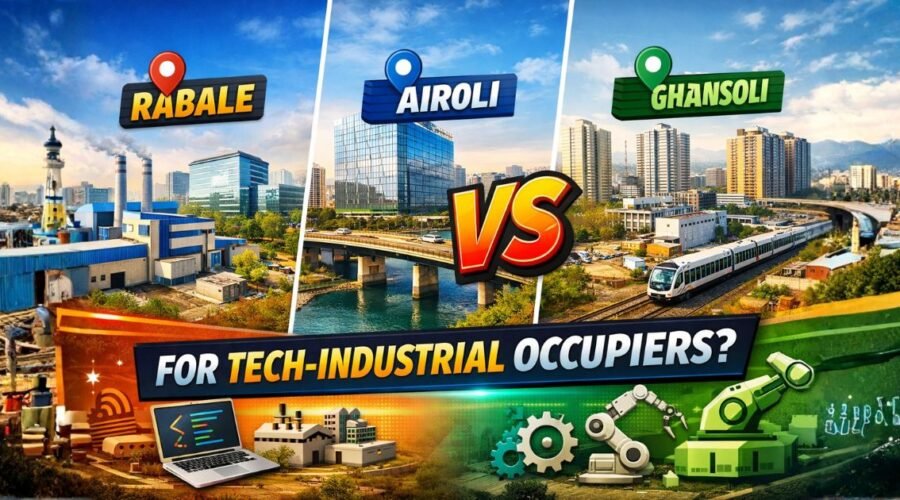
Rabale vs Airoli vs Ghansoli for Tech-Industrial Occupiers: Which Belt Fits Best?
If you want the short answer first, here it is: Airoli usually suits office-heavy tech occupiers best, Rabale usually suits engineering-led and operations-heavy tech-industrial users best, and Ghansoli usually works best as the middle path for hybrid occupiers. But that answer changes quickly once you look at workforce origin, building stock, floor loading, power needs, last-mile friction, and whether your business is really office-led or operations-led.
That is the real problem in this belt. Many companies compare Rabale, Airoli, and Ghansoli as if they are just three nearby commercial locations on the same line. They are not. On the ground, they behave very differently.
A clean glass-facade office in Airoli can be the right move for a software or support team and the wrong move for a company that needs prototype assembly, testing equipment, or heavy power. A cheap industrial space in Rabale can look like a smart cost-saving decision and later turn into a hiring problem if your team is white-collar heavy. Ghansoli, meanwhile, often looks like the compromise option, and in many cases that is exactly why it works.
This guide is for occupiers who want the practical answer, not brochure language.
Quick summary
| Node | Usually best for | Main strength | Main tradeoff | Broad practical verdict |
|---|---|---|---|---|
| Airoli | IT, software, BPO, support, GCC, client-facing tech teams | Better office stock, stronger white-collar comfort, better road pull from Thane and Mulund | Higher cost pressure, not ideal for heavy industrial-tech use | Best for office-heavy tech occupiers |
| Ghansoli | Hybrid tech teams, R&D-style users, life-science-linked occupiers, mid-sized tech offices | Balanced corporate comfort and functional access | Internal traffic friction and variable building-level fit | Best middle-path option |
| Rabale | Engineering, industrial automation, hardware, fabrication-linked tech, data centers, operations-heavy occupiers | Strong utility logic, industrial realism, practical building capability | Less polished environment for pure white-collar teams | Best for engineering-led and operationally heavy users |
What exactly counts as a tech-industrial occupier in this comparison?
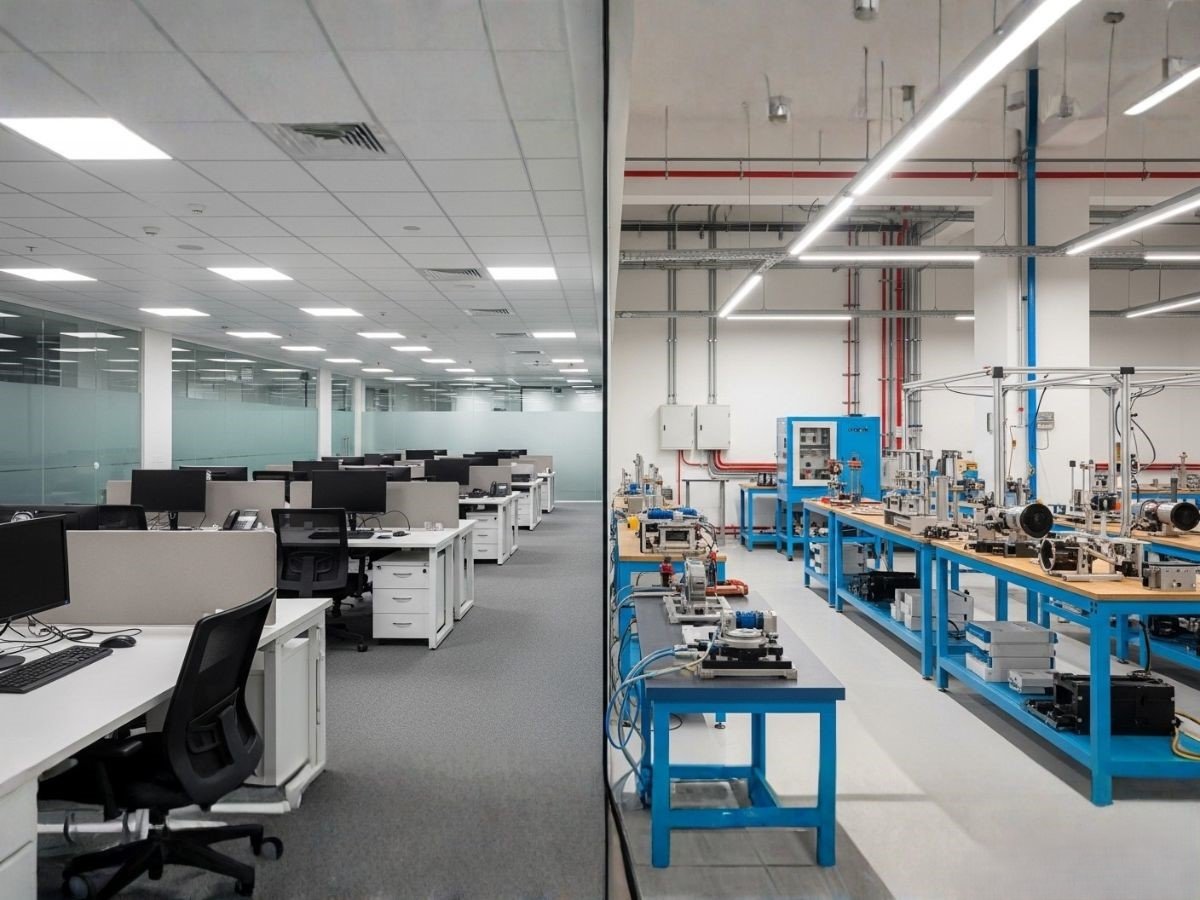
A tech-industrial occupier is not just a company with computers inside an industrial building. It is usually a business that sits somewhere between a normal office user and a traditional factory user.
These occupiers may need office-quality space, but they also need some combination of power density, floor-loading strength, equipment movement, testing capacity, warehousing support, or industrial ecosystem access.
Office-heavy tech team with limited industrial dependency
This includes software companies, IT support teams, BPOs, design teams, analytics operations, remote service teams, and corporate support functions.
For this type of occupier, the key questions are not heavy power or freight movement. The real questions are staff comfort, hiring ease, visitor impression, station access, road access, parking, and the quality of the building environment.
This is where Airoli usually becomes strong.
Engineering or manufacturing-linked occupier with some office requirement
This includes automation companies, electronics assembly users, industrial design teams, machinery-linked engineering firms, vendor-coordination hubs, technical service operators, and businesses that need both desks and operational utility.
For them, a normal office is often not enough. They may need stronger floor loading, three-phase power, service access, freight movement, and more tolerance for technical activity.
This is where Rabale becomes very relevant.
Hybrid occupier that needs both staff-facing office quality and industrial practicality
This is the category where the location choice gets tricky.
Think of robotics, R&D, life-sciences support functions, test labs, hardware-linked product teams, or companies where one part of the team is white-collar and another part is technical or operations-linked. These occupiers often need better quality office stock than Rabale’s older industrial inventory offers, but they also cannot function well in a purely polished office park that has low structural tolerance.
This is where Ghansoli often enters the picture as the middle path.
Why Airoli often works best for office-heavy tech occupiers
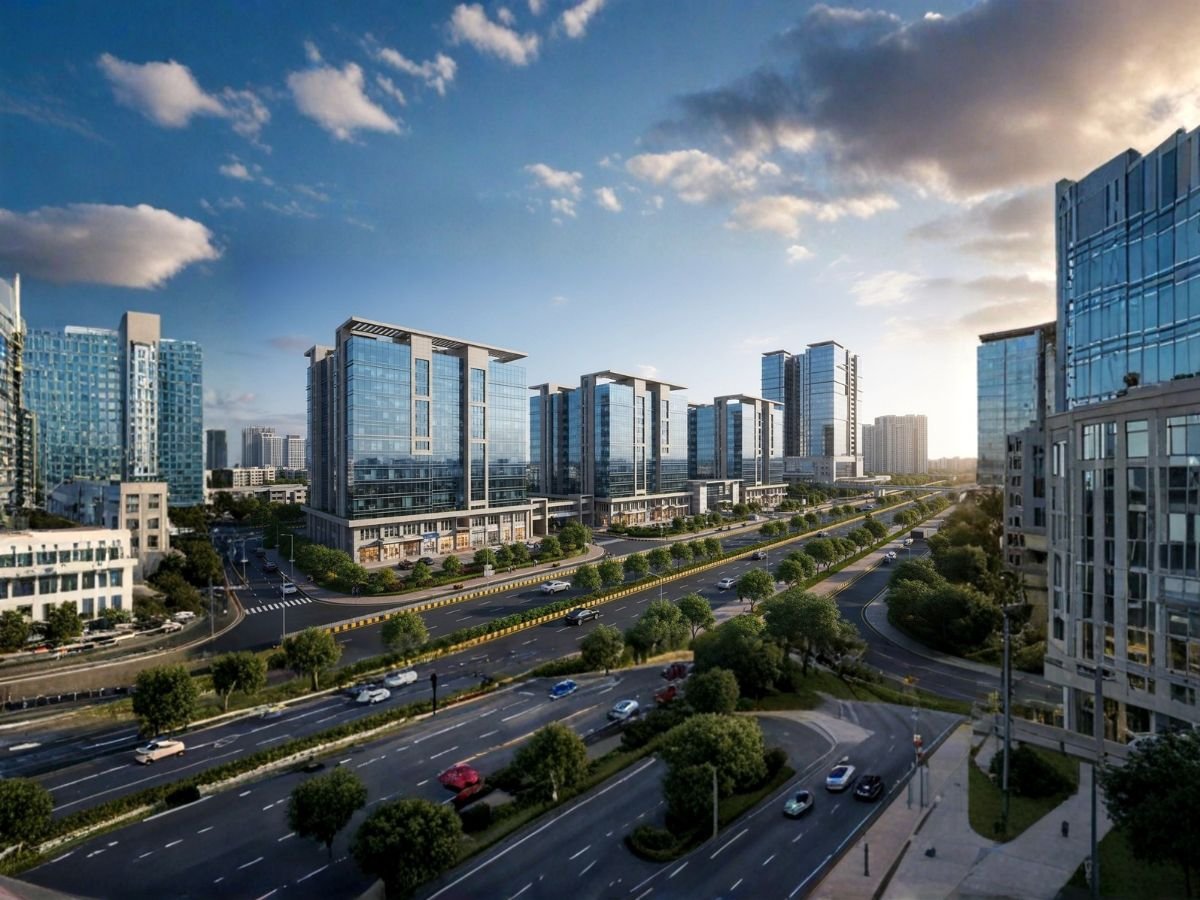
Airoli is not just another node on the Trans-Harbour line. In practice, it is one of the cleanest and most institutionally accepted office-led tech environments in this belt.
The biggest reason is simple: Airoli already behaves like an office market first and an industrial market second.
Major office-led ecosystems and tech campuses have shaped occupier expectations here. That matters because office-heavy companies are not only choosing a location. They are choosing a hiring environment, a client-facing environment, and a workplace experience.
Where Airoli wins on talent access and daily commute logic
Airoli’s biggest practical advantage is that it pulls well from Thane and Mulund side road commuters, especially through the Mulund-Airoli access logic. For senior management, client meetings, and white-collar teams, this is a real advantage.
It also sits on the Trans-Harbour line, but the railway story needs honest decoding. All trains on this corridor are slow trains. There is no fast-train shortcut that magically solves commute time. Employees coming from Kalyan, Dombivli, or beyond still face the line-change friction at Thane. So Airoli is not automatically perfect for every commuter catchment.
Still, for office-heavy firms with leadership or talent pools leaning toward Thane, Mulund, and nearby eastern suburbs, Airoli often feels easier and more corporate from day one.
Why better office stock changes hiring and client comfort
This is where generic articles usually become too soft. Better office stock is not just about appearance.
It affects:
- hiring quality
- interview turnout
- staff retention
- visitor confidence
- day-to-day team comfort
- how “serious” the company feels to clients and employees
A tech company trying to scale a support, software, analytics, or back-office team will usually find it easier to do that in a cleaner office environment than in an older industrial setting. This is one reason Airoli keeps attracting office-led occupiers.
Mid-2024 to 2026 market averages have also kept Airoli on the higher side in this corridor, with capital values around the upper band of this comparison and office rents often sitting in the roughly ₹50 to ₹90 per sq. ft. per month range in stronger stock, depending on building quality, age, and exact micro-location.
Where Airoli becomes a weak fit despite its image
This is the part many occupiers understand too late.
Airoli can be the wrong choice if your business needs:
- meaningful equipment movement
- high floor loading
- industrial power logic
- regular prototype assembly
- operations that do not fit normal corporate building rules
Standard corporate stock usually works with lower floor loading, often in the range of roughly 0.25 to 0.5 T/sqm, which is normal for office use but can quickly become restrictive for technical operations.
So yes, Airoli is excellent for office-heavy tech occupiers. But if your “tech” business is actually operations-heavy, hardware-linked, or test-intensive, the premium image can become a very expensive mismatch.
Why Rabale still makes strong sense for engineering-led and practical industrial-tech users
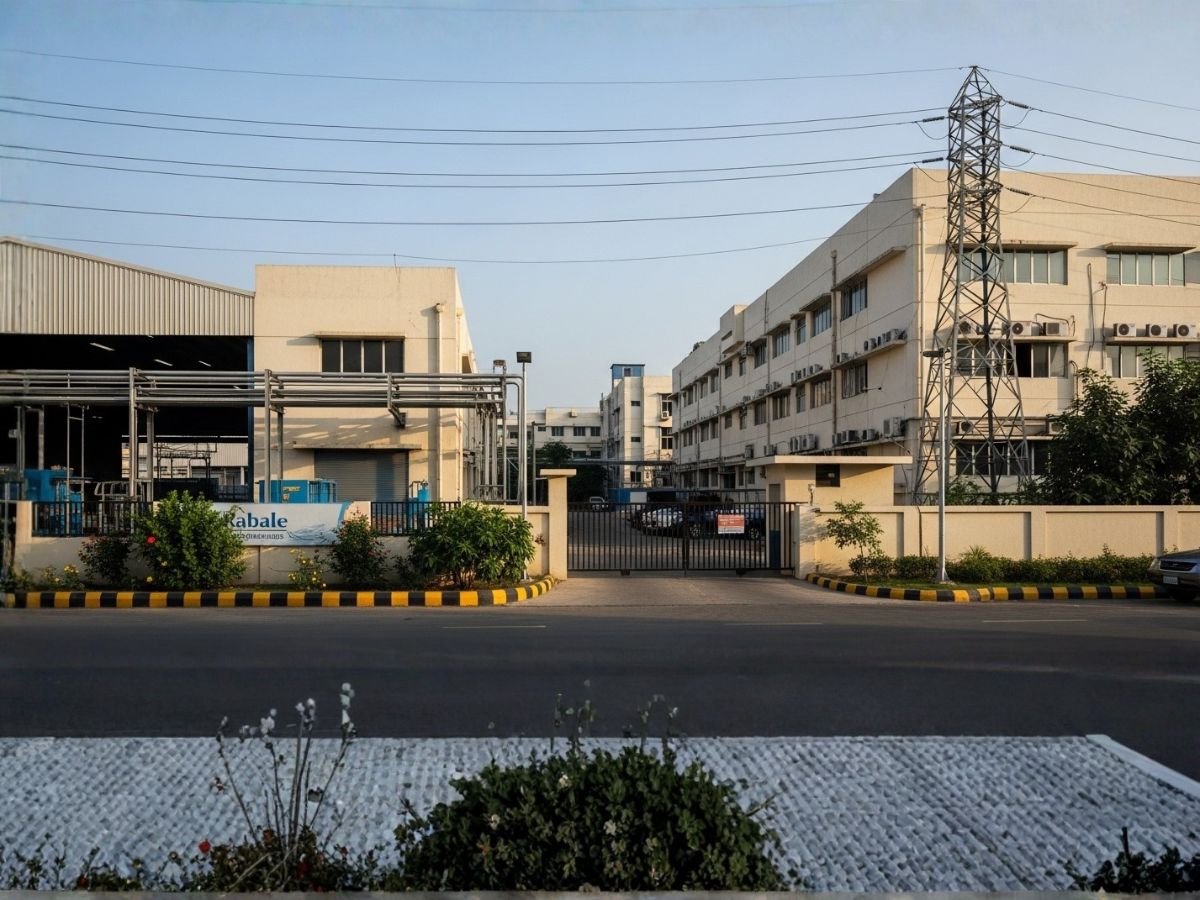
Rabale is often misunderstood by outside occupiers. It is frequently seen as the rougher, less polished alternative to Airoli. That is true visually in some pockets, but it misses the point.
Rabale is not trying to win a beauty contest. It is trying to solve operational problems.
And for many tech-industrial occupiers, that is exactly why it wins.
Where Rabale wins on operational realism
Rabale makes sense when your business depends on function more than facade.
This includes occupiers that need:
- stronger industrial utility
- heavier floor loading
- practical equipment access
- engineering ecosystem support
- vendor movement
- technical teams that interact with operations, not only laptops
In this type of environment, the question is not “Which node feels more premium?” It is “Which node lets the business actually operate without fighting the building every day?”
Rabale’s strength is that it remains deeply connected to the TTC/MIDC industrial logic of the corridor. It supports practical, no-nonsense use better than many cleaner office-led options.
Why some occupiers choose Rabale even when Airoli looks cleaner
Because cleaner is not always better.
A business involved in industrial automation, hardware integration, specialized engineering, fabrication-linked technology, or data infrastructure may get more real value from Rabale than from Airoli. That value comes from utility alignment, not visual polish.
The most powerful example here is the data center reality. Large technology infrastructure players did not choose Rabale because it had the most attractive office towers. They chose it because of serious power capacity and structural suitability. The presence of active 110KV and 220KV substation-level infrastructure tells you what kind of node this really is.
That is not a small signal. It tells you Rabale can support heavier technical demand in a way that a normal office market cannot.
The hidden tradeoff: image, building quality, and visitor impression
This is where you need honesty.
Rabale can absolutely feel less refined for office-heavy white-collar teams. Some buildings are older. Some pockets are more industrial in character. The surrounding environment may not support the same employee experience as a cleaner office-led ecosystem.
So if your business depends on:
- client visits
- frequent hiring of software talent
- polished work environment
- strong white-collar perception
then Rabale may start creating friction.
But if your business depends on:
- power
- utility
- engineering support
- technical fit
- practical occupancy cost logic
then Rabale may be the smarter choice, even if it looks less glamorous on day one.
Real-world style example: when Rabale is the better answer
Imagine a robotics or industrial automation firm with a design team, testing team, and light assembly requirement.
If it chooses a polished Airoli office purely for image, it may later discover that the building cannot comfortably support its equipment needs, movement patterns, or utility requirements. Fit-out becomes restrictive. Operations get split. The team loses efficiency.
If the same firm takes the right mixed or industrial-capable stock in Rabale, it may sacrifice some visitor polish, but gain the daily operational freedom it actually needs.
That is why Rabale still matters.
Where Ghansoli fits between corporate comfort and industrial usability
Ghansoli usually works best when Airoli feels too expensive or too office-pure, and Rabale feels too industrial or too rough for the type of team you are building.
In other words, Ghansoli is often the compromise that makes sense when your company has mixed needs.
When Ghansoli is the smarter middle path
Ghansoli tends to fit occupiers who need:
- a more acceptable office environment than older industrial stock
- some ecosystem comfort for white-collar and technical teams
- access to campus-style or organized commercial environments
- a lower or more balanced entry point than premium Airoli stock in some cases
This makes it relevant for hybrid R&D users, life-science-linked occupiers, mid-sized tech offices, and companies that cannot function well in a rough industrial environment but also do not need Airoli’s full corporate positioning.
Where Ghansoli benefits from station-linked and campus-style demand
Ghansoli gains from its mix of station-linked usability and organized corporate-style pockets. In broad market terms, it has often sat slightly below Airoli in capital value positioning, with a mid-2024 to 2026 reference band around ₹14,500 per sq. ft. in stronger market discussions, though actual property-level numbers vary significantly by asset, age, and product type.
It also benefits from the presence of serious corporate-scale environments, which changes how occupiers perceive the node. For companies that want a more balanced corporate setting without going full premium, Ghansoli can make sense.
Where Ghansoli can look stronger on paper than in actual fit
This is the caution part.
On paper, Ghansoli can sound ideal: decent positioning, campus-style perception, corporate comfort, reasonable middle-ground logic. But building-level and road-level reality still matter.
Internal traffic bottlenecks, especially around local access points and village-side road interfaces, can create frustrating last-mile delays during peak hours. A building may look close to the highway on a map and still cost your team 15 to 20 minutes of access pain at the wrong time of day.
So Ghansoli is not automatically the perfect compromise. It is the right compromise only if:
- the building stock genuinely supports your use
- your team can handle the commute pattern
- the location’s internal road friction is acceptable for your daily operations
Which area works best if your staff comes from Thane, Mulund, Dombivli, Kalyan, or Navi Mumbai?
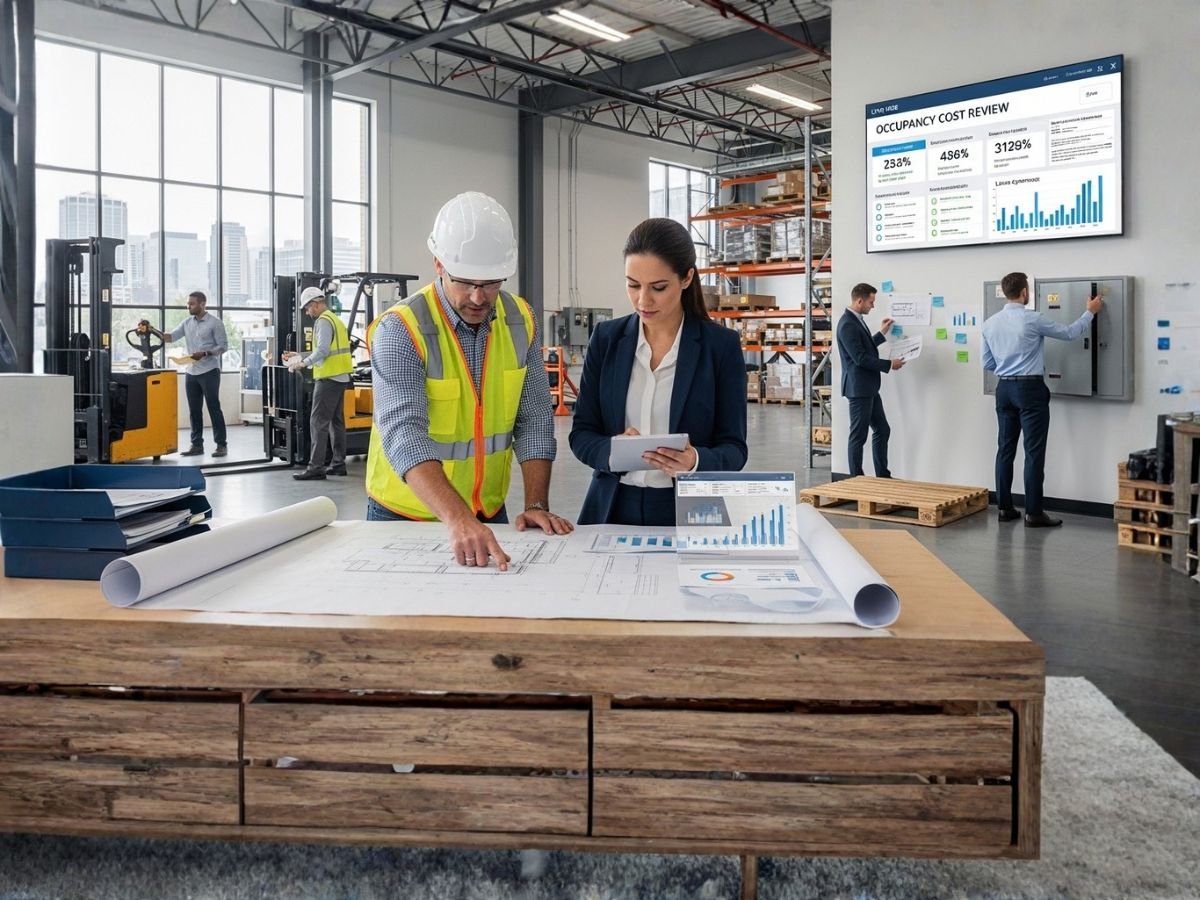
This section matters more than many occupiers think.
A bad commute does not just irritate employees. It affects retention, attendance reliability, hiring quality, and team morale. In a competitive labour market, daily friction becomes a business cost.
The most important local reality here is simple: the Trans-Harbour line runs slow trains only. Also, commuters from central suburbs such as Kalyan and Dombivli often have to change at Thane, which adds daily friction.
Staff commute comparison table
| Staff origin | Usually stronger node | Why | Main caution |
|---|---|---|---|
| Mulund | Airoli | Better road pull via Mulund-Airoli access | Not all buildings are equally last-mile friendly |
| Thane | Airoli / Ghansoli | Airoli works well by road, Ghansoli can also work depending on exact office location | Peak-hour road and transfer friction still matter |
| Dombivli | Ghansoli / Rabale / Airoli depending on exact route, but with caution | All are possible through Thane-side interchange logic | Daily line change at Thane can become tiring |
| Kalyan | Ghansoli / Rabale / Airoli depending on business need, but none is friction-free | Reach is possible through the rail network | Do not underestimate the Thane interchange burden |
| Navi Mumbai-side residents | Depends on micro-catchment and exact station-road mix | All three can work in different cases | Do not assume “same city” means easy commute |
The practical lesson is this: station access is helpful, but not enough. You also need to check:
- where most employees actually live
- whether they need a train change
- whether first-mile and last-mile connectivity works
- whether road access is smooth for the senior team and client movement
If your team is heavily Thane and Mulund oriented, Airoli usually improves the answer. If your team is more mixed and your business is not purely office-led, Ghansoli or Rabale may become more reasonable.
Do not compare only the node names. Compare the actual building stock you will occupy
This is one of the biggest mistakes in the entire Navi Mumbai commercial market.
A good building in the “less premium” node can be more useful than the wrong building in the “better” node. That is especially true for tech-industrial occupiers.
Campus-style office parks vs older industrial buildings
Campus-style office parks are designed for human density, corporate movement, central air-conditioning, meeting culture, and cleaner white-collar operations. They are not automatically designed for heavy testing, technical loading, or industrial-grade movement.
Older industrial buildings or galas may look less attractive, but some of them support operations far better for the right occupier type.
So do not compare node names only. Compare the actual asset.
Mixed office-industrial buildings vs pure office environments
A pure office building may give you:
- lobby quality
- branding value
- parking structure
- visitor comfort
- cleaner staff experience
A mixed or industrial-capable building may give you:
- stronger floor loading
- higher clear height
- better freight movement
- easier equipment handling
- more operational flexibility
For a hybrid tech-industrial occupier, this difference is not minor. It can decide whether the space works or fails.
Why internal road quality, loading, parking, and access matter more than brochure language

A brochure can say:
- close to station
- near highway
- strategic location
- strong ecosystem
But daily life asks different questions:
- Can delivery vehicles enter easily?
- Is there loading support?
- Will peak-hour congestion trap your staff?
- Is there enough power without expensive upgrades?
- Can the building legally and physically support your activity?
Practical building checklist for tech-industrial occupiers
Before choosing Rabale, Airoli, or Ghansoli, check these points at the building level:
- What is the approved use of the property: industrial, IT/ITES, commercial, or mixed-permitted structure?
- What is the floor loading capacity?
- Is the power availability enough for current and future use?
- Are three-phase power and utility upgrades feasible?
- Is there a freight elevator, service lift, or proper goods movement path?
- What is the clear height if technical setup is involved?
- Is there loading/unloading practicality?
- How does parking actually work in daily use?
- What does last-mile traffic look like during peak hours?
- Will your white-collar team feel comfortable reporting here five days a week?
This is where a lot of bad decisions can still be avoided.
Which belt makes more sense for different occupier types?
Now let us turn the comparison into a more direct decision tool.
Occupier-fit matrix
| Occupier type | Best-fit node | Why |
|---|---|---|
| Software, IT, BPO, support, analytics, GCC-style teams | Airoli | Better office environment, stronger white-collar comfort, better corporate perception |
| Engineering services, automation, hardware-linked firms, technical operations | Rabale | Better operational realism, stronger industrial logic, more suitable utility profile |
| Hybrid R&D, life-science support, mixed office plus technical users | Ghansoli | Balanced fit between corporate comfort and functional practicality |
| Data infrastructure, power-heavy technical setups | Rabale | Utility capability matters more than facade |
| Client-facing tech teams with leadership from Thane/Mulund side | Airoli | Better road-led access and office ecosystem alignment |
| Cost-conscious hybrid occupiers that still need acceptable office quality | Ghansoli | More balanced middle-ground logic in the right building |
IT, software, BPO, support, data, and back-office teams
For these occupiers, Airoli is usually the cleanest answer.
The reason is not just brand prestige. It is the full office-use package: better building expectations, cleaner environment, better team comfort, and stronger fit for white-collar operations.
Ghansoli can work if cost and building-level selection align properly. Rabale is usually harder for this category unless the company’s culture and operating model are unusually tolerant of industrial surroundings.
Industrial design, automation, engineering services, and vendor-linked firms
This is Rabale’s territory more often than people admit.
If your team works close to machinery, hardware, fabrication, testing, vendor movement, technical services, or operational utility, then Rabale’s practical fit often beats cleaner-looking alternatives.
Airoli may still appeal emotionally, but that does not mean it will support the business properly. Ghansoli can work for some lighter technical use-cases, but Rabale usually remains stronger where utility and industrial ecosystem matter.
Companies that need both office talent and industrial ecosystem access
This is the toughest category, and that is why Ghansoli becomes important.
A hybrid company may need enough office quality to attract and retain skilled staff, but also enough functional practicality to support technical activity. That company may find Airoli too office-pure and Rabale too industrial in feel.
In the right asset, Ghansoli often becomes the balance point.
Where do companies make the wrong choice between Rabale, Airoli, and Ghansoli?
This is where expensive mistakes happen.
Paying for image when the business really needs functionality
Some companies choose Airoli because it looks safer, more premium, and more “corporate.” If the actual business is operations-heavy, that choice can create structural and functional constraints.
The address looks right. The building behaves wrong.
Choosing the cheapest rent without checking staff friction
This is the opposite mistake.
A company may save money by taking a cheaper functional space in Rabale or another industrial-style stock, then find that its white-collar hiring becomes harder, employee dropout rises, and team culture weakens because the daily environment does not match the role type.
Lower headline rent does not always mean lower business cost.
Assuming station proximity solves everything
This is one of the biggest myths in this corridor.
A station-near building is helpful, but it does not cancel:
- slow-train limitations
- line changes at Thane
- internal road bottlenecks
- last-mile problems
- poor building usability
Caution box: do not ignore the MIDC and NMMC cost reality
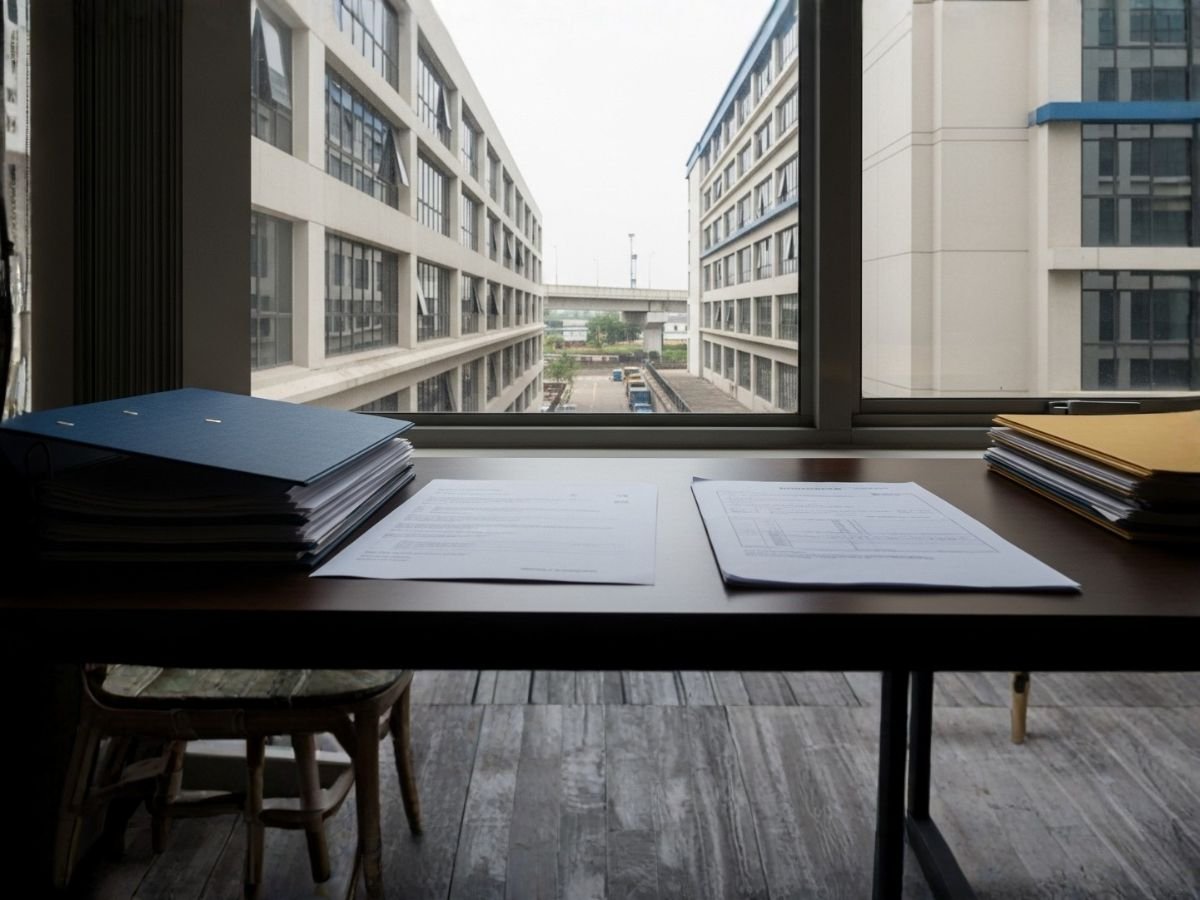
This part is especially important if you are leasing or occupying space in an MIDC-linked environment.
The occupancy cost is not just the landlord’s quoted rent.
Practical risks include:
- MIDC subletting charges, where official rules can differentiate between IT/ITES and industrial/commercial use
- Change of activity issues if the approved use of the property does not match the actual intended activity
- NMMC property tax exposure, because the legal position is not “MIDC area means no NMMC tax”
- leasehold complexity, because this belt is generally leasehold, not freehold, under long-term land structures
The official framework matters here. If your legal and commercial team does not verify property use, subletting treatment, and total occupancy cost properly, the deal can look attractive upfront and become expensive later.
Conclusion
Choose Airoli if:
- your business is office-heavy
- hiring white-collar talent matters more than industrial utility
- client-facing perception matters
- your team or leadership draws strongly from Thane and Mulund side
- you want stronger corporate comfort and can justify the premium
Choose Rabale if:
- your business is engineering-led, technical, utility-heavy, or operations-first
- you need stronger floor loading, power logic, freight practicality, or industrial ecosystem support
- your business gains more from functionality than facade
- you do not want to overpay for the wrong type of building
Choose Ghansoli if:
- your business sits between office and operations
- you need a cleaner working environment than old industrial stock but do not need a fully premium office-led node
- you are a hybrid occupier and building selection matters more than area branding
- you want a more balanced compromise between team comfort and practical use
The real answer is not about which node sounds better. It is about which node lets your business operate with the least daily friction.
For pure tech teams, Airoli usually wins. For engineering and practical industrial-tech users, Rabale usually wins. For hybrid occupiers, Ghansoli often wins.
That is the clearest way to think about it.