
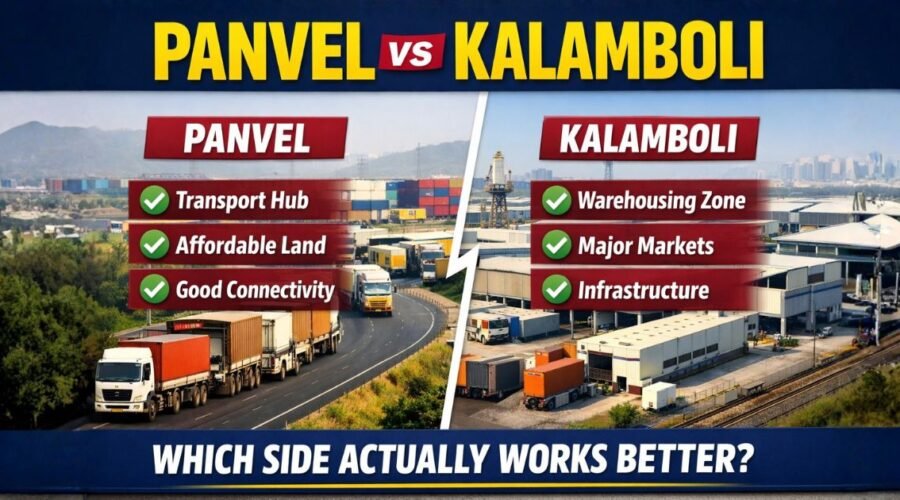
Panvel vs Kalamboli for Logistics and Industrial Setup: Which Side Actually Works Better?
If the goal is immediate logistics operations, regular truck movement, faster dispatch, and a mature transport ecosystem, Kalamboli usually works better. If the goal is larger land play, future expansion, airport-influenced growth, or a more mixed industrial strategy, Panvel can make more sense. That is the real answer. These two places sit close to each other on the map, but on the ground they behave very differently for warehousing, transport, and industrial setup.
Many people make the mistake of treating this as a simple location comparison. It is not. This is really a decision about operational fit. A 3PL, a steel stockist, a transport fleet operator, a clean-tech assembly unit, and a long-horizon land investor should not get the same answer.
Panvel or Kalamboli: which is the better choice for logistics and industrial setup?
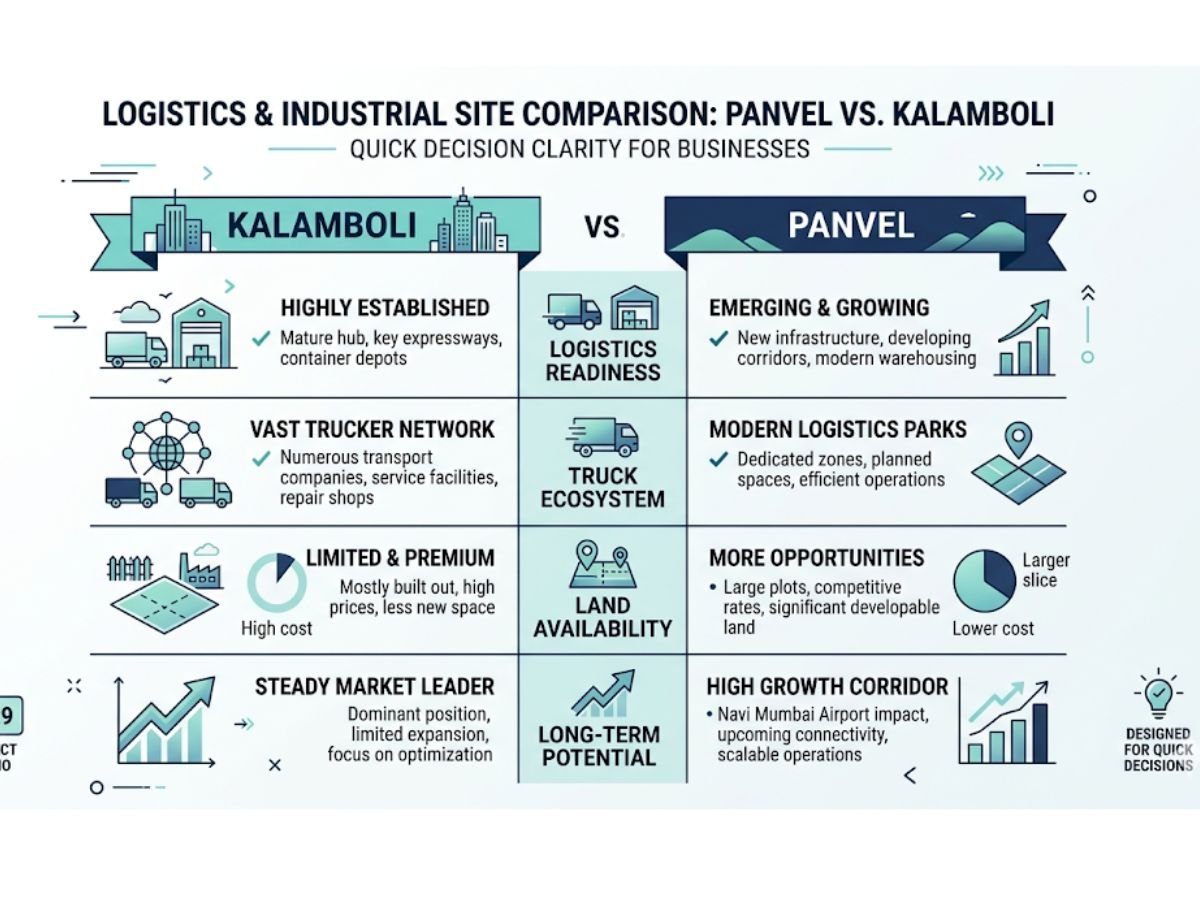
The short verdict is simple: Kalamboli is sharper for logistics. Panvel is broader for industrial and land-led strategy.
Kalamboli has a more established transport character. It is already built around truck movement, steel trade, freight support, highway access, and operational density. Panvel is a larger and more fragmented belt. It offers more directional upside in some pockets, especially where future infrastructure matters, but that does not automatically make it better for present-day logistics execution.
Quick Summary
Kalamboli vs Panvel: Industrial Decision Guide (2026)
| Decision Factor | Kalamboli | Panvel |
|---|---|---|
| Best fit | 3PL, trucking, warehousing, heavy freight distribution | Land banking, expansion, airport-linked long-term play |
| Operational readiness | Usually stronger | Varies heavily by micro-location |
| Truck ecosystem | Deep and established | More scattered |
| Land availability | Scarcer, premium, saturated | Broader but fragmented and policy-sensitive |
| Warehouse practicality | Strong for immediate use | Works in select pockets (like Palaspe), not uniform |
| Factory layout flexibility | More constrained | Better in peripheral belts, but needs strong due diligence |
| Rail freight relevance | Stronger ecosystem support | More indirect in many cases |
| Long-term upside | More limited | Higher (with higher risk) |
| Best approach | Lease and operate | Buy carefully and plan long-term |
Why this comparison is more complicated than it looks on Google Maps
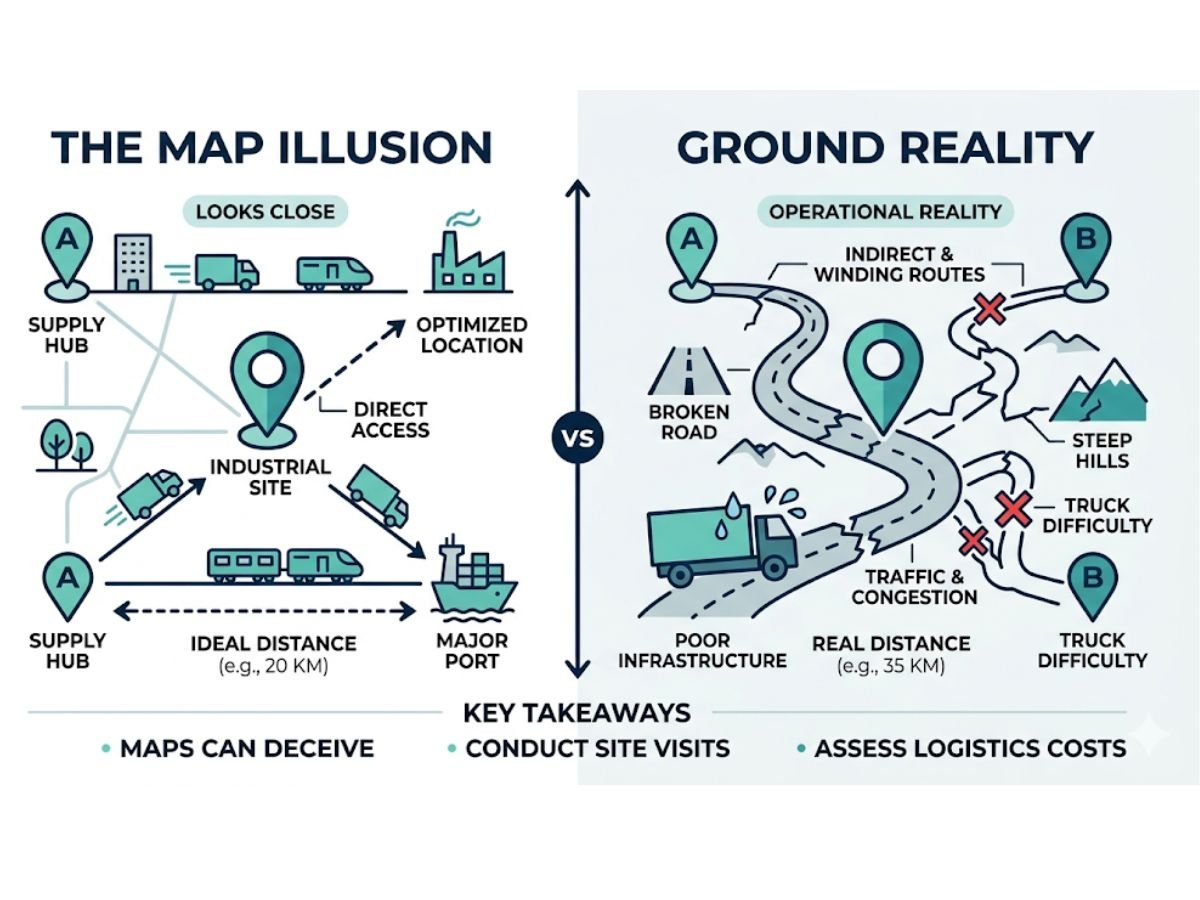
The biggest mistake here is the map illusion.
Panvel sounds like one place, but in reality it includes a much wider and more mixed geography: old urban Panvel, New Panvel, highway-linked belts, peripheral villages, and NAINA-influenced areas. Kalamboli, by contrast, is more compact, more legible, and more operationally defined. That difference matters a lot.
Panvel is a broad belt, not one uniform industrial answer
A property advertised as “Panvel industrial” may be close to a meaningful highway corridor, or it may sit deeper inside a peripheral village where the last-mile approach road is weak, narrow, or monsoon-sensitive. On paper, both properties may look equally close to NH-48. In real working conditions, they are not.
This is why Panvel creates both opportunity and confusion. It can offer more land and more future growth narratives, especially because of the airport and NAINA-linked planning changes. But it also demands more due diligence. A wrong Panvel choice can look attractive in a brochure and still fail basic operational tests.
Kalamboli is smaller, but often more operationally legible
Kalamboli has its own complexity, but compared with Panvel it is far easier to read. It is an old transport and trade ecosystem, not just a new story being sold on future infrastructure. The BIMA complex, steel market activity, truck movement culture, goods yard relevance, and support services all give Kalamboli a more predictable operating environment for logistics-first users.
That is an important distinction. Predictability itself is a business advantage.
> Caution: A location being close to Panvel station, Panvel city, or a major road does not make it automatically fit for logistics. In this comparison, the real question is not “Which area is famous?” The real question is “Which property can handle my daily operational reality?”
Which side works better for warehouse users, transporters, and trucking-led businesses?
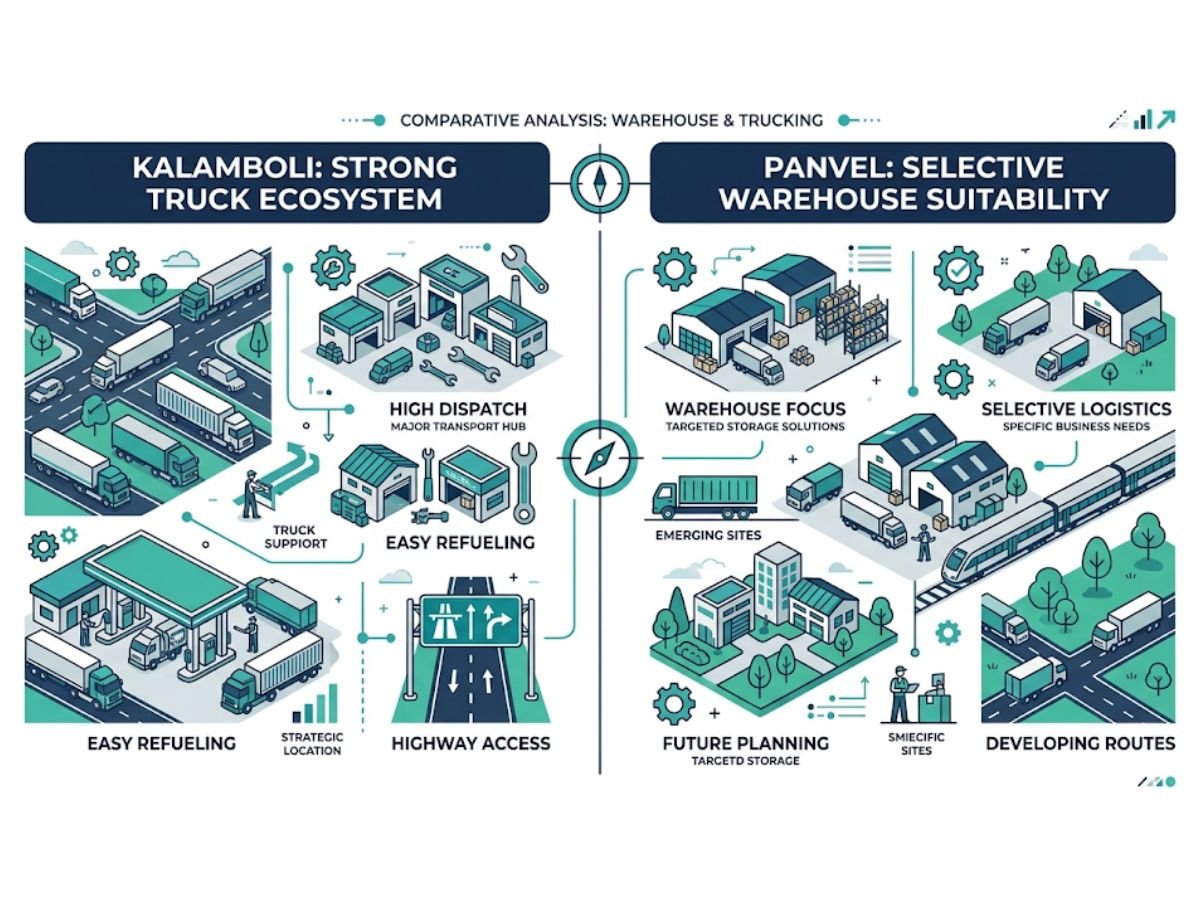
For most warehouse users, transporters, and trucking-led businesses, Kalamboli usually has the edge.
Where Kalamboli usually has the edge
Kalamboli works better when the business depends on high-frequency dispatch, reliable truck movement, support services, and fast problem-solving at odd hours. That matters for 3PL operators, distribution hubs, e-commerce fulfillment, steel and heavy material movement, and fleet-led businesses.
The practical advantage is not just “connectivity.” It is the ecosystem around it. Kalamboli has an established transport culture with truck staging, freight handling familiarity, heavy vehicle support services, weighbridges, and goods-yard relevance. That ecosystem reduces friction. A truck breakdown, delayed dispatch, or after-hours issue is easier to manage in a logistics-heavy node than in a scattered peripheral belt.
The ongoing Kalamboli stack interchange upgrade is also important in business terms. It is not just a flyover story. The real meaning is smoother conflict-free movement between major freight routes over time. During construction there can be disruption, yes, but the long-term direction clearly supports freight efficiency.
Where Panvel can still make sense
Panvel can still work for warehousing, especially in selected corridors such as Palaspe-side and highway-oriented belts, but the answer becomes much more micro-location dependent. A compliant larger-format PEB warehouse with good frontage and loading access can work well. A random peripheral shed with weak internal access will not.
Panvel becomes more viable for warehousing when the user does not need the same level of dense trucking ecosystem that Kalamboli naturally offers. For example, long-duration storage, lower-dispatch-frequency warehousing, or land-heavy warehouses with future expansion logic may justify Panvel-side selection.
Still, for pure transport-led operations, Kalamboli remains the cleaner answer.
Which side works better for industrial plots, sheds, and small factory setups?
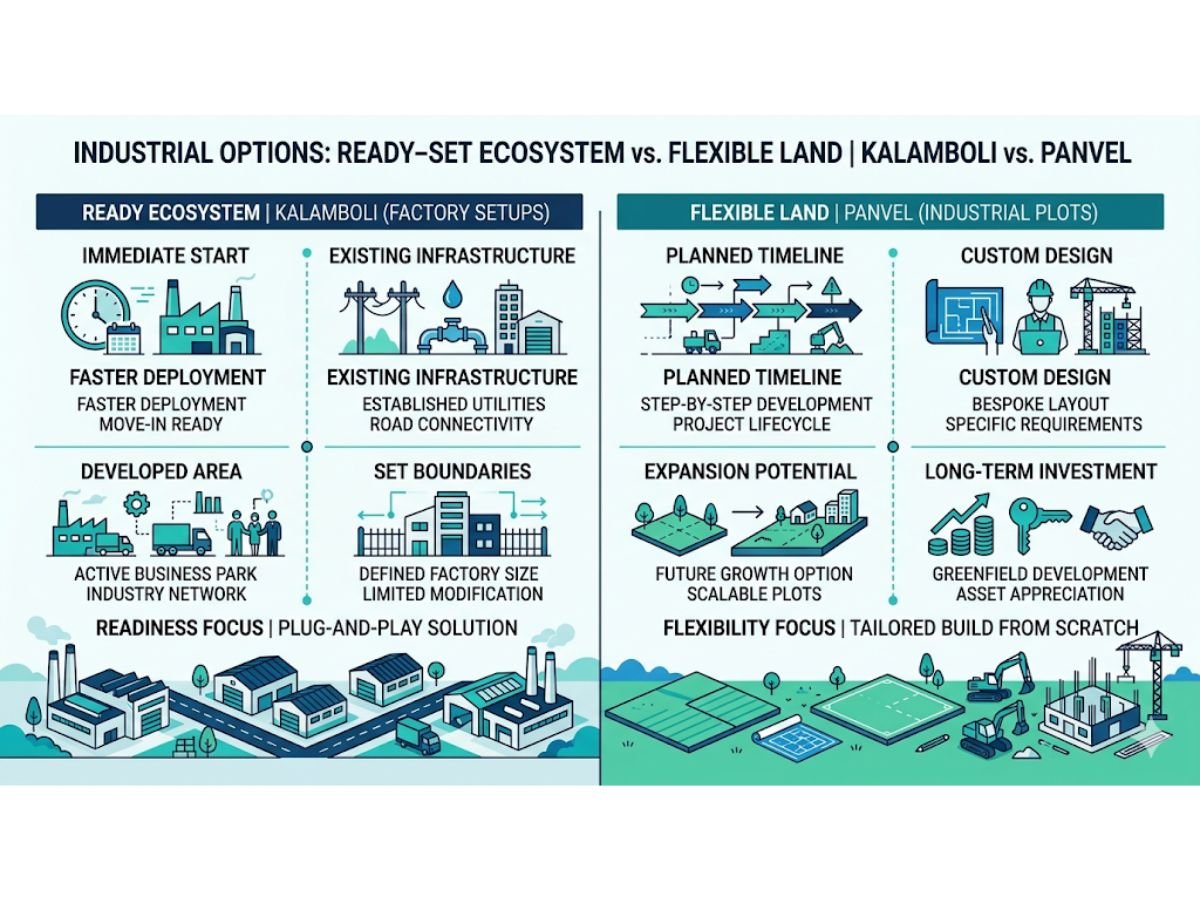
This is where the answer becomes less one-sided. For industrial plots, sheds, and small factory setups, Panvel can become more attractive in the right belt, but only after stricter legal and infrastructure checks.
Plot-led flexibility vs immediate logistics usability
Kalamboli offers more established industrial pockets and a more mature setup environment, but it is also more built-up, scarcer, and less flexible if you need a large horizontal footprint. In practical terms, it is better when you want a more ready operating context.
Panvel offers more scope for larger parcels and longer-term planning, but this comes with serious filtering. If you are looking at peripheral Panvel for a factory or industrial shed, the exact plot’s legal status, access geometry, utility readiness, and development framework matter much more than they do in a fully established logistics node.
Compliance, layout, and expansion practicality
This is where many buyers go wrong. They buy into the broad “Panvel growth” story without understanding what that means for industrial land.
In NAINA-linked areas, the 60:40 land pooling model can change the entire layout logic of a project. For a buyer who needs large contiguous ground coverage for a factory, storage yard, or low-rise industrial setup, surrendering 60% of the land and relying on 2.5 FSI on the retained portion may not solve the real operational need. Vertical build-up is not always useful for heavy industrial use.
That is why Panvel is better only for certain industrial users, not all. It works better for those who are patient, flexible, and willing to do real groundwork. Kalamboli works better for those who value readiness over theoretical expansion.
Simple example: A small engineering unit needing stable 3-phase power, staff access, and a predictable legal setup may prefer an established Kalamboli-side industrial environment. A cleaner light-assembly or future-oriented industrial user who can wait, plan, and shape a larger site may prefer selected Panvel belts.
Does highway, rail, and port-side connectivity actually favor one side more?
Yes, but not in the simple way brokers usually pitch it.
Both Panvel and Kalamboli can claim strong regional connectivity. But regional connectivity and daily freight efficiency are not the same thing.
NH-48 and junction logic
Kalamboli’s strength is not just that it touches major routes. Its strength is that it sits in a freight-oriented junction ecosystem. The node is deeply tied to NH-48, highway transitions, and container-heavy movement patterns. That matters more than a generic “near highway” label.
The Kalamboli Circle transformation into a signal-free stack interchange is a good example. The technical design may sound like an engineering detail, but the business meaning is simpler: less stoppage, fewer at-grade conflicts, and better freight movement over time.
JNPA-side freight logic and why it matters differently
The JNPA–Chowk greenfield highway is especially important because it shows where freight planning is heading. The logic is increasingly to move heavy cargo more directly and reduce urban friction. That benefits freight corridors and logistics nodes that are structurally aligned with truck flow.
Kalamboli is more naturally positioned inside that freight logic. Panvel benefits from broader regional infrastructure, but its role is becoming more mixed. In simple words, Kalamboli is leaning harder into freight movement; Panvel is leaning into a wider economic role that includes airport influence, mixed development, and future growth narratives.
Why broad regional connectivity is not the same as daily operational efficiency
A location can be “close” to the port corridor and still fail at the last mile. If a 40-foot trailer cannot comfortably enter, turn, load, wait, and exit, the map advantage becomes meaningless.
This matters even more now because heavy vehicle movement is increasingly shaped by scheduling limits and corridor restrictions in the Mumbai and Thane region. That makes legal staging space and truck-handling practicality more valuable than before. This is one reason Kalamboli’s truck-support ecosystem remains so relevant.
Which side is better if you want to lease now, and which side is better if you want to buy for the long term?
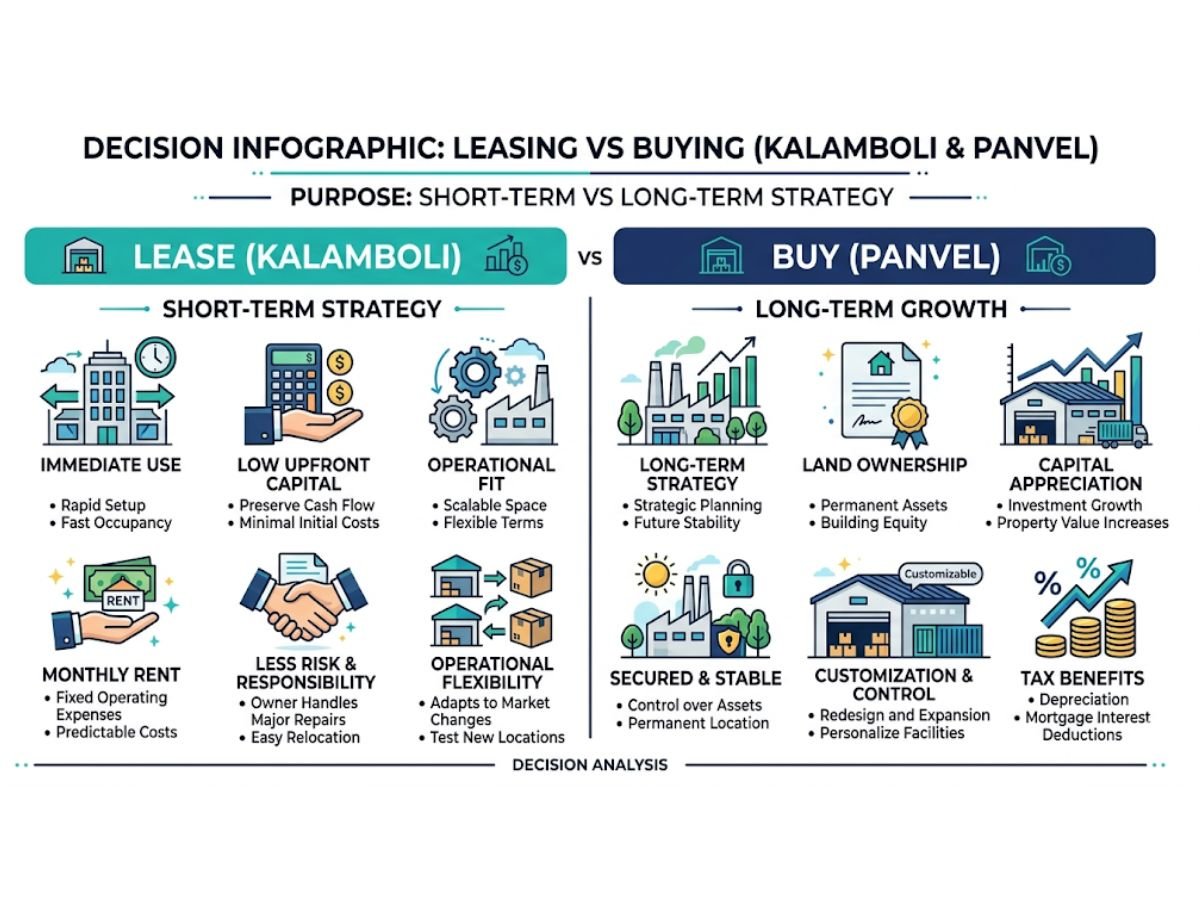
For most occupiers, the practical answer is: lease in Kalamboli, buy selectively in Panvel.
Kalamboli’s lease logic is stronger because the user is paying for immediate utility. The asking rent bands in fitted warehouse spaces can be higher, but that premium often reflects operational value. Recent market trends place many fitted Kalamboli warehouses roughly in the ₹24 to ₹35 per sq.ft. per month band, depending on exact location, frontage, clearance, fit-outs, and heavy-use features.
Panvel-side warehouse rents can also reach similar bands in selected compliant belts, especially where large PEB formats and useful frontage exist. But Panvel is less uniform. The variance is wider.
For buying, Panvel becomes more interesting because of land availability, broader expansion possibility, airport-led future attention, and long-horizon infrastructure uplift. But that does not mean “buy anywhere in Panvel.” It means buy only after filtering hard for legal clarity, access, and actual industrial usability.
Where do businesses usually make the wrong choice between Panvel and Kalamboli?
Most bad decisions happen because people choose by headline story, not by operational geometry.
Here are the most common mistakes:
- Choosing “Panvel” because it sounds bigger and more future-ready, without checking whether the actual property sits deep inside a weak-access belt
- Assuming every roadside parcel is logistics-ready
- Buying NAINA-influenced land without understanding how the pooling framework affects ground coverage
- Confusing broad appreciation stories with present-day warehouse utility
- Ignoring truck staging needs, especially with tighter corridor restrictions around the Mumbai region
- Underestimating CIDCO leasehold complications, transfer-related costs, or approval processes
- Confusing passenger rail relevance with freight rail relevance
That last point matters. In logistics planning, the Kalamboli Goods Yard matters far more than the passenger station. A reader who understands that difference is already thinking more clearly than most.
Which types of businesses should choose Kalamboli, and which should choose Panvel?
Kalamboli vs Panvel: Best Fit by Business Type (2026)
| Business Type | Better Fit | Why |
|---|---|---|
| 3PL / e-commerce warehousing | Kalamboli | Faster dispatch ecosystem, strong truck movement, better support density |
| Transport operator / fleet business | Kalamboli | Truck staging, freight ecosystem, operational efficiency |
| Steel / heavy materials / chemicals | Kalamboli | Heavy-movement suitability and existing trade ecosystem |
| Local distributor (truck movement) | Kalamboli | Better immediate operational practicality |
| Small manufacturer (ready setup) | Kalamboli or selected Panvel | Depends on shed readiness, utilities, and access |
| Light assembly / clean industrial use | Selected Panvel belts | Better scope for future-oriented land use |
| EXIM / long-storage / land-heavy users | Panvel (peripheral belts) | Supports larger land use if dispatch intensity is lower |
| Institutional land investor | Panvel | Better long-term upside (with higher filtering need) |
What should you check before buying or leasing in either location?
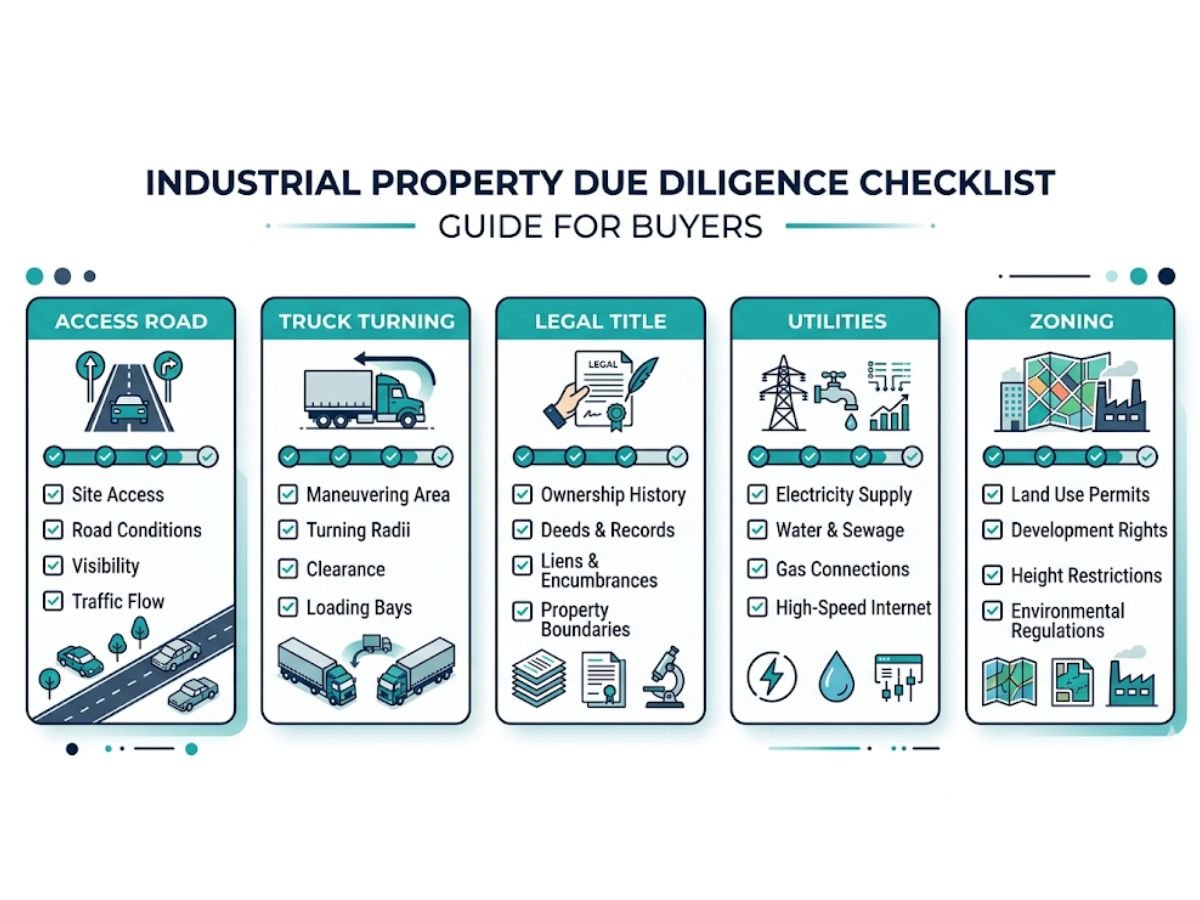
This is the section many buyers should read twice.
Access road, turning radius, loading edge, and truck movement
Do not rely on a broker’s location pin alone. Visit the site with an operational mindset.
Check:
- actual approach road width
- whether a 40-foot trailer can enter and turn properly
- loading dock practicality
- internal circulation
- monsoon waterlogging risk
- legal or informal parking/staging capacity
A property can look attractive on paper and still be practically dead for logistics.
Title, approvals, zoning, and authority-side clarity
This is especially important in the Panvel side context.
You must know:
- is it under PMC civic control?
- is it a CIDCO leasehold property?
- does the plot fall under NAINA framework?
- what is the exact land-use category?
- are transfer charges, NOCs, pooling obligations, or use restrictions likely to apply?
If the property is inside a structured development or park, check whether MahaRERA applies. For open industrial land or older stock, do not force MahaRERA into the conversation if it is not the relevant approval path.
Utility and expansion suitability
An industrial setup is not just about buying land. It is about whether the site can actually run your business.
Check for:
- 3-phase power availability
- water reliability
- ground load suitability
- expansion capacity
- labor access
- future conflict between surrounding urban use and truck-heavy operations
Also remember: IGR Maharashtra ready reckoner rates are a benchmark, not the full market truth. They help with baseline valuation logic, but they do not replace real negotiation and on-ground market checks.
Conclusion
Panvel and Kalamboli are not two equal versions of the same industrial market.
Kalamboli is the better answer for businesses that need logistics performance now. It suits warehousing, transport fleets, steel and freight-linked trade, and users who cannot afford daily friction in truck movement, support services, or dispatch timing.
Panvel is the better answer only when the business needs broader land options, future expansion, or a longer-horizon industrial strategy. It can reward patient capital and selected users, especially where airport and corridor changes matter over time. But it also demands much stricter filtering because legal, planning, and last-mile realities vary sharply.
So the final answer is this:
- Choose Kalamboli if you want to lease and operate today
- Choose Panvel if you want to buy, build, and wait for the right long-term fit
- Avoid both if you have not checked access geometry, legal framework, and real operational usability
In this comparison, the smartest decision is not based on which place sounds bigger. It is based on which place can actually support your business every day after the lease is signed or the cheque is paid.
FAQs
Frequently Asked Questions