
JNPA-Uran Road vs Kalamboli for Port-Linked Warehousing
JNPA-Uran Road usually makes more sense when the warehouse is tightly linked to container movement, customs activity, CFS operations, and export-import turnaround. Kalamboli usually makes more sense when the requirement is broader warehousing practicality, highway dispatch, truck staging, and flexible domestic distribution. That is the real answer. The better belt depends less on “near port” marketing and more on cargo type, dispatch pattern, truck movement, and whether the warehouse truly depends on maritime flow or only touches imported cargo once in a while.
Quick summary
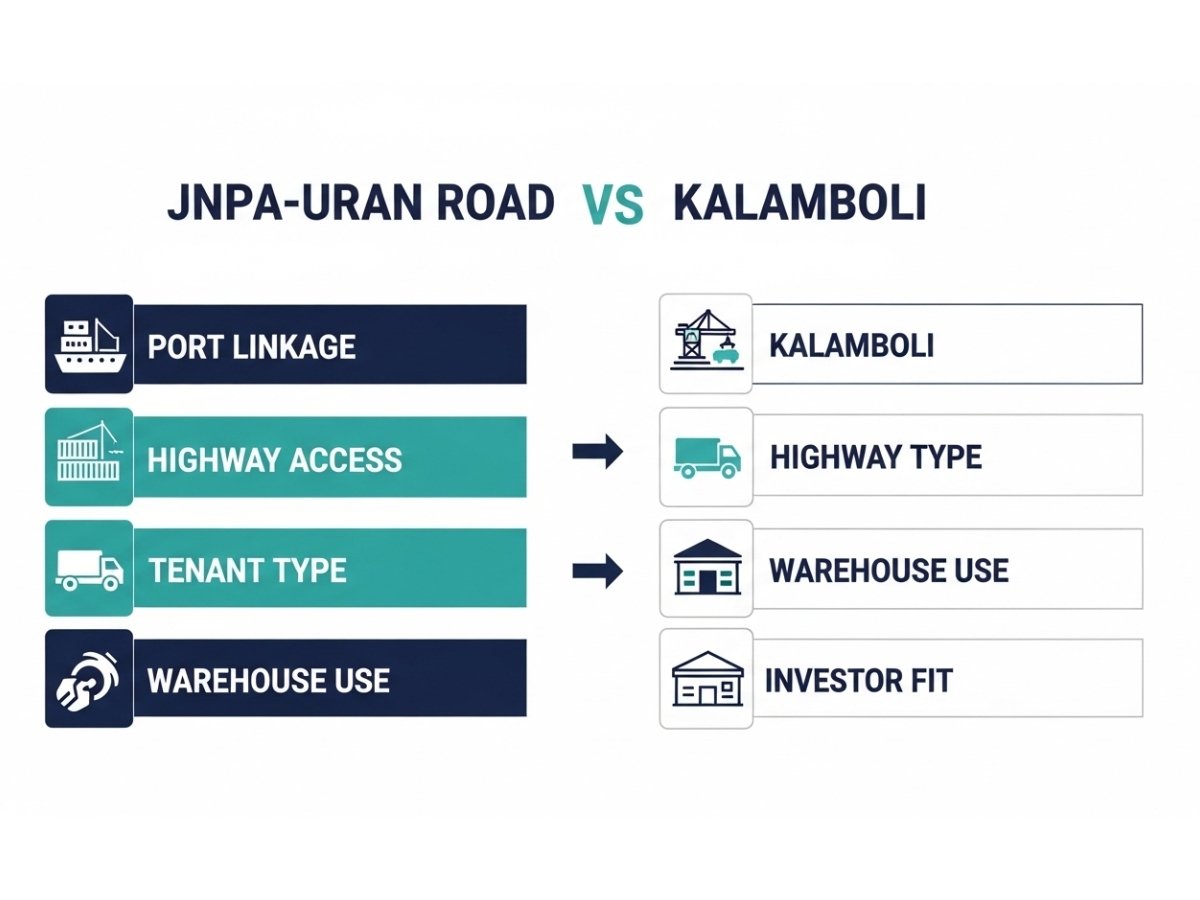
| Comparison factor | JNPA-Uran Road | Kalamboli | Practical winner |
|---|---|---|---|
| True port-linked warehousing | Stronger | Limited | JNPA-Uran Road |
| CFS and customs ecosystem | Stronger | Weaker | JNPA-Uran Road |
| Direct container staging | Stronger | Weaker | JNPA-Uran Road |
| Regional highway dispatch | Weaker | Stronger | Kalamboli |
| General dry warehousing | Selective | Stronger | Kalamboli |
| Truck staging and holding | Moderate | Stronger | Kalamboli |
| Broad tenant pool | Narrower, more specialized | Wider | Kalamboli |
| Risk from port-side congestion | Higher | Lower | Kalamboli |
| Best fit for EXIM operators | Stronger | Weaker | JNPA-Uran Road |
| Best fit for mixed domestic distribution | Weaker | Stronger | Kalamboli |
JNPA-Uran Road or Kalamboli: which belt is usually better for port-linked warehousing?
For true port-linked warehousing, JNPA-Uran Road is usually the better belt. For broader logistics warehousing, mixed cargo storage, and regional dispatch, Kalamboli usually works better.
This difference matters because these are not just two nearby warehouse zones with slightly different access roads. They serve different logistics logics. JNPA-Uran Road is built around maritime cargo rhythm, container flows, customs-linked operations, empty container movement, and port-side support activity. Kalamboli is built around surface transport, highway dispatch, heavy goods handling, transporter ecosystems, and inland distribution practicality.
A lot of people collapse both into one simple idea: “near JNPA.” That is where bad decisions begin. In reality, proximity to the port helps only when your business actually lives off the port. If your cargo is mostly moving onward by road across Mumbai Metropolitan Region, Pune side, Gujarat side, or deeper domestic routes, Kalamboli often becomes more practical than a warehouse marketed as port-adjacent.
What changes the answer: are you buying for true port-linked cargo or for broader warehousing use?
This is the question that changes the entire conclusion.
What counts as true port-linked warehousing
True port-linked warehousing is not just a warehouse that stores imported goods. It is warehousing whose economics depend on staying close to maritime operations.
That usually includes:
- EXIM staging
- customs-bonded storage
- CFS-linked handling
- FTWZ or duty-deferred logic
- direct container de-stuffing close to terminal cycles
- frequent empty container returns
- cargo that moves according to vessel schedules and customs processes
In such cases, being closer to the JNPA-side ecosystem is not a branding benefit. It is part of how the business functions.
What is actually general logistics warehousing dressed up as port-linked
Many warehouses are called port-linked simply because imported cargo passes through JNPA at some point. But once the container is cleared, de-stuffed, palletized, and shifted into domestic supply chains, the warehouse is no longer operating on port logic. It is now operating on storage, dispatch, and road logistics logic.
That is where many occupiers overpay.
If goods are meant for steady domestic distribution across western India, keeping the main warehouse near Uran Road or Dronagiri only because the container came through JNPA can be inefficient. You end up paying for port-side positioning while exposing domestic dispatch trucks to maritime congestion and unnecessary operational friction.
Which location works better by warehouse use case?
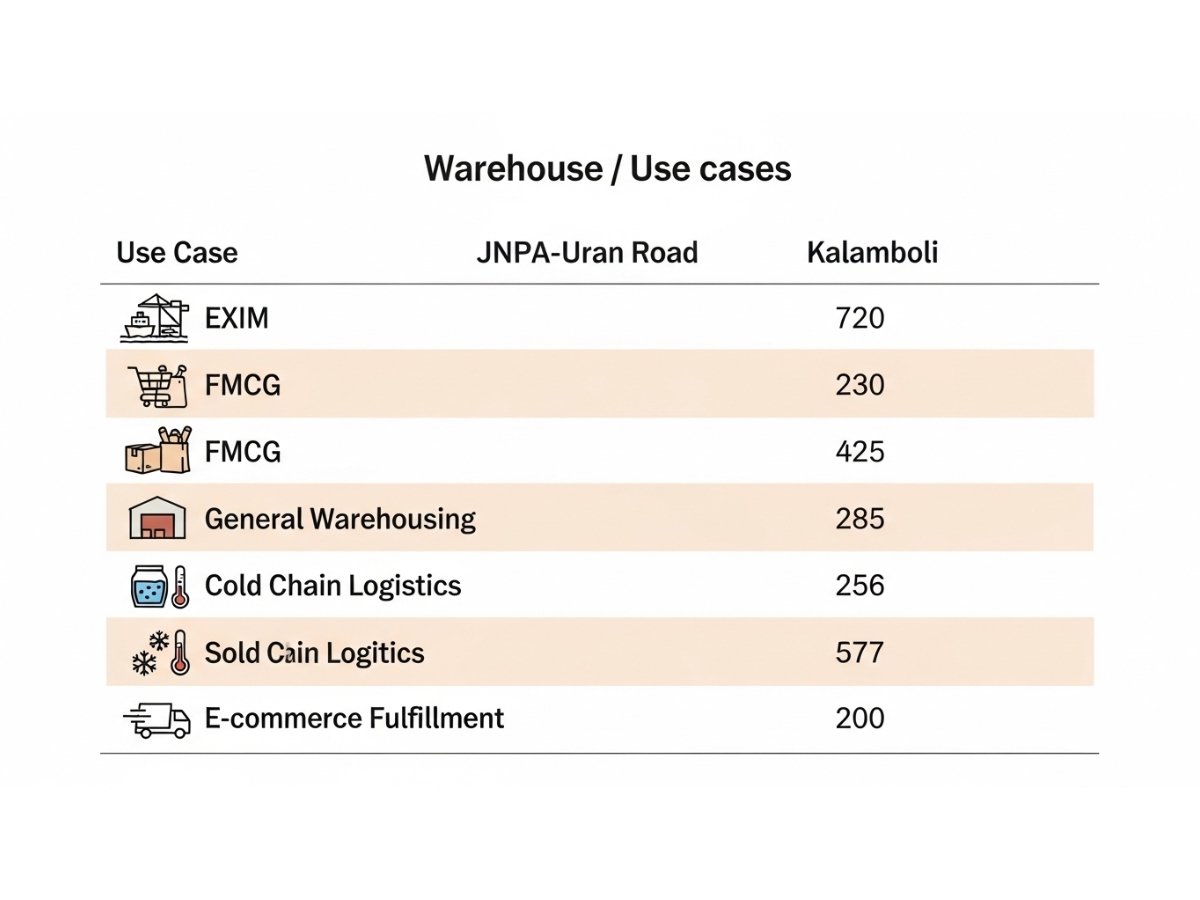
| Warehouse use case | Better fit | Why |
|---|---|---|
| EXIM staging | JNPA-Uran Road | Better customs and port-side handling relevance |
| Customs-bonded storage | JNPA-Uran Road | Closer to maritime clearance ecosystem |
| Container-linked transit warehouse | JNPA-Uran Road | Works better for direct container rhythm |
| General dry warehousing | Kalamboli | Better highway dispatch and broader usability |
| Regional distribution hub | Kalamboli | Faster outbound road logic |
| Mixed SKU storage | Kalamboli | Flexible for domestic supply chains |
| Heavy B2B and steel-linked storage | Kalamboli | Existing rugged logistics and transporter ecosystem |
| Truck staging and holding | Kalamboli | Stronger for waiting, dispatch timing, and surface movement |
| Agro-export reefer support | JNPA-Uran Road | Stronger when maritime timing matters |
| Long-term broad leasing | Kalamboli | Wider tenant pool and easier reletting |
This is why a simple “which is better?” question is not enough. The correct question is: better for what?
Why JNPA-Uran Road usually fits better for direct port-linked warehousing
If the operation is truly container-dependent, JNPA-Uran Road has a real edge.
First, it sits close to the customs and CFS ecosystem. That matters for operators who need frequent interaction with shipping lines, container yards, bonded handling systems, or quick cargo movement between terminal and warehouse.
Second, it reduces distance in operations where drayage, port turnaround, and container cycles directly affect margins. In such businesses, every extra inland move adds cost, time, and coordination pressure.
Third, the belt is naturally aligned to maritime logistics rather than broad domestic warehousing. That makes it stronger for operators whose entire model depends on ship-to-shed-to-clearance style movement.
This is the kind of occupier who usually fits JNPA-Uran Road well:
- CFS operators
- EXIM transit handlers
- customs-bonded storage users
- port-adjacent reefer or agro-export support facilities
- operators who depend on quick empty return cycles
- businesses whose margins are affected by ship schedules and customs clearance timing
For such users, Kalamboli can feel inland, indirect, and slower.
Why Kalamboli often works better for broader warehousing and dispatch logic
Kalamboli wins surprisingly often, especially when the warehouse is not living inside the port cycle.
The biggest reason is simple: Kalamboli is a road logistics machine. It sits at a powerful surface transport junction connected to the Mumbai-Pune Expressway, NH-48, NH-66, and the Sion-Panvel side movement network. That gives it far more natural strength for highway-led dispatch than a belt designed mainly around port access.
It is also not a theoretical advantage. In 2026, Mumbai heavy vehicle restrictions have made Kalamboli even more useful as a staging and waiting zone. Trucks cannot move into Mumbai freely through all hours. That means transporters often need practical holding areas, route flexibility, and better timing control. Kalamboli supports that pattern much better.
Then there is the transporter ecosystem. Kalamboli has a rugged, active, ground-level freight environment. It is not polished, but it is highly functional for dry warehousing, heavy goods movement, B2B dispatch, and mixed cargo logic. For many occupiers, especially those serving regional distribution rather than ship-side turnover, that matters more than being closer to the port on paper.
So yes, JNPA-Uran Road may sound more port-linked. But Kalamboli often makes more business sense.
For occupiers, what matters more than the brochure: truck movement, turnaround, and day-to-day operability
A warehouse can look attractive in a brochure and still be operationally wrong.
Road approach and heavy vehicle practicality
The real-world issue is not just distance. It is movement friction. During periods of port disruption, truck queues on the JNPA side can become severe. If your warehouse does not actually need that port access, getting trapped in that traffic is not a logistics advantage. It is self-created inefficiency.
Kalamboli also has its own pressures. It is a heavy movement zone with trailer activity, steel-linked transport, and ongoing infrastructure adjustments. But that environment is at least aligned to domestic freight logic. If your operation is road-led, that kind of stress is often easier to work around than maritime queue dependency.
Whether the warehouse needs port rhythm or not
This is the core operational test.
If a missed port cycle, container turnaround delay, or customs movement problem directly hurts your margins, you should stay closer to JNPA-Uran Road.
If your main challenge is how fast you can dispatch pallets, service dealers, feed distribution lines, or move mixed cargo toward inland markets, Kalamboli is usually more practical.
Staff, support vendors, and operating convenience
Occupiers should also think beyond truck movement. Vendor support, fleet coordination, transporter availability, and day-to-day industrial practicality often matter more than a map pin.
Kalamboli is stronger for broad logistics ecosystems. JNPA-Uran Road is stronger for maritime ecosystem support. Choosing the wrong one creates daily friction even if the rent looks attractive.
For investors, which belt is usually easier to lease and easier to exit?
For most mid-tier investors, Kalamboli is usually safer.
Why? Because its tenant base is broader. It can attract dry warehouse users, distributors, 3PL operators, heavy goods handlers, and other logistics occupiers who do not need highly specialized maritime infrastructure. That generally helps with vacancy control and reletting flexibility.
JNPA-Uran Road can deliver strong interest when the market is hot and port-side demand is active. But it is more specialized. That means the tenant pool can be narrower and more cyclical. If global trade slows, congestion patterns change, or the asset is too specific to one kind of operator, exit can become harder.
There is another serious point here: CIDCO transfer-side friction. In Navi Mumbai, ownership, transfer, and leasehold realities matter. Buyers who ignore this and treat industrial or commercial assets like simple freehold property can get badly trapped. Transfer charges, plot history, use permission, and lease conditions all affect exit. That matters even more when the asset is already specialized and buyer demand is thinner.
So from a pure liquidity point of view, Kalamboli often gives a safer mid-market investment thesis.
When JNPA-Uran Road is the wrong choice even if the warehouse sounds port-linked
This mistake happens often.
If the business imports goods through JNPA, clears them, and then mainly stores and distributes them domestically, the main warehouse does not automatically need to sit near Uran Road or Dronagiri. Once the goods enter domestic distribution, highway efficiency often matters more than port-side proximity.
In that situation, a JNPA-side warehouse can become expensive, congested, and unnecessarily restrictive. You are paying for a maritime location while running a road-driven business.
This is especially risky when:
- the cargo is not container-sensitive after clearance
- the warehouse mainly serves MMR, Pune, Gujarat, or inland markets
- the business wants easy truck rotation rather than port-side coordination
- the asset is being sold mainly on future branding rather than current operability
- deeper pockets lack strong finished approach-road practicality for large vehicle movement
In simple words, “near port” is often oversold.
When Kalamboli is the wrong choice even if it looks more practical on paper
Kalamboli is not the answer for everything.
If your warehouse depends on direct port-linked movement, customs systems, bonded cargo, or fast container return cycles, Kalamboli can become too inland for the job. The extra movement may not sound huge on paper, but in container-led operations it can add serious cost, coordination delay, and operational friction.
Kalamboli can also be a poor fit for very sensitive cargo. Its rugged freight environment is excellent for many warehousing uses, but not every occupier wants a heavy steel-market style ecosystem around them. Clean-room style storage, dust-sensitive operations, or premium handling environments may need a more selective micro-location strategy.
So Kalamboli is highly practical, but not universally superior.
JNPA-Uran Road vs Kalamboli: practical winner by buyer type
| Buyer or occupier type | Better fit | Reason |
|---|---|---|
| CFS or EXIM freight operator | JNPA-Uran Road | Needs terminal and customs ecosystem |
| Customs-bonded warehouse user | JNPA-Uran Road | Maritime-linked storage logic |
| Regional 3PL operator | Kalamboli | Highway and inland distribution strength |
| Heavy goods or steel-linked transporter | Kalamboli | Better fit with existing freight environment |
| Risk-averse warehouse investor | Kalamboli | Broader tenant pool and easier reuse |
| Long-horizon port-side land aggregator | JNPA-Uran Road | Better if thesis is future maritime expansion |
| Mumbai-side fleet staging operator | Kalamboli | Better for waiting, timing, and onward movement |
| Mixed domestic distributor | Kalamboli | More flexible warehousing logic |
Before you buy or lease, what should you verify on the ground?
Do not buy or lease industrial warehousing stock in Navi Mumbai only on location pitch. Verify the following:
- whether the plot or building use actually allows logistics or warehousing activity
- whether the asset is under CIDCO, MIDC, or another control structure
- whether all transfer-side dues, approvals, and permissions are clear
- whether the road approach can actually handle trailer turning and heavy vehicle entry
- whether the loading layout suits your vehicle type
- whether the warehouse is meant for dry storage, container staging, or specialized cargo
- whether the surrounding micro-market helps or hurts your cargo type
- whether the deal is being sold on present practicality or future storytelling
- whether quoted pricing is asking-level only and subject to asset specifications
- whether the exit path is realistic if you want to sell later
This last point matters more than people think. A warehouse is not just a building. In Navi Mumbai, it is also a legal position inside a regulated land framework. If the land-use and transfer side are weak, even a strong location can become a bad asset.
So which one makes more practical sense?
The answer is not emotionally balanced. It is use-case driven.
If the business is genuinely maritime-dependent, JNPA-Uran Road is the better choice. It is stronger for customs-linked, CFS-linked, bonded, and container-sensitive warehousing. That is where its location premium makes sense.
If the business is mainly about storage, dispatch, domestic distribution, truck staging, and broad logistics flexibility, Kalamboli is usually the better choice. It has better surface transport logic, broader occupier appeal, and usually safer reletting and exit depth.
The mistake is choosing JNPA-Uran Road because it sounds premium when your cargo is really inland-distribution cargo. The opposite mistake is choosing Kalamboli for a business that genuinely lives on container cycles and port-side movement.
Choose the belt that matches the cargo lifecycle. Not the brochure.
FAQs
Is JNPA-Uran Road always better for port-linked warehousing?
No. It is better when the warehouse is truly tied to container movement, customs handling, bonded storage, or EXIM staging. If imported goods are quickly converted into domestic road-dispatch cargo, Kalamboli can be more practical.
Is Kalamboli better for general warehousing than port-led warehousing?
Usually yes. Kalamboli is stronger for highway dispatch, mixed cargo storage, broader transporter access, and domestic distribution use cases.
Which belt is usually easier to lease out?
For broad warehousing, Kalamboli is usually easier because the tenant pool is wider. JNPA-Uran Road can still attract strong tenants, but the demand is more specialized.
What kind of occupier should choose JNPA-Uran Road?
An occupier who depends on frequent container movement, customs ecosystem access, bonded handling, or maritime turnaround cycles should usually prefer JNPA-Uran Road.
Is “near port” enough reason to buy a warehouse?
No. That is one of the most common mistakes in this market. Near port helps only when the business actually depends on port-side logistics.
Which belt is better for mixed cargo storage?
Kalamboli is usually better for mixed cargo, broader dry warehousing, and phased domestic dispatch.
Final verdict
JNPA-Uran Road is the sharper choice for warehouses that are structurally tied to the port. Kalamboli is the smarter choice for warehouses that are structurally tied to the highway.
That one line captures the entire comparison.
If your margin depends on the ship, customs, container, and port-side cycle, choose JNPA-Uran Road. If your margin depends on inland truck movement, broader tenant demand, regional dispatch, and flexible warehousing use, choose Kalamboli. In Navi Mumbai logistics, the wrong node does not just reduce efficiency. It changes the entire economics of the warehouse.