
Kalamboli vs Panvel for Warehousing and Logistics
Kalamboli usually makes more sense when the priority is rugged freight movement, highway-linked dispatch, steel and industrial trade relevance, and a belt that already works like a logistics machine. Panvel usually makes more sense when the requirement is modern warehouse format, cleaner storage conditions, bigger campus-style parks, and longer-term scale. The real answer depends on cargo type, truck logic, warehouse format, and the exact pocket, not just the area name.
Choosing between these two is not really about which name sounds bigger on a brochure. It is about what kind of warehouse operation you want to run. In Navi Mumbai ground reality, that difference matters a lot. A heavy industrial distributor, a 3PL operator, and a passive investor should not read these two locations in the same way.
Kalamboli or Panvel: which one is better for warehousing and logistics?
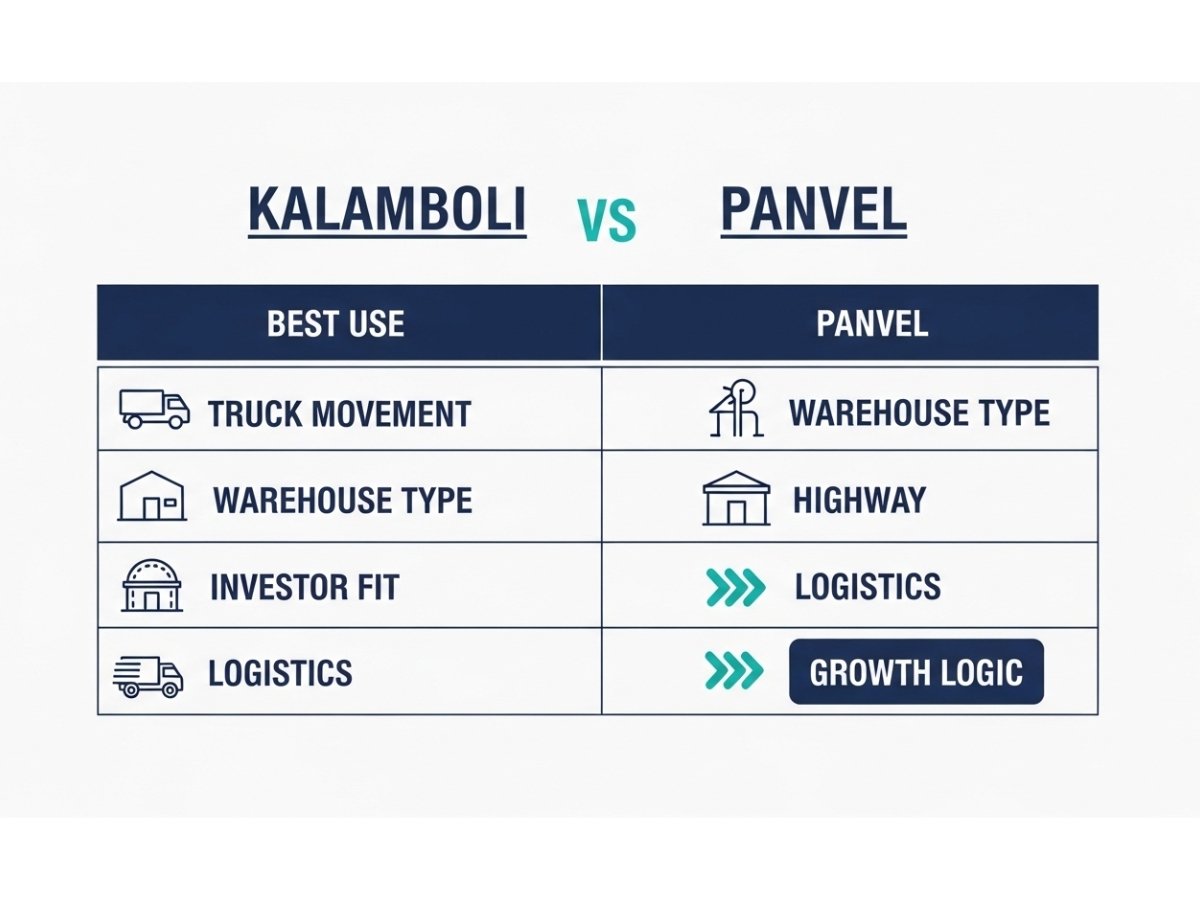
For most heavy B2B, trade-linked, transport-oriented users, Kalamboli remains the more practical belt. For most modern, cleaner, higher-spec, expansion-oriented warehouse users, Panvel-side peripheral parks usually have the edge.
| Factor | Kalamboli | Panvel Peripheral Belt |
|---|---|---|
| Best for | Heavy B2B distribution, steel, industrial spares, rugged dispatch | 3PL, FMCG, e-commerce, cleaner storage, larger-format logistics |
| Truck movement reality | Excellent macro junction access, but internal congestion can be a real issue | Approach road quality varies by village, but internal park movement is often much better |
| Present practicality | Immediate, established, transport-network-driven | Strong where modern Grade A or organized stock exists |
| Broader growth logic | Mature belt, more constrained | Wider long-term expansion story around large parcels and modern parks |
| Occupier fit | Strong for rough-and-ready freight operations | Strong for cleaner, structured, scalable operations |
| Investor fit | Works better for long-hold, yield-driven logic | Better for longer lease stability and institutional-grade occupiers |
| Main caution | Dust, congestion, and heavy-trade conditions are not for every cargo type | Do not buy only because of the “Panvel airport growth” story |
That is the short answer. Kalamboli is not automatically old and inferior. Panvel is not automatically superior just because it sounds future-facing. Each belt solves a different logistics problem.
Why this comparison is more confusing than it looks
The biggest confusion is that these two names are not used equally in the market. “Kalamboli” usually means a very specific, known logistics-heavy node. “Panvel,” in contrast, is often used much more loosely.
Why many people use “Panvel” as a broad label
In the warehouse market, “Panvel” is often used as a macro tag rather than a precise location. A listing may say Panvel, but the actual site may be in a peripheral village belt such as Palaspe, Shirdhon, Adivali, Dhansar, or another pocket that falls into the wider Panvel influence zone. That matters because daily freight economics, staff access, toll burden, and turnaround time can change sharply from one such pocket to another.
This is where many users make a mistake. They compare “Kalamboli” with a broad, stretched “Panvel story,” not with an exact Panvel-side warehouse pocket. On paper both look close. In operations, they may behave very differently.
Why Kalamboli often functions as the more immediate logistics belt
Kalamboli is far more specific in functional identity. It sits at a major highway convergence and has long worked as a heavy transport, trade, and industrial movement zone. CIDCO’s own planning history for Navi Mumbai positioned Kalamboli as a transport and industrial-support node, and market reality built around that over time.
That is why Kalamboli often feels “plug-and-play” for certain warehouse users. Local transporters know it. Drivers know the routes. Trade-linked freight users understand the rhythm. You may not get a polished logistics park feel, but you get an already functioning freight ecosystem.
Which belt works better on truck movement, highway access, and freight practicality?
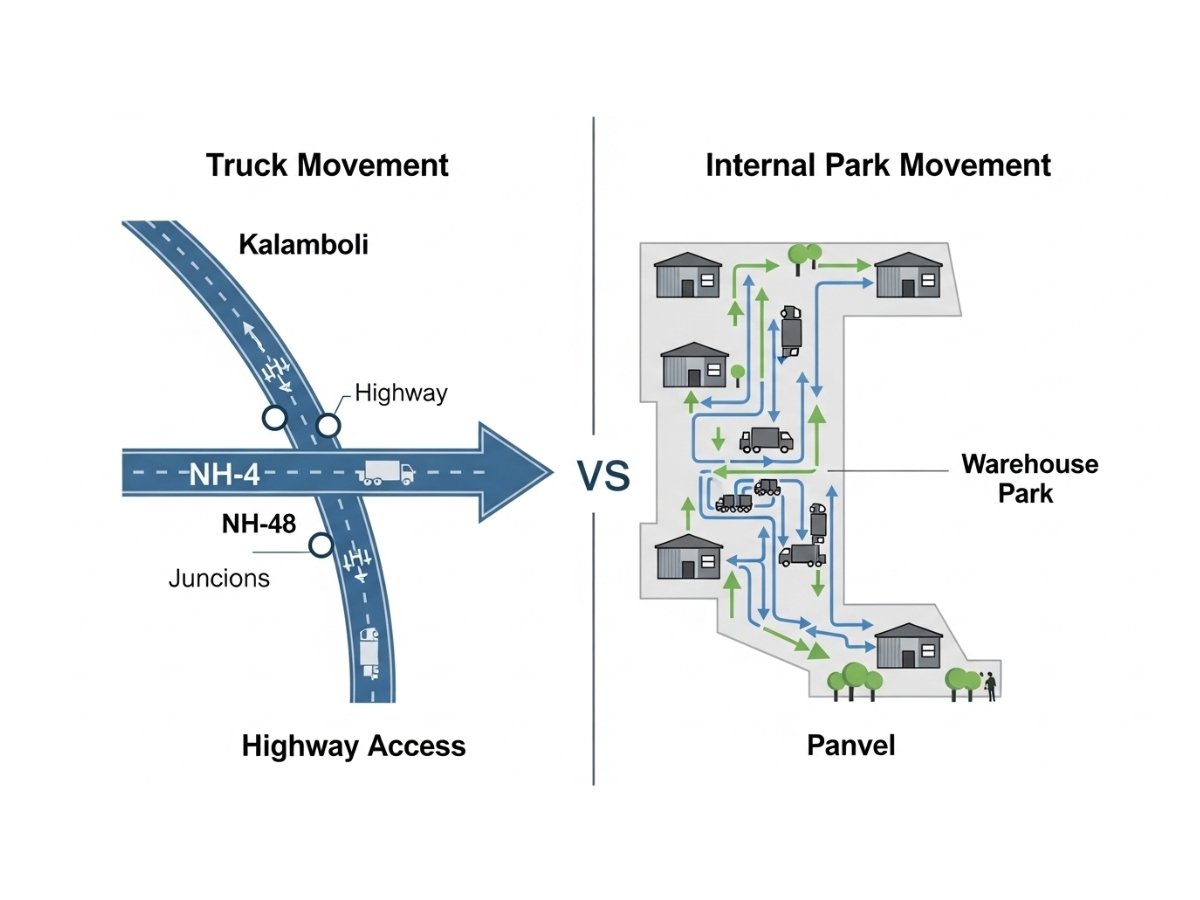
At the macro level, both belts are strategically strong. At the daily movement level, they behave very differently.
Kalamboli sits near one of the most important highway junction systems in this side of MMR, linking the Sion-Panvel corridor, Mumbai-Pune side movement, NH-48 and NH-66 logic. Its freight relevance could strengthen further because the Morbe-Kalamboli connector has been taken up as a roughly 14 km road meant to link the Delhi-Mumbai Expressway side more directly with JNPA access.
The wider region is also getting a structural freight boost from the final JNPT–New Saphale trial run completed on March 31, 2026, which marked operational readiness of the full Western Dedicated Freight Corridor. That does not automatically make every warehouse better, but it does reinforce the long-term freight importance of the Navi Mumbai-JNPA-side logistics geography.
Comparison table: truck movement and logistics practicality
| Comparison point | Kalamboli | Panvel Peripheral Belt | Practical winner |
|---|---|---|---|
| Highway junction advantage | Extremely strong | Strong, but depends more on exact pocket | Kalamboli |
| Internal road movement | Often congested and rougher in active heavy-freight stretches | Usually much better inside organized parks | Panvel |
| Trailer turning and docking | Can become messy in older or transport-heavy pockets | Better in newer Grade A park environments | Panvel |
| Spot-market freight integration | Stronger | More selective | Kalamboli |
| Clean dispatch environment | Weaker | Stronger | Panvel |
| Holding/staging comfort | More friction in many belts | Better where park-level truck parking exists | Panvel |
| Immediate heavy-trade functionality | Stronger | More selective | Kalamboli |
A second major operational point is regulation. Mumbai Traffic Police imposed tighter heavy-vehicle movement restrictions from February 1, 2026, including peak-hour limits of 8 AM to 11 AM and 5 PM to 9 PM for heavy vehicles entering Mumbai, with separate restrictions on certain corridors such as the Eastern Freeway. This increases the importance of peripheral warehouse nodes that can stage, park, and dispatch trucks more efficiently.
That change helps both belts, but it helps them differently. Kalamboli benefits because it remains a natural freight-handling belt. Panvel-side modern parks benefit because on-site truck parking and controlled internal circulation become more valuable when trucks cannot move freely during all hours.
Which one suits your warehouse use case better?
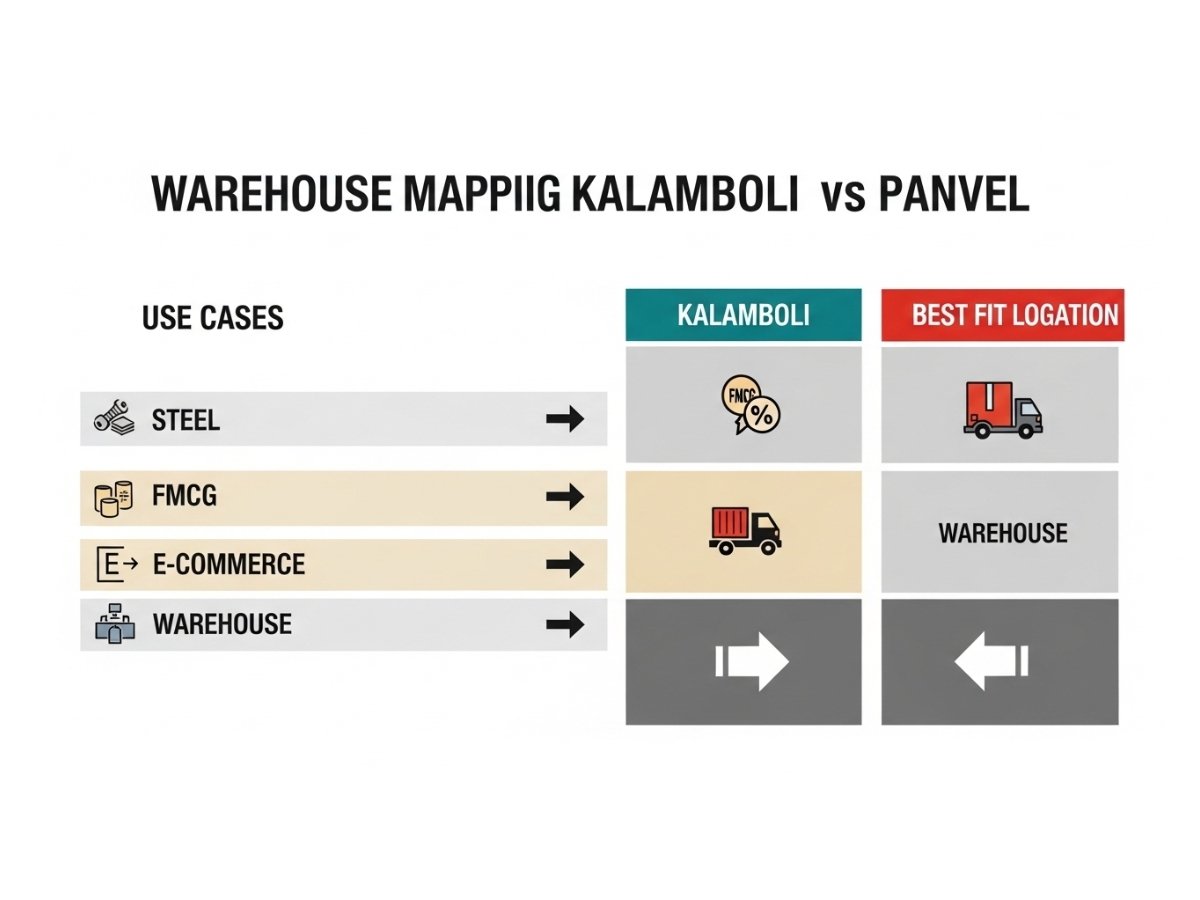
This is the section that actually decides the answer.
Regional dispatch and trade-linked warehousing
Kalamboli is usually better for regional dispatch tied to steel, hardware, heavy materials, industrial spares, machinery movement, and transport-driven B2B flow.
Why? Because the belt already behaves like a working freight market. Users dealing in rugged goods usually care less about glossy infrastructure and more about loading practicality, fast broker coordination, weighbridge access, and quick linkage to highway-facing dispatch. For these users, Kalamboli’s rough edges are often part of the ecosystem, not a deal-breaker.
General storage and flexible warehouse use
This is where the answer becomes mixed.
If you need a simple, functional warehouse for non-sensitive goods and you find the right building in the wider Panvel belt, Panvel can be a very sensible choice. A lot depends on whether the actual stock is an older standalone godown, a mid-format shed, or a genuine organized park unit.
Kalamboli can still work for general warehousing, especially if movement efficiency matters more than environment quality. But once cargo becomes more organized, more retail-facing, or more specification-sensitive, Panvel starts looking better.
Industrial-linked warehousing
If the warehouse is closely tied to manufacturing, fabrication, engineering, or nearby industrial movement, Kalamboli often has the advantage.
This is especially true where the warehouse functions like an operational extension of industrial supply chains rather than a polished regional fulfillment center. Shorter drayage logic, familiarity with industrial cargo handling, and transport ecosystem depth can matter more than newer construction.
Large future-facing logistics setup
Panvel is the stronger answer here.
If your model depends on cleaner warehouse conditions, bigger floor plates, better trailer circulation, higher clear heights, organized park management, and long-term expansion, Panvel-side logistics parks usually make more sense. That is where the modern warehousing story becomes real, not just a marketing line.
This is particularly relevant for 3PL operators, e-commerce, FMCG, retail distribution, and occupiers who want structured dispatch rather than freight-market improvisation.
Small and mid-size investors looking for easier leasing
For pure investors, Panvel-side organized stock often looks cleaner on paper and in practice.
That does not mean every Panvel-side asset is good. It means the leasing story is easier when the tenant profile is more structured, the building format is easier to underwrite, and the environment suits a wider set of modern occupiers. Kalamboli still has demand, but the tenant universe is often more fragmented and the asset may face heavier wear and tear.
When Kalamboli is the better answer even if Panvel sounds bigger
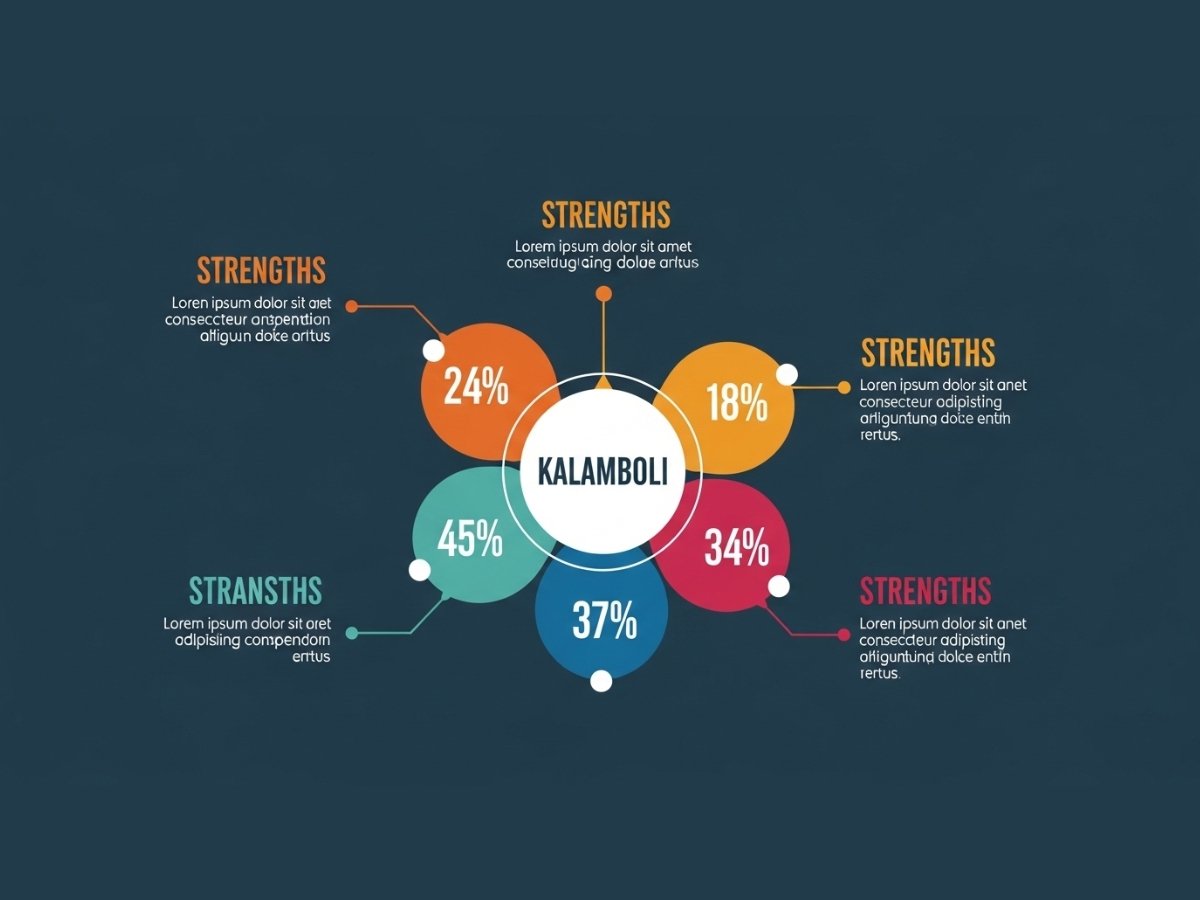
This happens more often than many buyers admit.
If your operation depends on heavy materials, open-yard logic, industrial traffic familiarity, or transport-market immediacy, Kalamboli can be the smarter choice even if Panvel sounds more aspirational. A rugged goods distributor does not need to pay for a premium warehouse ecosystem that adds little value to the actual business.
Kalamboli also makes more sense when the operation needs to feel plugged into a live industrial belt from day one. The ecosystem is older, denser, and less polished, but that is exactly why certain businesses function better there.
Another practical point: not every company benefits from “future growth.” Some businesses need working movement now, not a five-year infrastructure story. For them, Kalamboli may still be the stronger operational answer.
> Caution: Do not reject Kalamboli just because it feels older. Reject it only if your cargo, environment requirements, or warehouse format genuinely do not fit its conditions.
When Panvel is the better answer even if Kalamboli feels more established
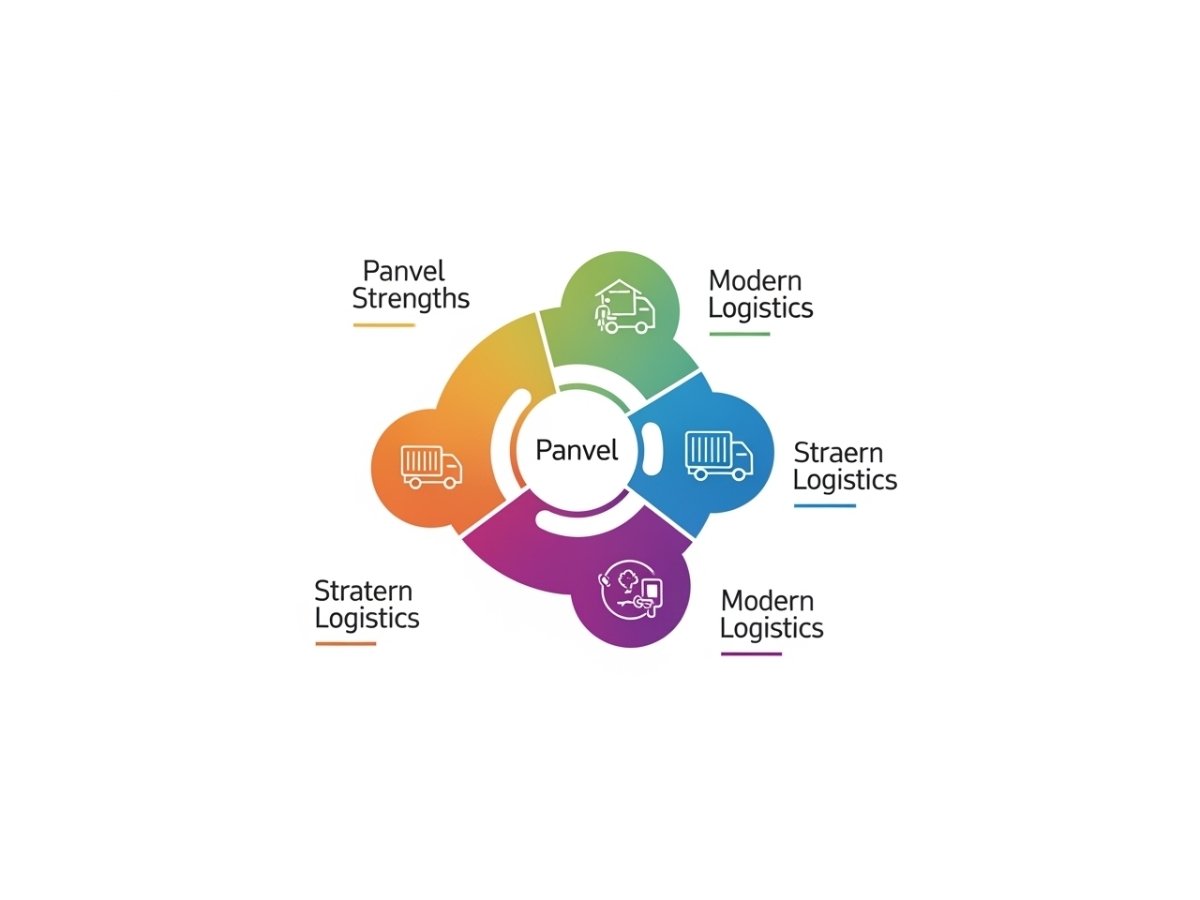
Panvel wins when the warehouse needs to be more modern than merely functional.
If you need cleaner stock conditions, structured internal circulation, large trailer movement space, expansion capacity, and higher-quality organized parks, Panvel-side warehousing is usually ahead. This is where the “future-ready” argument becomes practical rather than promotional.
Panvel also fits better when the warehouse is part of a larger corporate supply-chain system. In such cases, standardized specs, cleaner compliance, better campus-level operations, and longer lease stability can matter more than proximity to a rugged transport market.
There is also a hard environmental reality here. Dust-heavy, industrial surroundings may be manageable for steel, hardware, or rough cargo. They are a poor match for apparel, electronics, premium FMCG, or any inventory where cleanliness and damage control matter. In those cases, Panvel-side organized stock is not just nicer. It can be cheaper in total operating terms because it reduces spoilage, handling friction, and inventory stress.
> Caution: Do not buy only because someone says “airport side” or “Panvel growth.” The actual village, approach road, and utility readiness decide whether the warehouse works.
What should you check in the exact pocket before choosing either location?
This matters more than the Kalamboli-versus-Panvel headline itself.
Practical micro-location checklist
Before you lease or buy, check these points physically:
- Can a 40-foot trailer actually enter and turn comfortably?
- Is the approach road truly warehouse-grade or only passable on maps?
- Are there proper loading and unloading conditions?
- Is the stock an older shed, a standalone godown, or a real organized park unit?
- What kind of neighboring activity surrounds the site?
- Is the cargo dust-sensitive, contamination-sensitive, or cold-chain dependent?
- Is staff access important or is the site largely truck-driven?
- Is title, NA status, and planning approval clear?
- Is the site under CIDCO, PMC-side influence, or a broader NAINA-linked planning area?
- Are power and water practical for the intended operation?
This is also where legal cost can materially change the decision. CIDCO sharply increased transfer fees from April 1, 2025, and for some larger commercial plots the revised rates became extremely high. That means acquisition modeling in CIDCO-linked nodes needs much more caution than older market assumptions suggest.
In broader Panvel-side growth belts, another caution is planning complexity. NAINA-linked land economics and approval conditions can materially affect usable development potential and project feasibility, so buyers should never rely on a simple village-level pitch alone. CIDCO’s NAINA planning framework itself shows that this is not a casual, one-paper-check environment.
Which location is better for occupiers, and which is better for investors?
The answer changes depending on who you are.
Occupier view
Occupiers should think first about throughput, handling conditions, dispatch pattern, and hidden friction.
A rugged industrial occupier may find Kalamboli more efficient despite congestion because the ecosystem is aligned with heavy cargo movement. A modern fulfillment occupier may find Panvel cheaper in real terms even at a higher base rent because the warehouse format works better and damages or inefficiencies are lower.
So for occupiers, the question is not “which area is better?” It is “which area reduces total operating friction for my cargo model?”
Investor view
Investors should think differently. They should care about tenant depth, building relevance, lease stability, and exit friction.
Kalamboli can still work for long-hold investors who understand trade-led demand and are comfortable with older industrial realities. But it is less forgiving if the investor expects clean, simple exits or a broad tenant pool.
Panvel-side organized warehousing is usually easier to position for institutional or formal occupiers. That often improves lease stability and makes the asset story easier to understand.
Where vacancy and exit risk can differ
This is important.
Kalamboli may have stronger immediate trade relevance, but that does not automatically mean easy exit for every investor. Heavy industrial usage can create more wear, more negotiation complexity, and a narrower buyer universe for certain assets. CIDCO transfer charges also make secondary transactions more sensitive in applicable nodes.
Panvel may look safer, but only if the warehouse is in the right pocket and built to the right standard. A weak building in a loosely marketed Panvel-side village is not saved by the Panvel name. A bad micro-location is still a bad micro-location.
Three practical decision examples
1) Steel or industrial distributor
A steel trader, machinery parts distributor, or industrial-material supplier usually fits Kalamboli better.
Why? Because such a business values freight access, heavy-goods handling familiarity, transport-market convenience, and rugged operational practicality more than polished park infrastructure.
2) Regional FMCG or B2B stockist
A packaged-goods distributor, structured retail stockist, or organized 3PL operator often fits Panvel-side warehousing better.
Why? Because the operation benefits from cleaner conditions, better internal movement, organized docking, and a warehouse environment that supports faster and more disciplined dispatch.
3) Passive investor chasing stable warehouse demand
A passive investor should usually lean toward better-quality Panvel-side stock rather than assume Kalamboli’s long-standing activity automatically means better investing.
Why? Because the investment case depends on tenant quality, lease structure, and exit logic, not just current freight intensity.
Conclusion
Kalamboli remains one of the most practical belts in Navi Mumbai for heavy trade, steel-led, rugged B2B dispatch, and transport-linked warehousing. It works because the ecosystem is already alive, dense, and freight-oriented. That same strength also creates its limitations: congestion, dust, older stock, and a rougher operating environment.
Panvel-side warehousing is the better answer when the business needs cleaner storage, modern logistics format, better organized internal movement, and a wider future expansion story. But Panvel should never be treated like one uniform belt. The actual village, park, road approach, and legal-planning context decide whether the asset is good.
So the right decision is simple in principle: Choose Kalamboli for rugged freight practicality. Choose Panvel for structured modern warehousing. But make the final call only after checking the exact pocket, because in warehousing, the micro-location often matters more than the location label.
FAQs
Frequently Asked Questions