
Taloja vs Panvel for Industrial Land and Growth Potential: Which Is Better?
Taloja usually makes more sense for buyers who need an already working industrial ecosystem and land tied to real manufacturing demand. Panvel usually makes more sense for buyers betting on longer-term corridor growth, logistics expansion, and infrastructure-led appreciation. That is the practical answer. But it is not one-size-fits-all. The right choice depends on your use case, holding period, title comfort, and whether you want operational readiness now or future upside with more variation.
If you compare Taloja vs Panvel for Industrial Land only on map distance or quoted land rates, you will almost certainly read the market wrong. These are not twin industrial markets. Taloja is a more structured industrial environment with MIDC discipline, industrial history, and operational relevance. Panvel is broader, looser, and more fragmented. It carries bigger corridor logic, but also bigger pocket-level variation.
Taloja or Panvel: which is the better bet for industrial land today?
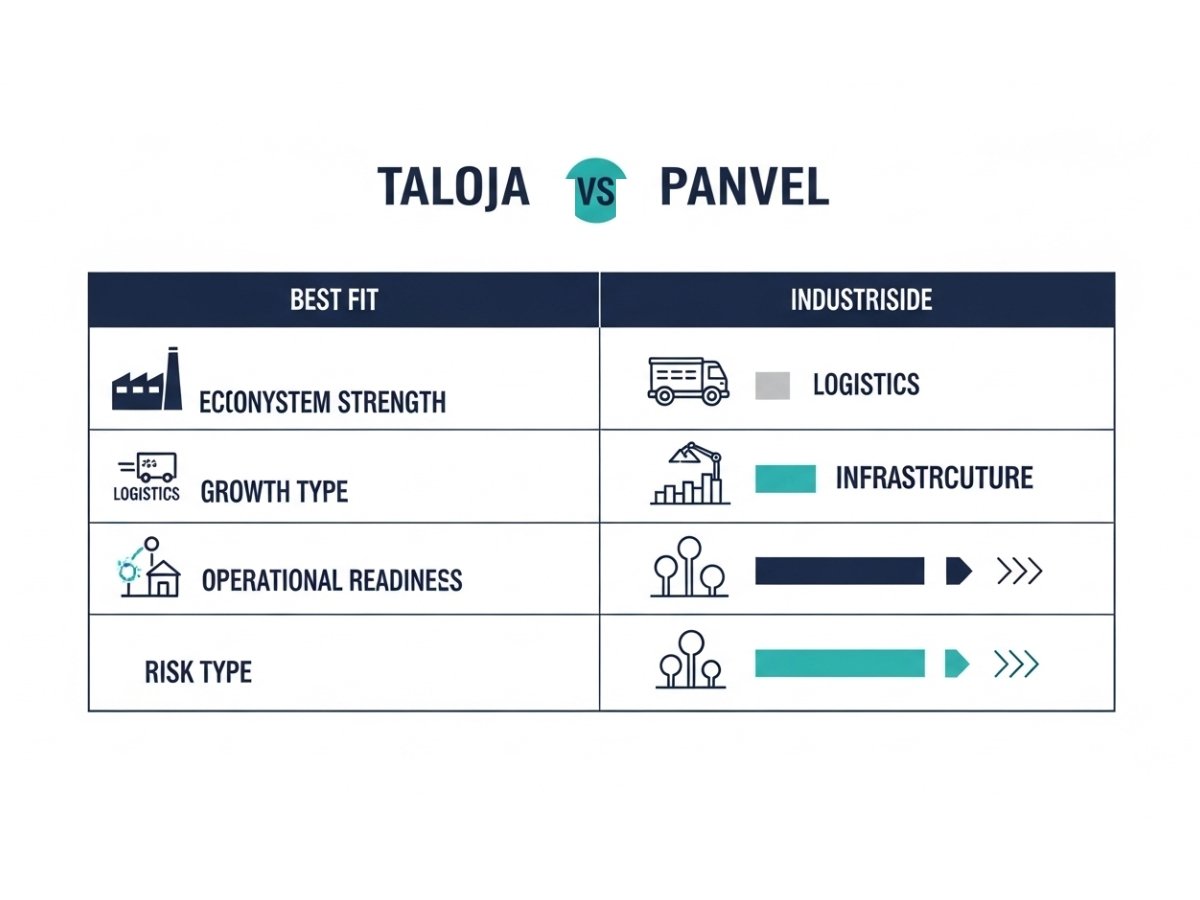
For most actual industrial users, Taloja is the better bet today. For many patient investors and logistics-led buyers, Panvel can be the better long-horizon bet.
Here is the fast comparison:
| Factor | Taloja | Panvel |
|---|---|---|
| Best fit | Manufacturing, engineering, chemical, pharma, industrial users | Logistics, cold chain, distribution, patient land investors |
| Current industrial ecosystem | Strong and already established | Uneven, depends heavily on pocket |
| Growth style | Ecosystem-led | Infrastructure-led and corridor-led |
| Operational readiness | Better for real industry, but with utility stress | Better for freight movement in the right belts, but not uniformly ready |
| Title and zoning clarity | Usually easier to understand under MIDC structure | Requires much deeper plot-level verification |
| Risk type | Utility deficits, traffic, MIDC transfer rules | Title risk, zoning confusion, wrong-pocket buying |
| Better for short-term passive land banking | Usually no | More possible, but only with careful legal filtering |
| Better for immediate factory setup | Yes, in most cases | Only selectively |
That table alone settles most confusion. Taloja is stronger when you want land that already behaves like industrial land. Panvel is stronger when you are reading the future of the corridor and are willing to accept slower, more complex, more selective upside.
Why this is not really a simple location comparison
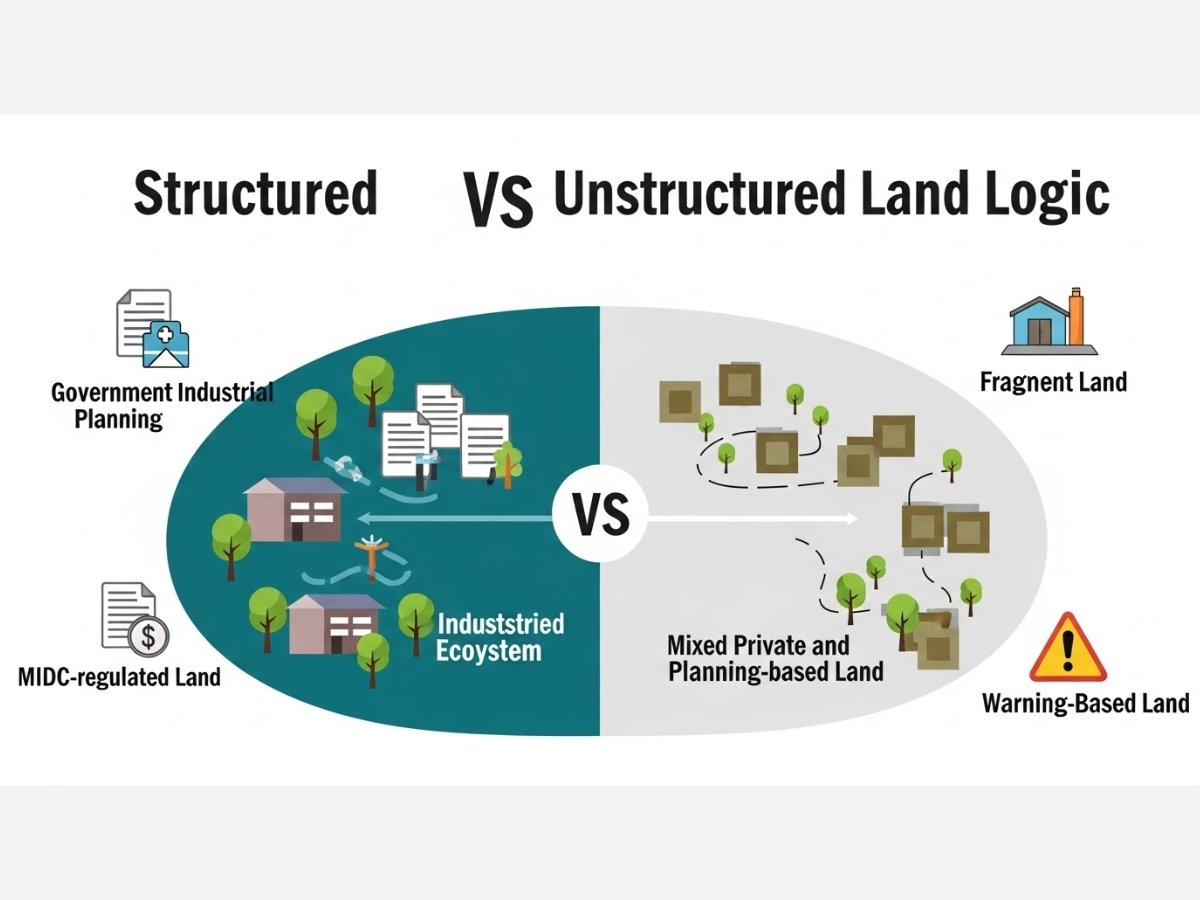
This comparison is not just Taloja versus Panvel. It is also MIDC-regulated industrial land versus a wider mix of CIDCO-side, NAINA-side, and private land situations.
That changes everything.
In Taloja, the land logic is stricter. MIDC leasehold land comes with clearer industrial intent, clearer regulatory structure, and clearer use expectations. But it also comes with lock-ins, transfer premiums, and a basic message from the authority: use the plot for industry, do not simply sit on it forever.
In Panvel, the upside looks wider because the geography is wider. NMIA is operational from December 25, 2025. The Kalamboli junction upgrade is reshaping freight movement. NAINA planning has changed how people think about land. But wider upside does not mean every Panvel-side plot is equally useful for industry. It absolutely is not.
So the real question is not, “Which area is better?” The real question is, “Do you want structured industrial land with existing relevance, or flexible corridor-led opportunity with more verification work?”
What kind of buyer usually fits Taloja better, and who usually fits Panvel better?
Different buyers should not read these two markets in the same way.
| Buyer type | Better fit | Why | Main caution |
|---|---|---|---|
| SME manufacturer | Taloja | Industrial zoning, existing ecosystem, practical manufacturing relevance | Water, power, traffic stress |
| Chemical or pharma unit | Taloja | CETP-backed industrial ecosystem and red-category relevance | Effluent capacity and compliance limits matter |
| Engineering or fabrication user | Taloja | Easier industrial fit and supplier ecosystem | Some older stock may need heavy capex |
| 3PL or e-commerce logistics player | Panvel | Highway logic, airport-region freight relevance, expansion corridors | Entry cost and pocket selection matter |
| Cold chain operator | Panvel | Broader logistics alignment and future corridor logic | Must verify actual land use permissions |
| Patient land investor | Panvel | No MIDC build-pressure in the same way, more corridor-led appreciation angle | Title, zoning, and gestation risk |
| Passive short-term speculator | Neither, usually | Taloja punishes passive holding; Panvel punishes lazy due diligence | Wrong strategy can destroy returns |
Buyers who usually fit Taloja
Taloja fits businesses that need to actually run industry. Manufacturing units, engineering workshops, process industries, chemical users, and pharma-linked occupiers usually understand the value of an ecosystem where industrial activity is normal, approvals are industrial in character, and surrounding land use supports operations.
This matters more than many buyers admit. A cheap plot with a big future story is not useful if your business needs to start real industrial activity in a reasonable timeline.
Buyers who usually fit Panvel
Panvel fits people who are reading freight, corridor growth, and land optionality. That includes logistics operators, distribution-led businesses, land bankers, and investors who are comfortable waiting through infrastructure gestation and doing deep legal checks before buying.
Panvel also fits those who do not need a heavy industrial setup from day one. Clean assembly, packaging, storage, and network-led business models can align better here than chemical or effluent-heavy industry.
Buyers who should slow down before choosing either
If you are not prepared for plot-level due diligence, both markets can punish you for different reasons.
In Taloja, the mistake is assuming you can treat MIDC land like passive land banking. In Panvel, the mistake is assuming all land near a big infrastructure story is industrially valuable. Neither assumption is safe.
If the goal is actual industrial use, which side makes more sense?
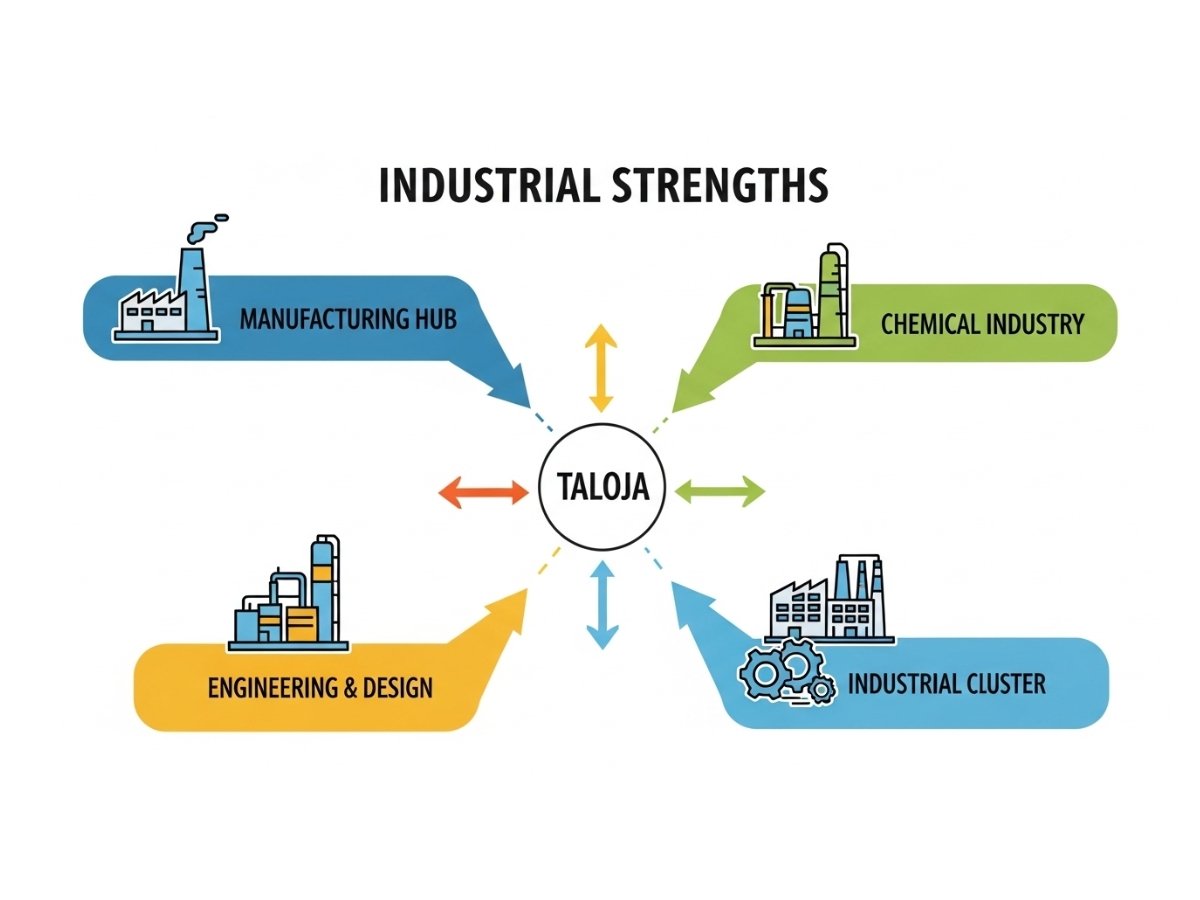
For actual industrial use, Taloja usually wins.
Existing industrial ecosystem and surrounding use pattern
Taloja already has the industrial identity many occupiers want. The ecosystem is not theoretical. It is built around working industrial plots, established plant activity, and a long industrial track record. That reduces one major uncertainty: whether the surrounding area truly supports industrial use.
Panvel, by contrast, is much more mixed. Some pockets can work very well for logistics and light operational use. But Panvel as a whole should not be read as a ready-made industrial zone in the same way.
Manufacturing, processing, warehouse, and yard suitability
Taloja is stronger for manufacturing, chemical processing, pharma, fabrication, and engineering-linked users. It gives a more natural base for heavy or serious industrial use.
Panvel is stronger for cleaner logistics-linked use cases, distribution, cold chain, and freight-led operations in the right corridors. It is not automatically stronger for traditional factory logic.
There is also an important economic point here. Land rates in the immediate Taloja-Kalamboli cluster have reportedly become high enough to make standard, low-yield warehousing financially less attractive, which is one reason larger warehousing logic has been pushing further outward toward stretches like Rasayani-Patalganga. That changes the industrial land reading significantly.
Utility and operational comfort
Taloja wins on industrial relevance, but it is not an industrial paradise. It carries real operational friction.
Ground reality includes water shortages, power cuts, and dependence on backup systems. Traffic bottlenecks around Taloja-side junctions also slow real operations. So yes, Taloja is often the stronger industrial choice, but the buyer must budget for operational pain, not just land price.
Panvel can feel smoother from a freight movement perspective in the right areas, especially as the Kalamboli-side logistics structure improves. But smoother movement does not replace missing industrial infrastructure.
If the goal is future appreciation, where is the stronger growth story and where is the bigger risk?
This is where the answer becomes more nuanced.
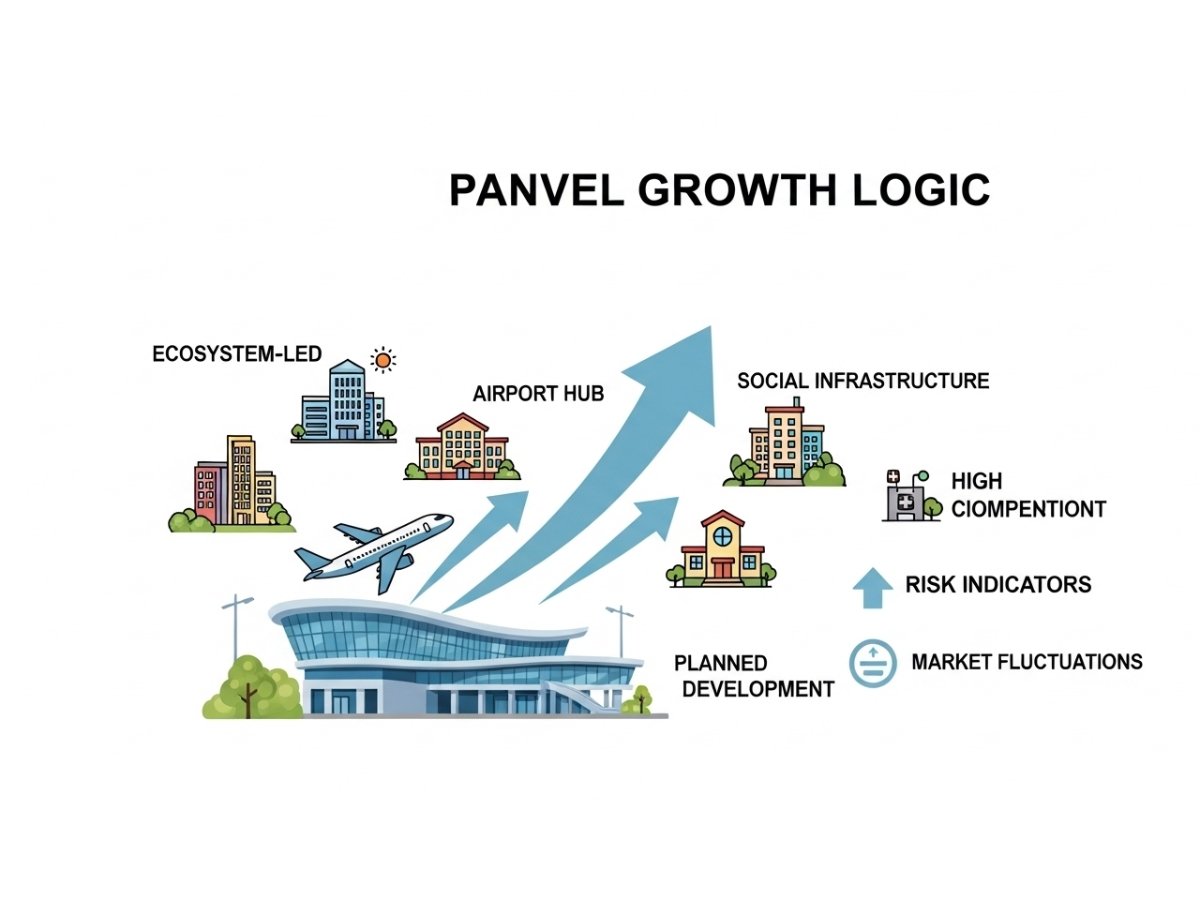
Taloja’s appreciation logic is ecosystem-led. Panvel’s appreciation logic is infrastructure-led.
Taloja appears to carry stronger percentage upside from a lower industrial base in some scenarios, with historical or projected patterns in the 50 to 70 percent range over a 5-year horizon being discussed in market research. Panvel appears more moderate in percentage terms, often around 35 to 50 percent in similar forward-looking estimates, partly because a lot of macro-infrastructure optimism has already influenced pricing in stronger belts.
That does not make Taloja automatically better. It just means the growth style is different.
Ecosystem-led appreciation in Taloja
Taloja grows when real industrial demand deepens. If more businesses need functioning industrial land, usable sheds, or industrial expansion, Taloja benefits because it already has an industrial identity.
That kind of appreciation is often more grounded. It is tied to use. It is not only tied to story.
Infrastructure-led appreciation in Panvel
Panvel grows because larger infrastructure is reshaping the map around it. NMIA is operational. Freight movement logic is changing. The Kalamboli junction upgrade matters. NAINA planning matters. That creates long-term value.
But infrastructure-led growth often attracts lazy capital too. Buyers start assuming that every plot touched by the airport or corridor narrative will become commercially powerful. That is where many mistakes begin.
Pocket-level variation and timing risk
Panvel has more upside variation. That is both the attraction and the danger.
One Panvel-side parcel inside or near a meaningful development framework can behave very differently from another raw parcel with weak title comfort, zoning limitations, or slow infrastructure catch-up. So yes, Panvel has a strong future story. But it is less uniform and less forgiving.
Taloja’s growth logic: what is already working, and what is still selective?
Taloja’s strength is that much of its growth story is already visible on the ground.
Its industrial relevance is not based on future brochures. It comes from its existing ecosystem, large industrial base, working plots, industrial employment, and real demand for industrial occupancy. Rental yields in the region for industrial sheds have also been stronger than many broader markets, which supports the idea that Taloja’s demand is not only speculative.
But growth in Taloja is selective too.
Not every Taloja asset is good. Buyers sometimes overpay for outdated sheds, weak internal roads, or aging leasehold stock simply because the MIDC address itself feels valuable. That can be a mistake. In some cases, the buyer is really paying for land position and then taking on heavy redevelopment cost.
Taloja also has a ceiling issue. Expansion is not infinite. Industrial density, utility strain, and environmental capacity matter. For some users, especially those with future scale in mind, that may limit how attractive the location feels beyond a point.
Panvel’s growth logic: where the upside comes from, and why it is not uniform
Panvel’s upside comes from geography, infrastructure, and planning scale.
It sits closer to a much wider future story: airport influence, highway movement, freight restructuring, NAINA planning, and broader regional expansion. For logistics-led and corridor-sensitive businesses, that matters a lot.
But Panvel should never be treated as one uniform industrial market.
Some land falls under stronger development logic. Some may sit inside or near NAINA planning frameworks. Some may be in Limited Development Zones where standard manufacturing is restricted. Some private parcels may look attractive on price and location but become problematic once title, mutation, or land-use checks start.
That is the real Panvel problem. The upside is real, but the market is uneven.
A plot inside a useful planning structure is not the same thing as a random parcel being sold with an airport story. Smart buyers separate those two very early.
Which market is usually easier to understand, and which one demands more micro-location caution?
Taloja is usually easier to understand. Panvel demands more micro-location caution.
That is one of the most important practical takeaways in this entire comparison.
In Taloja, the industrial framework is clearer. Plot identity, leasehold structure, zoning logic, and industrial relevance are usually easier to underwrite. You still need due diligence, of course, but you are operating in a more standardized environment.
In Panvel, legal and planning work becomes more serious.
Quick due diligence checklist for Panvel-side industrial land
- Check whether the land is private freehold, CIDCO leasehold, or part of a NAINA-linked structure
- Verify the latest 7/12 extract, not just shorthand ownership assumptions
- Do not rely only on 8A records
- Check mutation history and pending family or ownership issues
- Confirm Non-Agricultural status where relevant
- Cross-check zoning under the applicable planning framework
- Verify whether the land is in a restricted or limited development belt
- Confirm whether actual intended industrial use is permitted
Panvel rewards sharp due diligence. It punishes casual reading.
MIDC plot logic, CIDCO-side context, and non-standard land risk: what changes the answer?
This section changes the investment case more than many buyers realise.
Why land authority and land category matter
In Taloja, MIDC status is a major advantage for real industrial users. It gives structure. But it also controls behaviour. An open MIDC plot cannot always be treated like a free passive asset. Transfer rules, lock-in logic, and differential premium mechanisms materially affect returns.
The research dossier notes that transferring an open MIDC plot usually requires a 5-year lock-in and can attract a 30 percent differential premium. If at least 20 percent FSI is consumed through development, that premium may reduce to 10 percent. In plain language, MIDC economically pushes you toward use, not hoarding.
What buyers should verify before assuming industrial usability
In Panvel, title risk and category risk matter more.
CIDCO leasehold land is not the same as absolute freehold land. NOCs and transfer conditions matter. Private land also demands serious title verification, especially in rural and fringe belts.
The most dangerous mistake is assuming that cheap land with an industrial-sounding pitch is legally safe and operationally usable. That assumption has damaged plenty of buyers.
Why transfer, title, and permissions can change the investment case
A good industrial land buy is not just about entry. It is also about exit.
Taloja can be harder for passive speculators because the regulatory exit friction is real. Panvel can be easier in a pure market sense if the title is clean and the land is genuinely attractive. But if the title chain is weak, the exit can become painfully slow or commercially impossible.
There is also a serious legal caution in Panvel and Raigad-side belts. Occupancy Class II tribal land under Section 36A of the Maharashtra Land Revenue Code cannot be casually transferred to non-tribals without prior sanction. If that step is ignored, the transaction can be void. That is not a minor technicality. It is a capital-destruction risk.
What usually goes wrong when buyers compare Taloja and Panvel too casually?
Most mistakes fall into five patterns.
First, buyers compare only price and ignore land structure. Second, they assume all airport-region land has industrial value. Third, they treat MIDC leasehold and private land as if both behave the same. Fourth, they underestimate utility pain in Taloja. Fifth, they underestimate title and zoning pain in Panvel.
A very common Panvel-side mistake is buying story before checking paperwork. A very common Taloja-side mistake is buying an industrial address without fully pricing in traffic, utilities, and MIDC transfer mechanics.
Both are costly.
Taloja vs Panvel on the factors that actually affect industrial land decisions
| Decision factor | Taloja | Panvel | Practical winner |
|---|---|---|---|
| Immediate industrial usability | Strong | Selective | Taloja |
| Heavy manufacturing fit | Stronger | Weaker in most cases | Taloja |
| Logistics and corridor growth | Good, but not the main edge | Stronger | Panvel |
| Title and zoning clarity | Usually clearer | More fragmented | Taloja |
| Flexibility for patient investors | Lower | Higher | Panvel |
| Passive land banking comfort | Weak due to MIDC discipline | Better, if title is clean | Panvel |
| Freight movement future | Constrained by local industrial friction | Improving with corridor upgrades | Panvel |
| Utility reliability | Real weakness | Varies by pocket, but no Taloja-style industrial legacy strain | Panvel in some pockets |
| Legal complexity | Moderate and structured | Higher and plot-specific | Taloja |
| End-user industrial confidence | Higher | Selective | Taloja |
So which one should you choose?
Choose Taloja if…
Choose Taloja if your business needs real industrial land, not just future promise. It is the stronger choice for manufacturing, chemical, pharma, engineering, and businesses that need an established industrial environment even if it comes with water, power, and traffic stress.
Choose Panvel if…
Choose Panvel if you are thinking like a logistics operator, cold-chain player, corridor-led investor, or patient buyer who can handle longer timelines and deeper due diligence. Panvel works better when your thesis is expansion, freight movement, and infrastructure-led appreciation rather than immediate heavy industrial use.
Wait or re-evaluate if…
Wait if you are treating this as a simple price comparison. Wait if you have not checked title properly. Wait if you are expecting Taloja to behave like passive land banking or Panvel to behave like a ready industrial park. Those assumptions are where the real damage begins.
Conclusion
If your priority is real industrial use, faster operational relevance, and a market that already behaves like an industrial ecosystem, Taloja usually makes more practical sense.
If your priority is future corridor growth, logistics alignment, land optionality, and patient appreciation, Panvel can make more sense, but only when the specific plot, title, zoning, and planning context are properly verified.
So the clean conclusion is this: Taloja is usually the better industrial user market. Panvel is usually the better strategic growth corridor market. The wrong buyer can lose money in either. The right buyer, with the right land and the right expectations, can do well in both.
FAQs
Frequently Asked Questions